
What you’ll learn in this article…
- Several CSWE-accredited BSW programs near San Antonio carry an effective net price as low as $1,300 per year.
- Texas LBSW licensure requires no post-degree supervised experience, so graduates can apply immediately after earning their BSW.
- All BSW formats, including fully online programs, require a minimum of 400 supervised field placement hours in person.
- Advanced standing MSW tracks let BSW holders finish graduate school in roughly one year, cutting both time and cost.
Texas is adding social work jobs faster than the national average, and demand for bachelor-level practitioners continues to climb in child welfare, school systems, and community health settings. Yet affordability remains the single biggest barrier for students considering a BSW, especially in a state where net tuition can range from roughly $1,300 to over $15,500 per year depending on the institution and financial aid package.
The ten programs ranked in this guide reflect that spread. All hold Council on Social Work Education accreditation, the credential required for state licensure in Texas, and all are within driving distance of San Antonio or offer flexible formats that work for students living in the region. Net price after financial aid is the primary ranking factor, but graduation rates, median debt, and post-enrollment earnings also weigh into the score.
A BSW opens the door to entry-level practice and puts you one step closer to the Licensed Baccalaureate Social Worker credential, which Texas awards without requiring post-degree supervised hours. That timeline advantage matters when tuition is climbing and every semester counts against your degree cost.
Best Low-Cost BSW Programs Near San Antonio, Ranked
Affordable CSWE-accredited BSW programs are available across Texas, and several sit within reasonable distance of San Antonio or offer flexible formats that work for students based there. The programs below are ranked primarily by net price after financial aid, with graduation rates, program features, and relevance to the San Antonio region factored in. All graduation rates cited are institution-wide figures, not program-specific, due to data limitations.
- Net price after financial aid
- Institution-wide graduation rate
- Program format and flexibility
- CSWE accreditation status
- Regional relevance to San Antonio
- Internal program database
- NCES-IPEDS federal institutional data — nces.ed.gov
- College Scorecard graduate earnings — collegescorecard.ed.gov
- Independent program research

Texas A&M University-Central Texas
Texas A&M University-Central Texas stands out for its remarkably low net price, making it the most affordable BSW option on this list by a wide margin. Located in Killeen, about two and a half hours north of San Antonio, the school is a designated Hispanic-Serving Institution where more than 82% of undergraduates receive Pell Grants. The CSWE-accredited BSW program requires 120 credit hours and offers concentrations in Child Welfare and Mental Health and Substance Abuse, giving students early specialization that many competing programs lack.
- CSWE-accredited, 120 credit hour on-campus program
- Child Welfare concentration with Title IV-E CPS partnerships
- Mental Health and Substance Abuse concentration available
- Field placements at local social service agencies
- Strong faculty-to-student interaction at a 16:1 ratio
- Designed to prepare graduates for Texas licensure
- Solid foundation for advanced standing in MSW programs
Bachelor of Social Work — On-Campus

The University of Texas Rio Grande Valley
UT Rio Grande Valley delivers one of the lowest net prices among Texas public universities and carries the lowest median graduate debt on this list at $12,950. As a Hispanic-Serving Institution where nearly 89% of students receive Pell Grants, UTRGV is built to serve first-generation and financially constrained students. Its CSWE-accredited BSW covers social welfare systems, practice theories, and generalist skills, and the university's Tuition Advantage program adds another layer of support for eligible undergraduates.
- CSWE-accredited generalist social work curriculum
- Covers social welfare systems and practice theories
- UTRGV Tuition Advantage program for eligible students
- Median graduate debt of just $12,950
- Prepares graduates for roles such as school social worker or counselor
- Institution-wide graduation rate of approximately 51%
- Pathway to graduate studies in social work
Bachelor of Social Work in Social Work — On-Campus

The University of Texas at El Paso
UTEP offers a campus-based BSW with a net price under $9,500, paired with an institution-wide graduation rate just above 50%. Situated in El Paso, this Hispanic-Serving Institution draws more than 84% Pell Grant recipients, and its social work curriculum emphasizes both practical skills and theoretical grounding. Median earnings for graduates reach roughly $50,900 ten years after enrollment, a solid outcome for a program at this price point.
- CSWE-accredited campus-based program
- Comprehensive curriculum in social work theory and practice
- Personal statement and letters of recommendation required for admission
- Emphasis on preparing graduates for community social services
- 21:1 student-to-faculty ratio
- Median ten-year earnings of approximately $50,900
- Hispanic-Serving Institution with strong Pell Grant support
Bachelor of Social Work — On-Campus

University of Houston-Downtown
University of Houston-Downtown provides a BSW focused on anti-oppressive practice, leadership in diverse communities, and equity, all delivered from its urban Houston campus. The program features smaller class sizes, faculty mentoring, and a distinctive Spanish-Track option that prepares graduates to serve Spanish-speaking populations directly. Over 79% of UHD students receive Pell Grants, and its HSI designation reflects the institution's commitment to the communities it serves.
- Generalist social work program with anti-oppressive practice focus
- Spanish-Track option for bilingual service delivery
- Smaller class sizes with dedicated faculty mentoring
- Flexible scheduling designed for working students
- Field placements across schools, hospitals, and mental health settings
- Median ten-year earnings of approximately $53,550
- On-campus format in downtown Houston
Bachelor of Social Work — On-Campus

The University of Texas at San Antonio
UTSA is the most geographically convenient option for San Antonio residents, and its BSW emphasizes culturally competent, transformative practice with a social justice lens. As a Hispanic-Serving Institution, UTSA pairs well with the region's demographics, and graduates report strong median earnings of about $57,100 a decade after enrollment. The program also positions students for advanced standing in UTSA's own CSWE-accredited MSW, creating an efficient in-region pipeline from bachelor's to master's degree.
- On-campus CSWE-accredited program in San Antonio
- Curriculum centers equity, social justice, and cultural competence
- Includes field practicum for hands-on community experience
- 2.5 GPA required for admission
- Electives in global thinking and transformative practice
- Direct pathway to UTSA's MSW with advanced standing eligibility
- Institution-wide graduation rate of approximately 53%
- Median ten-year earnings of roughly $57,100
Bachelor of Social Work — On-Campus

University of Houston-Clear Lake
University of Houston-Clear Lake's BSW prepares students to work with vulnerable and marginalized populations, blending classroom instruction with required internships and faculty-led research opportunities. The 15:1 student-to-faculty ratio is the lowest on this list, meaning more individualized attention during a demanding curriculum. Median earnings ten years out are roughly $59,000, the highest among these ten programs, though the net price of about $15,560 is also among the higher entries.
- CSWE-accredited on-campus program in Houston
- Required internship placements at community agencies
- Opportunities to participate in faculty research
- 15:1 student-to-faculty ratio, lowest on this list
- 2.5 GPA and personal statement required for admission
- Emphasis on ethical practice with diverse populations
- Median ten-year earnings of approximately $59,000
Bachelor of Social Work — On-Campus

The University of Texas at Tyler
UT Tyler distinguishes itself as one of the few Texas public universities offering its BSW in both on-campus and online formats, a significant advantage for working students or those based in San Antonio who want a UT-system degree without relocating. The program includes 420 clock hours of applied field experience and collaborations with criminal justice and psychology departments that broaden students' professional toolkit. Its institution-wide graduation rate of about 54% is the highest among these ten schools.
- On-campus and online delivery options available
- 420 clock hours of supervised field experience
- Cross-departmental work with criminal justice and psychology
- 57 semester hours of required social work coursework
- Social Work Club for service-learning projects
- Highest graduation rate on this list at roughly 54%
- Prepares graduates for MSW advanced standing
- Expert faculty with real-world practice backgrounds
Bachelor of Social Work — On-Campus

Texas Woman's University
Texas Woman's University offers a structured, face-to-face BSW in Denton with daytime courses scheduled between 8 a.m. and 4 p.m. TWU is a Hispanic-Serving Institution with a 16:1 student-to-faculty ratio and a curriculum organized around five pillars: human behavior, social welfare policy, intervention methods, research, and field education. Graduates report median earnings of roughly $56,500 a decade after enrollment.
- CSWE-accredited on-campus program in Denton
- Daytime course schedule from 8 a.m. to 4 p.m.
- Field education at local agencies under supervision
- Curriculum spans five core areas of social work
- 2.5 GPA required for program admission
- Professional readiness assessment as part of admissions
- Collaborative learning community with experienced faculty
Bachelor of Social Work — On-Campus

The University of Texas Permian Basin
UT Permian Basin in Odessa delivers a 120-credit-hour BSW grounded in cultural competence, crisis intervention, and advocacy. As a Hispanic-Serving Institution serving West Texas, the program emphasizes human dignity and social justice while preparing students for careers in healthcare, schools, and criminal justice settings. Its net price of about $12,720 falls in the mid-range for this list.
- CSWE-accredited, 120 credit hour campus-based program
- Focus on cultural competence and crisis intervention
- Advocacy training built into the curriculum
- 2.5 GPA required for admission
- Career paths in healthcare, education, and criminal justice
- Hispanic-Serving Institution in West Texas
- Prepares graduates for Texas social work licensure
Bachelor of Social Work — On-Campus

Lamar University
Lamar University rounds out the list with a BSW in Beaumont that combines 120 credit hours of coursework with a supervised field practicum and required volunteer hours. Graduates qualify for advanced standing in MSW programs and are eligible for Texas licensure. Lamar is a Hispanic-Serving Institution, and while its net price of about $9,370 is competitive, the institution-wide graduation rate of roughly 37% is worth weighing carefully.
- CSWE-accredited, 120 credit hour campus program
- Field practicum and volunteer hours required
- Graduates eligible for MSW advanced standing
- Texas licensure eligibility upon completion
- 2.5 cumulative GPA required for seniors
- Experiential learning across multiple community settings
- Median ten-year earnings of approximately $49,650
Bachelor of Social Work — On-Campus
How We Ranked These BSW Programs
Sorting programs by sticker price versus sorting by what students actually pay after financial aid can produce dramatically different lists. Because this guide focuses on affordability, we weighted the factors that hit your wallet hardest while still accounting for outcomes that matter once you graduate.
Why Net Price Takes Priority
The rankings emphasize net price, which reflects average out-of-pocket costs after grants and scholarships rather than published tuition rates. A university with high tuition but generous aid packages may cost less than a school advertising lower sticker prices. We pulled net price figures from the College Scorecard, which calculates averages for students receiving federal financial aid. Keep in mind that your individual cost will vary based on your family income, residency status, and the aid you qualify for.
Additional Factors in the Mix
Beyond affordability, we considered institution-wide graduation rates as a proxy for student support and retention. These figures represent all undergraduates at a given school, not BSW majors specifically, so treat them as a general indicator rather than a program-level guarantee. Where available, we also examined program-level earnings and debt outcomes from federal data, giving preference to schools where graduates enter the workforce without excessive loan burdens relative to early-career wages.
The Accreditation Baseline
Every program on this list holds accreditation from the Council on Social Work Education. CSWE accreditation is non-negotiable if you plan to pursue licensure as a social worker in Texas or elsewhere. Programs without this credential may not qualify you for the Licensed Baccalaureate Social Worker (LBSW) exam, so we excluded any institution lacking current CSWE recognition.
What the Numbers Cannot Tell You
Rankings provide a useful starting point, but they cannot capture campus culture, field placement quality, or faculty mentorship. Use these figures to narrow your options, then dig deeper through campus visits, conversations with current students, and reviews of each program's practicum partnerships in the San Antonio area.
BSW Program Costs Compared: Tuition, Net Price, and Financial Aid
The gap between published tuition and what students actually pay after grants and scholarships can be dramatic. At the most affordable program on this list, the effective net price is roughly $1,300 per year, nearly $6,000 less than the sticker price. Texas residents should also explore the Texas Public Education Grant (TPEG), a need-based award whose amount is set by each campus, and Title IV-E child welfare stipends, which can provide $7,000 to $10,000 per semester at participating universities for students who commit to working in public child welfare after graduation. Texas State University additionally offers department-level BSW scholarships ranging from $700 to $3,400 for students with at least a 3.0 GPA. Layering these awards on top of Pell Grants can shrink your out-of-pocket costs significantly.
| School | In-State Tuition | Out-of-State Tuition | Net Price (After Aid) | Sticker-to-Net Savings | Pell Grant Recipients |
|---|---|---|---|---|---|
| Texas A&M University, Central Texas | $7,363 | $17,155 | $1,300 | $6,063 | 82.2% |
| UT Rio Grande Valley | $9,799 | $19,645 | $4,831 | $4,968 | 88.6% |
| Lamar University | $8,905 | $18,745 | $9,366 | N/A | 63.7% |
| UT El Paso | $9,544 | $25,502 | $9,403 | $141 | 84.7% |
| University of Houston, Downtown | $7,582 | $17,434 | $10,542 | N/A | 79.4% |
| UT San Antonio | $9,326 | $22,249 | $10,836 | N/A | 69.5% |
| Midwestern State University | $9,950 | $11,770 | $11,656 | N/A | 65.7% |
| Texas Woman's University | $8,640 | $18,480 | $11,963 | N/A | 68.3% |
| Texas A&M University, Kingsville | $9,892 | $25,746 | $12,090 | N/A | 75.2% |
| UT Permian Basin | $9,607 | $21,900 | $12,723 | N/A | 68.8% |
Questions to Ask Yourself
Online vs. On-Campus BSW Options Near San Antonio
Choosing between online and on-campus study shapes your daily schedule, your budget, and how you complete field education. One non-negotiable applies to every format: CSWE accreditation standards require a minimum of 400 hours of supervised, in-person field placement, and most programs assign 420 to 480 hours. That means even fully online BSW students must arrange hands-on practicum at an agency in their area. Here is how the three delivery formats compare across the factors that matter most.
| Factor | On-Campus | Online | Hybrid |
|---|---|---|---|
| Scheduling flexibility | Fixed class times, typically weekdays; best for traditional full-time students | Asynchronous or evening lectures; ideal for working adults, parents, and career changers who need to study around jobs or family obligations | Mix of scheduled campus sessions and online coursework; offers moderate flexibility |
| In-person field placement | 400+ hours arranged through the school's local agency network, often within the same metro area | 400+ hours still required in person; students coordinate placements near their home, sometimes at their current employer if the agency qualifies | 400+ hours required in person, typically placed through the school's partnerships |
| Cost considerations | Tuition generally matches posted in-state rates (e.g., UTSA at roughly $9,326/year in-state); campus fees for facilities and activities apply | May carry the same per-credit tuition but can save on commuting, parking, and housing costs; some Texas public universities charge identical in-state rates regardless of format | Costs fall between the two; students still pay some campus fees but reduce commute frequency |
| Ranked programs near San Antonio offering this format | UTSA, Texas A&M University-Central Texas, UT Rio Grande Valley, UTEP, University of Houston-Downtown, University of Houston-Clear Lake, UT Tyler, Texas Woman's University, UT Permian Basin, Lamar University (all listed as campus programs) | None of the top-ranked schools in this list currently offer a fully online BSW; students seeking online delivery should look at CSWE-accredited options outside the ranking | UT Tyler notes flexible on-campus and online course formats within its BSW, suggesting a hybrid approach may be available |
| Best fit for nontraditional students | Works well if you live close to campus and can attend daytime classes; University of Houston-Downtown, for example, offers flexible scheduling and smaller class sizes | Strongest option for students who cannot relocate or attend daytime courses; employment-based placements may count toward field hours if approved by the program | Good middle ground for students who want some peer interaction on campus but need remote access for part of their coursework |
| Peer and faculty interaction | Daily face-to-face contact with classmates and professors; student-faculty ratios on the ranked list range from 15:1 (UHCL) to 24:1 (UTSA) | Virtual discussion boards, video conferences, and email; interaction is consistent but less spontaneous | Combines periodic in-person seminars with online collaboration tools |
Career Outcomes and Earnings for BSW Graduates
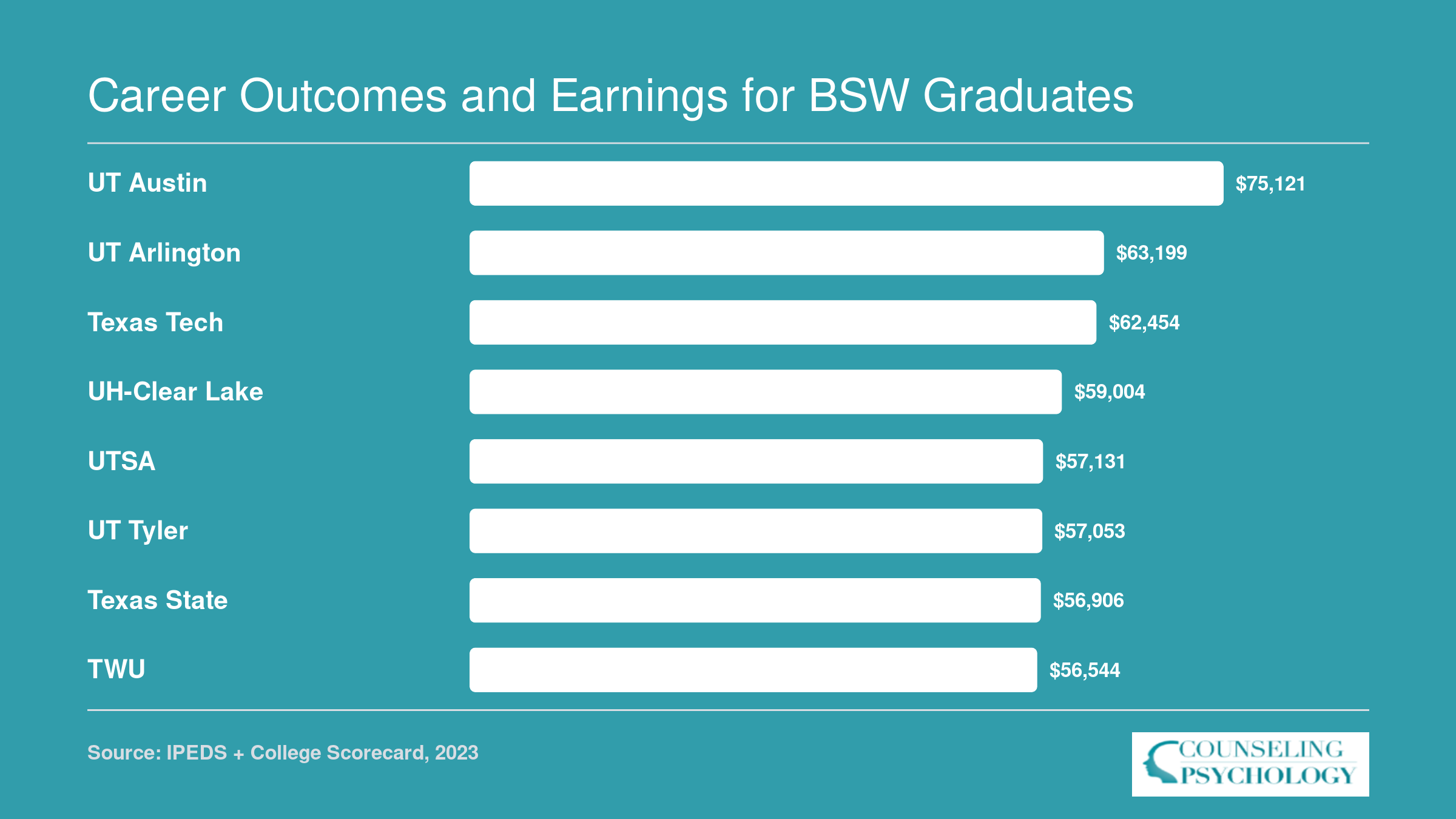
Program-level earnings and employment data for BSW graduates at these Texas schools are not yet published at the individual program level. However, institution-wide median earnings ten years after enrollment offer a useful proxy for comparing long-term outcomes. For context, the BLS reports that social workers in Texas earned a statewide median of $52,280 as of 2024, with the field projected to grow 6% nationally through 2034. Early-career BSW holders typically start below that statewide median and climb toward it (or past it) as they gain experience and pursue licensure or an MSW.
Texas LBSW Licensure: What BSW Graduates Need to Know
Some social work credentials require years of supervised post-degree hours before you can practice independently. The Licensed Baccalaureate Social Worker (LBSW) in Texas takes a different route: no post-degree supervised experience is required, which means you can move from graduation to licensure in a matter of months rather than years.1 Understanding exactly how that pathway works will help you plan your career timeline from the moment you enroll.
The Licensing Pathway
To earn an LBSW in Texas, you need three things: a BSW from a CSWE-accredited program, a passing score on the ASWB Bachelors Examination, and a completed application to the Texas Behavioral Health Executive Council (BHEC), the state agency that oversees social work licensure.1
The application process begins with an exam preapproval request submitted to BHEC. The preapproval fee is $60.3 Once BHEC confirms your eligibility, you register with ASWB to sit for the Bachelors-level exam. The exam consists of 170 multiple-choice questions (150 scored, 20 pretest items) covering human development, diversity, assessment, direct practice, and professional values.2 ASWB publishes candidate handbooks with current passing-score information, and registration fees are set by ASWB directly, so confirm the current cost on the ASWB exam information page before budgeting.
A rule change took effect November 9, 2025, so if you read older guides about BHEC requirements, double-check current details against the BHEC Board News page.3
Scope of Practice
The LBSW authorizes non-clinical social work services.1 In practice, that includes case management, eligibility determination, community outreach, and connecting clients with resources. What it does not authorize is clinical assessment, diagnosis, or psychotherapy. Those services require an LMSW or LCSW. If your career goal involves clinical mental health work, you will eventually need a master's degree and additional licensure, but the LBSW is a recognized, employable credential for a wide range of human services roles.
Continuing Education for Renewal
Texas LBSW licenses renew on a biennial cycle. Your renewal deadline falls on the last day of your birth month every two years.4 To renew, you must complete 30 hours of continuing education, including:
- Ethics: 6 hours required
- Diverse populations: 3 hours required
- Approved providers: at least 15 of the 30 hours must come from BHEC-approved providers2
Texas uses CE Broker as the reporting platform for continuing education tracking, so setting up an account early makes renewal straightforward.3 All requirements above reflect the 2025-2026 licensing cycle; always verify with BHEC before your renewal date.
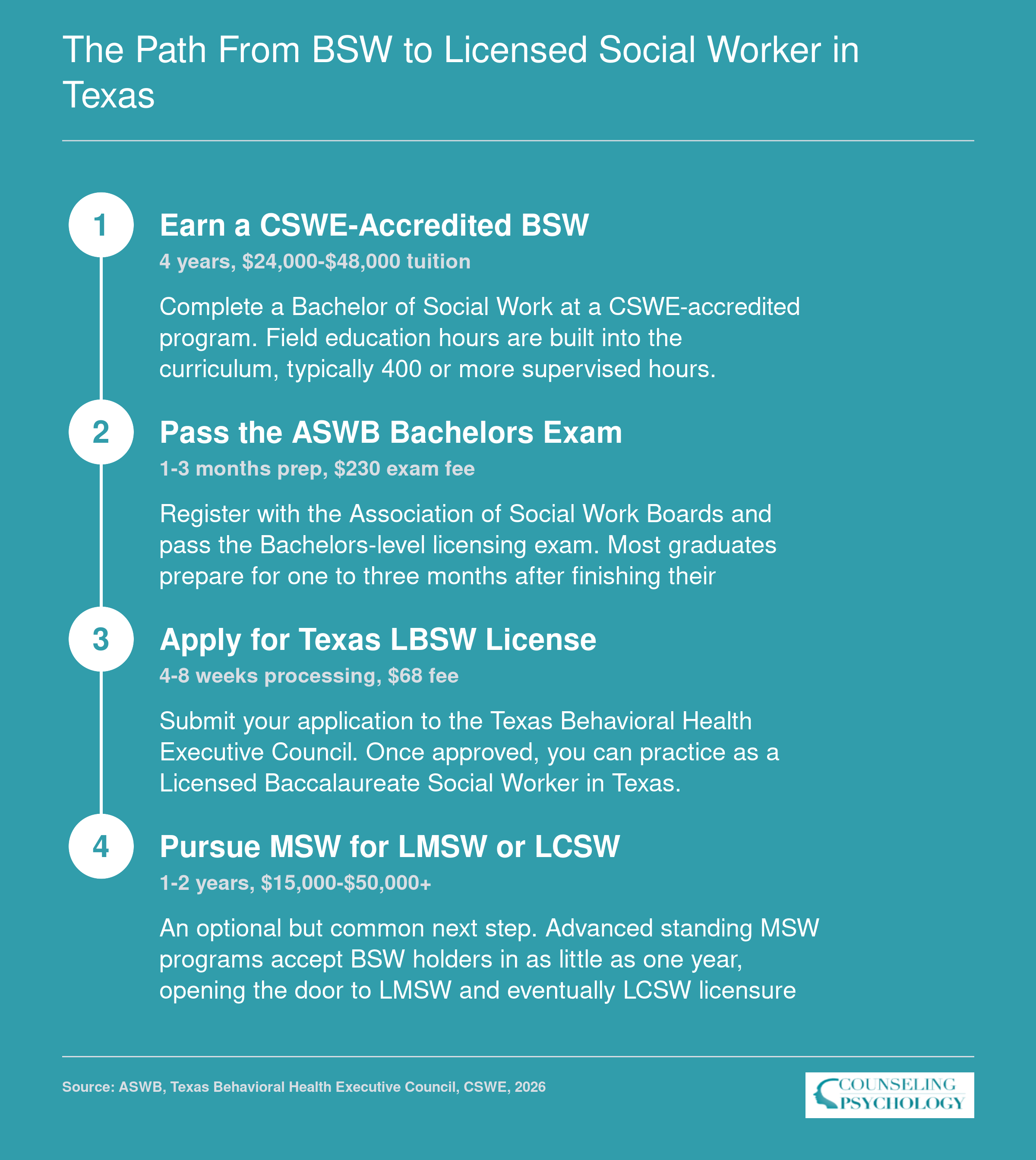
The Path from BSW to Licensed Social Worker in Texas
Getting from your first social work class to a Texas license follows a clear sequence. Here is what each milestone looks like in terms of time and money.
How to Choose the Right BSW Program in San Antonio
Choosing the right BSW program comes down to five factors that directly affect your career trajectory, licensure eligibility, and financial return on your education investment.
Start with CSWE Accreditation
Council on Social Work Education accreditation is non-negotiable. Without it, you cannot sit for the Licensed Baccalaureate Social Worker exam in Texas, and you will not qualify for advanced standing MSW programs. Every program featured in the San Antonio area holds CSWE accreditation, but if you are considering schools outside this list, verify accreditation status before applying.
Evaluate Field Placement Networks
Your 400-hour field practicum shapes your professional skills and job prospects more than any classroom course. Programs with established partnerships at hospitals, Child Protective Services offices, VA clinics, school districts, and nonprofit agencies across the San Antonio metro offer stronger practicum experiences and often lead to job offers after graduation. Ask admissions representatives for a list of current placement sites and whether students can propose their own placements based on career interests.
Consider Advanced Standing MSW Pathways
If you plan to pursue an MSW after your bachelor's degree, selecting a BSW program with clear advanced standing agreements can save you a full year of graduate school. UTSA, Our Lady of the Lake University, and Texas State University all offer advanced standing MSW tracks for BSW graduates.2 OLLU's advanced standing MSW requires 30 credits and is available on campus or online, with a specialized concentration in practice with Hispanic children and families.3 Texas State's track requires 36 credits with a 3.0 GPA minimum. These accelerated pathways typically take 12 months to complete rather than the standard two years. If your interests extend to counseling programs in Texas, many of the same universities offer related graduate degrees worth exploring alongside an MSW.
Assess Flexibility for Your Schedule
Working adults and students with family responsibilities need programs that fit their lives. Look for evening or weekend cohorts, hybrid coursework that blends online and in-person sessions, and part-time enrollment options. Some San Antonio programs offer fully online course sequences with local field placements, letting you complete didactic work remotely while gaining hands-on experience in your community.
Compare ROI, Not Just Sticker Price
Tuition alone does not tell the full story. Review the program-level debt and earnings data presented earlier in this article to compare what graduates actually earn against what they borrowed. A program with higher tuition but lower net price after aid, stronger employment outcomes, or a direct pipeline to an advanced standing MSW may deliver better long-term value than the cheapest option on paper.
A BSW is not a detour. It gets you into the workforce sooner, at a lower cost, and many CSWE-accredited MSW programs offer advanced standing tracks that cut graduate school down to roughly one year. That means you can start gaining professional experience, earning a salary, and confirming social work is right for you, all while positioning yourself for a faster, more affordable path to the MSW if you choose to continue.
Frequently Asked Questions About BSW Programs Near San Antonio
Choosing a BSW program involves practical questions about cost, accreditation, licensure, and career potential. Below are answers to the questions prospective students in the San Antonio area ask most often, drawing on the program and outcome data covered earlier in this article.
More Accredited BSW Programs in Texas to Consider
Beyond our top ten, these additional CSWE-accredited BSW programs across Texas offer affordable pathways to a social work career. Organized by region, each listing highlights program format, unique features, and net price, making it easier to find a program that fits your location and learning style.
East Texas
- Bachelor of Social Work
- Bachelor of Social Work
South Texas
- Bachelor of Social Work
DFW Metroplex
- Bachelor of Social Work
- Bachelor of Social Work
North Texas
- Social Work, B.S.W.
West Texas
- Bachelor of Social Work
- Bachelor of Social Work (Children, adolescents, and families)
- Bachelor of Social Work (Health and mental health settings)
- Bachelor of Arts in Social Work
- Bachelor of Science in Social Work
- Bachelor of Arts in Social Work
Central Texas
- Bachelor of Social Work
Austin Area
- Bachelor of Social Work
- Bachelor of Social Work
Greater Houston
- Bachelor of Social Work
- Social Work, Bachelor of Arts
San Antonio Area
- Bachelor of Social Work