
What you’ll learn in this article…
- California hosts over 20 APA-accredited clinical psychology doctoral programs, more than any other state.
- Median annual wages for clinical psychologists in California exceed the national median by a significant margin.
- Licensure requires a doctoral degree, 3,000 supervised hours, and passing the EPPP plus the California supplemental exam.
- Net prices across ranked programs range from roughly $11,000 to over $50,000 per year depending on institution type.
California trains more clinical psychologists than any other state, yet the mental health workforce still falls well short of demand across Los Angeles, the Central Valley, and rural northern counties. The California Board of Psychology requires a doctorate for licensure as a psychologist, meaning the degree choice carries real stakes: a research-oriented Ph.D. typically takes five to seven years and often comes with funding, while a practice-focused PsyD runs three to five years but usually does not.
Programs here vary sharply on cost, accreditation, and career outcomes. In-state tuition at UC San Diego sits around $15,000 per year; private programs like USC or Pepperdine can exceed $44,000 to $72,000 annually. Rankings in this article draw on graduation rates, median graduate debt, estimated long-term earnings, and APA or PCSAS accreditation status to help you weigh those tradeoffs clearly.
The practical tension for most applicants is not which program is most prestigious but which format, funding structure, and licensure pathway fits a realistic timeline. California's supervised-hours requirement and EPPP pass rate data make program selection a long-range financial and professional commitment.
Top Clinical Psychology Programs in California: 2026 Rankings
California is home to some of the most respected clinical psychology training programs in the country, spanning research-intensive Ph.D. tracks, practice-oriented PsyD pathways, and master's programs that feed directly into state licensure. The 2026 rankings below reflect a composite of institutional quality, program relevance, graduate outcomes, and affordability. Note that graduation rates listed are institution-wide figures reported by IPEDS, not specific to any individual program, and program-level median earnings are not yet available for most of these programs.
- Graduate earnings and debt outcomes
- Institutional graduation and retention rates
- Tuition and net price affordability
- Program accreditation and clinical training
- Admissions selectivity and student support
- Internal program database
- College Scorecard graduate earnings — collegescorecard.ed.gov
- NCES-IPEDS federal institutional data — nces.ed.gov
- Independent program research

University of Southern California
USC's Clinical Science Ph.D. program takes a life-span developmental approach to training clinical psychologists, with APA and PCSAS accreditation and deep ties to Los Angeles medical centers, VA facilities, and community mental health agencies. The program emphasizes research with California's diverse and urban populations, including Latinx and Asian American communities, and prepares graduates for careers in academia, healthcare, and public mental health systems. A 9:1 student-to-faculty ratio and 91.8% institution-wide graduation rate underscore the university's investment in student success.
- APA and PCSAS accredited doctoral program
- Life-span developmental approach to clinical training
- Sub-specialties in clinical geropsychology available
- Couples, child, and family psychology track offered
- Practicum placements across LA medical and VA sites
- Diverse research opportunities with urban populations
- Designed to meet California psychologist licensure requirements
- Campus-based program at a major R1 university
Ph.D. in Clinical Science — On-Campus

University of California-San Diego
The Joint Doctoral Program in Clinical Psychology merges the resources of UC San Diego and San Diego State University, creating an interdisciplinary training model unique in California. Accredited by the APA since 1990, the five-year curriculum integrates research and clinical practice across behavioral medicine, neuropsychology, and experimental psychopathology, with practicum sites spanning San Diego County hospitals, VA facilities, and community clinics. The program is well suited to students interested in border-region health, military populations, and multicultural clinical work in Southern California.
- APA accredited continuously since 1990
- Five-year curriculum with twelve-month academic year
- Concentrations in behavioral medicine and neuropsychology
- Experimental psychopathology track available
- One-year full-time clinical internship required
- Joint partnership between a UC and CSU campus
- Clinical placements across San Diego County systems
- Scientifically oriented training model
Joint Doctoral Program in Clinical Psychology (Ph.D.) — On-Campus

University of California-Irvine
UC Irvine's Ph.D. in Clinical Psychology operates within the School of Social Ecology, giving students an interdisciplinary lens that connects clinical science with public health, criminology, and urban planning. The program provides full funding for five years, including tuition and health insurance, and uses a holistic admissions approach with optional GRE submissions. As a Hispanic-Serving Institution, UCI is particularly focused on preparing clinicians to serve Orange County's racially and ethnically diverse communities, and the program is actively pursuing full APA accreditation.
- Clinical science research model with biopsychosocial focus
- Full funding guaranteed for first five years
- Housed in interdisciplinary School of Social Ecology
- Preparing for full APA accreditation
- Holistic admissions with optional GRE submissions
- One-year full-time clinical internship included
- Minority-Serving Institution commitment to diversity
- In-state tuition approximately $14,827 per year
Ph.D. in Clinical Psychology — On-Campus

San Diego State University
San Diego State University participates in the same Joint Doctoral Program with UC San Diego (ranked above), but also offers standalone master's-level programs relevant to clinical careers. The joint Ph.D. provides APA-accredited training with a strong emphasis on border-region, Latino, and immigrant population health. SDSU's partnerships with San Diego County Health and Human Services and local school districts create a direct pipeline into California public-sector clinical roles. In-state tuition of roughly $10,252 makes it one of the most affordable doctoral entry points in the state.
- APA accredited since 1990
- Concentrations in behavioral medicine and neuropsychology
- Experimental psychopathology track available
- Emphasis on border-region and Latino population health
- Diverse clinical practicum sites across San Diego
- Strong pipeline into California public-sector careers
- Commitment to equity and inclusion in training
- CACREP accredited 60-unit master's program
- On-campus and online options available
- Clinical license preparation included
- Multiple specialization areas offered
- Ranked among top programs nationally
- Projected 9% employment growth in the field
Ph.D. in Clinical Psychology (Joint SDSU/UC San Diego) — On-Campus
M.S. in Rehabilitation Counseling (Clinical Rehabilitation Counseling) — On-Campus

California State University-Northridge
CSUN's M.A. in Psychology with a Clinical Psychology concentration is a 36-unit campus-based program designed to launch students into competitive doctoral programs or master's-level clinical and research careers in California. Students complete fieldwork at the Child and Adolescent Diagnostic Assessment Clinic and other Los Angeles-area hospitals, community clinics, and social service agencies. Three concentration tracks (Clinical Fieldwork, Clinical Research, and Clinical Psychology) let students tailor their training, and the program explicitly positions itself as a stepping stone into California's Ph.D. and PsyD programs. In-state tuition sits near $8,982.
- 36-unit campus-based master's program
- Clinical Fieldwork concentration with practicum placements
- Clinical Research track for doctoral preparation
- Fieldwork in LA-area hospitals and community clinics
- Psychological assessment and psychotherapy coursework
- Comprehensive examinations required for completion
- GPA of 3.0 and personal interview required
- Seven-year completion limit for all tracks
M.A. in Psychology, Clinical Psychology Concentration — On-Campus

University of the Pacific
The University of the Pacific offers a PsyD in Counseling Psychology through a four-year hybrid format that requires only one to two days on campus per week in Stockton, making it a practical choice for working professionals in Northern and Central California. The program guarantees internship placements largely within California mental health and healthcare settings, and its curriculum is structured to meet California Board of Psychology educational requirements. Pacific highlights the high demand for mental health providers in the Central Valley and underserved regions of the state.
- Four-year hybrid doctoral program
- On campus one to two days per week
- Guaranteed internship experience in California settings
- Designed to meet CA Board of Psychology requirements
- Comprehensive clinical training across diverse settings
- Expert practitioner faculty with applied focus
- Targets mental health workforce gaps in Central Valley
- Combines online learning with in-person sessions
PsyD in Counseling Psychology — Hybrid

San Francisco State University
San Francisco State University offers two master's programs tied directly to California clinical practice. The M.S. in Psychology with a Clinical Psychology concentration prepares graduates for California Marriage and Family Therapist (MFT) licensure, while the M.S. in Clinical Mental Health Counseling aligns with Licensed Professional Clinical Counselor (LPCC) requirements. Both programs partner with over 150 Bay Area community agencies for field placements, and training emphasizes social justice, multicultural competence, and work with marginalized urban populations. In-state tuition of about $9,370 keeps costs low.
- Two-year full-time training program founded in 1952
- Prepares for California MFT licensure
- Covers psychodynamic, family systems, and multicultural perspectives
- Comprehensive clinical practicum included
- Strong placement into CA mental health agencies
- Pipeline to in-state Ph.D. and PsyD programs
- 60-unit program aligned with CA LPCC licensure
- Two academic years of field placements required
- Partnerships with 150+ Bay Area community agencies
- Social justice-oriented counseling framework
- Full-time and part-time enrollment options
- Fall semester admission only
M.S. in Psychology, Clinical Psychology Concentration — On-Campus
M.S. in Clinical Mental Health Counseling — On-Campus

University of San Diego
The University of San Diego's M.A. in Counseling with a Clinical Mental Health Counseling concentration prepares students to meet California Board of Behavioral Sciences requirements for the LPCC credential. Campus-based training in San Diego includes practica and internships with regional community mental health organizations, hospitals, schools, and nonprofits. The program emphasizes social justice counseling and work with immigrant and border-region communities, reflecting the realities of clinical practice in Southern California.
- Campus-based graduate program in San Diego
- Structured for California LPCC licensure preparation
- Advanced psychological assessment skills training
- Practica with San Diego-area community agencies
- Social justice and border-region community focus
- Strong local employer connections for graduates
M.A. in Counseling, Clinical Mental Health Counseling — On-Campus

Touro University California
Touro University California in Vallejo is a graduate-focused health sciences institution with a 3:1 student-to-faculty ratio. While its primary clinical offerings center on nursing and health professions rather than a standalone clinical psychology degree, its inclusion reflects the institution's strong graduate outcomes, with median earnings of $104,805 ten years after enrollment. Program-level details specific to clinical psychology training are limited in available data.
- Hybrid program with ADN-to-MSN and BSN-to-MSN tracks
- 12 to 18 month completion timeline
- Small cohort sizes for personalized support
- Eligible for CNL exam and CA PHN certification
- Rolling admissions with fall or spring starts
- Evidence-based practice and leadership emphasis
M.S. in Nursing, Clinical Nurse Leader — Hybrid

California State University-Los Angeles
Cal State LA serves one of the most diverse student bodies in the CSU system, with nearly 87% of undergraduates receiving Pell Grants and in-state tuition around $8,688. The university's Patricia A. Chin School of Nursing offers a Doctor of Nursing Practice with a Clinical Nurse Specialist concentration rather than a psychology-specific doctoral degree. Its remarkably low net price of approximately $3,967 makes it one of the most accessible graduate institutions in California, and strong clinical partnerships across Los Angeles support hands-on training.
- Full-time hybrid doctoral program
- Direct Care Track for CNS, NP, CRNA, or CNM
- Active California RN license required for admission
- Faculty panel interview and proctored writing evaluation
- Fall-term start dates only
- National certification required for Direct Care track
- Emphasis on evidence-based practice and leadership
- Clinical partnerships across Los Angeles
Doctor of Nursing Practice, Clinical Nurse Specialist — Hybrid
APA-Accredited Clinical Psychology Programs in California
Choosing between an accredited program and one without that credential shapes your entire career trajectory in clinical psychology. APA accreditation signals that a doctoral program meets rigorous training standards, while programs lacking this designation may leave graduates facing licensure barriers and employer skepticism.
What APA Accreditation Means for Your Career
The American Psychological Association accredits doctoral programs in clinical, counseling, and school psychology, but not master's programs. This distinction matters: if you are pursuing a master's degree in clinical psychology at a California State University campus, APA accreditation does not apply to your program. Master's-level training prepares you for roles such as Marriage and Family Therapist or Licensed Professional Clinical Counselor, not for licensure as a psychologist.
For doctoral candidates, APA accreditation carries practical weight in three areas:
- Licensure eligibility: The California Board of Psychology strongly favors graduates of APA-accredited programs. While alternative pathways exist, they often require additional documentation and review.
- Internship matching: APPIC-listed internship sites, particularly competitive placements at medical centers and VA hospitals, typically require or prefer applicants from accredited programs.
- Employer credibility: Academic medical centers, federal agencies, and many healthcare systems prioritize hiring psychologists whose training meets APA standards.
APA-Accredited Clinical Psychology Programs in California
California hosts multiple APA-accredited doctoral programs spanning both PhD and PsyD tracks. Based on current APA directory information, the following programs hold full accreditation status:
- Alliant International University, California School of Professional Psychology, Clinical Psychology PhD1
- Palo Alto University, Clinical Psychology PsyD (offered through the PAU-Stanford Consortium)2
- Pepperdine University Graduate School of Education and Psychology, Doctorate in Clinical Psychology PsyD3
- University of Southern California, Clinical Science PhD
- UC San Diego/SDSU Joint Doctoral Program, Clinical Psychology PhD
- California Lutheran University, Clinical Psychology PsyD
- University of La Verne, Clinical Psychology PsyD
- Biola University, Clinical Psychology PsyD
- California Baptist University, Clinical Psychology PsyD
- Azusa Pacific University, Clinical Psychology PsyD
Several programs appearing in the rankings section of this article hold APA accreditation, including USC, the UCSD/SDSU Joint Doctoral Program, Pepperdine, Palo Alto University, and California Lutheran. If you are also considering broader options beyond the state, our overview of clinical psychology doctorate programs provides a national perspective. UC Irvine's clinical psychology PhD program was preparing for accreditation as of recent catalog information, so prospective applicants should verify current status directly with the department.
Verifying Accreditation Status
Accreditation status can change. Programs may move from full accreditation to contingent status, or new programs may achieve initial accreditation. Always confirm a program's current standing through the APA's official accreditation database before applying. Look specifically for whether the program holds "full" accreditation or operates under "contingent" or "probationary" status, as these distinctions affect internship placement competitiveness and some employer hiring policies.
If you are weighing a master's program in clinical psychology, understand that APA accreditation will not apply. Focus instead on whether the curriculum meets California licensing requirements for LMFT or LPCC credentials, which follow different regulatory standards.
PhD vs. PsyD Clinical Psychology Programs in California
California offers two doctoral paths into clinical psychology: the PhD, which trains you as both a researcher and a clinician, and the PsyD, which centers almost entirely on applied clinical practice. Both degrees qualify you for licensure through the California Board of Psychology, so the question is not which one "counts" but which one fits your goals, finances, and tolerance for a longer academic runway.1
Training Model and Research Expectations
PhD programs follow a scientist-practitioner or clinical-scientist model. You will design and run original studies, publish in peer-reviewed journals, and defend a data-driven dissertation, all while accumulating supervised clinical hours. PsyD programs use a practitioner-scholar model: you still engage with research literature, but the dissertation is typically an applied project rather than a novel empirical study, and coursework tilts heavily toward assessment, intervention, and practicum rotations.1
Funding, Cohort Size, and Time to Degree
This is where the practical differences hit hardest.
- PhD funding: Most California PhD programs (housed in the UC system and select private research universities) offer tuition waivers plus a stipend. Cohorts are small, usually four to ten students per year, and acceptance rates hover around 10 to 15 percent.1
- PsyD funding: Professional schools such as the California School of Professional Psychology and Pepperdine admit larger cohorts of 20 to 50 or more students annually, with acceptance rates near 40 percent. Institutional funding is rare; most PsyD students rely on loans and personal funds.1
- Timeline: Expect five to eight years for a PhD (factoring in the dissertation and predoctoral internship) versus four to six years for a PsyD.1
The financial calculus matters: graduating with substantially less debt from a funded PhD program can shape your early career options, while the PsyD route gets you into practice sooner, often at the cost of higher loan balances.
Career Path Alignment
If you see yourself splitting time between a university lab and a therapy office, or pursuing faculty positions, a PhD is the stronger credential. If your priority is direct clinical work in hospitals, community mental health, private practice, or forensic psychology doctoral programs, a PsyD delivers concentrated clinical training with fewer research obligations. In California's competitive job market, hiring managers in clinical settings generally treat the two degrees as equivalent; academic and research positions still lean toward PhD holders.
The tuition and debt comparison elsewhere in this article puts concrete numbers behind these distinctions, so review those figures alongside your own career timeline before deciding which path to pursue.
Questions to Ask Yourself
Tuition, Debt, and ROI for California Clinical Psychology Programs
The table below ranks California clinical psychology programs by their ROI ratio, calculated from median graduate debt and median earnings ten years after enrollment. Net price figures shown are institution-level averages after financial aid for typical aid recipients; your actual cost will vary based on degree level, enrollment status, and individual aid packages. Program-level earnings data are not yet available for these programs, so the earnings column reflects institution-wide medians reported by College Scorecard. A clear pattern emerges: public University of California PhD programs and affordable CSU master's programs carry notably lower debt loads than private alternatives. UC San Diego and UC Irvine, both offering funded doctoral programs, pair moderate debt (around $15,000) with strong earnings and land near the top. Meanwhile, CSU campuses like Cal State LA and CSUN keep sticker prices under $9,000 for in-state students, though their institution-wide earnings trail the research universities. Private institutions such as USC deliver high earnings but at substantially higher tuition. Touro University California tops the ROI list thanks to exceptionally low reported debt relative to earnings, though its listed program is a nursing master's rather than a psychology doctorate. Overall, students weighing a public PhD against a private PsyD should factor in that UC doctoral programs typically fund students through assistantships and fee remissions, which keeps real out-of-pocket costs well below posted tuition.
| School | In-State Tuition | Out-of-State Tuition | Avg. Net Price (After Aid) | Median Graduate Debt | Median Earnings (10 yr) | ROI Ratio |
|---|---|---|---|---|---|---|
| Touro University California | $33,867 | $33,867 | Not reported | $12,500 | $104,805 | 8.38 |
| UC San Diego | $15,097 | $30,199 | $12,470 | $15,500 | $84,943 | 5.48 |
| UC Irvine | $14,827 | $29,929 | $14,251 | $15,000 | $80,735 | 5.38 |
| San Jose State University | $9,934 | $20,014 | $13,760 | $15,000 | $78,988 | 5.27 |
| University of Southern California | $71,515 | $71,515 | $32,740 | $18,000 | $92,498 | 5.14 |
| Cal State Los Angeles | $8,688 | $18,768 | $3,967 | $13,000 | $59,211 | 4.55 |
| San Francisco State University | $9,370 | $19,450 | $12,278 | $15,371 | $68,077 | 4.43 |
| San Diego State University | $10,252 | $20,332 | $15,364 | $15,000 | $64,909 | 4.33 |
| Cal State Northridge | $8,982 | $19,062 | $7,021 | $13,872 | $59,115 | 4.26 |
| Cal State Dominguez Hills | $8,978 | $19,058 | $8,615 | $13,807 | $57,162 | 4.14 |
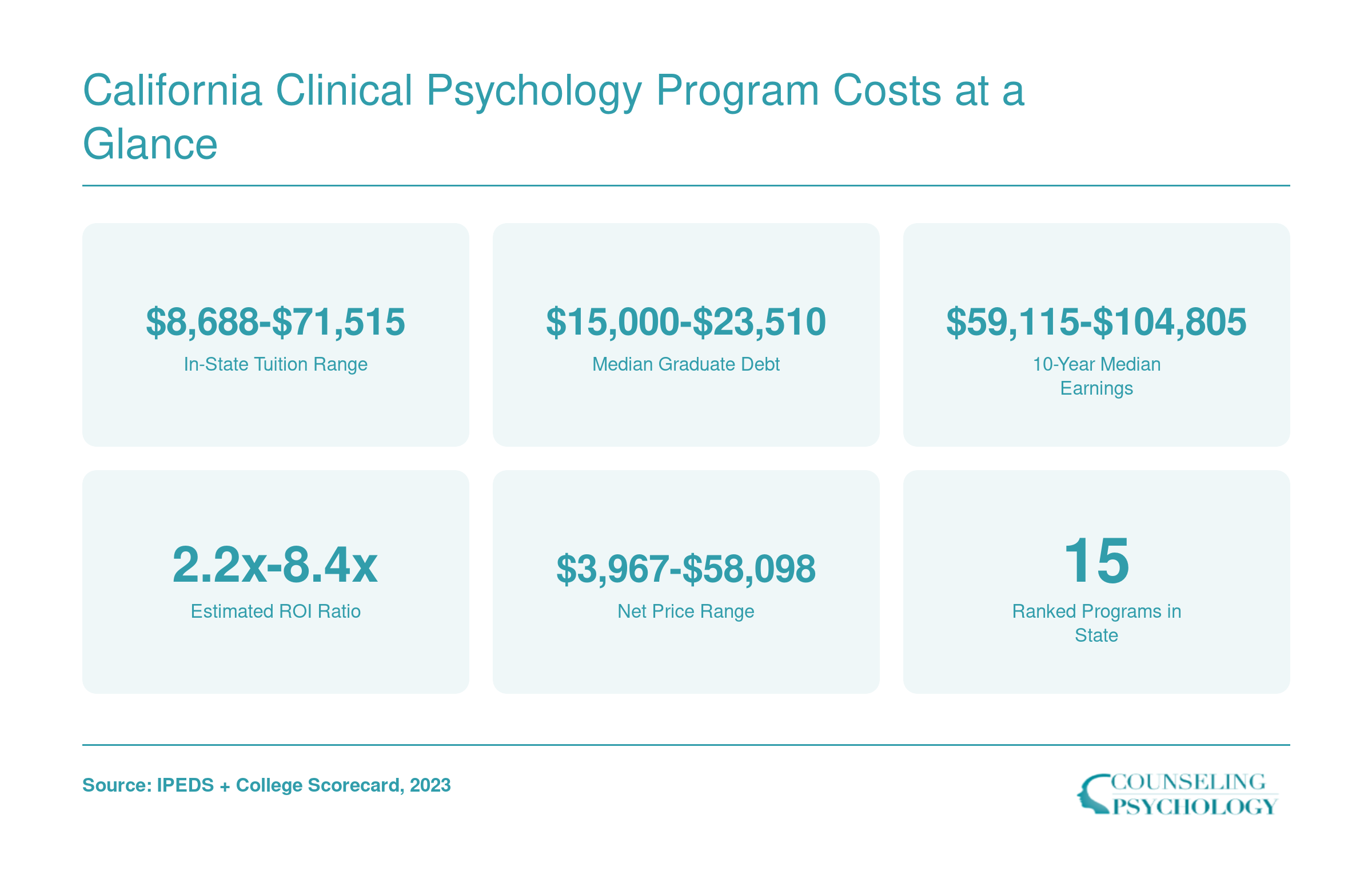
California Clinical Psychology Program Costs at a Glance
Financial planning is essential when choosing a clinical psychology program in California. These figures are drawn from our ranked programs and reflect the wide range of costs and outcomes across public universities, private institutions, and doctoral versus master's pathways.
Online, Hybrid, and Campus Clinical Psychology Programs in California
Campus-based doctoral training versus flexible hybrid or online formats: the difference matters more in clinical psychology than in almost any other graduate field, because the profession is built on supervised contact hours that simply cannot happen in front of a laptop.
What the Program Type Actually Means
Among the California programs covered here, the majority of doctoral programs operate entirely on campus. USC, UC San Diego, UC Irvine, Pepperdine, California Lutheran University, University of La Verne, Biola University, California Baptist University, and Azusa Pacific University all list campus delivery for their doctoral offerings. Palo Alto University runs its PGSP-Stanford PsyD Consortium on campus in Palo Alto. The one notable exception at the doctoral level is the University of the Pacific, which offers a hybrid PsyD in Counseling Psychology structured around one to two in-person days per week, a format designed to let working professionals stay enrolled without relocating.
At the master's level, the picture is more varied. Campus-only programs include CSUN's M.A. in Clinical Psychology, San Francisco State's M.S. in Psychology, San Jose State's Clinical Psychology M.S., Antioch University Los Angeles, and CSUDH's M.A. option. Hybrid master's formats appear at Simpson University in Redding and Vanguard University in Costa Mesa. Fully online master's-level options include National University's Clinical Mental Health Counseling M.S. and UMass Global's M.A. in Professional Clinical Counseling, both of which market explicitly to working adults and accept rolling or near-continuous enrollment.
The Practica Requirement Does Not Bend
Regardless of how a program labels its format, APA-accredited doctoral programs carry a non-negotiable in-person requirement: students must complete substantial clinical practica hours under face-to-face supervision, followed by a full-year predoctoral internship. Even a doctoral program marketed as hybrid or partially online will require students to be physically present at approved training sites for hundreds of hours each year. Anyone assuming a hybrid doctorate means remote clinical training should read program materials carefully before applying.
For master's students pursuing the Licensed Professional Clinical Counselor (LPCC) or MFT programs in California licensure track, the same logic applies. Practicum hours must be completed in person at approved sites, even if some coursework is delivered asynchronously.
Geography and Training Site Access
Where a program sits in California shapes what practicum placements are realistically available. Los Angeles programs benefit from one of the densest concentrations of clinical training sites in the country, including county mental health agencies, hospital systems, Veterans Affairs facilities, and private group practices. USC, Cal State LA, CSUDH, Pepperdine, Chapman, California Lutheran, and several others draw on this network.
San Diego programs, including those at UCSD and the University of San Diego cluster, have strong ties to military-connected care, community mental health centers, and several federally qualified health centers serving a large Spanish-speaking population. Students interested in bilingual clinical work or military psychology will find San Diego particularly well-resourced.
Bay Area programs, anchored by San Francisco State, San Jose State, and Palo Alto University, connect students to a tech-adjacent population with distinct mental health demand patterns, plus major academic medical centers across the region.
For students in less urban areas, hybrid formats like Simpson University in Redding can reduce commute burden while keeping clinical training local. The tradeoff is a narrower range of specialized placement sites compared with the major metro clusters.
California Licensure Pathway and EPPP Outcomes
California requires 3,000 total hours of supervised professional experience before licensure as a psychologist, split into pre-doctoral and post-doctoral components.1 The supervised hours break down into at least 1,500 hours completed during your post-doctoral period under board-approved supervision. Before entering post-doctoral work, you must complete a minimum of 48 semester (or 72 quarter) units of pre-doctoral supervised experience within 30 months of starting your program. The California Board of Psychology enforces these thresholds alongside doctoral degree completion, two national exams, and a detailed application process.
Supervised Experience Requirements
California divides supervised professional experience (SPE) into two phases. Pre-doctoral hours accumulate during your doctoral program, typically through practicum placements and internship. The Board mandates that these hours occur within 30 months of beginning your coursework and meet specific supervision ratios and settings.1 Post-doctoral hours must be completed within 30 months after graduation (or up to 60 months under certain conditions), during which you work under a licensed psychologist who submits quarterly supervision documentation to the Board. The 1,500-hour post-doctoral requirement is the most tightly regulated portion: supervisors must hold an active California license, and the work must align with the scope of practice for clinical psychology.
Examination Requirements and Passing Scores
Once you complete the supervised hours, you sit for two exams. The Examination for Professional Practice in Psychology (EPPP) is the national licensure test; California requires a scaled score of 500 or higher to pass.1 After clearing the EPPP, you take the California Psychology Law and Ethics Exam (CPLEE), formerly known as the CPSE. The CPLEE tests state-specific law, ethical standards, and professional conduct rules unique to California practice. Both exams must be passed before the Board issues your license. Other doctoral-level psychology careers, such as those in forensic psychologist requirements, follow a similar exam structure in many states, though the supervised-hour thresholds and specialty exams differ.
EPPP Pass Rates and Internship Match Data
California doctoral programs vary in first-time EPPP pass rates, though the California Board of Psychology does not publish program-specific pass data publicly in the same detail as some other states. Programs often report their own pass rates in self-study documents or during site visits, and national data from ASPPB aggregates state-level outcomes. Prospective students should ask admissions offices directly for recent cohort EPPP performance during campus visits or interviews.
APPIC internship match rates offer another window into program quality. California clinical psychology programs historically perform above the national average in the Match, with many APA-accredited doctoral programs placing 90 percent or more of their students in accredited internships on the first attempt. Unmatched students face delays in completing licensure requirements, so reviewing each program's three-year match history during your application process helps forecast your own timeline to licensure. Programs that consistently underperform in the Match may signal faculty advising gaps, weaker training partnerships, or less competitive applicant preparation.
Recent Regulatory Updates
As of 2026, the Board has not introduced sweeping changes to the 3,000-hour framework or exam passing scores, but minor clarifications around telepsychology supervision and out-of-state practicum credit continue to evolve. Check the California Board of Psychology Licensing FAQ for the latest bulletins before you begin accumulating hours, especially if you plan to complete any supervision outside California or through telehealth modalities. The Board's FAQ addresses common questions about hour documentation, acceptable supervision formats, and exam registration procedures.
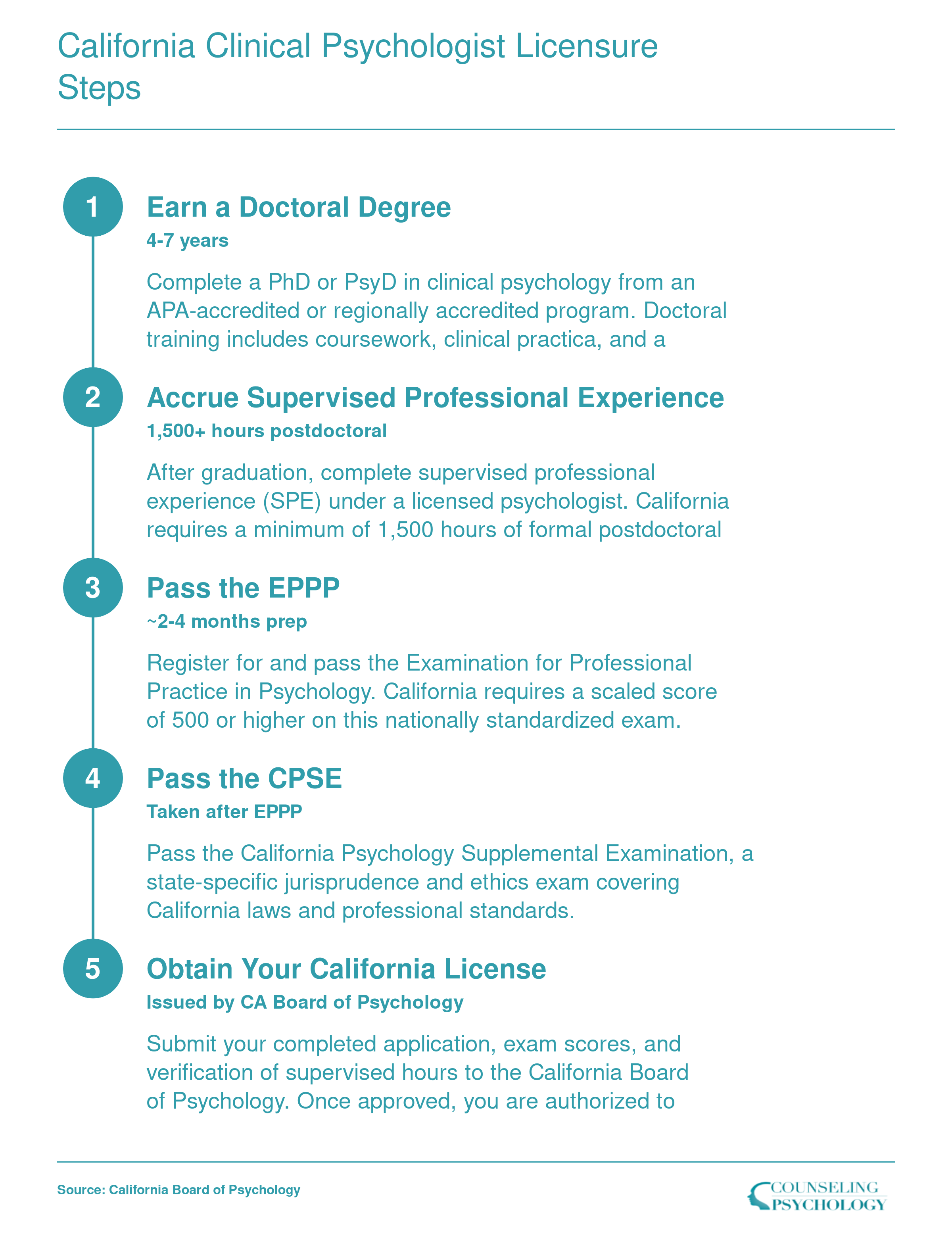
California Clinical Psychologist Licensure Steps
Becoming a licensed clinical psychologist in California follows a structured path overseen by the Board of Psychology. Each step must be completed in order, and the full timeline typically spans 10 to 14 years from the start of doctoral training.
Career Outlook and Earnings for Clinical Psychologists in California
California pays clinical psychologists more than almost any other state, and demand is climbing faster than the national average for the broader psychology workforce.
What the Wage Data Shows
According to the May 2023 Occupational Employment and Wage Statistics from the Bureau of Labor Statistics, clinical and counseling psychologists (SOC 19-3033) in California earned a mean annual wage of $132,410, or roughly $63.66 per hour.1 That is well above the national median of $96,100 for the same occupation. Nationally, the 10th percentile sits at $48,820 and the 90th percentile reaches $168,870, so early-career psychologists and senior practitioners can occupy very different rungs of the same ladder. More recent state-level estimates compiled by industry trackers put California's median closer to $115,000 in 2024, with a typical range of about $60,000 to $190,000 depending on setting and experience.2
Metro-level pay generally tracks cost of living. The Los Angeles, San Francisco Bay Area, and San Diego markets tend to anchor the upper end of California wages, while Sacramento and inland metros run closer to the state median. Specific metro medians shift year to year, so check the current OEWS metro tables before negotiating.
Program Earnings vs. Occupational Wages
A caveat on program-level earnings data: federal post-graduation earnings figures for clinical psychology doctoral programs in California are not yet publicly reported in a usable form. That means BLS occupational wages are the most reliable benchmark right now. Use them as your floor for licensed practice, recognizing that newly minted psychologists in their first postdoctoral year typically earn below the state median while they accrue supervised hours toward licensure.
Growth Drivers and Trauma-Focused Demand
BLS projects 11.2% employment growth for clinical and counseling psychologists nationally from 2024 to 2034, faster than the 6% projected for psychologists overall and well above the average across occupations.3 California's demand pressure is amplified by the state's population, its mental health parity enforcement, and Medi-Cal behavioral health expansion, all of which pull more licensed providers into community and integrated-care settings. For a broader look at the profession's trajectory, see our overview of careers in psychology.
Can clinical psychology help with trauma? Yes, and trauma-focused practice (PTSD, complex trauma, first responder care, and refugee mental health) is one of the highest-demand specializations in California. Training in evidence-based protocols like CPT, PE, and EMDR meaningfully expands employability across VA, county, and private-practice settings. Clinicians interested in working with younger populations may also find overlap with childhood trauma counseling roles.
Yes, you can be a clinical psychologist with autism. California and all other states base licensure decisions on education, supervised hours, and examination results, not on a candidate's diagnoses. Neurodivergent clinicians work successfully in the field and often bring a meaningful lived-experience perspective that strengthens their rapport with clients.
Frequently Asked Questions About Clinical Psychology Programs in California
Prospective students often have overlapping questions about timelines, accreditation, and licensure when evaluating clinical psychology programs in California. The answers below draw on current guidance from the APA, the California Board of Psychology, and program admissions offices to help you plan realistically.
More Clinical Psychology Programs in California to Consider
Beyond our top 10 ranked programs, California offers many other clinical psychology programs worth exploring. The following directory lists additional accredited programs across the state, organized by region. Whether you prioritize location, format, or cost, these schools expand your options for pursuing a clinical psychology degree.
Bay Area
- Clinical Psychology, MS
- Clinical Mental Health Counseling, MS
- Master's Entry MSN, Clinical Nurse Leader
- Clinical Psychology, PsyD
- Master in Clinical Mental Health
- Clinical Psychology, PsyD (Child Clinical Psychology)
- Clinical Psychology, PsyD (Neuropsychology)
Greater Los Angeles
- Doctor of Psychology in Clinical Psychology
- Master of Arts in Clinical Psychology
- Master of Arts in Clinical Psychology (Marriage and Family Therapy with Latinx Communities)
- Master of Arts in Clinical Psychology (Marriage and Family Therapy)
- MA in Counseling with an emphasis in Professional Clinical Counseling
- Doctor of Psychology (PsyD) in Clinical Psychology (Forensic Psychology, Psychodynamic Systems of Psychotherapy)
- Doctor of Psychology (PsyD) in Clinical Psychology
- Doctor of Psychology (PsyD) in Clinical Psychology (Psychodynamic Systems of Psychotherapy)
- Master of Arts in Psychology - Clinical Psychology Option
- PsyD in Clinical Psychology
- MS in Clinical Psychology
- Doctorate in Clinical Psychology (PsyD)
- Master of Arts in Clinical Mental Health Counseling
- Doctor of Psychology in Clinical Psychology
- Master of Science (MS) in Clinical Psychology
- Master of Science in Clinical Psychology
- Clinical Psychology, PsyD
- Clinical Psychology, MA
Northern California
- Master of Arts in Counseling Psychology