
What you’ll learn in this article…
- New Jersey addiction counselors earned a mean annual wage of $67,250 according to the latest BLS state data.
- Seven NJ programs appear in the federal College Scorecard with earnings data for addiction counseling graduates.
- The CADC requires a high school diploma while the LCADC requires a master's degree with clinical hours.
- Most ranked NJ programs use hybrid formats that combine online coursework with required on-site components.
Which addiction counseling credential do you actually need in New Jersey, and which programs align with it? The answer depends on whether you pursue the CADC, requiring 270 education hours and a high school diploma, or the LCADC, which demands a master's degree and clinical supervision. Both credentials are in high demand: New Jersey continues to face one of the highest per-capita rates of opioid-related overdose deaths in the Northeast, and treatment facilities across the state report persistent staffing shortages.
The programs ranked here range from hybrid graduate certificates at Rutgers and Montclair State to CACREP-accredited master's degrees at Monmouth University, with in-state graduate tuition starting around $16,000. Choosing the wrong program format or credential track can cost you a year or more in unnecessary coursework, so the distinction between CADC and LCADC pathways matters from day one. If you are still exploring broader options, our guide to online addiction counseling degrees covers accredited programs nationwide.
Ranked: Best Addiction Counseling Programs in New Jersey
New Jersey's addiction counseling programs span graduate certificates built for working clinicians to full master's degrees that open dual-licensure pathways. The schools below were evaluated on institutional outcomes, licensure alignment, net cost, and program-level strengths. Program-level earnings and completion data are not yet published for these specific addiction counseling tracks, so we leaned on institution-wide outcomes and hands-on research into each curriculum's fit with CADC and LCADC certification requirements.
- NJ licensure and certification alignment
- Institutional graduation and retention rates
- Net price and return on investment
- Program format and accessibility
- Curriculum depth and fieldwork hours
- College Scorecard graduate earnings — collegescorecard.ed.gov
- Internal program database
- Independent program research
- NCES-IPEDS federal institutional data — nces.ed.gov

Montclair State University
Montclair State University stands out for offering both a graduate certificate and a 60-credit MA in Counseling with an Addictions Counseling concentration, giving students a clear ladder from CADC certification to LCADC and LPC licensure. The counseling programs are currently under review for the next CACREP accreditation cycle, with a site visit scheduled for the 2025 to 2026 academic year. With a net price of $15,566, median graduate debt of $22,000, and institution-wide median earnings of $61,415 at ten years, Montclair delivers solid value for NJ residents. The school offering these programs has a graduation rate of 64.7%.
- Hybrid format blending online coursework with campus sessions
- Meets all NJ educational requirements for CADC certification
- Option to pursue the MA in Counseling concurrently
- Covers substance abuse counseling across clinical settings
- Designed for students new to the addiction counseling field
- No entrance exam requirement specified for admission
- 60-credit campus-based master's program with evening and summer courses
- Prepares graduates for both LCADC and LPC licensure in New Jersey
- Three semesters of supervised fieldwork in clinical placements
- Emphasizes work with marginalized and underserved populations
- Accommodates working professionals with full-time and part-time tracks
- Minimum 2.9 GPA required for admission
- Recently reported 26 enrollees and 10 graduates in the addiction track
Certified Alcohol and Drug Counselor (CADC) Graduate Certificate — Hybrid
MA in Counseling, Addictions Counseling Concentration — On-Campus

Monmouth University
Monmouth University brings CACREP-accredited rigor to its addiction counseling offerings through two distinct master's pathways: an M.S. in Clinical Mental Health Counseling with an Alcohol and Drug Counseling concentration and an MSW with the same specialization. Both programs prepare students for LCADC licensure, but the MSW route adds 1,000 hours of field placement specifically in addiction treatment settings. The school offering these programs has a graduation rate of 71.9%, and institution-wide median earnings reach $67,991 at ten years, though the net price of $30,988 and median debt of $27,000 reflect its status as a private university.
- CACREP-accredited campus-based master's program
- Specialized courses in treatment and advanced alcohol and drug counseling
- Includes field placement opportunities in clinical settings
- Prepares graduates for New Jersey LCADC licensure
- Student and alumni organizations support professional networking
- 12:1 student-to-faculty ratio supports individualized mentoring
- 54-credit campus-based social work degree with addiction focus
- 1,000 hours of field placement in addiction treatment settings
- Electives include Clinical Practice Addictions and Addictions Considerations
- Prepares students for LCADC licensure alongside LCSW eligibility
- Emphasis on practical clinical skills for substance use disorders
- Projected 18% job growth in substance abuse counseling roles
M.S. in Clinical Mental Health Counseling, Alcohol and Drug Counseling Concentration — On-Campus
MSW, Alcohol and Drug Counseling Concentration — On-Campus

Rutgers University-Newark
Rutgers University-Newark's Addiction Counselor Training (ACT) Certificate is a focused, six-course hybrid program designed for MSW students and post-graduate clinicians who want to add LCADC credentials without completing a second full degree. The curriculum covers all five domains required for CADC and LCADC certification, includes supervised practicum hours at DMHAS-approved agencies, and also satisfies the educational requirements for Certified Compulsive Gambling Counselor (CCGC) certification. With an in-state net price of $19,703 and median graduate debt of $21,500, it offers strong return on investment: institution-wide median earnings sit at $74,479 ten years after enrollment. The school offering this program has a graduation rate of 63.8%.
- Six-course hybrid program combining online and in-person learning
- Covers all five CADC and LCADC certification domains
- Includes supervised practicum at DMHAS-approved agencies
- Also meets educational requirements for CCGC certification
- Prepares for dual LCADC and LCSW licensure
- Emphasizes evidence-based interventions and trauma-informed care
- Strong focus on cultural competence and recovery principles
- Designed for MSW students and practicing post-graduate clinicians
Addiction Counselor Training (ACT) Graduate Certificate — Hybrid

Rutgers University
Rutgers University's New Brunswick campus offers its own version of the Addiction Counselor Training (ACT) Certificate in a hybrid format, sharing the same Rutgers School of Social Work curriculum available at the Newark and Camden locations. The program covers all educational domains required for LCADC licensure, includes supervised practicum hours, and features a competitive admissions process with both spring and fall entry points. The school offering this program has an 83.6% graduation rate, the highest among institutions on this list, and a 93% retention rate. Institution-wide median graduate debt is $21,500, with median earnings of $74,479 at ten years.
- Hybrid format with online coursework and in-person components
- Covers all LCADC educational hour requirements
- Competitive application process with spring and fall admission cycles
- Financial aid available for eligible students
- Supervised practicum hours in approved addiction treatment settings
- Comprehensive addictions curriculum with self-help meeting component
- Dual credential preparation for behavioral health professionals
Addiction Counselor Training (ACT) Graduate Certificate — Hybrid

Rutgers University-Camden
Rutgers University-Camden rounds out the Rutgers system's ACT Certificate offerings with the same hybrid curriculum focused on dual LCADC and LCSW preparation. Located in southern New Jersey, the Camden campus provides more convenient access for students in the Philadelphia metro area. The program covers all five CADC and LCADC domains, includes practicum at DMHAS-approved agencies, and emphasizes evidence-based approaches to co-occurring disorders. With the lowest net price on this list at $18,745 and median graduate debt of $21,500, this campus delivers the strongest value by sticker price among the Rutgers locations. The school offering this program has a graduation rate of 66.7%.
- Hybrid format with online and in-person learning components
- Prepares for dual LCADC and LCSW licensure in New Jersey
- Practicum at DMHAS-approved addiction treatment agencies
- Covers all five required CADC and LCADC certification domains
- Focus on evidence-based interventions for co-occurring disorders
- Lowest net price among ranked programs at $18,745
- Convenient southern NJ location near the Philadelphia metro area
Addiction Counselor Training (ACT) Graduate Certificate — Hybrid
How We Ranked These New Jersey Addiction Counseling Programs
Seven New Jersey programs appear in the federal College Scorecard with earnings data for addiction counseling or substance abuse/addiction counseling graduates. We built this ranking using four quantitative measures: median earnings one year after graduation, median federal loan debt at completion, a debt-to-earnings return-on-investment ratio, and the number of graduates in the most recent cohort.
What the Scorecard Tells Us
The College Scorecard publishes program-level earnings and debt figures for graduates who received federal aid. These numbers reflect real outcomes for completers in addiction counseling and related titles. When a program reports median earnings of $45,000 and median debt of $18,000, those figures come directly from federal wage records and loan disbursement data, not self-reported surveys or institutional marketing.
Institution-Wide Averages Fill the Gaps
Graduation rates and net price are reported at the institutional level, not by individual program. A university's overall six-year completion rate and average annual net price after aid apply to all undergraduates, so we use those institution-wide figures when program-specific data are unavailable. Similarly, online and hybrid format availability reflects the delivery modes each school offers for its addiction counseling degree or certificate, and tuition figures correspond to graduate-level rates where applicable.
A Data-Driven Approach
This is not an editorial popularity contest or a pay-to-play sponsored list. Every program in the ranking met a minimum threshold for data completeness and was scored identically. Higher earnings, lower debt, stronger ROI ratios, and larger cohorts all contribute to a program's position. We did not adjust scores for reputation, campus amenities, or alumni networks. The result is a transparent, repeatable formula that prioritizes measurable career outcomes over subjective opinion.
Program Costs and Financial Comparison
The table below compares tuition, average net price, median graduate debt, and estimated monthly loan payments across the New Jersey addiction counseling programs featured in this article. Net price figures are institution-wide averages after financial aid, drawn from federal data. Your actual cost will depend on your program level, enrollment status, and individual aid package. Program-level debt and earnings data are not yet available for these specific addiction counseling programs, so the debt and earnings columns reflect institution-wide medians. Montclair State University stands out as the most affordable option on both sticker price and net price. Among the Rutgers campuses, Camden offers the lowest net price. When you factor in debt relative to median earnings ten years after enrollment, Rutgers Camden and Rutgers Newark deliver the strongest debt-to-earnings ratio, with graduates earning roughly $3.46 for every dollar of median debt.
| School | In-State Tuition | Out-of-State Tuition | Avg. Net Price (After Aid) | Median Graduate Debt | Est. Monthly Payment (10-Yr Plan) | Median Earnings (10 Yr Post-Entry) |
|---|---|---|---|---|---|---|
| Montclair State University | $16,056 | $16,056 | $15,566 | $22,000 | ~$253 | $61,415 |
| Rutgers University, Camden | $23,428 | $36,772 | $18,745 | $21,500 | ~$247 | $74,479 |
| Rutgers University, Newark | $23,221 | $37,669 | $19,703 | $21,500 | ~$247 | $74,479 |
| Rutgers University, New Brunswick | $23,241 | $37,689 | $24,406 | $21,500 | ~$247 | $74,479 |
| Monmouth University | $26,918 | $26,918 | $30,988 | $27,000 | ~$310 | $67,991 |
Questions to Ask Yourself
Online, Hybrid, and Campus Options in New Jersey
Flexibility in how students complete addiction counseling coursework has expanded significantly, yet New Jersey's ranked programs lean heavily toward formats that blend remote learning with required on-site components. Understanding what each delivery model actually entails can help you choose a program that fits your schedule without compromising clinical preparation.
Hybrid Programs Dominate the New Jersey Landscape
Most addiction counseling programs ranked for New Jersey use a hybrid format, combining online coursework with scheduled campus sessions or in-person practica. Montclair State University's CADC certificate follows this model, pairing web-based instruction with on-campus learning to meet state certification requirements. The three Rutgers campuses offering the Addiction Counselor Training (ACT) Certificate (New Brunswick, Newark, and Camden) all use hybrid delivery as well, blending online classes with in-person supervision and practicum hours at DMHAS-approved treatment agencies.
Campus-Only Options
Monmouth University's M.S. in Clinical Mental Health Counseling with an Alcohol and Drug Counseling concentration stands apart as a fully campus-based program. Students complete all coursework and field placements in person, which can strengthen networking with local treatment facilities and clinical supervisors. For those who thrive in traditional classroom settings or want direct access to faculty and peers, this route offers built-in structure.
Are Fully Online Addiction Counseling Degrees Available in New Jersey?
Among the ranked programs, none currently offer a fully online path for an addiction counseling degree or certificate through a New Jersey institution. If your goal is completing every requirement remotely, you may want to explore online graduate certificate in addiction counseling options offered by accredited programs outside the state. Keep in mind that even programs marketed as online often require clinical or fieldwork hours at approved sites, and New Jersey's CADC and LCADC credentials mandate supervised experience that cannot be completed virtually.
Practical Tradeoffs to Consider
- Flexibility: Hybrid formats let working professionals manage coursework around job or family commitments while still meeting in-person requirements on a set schedule.
- Practicum access: Campus and hybrid programs often have established relationships with New Jersey treatment centers, which can simplify finding approved fieldwork placements.
- Networking: On-site sessions connect you with classmates and supervisors who may become referral sources or colleagues in your future career.
- Time commitment: Fully campus-based programs require more predictable availability, which may not suit everyone.
Regardless of which format you select, expect some clinical hours to take place in person at a state-approved facility. This requirement ensures you gain hands-on skills essential for working with clients in recovery settings.
CADC and LCADC Licensure Alignment by Program
New Jersey recognizes two tiers of addiction counseling credentials. The CADC (Certified Alcohol and Drug Counselor) requires a high school diploma or GED, 270 education hours, 300 practicum hours, 3,000 supervised work experience hours, attendance at 30 self-help meetings, and passage of the IC&RC ADC written and oral exams. The LCADC (Licensed Clinical Alcohol and Drug Counselor) builds on the CADC: candidates must hold an active CADC (or equivalent), earn a master's degree in counseling, addictions, psychology, or a closely related clinical discipline with at least 18 graduate semester hours, and meet continuing education requirements. The table below maps each ranked program to the credential tier its coursework is designed to satisfy. Online coursework is accepted for both credentials when offered by an approved provider.
| Program | Degree Level | Credential Tier Targeted | Meets 270 Education Hours (CADC) | Meets 18 Graduate Semester Hours (LCADC) | Supervised Practicum Included | IC&RC Exam Eligibility Prep | Dual Licensure Pathway |
|---|---|---|---|---|---|---|---|
| Montclair State University, CADC Certificate | Graduate Certificate | CADC | Yes | No (certificate level) | Yes | Yes | Can be paired with MA in Counseling for LCADC track |
| Montclair State University, MA in Counseling, Addictions Concentration | Master's | LCADC | Yes | Yes | Yes (three semesters of fieldwork) | Yes | Prepares for both LCADC and LPC |
| Monmouth University, M.S. Clinical Mental Health Counseling, Alcohol and Drug Counseling Concentration | Master's | LCADC | Yes | Yes | Yes (field placement) | Yes | CACREP accredited; prepares for LCADC |
| Rutgers University (Newark), ACT Certificate | Graduate Certificate (within MSW) | LCADC | Yes (covers all five CADC/LCADC domains) | Yes (paired with MSW coursework) | Yes (practicum at DMHAS approved agencies) | Yes | Prepares for LCADC and LCSW |
| Rutgers University (New Brunswick), ACT Certificate | Graduate Certificate (within MSW) | LCADC | Yes (covers all five CADC/LCADC domains) | Yes (paired with MSW coursework) | Yes | Yes | Prepares for LCADC and LCSW |
| Rutgers University (Camden), ACT Certificate | Graduate Certificate (within MSW) | LCADC | Yes (covers all five CADC/LCADC domains) | Yes (paired with MSW coursework) | Yes (practicum at DMHAS approved agencies) | Yes | Prepares for LCADC and LCSW |
Related Articles
How to Become an Addiction Counselor in New Jersey
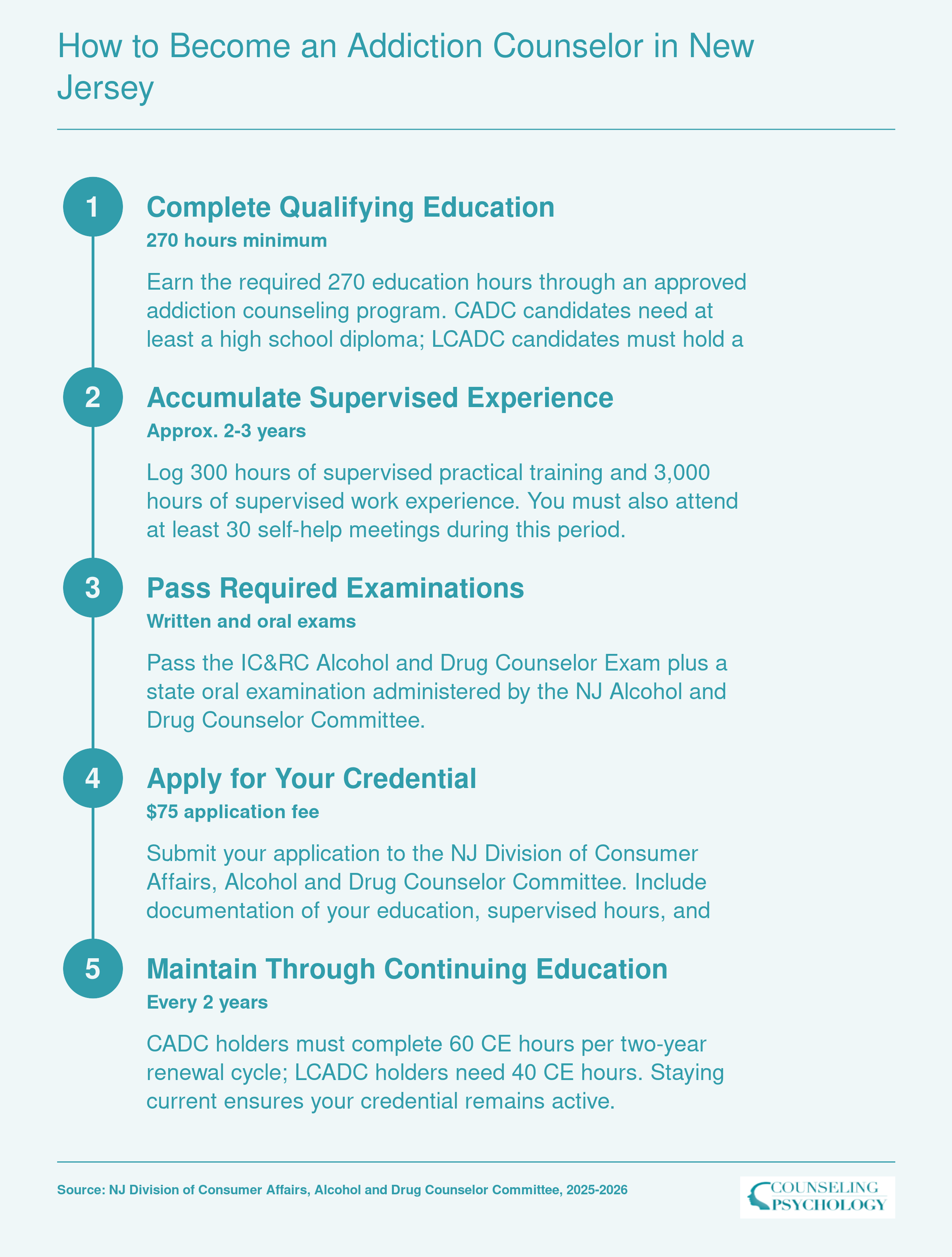
New Jersey offers two primary credentials for addiction counselors: the Certified Alcohol and Drug Counselor (CADC), which requires a high school diploma or GED, and the Licensed Clinical Alcohol and Drug Counselor (LCADC), which requires a master's degree with at least 18 graduate semester hours in relevant coursework. Both credentials share the same supervised experience and exam requirements, but the LCADC opens the door to independent clinical practice. Selecting a program from the ranked list above is the critical first move, because your coursework must cover all 270 required education hours to qualify.
Salary and Career Outcomes for NJ Addiction Counselors
What can you expect to earn as an addiction counselor in New Jersey after completing one of these programs? Substance abuse, behavioral disorder, and mental health counselors in New Jersey earned a mean annual wage of $67,250 in 2023, according to the Bureau of Labor Statistics, notably higher than the national median of $53,710 for the same occupation.1 The field employs approximately 13,320 counselors statewide, with strong demand across outpatient treatment centers, hospital behavioral health units, community mental health agencies, and state-funded rehabilitation facilities.
Statewide and Metro-Area Wage Patterns
While BLS publishes detailed percentile wage data at the national level for this occupation (ranging from $36,700 at the 10th percentile to $89,920 at the 90th percentile), New Jersey-specific percentile breakdowns are not yet available in the 2023 release.1 The Newark-Jersey City metro area, which spans parts of New York and Pennsylvania, reported a mean annual wage of $71,180 for substance abuse and mental health counselors in 2023, reflecting the region's higher cost of living and concentration of treatment facilities. Trenton and Atlantic City area wages are not separately published in the latest data.
Nationally, the 25th percentile sits at $44,600 and the 75th at $70,130, giving you a sense of the earning trajectory as you gain experience and credentials. New Jersey's mean of $67,250 suggests that the state's wage distribution likely skews above these national benchmarks, particularly in urban and suburban corridors. For broader context on how these figures compare across specialties and states, see our counselor salary breakdown.
How Program Graduates Fare: Scorecard Earnings
Program-level earnings data from the College Scorecard for the ranked New Jersey addiction counseling programs are not yet available. Graduate certificate programs often do not appear in federal earnings tracking because many students already hold degrees and jobs, making it difficult to isolate the certificate's impact. For this reason, institution-wide median earnings ten years after entry, such as the $74,479 figure for Rutgers University-Newark, reflect all undergraduate and graduate alumni, not just addiction counseling certificate holders. These figures provide a rough benchmark for the institution's alumni network but should not be interpreted as typical outcomes for certificate completers.
Credential Level and Earning Potential
LCADC holders typically command higher salaries than CADC-certified counselors due to the clinical scope of the LCADC credential, which permits independent practice, diagnosis, and treatment planning. CADC-level work often occurs under supervision in entry-level or paraprofessional roles, while LCADC licensure opens doors to clinical director positions, private practice, and leadership roles within hospital systems and state agencies. Dual-licensed professionals, such as those holding both LCADC and LCSW or LPC credentials, enjoy the widest range of employment settings and compensation packages, particularly in integrated behavioral health environments. Pursuing a masters in addiction counseling can position you for these advanced credentials and higher earning potential.
Major Employers and Career Pathways
New Jersey's largest employers for addiction counselors include state-funded treatment centers operated by the Division of Mental Health and Addiction Services (DMHAS), hospital behavioral health units at institutions like Hackensack Meridian Health and RWJBarnabas Health, private residential and outpatient rehab facilities, and nonprofit community mental health agencies. These settings offer varied schedules, benefits, and opportunities for specialization in co-occurring disorders, adolescent treatment, and family therapy. As of 2023, the state's behavioral health workforce continues to expand in response to opioid and mental health crises, creating stable demand for credentialed addiction counselors.
NJ Addiction Counselor Salary at a Glance
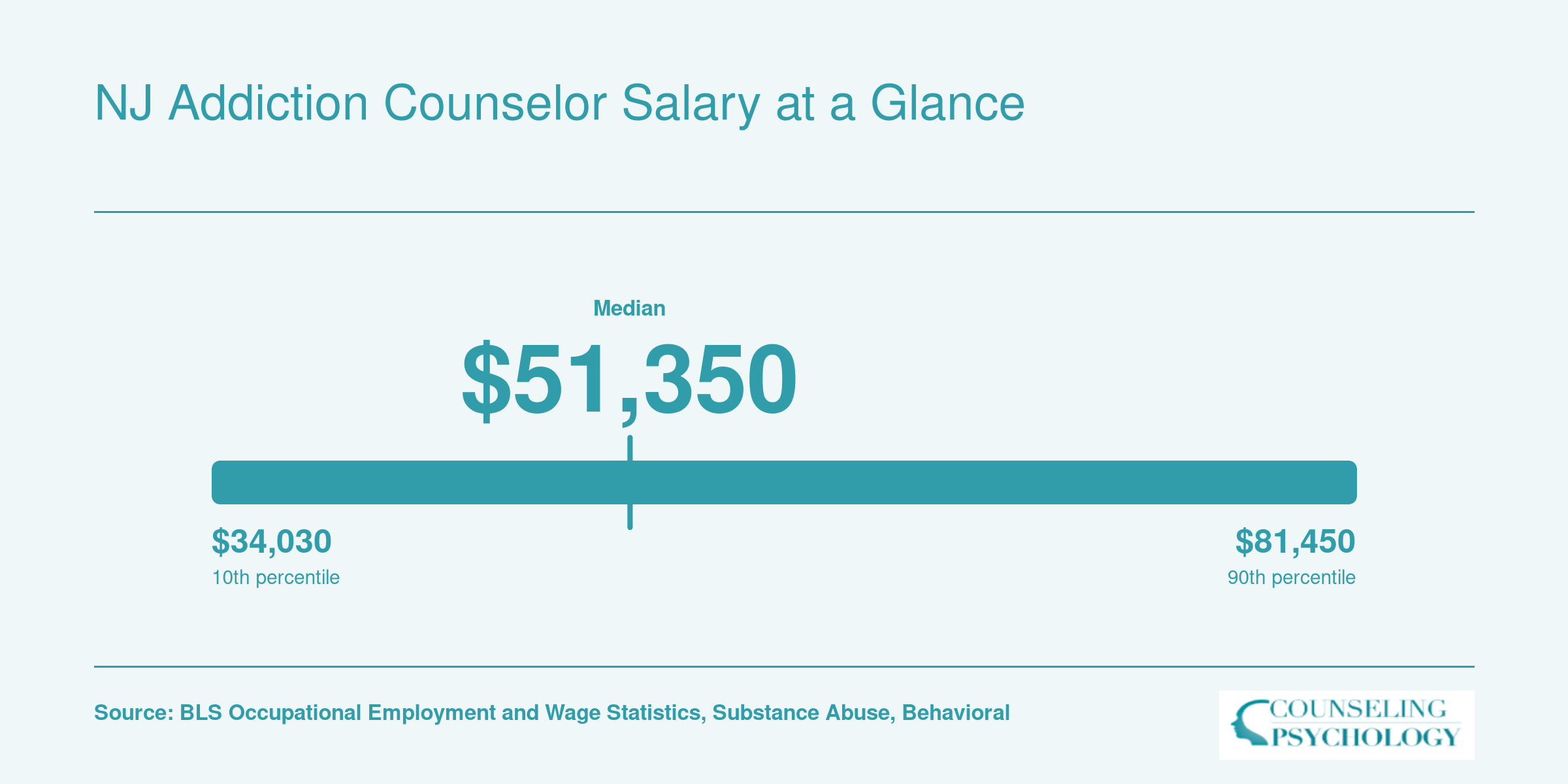
Wages for substance abuse, behavioral disorder, and mental health counselors in New Jersey span a wide range depending on credential level and experience. Entry-level CADC holders typically fall near the lower percentiles, while experienced LCADCs with supervisory roles or specialized caseloads tend to earn toward the upper end of the distribution.
Frequently Asked Questions About Addiction Counseling Programs in NJ
Choosing the right addiction counseling program means understanding credentials, career steps, and what to expect from training in New Jersey. Below are answers to the questions prospective students ask most often.