
What you’ll learn in this article…
- Truckee Meadows Community College and Western Nevada College both serve Reno students with accredited psychology associate programs.
- Nevada Promise Scholarship plus the Pell Grant can reduce in-state community college tuition to near zero.
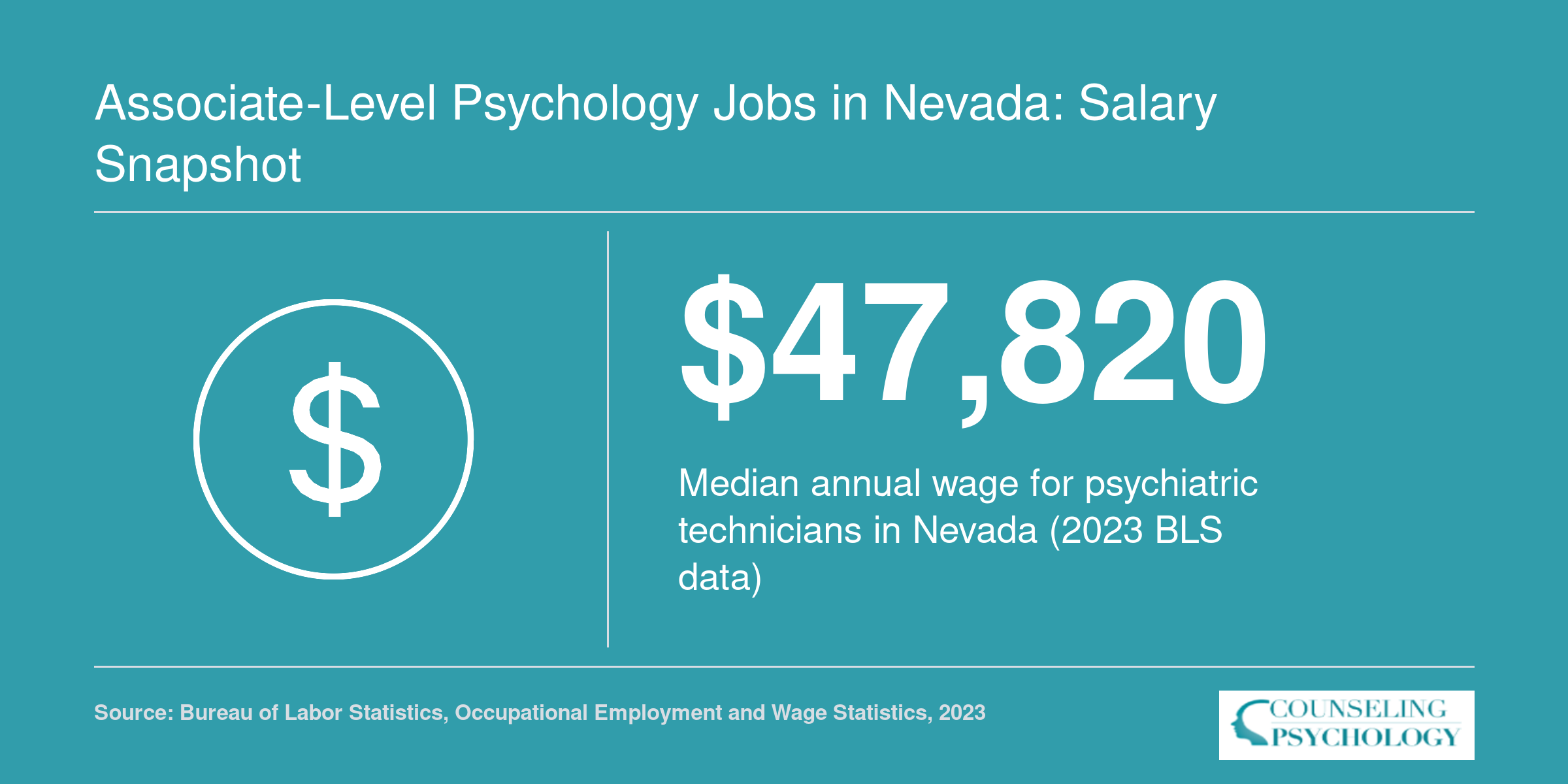
- Psychiatric technicians in Nevada earned a median annual wage of $47,820 as of 2023 per BLS data.
- TMCC's structured transfer pathway lets associate graduates enter UNR with full junior standing in psychology.
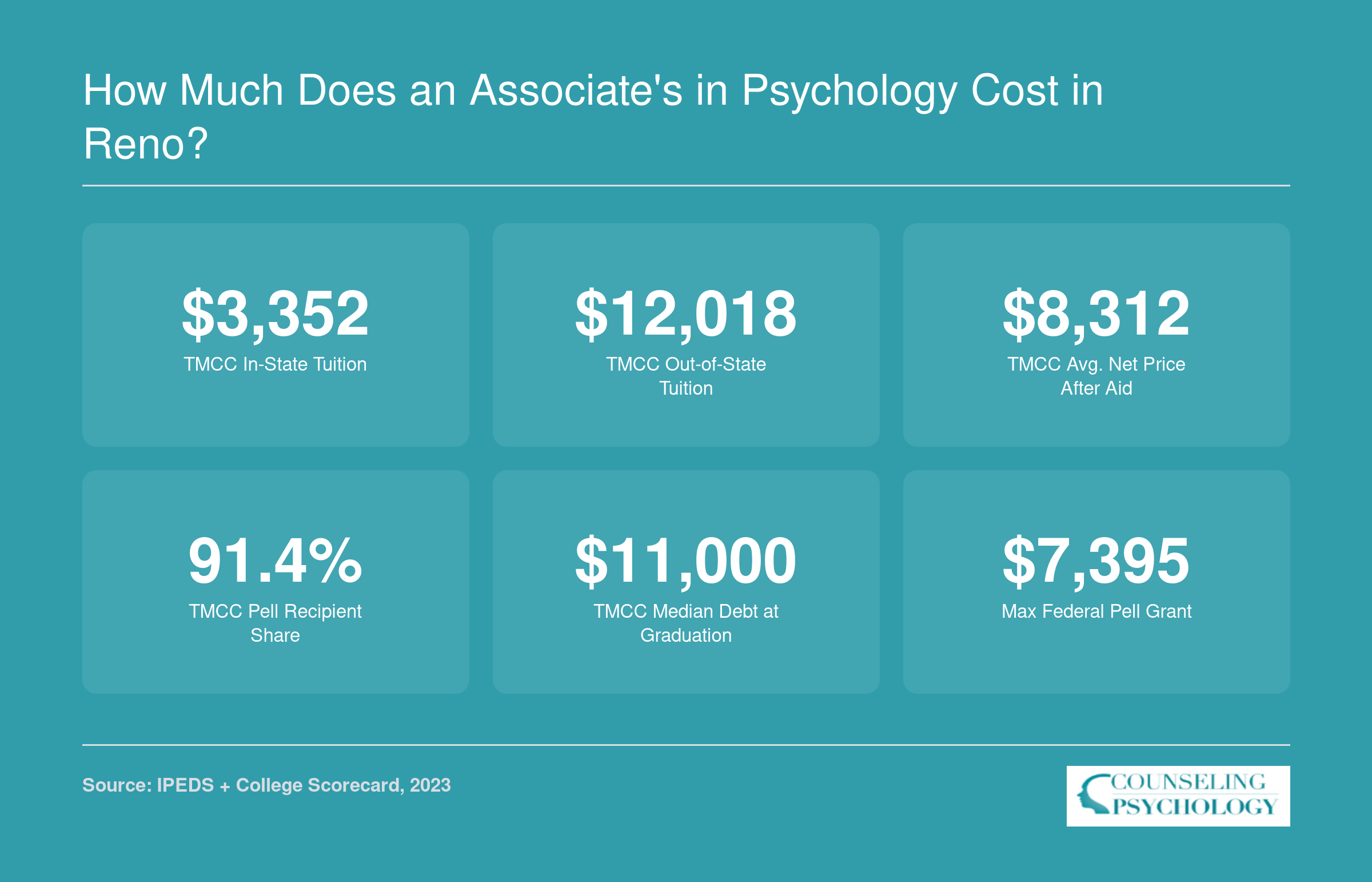
At Truckee Meadows Community College in Reno, in-state tuition for a Psychology AA runs $3,352 per year, one of the lower published rates among Nevada's public two-year colleges. That price point matters because most students pursuing a psychology career will eventually need a bachelor's degree, a master's, or a doctoral license, meaning the cost of entry-level coursework compounds across a long educational path.
Reno-area community colleges, particularly TMCC and the College of Southern Nevada, carry net prices that drop sharply once Pell Grants and the Nevada Promise Scholarship are applied. Both schools maintain transfer articulation agreements with the University of Nevada, Reno and UNLV, so credits earned at the associate level translate directly toward a bachelor's without significant loss.
The practical tension for students here is timing: an associate's degree alone qualifies you for entry-level behavioral health support roles, but licensure as a counselor or psychologist requires graduate-level counseling programs in Nevada or doctoral work. Understanding where the associate's credential fits in that longer sequence, and what it costs to get there, is the core question this article addresses through ranked program profiles, cost comparisons, career earnings data, and Nevada's licensure roadmap.
Best Associate's Degree in Psychology Programs Near Reno
Two Nevada community colleges offer associate-level psychology programs within reach of Reno students, and each brings a different edge. Truckee Meadows Community College sits right in Reno with a formalized transfer pipeline to the University of Nevada, Reno, while the College of Southern Nevada delivers one of the lowest net prices in the state and serves as an on-ramp to both UNR and UNLV. Below, we break down what each school offers so you can weigh cost, flexibility, and long-term fit.
- Net price and affordability
- Graduation and completion rates
- Transfer pathway strength
- Program flexibility and format
- Pell recipient accessibility
- NCES-IPEDS federal institutional data — nces.ed.gov
- College Scorecard graduate earnings — collegescorecard.ed.gov
- Internal program database
- Independent program research

Truckee Meadows Community College
Located in the heart of Reno, Truckee Meadows Community College is the most direct community college feeder into the University of Nevada, Reno. UNR's own catalog publishes a dedicated transfer map for TMCC psychology students, meaning credits align course by course with the UNR B.A. in Psychology. With over 91% of students receiving Pell Grants and a 100% online option for the Psychology AA, TMCC balances accessibility with a clear path toward a four-year degree.
- Designed as a direct two-year transfer plan into UNR's B.A. in Psychology
- Available 100% online or on campus in Reno
- In-state tuition of $3,352 per year keeps upfront costs low
- Covers core psychology concepts, research methods, and general education
- Requires at least 15 units completed in residence at TMCC
- Nevada Promise Scholarship may cover most or all tuition for eligible grads
- Net price of roughly $8,312 after aid, per federal data
- Emphasizes math, statistics, and research design beyond the AA track
- Suited for students eyeing graduate study or behavior analysis careers
- Online and on-campus scheduling available for flexible completion
- 60 total units required, with stronger science foundation than the AA
- Prepares students for transfer to four-year programs across NSHE
- Aligns with Nevada's growing behavioral health workforce needs
Psychology, AA — On-Campus
Psychology, AS — On-Campus

College of Southern Nevada
The College of Southern Nevada, based in Las Vegas, posts one of the lowest net prices in the state at roughly $6,615 after aid. Its Psychology AA lays a transfer-ready foundation across the entire Nevada System of Higher Education, so Reno-area students who complete the degree can move into UNR, UNLV, or Nevada State with junior standing. A recent curriculum update tightened course sequencing to match UNR's lower-division requirements, making the program especially practical for northern Nevada students willing to study remotely or relocate temporarily.
- Net price of approximately $6,615, among the lowest in Nevada's public system
- 60 credits including 28 major-requirement credits in psychology
- Covers psychological theories, research methods, and statistical techniques
- Includes a Nevada and U.S. constitutions requirement that transfers across NSHE
- Open admissions with no additional GPA or test-score barriers for psychology
- 2024 to 2025 curriculum refresh aligned course sequencing with UNR requirements
- Median graduate debt of $8,000, well below national community college averages
- Eligible for Nevada Promise Scholarship, potentially covering full tuition
Psychology, AA — On-Campus
How Much Does an Associate's in Psychology Cost in Reno?
Published tuition rates rarely tell the full story. Between the Nevada Promise Scholarship, which covers remaining tuition and fees as a last-dollar award for up to three years, and the federal Pell Grant (up to $7,395 for 2025-2026), most Reno-area community college students pay significantly less than the sticker price. Over 91% of students at Truckee Meadows Community College and roughly 88% at the College of Southern Nevada receive Pell Grants, which underscores just how accessible financial aid is at these schools. When you compare published tuition to the average net price after all grants and scholarships, the gap is striking.
Reno-Area Psychology Tuition: In-State vs. Out-of-State Comparison
Nevada community colleges offer some of the steepest tuition discounts in the Mountain West for in-state residents, and that gap widens further when state scholarship programs enter the picture.
In-State vs. Out-of-State Tuition at Reno-Area Colleges
Truckee Meadows Community College in Reno charges $3,352 annually for in-state students pursuing an associate degree in psychology, compared to $12,018 for out-of-state learners. That $8,666 difference underscores Nevada's commitment to subsidizing local enrollment. At College of Southern Nevada in Las Vegas, which serves as a tuition benchmark for the state system, in-state students pay $4,358 while out-of-state peers face $13,024, an $8,666 premium. Both institutions operate on the same state funding model, so these figures reflect Nevada's standard approach: residents pay roughly one-quarter to one-third what non-residents do.
Nevada Promise Scholarship: The Last-Dollar Advantage
Qualifying Nevada high school graduates can attend community college at zero tuition cost through the Nevada Promise Scholarship, a last-dollar program that covers whatever remains after federal Pell Grants and other aid. Because Pell already offsets much or all tuition for low-income students, Promise effectively fills gaps for middle-income households who earn too much for Pell but still face cost barriers. Students must graduate from a Nevada high school, enroll full-time within six months of graduation, complete a FAFSA, contribute eight hours of community service per semester, and maintain a 2.5 GPA. For qualifying students, the sticker price becomes irrelevant: tuition is covered.
Beyond Tuition: The Full Cost Picture
Published tuition figures exclude textbooks (typically $600 to $1,000 per year for psychology programs), mandatory campus fees (roughly $300 to $500 annually), and living expenses. Reno's cost of living runs about 7 percent above the national median, with average rent for a one-bedroom apartment near campus hovering around $1,350 per month in 2026. Students living at home or splitting housing costs can keep non-tuition expenses under $8,000 annually; those renting independently should budget $18,000 to $22,000 for the full year.
Why Reno-Area Programs Rank Among the Mountain West's Most Affordable
When you combine sub-$4,000 in-state tuition, the Nevada Promise safety net, and the option to live at home or work part-time in a metropolitan economy, Reno-area associate psychology programs deliver one of the lowest total cost-of-ownership profiles between Denver and Sacramento. That affordability extends the runway for students who plan to transfer into a bachelor's program or who need to work while earning credentials, making these programs particularly strategic starting points for first-generation and non-traditional learners.
Questions to Ask Yourself
Career Outcomes and Earnings With a Reno Psychology Associate's Degree
What Psychology Associate Graduates Actually Earn
Program-level earnings data for associate psychology completers at Nevada community colleges are not yet widely published in federal scorecard datasets, making it difficult to report precise one- or two-year post-graduation median wages specific to the degree. When such data become available, they will offer the clearest picture of early-career income for local graduates. Until then, regional wage data for occupations commonly entered by associate-level psychology alumni provide a useful proxy.
Entry-Level Job Titles and Salary Ranges in Reno
An associate's degree in psychology opens the door to several behavioral health and human services roles in the Reno area, each with distinct responsibilities and pay scales:
- Psychiatric Technicians: Working in hospitals, residential treatment centers, or state facilities, these professionals assist with patient observation, crisis intervention, and therapeutic activities. The Reno, NV MSA reports a median annual wage of $40,700 (May 2023 Bureau of Labor Statistics data), with approximately 200 psychiatric technicians employed locally.1
- Community Health Workers: These roles involve connecting clients to social services, conducting outreach, and navigating healthcare systems. Community health workers in the Reno MSA earn a median of $66,290 per year (May 2023), significantly higher than the psychiatric technician track, though employment is smaller at around 130 positions metro-wide.1
- Social and Human Service Assistants: Supporting social workers and counselors, assistants coordinate client services, maintain case files, and provide direct client support in agencies and nonprofits. Salaries typically range from the mid-$30,000s to low $40,000s locally, though precise Reno MSA figures for this occupation are not published separately in the May 2023 OEWS release.
- Behavioral Health Technicians and Case Aides: Across Nevada's behavioral health facilities, associate-level staff provide daily living support, crisis de-escalation, and activity coordination. Entry wages hover in the $32,000 to $42,000 range depending on setting and shift differentials.
Is It Worth It to Get an Associate's Degree in Psychology?
The value proposition rests on two pillars: immediate employability and transfer potential. As a standalone credential, the associate's opens access to para-professional roles that offer stable work, benefits, and field experience while you decide whether to pursue licensure. Regional demand for behavioral health staff has grown consistently, and Nevada Department of Employment, Training and Rehabilitation projections through 2034 show continued expansion in these occupations, driven by population growth and increased mental health service utilization.
At the same time, the associate's functions as a low-cost launchpad toward a bachelor's and eventual licensure. Completing general education and foundational psychology courses at community-college tuition rates reduces total degree debt and accelerates time to credential when you transfer. Students interested in hands-on clinical work might eventually explore an applied behavior analysis bachelor's degree, while others may pivot toward organizational or counseling tracks. For students balancing work and family, this staged approach turns an all-or-nothing bachelor's commitment into two manageable phases, each with its own career milestone.
Demand Trajectory: What the Numbers Say
Nevada DETR occupational projections for the 2024 to 2034 decade anticipate steady growth in behavioral health support roles statewide, with particular strength in Washoe County. Psychiatric technicians, community health workers, and social service assistants all appear on the state's in-demand lists, reflecting both aging demographics and policy shifts toward community-based mental health care. For associate-degree holders, this translates to job security and the flexibility to gain experience before committing to graduate school or licensure tracks.
Associate-Level Psychology Jobs in Nevada: Salary Snapshot
Graduates with an associate's degree in psychology can step into several entry-level roles across Nevada's behavioral health workforce. The BLS reports that psychiatric technicians in Nevada earned a median annual wage of $47,820 as of 2023, one of the stronger starting points among associate-level positions. Comparable roles such as community health workers, social and human service assistants, and substance abuse counselors typically fall in a broad range from the mid-$30,000s to mid-$40,000s nationally, though Nevada-specific figures for those occupations were not published in available data. Earnings climb substantially once you transfer and complete a bachelor's or master's degree, opening the door to licensed counseling and clinical positions with significantly higher pay.
Online vs. On-Campus Associate Psychology Programs Near Reno
Yes, you can absolutely earn an associate's degree in psychology online from a Reno-area college. Truckee Meadows Community College (TMCC) offers both its Psychology AA and Psychology AS with a 100% online option, meaning no in-person components are required. The College of Southern Nevada (CSN) lists its Psychology AA as a campus-based program, though individual courses may be available online. Below is a side-by-side look at how fully online, hybrid, and traditional on-campus formats compare across the dimensions that matter most when choosing your path.
| Dimension | Fully Online (e.g., TMCC Psychology AA/AS) | Hybrid (mix of online and in-person) | On-Campus (e.g., CSN Psychology AA) |
|---|---|---|---|
| Scheduling Flexibility | Maximum flexibility. Complete coursework on your own schedule from anywhere. Ideal for students balancing work or family obligations. | Moderate flexibility. Most lectures are asynchronous online, but some meetings, exams, or labs may require set campus visits. | Least flexible. Fixed class times on campus, which can make it harder to accommodate a full-time job or long commute. |
| Access to Campus Resources | Virtual tutoring, online library databases, and remote academic advising are available. No access to physical labs or spontaneous study groups. | Students get partial access to labs, campus advising offices, and peer study sessions during their scheduled on-campus days. | Full access to laboratories, in-person advising, campus mental health services, peer study groups, and student organizations. |
| Transfer Pathway Support | TMCC's Psychology AA is specifically designed as a transfer program to the University of Nevada, Reno (UNR). Online students receive the same transfer advising as on-campus peers. | Transfer support varies by institution and format. Verify that hybrid sections carry the same course numbers accepted by your target four-year school. | CSN's Psychology AA prepares students for transfer within the Nevada System of Higher Education. Campus advisors can assist with articulation agreements in person. |
| Cost Differences | TMCC in-state tuition is approximately $3,352 per year. Online students often save on commuting, parking, and campus fees, though some technology or distance-education fees may apply. | Tuition typically matches the home institution's posted rate. Savings on commuting are partial, since some campus attendance is still required. | CSN in-state tuition is approximately $4,358 per year. Factor in commuting costs, parking, and on-campus meal expenses for a full picture. |
| Ideal Student Profile | Self-motivated learners who need location independence, working adults, parents, or anyone in rural areas outside Reno who wants a Nevada community college credential without relocating. | Students who value some face-to-face interaction but still need scheduling flexibility. A good middle ground for those near campus but with unpredictable weekly schedules. | Traditional students who thrive with structured routines, want hands-on lab experience, and benefit from daily peer interaction and direct faculty mentorship. |
Transfer Pathways: Associate to Bachelor's in Psychology in Nevada
The most common question Reno psychology students ask is straightforward: can you transfer from TMCC to UNR with a psychology associate's degree? The short answer is yes, and the Nevada System of Higher Education has built a structured pathway to make the transition as seamless as possible. Here is how it works and what you need to know before you start.
The TMCC-to-UNR 2+2 Route
Truckee Meadows Community College offers both an Associate of Arts and an Associate of Science in Psychology, each built on 60 credits and designed explicitly for transfer to the University of Nevada, Reno.12 UNR's Bachelor of Science in Psychology requires 120 total credits, with at least 40 at the 300-level or above, so you will complete your upper-division coursework after you arrive on campus.3
TMCC and UNR participate in a Co-Admission program that gives you coordinated advising and automatic transcript exchange while you are still completing your associate's degree.3 That means an advisor at each institution can confirm, semester by semester, that your courses will count toward the bachelor's. Several TMCC psychology courses map directly to UNR lower-division requirements:
- PSY 101 (General Psychology): Satisfies UNR's introductory psychology prerequisite.
- PSY 210 (Introduction to Statistical Methods): Covers the statistics foundation required for upper-division research courses.
- PSY 240 (Introduction to Research Methods): Fulfills the research methods prerequisite that gates many 300-level seminars.
- PSY 233 (Child Psychology), PSY 261 (Introduction to Social Psychology), PSY 241 (Introduction to Abnormal Psychology): Align with common UNR elective and breadth requirements.
- PSY 205 (Elementary Analysis of Behavior): Recommended if you plan to pursue UNR's Behavior Science specialization within the BS.1
You will need at least a 2.0 cumulative GPA at TMCC to earn the associate's degree.1 UNR's admission standards for transfer students may set a higher threshold for competitive applicants, so aiming for a 3.0 or above strengthens both your admission prospects and your eligibility for transfer scholarships.
Other Transfer Destinations in Nevada
UNR is not the only option. UNLV and Nevada State University both maintain articulation agreements with TMCC and other Nevada community colleges.4 If you are considering relocating to the Las Vegas area or prefer a smaller university setting, these institutions accept the same general lower-division psychology core. The articulation model across the state system follows a similar pattern: a defined set of lower-division courses maps to the receiving institution's bachelor's program, minimizing lost credits.
Western Nevada College, located in Carson City, also feeds into UNR through comparable transfer agreements for students living south of Reno who want a nearby community college option before making the move.
The Cost Advantage of Transferring
Completing your first 60 credits at TMCC rather than starting directly at UNR typically saves somewhere in the range of $15,000 to $25,000, depending on residency status and fee fluctuations. Community college tuition in Nevada remains substantially lower than university tuition, and that savings compounds when you factor in smaller class sizes and the flexibility to work while studying. Finishing the associate's degree before transferring also means you arrive at UNR with junior standing, letting you focus entirely on upper-division psychology coursework and research opportunities. For students considering how a bachelor's connects to longer-term career goals, our guide to bachelor's in counseling psychology online programs outlines what comes next after UNR.
Concrete Steps to Transfer
- Enroll in TMCC's AA or AS in Psychology and sign up for the Co-Admission program with UNR as early as your first semester.
- Work with advisors at both institutions to confirm your course selections each term.
- Maintain a strong GPA, ideally 3.0 or higher, to remain competitive for admission and scholarship consideration.
- Apply to UNR as a transfer student during the semester you expect to complete your associate's degree.
- Request official transcripts through the automatic exchange built into Co-Admission, and verify that all credits transferred correctly before registering for fall classes at UNR.
Starting at a community college and transferring is one of the most cost-effective strategies for earning a bachelor's in psychology in Nevada, and the infrastructure between TMCC and UNR exists specifically to support that transition.
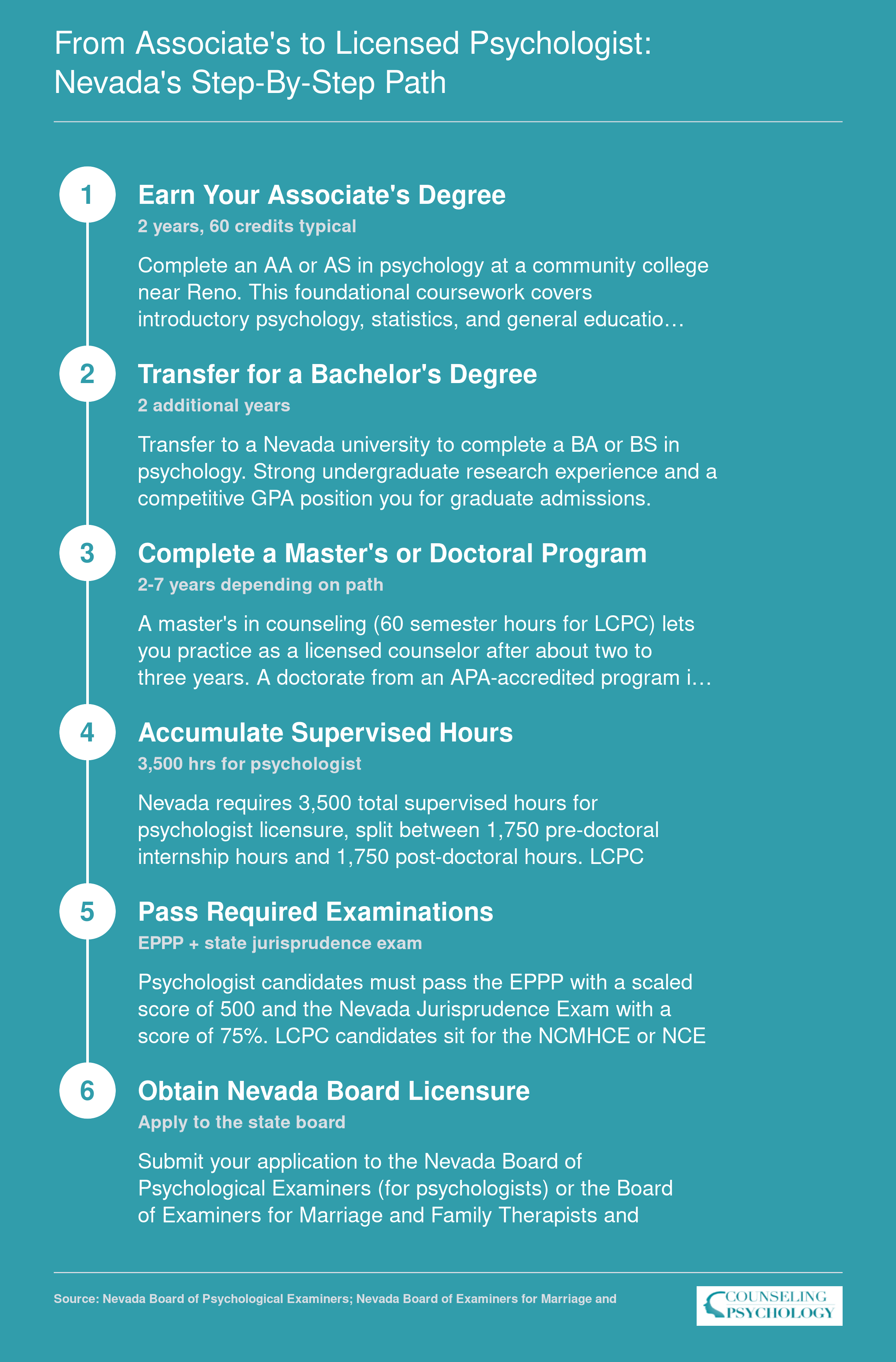
From Associate's to Licensed Psychologist: Nevada's Step-by-Step Path
Wondering whether 25 is too late to become a psychologist? It isn't. Many licensed psychologists begin their academic journey well into their late twenties or thirties, and an associate's degree is a perfectly valid on-ramp at any age. The path to full licensure in Nevada involves several distinct stages, but each builds on the last, and you can enter the workforce at intermediate points along the way. If a doctorate feels like more than you need, keep in mind that counselor licensure (LCPC) or clinical social work licensure (LCSW) requires only a master's degree, which is a meaningfully shorter route to independent clinical practice.
Students who earn an associate's degree at a Reno-area community college and transfer to UNR graduate holding the exact same bachelor's credential as anyone who enrolled as a freshman, but typically at a significantly lower total cost. Choosing the associate's path first is a deliberate financial strategy, not a detour or a compromise.
How to Choose the Right Associate Psychology Program in Reno
The difference between a psychology program that launches your career and one that stalls it often comes down to five concrete factors you can evaluate before enrolling.
Accreditation Is Non-Negotiable
Regional accreditation through the Northwest Commission on Colleges and Universities (NWCCU) determines whether your credits transfer to a four-year institution. Nevada's community colleges hold NWCCU accreditation, but if you're considering online programs based elsewhere, verify their regional accreditor before applying. Nationally accredited schools may cost less upfront, but many universities refuse to accept their credits, forcing you to repeat coursework. When comparing options, confirm accreditation status directly on the school's website or through the U.S. Department of Education database.
Class Size and Advising Access
Smaller class sizes mean more interaction with instructors who can write recommendation letters and connect you with opportunities. Ask prospective programs about their student-to-advisor ratio, particularly for psychology majors. At community colleges, ratios vary widely by department. A program where you see an advisor once per semester differs substantially from one offering walk-in hours and dedicated transfer counselors for psychology students.
Psychology-Specific Support Services
General tutoring centers help with writing and math, but psychology coursework requires understanding research methods and statistical concepts that generic tutors may not address well. Investigate whether programs offer psychology tutoring, research skills workshops, or career counseling specific to behavioral health fields. If you're exploring broader online counseling degree programs, the same scrutiny applies: look for dedicated academic support rather than generic resources. These services signal institutional investment in student success beyond enrollment numbers.
Schedule Flexibility for Working Adults
Many students pursuing associate degrees work part-time or full-time. Evening and weekend classes, asynchronous online options, and eight-week accelerated terms make completion possible without sacrificing income. Ask directly: Can you complete the degree entirely outside traditional weekday hours if needed? Programs that offer flexibility in theory but schedule required courses only at 10 a.m. on Tuesdays create barriers they don't advertise.
Non-Traditional Student Accommodations
Veterans benefit from schools with dedicated VA certification officers and peer support groups. Parents need to know about campus childcare availability and waitlist timelines. First-generation students should look for mentorship programs pairing them with faculty or alumni. These accommodations don't appear in glossy brochures but shape daily experience.
Your Comparison Checklist
When you've narrowed options to two or three programs, run each through these questions:
- Accreditation: Is it regionally accredited by NWCCU or an equivalent body?
- Transfer agreements: Does the school have articulation agreements with your target four-year universities?
- Advising ratio: How many students does each psychology advisor support?
- Tutoring: Is psychology-specific academic support available, and during what hours?
- Scheduling: Can you complete all required courses in evenings, weekends, or online?
- Support services: What accommodations exist for veterans, parents, or working professionals?
A program that checks every box costs you less time and money than one that looks affordable but lacks the infrastructure to get you to graduation and beyond.
Frequently Asked Questions About Associate Psychology Programs in Reno
Prospective students near Reno often have practical questions about cost, career value, and next steps before committing to an associate's degree in psychology. The answers below draw on tuition figures, transfer details, and career data discussed throughout this article.