
What you’ll learn in this article…
- Denver-area graduate counseling certificate tuition varies widely by institution type and residency status, so comparing net price is essential.
- Colorado requires a master's degree for full LPC licensure, meaning a certificate alone cannot make you an independently licensed counselor.
- Certificate holders in Colorado typically earn less than master's-level licensed counselors but carry significantly lower student debt.
- Programs are offered in online, hybrid, and on-campus formats, with most designed for working professionals to complete in roughly one year.
Colorado added more than 1,200 mental health counseling positions between 2020 and 2024, and demand continues to outpace supply across the Front Range. For professionals looking to add a specialization or pivot into counseling without committing to a full master's program, graduate certificate in counseling options offer a faster, more affordable on-ramp. Tuition across the Colorado programs ranked here ranges from roughly $5,900 to over $42,000, a spread that makes comparison shopping essential.
The practical question is not just cost but credential value. Colorado's licensure rules limit what a stand-alone certificate qualifies you to do, and the gap between a certificate and a masters in counseling denver shapes everything from caseload eligibility to long-term earning potential.
Best Affordable Graduate Counseling Certificate Programs in Denver for 2026
Colorado's graduate counseling certificate landscape offers surprisingly varied price points, delivery formats, and specializations. The programs below are ranked primarily by net price so cost-conscious students can compare quickly, but each entry also flags whether coursework is online, on campus, or hybrid, which concentration areas are covered, and what admissions prerequisites to expect. Note that several of these schools sit outside Denver proper yet serve Denver-area students through online or hybrid delivery.
- Net price and tuition affordability
- Program format and flexibility
- Specialization and concentration focus
- Institutional graduation outcomes
- Credit requirements and time to completion
- NCES-IPEDS federal institutional data — nces.ed.gov
- Internal program database
- Independent program research
- College Scorecard graduate earnings — collegescorecard.ed.gov

Adams State University
Adams State University, a public institution in Alamosa, delivers one of the most budget-friendly graduate counseling credentials in the state. Its hybrid School Counseling Certificate is purpose-built for licensed Colorado mental health counselors who want to pivot into P-12 settings, combining remote coursework with a rigorous 600-hour internship across three diverse school environments. With in-state graduate tuition around $5,898 and a net price of roughly $12,980, this is the least expensive pathway on this list. Schools offering this program have a graduation rate of 39.4%, so prospective students should weigh cost savings against broader institutional retention metrics.
- 18 credit hours completed over three semesters
- Hybrid format with synchronous weekly internship class
- 600-hour internship spanning three school settings
- Requires a CACREP-accredited master's degree for admission
- Cohorts begin each May
- Designed specifically for Colorado-resident mental health counselors
School Counseling Certificate — Hybrid

University of Colorado Colorado Springs
UCCS offers a Substance Use and Recovery Graduate Certificate that prepares students to sit for the Licensed Addictions Counselor (LAC) credential. The 18-credit program stands out for its triple delivery option: fully online, on campus in Colorado Springs, or a hybrid blend, making it one of the most flexible choices for Denver-area working professionals. Coursework covers psychopharmacology, group counseling, trauma-informed care, and culturally responsive treatment. The university's net price sits at approximately $15,788, and schools offering this program have a graduation rate of 46.9%.
- 18 credit hours with NAADAC approval
- Available fully online, on campus, or hybrid
- Prepares candidates for Licensed Addictions Counselor certification
- Covers psychopharmacology, group counseling, and addiction treatment
- Requires a bachelor's degree for admission
- Fall semester entry with April 20 application deadline
- Financial aid priority deadline of March 1
Substance Use and Recovery Graduate Certificate — Online

Regis University
Regis University, a Jesuit institution located in northwest Denver, offers a Post-Graduate Marriage and Family Therapy Certificate tailored to already-licensed mental health professionals. At $806 per credit hour across 18 credits, the program carries a sticker cost near $14,508, while the institution-wide net price is about $18,397. The on-campus format emphasizes systemic therapy techniques and requires 120 supervised clinical hours under licensed MFTs. Rolling admissions with starts in January, May, and August give working clinicians scheduling flexibility. Schools offering this program have a graduation rate of 61%, paired with an 11:1 student-to-faculty ratio.
- 18 credit hours at $806 per credit hour
- On-campus courses only in Denver
- 120 clinical hours supervised by licensed MFTs
- Rolling admissions with three annual start dates
- Requires a master's degree in a clinical field
- Focuses on systemic and relational therapy approaches
Marriage and Family Therapy Certificate — On-Campus

Colorado State University-Fort Collins
Colorado State University's Graduate Certificate in Substance Use Disorder Identification and Treatment is a 12-credit, campus-based credential housed in the Department of Psychology. The curriculum trains mental and behavioral health clinicians in empirically supported screening tools, motivational interviewing, cognitive behavioral therapy for addictions, and the neuropharmacology of substance use. Located in Fort Collins (about an hour north of Denver), the program is best suited for students who can commute or relocate. The institution-wide net price is approximately $21,279, and schools offering this program have a graduation rate of 66.5%.
- 12 credit hours of graduate-level coursework
- Campus-based learning in Fort Collins
- Covers motivational interviewing and CBT for addictions
- Includes neuropharmacology of addiction content
- Focus on diverse populations across the lifespan
- Prerequisites may apply; graduate application required
Graduate Certificate in Substance Use Disorder Identification and Treatment — On-Campus

Colorado Christian University
Colorado Christian University, based in Lakewood just west of Denver, integrates biblical principles with clinical training. While CCU does not list a standalone graduate counseling certificate, its CACREP-accredited Master of Arts in Clinical Mental Health Counseling includes a Marriage and Family Therapy concentration and a general clinical track, both delivered primarily online with three required in-person residencies. The institution-wide net price is about $29,500, and schools offering this program have a graduation rate of 64.4%. Students can complete either track in roughly 30 months and transfer up to 12 credits.
- 69 credit hours with MFT specialization
- 100% online or hybrid format available
- CACREP-accredited program
- Completable in approximately 30 months
- Three in-person residencies required
- Transfer up to 12 credits from prior graduate work
- 60 credit hours with optional emphases
- Online and hybrid delivery for working adults
- CACREP-accredited with licensure preparation
- 700 hours of practicum and internship
- Christian faith integration throughout curriculum
- Fall, spring, and summer start options
MA in Clinical Mental Health Counseling, Marriage and Family Therapy Concentration — Online
MA in Clinical Mental Health Counseling — Online

University of Denver
The University of Denver's Morgridge College of Education houses a 24-credit School Counseling Certificate designed for professionals who already hold a master's degree. The CACREP-accredited program can be completed in 8 to 18 months, with fall, winter, or summer start dates offering Denver-area educators substantial scheduling latitude. A supervised internship in P-12 settings anchors the curriculum alongside coursework in student advocacy, culturally responsive techniques, and social justice principles. At a net price of roughly $36,131, DU is the most expensive option on this list, but schools offering this program have the highest graduation rate here at 75.6%, and the 9:1 student-to-faculty ratio is the most favorable.
- 24 credit hours with CACREP accreditation
- On-campus program in Denver
- Completable in 8 to 18 months
- Fall, winter, or summer start dates available
- Supervised internship in P-12 school settings
- Requires a master's degree and minimum 3.0 GPA
- Social justice and culturally responsive focus
- Eligible for F-1 and J-1 visa students
School Counseling Certificate — On-Campus
Can You Become a Counselor in Colorado With a Graduate Certificate?
The tension is real: a graduate certificate costs less and takes less time, but Colorado's licensing framework draws a hard line between what a certificate can and cannot do for your career. Understanding that boundary before you enroll will save you both money and frustration.
LPC Licensure Requires a Master's Degree
Colorado's Department of Regulatory Agencies (DORA) is unambiguous on this point. To earn a Licensed Professional Counselor (LPC) credential, you must hold a master's or doctoral degree in professional counseling or a closely related field from a regionally accredited institution. The program must include at least 60 semester hours, and DORA expects coursework that aligns with CACREP standards or their equivalent.2 You will also need to pass a national examination and complete supervised practice hours.3 A graduate certificate alone does not satisfy any of these degree requirements, and DORA's rules (referenced under Rule 1.14) require official transcripts documenting completion of a qualifying master's or doctoral program.4 The same master's-level threshold applies to Licensed Marriage and Family Therapist (LMFT) credentials and school counselor endorsements in Colorado.2
What a Certificate Can Unlock
Even without LPC eligibility, a graduate certificate opens doors to several meaningful roles in Colorado's behavioral health landscape:
- Certified Addictions Counselor (CAC): Colorado's CAC pathway is tiered (CAC I, CAC II, CAC III), and the earlier tiers do not require a full master's degree. A graduate certificate focused on addiction counseling can help you meet the education and training requirements for CAC I or CAC II while you gain supervised experience hours.
- Community mental health aide: Agencies across the Denver metro area employ paraprofessional staff in case management and crisis support roles where a certificate-level education is sufficient.
- Peer support specialist: Colorado recognizes peer support as a distinct workforce category. A certificate can formalize your training and make you more competitive for these positions.
- School-based support roles: While the licensed school counselor title requires a master's degree, many districts hire educational support staff, behavioral interventionists, and student services aides whose qualifications align with a graduate certificate.
If you are drawn to the addiction counseling track specifically, our guide on how to become a substance abuse counselor covers the national landscape and common credential tiers.
The Certificate as a Bridge Credential
Many Denver-area programs design their graduate certificates to be stackable, meaning the credits you earn transfer directly into a master's program at the same institution or within the same university system. This makes a certificate a practical first step if you are testing the waters, managing work or family responsibilities, or building foundational knowledge before committing to a full 60-credit master's track. Completing a certificate first lets you demonstrate academic readiness, and some programs waive additional application requirements for certificate completers who continue into the master's program.
The bottom line: a graduate certificate is not a shortcut to full licensure in Colorado, but it is far from a dead end. Whether you pursue a CAC credential, take on a community-based role, or stack your certificate into a master's degree, the coursework you complete has real professional value. Go in with clear expectations about where the credential will and will not take you.
How Much Do Graduate Counseling Certificates Cost in Denver?
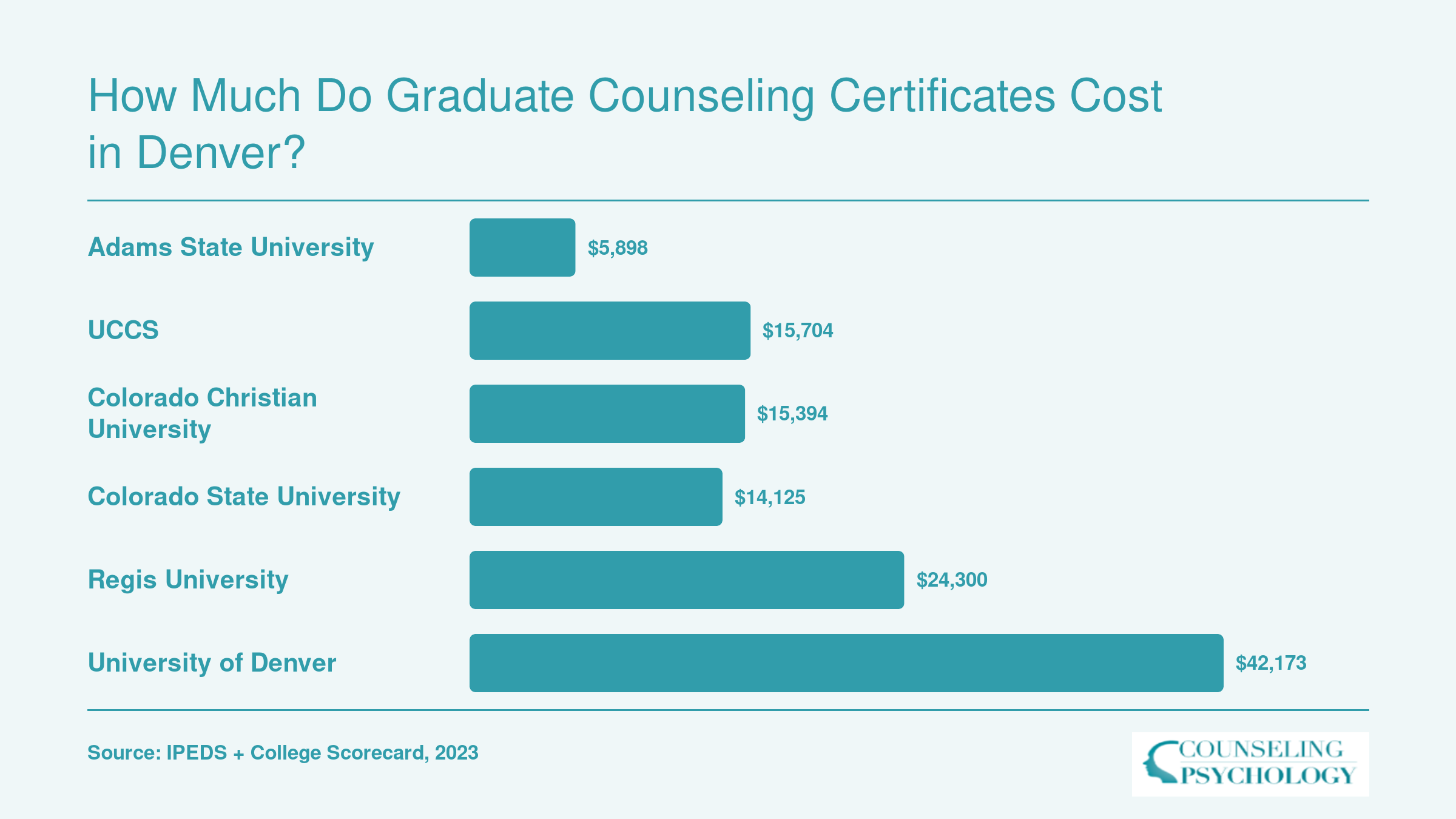
Tuition for graduate counseling certificates in the Denver area spans a wide range depending on institution type and residency status. The figures below reflect program-level tuition where available. Keep in mind that net price, which accounts for institutional aid and grants, is an institution-wide average reported by IPEDS and will differ from your actual out-of-pocket cost based on your individual financial aid package.
Certificate vs. Master's Degree in Counseling: Which Path Is Right for You?
A 15-credit graduate certificate finished in about a year and a 60-plus-credit master's degree spanning three to four years represent very different investments of time, money, and career positioning. Understanding where each path leads, and where it doesn't, is essential before you commit.
Time to Complete and Credit Load
Graduate counseling certificates in the Denver area and across Colorado typically require 15 to 18 credits and can be completed in roughly 12 months.12 By contrast, master's programs in counseling at institutions like CU Denver and Colorado State University run 60 to 63 credits and take 36 to 48 months of study.3 That difference is significant if you need to keep working full time or want to pivot into a counseling-adjacent role quickly.
Prerequisites for Each Path
The entry requirements diverge sharply. Master's programs generally require a bachelor's degree in any field, along with standard graduate admissions materials.3 Most graduate certificates in counseling, however, are post-master's credentials. Programs at Adams State University and Rocky Mountain University, for example, require applicants to already hold a master's degree.12 This means the certificate is not a shortcut around a master's; it is an add-on for professionals who already have advanced education.
Licensure Eligibility and Career Ceiling
This is the dimension that matters most for long-term earning power. Colorado's Licensed Professional Counselor (LPC) credential requires a master's degree of at least 60 semester hours from an accredited program, plus supervised experience and a licensing exam. A graduate certificate alone does not satisfy LPC requirements. Certificates can, however, qualify you for non-licensed roles or specialized endorsements, such as school counseling add-ons or addictions counseling credentials, depending on the program's focus and your existing degree. If you are weighing broader options, our guide to counseling certificate programs covers online offerings nationwide.
Without LPC eligibility, your career ceiling in clinical counseling settings is lower. You may work in supportive, psychoeducational, or paraprofessional capacities, but independent clinical practice is off the table.
Stackability
Some certificate credits can transfer into a master's program if you decide to pursue full licensure later, though transfer policies vary by institution and are never guaranteed. If stackability matters to you, confirm articulation agreements before enrolling. Choosing a certificate from a regionally accredited institution improves your odds. Students ultimately aiming for independent clinical practice may want to explore the best masters in mental health counseling programs from the start.
Quick Comparison
- Time: Certificate, roughly 12 months; master's, 3 to 4 years.
- Credits: Certificate, 15 to 18; master's, 60 to 63.
- Cost: Certificate tuition is proportionally lower given fewer credits, though per-credit rates vary.
- Prerequisites: Certificate typically requires a master's degree; master's requires a bachelor's.
- Licensure: Master's opens the door to LPC and LMFT pathways; certificate alone does not.
- Career ceiling: Master's holders can pursue independent clinical practice; certificate holders generally fill specialized or supportive roles.
The right choice depends on where you already are in your education and where you want to end up. If you hold a master's and need a focused specialization, a certificate is efficient and cost-effective. If you are starting from a bachelor's degree and want to practice as a licensed counselor in Colorado, the master's is the only route that gets you there.
Questions to Ask Yourself
Online, Hybrid, and On-Campus Options Compared
How do online, hybrid, and on-campus formats differ for graduate counseling certificate programs in Denver, and which best fits your schedule?
Graduate counseling certificates in Denver are designed with working professionals in mind, which is why programs offer flexible delivery formats. Understanding the trade-offs between online, hybrid, and on-campus options helps you select a structure that aligns with your current responsibilities and learning preferences.
Online Certificate Programs
Online counseling certificate programs deliver coursework entirely through web-based platforms, allowing you to complete readings, assignments, and video lectures on your own schedule. Most online programs in Colorado still require synchronous (live) sessions for skills-based courses or group discussions, typically scheduled in the evenings. Programs typically span 9 to 18 credits, completed over one to two years part-time. Visit the websites of Colorado universities such as University of Colorado Denver and Regis University to review program-specific credit loads and whether practicum hours are required. Not all counseling certificates mandate practicum, but those that do may ask you to arrange local supervision, even if coursework is online. If you are specifically interested in clinical specialization, explore graduate certificate in mental health counseling options to compare practicum requirements across programs. Contact program advisors directly via email or phone to confirm whether your certificate track requires supervised clinical hours.
Hybrid Format: Balancing Flexibility and Face-to-Face Learning
Hybrid programs blend online coursework with periodic on-campus sessions, often scheduled on weekends or as intensive week-long residencies. This format suits students who value in-person skill-building (role plays, case consultations) but cannot attend campus weekly. Hybrid structures typically follow the same 9 to 18 credit range and part-time timeline as fully online options. Check the American Counseling Association and Colorado Counseling Association websites for accreditation guidance and clarification on whether practicum components can be completed remotely or require in-person attendance.
On-Campus Programs: Immersive and Structured
Traditional on-campus certificate programs meet weekly, usually in evening or weekend cohorts to accommodate working students. Face-to-face formats offer immediate feedback, peer networking, and hands-on practice but demand regular travel to campus. Average completion times mirror online and hybrid tracks (one to two years part-time), though scheduling is less flexible. Many counseling roles prefer or require a master's degree and state licensure, so a certificate alone may serve as a stepping stone or specialization rather than a terminal credential. Students considering a full master's pathway in Colorado can review the best masters in counseling Colorado rankings for additional context. Confirm with advisors whether your certificate program is designed as a bridge to a master's or as standalone professional development.
Choosing the Right Format
Your choice hinges on learning style, geographic proximity to campus, work schedule, and whether you need practicum supervision. Online formats maximize flexibility, hybrid balances convenience with interaction, and on-campus programs offer the most structured, immersive experience. All three can be completed part-time, but verify specific requirements and timelines directly with each institution before applying.
Career Outcomes and Earnings After a Counseling Certificate
A certificate can launch your counseling career in months, but the earnings ceiling typically sits lower than what a master's-level license unlocks. Understanding the real compensation landscape for certificate-holders, especially in Denver's competitive behavioral health market, will help you gauge whether the shorter, cheaper route aligns with your long-term goals. The numbers aren't hidden; they simply require looking in the right places.
Probing Local Wages for Substance Abuse and Mental Health Counselors
The federal Bureau of Labor Statistics tracks detailed wage data for roles that a graduate certificate can directly support. To get current median wages in the Denver-Aurora-Lakewood metro area, head to data.bls.gov and use the Occupational Employment Statistics (OES) tool. Search by SOC codes 21-1018 (Substance Abuse, Behavioral Disorder, and Mental Health Counselors) and 21-1014 (Mental Health Counselors), then filter results to the Denver-Aurora-Lakewood metropolitan statistical area. The output shows hourly and annual wages at the 10th, 50th, and 90th percentiles, giving you a realistic pay range for certificate-track positions like addiction counselor, intake specialist, or behavioral health case manager. Keep in mind that these metro-area figures often exceed the national median for the same occupation, so a side-by-side comparison can reveal whether staying local pays off. For a broader look at what these roles entail, explore our overview of best jobs for mental health counselors.
National LPC vs. LMFT Earnings: Comparing Credential Pathways
If your sights are set on a licensed professional counselor (LPC) or licensed marriage and family therapist (LMFT) role later, national salary surveys from professional associations offer broad benchmarks. The American Counseling Association (counseling.org) publishes periodic salary surveys for LPCs, while the American Association for Marriage and Family Therapy (aamft.org) does the same for LMFTs. These tools highlight differences in earning potential by sector (private practice, agency, hospital) and geography, but they lack the granularity of the OES metro data. Use them to answer the "what if": would the eventual income bump from licensure justify the extra time and tuition of a master's program? For those leaning toward the LMFT path specifically in Colorado, reviewing MFT programs in Colorado can help you weigh your next academic step. Remember that national medians can obscure wide state-level variation, so treat them as directional, not definitive.
Colorado-Specific and Institutional Resources
For Colorado-only LPC and LMFT salary snapshots, the Colorado Department of Labor and Employment maintains a wage portal where you can pull occupational estimates by region. The state's Mental Health Board and other licensing authorities occasionally release annual reports that include compensation trends; these can reveal whether certain specialties are oversaturated or in high demand locally. Another practical step: reach out directly to the career centers of Denver-area universities that offer counseling certificates. Many publish alumni employment data or can share aggregate salary benchmarks for recent graduates working in the region. Since regional pay can diverge sharply from national figures, triangulating multiple sources gives you a clearer picture of what you're likely to earn after a certificate and how that number grows if you pursue full licensure.
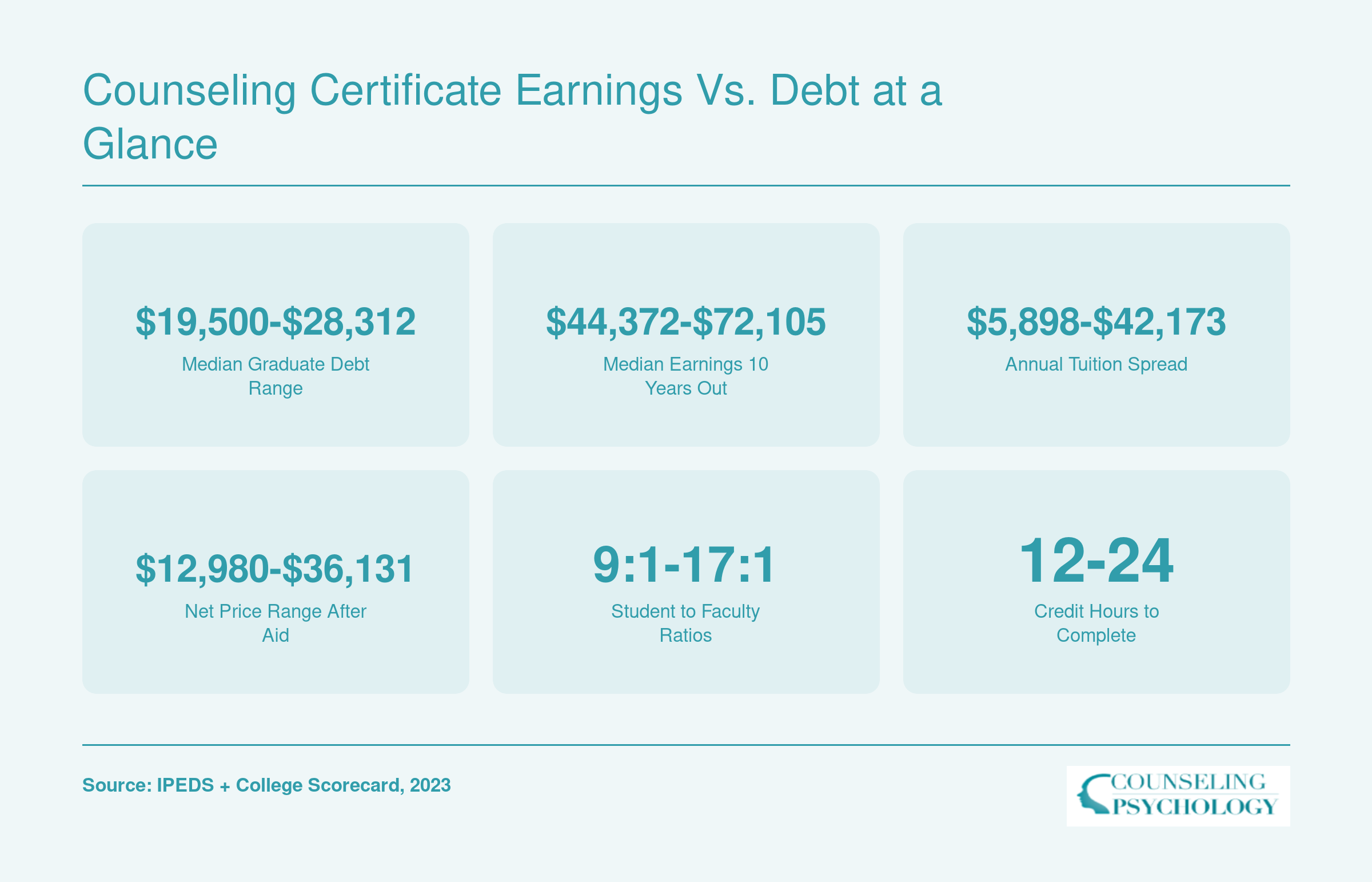
Counseling Certificate Earnings vs. Debt at a Glance
Graduate counseling certificates in Colorado carry a notably lower debt load than full master's programs, which makes the return on investment compelling even before factoring in career advancement. These institution-level figures from Colorado schools offering counseling certificates illustrate the financial picture.
Key Factors When Choosing a Counseling Certificate Program
Colorado institutions currently offer graduate counseling certificates in three main specialty tracks: trauma and crisis response, addictions and substance use counseling, and child and adolescent counseling. Each track carries distinct prerequisites and licensure implications, so matching the certificate to your intended scope of practice matters more than picking the lowest sticker price.
Verify Specialty Offerings and Prerequisites
Start with the Colorado Department of Higher Education site at highered.colorado.gov for an authoritative list of approved post-baccalaureate programs in the state. From there, click through to individual university program pages. Listings change each academic year as departments add or sunset specialty tracks, so the official source beats secondhand summaries.
Prerequisites vary widely. Some Denver-area certificates require a master's degree in counseling, psychology, or social work already in hand. Others accept applicants with a bachelor's plus relevant coursework in human development, abnormal psychology, or statistics. Trauma-focused certificates often expect prior clinical exposure, while addictions tracks may require a background check given the supervised practicum component.
Confirm Accreditation Status Carefully
CACREP accredits master's and doctoral counseling degree programs, not standalone certificates. A school may have a CACREP-accredited master's program while its certificate offerings sit outside that accreditation umbrella. Ask admissions directly: is this certificate CACREP-aligned in its coursework, or does CACREP only apply to the degree program? The distinction affects whether credits will transfer into a future master's and whether the certificate satisfies any portion of LPC licensure coursework in Colorado.
Cross-reference what you hear from admissions with the American Counseling Association (counseling.org) and the National Board for Certified Counselors (nbcc.org) directories. Both maintain searchable lists of recognized credentials and the certificate-level training that feeds into specialty certifications like the Master Addictions Counselor (MAC) or the National Certified Counselor (NCC).
Cross-Check Against Career Requirements
The Bureau of Labor Statistics Occupational Outlook Handbook at bls.gov spells out the standard education path for substance abuse counselors, mental health counselors, marriage and family therapists, and school counselors. Read the entry for your target role before committing. If the handbook indicates a master's is the entry-level requirement, treat the certificate as a supplement or stepping stone rather than a terminal credential. For students interested in working with younger populations, learning how to become a child counselor can clarify whether a certificate or a full degree is the right starting point.
Call admissions offices at the University of Denver, Regis University, and any other program on your shortlist. Ask three direct questions: what are the exact prerequisites, does this certificate count toward Colorado LPC or LAC licensure hours, and can credits roll into the master's program later?
Frequently Asked Questions
Denver's graduate counseling certificate landscape raises plenty of practical questions, from cost and timelines to licensure eligibility. Below are answers grounded in the latest available program data and Colorado labor market figures.