
What you’ll learn in this article…
- CACREP accreditation aligns directly with Michigan LARA requirements, reducing licensure delays for LPC candidates.
- Net prices near Lansing range widely, so comparing actual cost after aid matters more than sticker tuition.
- BLS projects strong national demand for mental health counselors, and the Lansing metro offers competitive regional wages.
- Hybrid and online formats are available at most ranked programs, giving working students scheduling flexibility.
How much does a clinical mental health counseling master's degree actually cost in Michigan after financial aid?
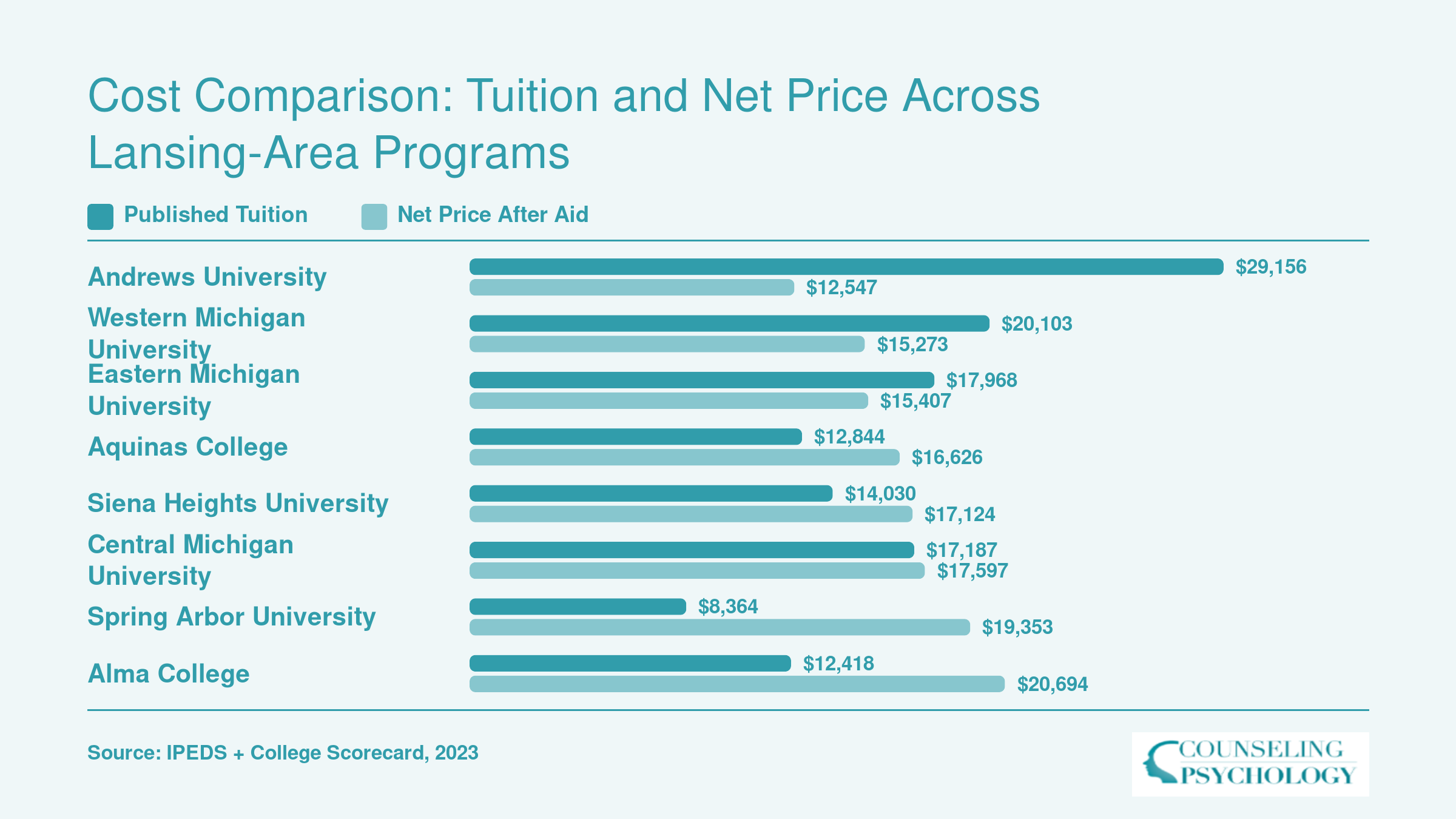
Demand for licensed counselors in Michigan has grown steadily, driven by workforce shortages in community mental health centers, school systems, and private practice settings. The practical barrier for most prospective students is not admission; it is cost. Among the eight programs covered here, effective net prices range from roughly $12,500 to just over $20,700 per year, a spread wide enough to meaningfully affect how much debt a graduate carries into a field where entry-level salaries are real but not large.
The programs span public universities, private liberal arts colleges, and one post-master's certificate option for credentialed professionals. Formats include hybrid, campus-based, and heavily online models. For a statewide view of options, see our ranking of the best masters in counseling programs in Michigan. Michigan's licensure framework adds a layer of complexity: the state requires specific coursework and supervised hours, and CACREP accreditation status determines how smoothly a graduate can move through the Limited Licensed Professional Counselor (LLPC) stage toward full LPC licensure. Picking the wrong program on price alone, without verifying accreditation and licensure alignment, is a costly mistake to untangle after graduation.
Best Affordable Mental Health Counseling Programs Near Lansing, Michigan
Lansing-area students pursuing clinical mental health counseling have several strong options within driving distance, ranging from CACREP-accredited master's programs to a post-master's certificate for professionals looking to add credentials. The programs below were evaluated on net price, institutional outcomes, and program-level strengths so you can weigh cost against quality with confidence. Note that all graduation rates cited are institution-wide figures reported to the federal government, not specific to any single program.
- Net price and tuition affordability
- Institutional graduation and retention rates
- Program accreditation and licensure alignment
- Delivery format flexibility
- Earnings-to-debt value signal
- Internal program database
- Independent program research
- College Scorecard graduate earnings — collegescorecard.ed.gov
- NCES-IPEDS federal institutional data — nces.ed.gov

Siena Heights University
Siena Heights University stands out for Lansing-area students because its Clinical Mental Health Counseling M.A. holds classes on both the Adrian and Lansing campuses, eliminating a long commute. The university carries one of the lowest median graduate debt figures in this group at $18,750, paired with the highest median earnings ten years out ($57,529), giving it a strong return on investment. Students enter the program in cohort groups and benefit from a blended on-ground and online format that keeps scheduling manageable.
- Hybrid format with Adrian and Lansing campus options
- Cohort-based admissions model
- Covers assessment, intervention, and therapeutic techniques
- Supervised clinical experience included
- Minimum 3.0 GPA required, conditional admission possible
- Emphasizes ethical, legal, and professional competencies
- Prepares graduates for Michigan LLPC/LPC pathway
Clinical Mental Health Counseling M.A. — Hybrid

Western Michigan University
Western Michigan University offers a well-rounded Clinical Mental Health Counseling master's program through its Kalamazoo and Grand Rapids locations. In-person and hybrid course formats give working students some scheduling flexibility, and the program is built to meet Michigan LLPC educational requirements. A 16:1 student-to-faculty ratio at the institutional level keeps class sizes reasonable for a public research university, while the $15,273 net price is competitive among the public schools on this list.
- Accredited counseling program meeting LLPC requirements
- Offered in Kalamazoo and Grand Rapids locations
- Hybrid and in-person course delivery
- Covers research methods, ethics, and multicultural counseling
- Strong regional job market outlook for graduates
- Requires 3.0 GPA in psychology or related field
- Comprehensive counseling techniques curriculum
Clinical Mental Health Counseling (M.A.) — Hybrid

Central Michigan University
Central Michigan University's CACREP-accredited Master of Arts in Counseling lets students specialize in Clinical Mental Health Counseling within a 60-credit-hour framework. The hybrid learning format, combining online coursework with on-campus intensives in Mount Pleasant, is designed for working professionals. Faculty members are licensed counselors themselves, which translates into mentorship grounded in real-world practice. At a net price of $17,597 and median ten-year earnings of $55,874, the debt-to-earnings balance is solid.
- CACREP-accredited program
- 60 credit hours required for completion
- Hybrid format with online and on-campus components
- Three concentration options available
- Faculty are licensed professional counselors
- Includes practicum and internship hours
- Prepares students for Michigan LPC licensure
Master of Arts in Counseling, Clinical Mental Health Counseling Concentration — Hybrid

Andrews University
Andrews University in Berrien Springs delivers a campus-based Master of Arts in Clinical Mental Health Counseling grounded in a holistic approach to mental health. The university posts the lowest net price on this list at $12,547 and pairs that with a strong 71.5% institution-wide graduation rate and a 10:1 student-to-faculty ratio. Students complete practicums and internships that build hands-on clinical skills, and the curriculum covers theories, ethics, and evidence-based practices needed for licensure in many states.
- Campus-based delivery in Berrien Springs
- Holistic counseling philosophy integrated into curriculum
- Practicum and internship experiences included
- Covers counseling theories, ethics, and evidence-based practice
- 10:1 student-to-faculty ratio institution-wide
- Designed to meet licensure educational requirements
- Financial aid available for eligible students
- No GRE requirement listed
Clinical Mental Health Counseling (M.A.) — On-Campus

Aquinas College
Aquinas College in Grand Rapids offers a 60-semester-hour Master of Arts in Clinical Mental Health Counseling built around a practice-based cohort model. The curriculum emphasizes multicultural competence, trauma-informed care, and both individual and group therapy techniques. With a $16,626 net price and $23,000 median graduate debt, Aquinas keeps total costs below many private peers. A 10:1 student-to-faculty ratio supports close mentorship throughout the program.
- 60-semester-hour cohort-based program
- Prepares graduates for Licensed Professional Counselor credential
- Emphasizes multicultural counseling competence
- Includes individual and group therapy training
- Trauma-informed care integrated into coursework
- Flexible program completion timeline
- Campus-based delivery in Grand Rapids
- Covers career development, assessment, and human growth
Master of Arts in Clinical Mental Health Counseling — On-Campus

Eastern Michigan University
Eastern Michigan University in Ypsilanti gives students two distinct pathways: a 60-credit Master of Arts in Clinical Mental Health Counseling designed for Michigan licensure, and a Post-Master's Certificate for counselors who already hold a master's degree but need additional clinical hours. The M.A. program offers multiple start terms, including summer, fall, and winter entry points, and targets careers in community mental health centers, hospitals, and private practice. The certificate program features a 300 to 600 hour supervised internship, though it does not fulfill Michigan LLPC requirements on its own.
- 60-semester-hour licensure preparation track
- Multiple start terms: summer, fall, and winter
- In-person and hybrid delivery options
- Supervised counseling experience required
- Prepares for community, hospital, and private practice roles
- Must complete within six years
- GPA requirement ranges from 2.7 to 3.0
- Designed for professionals who already hold a master's degree
- 300 to 600 hour supervised internship included
- Focus on advanced treatment planning and interventions
- Covers ethical, legal, and professional issues
- Campus-based delivery in Ypsilanti
- Does not fulfill Michigan LLPC requirements independently
Master of Arts in Clinical Mental Health Counseling — On-Campus
Post-Master's Certificate in Clinical Mental Health Counseling — On-Campus

Spring Arbor University
Spring Arbor University's CACREP-accredited Master of Arts in Counseling with a Clinical Mental Health concentration integrates a Christian worldview with rigorous clinical training. The 61-credit curriculum covers psychopathology, crisis intervention, and culturally responsive practice, and it is delivered through virtual classrooms and online coursework for maximum flexibility. The program prepares graduates to sit for Michigan LPC licensure. A 12:1 student-to-faculty ratio supports individualized mentoring.
- CACREP-accredited program
- 61-credit comprehensive curriculum
- Hybrid and online learning options
- Integrates faith-based principles with clinical expertise
- Focuses on cultural responsiveness and social justice
- Prepares for Michigan LPC licensure
- Covers crisis intervention and psychopathology
- 12:1 student-to-faculty ratio institution-wide
Master of Arts in Counseling, Clinical Mental Health Concentration — Hybrid

Alma College
Alma College's Master of Arts in Clinical Mental Health Counseling uses a mostly online format, with 90% of coursework delivered digitally and two five-day residencies on campus. The program requires 60 credit hours, does not require the GRE, and aligns with CACREP standards while preparing students for Michigan licensure. An 85% retention rate, the highest institution-wide figure in this group, signals strong student satisfaction. The curriculum covers trauma, family therapy, and crisis intervention with a social justice orientation.
- 90% online coursework with two five-day residencies
- 60 credit hours over approximately two years
- No GRE required for admission
- Aligns with CACREP standards
- Prepares students for Michigan licensure
- Covers trauma, family therapy, and crisis intervention
- Nine credit hours of supervised clinical experience
- Social justice focus embedded throughout curriculum
Master of Arts in Clinical Mental Health Counseling — On-Campus
How We Ranked These Counseling Programs
Affordability, completion rates, and long-term earnings power shape every position in this list.
Key Metrics That Drive the Rankings
We start with the net price, the actual amount a typical student pays after subtracting grant and scholarship aid. This figure, drawn from the U.S. Department of Education's College Scorecard, reflects the full-time, first-time undergraduate experience and includes tuition, fees, books, and living expenses. Because counseling programs are often graduate-level offerings, the effective net price may differ for master's students, but the Scorecard remains the most consistent, comparable data point available. We also incorporated federal financial aid percentages and student loan amounts to gauge upfront cost burden.
Graduation rates entered the equation to measure whether students who enroll actually complete their studies. Higher completion rates signal stronger student support and a more realistic path to the credential. Note that these rates are calculated across the entire institution, not the counseling department alone. Similarly, the program-level earnings we consult (median earnings of graduates 10 years after entry) are institution-wide and may not isolate counseling alumni. Still, they offer a valuable signal of how well alumni fare in the labor market. For a broader look at top-ranked options nationwide, explore our guide to the best masters in mental health counseling programs.
Interpreting the ROI Ratio
We calculated a simplified return-on-investment proxy: median 10-year earnings divided by median graduate debt from Scorecard. This ratio helps compare programs on how much annual income a graduate can expect for each dollar of debt. A higher ratio suggests that debt is more manageable relative to earning potential. While not a perfect predictor (individual career paths vary widely), it gives an apples-to-apples way to weigh cost against reward across institutions.
Because our focus is affordability, programs had to demonstrate either a low net price, a robust ROI ratio, or strong graduation outcomes to appear high on the list. No single metric dominated; instead, we looked for a balance that indicated a high-value education.
What This Ranking Doesn't Cover
We did not factor CACREP accreditation status into the numeric ranking. Accreditation is essential for licensure portability and quality assurance, but it is not a financial metric. We address accreditation thoroughly in a separate section below, so you can weigh that credential against the cost findings presented here.
Cost Comparison: Tuition and Net Price Across Lansing-Area Programs
Sticker-price tuition is what a school publishes in its catalog. Net price is the average amount students actually pay after grants and institutional aid are subtracted. The gap between the two can be dramatic, especially at private institutions where generous aid packages shrink the effective cost well below the listed rate. Public universities tend to post lower sticker prices but award smaller discounts, so their net prices sometimes rival or exceed those of private schools. The chart below groups both figures for each program so you can compare real out-of-pocket cost at a glance.
Debt and Monthly Payment Breakdown by Program
When evaluating counseling programs, monthly loan payments matter more than the total debt figure on paper. A common rule of thumb in financial planning is that your total student debt should not exceed your annual starting salary, keeping monthly payments to roughly 10% or less of gross monthly income. For mental health counselors in Michigan, that threshold is realistic only when median debt stays well below median earnings. The table below pairs each school's median graduate debt with an estimated monthly payment on a standard 10-year federal repayment plan (calculated at a 6.5% fixed rate) and an ROI ratio that divides median earnings ten years after enrollment by median debt. A higher ROI ratio signals a more favorable debt-to-earnings balance. Program-level debt and earnings breakdowns are not yet available for these specific counseling programs, so the figures shown are institution-wide medians reported by the College Scorecard.
| School | Median Graduate Debt | Est. Monthly Payment (10-Year, 6.5%) | Median Earnings (10 Yr Post-Enrollment) | ROI Ratio (Earnings / Debt) |
|---|---|---|---|---|
| Siena Heights University | $18,750 | $213 | $57,529 | 3.07 |
| Aquinas College | $23,000 | $261 | $49,584 | 2.16 |
| Eastern Michigan University | $25,000 | $284 | $51,793 | 2.07 |
| Andrews University | $26,000 | $295 | $53,187 | 2.05 |
| Western Michigan University | $26,188 | $297 | $53,562 | 2.05 |
| Spring Arbor University | $26,375 | $299 | $51,732 | 1.96 |
| Central Michigan University | $27,000 | $307 | $55,874 | 2.07 |
| Alma College | $27,000 | $307 | $54,742 | 2.03 |
CACREP Accreditation and Michigan LPC/LLPC Licensure Requirements
Licensure rules for counselors are tightening nationwide, and Michigan's framework through the Department of Licensing and Regulatory Affairs (LARA) reflects that broader push toward more rigorous, standardized pathways.1 Understanding both CACREP accreditation and LARA's specific requirements before you enroll can save you from costly surprises later.
What CACREP Accreditation Means for Your Career
CACREP is the Council for Accreditation of Counseling and Related Educational Programs. A CACREP-accredited degree signals that your program met a nationally recognized set of curricular, clinical, and faculty standards. Michigan does not legally mandate CACREP accreditation for licensure, but the distinction matters in a concrete way: graduates of CACREP-accredited programs need only 1,500 post-degree supervised hours over one year to reach full LPC status, while graduates of non-CACREP programs must complete 3,000 hours over two years.2 That difference is roughly one to two years of your life and income.
Michigan has 25 CACREP-accredited programs as of 2026.3 Among programs accessible to students in the Lansing area, Spring Arbor University (Clinical Mental Health Counseling), Cornerstone University (MA in Clinical Mental Health Counseling), and Western Michigan University (which holds CACREP status across multiple tracks including Clinical Mental Health, School, Marriage/Couple/Family, and Counselor Education) all carry current accreditation.3
Michigan LLPC and LPC Licensure Requirements
Michigan uses a two-tier structure. The Limited Licensed Professional Counselor (LLPC) credential is your entry point after graduation; the Licensed Professional Counselor (LPC) follows after you complete supervised post-degree experience. If you are comparing this path with counseling licensure requirements in other states, Michigan's tiered model is fairly typical.
To qualify for the LLPC, LARA requires:1
- Credit hours: A minimum of 48 semester hours from a non-CACREP program, or 60 semester hours from a CACREP-accredited program.
- Practicum and internship: At least 600 supervised clinical hours embedded in your graduate program.
- Required content areas: Your coursework must cover counseling theories, counseling techniques, testing and assessment, group techniques, multicultural counseling, career development, research methods, professional ethics, consulting, and counseling philosophy.
- Exam: You must pass the National Counselor Examination (NCE), the National Clinical Mental Health Counseling Examination (NCMHCE), or the Certified Rehabilitation Counselor exam (CRC).
Once you hold the LLPC, the path to full LPC licensure depends on your program's accreditation status. CACREP graduates complete 1,500 supervised hours (including 50 hours of direct supervision) over at least one year.2 Graduates of non-CACREP programs complete 3,000 supervised hours (including 100 hours of direct supervision) over at least two years.4
Why a Graduate Certificate Alone Will Not Get You Licensed
Graduate certificates in counseling-related subjects can deepen expertise in a specialty area, but they do not satisfy Michigan's licensure requirements on their own. LARA requires a master's degree that meets the credit-hour thresholds above.1 A certificate typically represents 12 to 18 credits, well short of the 48- or 60-credit master's floor. Students exploring licensed professional counselor online programs should confirm the program leads to a full master's degree, not just a certificate. If your goal is independent clinical practice, a full master's degree from an appropriately structured program is the required starting point, not an optional upgrade.
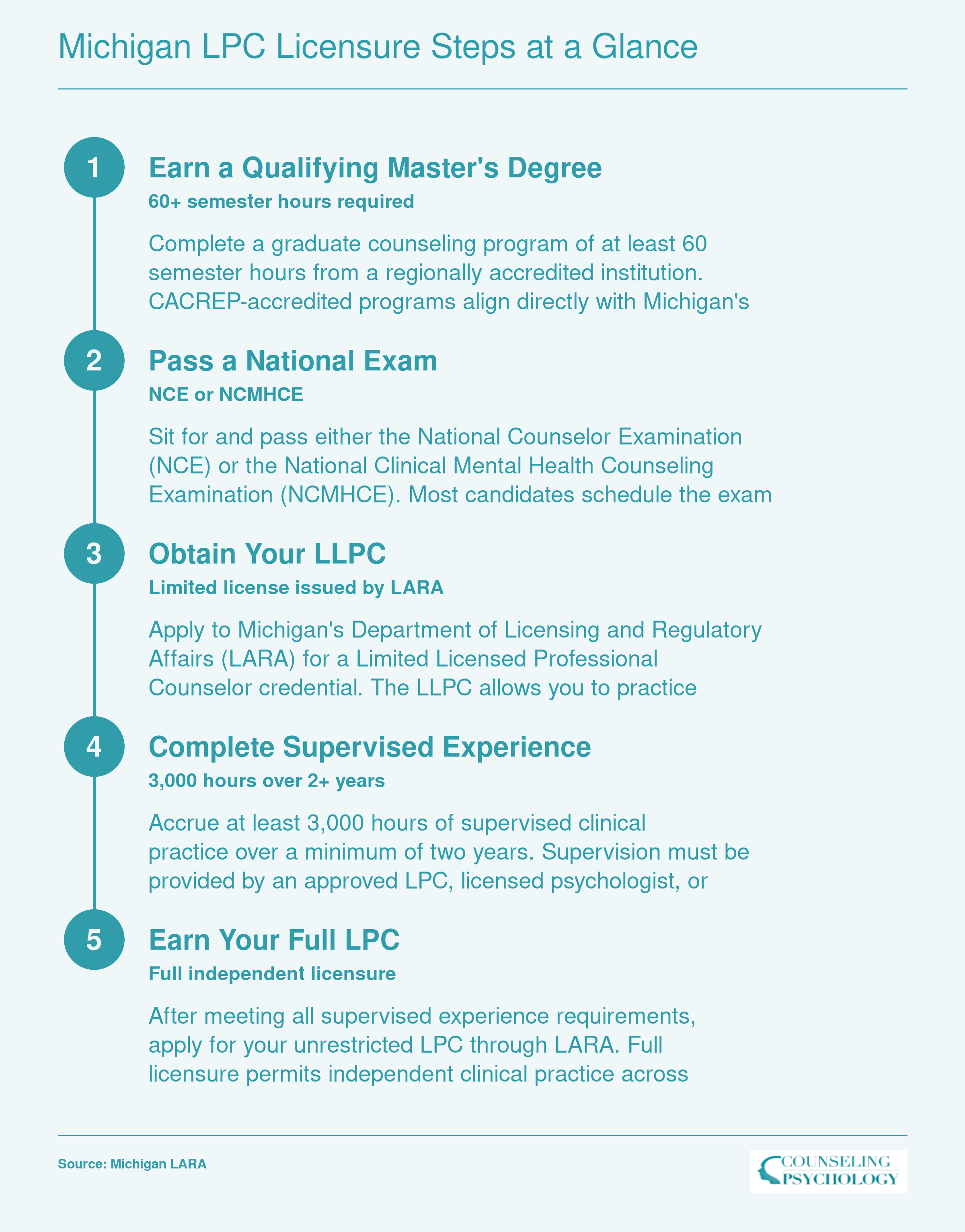
Michigan LPC Licensure Steps at a Glance
Earning your Licensed Professional Counselor (LPC) credential in Michigan follows a defined sequence. Completing a CACREP-accredited master's program satisfies the educational requirements cleanly, reducing delays at the application stage.
Online vs. On-Campus Counseling Programs Near Lansing
Choosing between online and on-campus delivery is one of the biggest practical decisions you will face when selecting a clinical mental health counseling program. Among the ranked programs near Lansing, four use a hybrid format, three are fully campus based, and none are entirely online, which tells you something important about how this field is taught. Regardless of delivery mode, virtually all CACREP aligned programs require in-person practicum and internship hours, so even a hybrid option will have a meaningful local component.
Pros
- Online or hybrid formats cut commuting costs and allow working adults to complete coursework on flexible evening or weekend schedules.
- Hybrid delivery opens the door to programs outside the immediate Lansing area, such as Western Michigan University or Central Michigan University, without relocating.
- Asynchronous lectures let students review material at their own pace, which can deepen comprehension of complex clinical theories.
- Lower overhead for institutions sometimes translates to reduced tuition or fees, helping keep total program cost down.
Cons
- Campus based programs offer live clinical skills practice with peers, which is difficult to replicate through a screen during role plays and simulated sessions.
- On-campus cohorts tend to build stronger professional networks through daily interaction, group supervision, and shared practicum site placements.
- Faculty mentorship is often more accessible in person, making it easier to secure research opportunities and strong letters of recommendation.
- Students in hybrid programs still need to arrange local practicum and internship sites near Lansing, so the convenience of remote coursework has clear limits.
Career Outcomes and Earning Potential After Graduation
A clinical mental health counseling degree is an investment in a profession with deepening demand and a clear pathway to financial stability. While starting salaries are often modest, the field offers strong growth potential, especially as you move from limited licensure to full independent practice. Understanding the real-world outcomes of graduates can help you evaluate whether a program near Lansing is worth the cost.
What Graduates of These Programs Can Expect to Earn
Program-specific earnings data for the counseling programs near Lansing is not yet available through federal scorecard reporting. However, institutional outcomes give a useful benchmark. Across the ranked schools, median earnings of former students ten years after enrolling range from approximately $49,600 at Aquinas College to $57,500 at Siena Heights University. Central Michigan, Western Michigan, and Alma College all fall within the $53,000 to $56,000 band. These figures reflect all graduates, not just counseling majors, so they provide a general idea of the earning power associated with a degree from each institution. For a deeper look at how specialization and geography affect pay, our counselor salary guide breaks down compensation by degree, state, and specialty. Keep in mind that counseling salaries can vary widely based on your work setting, geographic location, and license level.
The National Picture: High Demand and Shortages
The long-term outlook for mental health counselors is exceptionally strong. According to the Health Resources and Services Administration (HRSA), national demand for behavioral health workers is projected to grow by 49% through 2033, while supply is expected to increase by only 11%.1 For mental health counselors specifically, projections suggest a shortage of 88,000 to 100,000 full-time equivalent positions by 2037.1 Addiction counselors face an even larger shortfall, exceeding 100,000 FTEs.1 Over 122 million Americans currently live in areas designated as mental health professional shortage areas.1 In Michigan, many communities, including those near Lansing, continue to need skilled practitioners, which translates into abundant job openings for new graduates.
The Licensing Journey and Your Future Paycheck
In Michigan, your earning potential is closely tied to your licensure status. As a Limited Licensed Professional Counselor (LLPC), you will earn a more entry-level wage while completing supervised practice hours. Once you meet the requirements for full Licensed Professional Counselor (LPC) status, you become eligible for higher-paying roles in private practice, hospitals, and agencies. Many counselors further boost their earnings by specializing in areas like substance abuse, trauma, or child and adolescent therapy. Students interested in the substance abuse track may want to explore online addiction counseling degree options that complement a CMHC foundation. These specializations can open doors to advanced positions and leadership roles that command premium compensation.
Making the Investment Count
When you pair modest program costs with the field's robust demand, the value proposition is clear. Most programs on this list offer a net price under $20,000 per year, and graduate debt levels remain manageable. Starting salaries may feel tight initially, but the combination of low student loan payments and rapid job placement means your monthly budget should stabilize quickly. As you advance to full licensure and build a client base, your earnings can outpace the initial investment many times over.
Frequently Asked Questions About Counseling Programs in Lansing
Prospective counseling students in the Lansing area often have overlapping questions about program logistics, affordability, and how to access mental health services while they are still training. Below are straightforward answers grounded in current data and local resources.