

What you’ll learn in this article…
- Portland-area MFT program net prices range from roughly $9,550 at Portland State University to about $36,000 at Lewis & Clark College.
- Oregon allows up to 400 pre-degree clinical hours to count toward LMFT licensure, giving students a head start.
- Four of the six ranked programs use a hybrid format, while two remain fully campus-based.
- Over 200 MFT internship positions were posted across Portland community mental health agencies in 2026.
Which MFT programs near Portland actually prepare you for Oregon licensure, and what will they cost? The state's demand for licensed marriage and family therapists continues to climb, with the Bureau of Labor Statistics projecting 15% job growth for MFTs nationally through 2032. Portland's therapy culture, shaped by a dense network of community mental health agencies and private practices, creates strong clinical training opportunities but also means competition for practicum placements at top sites.
The Portland metro area offers both COAMFTE and CACREP-accredited options, each with different implications for your license path and clinical training structure. Net prices range from under $10,000 to over $36,000, and format options span fully on-campus to hybrid models. Oregon's licensing board accepts graduates from either accreditation pathway, though the clinical hour requirements differ in ways that affect your post-graduation timeline. For a statewide perspective, our guide to MFT programs in Oregon covers every ranked option across the state.
Best MFT Programs Near Portland, OR: Rankings Overview
Oregon offers a surprisingly diverse set of marriage and family therapy graduate programs within reach of Portland, from COAMFTE-accredited research universities to faith-integrated seminaries. The programs below range in net price from roughly $9,500 to $36,000 and span hybrid, online, and on-campus delivery formats. All graduation rates listed reflect institution-wide figures, not program-specific outcomes.
- Accreditation and licensure alignment
- Net price and financial value
- Clinical training depth
- Delivery format flexibility
- Institutional graduation metrics
- NCES-IPEDS federal institutional data — nces.ed.gov
- College Scorecard graduate earnings — collegescorecard.ed.gov
- Internal program database
- Independent program research

University of Oregon
The University of Oregon is a Research I institution in Eugene that houses one of only two COAMFTE-accredited MFT programs in the state. Its Couples and Family Therapy M.S. uses a cohort model built around intensive clinical work at the on-campus Center for Healthy Relationships, plus community externships across the region. The institution-wide graduation rate stands at 71.7%, with a net price of $22,182 for undergraduates (graduate costs differ; contact the program directly).
- COAMFTE-accredited, 90-credit hybrid Master of Science degree
- Cohort model admitting 22 to 24 students each fall
- Requires 350 direct client contact hours before graduation
- Clinical training at the Center for Healthy Relationships
- Spanish Language Specialization available for bilingual practice
- Small supervision groups with live therapy observations
- GRE and MAT not required for admission
- Approved by the Oregon Board of Licensed Professional Counselors and Therapists
Couples and Family Therapy, M.S. — Hybrid

Lewis & Clark College
Lewis & Clark College sits directly in Portland and offers a Master of Arts in Marriage, Couple, and Family Therapy through an on-campus, cohort-based format. The program stands out for its distinctive elective concentrations and a social justice perspective woven throughout 60 credits of coursework. The college reports a 75.4% institution-wide graduation rate, the highest among schools on this list, and a net price of $36,013.
- 60-credit MA with full-time (3-year) or part-time (4-year) tracks
- Concentrations in addictions treatment, sex therapy, and ecopsychology
- Cohort learning model with fall-only admission
- Clinical internship integrated into the curriculum
- Strength-based and social justice therapeutic framework
- Prepares graduates for LMFT licensure in Oregon
Master of Arts in Marriage, Couple, and Family Therapy — On-Campus

Oregon Institute of Technology
Oregon Institute of Technology, based in Klamath Falls, delivers its Marriage and Family Therapy M.S. in a hybrid format that blends online coursework with face-to-face sessions, making it accessible to students across Oregon. The program has a strong rural mental health focus and offers three distinct concentrations. Oregon Tech's institution-wide graduation rate is 53.8%, and its net price of $15,706 is among the lowest on this list.
- Hybrid M.S. with Medical Family Therapy concentration
- Substance Use Disorder Treatment concentration available
- Integrated Behavioral Healthcare concentration option
- Emphasizes rural mental health and multicultural competence
- Trauma-informed care and cultural humility throughout curriculum
- No entrance exam required; bachelor's degree in any field accepted
- Year-long practicum begins between second and third year
- Aligned with both AAMFT and ACA ethical codes
Marriage and Family Therapy, M.S. — Hybrid

George Fox University
George Fox University in Newberg, roughly 25 miles southwest of Portland, offers a CACREP-accredited Master's in Marriage, Couple and Family Counseling designed for dual licensure as both LPC and LMFT. The 64-credit program is available through online synchronous and hybrid tracks, with in-person options at the Portland Center. George Fox posts a 72% institution-wide graduation rate and a net price of $31,679.
- CACREP-accredited, 64-credit program with dual LPC and LMFT preparation
- Online synchronous and hybrid tracks with day, evening, and weekend classes
- Total estimated tuition of $52,864 at $826 per credit
- 700 hours of supervised clinical internship required
- 280 hours of direct client contact, 120 with couples and families
- Integrates spiritual perspectives within a systemic clinical framework
- Three-year and four-year completion options available
Marriage, Couple and Family Counseling, Master's — Hybrid

Portland State University
Portland State University is a public, urban research university offering a CACREP-accredited master's in Marriage, Couple, and Family Counseling. Its 90-credit, three-year cohort program is designed for students who can attend evening classes on campus and commit to daytime clinical rotations at PSU's Community Counseling Clinic and partner agencies. PSU's institution-wide graduation rate is 52.7%, and its net price of $9,552 is the lowest among these programs.
- CACREP-accredited, 90-credit hybrid program over three years
- Cohort model with primarily evening classes on the PSU campus
- Estimated resident cost of approximately $56,350
- Prepares graduates for both LPC and LMFT licensure in Oregon
- Clinical practice at PSU's Community Counseling Clinic
- Internships of 20 to 30 hours per week with community partners
- Financial aid and scholarships available for qualifying students
Marriage, Couple, and Family Counseling, Master's — Hybrid

Western Seminary
Western Seminary, headquartered in Portland, offers two Master of Arts pathways in marriage and family therapy that integrate a Christian worldview with clinical training. One track (73 credits) prepares students for MFT or LPCC licensure, while a newer 71-credit counseling track emphasizes marriage, couple, and family therapy with 700 total clinical hours. Classes meet on weeknights and Saturdays, with some distance options. Net price and institution-wide graduation rate data are not currently reported for Western Seminary.
- 73-credit MA integrating Christian faith with family systems coursework
- Three semesters of practicum totaling 325 clinical hours
- 225 direct client contact hours required
- Prepares for both MFT and LPCC licensure
- Weeknight and Saturday classes with some distance options
- Requires 3.0 GPA and counseling readiness entrance exam
- 71-credit MA blending counseling, biblical studies, and theology
- 700 total clinical hours with 280 direct client contact hours
- Includes practicum and internship placements
- Counselor Preparation Comprehensive Exam required
- No entrance exam needed; interview and references required
- Some online coursework available alongside on-campus sessions
Master of Arts in Marital and Family Therapy — On-Campus
Master of Arts in Counseling: Marriage, Couple, and Family Counseling — On-Campus
How We Ranked These MFT Programs
Five factors drive every position on this list: accreditation status, net price, institutional graduation rate, program-level earnings and debt for MFT completers, and format availability (on-campus, hybrid, or online). Each factor maps to a question a prospective student should already be asking before signing a tuition bill.
Accreditation Is the Floor, Not a Tiebreaker
A program either qualifies graduates for the Oregon LMFT pathway or it does not. The Oregon Board of Licensed Professional Counselors and Therapists recognizes degrees from programs accredited by COAMFTE, and counseling-track degrees accredited by CACREP can also lead to licensure when coursework aligns with state requirements. Programs without one of these accreditations were excluded from ranking consideration, regardless of how strong their other metrics looked. If a school cannot get you to a license, the rest of the data is academic. For a broader look at accredited MFT programs online, our national overview covers COAMFTE-approved options across the country.
Cost, Completion, and Outcomes
Net price reflects what students actually pay after grants and scholarships, not the published sticker tuition. Graduation rates come from IPEDS and are reported at the institution level, which is an important caveat: these figures describe the school overall, not the MFT program specifically. A university with a 75% institutional graduation rate may run a master's program with very different completion patterns, and IPEDS simply does not slice the data that finely for most graduate degrees.
Earnings and debt figures come from College Scorecard's program-level outcomes for marriage and family therapy completers, which tracks federal aid recipients in the years after graduation. Format availability rounds out the picture, since a strong program that requires daytime in-person attendance is not realistically accessible to a full-time working clinician-in-training. If you are comparing best MFT programs nationally, the same methodology applies, just on a wider scale.
COAMFTE vs. CACREP: Accreditation Explained for Oregon MFT Students
If you are comparing marriage and family therapy graduate programs near Portland, understanding the difference between COAMFTE and CACREP accreditation is essential. Both are respected national accrediting bodies, but they serve different professional tracks, and Oregon's licensing board treats them differently when you apply for LMFT credentials. As of 2026, Oregon has two COAMFTE-accredited MFT programs and zero CACREP-accredited MFT programs, so most students in the Portland area will encounter COAMFTE or state board approval as their primary accreditation pathways.
| Dimension | COAMFTE | CACREP |
|---|---|---|
| Professional Focus | Designed specifically for marriage and family therapy programs | Covers a broad range of counseling specializations (clinical mental health, school counseling, rehabilitation counseling, and others) |
| Oregon Programs (2026) | Two accredited programs: Lewis & Clark College (Portland) and the University of Oregon (Eugene) | No CACREP-accredited MFT programs currently exist in Oregon; CACREP accredits counseling programs in the state, not MFT tracks |
| Oregon LMFT Licensure Alignment | Graduates automatically meet the coursework requirements set by the Oregon Board of Licensed Professional Counselors and Therapists (OBLPCT) | Graduates must undergo a content-specific, course-by-course review by OBLPCT to verify that MFT-related coursework requirements are satisfied |
| Clinical Hour Requirements | Programs must include a minimum of 500 direct client-contact hours within the curriculum; Oregon licensure requires at least 600 total practicum clock hours | Clinical hour requirements vary by specialty track; candidates pursuing LMFT licensure in Oregon still need to document 600 practicum clock hours and demonstrate MFT-specific clinical training |
| Curriculum Emphasis | Curriculum centers on systemic and relational therapy models, family systems theory, couples therapy techniques, and MFT ethics | Curriculum emphasizes general counseling theory, individual assessment, career development, and group work, with less built-in focus on relational and systemic approaches |
| Employer and Licensing Board Preference in Oregon | Oregon employers hiring specifically for MFT roles and the state licensing board recognize COAMFTE as the gold-standard credential for this specialty, streamlining the application process | A CACREP degree is highly valued for licensed professional counselor (LPC) roles, but applicants seeking LMFT licensure with a CACREP background face additional documentation requirements, which can add time to the licensing process |
| Minimum Program Length for Oregon LMFT | Programs align with Oregon's 60-semester-hour minimum for LMFT licensure | A standard 60-credit CACREP counseling degree may or may not include sufficient MFT-specific content, requiring supplemental coursework in some cases |
Questions to Ask Yourself
How to Become a Marriage and Family Therapist in Oregon
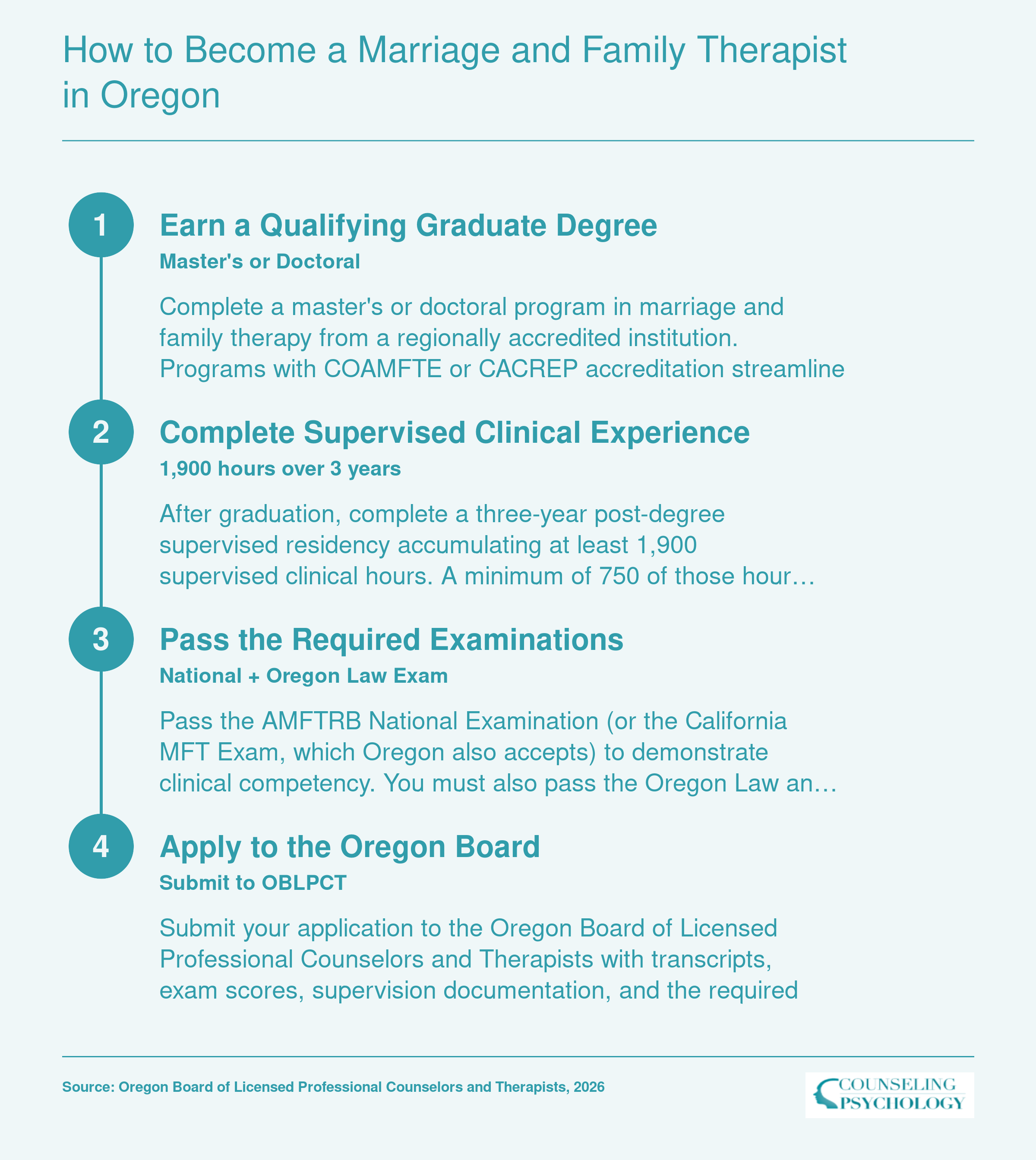
Oregon's LMFT licensure path involves a structured sequence of education, supervised practice, and examination. Notably, Oregon allows up to 400 pre-degree clinical hours to count toward the total, and the state requires its own Law and Rules Exam on top of the national clinical exam. The full process typically spans about five years from graduate enrollment to full licensure.
Related Articles
Tuition and Cost Comparison Across Portland-Area MFT Programs
Costs for MFT programs in the Portland area vary widely. Among the five ranked schools, the institution-level average net price ranges from roughly $9,550 at Portland State University to about $36,000 at Lewis & Clark College, a spread of more than $26,000. Public universities generally carry lower sticker prices and net costs, though private programs sometimes offset higher tuition with institutional aid. Keep in mind that net price figures shown here are institution-level averages drawn from federal data and reflect what typical undergraduates pay after grants and scholarships. Your actual graduate-level cost will differ based on your enrollment status, financial aid package, and program length. Estimated monthly payments assume a standard 10-year repayment plan at a 5.5% fixed interest rate.
| School | In-State Tuition | Out-of-State Tuition | Avg. Net Price (Institution Level) | Median Debt at Completion | Est. Monthly Payment (10-Year Plan) |
|---|---|---|---|---|---|
| Portland State University (public) | $17,745 | $23,334 | $9,552 | $20,500 | ~$222 |
| Oregon Institute of Technology (public) | $22,470 | $36,164 | $15,706 | $22,500 | ~$244 |
| University of Oregon (public) | $19,474 | $33,379 | $22,182 | $20,139 | ~$218 |
| George Fox University (private) | $15,920 | $15,920 | $31,679 | $24,250 | ~$263 |
| Lewis & Clark College (private) | $19,800 | $19,800 | $36,013 | $19,500 | ~$211 |
Program Outcomes: Earnings, Debt, and Employment After Graduation
Graduate program outcomes tell you more about your future than any marketing brochure, yet detailed earnings and employment data for MFT programs near Portland remain frustratingly incomplete in federal databases.
What the Data Does (and Does Not) Show
The U.S. Department of Education's College Scorecard publishes program-level earnings at one, two, and four years after completion for many graduate programs. For the MFT programs ranked on this page, those specific outcome figures are not yet available. This gap exists because reporting thresholds require minimum cohort sizes, and many MFT programs graduate relatively small classes each year.
What you can compare today is institutional-level data. The schools on our list report median debt ranging from approximately $19,500 at Lewis & Clark College to $24,250 at George Fox University. Oregon Institute of Technology reports median debt of $22,500, while University of Oregon and Portland State University fall in the $20,000 to $21,000 range. These figures reflect all graduate borrowers at each institution, not specifically MFT students, so treat them as directional rather than precise.
Regional Salary Benchmarks for MFTs
BLS data for the Portland-Vancouver-Hillsboro metropolitan area shows that marriage and family therapists at the 75th percentile earn $107,480 annually.1 The national median for MFTs sits at $58,510, with the 10th percentile at $39,090 and the 90th percentile reaching $104,710.1 Portland-area MFTs who build strong clinical practices and accrue experience can realistically expect to land in the upper quartile.
For comparison, mental health counselors (the category covering most LPCs) earn a national median of $63,700, while clinical social workers earn a national median of $64,400.2 Metro-specific figures for these occupations fluctuate, but the takeaway is clear: MFT, LPC, and MSW career tracks produce similar starting wages, with earnings diverging more based on specialization, practice setting, and licensure status than on credential type alone. Students weighing the LPC pathway may also want to explore clinical counseling program options for additional context.
Calculating Your Personal ROI
Without program-specific earnings data, you can still estimate return on investment using published tuition figures:
- Portland State University: Estimated in-state cost of $56,350 for the full 90-credit program
- George Fox University: Total tuition around $52,864 for 64 credits
- University of Oregon: In-state tuition runs approximately $19,474 per year (total varies by pace)
- Oregon Institute of Technology: In-state annual tuition near $22,470
- Lewis & Clark College: Per-credit cost of $825 multiplied by 60 credits yields roughly $49,500
Divide these costs against the Portland-area 75th percentile salary of $107,480, and you get a rough sense of payback timelines, though individual outcomes vary significantly.
Employment Rates and Placement Signals
Employment share data (the percentage of graduates working and not enrolled one year after completion) is not currently published for these specific MFT programs. Absent hard numbers, look at proxies: COAMFTE-accredited programs like University of Oregon historically report strong clinical placement rates, and CACREP-accredited programs like George Fox and Portland State emphasize supervised internship pipelines that often convert to job offers. Prospective students in the neighboring state can compare notes with MFT accredited programs in Washington to gauge regional trends.
One critical caveat: any federal earnings data you eventually find reflects all program completers, not just those who achieved LMFT licensure. Graduates who leave the field, work part-time, or pursue different careers pull median earnings down. Licensed MFTs practicing full-time in the Portland area typically out-earn these aggregate figures.
Portland's extensive network of community mental health agencies like Cascadia Behavioral Healthcare, Morrison Child and Family Services, Central City Concern, and Trillium Family Services provides MFT students with strong practicum placements. In 2026, over 200 MFT internship positions were posted in the metro area, reflecting the region's demand for clinical trainees.
Online, Hybrid, and On-Campus MFT Options Near Portland
Of the six ranked MFT programs near Portland, four use a hybrid delivery model, while two remain fully campus-based. This mix gives students a range of structures to balance coursework, clinical training, and personal obligations.
Program Formats: Hybrid, Campus, and Online Options
The University of Oregon, Oregon Institute of Technology, George Fox University, and Portland State University offer hybrid programs.1 These blend online classes with periodic on-campus sessions, allowing students to live in the Portland area while completing much of the coursework remotely. In contrast, Lewis & Clark College and Western Seminary hold all classes on campus, which can appeal to those who learn best with face-to-face faculty and peer interaction.
Fully online MFT programs are less common among schools physically near Portland, but George Fox provides a synchronous online track alongside its hybrid option.2 For students open to programs farther afield, Northcentral University's COAMFTE-accredited online MFT is a nationally available alternative, though clinical placements must be arranged locally.3 If you are exploring options beyond Oregon, our guide to the best MFT programs nationwide is a useful starting point.
Part-Time and Accelerated Pathways
Most programs assume full-time enrollment, but several offer flexibility. Lewis & Clark's 60-credit MA can be completed in three years full-time or four years part-time. George Fox's 64-credit program maps to three- and four-year tracks, accommodating working adults.2 Western Seminary's weeknight and Saturday schedule effectively functions as a part-time design, spreading 71 to 73 credits across several years. Accelerated tracks are uncommon in the Portland area; the University of Oregon's 90-credit MS, for example, moves at an intensive two-year pace, while Portland State's 60-credit program is structured as a three-year cohort, with students taking nine credits per term.5
Online Learning and Oregon Licensure Requirements
Online coursework can satisfy the academic requirements for Oregon LMFT licensure, but the state mandates 600 hours of supervised clinical practicum, and those hours must be completed in person. Whether you enroll in an online, hybrid, or campus program, you will need to secure a local practicum site in the Portland area. Hybrid programs typically assist with placement; fully online students should confirm support for arranging local sites before enrolling.
Evening and Weekend Scheduling for Working Professionals
Programs aware of the need for work-life balance build schedules directly into their design. George Fox offers day, evening, and weekend classes. Portland State holds evening courses, with daytime clinical training. Western Seminary runs weeknight and Saturday sessions. Even programs with a cohort structure, like Lewis & Clark's fall-start model, schedule core classes during windows that working students can plan around.
Frequently Asked Questions About MFT Programs in Portland
Prospective MFT students near Portland tend to ask many of the same questions about timelines, accreditation, and earning potential. Below are concise, research-grounded answers to the topics that come up most often.