
What you’ll learn in this article…
- Lincoln University's online master's in addiction counseling is the most affordable dedicated program serving St. Louis students.
- Missouri's credentialing ladder lets you begin working after a certificate, then advance while earning supervised hours.
- Master's-level licensed counselors in St. Louis earn substantially more than certificate-only practitioners over a career.
- Federal aid, state grants, and workforce scholarships can significantly reduce out-of-pocket tuition costs.
Addiction counseling training in St. Louis spans a wide cost spectrum, from under $5,000 for a short-term certificate to more than $30,000 for a full master's degree. That range reflects real differences in what each credential opens up: scope of practice, supervision requirements, and earning potential under Missouri's licensing structure.
The tension most prospective students face is not simply price. It is whether the cheapest path into the field matches where they want to be in five years. A Certified Alcohol and Drug Counselor credential lets you start working sooner, but a master's-level license unlocks independent practice and a measurably higher salary ceiling. Students exploring their options can compare counseling degrees at every level to understand how credential type shapes career trajectory.
Missouri's tiered credentialing system means the education decision and the licensing decision are inseparable. The state's Certified Alcohol and Drug Counselor (CADC) credential requires formal education and supervised hours, while the Licensed Professional Counselor track demands a graduate degree. Getting those two tracks confused early can mean expensive backtracking.
Best Affordable Addiction Counseling Programs in St. Louis, Ranked by Cost
Only one regionally accredited Missouri institution currently offers a dedicated addiction counseling degree that appears in our cost-focused dataset for the St. Louis area. Lincoln University, a historically Black public university based in Jefferson City, delivers its program entirely online, making it accessible to St. Louis students without a commute. Because the search returned a single qualifying school, prospective students should also weigh online programs from other states and local alternatives at different credential levels (explored in later sections of this article).
- In-state tuition and net price
- Online or campus delivery format
- Institution-wide graduation rate
- Missouri licensure alignment
- Program-level credential and outcomes
- NCES-IPEDS federal institutional data — nces.ed.gov
- Internal program database
- Independent program research

Lincoln University
Lincoln University is a public HBCU in Jefferson City that serves a large share of Pell Grant recipients, roughly 84 percent of its undergraduates, underscoring its commitment to affordability. Its online Master of Education in Counseling with an Addiction Counseling concentration is structured around Missouri's Certified Alcohol and Drug Counselor (CADC) requirements, giving St. Louis students a direct pipeline to state credentialing without relocating. The institution-wide graduation rate sits at about 21 percent; that figure reflects the full undergraduate population across all majors and does not isolate outcomes for graduate counseling students, so interpret it cautiously.
- Fully online format designed for working professionals across Missouri
- Coursework aligned with Missouri CADC credentialing standards
- In-state graduate tuition of roughly $7,782 per year (before fees)
- Approximate institution-wide average net price of $19,092 after aid
- Prepares students to sit for the Alcohol and Drug Counselor Exam
- 11:1 student-to-faculty ratio supports individualized advising
- Program-level earnings data not yet published for this concentration
- Ideal entry point for those with psychology or social work backgrounds
Master of Education in Counseling, Addiction Counseling Concentration — Online
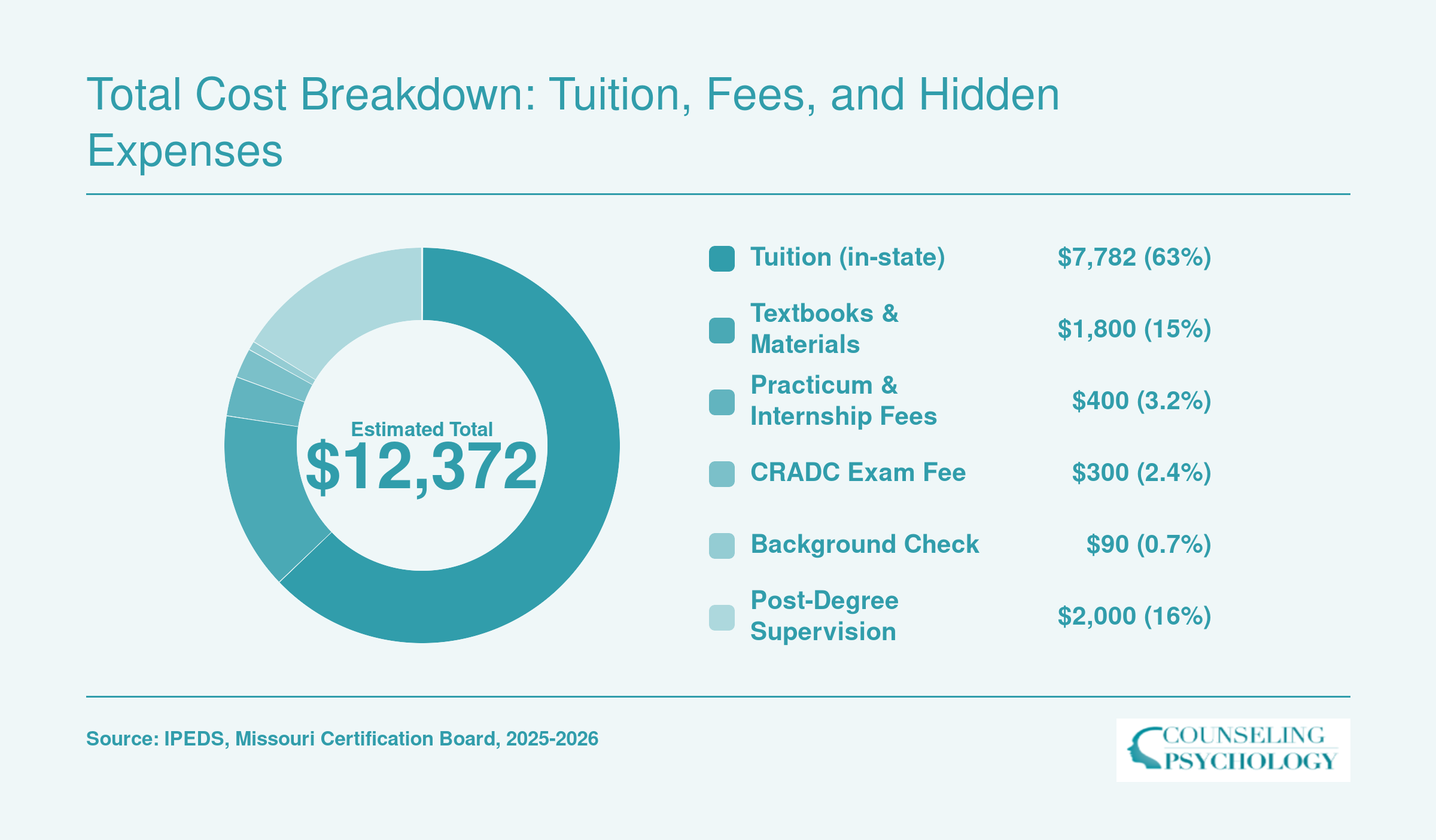
Total Cost Breakdown: Tuition, Fees, and Hidden Expenses
Tuition is only part of the picture. When you map every dollar you will spend from enrollment through licensure, several less obvious line items add up fast. The breakdown below uses Lincoln University's in-state master's tuition as an anchor and layers on the non-tuition costs Missouri addiction counseling students typically face. One cost that doesn't appear on any invoice: practicum hours required for Missouri licensure are almost always unpaid clinical time, which means lost wages on top of the fees listed here.
Certificate vs. Associate vs. Bachelor's vs. Master's: Cheapest Path to Become an Addiction Counselor
Choosing the right credential level is one of the biggest cost decisions you will make on the path to addiction counseling. The table below compares four common credential tiers on cost, timeline, the Missouri credential each qualifies you for, and the approximate salary range you can expect. A certificate is the quickest counseling credential to earn: the STLCC Addictions Study Certificate of Specialization, for example, can be completed in about 12 months. Yes, you can become an addiction counselor in St. Louis with just a certificate, which qualifies you for CRAADC (Certified Reciprocal Advanced Alcohol and Drug Counselor) entry-level credentialing, though your scope of practice will be more limited than counselors who hold a bachelor's or master's degree.
| Credential Level | Cheapest Verified Option in the St. Louis Area | Approximate Total Cost | Typical Timeline | Missouri Credential It Qualifies You For | Expected Salary Range (Missouri) |
|---|---|---|---|---|---|
| Certificate | STLCC Addictions Study Certificate of Specialization (27 credits at $127/credit, in-district) | Approximately $3,429 | Under 1 year (about 12 months) | CRAADC entry-level (limited scope of practice) | Entry-level; typically lower end of substance abuse counselor pay scale |
| Associate Degree | Community college associate programs (varies by institution) | Roughly $7,000 to $10,000 (in-district, based on typical community college rates) | About 2 years | CRAADC with additional supervised hours | Low to mid-range for substance abuse counselors |
| Bachelor's Degree | Four-year university programs in human services, psychology, or related fields | Varies widely; public in-state options typically $30,000 to $50,000 total | 4 years | Qualifies for higher-level CRAADC credentialing; broader scope of practice | Mid-range for substance abuse counselors |
| Master's Degree | Lincoln University M.Ed. in Counseling, Addiction Counseling concentration (in-state tuition: $7,782/year) | Total program cost varies by length; in-state tuition starts at $7,782/year | 2 to 3 years (post-bachelor's) | Eligible to pursue Licensed Professional Counselor (LPC) with addiction specialization | Higher end of counselor salary range in Missouri |
Questions to Ask Yourself
Missouri Licensure and Certification Requirements for Addiction Counselors
Missouri structures its addiction counselor credentials so that your education level drives the experience hours, exam, and scope of practice you will have. Knowing the exact thresholds early can prevent costly backtracking on degrees or supervision that do not align with your target credential.
Understanding Missouri's Three Credential Pathways
The Missouri Credentialing Board (MCB) oversees two core addiction-specific certificates: the Certified Reciprocal Alcohol & Drug Counselor (CRADC) and the Certified Reciprocal Advanced Alcohol & Drug Counselor (CRAADC).1 A third option, Licensed Professional Counselor (LPC) with a substance abuse emphasis, falls under the Committee for Professional Counselors and opens private-practice doors that the MCB credentials alone do not. Each pathway has separate education minimums, supervised experience hours, and examination requirements.
- CRADC: This is the standard professional certification. You can qualify with a high school diploma, an associate degree, or a bachelor's/master's degree that includes relevant coursework.2 No matter which education route you take, you must complete 6,000 hours of supervised work experience in the addiction field, including 300 hours of practicum, and pass the IC&RC Alcohol & Drug Counselor (ADC) exam.2
- CRAADC: The advanced credential requires a master's degree in a clinical field and 2,000 hours of supervised experience.3 You must already hold the CADC or CRADC, so the exam requirement is satisfied through the base credential.2 This path suits those targeting clinical supervision, higher pay grades, and leadership roles.
- LPC with substance abuse emphasis: Licensed by the state board, this requires a CACREP-aligned master's in counseling (usually 60 credits), passage of the NCE or NCMHCE, and 3,000 hours of post-degree supervised practice. Adding substance abuse coursework or a practicum in addiction settings qualifies you to treat substance use disorders while maintaining broader mental health practice authority.
Education and Supervised Hours at a Glance
What are Missouri's requirements to become a certified addiction counselor? For the CRADC, the MCB mandates at least 270 clock hours of education specifically in alcohol and drug counseling if you hold less than a relevant master's degree.2 The full 6,000 hours of supervised experience must be documented, accrued after the education is complete, and can take three to four years of full-time work. Renewal requires 40 continuing education hours every two years, including six hours in ethics.4
The CRAADC applicant needs a master's degree with clinical application, such as a Master of Education in Counseling with an addiction concentration, and 2,000 hours of supervised experience.3 Both credentials carry reciprocal recognition in many IC&RC member states, so they are portable if you relocate later. For a broader look at the career path, our guide on how to become a substance abuse counselor covers national requirements and salary expectations.
How St. Louis Programs Prepare You for Licensure
The ranked programs above map directly to these credentials. Associate and bachelor's programs in addiction counseling generally fulfill the education component for CRADC, though you still accumulate the 6,000 hours on the job after graduation. Students exploring a bachelor's degree in addiction counseling will find that these programs often embed the 270 clock hours of substance-specific coursework the MCB requires. Master's programs like Lincoln University's online M.Ed. in Counseling with a concentration in Addiction Counseling are built to meet CRAADC requirements and often cover the coursework necessary for LPC licensure as well. If you combine the Lincoln University master's with post-graduate supervision hours and the NCE, you can pursue both the CRAADC and Missouri LPC simultaneously, maximizing your clinical scope and employment options in the St. Louis area.
The 6,000-Hour Reality: Timing and Cost Implications
For anyone eyeing the CRADC, the 6,000-hour supervised experience requirement is the hidden cost multiplier. It typically spans over three years of full-time work at an addiction treatment agency while earning an entry-level salary. This timeline affects your total cost calculations when you compare program sticker prices: a lower-tuition associate or bachelor's program that requires three to four years of low-paid supervised work post-degree may result in a longer path to full earning power than a master's route that compresses supervision to 2,000 hours and qualifies you for the higher-paying CRAADC or LPC. Factor in that supervision itself can sometimes involve out-of-pocket fees if not provided by the employer, and the real cost gap between programs narrows or widens depending on how fast you can complete the hours and sit for the exam.
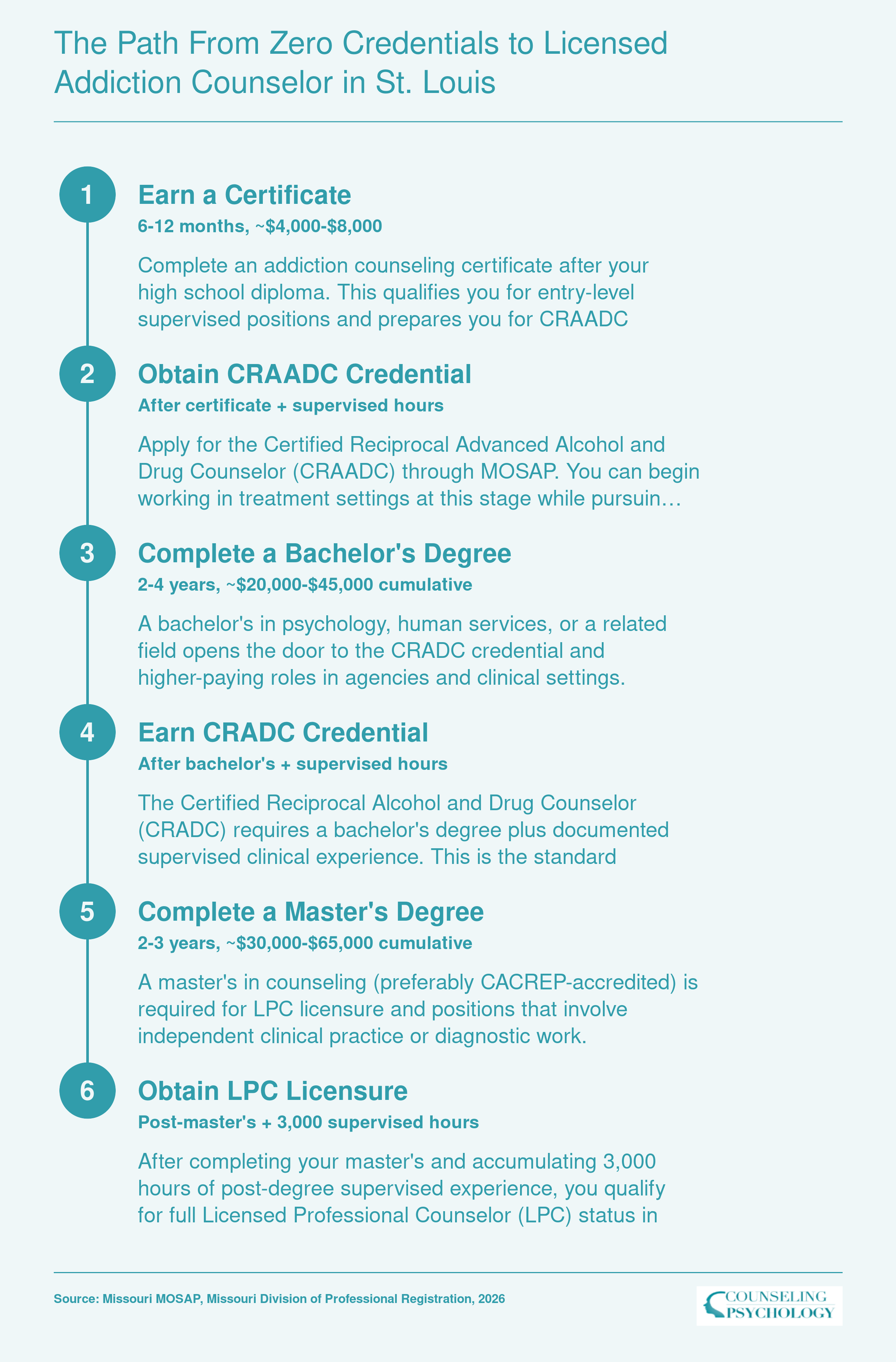
The Path from Zero Credentials to Licensed Addiction Counselor in St. Louis
You do not need a master's degree to start working in addiction counseling. Missouri's credentialing ladder lets you enter the field after completing a certificate program, then advance your credentials and earning power over time while you gain supervised experience.
Local vs. Online Programs: Cost Comparison for St. Louis Students
St. Louis students weighing a local campus experience against an online degree should look beyond sticker price. In-state tuition advantages, practicum logistics, and Missouri licensure alignment all factor into the real cost. Here is how three affordable options stack up for addiction counseling students in the greater St. Louis area.
| Feature | Lincoln University (Online, In-State) | City Vision University (Online, National) | City Vision University (Online, National) |
|---|---|---|---|
| Degree Level | Master of Education in Counseling, Addiction Counseling concentration | B.S. in Addiction Counseling | M.S. in Addiction Counseling |
| Delivery Format | Online | Online | Online |
| Total Estimated Tuition | Approximately $7,782/year in-state (graduate rate may differ from published undergraduate figure) | Around $32,000 at full price; approximately $22,000 with institutional scholarship | Approximately $9,600 to $12,800 at full price; roughly $6,600 to $8,800 with scholarship |
| Credits Required | Program-specific; contact the school for current credit hours | 120 credits | 36 to 48 credits |
| NAADAC Approved Provider | Prepares graduates for the CADC exam; aligns with Missouri requirements | Yes | Yes |
| Meets Missouri CRADC/CRAADC Education Standards | Yes, program aligns with Missouri certification requirements | Yes | Yes |
| In-State Tuition Advantage | Missouri residents pay significantly less than the out-of-state rate of $13,236/year | Flat tuition regardless of state; no in-state discount | Flat tuition regardless of state; no in-state discount |
| Practicum and Fieldwork | Students arrange supervised practicum, often at Missouri-based sites | Practicum coordinated through the program; verify Missouri site approval with your state board | Practicum coordinated through the program; verify Missouri site approval with your state board |
| Key Consideration for St. Louis Students | Public university pricing and HBCU designation; strong option for students who already hold a bachelor's in psychology or social work | Best suited for students starting at the bachelor's level who want a focused addiction counseling curriculum | One of the lowest-cost master's options nationally; confirm that practicum hours satisfy your specific Missouri credential tier |
Addiction Counselor Salary and Job Outlook in St. Louis, MO
Understanding what you can expect to earn as an addiction counselor in St. Louis helps you weigh program costs against your likely return on investment. The good news: demand for substance abuse counselors remains strong in the metro area, and wages vary meaningfully based on experience, credentials, and employer type.
What Addiction Counselors Earn in St. Louis
The Bureau of Labor Statistics tracks wages for Substance Abuse, Behavioral Disorder, and Mental Health Counselors (SOC 21-1018) in the St. Louis, MO-IL metropolitan area. According to the May 2025 Occupational Employment and Wage Statistics, the local median annual wage and total employment figures are available through the BLS OEWS database.1 You can search this data directly at BLS.gov by selecting the St. Louis metro area and filtering for SOC code 21-1018.
Wage percentiles tell an important story. Counselors in the lower wage quartiles (10th and 25th percentiles) typically hold entry-level positions or work as paraprofessionals, often with certificates or associate degrees. Those in the upper quartiles (75th and 90th percentiles) tend to hold master's degrees and full licensure. While the BLS does not break out wages by credential level in its OEWS data, this pattern holds across the field: higher credentials correlate with higher earning potential.
How Credentials Affect Your Earning Power
The BLS does not publish St. Louis-specific salary data segmented by education level for this occupation. However, field-wide trends are consistent. Entry-level roles, such as substance abuse technician or counselor assistant positions, generally pay toward the lower end of the wage spectrum. Licensed counselors holding a master's degree and state certification (such as the CRCC or LPC) typically access supervisory roles, private practice opportunities, and clinical positions that pay at or above the 75th percentile. For a broader look at how education level influences compensation, see our counselor salary breakdown by degree, state, and specialty.
The Missouri Department of Higher Education and Workforce Development occasionally publishes state-specific salary surveys. Some St. Louis-area institutions, including University of Missouri-St. Louis and Washington University, may share alumni salary outcomes by credential level. Contacting their career services offices can yield helpful benchmarks.
Major Employers in St. Louis
St. Louis has a robust network of addiction treatment providers. Large employers include Preferred Family Healthcare, Bridgeway Behavioral Health, and Sana Lake Recovery. Searching job boards like Indeed or browsing Google Maps for addiction treatment centers reveals dozens of additional clinics, outpatient programs, and residential facilities hiring counselors at all credential levels.
Professional associations can also guide your salary research. The Missouri Association of Addiction Professionals (MAAP) and the National Board for Certified Counselors (NBCC) maintain employer directories and sometimes share informal salary ranges through local chapters. The NAADAC salary survey provides national benchmarks that, while not specific to St. Louis, offer useful context for negotiating pay.
Job Outlook and Demand
Substance abuse counseling remains a growth occupation nationally, and the St. Louis metro area reflects this trend.2 Total employment figures from the May 2025 BLS data show steady demand for counselors in the region. Factors driving this demand include ongoing opioid recovery efforts, expanded insurance coverage for behavioral health, and increased public investment in community mental health services.
If you are weighing a low-cost program against a more expensive option, consider this: the credential you earn directly influences which jobs you qualify for and how quickly you reach higher wage tiers. A certificate or associate degree can get you working faster, but a master's-level licensure, sometimes supplemented by an addiction counseling certificate online, opens doors to clinical roles with stronger earning potential over your career.
Credential level is the single biggest lever on your lifetime earnings as an addiction counselor. Master's-level licensed counselors in the St. Louis area can earn substantially more per year than certificate-only practitioners, and that wage gap typically recoups the added tuition cost within just a few years of full-time work.
Financial Aid, Scholarships, and Ways to Lower Your Cost
The actual price most students pay to become an addiction counselor is considerably lower than the tuition figures listed on program websites, because a combination of federal, state, and workforce-specific aid can erase a substantial portion of the sticker cost.
Federal Aid: Your Starting Point
Filing the FAFSA unlocks the federal programs that cover the most ground. Pell Grants provide need-based funding that never has to be repaid, and schools serving addiction counseling students in the St. Louis region enroll a high share of Pell-eligible students. Lincoln University of Missouri, for instance, reports that roughly 84 percent of its undergraduates receive Pell funding, a signal that the institution serves students from a broad range of financial backgrounds. Beyond grants, Direct Loans and income-driven repayment plans can make a master's degree manageable on a counselor's salary. If you work for a qualifying nonprofit treatment center or government agency after graduating, 120 on-time payments under Public Service Loan Forgiveness eliminates your remaining federal loan balance entirely.4
Missouri-Specific Programs
Two state programs are worth building your budget around. Access Missouri Financial Assistance awards between $300 and $1,000 per year at community colleges and between $1,500 and $3,000 at four-year universities, with a 2.5 GPA requirement.1 Students who completed the A+ Scholarship criteria in high school (a 2.5 GPA and 50 hours of community service, among other requirements) can have tuition and fees covered at any Missouri public community college after other aid is applied, making STLCC's in-district addiction studies pathway nearly free for qualifying students.1
Many St. Louis area healthcare systems, including large hospital networks, also offer tuition reimbursement for employees pursuing behavioral health credentials. If you are already working in a clinical or administrative role, check your HR benefits before assuming you are paying out of pocket.
Workforce Scholarships and Loan Repayment
HRSA's Behavioral Health Workforce Education and Training program provides stipends ranging from $10,000 to $25,000 for students in supervised fieldwork, which can offset living expenses during an unpaid or low-paid practicum.2 Once licensed, the National Health Service Corps Substance Use Disorder Workforce Loan Repayment Program offers up to $75,000 over three years for counselors working in underserved communities.2 The Missouri Department of Mental Health runs a parallel loan repayment program awarding $10,000 to $50,000 over a 24- to 36-month service commitment.3
If you plan to pursue a graduate degree, reviewing counseling masters programs Missouri can help you compare options that pair well with these funding sources.
Three Practical Ways to Reduce Your Total Cost
- Start at STLCC: In-district rates at St. Louis Community College are among the lowest in the region. Completing foundational coursework or a certificate there before transferring to a bachelor's or master's program substantially reduces total degree cost.
- Transfer credits strategically: Many bachelor's completion and master's programs accept prior college credits. Confirm transfer articulation agreements before enrolling so no credits are wasted.
- Seek practicum sites that pay: Some treatment centers offer modest stipends for supervised hours. A paid or stipend-supported practicum site reduces the financial pressure of the clinical training period without adding debt.
Taken together, these sources mean that the real question is not simply "how much does it cost to become a substance abuse counselor?" but rather "how much will I pay after all available aid?" For many students in St. Louis, that net figure is far more manageable than the published tuition suggests.
How to Choose the Right Program for Your Goals and Budget
Your ideal addiction counseling credential depends on three variables: how quickly you need to start earning, how much you can invest upfront, and whether you want to build an independent practice or work under supervision.
If You Need to Start Earning Within a Year
A certificate program is the fastest route to entry-level work. St. Louis-area certificate programs typically run 6 to 18 months and cost between $3,000 and $8,000. You can begin working as a substance abuse counselor assistant or technician while accumulating supervised hours toward state certification. This path makes sense if you need immediate income or want to test the field before committing to a degree. The tradeoff: lower starting wages (often $30,000 to $38,000) and limited advancement without returning for a bachelor's or master's later.
If You Already Hold a Bachelor's Degree in Any Field
Go directly to a master's program. Most Missouri master's in addiction counseling or clinical mental health counseling accept students with unrelated undergraduate majors, and the credential jump is worth the investment. A master's qualifies you for Licensed Professional Counselor (LPC) or Licensed Clinical Professional Counselor (LCPC) tracks, which open private practice, clinical supervision roles, and salaries in the $50,000 to $65,000 range after licensure. Spending 18 to 24 months in a master's program (total cost $15,000 to $35,000 at the schools ranked earlier) is more efficient than earning an associate or bachelor's first.
If You Want the Highest Earning Power and Independent Practice
A master's degree offers the most flexibility and the clearest path to full licensure. Missouri's Credentialing Board requires a master's for LPC licensure, which allows you to diagnose, bill insurance independently, and supervise other counselors. The salary premium is substantial: master's-prepared counselors in St. Louis earn 30 to 50 percent more over a career than certificate or bachelor's holders. If your timeline allows two years and you can manage the upfront cost through aid or employer tuition benefits, the master's is the most future-proof choice. For a broader look at the profession, our guide on how to become a counselor covers the general steps and licensure pathways.
Verify Missouri Credentialing Board Approval Before You Enroll
Regardless of credential level, confirm that any program (especially online counseling degree programs) meets Missouri Credentialing Board education requirements for the license you are targeting. Not all nationally accredited programs satisfy Missouri's specific coursework mandates in ethics, psychopharmacology, and supervised practicum hours. Check the Credentialing Board's approved-program list or ask admissions directly for a written confirmation that graduates are eligible to sit for Missouri exams. Enrolling in a program that does not align with state requirements will cost you time and tuition without moving you closer to licensure.
Frequently Asked Questions About Addiction Counseling Degrees in St. Louis
Choosing an affordable addiction counseling program raises practical questions about timelines, costs, and credentials. Below are answers drawn from current Missouri licensing rules, published tuition figures, and labor market data for the St. Louis area.