

What you’ll learn in this article…
- Net prices at the six ranked Ohio schools range from roughly $11,000 to $28,400 per year for in-state students.
- Graduate assistantships and tuition waivers often reduce out-of-pocket costs more than any difference in published tuition rates.
- National median pay for social scientists sits near $76,000, though Akron-specific wage data remains limited or suppressed by the BLS.
- Online formats can cost less overall once you account for housing, commuting, and lost income from full-time on-campus attendance.
Northeast Ohio offers multiple pathways into social psychology without the steep cost of relocating to a major metro or enrolling at a private institution. Net prices across the six ranked programs range from approximately $11,000 to $28,400 annually for in-state students, with institutions scattered from Akron to Columbus and Oxford. The University of Akron, Wright State, Bowling Green, Ohio State, and Miami University each maintain psychology offerings that blend social, industrial-organizational, and applied tracks at varying degree levels.
The rankings ahead weigh affordability, graduation rates, and ROI alongside program-specific factors such as assistantship availability and research focus. Cost breakdowns clarify the gap between published tuition and actual net price, while funding sections detail how assistantships and waivers reshape total expense. Career outcome data and salary benchmarks anchor expectations for earnings in Northeast Ohio and beyond. Format comparisons reveal when campus programs deliver stronger value than online alternatives, and a final FAQ addresses program-specific questions that admissions offices field most often.
Best Affordable Social Psychology Programs Near Akron, Ohio, Ranked
Ohio is home to several public universities offering psychology programs that overlap with social psychology, ranging from bachelor's-level concentrations to doctoral training. Below, we rank six schools by a combination of affordability, institutional outcomes, and program strength. Note that graduation and retention rates listed here are institution-wide figures, not specific to any single program. Program-level earnings data is not yet available for these listings, so we rely on institution-wide median earnings ten years after enrollment as a broad value signal.
- Net price and tuition affordability
- Institutional graduation and retention rates
- Program reputation and curriculum depth
- Faculty ratio and student support
- Graduate debt and earnings outcomes
- Internal program database
- NCES-IPEDS federal institutional data — nces.ed.gov
- College Scorecard graduate earnings — collegescorecard.ed.gov
- Independent program research

University of Akron
Sitting right in the heart of Akron, the University of Akron houses one of the oldest and most established Industrial/Organizational Psychology doctoral programs in the country, consistently rated in the top ten for research productivity. In-state tuition runs about $10,125 per year, and after aid the average net price lands near $13,946. The institution posts a 51.9% graduation rate and a 73% retention rate, with median earnings of $46,600 ten years after enrollment. A 17:1 student-to-faculty ratio keeps classes manageable, and the doctoral program requires 90 graduate credits, comprehensive exams, and a dissertation.
- Requires a master's degree for admission
- 90 total graduate credits to complete
- Minimum 3.25 graduate GPA required
- Core specialty courses plus comprehensive exams
- Dissertation research is mandatory
- Minimum 3.5 GPA in core coursework expected
- Campus-based program in downtown Akron
Doctor of Philosophy in Psychology, Industrial/Organizational Concentration — On-Campus

Ohio State University
Ohio State University's Social Psychology master's program is part of a department recognized as one of the top-ranked social psychology groups internationally. The campus-based curriculum blends social cognition, attitudes and persuasion, and research methods with hands-on lab work and teaching opportunities. In-state tuition is approximately $13,901 per year, with a net price around $17,339 after aid. OSU's 87.7% graduation rate and 94% retention rate are the strongest on this list, and median graduate debt of roughly $19,976 is the lowest among these six schools. Median earnings reach $60,409 a decade after enrollment.
- Campus-based program in Columbus
- Curriculum covers social cognition and persuasion
- Lab work integrated into coursework
- Teaching opportunities available to students
- Strong faculty mentorship and support
- Focus on both research and practical application
Master's in Social Psychology — On-Campus

Wright State University
Wright State University in Dayton offers two relevant pathways: a Bachelor of Science in Psychology with an Industrial/Organizational concentration and a doctoral program blending Human Factors with I/O Psychology. In-state undergraduate tuition is about $10,991, with a net price near $15,415. The institution's graduation rate sits at 41.7%, with a 68% retention rate. Median graduate debt is $22,750, and institution-wide median earnings ten years out are $49,500. The I/O bachelor's concentration requires 60 credit hours and a minimum 3.2 GPA, while the doctoral track features interdisciplinary, real-world projects.
- Campus-based program in Dayton
- Requires 60 credit hours for entry
- Minimum 3.2 GPA admission standard
- Blends cognitive, social, and behavioral psychology
- Covers managerial and human resources topics
- Prepares graduates for advanced study or business roles
- Combines Human Factors with I/O Psychology
- Emphasis on interdisciplinary, real-world projects
- Campus-based doctoral training
- Prepares graduates for diverse career paths
- Supportive academic community in Dayton
- Designed for aspiring researchers and practitioners
Bachelor of Science in Psychology, Industrial/Organizational Concentration — On-Campus
Human Factors and Industrial/Organizational Psychology PhD — On-Campus

Bowling Green State University
Bowling Green State University runs a nationally ranked Industrial/Organizational Psychology doctoral program that combines an M.A. and Ph.D. track with strong research and practical experience. In-state tuition is roughly $10,291, though the average net price after aid climbs to about $24,022. Funding through graduate assistantships can significantly reduce that cost. BGSU posts a 63.7% graduation rate and 82% retention rate, with institution-wide median earnings of $47,896 ten years after enrollment. The median graduate debt is $25,000.
- Combined M.A. and Ph.D. track
- Nationally ranked I/O psychology program
- Funding available through assistantships
- Strong research component throughout
- Real-world consulting and applied experience
- Supportive cohort-based learning community
- Prepares graduates for corporate and academic roles
Industrial/Organizational Psychology Doctoral Program — On-Campus

Wright State University-Lake Campus
Wright State University's Lake Campus in Celina provides the same Bachelor of Science in Psychology with an I/O concentration offered at the main Dayton campus, but in a smaller, more intimate setting. With in-state tuition at about $7,372 and a net price near $11,081, this is the most affordable option on the list. The 13:1 student-to-faculty ratio is the lowest here, meaning more individualized attention. The trade-off is a 40.9% institution-wide graduation rate and 61% retention rate. Median graduate debt is $22,750, and institution-wide earnings sit at $49,500 ten years out.
- Campus-based at the smaller Lake Campus
- Lowest net price on this list at roughly $11,081
- 13:1 student-to-faculty ratio
- Workplace psychology focus in coursework
- 3.2 GPA admission requirement
- Multiple career path options after graduation
- Research experience recommended for applicants
Bachelor of Science in Psychology, Industrial/Organizational Concentration — On-Campus

Miami University
Miami University in Oxford offers a Master of Arts in Social Psychology with a distinctive focus on health and well-being through the lens of social connections, identities, and relationships. The program features graduate seminars, research apprenticeships, and teaching experience within a low student-to-faculty ratio environment. In-state tuition is approximately $16,751, with a net price around $28,384, making it the priciest option here. However, the university's 79.8% graduation rate and 90% retention rate reflect strong institutional support. Median earnings ten years after enrollment are $55,076, and median graduate debt is $23,000.
- Campus-based program in Oxford, Ohio
- Focus on health, well-being, and social identity
- Research apprenticeships built into the curriculum
- Graduate seminars in social psychology theory
- Teaching experience opportunities for students
- Low student-to-faculty ratio (16:1 institution-wide)
- Rigorous training in psychological research methods
- Prepares graduates for academia, industry, or government
Master of Arts in Social Psychology — On-Campus
How Much Does a Social Psychology Degree Cost in Ohio?
Understanding the true cost of a social psychology degree requires looking beyond the advertised tuition rate. Across the six programs near Akron profiled above, net prices range from approximately $11,000 to $28,400 annually for in-state students, while published in-state tuition spans $7,400 to $18,200. That gap between sticker price and net price matters enormously when you're evaluating affordability.
Sticker Price vs. Net Price: What You'll Actually Pay
Many prospective students focus on the tuition figure listed on a university's website, but that published rate rarely reflects what most students pay after grants, scholarships, and institutional aid. Net price represents the average annual cost after subtracting gift aid that does not need to be repaid. For example, Wright State University-Lake Campus lists in-state tuition near $7,400, yet the average net price stands around $11,100 once fees, books, and living costs are factored in and aid is applied. Conversely, Miami University's published in-state tuition exceeds $16,700, but the net price climbs to roughly $28,400 when you account for the full cost of attendance. Always request a personalized net-price estimate from each school's financial aid office, especially if you're comparing multiple programs.
Debt and Monthly Payments: Making Cost Tangible
Median debt at completion offers another lens on affordability. Among the institutions with available data, graduates typically carry between $19,900 and $25,000 in federal loans. Under a standard 10-year repayment plan, that translates to monthly payments in the neighborhood of $200 to $280, depending on interest rates and loan type. Program-level debt and repayment figures are not yet published for most of these social psychology tracks, so use institutional averages as a rough benchmark and ask departments directly about their graduates' borrowing patterns. If you are also weighing masters in counseling Ohio options, the same net-price comparison approach applies.
Akron's Cost-of-Living Advantage
Tuition is only part of the equation. Akron's overall cost of living sits roughly 14 percent below the national average, with housing costs running 43 percent lower than the U.S. median.12 A one-bedroom apartment in central Akron averages $983 per month, compared to substantially higher rents in Columbus, Cleveland, and Cincinnati.3 When you combine Akron's housing index of 57 with modest transportation costs (local bus fare is $1.25, and gas hovers around $3.13 per gallon), attending a program in Akron can save you several thousand dollars per year in non-tuition expenses relative to programs based in Columbus or Cincinnati.4
Per-Credit Costs and Hidden Fees
Published annual or semester tuition rates don't always reveal the per-credit cost, which matters for part-time students or those taking lighter course loads. Graduate programs, in particular, often price by the credit hour rather than a flat semester rate. Request a per-credit quote directly from the registrar or graduate admissions office, and ask about mandatory fees for technology, health services, athletics, and student activities. These fees can add hundreds of dollars per semester and are not always included in advertised tuition figures. Some programs also charge differential tuition for upper-division or specialized courses, so clarify the full cost structure before you commit.
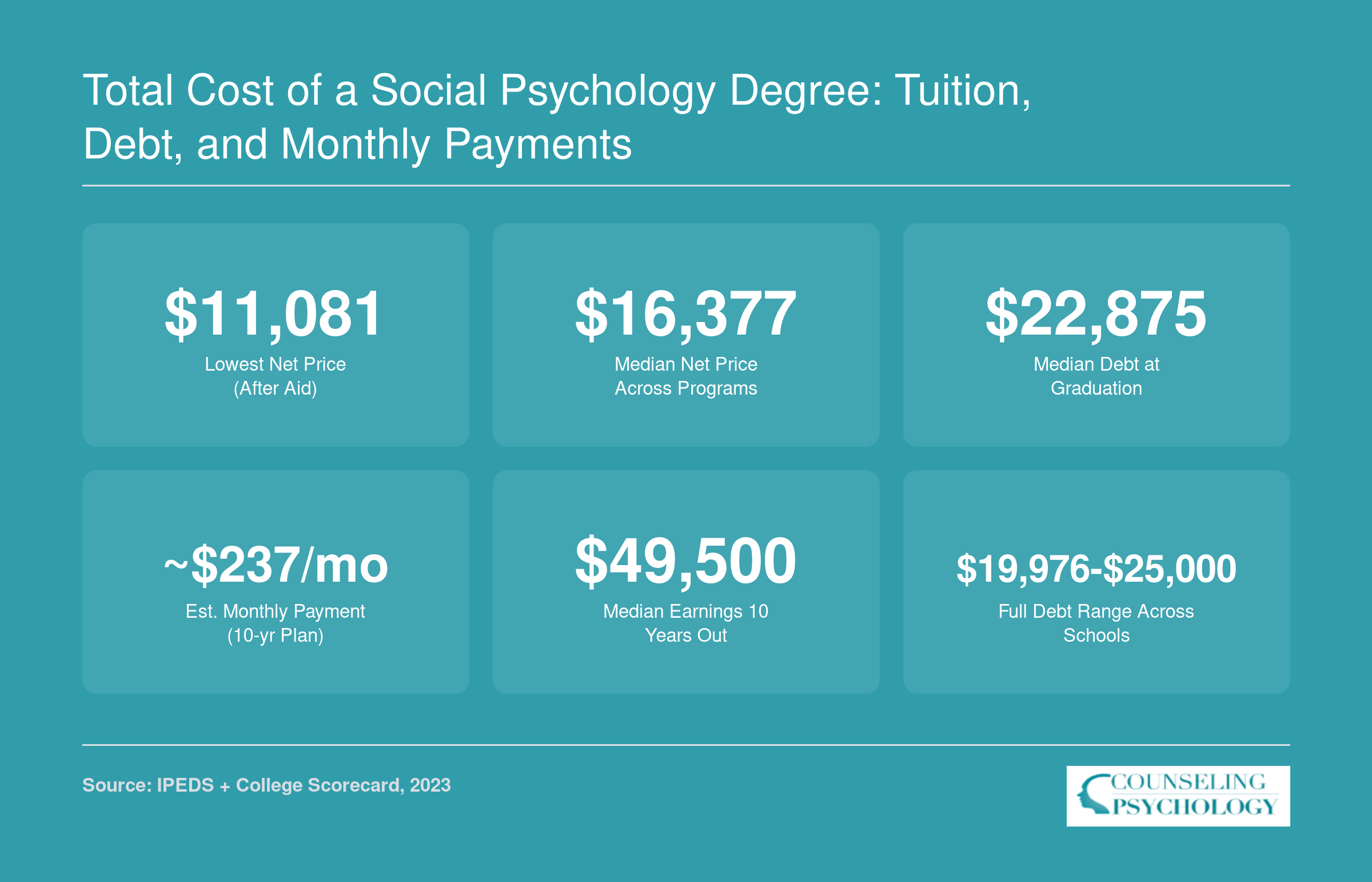
Total Cost of a Social Psychology Degree: Tuition, Debt, and Monthly Payments
Here is an at-a-glance snapshot of affordability across the six ranked Ohio programs. These institution-level figures give you a quick sense of what you can expect to pay, borrow, and earn before you dig into program-specific details.
Funding and Financial Aid: Assistantships, Scholarships, and Tuition Waivers
The true price of a psychology degree in Northeast Ohio is often determined less by tuition rates than by the funding package you negotiate before enrolling. Graduate assistantships, with their mix of stipends and tuition waivers, routinely transform what looks like a five-figure expense into a near-zero-cost degree. Yet specifics can be hard to pin down, and most applicants don't know where to look or what questions to ask.
What University of Akron Offers: Stipends, Waivers, and Workload
At the University of Akron, graduate assistantships are awarded by individual departments to full-time, fully admitted students.1 For psychology programs, the Counseling Psychology PhD offers a clear example. Students entering with a master's degree receive up to four years of funding; those entering with a bachelor's receive up to five years. The assistantship requires 20 hours of work per week, with a limit of 8 hours of outside employment per week during the academic term. The annual stipend for 2024-2025 was $15,000, and tuition waiver coverage is described as substantial or full.2
Other psychology programs at Akron, like the Industrial-Organizational (I-O) Psychology graduate program, do not publish assistantship details publicly. Prospective students should contact the program directly; its application deadline for the most recent cycle was December 15, 2024, so asking about funded positions and graduate assistant eligibility well in advance is essential.3 If you are exploring other doctoral specializations, our overview of industrial organizational psychology PhD programs can help you compare funding norms across the field. In many cases, simply submitting your admission application by the priority deadline also serves as your application for an assistantship, but always confirm this with the program coordinator.
Tuition Waivers, Stipends, and Scholarships: Know the Difference
Conflating these three forms of aid is one of the most common mistakes in graduate school planning.
- Tuition waiver: This covers part or all of your tuition and sometimes mandatory fees. It does not put money in your pocket; it simply reduces your bill to the university. A full waiver eliminates tuition entirely; a partial waiver reduces it by a set percentage or a fixed number of credit hours. At Akron, some assistantships provide tuition remission for up to 15 credit hours.4
- Stipend: This is a cash payment, typically disbursed monthly, meant to cover living expenses. It is not a wage for an hourly job but rather a fixed amount tied to an assistantship appointment. The $15,000 Counseling Psychology PhD stipend at Akron is one such example.2
- Scholarship: Unlike assistantships, scholarships are generally merit- or need-based awards that do not require a work obligation. Some are one-time; others are renewable. They can supplement or, in rare cases, replace an assistantship, but they rarely offer the same combination of tuition remission and living support.
At the University of Akron, a full funding package often layers a tuition waiver on top of a stipend. This means you receive both the salary-like stipend and the elimination of most or all tuition charges, a powerful value that can make the net cost of a graduate degree close to zero.
How to Strengthen Your Assistantship Application
Funding is competitive, and the timeline matters. Here are practical steps to improve your odds:
- Apply early. Many psychology programs consider assistantship eligibility when reviewing admission applications. For fall entry, that often means submitting by a December or January deadline. The University of Akron's I-O program used a December 15 deadline for its recent cycle; missing it likely means missing funding consideration.3
- Indicate your interest. In your statement of purpose, explicitly mention that you are seeking an assistantship and explain how your skills (research, teaching, administrative) align with the department's needs.
- Contact the graduate coordinator. Before applying, email the program's coordinator to ask whether assistantships are available, how they are awarded, and what materials strengthen an application. This also signals your seriousness.
- Prepare supporting materials. Some programs require a separate assistantship application, a resume, or a teaching philosophy statement. Check each department's website carefully or request a checklist.
Nearby institutions like Kent State and Cleveland State operate under similar models, but specific stipend amounts, waiver policies, and deadlines differ by department. Rely on direct communication, and never assume packages are identical. The gap in publicly available information is wide, but a few targeted emails can fill it and potentially save you tens of thousands of dollars.
Related Articles
Questions to Ask Yourself
Career Outcomes and Salary Expectations in Northeast Ohio
Understanding what you can actually earn after graduation helps put tuition costs into perspective. While program-level earnings data for specific social psychology completers at Ohio schools is not yet published in federal databases, institutional-level outcomes and regional wage data offer a useful framework for setting realistic expectations.
What the Regional Labor Market Pays
The Bureau of Labor Statistics tracks wages for industrial-organizational psychologists (SOC 19-3032) and broader social scientist categories in both the Akron and Cleveland-Elyria metro areas.1 I-O psychology represents one of the most common applied career paths for social psychology graduates, particularly those with graduate training.
In the Cleveland-Elyria metro, which encompasses much of northeast Ohio's job market, I-O psychologists and related social scientists tend to earn wages that track reasonably close to national medians, though local figures vary by employer type and experience level.2 The national median for I-O psychologists hovers well above $100,000 annually, but entry-level positions and roles in smaller organizations often start considerably lower. Akron-area employers, including healthcare systems, manufacturing firms, and regional corporations, hire graduates for applied research, HR analytics, and organizational development positions.
Compared to salary figures you might see cited for New York or San Francisco, northeast Ohio wages run lower in absolute terms. However, when you factor in the region's significantly lower cost of living, the purchasing power often balances out, and sometimes favors Ohio graduates.
Connecting Cost to Outcomes
One useful metric is the ratio of typical earnings to debt at graduation. Looking at institution-wide data for the ranked programs, schools like Ohio State University show a ratio around 3.0, meaning graduates earn roughly three times their median debt within a decade of completion. The University of Akron and Bowling Green State University show ratios closer to 2.0, which still represents a reasonable return for public university tuition. These ratios reflect all graduates at the institution rather than social psychology specifically, but they signal the general economic value of a degree from these schools.
Beyond Traditional Psychology Roles
Many social psychology graduates never work under a "psychologist" job title. Instead, they apply their training in HR departments, user experience research teams, market research firms, and consulting practices. Graduates interested in this direction may also want to explore applied psychology careers to understand the full range of possibilities. These applied roles often appear under different occupational codes, which means BLS psychology wage data captures only part of the picture. HR specialists in northeast Ohio earn median wages in the mid-$60,000 range, while market research analysts and UX researchers at regional tech firms can earn $70,000 to $90,000 depending on experience. If you are drawn to applied work rather than academia, your salary trajectory may look quite different from published psychology-specific figures.
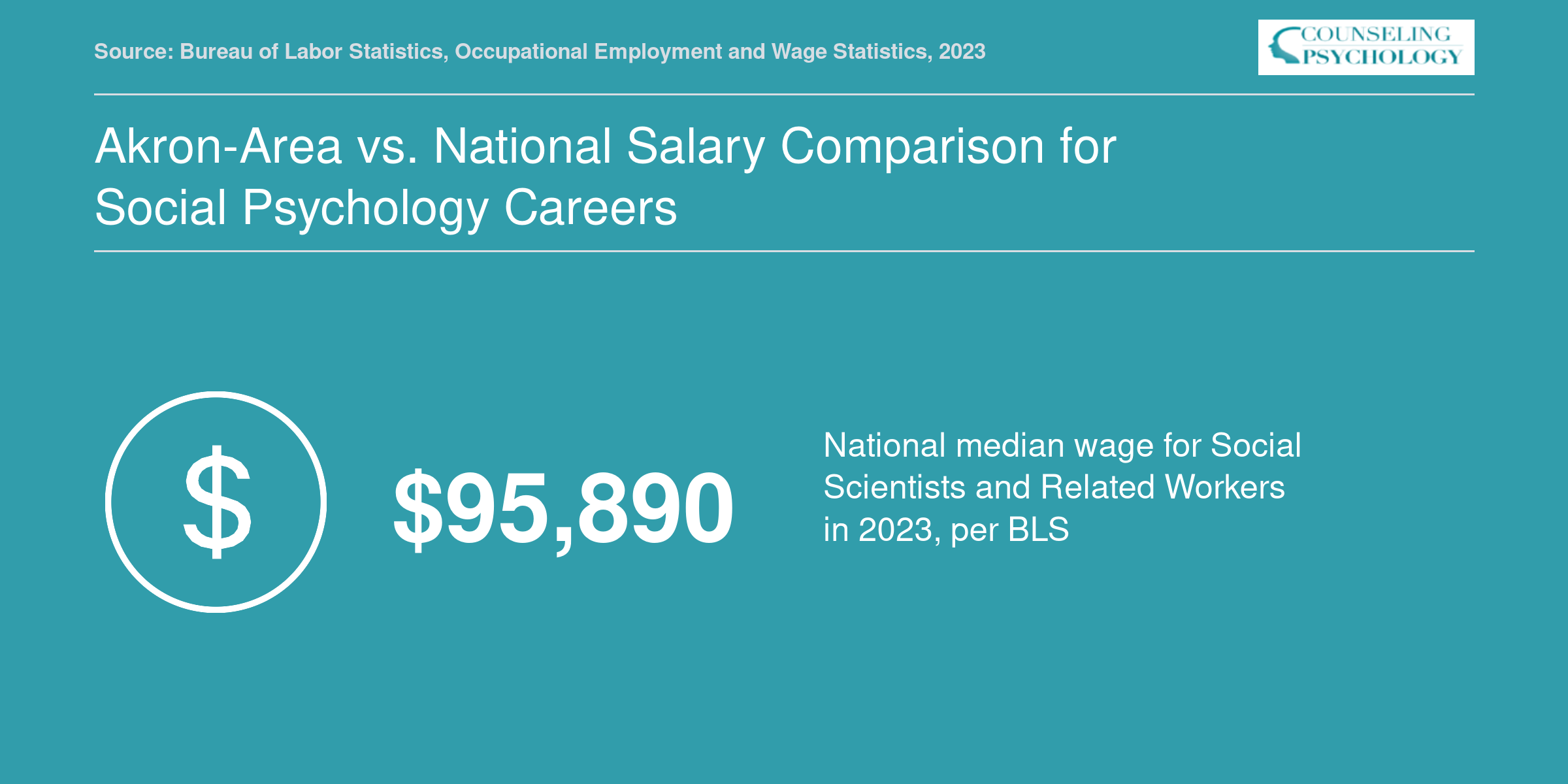
Akron-Area vs. National Salary Comparison for Social Psychology Careers
Publicly available BLS wage data for social scientists, industrial-organizational psychologists, and market research analysts is reported at the national level but is limited or suppressed for the Akron metro area specifically. The national median for Social Scientists and Related Workers was $95,890 in 2023. Metro-level breakdowns for these occupations in Akron and Cleveland are not consistently published by BLS, so a grouped comparison chart cannot be built without fabricating figures. That said, Northeast Ohio's cost of living runs roughly 10-15% below the national average, meaning even modestly lower nominal salaries can stretch further in the Akron and Cleveland corridors.
Online vs. On-Campus: Which Format Is More Economical?
Sticker price alone does not determine which delivery format saves you more money. When you factor in living expenses, lost wages, and funding packages, the calculus shifts in ways that surprise many applicants. Every ranked program in this list is currently offered on campus, so understanding the real cost trade-offs is especially important if you are weighing an online alternative elsewhere against an in-person seat at one of these Ohio schools.
Pros
- Online programs eliminate relocation and commuting costs, which can save thousands each year for students already established near Akron.
- Studying online lets you keep a full-time job, preserving income that on-campus students typically sacrifice during intensive research semesters.
- Some online master's programs in psychology charge lower per-credit rates than their on-campus counterparts, reducing the headline tuition bill.
- Geographic flexibility means you can shop nationally for the lowest tuition without uprooting your household or family.
Cons
- On-campus doctoral students at schools like Bowling Green State and the University of Akron often receive graduate assistantships with tuition waivers and stipends, making the net cost near zero.
- Research lab access and faculty mentoring on campus build a stronger CV, which can translate into higher starting salaries and faster career advancement.
- All six ranked programs near Akron are campus based, so choosing online means looking outside this cohort and potentially missing Ohio-specific networking opportunities.
- An online student paying full tuition at roughly $10,000 to $17,000 per year may actually spend more out of pocket than an on-campus peer whose GA package covers tuition and pays a living stipend.
- On-campus programs at Ohio State and Miami University emphasize teaching experience and research apprenticeships that are difficult to replicate in a virtual setting.
What Can You Do With a Social Psychology Degree?
Many graduates with social psychology degrees pursue roles in applied behavioral health, case management, community outreach, and organizational development, even without state licensure. Understanding which pathways require formal credentials and which accept relevant degree holders into entry-level positions helps clarify your planning.
Entry-Level Roles That Accept a Social Psychology Degree
Near Akron, psychology-related positions commonly accept bachelor's or master's degrees in psychology or related human services fields.1 Non-licensure roles include case management, behavioral health support, school-based or community programming, human resources, and research assistant positions. Job postings in the Akron area frequently list degree requirements as "bachelor's in psychology or related field," making a social psychology degree directly applicable.1 Fields like market research, user experience research, and data analytics also hire social psychology graduates for their training in human behavior and statistical methods. For a broader look at options, explore careers in psychology across disciplines.
Licensure and Certification for Advanced Practice
If you aim for independent clinical practice or roles carrying the title "psychologist," Ohio requires licensure through the Ohio Board of Psychology (psychology.ohio.gov). That pathway typically demands a doctoral degree (PhD or PsyD), supervised experience, and passing the EPPP examination. For related applied behavioral roles such as licensed counselor, social worker, or marriage and family therapist masters credential holders, check the Ohio Counselor, Social Worker, and Marriage & Family Therapist Board. Behavior analysts pursuing certification under the Behavior Analyst Certification Board (BACB) must complete approved coursework and supervised fieldwork, often through a dedicated applied behavior analysis master's program.
Alternative Credentials and Accelerated Options Near Akron
To explore alternative credential options, search university websites for graduate certificate, non-thesis master's, accelerated program, or part-time formats in social or applied psychology. The University of Akron2, Kent State, Cleveland State, and Youngstown State each offer graduate programs in psychology or adjacent fields; check their graduate catalogs for certificates or terminal master's tracks that emphasize applied skills without requiring a thesis. Contact program advisors directly for current information on accelerated tracks, since these options evolve more frequently than full doctoral programs.
Using National and Professional Resources to Map Your Path
The Bureau of Labor Statistics Occupational Outlook Handbook (BLS.gov) provides job titles and typical education requirements; cross-reference those listings with state-specific licensure boards to confirm credential requirements in Ohio. Professional associations like the American Psychological Association (APA) and the Ohio Psychological Association publish resources on educational pathways, licensure steps, and alternative credentials, often including state-specific guidance and career development tools.
How to Evaluate Program Value Beyond Sticker Price
Sticker price tells you almost nothing about whether a program is worth the money. Two programs with identical tuition can produce wildly different financial outcomes ten years out, and the cheapest option on paper can quietly become the most expensive once you factor in attrition, time-to-degree, and post-graduation earnings. Here are four practical filters to apply before you commit.
Use the Earnings-to-Debt Ratio
The earnings-to-debt ratio compares a graduate's typical annual earnings (measured 10 years after enrollment) to the median debt they carried at graduation. A ratio above 1.0 means typical earnings exceed total debt in a single year, a healthy signal. Below 1.0 means debt outpaces a year's earnings, and repayment will likely stretch and strain the budget.
Among the Ohio programs profiled here, Ohio State's social psychology pathway shows a ratio around 3.0 (roughly $60,400 in median earnings against $19,976 in median debt), Miami University lands near 2.4, and the University of Akron's I-O doctoral track sits around 2.0. All are well above the 1.0 floor, which is one reason Ohio's public research universities tend to look strong on value.
Run a Simple Payback Calculation
Divide median debt by the annual earnings bump the degree delivers. If a University of Akron graduate carries roughly $23,250 in debt and the degree adds, say, $15,000 per year over a bachelor's-only baseline, payback runs about 1.5 years of that earnings premium. The exact bump varies by individual, but the arithmetic exposes which programs leave you exposed for a decade and which clear quickly. For context on how post-graduation salary expectations vary across the broader field, our overview of counselor salary with masters data can help you benchmark realistic earnings.
Watch Completion Rates Closely
Cheap tuition means nothing if you don't graduate. Wright State's main campus reports a 42% six-year graduation rate, versus 88% at Ohio State and 80% at Miami. Attrition risk should weigh heavily for any student whose financial plan depends on finishing on schedule.
Ask Programs What Public Data Won't Tell You
Federal datasets don't publish job placement rates or median time-to-degree at the program level. Email the graduate coordinator directly and ask: What percentage of recent cohorts secured full-time employment within six months? What is the median years-to-completion for this specific track? Programs confident in their outcomes will share these numbers. If you are also exploring related graduate pathways, comparing applied psychology masters programs can reveal how different disciplines price similar credential levels.
Frequently Asked Questions About Social Psychology Programs Near Akron
Choosing the right social psychology program involves weighing cost, career outcomes, and program structure. Below are answers to the questions prospective students ask most often, grounded in data covered throughout this article.