
What you’ll learn in this article…
- UW-Madison and UW-Milwaukee offer Wisconsin's only doctoral social work programs, both granting the Ph.D.
- DSW degrees focus on advanced clinical practice, while Ph.D. programs emphasize original research and academic careers.
- Wisconsin LCSW and APSW licensure requires supervised clinical hours and exams regardless of doctoral degree earned.
- National median pay for social workers exceeds $60,000, with doctoral credentials opening higher earning roles.
Wisconsin offers exactly two in-state doctoral social work programs, both Ph.D. tracks: one at UW-Madison and one at UW-Milwaukee. Neither is a DSW. That gap matters because the DSW (a practice doctorate aimed at advanced clinicians, leaders, and educators) and the Ph.D. (a research doctorate aimed at academics and policy scholars) prepare graduates for very different roles.
For Wisconsin residents who want a DSW specifically, the realistic path runs through out-of-state programs, many of which are now delivered online or in hybrid formats with brief residencies. Tuition, format, admissions barriers, and post-degree licensure requirements all vary widely, and the choice between staying in-state for a Ph.D. or going online for a DSW often comes down to career intent rather than convenience.
Best DSW and Ph.D. in Social Work Programs Near Madison
Wisconsin's doctoral social work landscape is deliberately small, which means the programs that do exist are tightly focused and well resourced. Rather than a sprawling list, the two research universities below represent the state's strongest options for earning a Ph.D. in Social Welfare within driving distance of Madison. Both are CSWE-accredited public institutions with distinct strengths: one sits in the state capital with direct policy access, the other anchors Southeastern Wisconsin's urban research corridor with multiple concentration tracks. Program-level earnings data are not yet available for either doctoral program, so institution-wide figures are noted where helpful.
- Research resources and funding
- Faculty mentorship and cohort size
- Concentration and specialization options
- Regional relevance and policy access
- Financial support and tuition costs
- Independent program research
- NCES-IPEDS federal institutional data — nces.ed.gov
- College Scorecard graduate earnings — collegescorecard.ed.gov
- Internal program database

University of Wisconsin-Madison
UW-Madison's Social Welfare Ph.D. is built around interdisciplinary research training at the state's flagship campus. Doctoral students tap into powerhouse centers such as the Institute for Research on Poverty and the Center for Demography and Ecology, both of which rely heavily on Wisconsin administrative datasets for nationally influential work. Located steps from state agencies and the legislature, the program positions graduates for careers that bridge scholarship and public policy. Schools offering this program have a graduation rate of approximately 90%, and the median graduate debt across all programs is $20,484.
- On-campus format in Madison with individualized study plans
- Interdisciplinary training in social science theory and research methods
- Collaborations with the Institute for Research on Poverty and other top centers
- Graduate assistantships with tuition remission and health insurance
- Separate tracks for applicants with and without an MSW
- Requires a statistics course and 30 social science credits for admission
- Strong faculty mentoring and dissertation research support
- Access to Wisconsin-specific longitudinal and administrative datasets
Social Welfare, PhD — On-Campus

University of Wisconsin-Milwaukee
UW-Milwaukee delivers a Social Welfare Ph.D. with three distinct concentrations, giving doctoral students a level of specialization not available at Madison. As an R1 university with close to $8 million in extramural funding across its School of Social Welfare and Criminal Justice, UWM pairs small cohort sizes with large-scale, grant-funded urban research. The program accommodates both full-time and part-time study, making it a realistic option for working professionals elsewhere in Wisconsin. Schools offering this program have a graduation rate of about 49%, and median graduate debt is $23,000.
- On-campus program focused on child protective services and foster care systems
- Emphasizes equity and cultural diversity in urban child welfare
- Faculty-led research projects with Milwaukee-area agency partnerships
- 42 graduate credits required, with 36 completed at UWM
- Joint MSW/PhD pathway available for eligible applicants
- Part-time enrollment option for practicing social workers
- Structured around mental health equity in urban environments
- Research and teaching practicums in behavioral health and justice systems
- Covers research ethics, grant writing, and applied statistics
- Philosophy of science foundational coursework included
- Full-time or part-time study accommodated
- Small, close-knit cohort with accessible faculty
- Lifespan development focus in under-resourced urban communities
- Faculty drawn from both social work and criminal justice departments
- Nearly $8 million in extramural funding supports student research
- Prepares graduates for faculty, research, and leadership roles
- Joint MSCJC/PhD option available alongside the MSW/PhD track
- January 2 application deadline for fall admission
Social Welfare PhD, Child and Family Welfare Concentration — On-Campus
Social Welfare PhD, Mental Health Concentration — On-Campus
Social Welfare PhD, Resilience and Well-Being Across the Lifespan Concentration — On-Campus
DSW vs. Ph.D. in Social Work: Which Degree Is Right for You?
The degree you choose will shape your entire career trajectory, so the DSW vs. Ph.D. decision deserves more than a surface-level comparison.
Two Degrees, Two Different Missions
The Doctor of Social Work (DSW) is a practice doctorate. Its curriculum centers on advanced clinical methods, organizational leadership, administration, and the kind of applied teaching that translates directly to agency and community settings.1 The Ph.D. in Social Work is a research doctorate. Students spend years developing expertise in quantitative and qualitative methods, statistical analysis, social theory, and scholarly writing, because the expected output is original research that advances the field.1
Neither degree is inherently superior. They are designed for different destinations.2
Duration and Final Project
Timeline is one of the most practical differences:
- DSW: Typically 2 to 3 years, culminating in an applied capstone or practice-focused dissertation that addresses a real-world problem in clinical, policy, or organizational contexts.3
- Ph.D.: Typically 4 to 6 years, culminating in a traditional research dissertation that makes an original scholarly contribution to the discipline.3
For licensed social workers who are already mid-career, the DSW's shorter runway and applied focus often fit more naturally than a multi-year research residency.
Career Paths After Each Degree
DSW graduates most commonly move into advanced clinical practice, senior leadership and administration roles, or faculty positions at teaching-focused institutions.2 Ph.D. holders are the stronger candidates for tenure-track research faculty positions, research scientist roles, and policy analyst positions at think tanks or government agencies.2
If your goal is to run a behavioral health program, supervise clinical teams, or teach at the master's level, the DSW aligns well. If you want to publish peer-reviewed research, secure federal grants, or build an academic career at a research university, the Ph.D. is the more direct path.
What This Means for Wisconsin Students
UW-Madison offers a Ph.D. in Social Work with a clear research orientation, making it the natural choice for Wisconsin residents pursuing an academic or research career. DSW programs, however, are not widely available on campus in the state. Wisconsin residents who want a practice doctorate typically enroll in accredited online programs from out-of-state institutions, several of which actively accept Wisconsin students. Schools such as the University of St. Thomas, Rutgers, USC, and Millersville have offered online DSW options accessible to Wisconsin residents, though program availability and admission timelines should be confirmed directly with each school for the 2025, 2026 cycle.
The format difference matters here too. Online DSW programs offer flexibility that suits working clinicians, while UW-Madison's Ph.D. program generally expects on-campus engagement. Format options for both paths are covered in the next section.
Questions to Ask Yourself
Tuition and Financial Aid for Wisconsin Doctoral Social Work Students
The table below compares published tuition rates, institution-level average net price after aid, and median graduate debt for the two Wisconsin universities offering doctoral social work programs. Keep in mind that net price figures are institution-wide averages and may not reflect the actual cost for a given doctoral student. Program-level earnings and debt data are not yet available for these doctoral programs specifically. UW-Madison's Ph.D. in Social Welfare offers substantial funding: admitted students receive a five-year funding guarantee that covers tuition remission plus a research, teaching, or project assistantship at a 33.4% appointment, along with eligibility for health insurance. Students also remain responsible for segregated fees of roughly $726 per semester. Dissertation grants of up to $5,000 are available, and the program automatically considers all admitted students for fellowships. Note that UW-Madison admits Ph.D. cohorts on an alternate-year cycle and has paused admissions for the 2026 to 2027 year. Working social workers pursuing a DSW elsewhere may be able to tap employer tuition reimbursement (typically $3,000 to $5,250 per year) or, after 120 qualifying payments at a government or 501(c)(3) employer, Public Service Loan Forgiveness. Title IV-E child welfare stipends at UW-Madison are limited to BSW and MSW students and do not extend to doctoral candidates.
| University | In-State Tuition | Out-of-State Tuition | Avg. Net Price (Institution-Wide) | Median Graduate Debt |
|---|---|---|---|---|
| University of Wisconsin, Madison | $12,325 | $25,651 | $17,354 | $20,484 |
| University of Wisconsin, Milwaukee | $12,728 | $26,159 | $15,014 | $23,000 |
Online, Hybrid, and On-Campus Format Options for Wisconsin Residents
Wisconsin residents pursuing a doctoral degree in social work face a practical challenge: the state has very few DSW programs of its own. The two in-state doctoral programs ranked in this guide, the Ph.D. in Social Welfare at the University of Wisconsin-Madison and the Social Welfare Ph.D. at UW-Milwaukee, are both campus-based programs. That makes them strong options for students already living in Madison or Milwaukee, but they are research-focused Ph.D. programs, not practice doctorates. For clinically oriented professionals who want a DSW, looking beyond Wisconsin's borders is not just an option; it is often the only path.
The Online DSW Landscape in 2026
Several programs around the country deliver DSW coursework online and enroll Wisconsin students. Programs at Simmons University, the University of St. Thomas, and the University of Tennessee Knoxville are structured for online learners and typically take around 36 months to complete. Simmons requires a 3.0 GPA and at least three years of post-MSW practice experience.2 Tennessee has made the GRE optional, which removes one barrier for working professionals. All of these programs require an MSW from a CSWE-accredited institution as a prerequisite.
One thing every prospective applicant should understand before enrolling: as of 2025-2026, CSWE only began accepting applications for practice-doctorate accreditation in August 2025.3 That means no online DSW program currently holds full CSWE practice-doctorate accreditation. Programs like those at Rutgers, USC Suzanne Dworak-Peck, Millersville, and others are operating without that credential for now.3 This does not make them low-quality programs, but it is a factor worth weighing when comparing options, particularly if your long-term goals involve academic positions or credentialing that may one day reference accreditation status. You can verify baccalaureate, master's, and practice-doctorate accreditation through the CSWE Directory of Accredited Programs.4
State Authorization and Wisconsin Residents
Most online programs that enroll Wisconsin students do so under NC-SARA, the National Council for State Authorization Reciprocity Agreements. Wisconsin participates in NC-SARA, which streamlines the process for out-of-state institutions to offer online instruction to Wisconsin residents without requiring separate state approval. That said, Wisconsin does not maintain a centralized, publicly available database of which specific programs have confirmed authorization for in-state learners. Before enrolling in any online DSW, contact the program's admissions office directly and ask whether they are authorized to enroll Wisconsin residents.
Synchronous, Asynchronous, and Residency Requirements
Online DSW programs vary considerably in how they structure coursework. Some blend synchronous sessions (live video seminars scheduled at set times) with asynchronous readings and assignments. Others are almost entirely self-paced. If your schedule involves evening or weekend clinical hours, the distinction matters a great deal.
Almost every online DSW also includes some form of in-person residency requirement, typically one to two intensive weekend or week-long gatherings per year. These are usually held at the home institution. Budget for travel when calculating total program cost.
For the clinical practicum component, distance learners in Wisconsin typically arrange field placements with approved sites in their own communities. Confirm with each program how practicum supervisors are vetted and whether Wisconsin-based supervisors meet the program's credentialing standards, since requirements differ across institutions.
Related Articles
Career Outcomes and Earnings After a Doctoral Social Work Degree
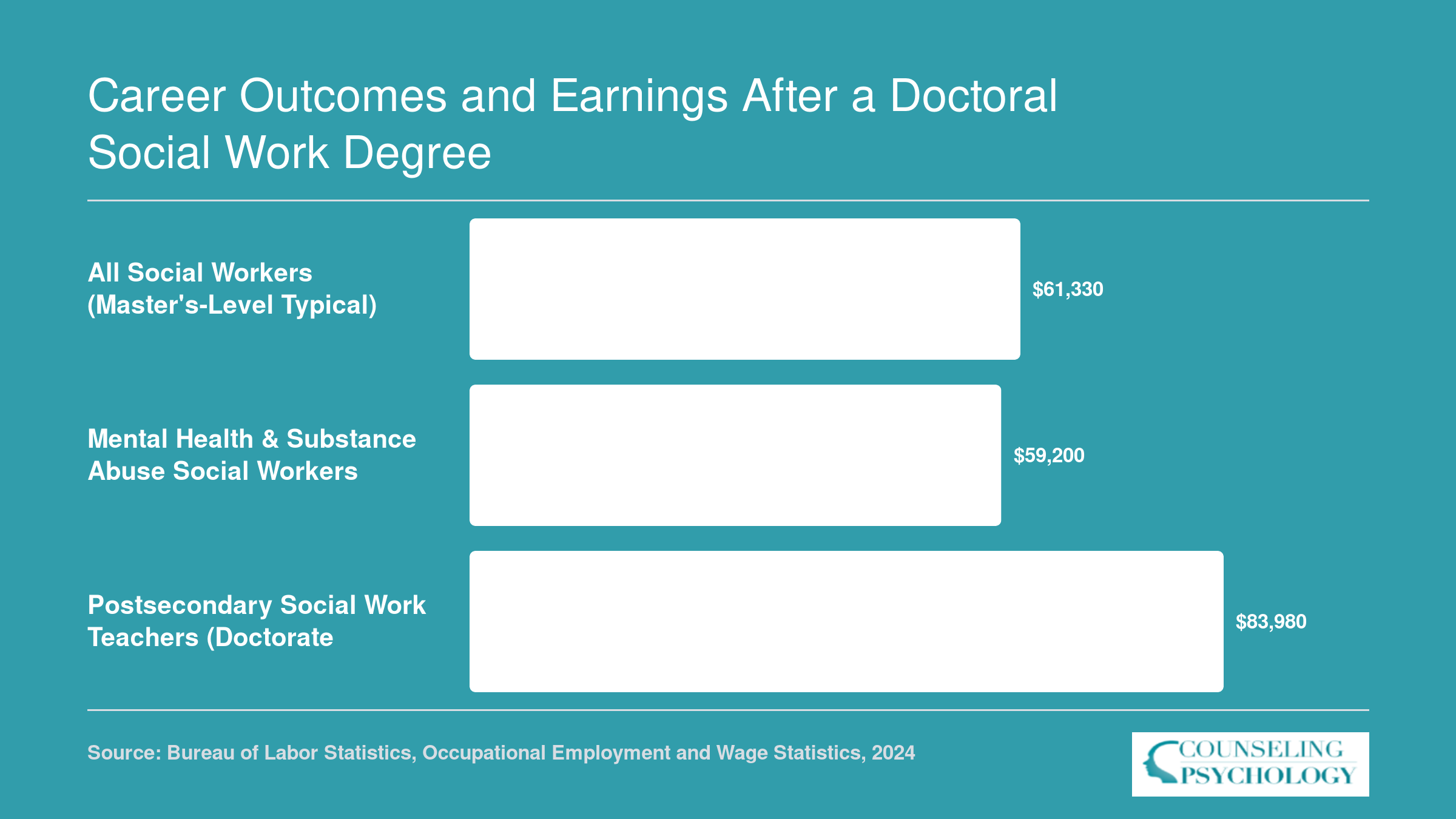
Is a doctorate in social work worth the investment? Program-level earnings data for the Ph.D. programs at UW-Madison and UW-Milwaukee are not yet published, so we can contextualize the doctoral premium using national BLS wage figures. The national median for all social workers (typically master's-level) was $61,330 in 2024, while postsecondary social work teachers, a role that generally requires a doctorate, earned a national median of $83,980 the same year. That roughly $22,650 gap illustrates the earning potential a doctoral degree can unlock, particularly for graduates pursuing academic or senior research positions. With median graduate debt at Wisconsin's flagship institutions hovering between $20,484 and $23,000, the long-term return on investment looks favorable for candidates who leverage the degree into faculty, administrative, or advanced clinical leadership roles.
Admissions Requirements and How to Apply
Doctoral social work programs set a high bar at the application stage, and knowing exactly what they expect lets you plan months, sometimes years, ahead.
Core Requirements Across Most Programs
Almost every DSW and Ph.D. program in social work requires the same foundational credentials:
- Degree prerequisite: A completed MSW from a CSWE-accredited program is non-negotiable at virtually all programs.
- GPA: Most programs want a minimum of 3.0, with competitive applicants often closer to 3.5 or above. UW-Madison's Social Welfare Ph.D. calculates the 3.0 floor against your last 60 undergraduate credits.1
- Post-MSW experience: Practice-focused DSW programs, including major online options like those at the University of St. Thomas and Rutgers, typically expect two or more years of post-MSW clinical work. Research-oriented Ph.D. programs weigh research exposure more heavily.
- Writing sample and statement of purpose: A polished writing sample and a clear, focused statement of purpose carry substantial weight. Admissions committees use these to assess scholarly readiness and fit with faculty research agendas.
- Letters of recommendation: Expect to provide three letters, ideally from academic mentors or supervisors who can speak directly to your capacity for doctoral-level work.
GRE Policy
The GRE has largely receded as a barrier. UW-Madison offers a GRE waiver for its Social Welfare Ph.D., and most well-regarded online DSW programs have either dropped the requirement entirely or made it optional.1 If you are applying to a program that still lists the GRE, contact the admissions office directly, since policies shifted significantly in recent years and published materials do not always reflect current practice.
UW-Madison also requires at least one prior statistics course and 30 semester credits in the social sciences. International applicants must meet English proficiency minimums (TOEFL 100, IELTS 7.0, or Duolingo 130).1
Application Timeline and When to Apply
Most doctoral social work programs admit one cohort per year, with fall start dates. Application deadlines cluster in December and January for the following fall. UW-Madison's Ph.D. program, for example, set a December 1 deadline for its 2025-2026 cycle.1
One important note for prospective UW-Madison applicants: the program admitted its most recent cohort for Fall 2026, is pausing admissions for the 2026-2027 cycle, and will next accept applications for Fall 2028 enrollment. Plan accordingly if UW-Madison is on your list.1
For online DSW programs, rolling or cohort-based admissions sometimes allow more flexibility, but priority deadlines still tend to fall in late fall or early winter.
How Long Does Completion Take?
Practice-focused DSW programs are generally designed for working professionals and run three to four years, often blending intensive residencies with online coursework. Ph.D. programs, which emphasize original research and dissertation work, typically take four to six years to complete, depending on dissertation progress and whether the student enrolls full-time or part-time. Factoring in application preparation time, plan on a full year between deciding to pursue a doctorate and your first day of class.
Licensure and Advanced Credentialing in Wisconsin
Earning a DSW or Ph.D. in social work does not automatically grant advanced licensure in Wisconsin. The Department of Safety and Professional Services (DSPS) requires every applicant to complete supervised clinical hours and pass the relevant exams, regardless of degree level. A doctorate confers no reduction in supervised hours, no exam waivers, and no automatic advanced standing. Here is the credentialing ladder most doctoral graduates follow.
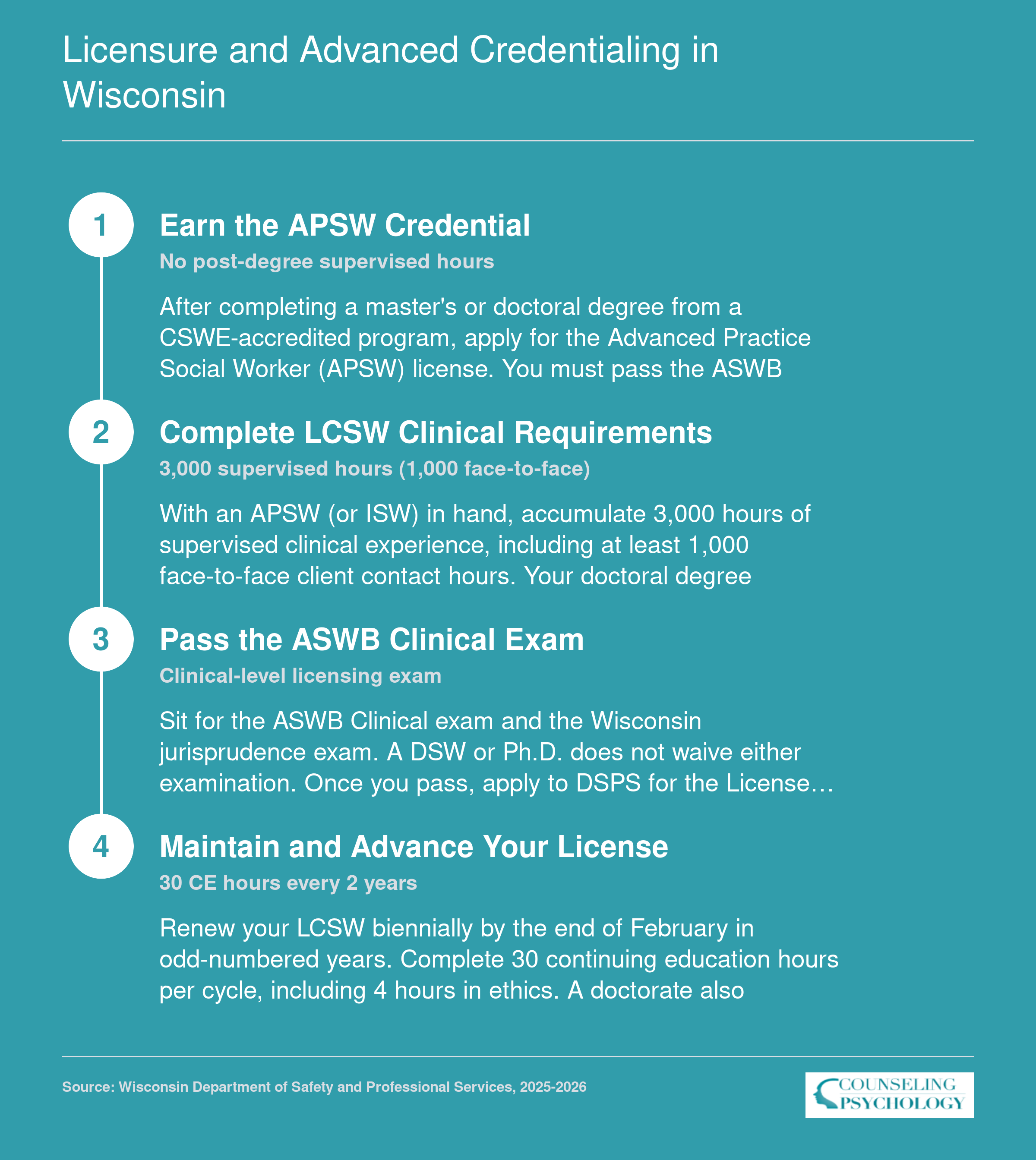
Earning a DSW or Ph.D. does not automatically qualify you for LCSW or APSW licensure in Wisconsin. You must still complete supervised clinical hours and pass required exams through the Department of Safety and Professional Services. Plan your clinical requirements alongside your doctoral coursework, not after graduation.
Frequently Asked Questions About Doctoral Social Work Programs
Prospective doctoral students in social work often have overlapping questions about degree types, program quality, and career outcomes. Below are direct answers to the most common questions, with a focus on considerations for Wisconsin residents exploring DSW and Ph.D. options near Madison.