
What you’ll learn in this article…
- On May 18, 2026, Elon University's CMHC program received NCASPPB Criteria C status, enabling a direct path to the LCAS credential.
- Criteria C designation confirms that a program meets North Carolina's coursework requirements for the Licensed Clinical Addictions Specialist credential.
- Prospective students should verify a program's Criteria C status on the NCASPPB website to avoid licensure delays.
Prospective clinical mental health counseling students often hit a wall of similar-sounding quality markers: CACREP-accredited, CACREP-aligned, Criteria C designated. One offers national portability for a licensed professional counselor career; the other confirms that a program's addiction-focused coursework meets North Carolina's specific training rules for the Licensed Clinical Addictions Specialist (LCAS) credential.
Criteria C is not a national accreditation but a curriculum review by the North Carolina Addictions Specialist Professional Practice Board (NCASPPB). It tells you, upfront, that graduates have completed the required education to pursue state addiction licensure without guesswork.
With North Carolina integrating mental health and substance use treatment more formally, knowing which label unlocks which license directly shapes where and how you can practice after graduation. For students weighing program options, online clinical mental health counseling programs vary widely in how they embed these licensure pathways, making early research essential.
What Is Criteria C Accreditation?
Criteria C is a curriculum-review designation granted by the North Carolina Addictions Specialist Professional Practice Board (NCASPPB). It confirms that a master's-level counseling program's required coursework and supervised clinical fieldwork fully satisfy the substance-use-disorder (SUD) education components for the Licensed Clinical Addictions Specialist (LCAS) credential in North Carolina.1 Unlike national programmatic accreditation, this is a state-board endorsement that targets integrated addictions- and mental-health training.
How the NCASPPB Tier System Works
The NCASPPB defines three pathways to the LCAS, labeled Criteria A, B, and C. Each represents a different set of eligibility documentation, not a ranking of quality.2
- Criteria A: The self-documented pathway. Candidates must hold a qualifying master's degree, complete 180 hours of SUD-specific education (with six hours in special topics), accrue 4,000 hours of supervised experience, and pass the IC&RC Alcohol and Drug Counselor (AADC) exam. Board pre-approval of the educational program is not required, but every course must be individually mapped to the board's content standards.2
- Criteria B: The credential-accelerated pathway. This is designed for practitioners who already hold a Certified Alcohol and Drug Counselor (CADC, formerly CSAC) credential and a qualifying master's degree. It waives the separate education and experience hour requirements entirely, though the AADC exam is still required.2
- Criteria C: The program-endorsed pathway. A master's-level program submits its curriculum for NCASPPB review. If approved, the board confirms that embedded coursework delivers the required 180 or more clock hours of SUD instruction and that required fieldwork includes supervised addictions-focused clinical experience.3 Graduates then need a reduced 2,000 hours of post-master's supervised experience and a passing score on the AADC exam.2
Criteria C Is a State Addictions Endorsement, Not a National Accreditation
It is important to distinguish Criteria C from national programmatic accreditations such as CACREP. For a broader look at how these national designations compare, CACREP vs. COAMFTE accreditation outlines the key differences between the two primary counseling-program standards. Criteria C is issued by a state addictions credentialing board and speaks only to a program's alignment with the LCAS requirements in North Carolina. It does not substitute for counseling-program accreditation and does not confer eligibility for licensure in other states unless those states have reciprocal arrangements. A program can hold Criteria C status while also being CACREP-accredited, but the two designations serve different purposes.
How Criteria C Streamlines Your Licensure Path
The primary practical benefit of graduating from a Criteria C program is that your transcript already maps to the board's expectations. You submit your degree documentation as a pre-approved package; the NCASPPB does not re-audit individual course descriptions. That eliminates the back-and-forth many Criteria A applicants face when a board reviewer questions whether a given course meets a specific content area. For anyone planning to pursue addiction counseling programs in North Carolina, this direct route can shorten the time from graduation to receiving LCAS candidate status.
How Criteria C Connects to the LCAS Credential in North Carolina
North Carolina's push toward integrated behavioral healthcare has made the Licensed Clinical Addictions Specialist (LCAS) credential more valuable than ever. For clinical mental health counseling students, earning the LCAS represents a direct path to work in settings where mental health and substance use disorders are treated together.
The LCAS Credential at a Glance
The LCAS is a master's-level credential issued by the North Carolina Addictions Specialist Professional Practice Board (NCASPPB).1 To apply, you must hold a master's degree in a behavioral health discipline and complete a clinical internship that includes at least 180 hours of direct addictions counseling experience.1 Required coursework covers HIV/AIDS, professional ethics, clinical supervision, and a specialty area.2 All candidates must pass the IC&RC Alcohol and Drug Counselor (AADC) exam3 and document post-graduate supervised work experience. The number of required supervised hours depends on your educational pathway.
How a Criteria C Program Simplifies the Pathway
A Criteria C designation signals that a master's program has been pre-approved by the NCASPPB as meeting the addictions-specific education and clinical training standards. For graduates, this eliminates the need for a course-by-course transcript review and streamlines the application. The biggest advantage is time: instead of completing 4,000 hours of post-degree supervised experience (the requirement for graduates of non-approved programs), Criteria C graduates need 2,000 hours. This can shorten the timeline to full licensure by a year or more. If you are weighing LCAS North Carolina credential pathways, understanding which program tier your degree falls under is one of the most consequential decisions you will make before enrolling.
Post-Graduation Supervision: What to Expect
Graduating from a Criteria C program does not waive supervised experience, it reduces it. You must still complete 2,000 hours of supervised clinical work under a board-approved supervisor, typically a fully licensed LCAS or equivalent.1 Your supervision plan and documentation are submitted through the online LearningBuilder system.1 Once hours are accrued and the exam is passed, you become eligible for the full LCAS license.
Why the LCAS Matters in Integrated Care
Employers increasingly seek clinicians who can treat co-occurring disorders. Mental health centers, hospitals, and integrated primary care practices often require or strongly prefer the LCAS for addictions caseloads. Holding both a clinical mental health counseling license and the LCAS expands your scope, strengthens your candidacy for leadership roles, and aligns with the movement toward whole-person care.
Questions to Ask Yourself
Criteria C vs. CACREP Accreditation: Understanding the Difference
When evaluating clinical mental health counseling programs, you will encounter two distinct quality markers: Criteria C status and CACREP accreditation. These designations serve different purposes and operate at different levels, but they are not mutually exclusive. Understanding the distinction helps you choose a program that aligns with your career goals.
Different Scopes and Purposes
Criteria C is a state-level curriculum endorsement granted by the North Carolina Addictions Specialist Professional Practice Board (NCASPPB). It specifically confirms that a master's program's coursework and supervised training meet the educational requirements for the Licensed Clinical Addictions Specialist (LCAS) pathway in North Carolina. In contrast, CACREP (the Council for Accreditation of Counseling and Related Educational Programs) is a national programmatic accreditor recognized by both the Council for Higher Education Accreditation (CHEA) and the U.S. Department of Education.1 CACREP evaluates entire counseling programs at the master's and doctoral levels against comprehensive standards for professional preparation.
Curriculum and Clinical Requirements Compared
The two designations have different curricular expectations. Criteria C programs typically require 42 to 48 credit hours, focused on addictions counseling competencies, with a minimum of 600 hours of supervised clinical field experience. Practicum hours are not separately mandated. CACREP-accredited programs, however, require a minimum of 60 credit hours, including a 100-hour practicum and a 600-hour internship, totaling 700 hours of clinical experience. This broader curriculum covers the eight core areas of counseling practice, preparing graduates for general licensure as professional counselors.
Recognition and Portability
CACREP accreditation carries national recognition and is explicitly written into state licensure laws in four states, making it easier for graduates to obtain licensure across state lines.3 Criteria C, by comparison, is specific to North Carolina's LCAS credential and is not currently recognized by CHEA or included in other states' licensing board standards. Its value is concentrated within the state's addictions counseling workforce.
Can a Program Have Both?
Absolutely. There is no conflict between holding CACREP accreditation and Criteria C status. A program may intentionally design its curriculum to meet both sets of standards, offering graduates the broadest possible career flexibility. accredited clinical mental health counseling programs that also align addictions coursework with NCASPPB requirements can simultaneously prepare students for general clinical licensure and the LCAS credential.
Avoiding Common Accreditation Confusions
Prospective students often confuse institutional accreditation (which applies to the entire university), programmatic accreditation (like CACREP), and state-board curriculum endorsements (like Criteria C). Institutional accreditation ensures the university meets basic quality standards. Programmatic accreditation tells you a specific degree program meets rigorous professional preparation benchmarks. A state-board curriculum endorsement confirms alignment with a particular state's credentialing pathway. A strong CMHC program may hold all three, and evaluating online counseling degree programs by these layers helps you assess the full scope of your educational investment.
CACREP-Accredited vs. CACREP-Aligned Programs: What's the Real Difference?
At least four states, Florida, Kentucky, North Carolina, and Ohio, now require a CACREP-accredited degree for professional counselor licensure, while others like California do not mandate it. For students evaluating clinical mental health counseling programs, the distinction between CACREP-accredited and CACREP-aligned can shape your entire licensure path.
What Does CACREP-Accredited Mean?
A CACREP-accredited program has undergone a rigorous, multi-year review by the Council for Accreditation of Counseling and Related Educational Programs.2 This process examines faculty qualifications, curriculum content, clinical training sites, and student assessment practices to confirm the program meets all current CACREP standards. The accreditation is a formal status, listed publicly in the CACREP directory, and signals that the program has demonstrated consistent quality through an external, peer-driven evaluation. When a state licensing board requires a CACREP-accredited degree, only graduates of programs with active accreditation can typically qualify.
What Programs Mean by CACREP-Aligned
A CACREP-aligned program models its coursework and supervised practicum requirements on CACREP standards but has not completed, or even entered, the formal accreditation process. This language is common among new programs that are still building their track record, programs housed within institutions that prioritize other accreditors (such as MPCAC), or programs that face budgetary constraints and choose not to pursue the full review. Alignment often means the curriculum covers the same content areas and credit-hour expectations, but it does not carry the same third-party verification of quality. Without accreditation documentation, licensing boards may not recognize the program as meeting equivalency, particularly in states with strict degree requirements.
Licensure Impact and State Variability
The real-world difference becomes most visible at the licensure application stage. In states like Florida, the path shifted in 2025: as of July 1, applicants for the LMHC credential must hold a degree from a CACREP-accredited program, an MPCAC-accredited program, or an equivalent accreditor.3 Kentucky and North Carolina mandate CACREP-accredited degrees for the LPCC and LCMHC respectively, and Ohio requires the same for its LPCC.2 In contrast, California does not impose a CACREP requirement. For counselors who anticipate relocating, this patchwork creates portability challenges. A graduate of a CACREP-aligned program may qualify in one state but face extra coursework or supervised experience requirements in another. online counseling program accreditation choices made at enrollment can follow you across state lines.
How to Verify Claims of Alignment
If a program describes itself as CACREP-aligned, ask for specifics: Which CACREP content standards does the curriculum address? Is there a crosswalk document mapping courses to the standards? Has any external body reviewed the alignment? Programs that can provide such materials show a genuine effort to meet national benchmarks. Also, contact your intended state licensing board directly to ask if they accept degrees from CACREP-aligned programs. Board staff can offer the most current guidance and may have a list of pre-approved programs. Relying solely on a program's marketing language without independent verification can delay your licensure timeline. The states with highest need for counselors are often those tightening accreditation requirements, so understanding these distinctions early protects your investment.
Why Criteria C Matters: Career Benefits for CMHC Graduates
Criteria C accreditation directly improves career prospects for clinical mental health counseling graduates by opening doors to licensure pathways that are in high demand. With the Licensed Clinical Addictions Specialist (LCAS) credential, you can serve a broader client base and qualify for specialized positions that integrate mental health and substance use treatment, a skillset that many employers now seek.
The Growing Demand for Integrated Treatment Skills
Mental health and substance use disorders frequently co-occur, and employers from community clinics to hospital systems actively recruit counselors trained in both areas. By completing a Criteria C program, you demonstrate competence in addictions counseling, trauma-informed care, and integrated treatment, capabilities that set you apart in a competitive job market. Many graduates find that LCAS eligibility expands their practice scope, making them versatile candidates for roles in outpatient treatment centers, residential facilities, and private practice. If you are still weighing your options, reviewing the types of counseling degrees available can help clarify which master's path aligns with your clinical goals.
How Accreditation Shapes Hiring Decisions
Employer preferences for program accreditation vary by setting. Some federal employers, like the Department of Veterans Affairs, have historically listed CACREP accreditation as a preferred qualification for licensed professional counselors. While a Criteria C credential may not be a direct substitute, it signals that your training meets rigorous state board standards, which can be equally valuable when an employer prioritizes licensed, practice-ready clinicians. Always verify whether an employer requires a specific programmatic accreditation or simply accepts any license-eligible degree.
Practical Steps to Research Employer Expectations
Prospective students can take several concrete steps to understand how accreditation influences career outcomes:
- Check the U.S. Bureau of Labor Statistics website for occupational outlook data on substance abuse, behavioral disorder, and mental health counselors. Pay attention to typical education requirements and job growth projections, even if they are presented broadly.
- Search for licensed professional counselor positions on usajobs.gov and examine the qualifications section. Note whether CACREP accreditation appears as a requirement or a preference, and how much weight it carries relative to state licensure.
- Visit the websites of clinical mental health counseling programs you are considering. Many institutions publish graduate employment rates, employer partnerships, and lists of organizations where alumni work.
- Contact professional associations such as the American Mental Health Counselors Association (AMHCA) or the National Board for Certified Counselors (NBCC). They can offer guidance on how accreditation status affects hiring in federal settings, substance use clinics, and other specialized environments.
Positioning Yourself for Long-Term Career Growth
Ultimately, Criteria C accreditation offers a clear advantage: it maps directly to a credential that addresses a recognized workforce shortage. By aligning your education with licensure requirements, you not only meet employer expectations but also signal a commitment to ethical, integrated care. Use the resources mentioned to build a job search strategy that highlights your dual competencies, and you will be well positioned for a rewarding career in clinical mental health counseling.
Criteria C status complements, rather than replaces, CACREP accreditation. It adds a state-board-approved pathway to the Licensed Clinical Addictions Specialist (LCAS) credential, giving graduates distinct expertise in treating co-occurring mental health and substance use disorders. This prepares them for versatile roles in integrated-care teams, hospitals, and community agencies.
Case Study: Elon University's CMHC Program Earns Criteria C Status
Choosing a clinical mental health counseling master's program means weighing established reputations against programs that build emerging credentials directly into their design. For students eyeing the Licensed Clinical Addictions Specialist (LCAS) in North Carolina, Elon University's new Clinical Mental Health Counseling (CMHC) program illustrates what that forward-looking approach can offer. On May 18, 2026, Elon announced that its CMHC master's program had received Criteria C status from the North Carolina Addictions Specialist Professional Practice Board (NCASPPB), a recognition that positions its graduates to pursue LCAS credentialing with a streamlined, integrated training foundation.1
A Milestone for Integrated Addictions Training
Instead of adding addictions coursework as an afterthought, Elon structured its CMHC program from the outset to meet NCASPPB's Criteria C requirements. This means the 60-credit curriculum includes the specific didactic and supervised clinical hours necessary for the LCAS pathway, eliminating the need for graduates to pursue separate, post-degree addictions education. For prospective students, this design reduces the time and cost associated with stacking credentials later, while signaling that the program sees substance use and mental health care as inextricably linked. Students who want to understand the broader landscape of addiction counseling vs. addiction psychology before choosing a specialty will find that Elon's integrated model sits squarely at the intersection of both fields.
Program Design: Hybrid Cohort and Curriculum
Housed in Elon's School of Health Sciences, the CMHC program uses a hybrid cohort model, blending online coursework with periodic on-campus intensives, to accommodate working professionals and students from across the state. The curriculum combines core counseling competencies with specialized training in trauma-informed care, addictions counseling, wellness strategies, and emerging mental health practices. Close faculty mentorship and immersive clinical training are cornerstones of the experience. Students complete supervised practicum and internship placements through partnerships with community agencies, gaining real-world exposure to integrated behavioral health settings. Applications for the Fall 2026 inaugural cohort were open until June 15, 2026, offering an early opportunity to join a program built around the LCAS pathway.
Faculty Vision: Competent, Ethical, Relationship-Centered Care
Two faculty leaders captured the program's ethos. Associate Professor Raychelle Lohmann stated, "This milestone reflects Elon University's commitment to preparing highly competent, ethical, and adaptable counselors."1 Interim Program Director Judy Folmar added, "Mental health and substance use challenges are deeply interconnected, and our students will learn to approach care in integrated, ethical, and relationship-centered ways."1 These statements highlight a deliberate move away from siloed treatment models toward a holistic, relationship-driven approach that many employers now demand.
Why a Built-in Credential Matters for the Field
Elon's decision to seek Criteria C status at launch, rather than retrofitting an existing program, reflects a growing institutional recognition that addictions counseling is not a niche specialty but a core part of mental health practice. Counseling specialties are multiplying as the field responds to co-occurring disorders and workforce gaps, and programs that embed licensure pathways from day one give graduates a measurable head start. As overdose rates and co-occurring disorders continue to strain communities, counselors trained from day one in integrated care will be better positioned to lead. For students, selecting a program that already holds this status can simplify licensure and accelerate entry into a workforce that urgently needs dual-competent clinicians.
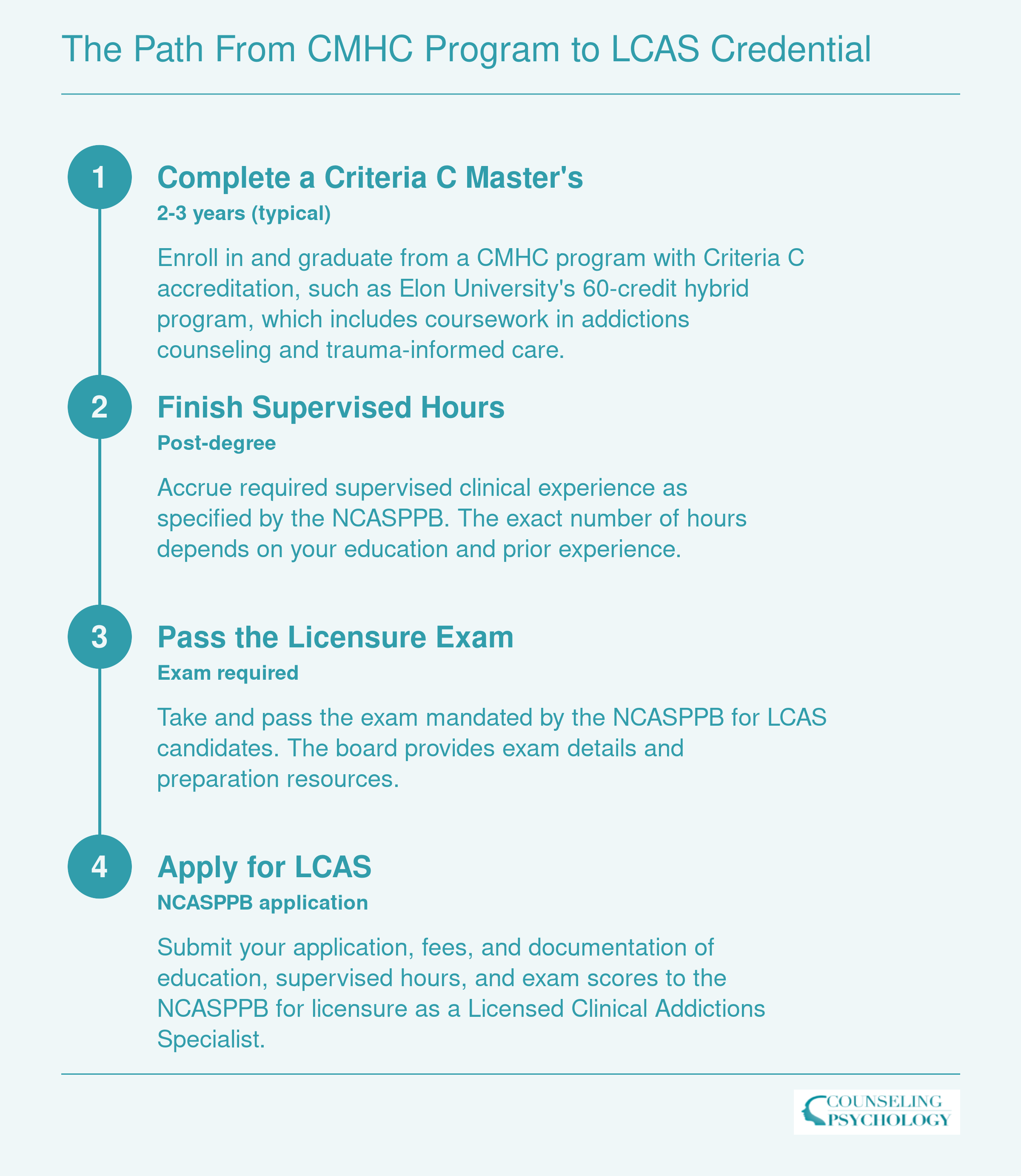
The Path from CMHC Program to LCAS Credential
The North Carolina Addictions Specialist Professional Practice Board (NCASPPB) established Criteria C accreditation to ensure counselors entering addiction treatment are thoroughly prepared. For students in clinical mental health counseling programs, meeting this standard creates a direct route to the Licensed Clinical Addictions Specialist (LCAS) credential. Here's how the process works.
How to Verify a CMHC Program's Accreditation Status
Relying solely on a program's marketing claims versus doing your own independent verification can mean the difference between a smooth path to licensure and unexpected roadblocks. Before you enroll, use these four steps to confirm exactly where a program stands.
Step 1: Search the CACREP Directory
Go to cacrep.org and use the public directory. Search by institution or program name. Look specifically for the clinical mental health counseling master's program listing. A fully accredited entry will show clear accreditation dates and any interim conditions. If the program is not listed or appears only under a broader counseling entry without the CMHC specialization, it may not hold active CACREP accreditation for that track.
Step 2: Confirm Criteria C Status with the NCASPPB
For programs in North Carolina that advertise Criteria C status, do not take the claim at face value. Visit the North Carolina Addictions Specialist Professional Practice Board website or contact the board directly. Ask whether the specific master's program holds current Criteria C approval, as this designation confirms the curriculum meets the educational requirements for the Licensed Clinical Addictions Specialist (LCAS) pathway. Board staff can tell you if the program is in good standing and when the status was granted.
Step 3: Scrutinize Program Disclosures
Read accreditation language on the program's website carefully. Precise wording matters. Evaluating online counseling degree programs by accreditation standing is a skill that pays off long before you submit an application. Look for these distinctions: - Accredited: The program has been reviewed and approved by the recognized accrediting body. - Aligned: The curriculum follows accrediting standards but the program itself has not yet earned accreditation. - In pursuit of accreditation: The program has begun the accreditation process but has not yet been granted status.
If the language feels vague, contact admissions and ask for written documentation of the program's current accreditation standing. Request evidence such as a board letter or a certificate of approval.
Step 4: Contact Your Target State Licensing Board
Licensure requirements vary by state, and a program's accreditation may not transfer seamlessly. Before committing, call or email the licensing board in the state where you intend to practice. Confirm that the program's accreditation combination, whether CACREP, Criteria C, or both, will meet that state's educational prerequisites for the license you seek, such as LCMHC, LCAS, or LPC. Board staff can often provide a pre-approval review or direct you to a list of approved programs.
Frequently Asked Questions About CMHC Accreditation
Navigating accreditation terms can be confusing. These answers clarify what Criteria C status means, how it differs from CACREP recognition, and why it matters for your counseling career.
Related Articles
The right program accreditation is not a box to check; it is the foundation of your licensure eligibility and long-term career mobility. As you evaluate programs, confirm both CACREP accreditation (or alignment where accepted) and any state-board designations such as Criteria C. These marks don't compete; they answer different questions about your future practice.
As integrated mental health and substance use treatment becomes the standard of care, counselors who hold credentials like the LCAS, grounded in Criteria C training, will find their expertise in increasingly high demand. For students still exploring how a clinical mental health counseling online degree fits into this landscape, comparing program features alongside accreditation status is a useful first step. Verify every program's status directly with state boards before you commit; this step alone can shape the first decade of your career.