What you’ll learn in this article…
- The University of Missouri-Columbia and UMSL both set a December 1 PhD application deadline for fall 2026 entry.
- Missouri licensure as a psychologist requires passing three separate exams after completing 10 to 14 years of combined education and training.
- Graduate assistantships at nearby programs can dramatically reduce out-of-pocket costs for doctoral students in developmental psychology.
- BLS occupational wages and College Scorecard program earnings measure different things, so comparing them requires careful context.
Columbia sits at the center of Missouri's higher-education corridor, home to the University of Missouri flagship campus and within two hours of nationally ranked doctoral programs in St. Louis. Demand for psychologists specializing in child development, aging, and lifespan transitions continues to grow across Missouri, driven by an aging rural population, expanding behavioral-health integration in pediatric clinics, and rising awareness of early-childhood intervention.
Programs near Columbia span bachelor's concentrations, master's tracks, and full-time PhD concentrations in experimental or clinical-developmental psychology. Tuition varies dramatically: a bachelor's program at a regional campus may cost one-tenth the sticker price of a private research university, yet net price after aid often narrows the gap. Washington University in St. Louis and Saint Louis University offer doctoral training with full funding packages, while Central Methodist and MU serve undergraduates looking to build research credentials before applying to graduate school.
Missouri requires a doctoral degree and 2,000 supervised hours before granting psychology licensure, a timeline that shapes every program decision from day one. Students interested in related graduate paths in the state may also want to review MFT programs in Missouri as a complementary option.
Best Developmental Psychology Programs Near Columbia, Missouri
This curated shortlist highlights the strongest developmental psychology programs within reach of Columbia, Missouri, balancing cost, outcomes, and research depth. Each school brings a distinct value proposition, whether you are launching an undergraduate career, pursuing a doctoral concentration, or seeking a budget-friendly path close to home. Graduation rates listed below are institution-wide figures and do not reflect a single program. Program-level median earnings data are not yet available for any of the three programs featured here; institution-wide earnings at ten years post-enrollment are included for broader context.
- Program relevance and specialization depth
- Institutional graduation and retention rates
- Net price after financial aid
- Research and mentorship opportunities
- Proximity to Columbia, Missouri
- Internal program database
- Independent program research
- NCES-IPEDS federal institutional data — nces.ed.gov
- College Scorecard graduate earnings — collegescorecard.ed.gov

Washington University in St Louis
Washington University in St. Louis pairs a prestigious Psychological and Brain Sciences department with a dedicated Lifespan Development specialization, giving undergraduates access to an aging and neuroscience research ecosystem that is rare at the bachelor's level. Collaborations with the campus Alzheimer's Disease Research Center and geriatric medicine groups open doors to hands-on study with older adult populations. A 7:1 student-to-faculty ratio and a 94.3% institution-wide graduation rate underscore the university's commitment to intensive mentorship, while substantial need-based and merit aid brings the typical net price to roughly $21,786.
- Focus on cognitive and physiological changes across the entire lifespan
- Emphasis on older adulthood and aging-related research
- Requires 43 to 46 units, combining core courses and electives
- Campus-based with strong faculty mentorship in every lab
- Culminates in a research project or supervised internship
- Combines theory and practice to prepare students for graduate programs
- Diverse elective options spanning developmental and clinical topics
Psychological & Brain Sciences, Lifespan Development Specialization (Bachelor's) — On-Campus

Saint Louis University
Saint Louis University offers one of the few fully funded doctoral pathways in developmental psychology within Missouri. Its Experimental Psychology Ph.D. with a Developmental Psychology concentration trains students through a vertical research team model, pairing newer cohort members with advanced students and faculty across multiple ongoing projects. The program does not require GRE scores, a practical advantage for working applicants. SLU's developmental labs maintain active collaborations with St. Louis area schools and community agencies, grounding doctoral research in real-world settings with Missouri children and families.
- Full-time, funded Ph.D. requiring 56 credit hours
- No GRE scores required for admission
- Vertical research team pairs students with experienced mentors
- Three concentration areas: cognitive neuroscience, developmental, social
- Multiple developmental labs with community-embedded projects
- Admits roughly three to four students per year
- Prepares graduates for academic and advanced research careers
- Comprehensive training in both quantitative and qualitative methods
Experimental Psychology Ph.D., Developmental Psychology Concentration (Doctorate) — On-Campus

Central Methodist University-College of Graduate and Extended Studies
Central Methodist University in Fayette sits just 30 minutes from Columbia, making it the closest campus on this list with a formal developmental psychology concentration. The BA or BS in Psychology lets students specialize in developmental topics while benefiting from a small-college setting, a required Senior Thesis, and practical data-analysis coursework that builds a strong graduate-school portfolio. At roughly $14,601 net price after aid, CMU delivers an affordable entry into the field, though students should weigh a higher student-to-faculty ratio and more modest institutional resources against the school's proximity and cost advantage.
- Minimum 120 credit hours with developmental concentration
- Required Senior Thesis builds hands-on research experience
- Coursework spans biological, applied, counseling, and developmental areas
- Emphasis on research design and practical data analysis skills
- Campus-based program on the Fayette, Missouri campus
- General education component totals 32 hours
- Psychology major requirements range from 24 to 30 hours
Bachelor of Arts or Bachelor of Science in Psychology, Developmental Psychology Concentration (Bachelor's) — On-Campus
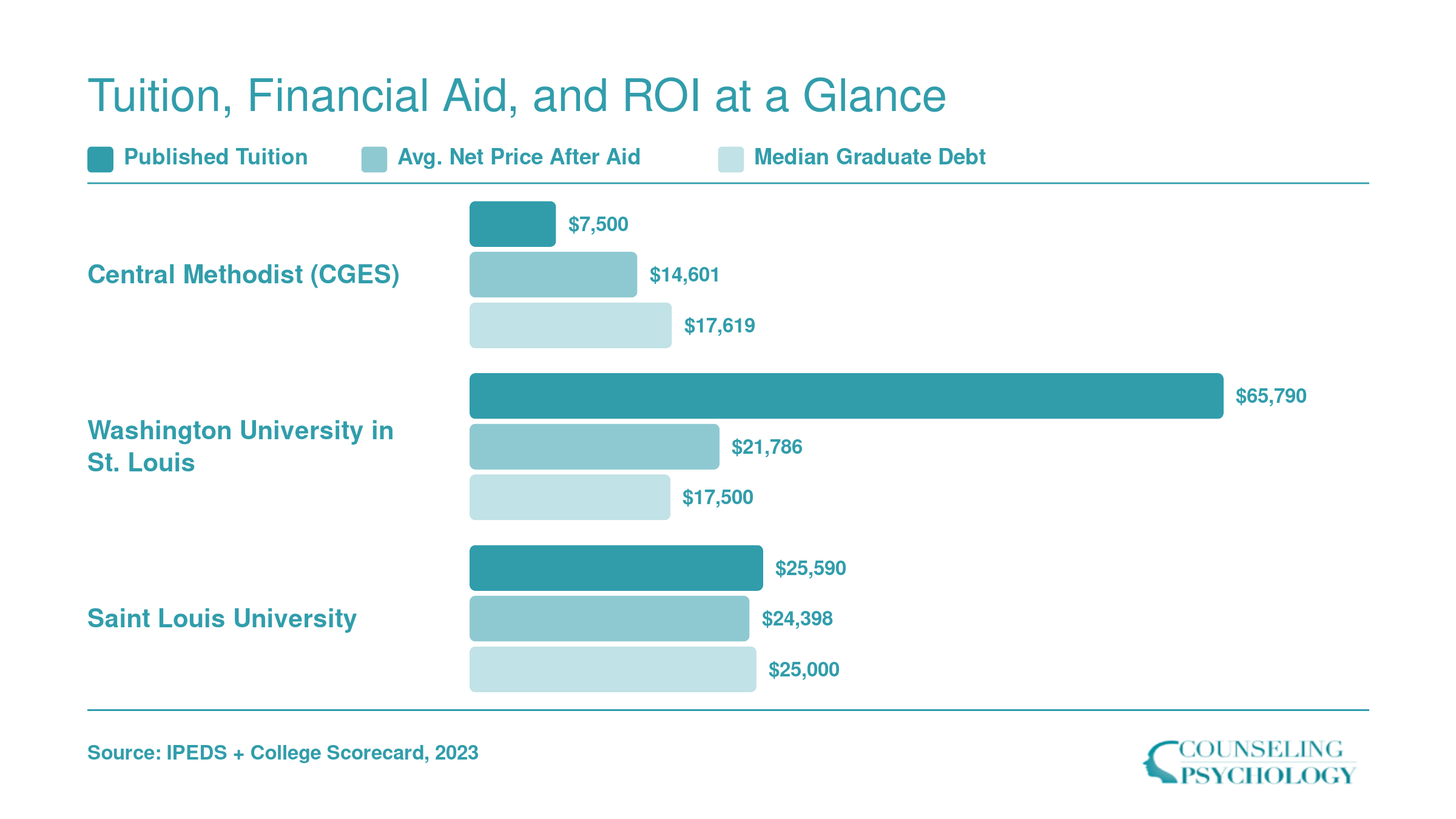
Tuition, Financial Aid, and ROI at a Glance
Sticker price rarely tells the full story. The net price after institutional aid, grants, and scholarships can differ dramatically from posted tuition, especially at private universities with large endowments. The figures below reflect institution-wide averages; your individual aid package may be higher or lower depending on academic merit, financial need, and program-level funding.
Funding, Assistantships, and Scholarships at Nearby Programs
Graduate education in developmental psychology represents a significant financial commitment, but most Missouri programs near Columbia offer structured funding packages that dramatically reduce out-of-pocket costs. Understanding the landscape of assistantships, fellowships, and institutional aid will help you plan effectively for the 2026-2027 academic year.
Graduate Assistantships and Stipend Ranges
Graduate assistantships remain the primary funding mechanism for psychology master's and doctoral students in Missouri. At the University of Missouri, standard assistantships require 20 hours of work per week (0.5 FTE) and typically cover tuition plus a stipend; specific stipend amounts vary by department and are negotiated annually, so contact the psychology department for current figures.1 International students are generally capped at 20 work hours per week, while domestic students may work up to 28 hours if they hold multiple assistantships.1
Missouri State University offers psychology graduate assistantships with a nine-month stipend of $7,340 for the 2025-2026 year, plus an additional $1,835 for summer work. Assistants receive full tuition coverage for up to 12 credits per semester during fall and spring, and up to 6 credits during summer terms.2 To qualify, students must maintain a 3.0 GPA and enroll in at least 6 credits per term.
Southeast Missouri State University provides a more generous stipend of $9,947 for 2025-2026, with tuition coverage for 9 credits in fall and spring and 6 credits in summer.3 The department typically offers two assistantship positions annually, requiring a minimum 6-credit enrollment.
Fellowships and Specialized Support
Beyond standard assistantships, many programs maintain competitive fellowships that reduce or eliminate teaching responsibilities, allowing students to focus on research. University-wide fellowships at Mizzou and other institutions often include health insurance benefits alongside tuition and stipend support. Doctoral students may also access multi-year funding packages; for example, some PhD programs at Mizzou guarantee 9-month funding for the duration of the degree, with work expectations ranging from 10 to 20 hours per week.4 If you are exploring doctoral-level options more broadly, reviewing best developmental psychology PhD programs can help you compare funding structures across institutions.
University-Wide Financial Aid Resources
All students should complete the FAFSA to access federal loans and need-based institutional grants. Data on undergraduate Pell grant shares offer a window into each institution's commitment to access: Washington University in St. Louis reports 42% of undergraduates receiving Pell grants, while Central Methodist University serves 66% Pell recipients, signaling a culture of affordability and aid.
Planning for 2026-2027
Funding packages evolve annually. Reach out to department graduate coordinators directly in fall 2025 or early 2026 to confirm current stipend levels, health insurance coverage, and application deadlines. Whether you are pursuing a developmental psychology masters or a doctoral track, many programs prioritize assistantship offers for students who apply by early deadlines, so submit materials as soon as applications open.
Related Articles
Degree Levels and Program Formats: Bachelor's Through PhD
Students today encounter a clearly defined ladder in developmental psychology, where each rung opens different career doors and comes with its own time and financial investment. Understanding what degree is needed for developmental psychology means first recognizing that the answer depends entirely on your career goals: a bachelor's launches entry-level roles, a master's qualifies you for supervised applied work, and a doctorate is the only route to independent licensure and clinical practice.
Bachelor's Programs: The Four-Year Foundation
A bachelor's degree in psychology or child development typically requires four years of full-time study and serves as the entry point for the field. Washington University in St. Louis offers a Psychological & Brain Sciences major with a Lifespan Development specialization, delivered on campus and requiring 43-46 units. Central Methodist University-College of Graduate and Extended Studies structures its Bachelor of Arts or Bachelor of Science in Psychology with a Developmental Psychology concentration around a minimum of 120 hours, including a senior thesis and coursework spanning four psychology areas. At this level, graduates qualify for positions as research assistants, case managers, or paraprofessionals in educational and social-service settings, but not for independent practice or licensure.
Master's Degrees: Applied Roles and Research Positions
A master's in developmental psychology typically spans two to three years and prepares graduates for supervised roles in clinical settings, schools, community agencies, and research labs. Programs at this level are less common in Missouri specifically for developmental psychology, though related tracks in clinical or school psychology exist at several institutions. Master's holders can work as program coordinators, assessment specialists, or research project managers, but cannot practice independently as licensed psychologists.
Doctoral Programs: PhD and PsyD Pathways
Independent practice and licensure as a psychologist require a doctorate. Saint Louis University's Experimental Psychology PhD with a Developmental Psychology concentration exemplifies the research-intensive PhD model, requiring 56 credit hours over approximately five to seven years and organizing students into research vertical teams. The program follows a mentorship-focused approach and does not require GRE scores for admission in 2026. PhD programs emphasize original research, dissertation work, and preparation for academic or high-level research careers.
PsyD programs, which prioritize clinical training over research, typically run four to five years. While no PsyD programs with a developmental emphasis appear in the immediate Columbia area, students often ask what the shortest PsyD program available is. Some institutions nationwide offer accelerated formats that compress coursework and practicum into as few as three and a half to four years, though these intensive schedules demand full-time commitment and often limit opportunities for assistantships or outside employment. Those drawn to working with younger populations should also explore child psychologist degree requirements to understand how doctoral training maps onto that specialization.
Format Options: Campus vs. Online
All three programs in the dataset operate on campus, reflecting a broader trend: bachelor's and doctoral programs in developmental psychology overwhelmingly favor in-person formats to support lab work, mentorship, and supervised practica. Online master's programs exist in related psychology specializations but remain rare at the doctoral level due to accreditation and practicum requirements. Students pursuing licensure should verify that any program, regardless of format, holds regional accreditation and meets Missouri Board of Psychology standards for supervised experience hours. For a wider look at the professional landscape, reviewing careers in psychology can help you connect degree-level decisions to long-term outcomes.
Questions to Ask Yourself
Admissions Requirements and Selectivity for 2026–2027
A December 1 application deadline applies to both the University of Missouri-Columbia (MU) and the University of Missouri-St. Louis (UMSL) PhD programs, meaning fall 2026 applicants should treat late November as the practical cutoff for assembling materials.1
GPA Benchmarks
Most Missouri doctoral programs set a 3.0 undergraduate GPA as the minimum for serious consideration, but minimums and competitive realities are different things.1 Saint Louis University's Clinical Psychology PhD lists a notably higher threshold of 3.7, reflecting the program's selectivity.1 Competitive applicants to any PhD program typically present GPAs well above stated minimums, along with research experience that supports their personal statement. If you are wondering how hard is it to get into grad school for psychology, GPA is only one piece of a holistic review.
Standardized Testing
GRE policies vary by program and are worth verifying directly before applying. MU's Developmental/Child Psychology PhD currently requires GRE scores.1 SLU's Experimental Psychology PhD, by contrast, has moved to a no-GRE policy. UMSL's requirements should be confirmed on the program's current admissions page, as test-optional policies across psychology programs have shifted in recent years. None of the facts available for 2026-2027 confirm a universal testing standard across Missouri programs, so do not assume one policy applies everywhere.
Prerequisite Coursework and Supporting Materials
Undergraduate preparation is taken seriously at the doctoral level. MU requires at least 15 hours of behavioral science coursework, including statistics.2 UMSL and SLU each expect 21 undergraduate psychology credits.1 Missouri State University's master's-level programs ask for a psychology major or equivalent substantial preparation, and applications are reviewed on a rolling basis, which rewards early submission.1
Beyond transcripts and test scores, PhD programs typically expect:
- Letters of recommendation: MU requires three; doctoral programs elsewhere generally follow the same convention.1
- Writing sample: MU asks for one, and it is an opportunity to demonstrate research thinking, not just writing mechanics.1
- Personal statement: Nearly universal at the doctoral level; articulating fit with specific faculty is more effective than a generic statement of purpose.
- Interview: UMSL invites select applicants for interviews before making admissions decisions.1
Students interested in broader developmental psychology degree online options may find that similar prerequisite expectations apply nationwide.
Application Timing
All doctoral programs in this region admit for fall entry only.1 There are no spring start options at the PhD level among the programs covered here. Rolling admissions at Missouri State's graduate programs means master's applicants have more flexibility, but waiting until spring to apply for a fall start carries real risk if cohort seats fill early. Confirm all deadlines directly with each program for the 2026-2027 cycle, as institutional policies occasionally shift between catalog years.
Career Outcomes and Earnings After Graduation
A developmental psychology degree opens doors to a wider range of careers than most students expect, from clinical practice and school-based roles to research labs and tenure-track faculty positions.
What Can You Do With a Developmental Psychology Degree?
Graduates at the bachelor's level often move into entry-level roles such as child development specialist, behavioral technician, early intervention coordinator, or research assistant in university or nonprofit settings. Those interested in foundational coursework may want to explore a child psychology degree online before committing to a graduate track. Students who continue to the master's or doctoral level unlock higher-responsibility positions:
- Research positions: University labs, federal agencies (NIH, CDC), and private think tanks regularly hire developmental psychologists to design and run studies on cognitive, social, and emotional growth across the lifespan.
- School psychologist: With appropriate credentialing, developmental psychology graduates assess learning differences, design individualized education plans, and consult with teachers and families.
- Clinical roles: Doctoral graduates who pursue licensure can diagnose and treat children, adolescents, or aging adults in clinical settings.
- Academic faculty: A PhD is the standard entry point for professorships, where teaching and publishing go hand in hand.
- Applied specialists: Roles in pediatric hospitals, child welfare agencies, policy organizations, and educational technology firms draw directly on developmental expertise.
Program-Level Earnings Data
For the Missouri programs profiled on counselingpsychology.org, program-level earnings data at one, two, four, and five years after completion are not yet available through federal reporting. Employment share figures and the proportion of graduates earning above 150% of the federal poverty line are also not currently published for these specific developmental psychology tracks. That gap is common for smaller or newer program concentrations, so readers should treat institutional outcome claims with healthy skepticism and ask admissions offices for any internal placement surveys they can share.
Professional Salary Benchmarks in Missouri
Bureau of Labor Statistics wage data offers a useful professional-level benchmark beyond early-career graduate outcomes. According to the most recent Occupational Employment and Wage Statistics data, clinical and counseling psychologists in Missouri earned a median annual wage of approximately $86,340 as of 2023.1 For comparison, the national median for that same occupation was about $96,100.1 Psychologists classified under the broader "all other" category earned a higher national median of roughly $117,750, reflecting that specialized research and industrial roles often command a premium.2 Students curious about those corporate and organizational tracks can learn more about becoming an industrial organizational psychologist.
Keep in mind that early-career earnings for bachelor's holders will sit well below these figures, which largely reflect licensed, doctoral-level professionals with several years of experience.3 The jump from a bachelor's-level salary to a doctoral-level one can be substantial, so factoring in the additional years and cost of graduate training is essential when calculating your long-term return on investment.
Putting the Numbers in Context
Missouri's cost of living is lower than the national average, which means the state-level median of $86,340 stretches further than it might appear on paper. Still, prospective students should weigh both the opportunity cost of extended graduate education and the geographic salary variation within Missouri itself. Salaries in the Columbia metro area, Kansas City, and St. Louis can differ meaningfully depending on employer type and clinical demand. Reaching out directly to program alumni or checking professional association salary surveys can fill in details that federal datasets do not yet capture for these developmental psychology tracks.
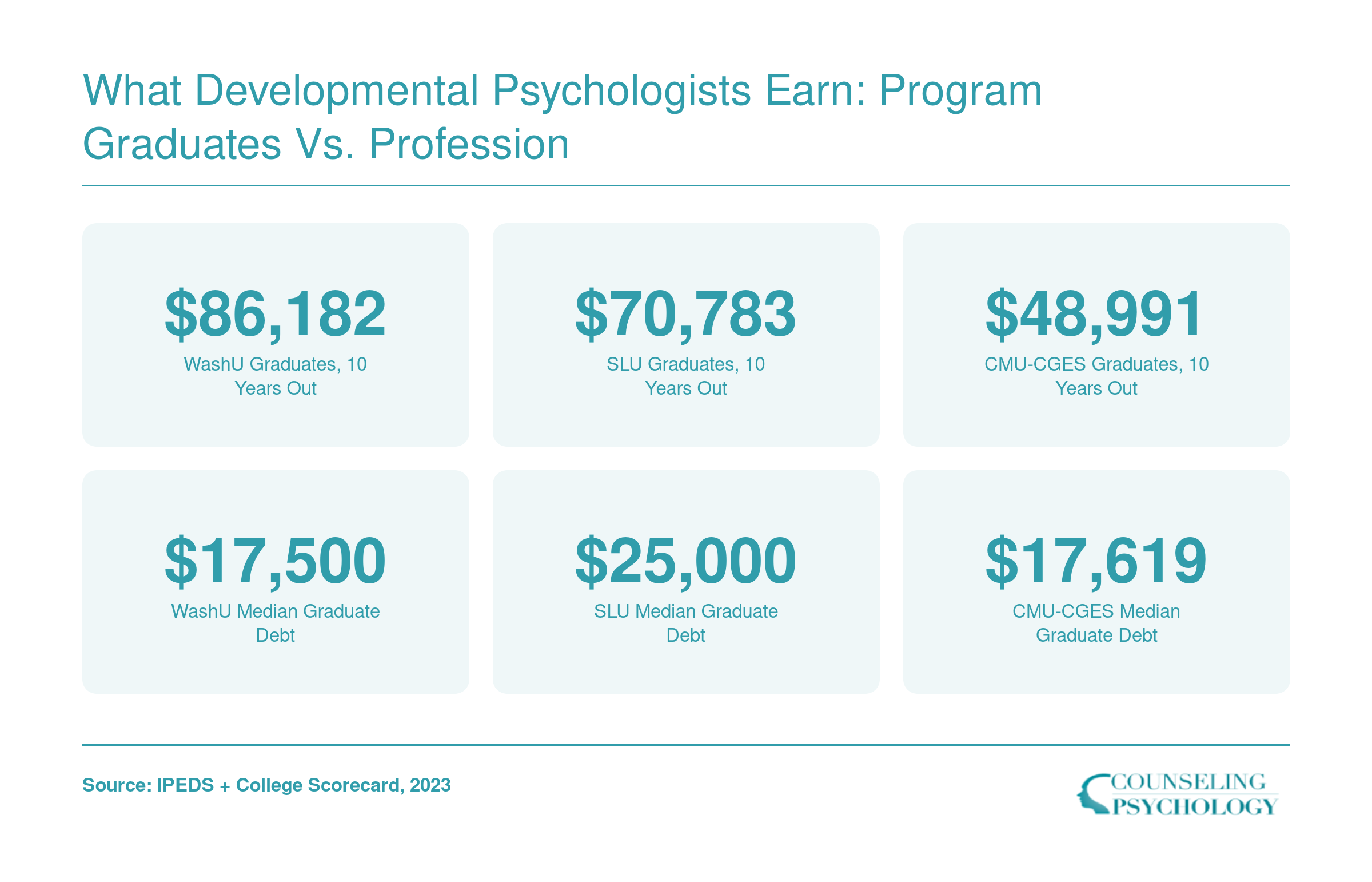
What Developmental Psychologists Earn: Program Graduates vs. Profession
Program-completer earnings (from College Scorecard) reflect what graduates of specific programs actually earn after leaving school, while occupational wages (from BLS) represent the broader pay range for all working psychologists regardless of where they studied. The two measures answer different questions, so keep that distinction in mind when comparing figures.
How to Become a Developmental Psychologist in Missouri
Three separate exams stand between you and a Missouri psychology license, and that number alone signals how seriously the state takes licensure.1 The Missouri Committee of Psychologists, housed within the Division of Professional Registration, oversees the full process. Here is what that pathway actually looks like from start to finish.
Step 1: Earn the Right Degree
Missouri requires a doctoral degree for licensure as a psychologist. That means either a PhD or PsyD from a program accredited by APA, CPA, PCSAS, or recognized by the ASPPB or the National Register of Health Service Psychologists. A master's degree alone does not qualify you for psychology licensure in Missouri, though it can open doors to other licensed professional counselor roles.
Developmental psychologists follow the same licensure pathway as clinical psychologists under Missouri law. There is no separate specialty license available. If your doctoral program carries an APA-accredited designation and includes clinical or applied training, you are on the right track.
Step 2: Complete Supervised Practice Hours
Missouri requires a total of 3,500 supervised hours. Within that total, at least 1,500 hours must come from a formal predoctoral internship lasting 12 to 24 months. An additional 1,500 hours of postdoctoral supervised experience are required after you have completed the degree.4 Missouri does offer a provisional licensed psychologist credential, which lets you accumulate those postdoctoral hours while operating under a supervising psychologist.
Step 3: Pass the Examinations
You must pass three separate examinations:1
- EPPP: The national Examination for Professional Practice in Psychology
- Missouri Jurisprudence Exam: A state-specific test on Missouri psychology law, with a minimum passing score of 70 percent
- Oral Examination: Administered by the Committee of Psychologists
You must also be at least 21 years old, pass a background check, and submit a completed application with all required documentation.4
Timeline and Non-Clinical Paths
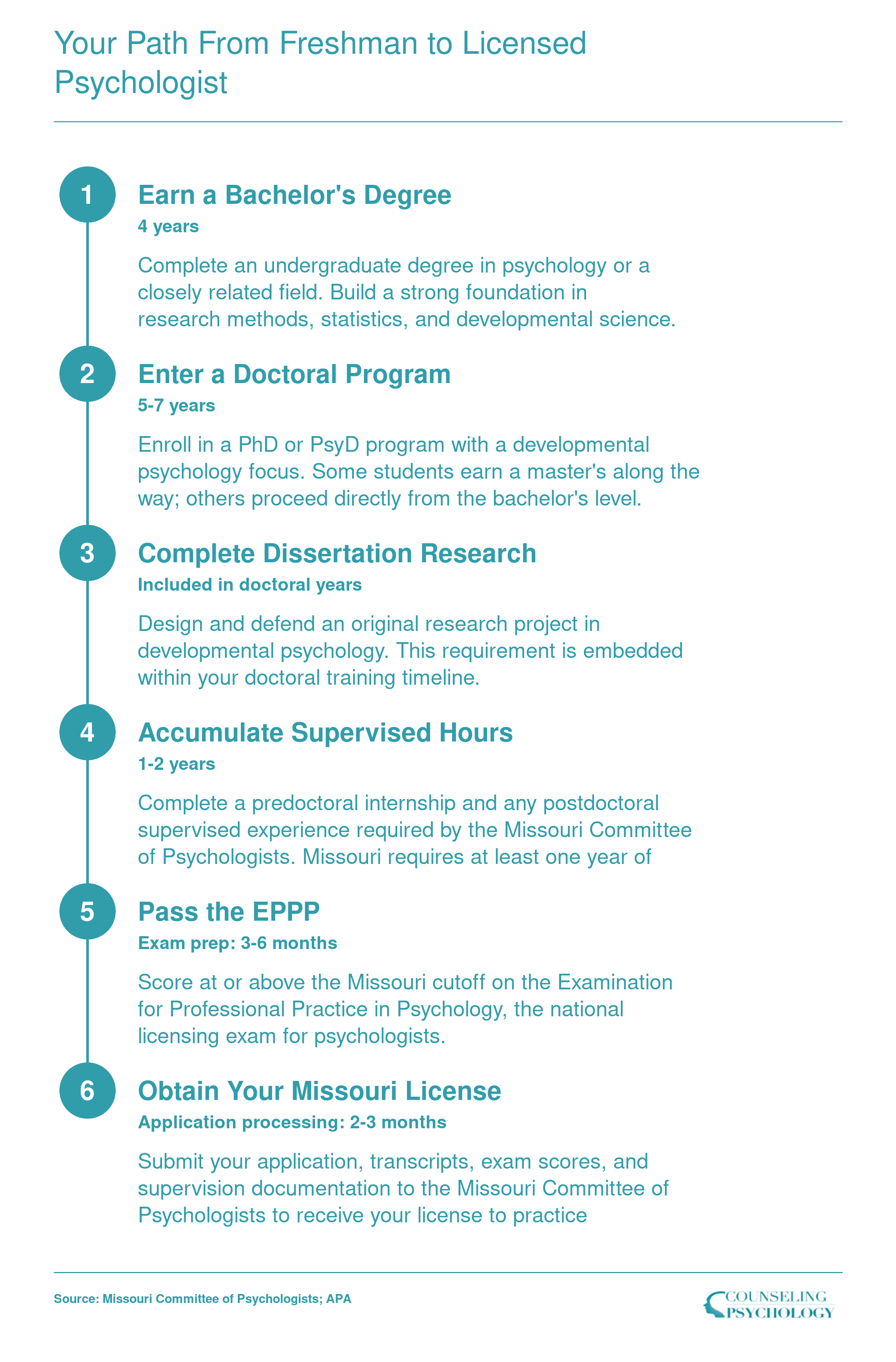
From the start of a bachelor's program through full licensure, plan for roughly 10 to 12 years: four years of undergraduate study, five to seven years for a doctoral program and internship, and one to two additional years of postdoctoral supervision.
Not every developmental psychologist pursues licensure. Those who focus on research, university teaching, or applied policy work can build careers without completing the clinical licensure pathway. Academic faculty positions and research scientist roles at universities, hospitals, and think tanks typically require the doctorate but not the license. If you are still exploring options, a broader look at becoming a clinical psychologist can help you compare requirements side by side.
Continuing Education for Renewal
Once licensed, Missouri psychologists renew every two years and must complete 40 hours of continuing education during each renewal period.5 Within those 40 hours, at least 3 hours must cover ethics and at least 2 hours must address suicide assessment or prevention training. Missouri does offer licensure by endorsement for psychologists already licensed in another state, and reciprocity is available for those with at least five years of licensed experience.
Your Path from Freshman to Licensed Psychologist
Becoming a licensed psychologist in Missouri is a multistep process that typically spans 10-14 years of education, research, and supervised practice. Here is a realistic timeline from your first college semester to full licensure.
Frequently Asked Questions About Developmental Psychology Programs
Choosing the right developmental psychology program involves sorting through details about timelines, admissions, and career prospects. Below are answers to the questions prospective students ask most often, along with guidance on where to verify the latest information.