
What you’ll learn in this article…
- CACREP-accredited programs near Fayetteville typically require 48 to 60 credit hours for a counseling master's degree.
- Accelerated pacing can compress a 60-credit clinical mental health counseling program into roughly 20 to 24 months.
- Arkansas LPC licensure requires a master's degree, a supervised post-graduate experience period, and passing the NCE or NCMHCE.
- In-state graduate tuition at Arkansas public universities runs significantly lower than private institution rates for the same credential.
Arkansas currently employs over 3,400 licensed professional counselors and school counselors, yet demand continues to outpace supply as mental health service gaps persist across rural and suburban counties, including Washington County. For students weighing a master's in counseling near Fayetteville, accelerated timelines matter: an 18-month program lets you enter the workforce nearly two years sooner than a traditional three-year track, shortening both your time out of the labor market and your total student debt load.
Programs accessible from Fayetteville range from 48 to 63 credit hours and vary widely in format. Some offer hybrid models with weekend intensives, while others require full-time campus attendance. Timelines stretch from 18 months for students who can sustain a heavy course load through consecutive terms to three years for those balancing work or family obligations. CACREP accreditation, tuition spreads that run from under $7,500 to over $30,000, and Arkansas licensure requirements all factor into the decision. For a broader comparison of accelerated counseling degree options beyond the region, national program rankings can offer useful context.
Arkansas does not yet mandate CACREP accreditation for initial licensure as a Licensed Professional Counselor, but several insurers and employers now require it for credentialing and reimbursement, making it a de facto standard in many hiring markets.
Best Accelerated Master's in Counseling Programs Near Fayetteville
Arkansas offers a surprisingly wide range of counseling master's programs within reach of Fayetteville, from hybrid options you can complete while working full time to traditional campus cohorts that lock in a two-year timeline. The programs below span clinical mental health counseling, marriage and family therapy, school counseling, and several niche concentrations. Tuition ranges from roughly $7,400 to $17,200 per year depending on public or private status, so cost differences are significant. We weighed each school's effective net price, institution-wide graduation rate, delivery flexibility, and program structure to surface the options most relevant to students prioritizing speed and accessibility.
- Tuition and net price affordability
- Institution-wide graduation rate
- Program delivery flexibility
- Clinical placement infrastructure
- Licensure alignment with Arkansas
- Independent program research
- NCES-IPEDS federal institutional data — nces.ed.gov
- Internal program database
- College Scorecard graduate earnings — collegescorecard.ed.gov

John Brown University
John Brown University, located about 30 minutes from Fayetteville in Siloam Springs, built its M.S. in Counseling specifically for working professionals in Northwest Arkansas. Over 70% of coursework can be completed online or through weekend classes before students move into clinical hours at JBU's own Community Counseling Clinics. A network of 44 clinical sites across Arkansas, Missouri, and Oklahoma supports a reported 100% clinical placement rate, which helps prevent the internship bottlenecks that commonly delay graduation. Graduate tuition runs $14,880 per year, with an effective net price of $20,397 and an institution-wide graduation rate of 71.8%.
- 60 credit hours with 41 core, 16 clinical, and 3 emphasis credits
- CACREP accredited; no GRE and no application fee required
- Hybrid format with weekend and online class options
- 100 practicum hours plus 600 internship hours at local clinics
- Prepares graduates for both LPC and LMHC licensure
- Class sizes capped at 24 students for close faculty interaction
- 82% NCE pass rate reported for 2024 to 2025
- 60 credit hours with a 3-credit play therapy emphasis
- Hybrid delivery blending online coursework with face-to-face sessions
- Designed for professionals interested in child-focused interventions
- 100% clinical placement rate across 44 partner sites
- No GRE required; 2.75 GPA minimum for admission
- Consistent 16-week course structure supports steady progression
- 60 credit hours with a 3-credit adventure therapy emphasis
- CACREP accredited through 2032
- Over 70% of coursework delivered online or on weekends
- Meets Arkansas LPC requirements directly
- 91% job placement rate reported by the program
- Christ-centered training integrated throughout curriculum
- 60 credit hours offered in online and in-person formats
- CACREP accredited for the in-person track
- Tuition listed at $600 per credit hour
- Multiple concentration options within the same degree
- 100% clinical placement rate with experienced faculty
- Prepares students for state licensure in Arkansas
Master of Science in Counseling, Marriage and Family Therapy — Hybrid
Master of Science in Counseling, Play Therapy — Hybrid
Master of Science in Counseling, Adventure Therapy — Hybrid
Master of Science in Counseling, Clinical Mental Health Counseling — Hybrid

Arkansas Tech University
Arkansas Tech University in Russellville has been recognized as offering the fastest path to a school counseling master's in the state, with a hybrid M.S.Ed. requiring fewer credit hours than most competitors. Its clinical mental health track is a separate 60-hour program with 700 hours of clinical experience. Monthly face-to-face meetings keep the format manageable for students commuting from Fayetteville, roughly 90 minutes away. In-state tuition of $7,670 and a $12,970 net price make ATU one of the most affordable options on this list, though its institution-wide graduation rate of 48.6% is lower than some peers.
- Hybrid format with monthly in-person meetings
- Includes 17 hours of leadership and 28 hours of counseling courses
- 600 direct service hours during internship
- 100% passing rate on the Professional School Counselor Praxis exam
- In-state tuition extended to students from bordering states
- Financial aid and graduate assistantships available
- 60-hour hybrid graduate program with evening scheduling
- Two specialized counseling tracks available
- 700 hours of supervised clinical experience required
- Designed to prepare graduates for licensure exams
- In-state tuition for border-state residents applies
- Graduate assistantships offered to qualifying students
M.S.Ed. in School Counseling and Leadership — Hybrid
Master's in Counseling, Clinical Mental Health — Hybrid

Harding University
Harding University in Searcy explicitly advertises a two-year average time to degree for both its 60-credit Marriage and Family Counseling program and its 48-credit Professional School Counseling program. The MFT track uses a full-time cohort model that starts each August, keeping students on a defined schedule. Harding also offers a 60-hour Clinical Mental Health Counseling M.S. in a hybrid format, adding some online convenience for students in Northwest Arkansas. Graduate tuition is $14,572, with a net price of $22,130 and a 68.8% institution-wide graduation rate. The 13:1 student-to-faculty ratio is among the lowest in this group.
- 60 credit hours; CACREP accredited
- Full-time cohort starts once per year in August
- 300 face-to-face client contact hours with 3:1 supervision
- Trains students for dual LPC and MFT licensure
- Focus on systemic counseling for family dynamics and mental health
- On-ground format in Searcy with personal faculty interview required
- 48 credit hours; ADE-approved for K-12 licensure
- Average two-year completion timeline
- Hybrid format blending online and campus sessions
- Cognitive, affective, behavioral, and systemic intervention training
- Pathway to Ed.S. in Counseling for further study
- Three recommendation letters and personal interview required
- 60 credit hours in a hybrid delivery format
- CACREP accredited; prepares for LPC licensure in Arkansas
- Christian values integrated throughout the curriculum
- Practical experience embedded in coursework
- Technology Assisted Counseling elective available
- Ed.S. in Counseling continuation option after graduation
M.S. in Marriage and Family Counseling — On-Campus
Professional School Counseling — On-Campus
M.S. in Clinical Mental Health Counseling — On-Campus

University of Arkansas
The University of Arkansas is the only major CACREP-aligned counseling provider physically located in Fayetteville, making it the most convenient choice for local students. Its M.S. in Counseling offers emphases in Clinical Mental Health Counseling, School Counseling, and Rehabilitation Counseling under one umbrella, so students can shift focus without transferring. In-state tuition is $12,470, but out-of-state students face a much steeper $30,892. The institution-wide graduation rate of 70.5% is among the strongest in the state, though the 20:1 student-to-faculty ratio is higher than smaller programs on this list.
- CACREP accredited campus-based program in Fayetteville
- Emphasis on developmental processes and cultural responsiveness
- Covers assessment, testing, group counseling, and consultation
- Prepares graduates for Arkansas LPC licensing and certification
- Includes research and program evaluation coursework
- Multiple counseling emphases available under one degree
M.S. in Counseling, Clinical Mental Health Counseling — On-Campus

University of Central Arkansas
The University of Central Arkansas in Conway offers a 60-credit M.S. in Mental Health Counseling that meets Arkansas licensure requirements and prepares graduates for private practice or community mental health roles. The program is campus-based, which means Fayetteville students would need to commute or relocate. In-state tuition of $7,446 makes UCA one of the more affordable public options, with a net price of $16,511. The institution-wide graduation rate sits at 53.5%. Admission requires GRE scores, transcripts, and a personal statement, with a February 1 deadline.
- 60 semester hours; campus-based in Conway
- Designed to meet Arkansas LPC licensure requirements
- Includes a semester-long clinical internship
- GRE scores required for admission
- February 1 application deadline
- Covers counseling theories, ethics, and professional standards
M.S. in Mental Health Counseling — On-Campus

Southern Arkansas University
Southern Arkansas University in Magnolia provides two counseling pathways: a hybrid M.Ed. in School Counseling and a fully online M.S. in Clinical and Mental Health Counseling. The online CMHC option is especially relevant for Fayetteville-area students who want to avoid regular travel to a distant campus. In-state tuition is $7,380 (out-of-state $10,656), making SAU the least expensive option for clinical mental health counseling in this comparison. The institution-wide graduation rate is 48.8%, and the net price is $14,027.
- Hybrid format blending online and on-campus learning
- Focused on student development and K-12 counseling techniques
- Bachelor's degree and specific prerequisites required
- Affordable tuition with financial aid options
- Designed for professionals seeking advancement or career shifts
- Practical school-based counseling preparation
- Fully online master's degree format
- Evidence-based therapeutic approaches emphasized
- Supports Arkansas licensure requirements
- Comprehensive mental health training curriculum
- Accessible to students statewide without relocation
- Professional counseling career preparation
M.Ed. in School Counseling — Hybrid
M.S. in Clinical and Mental Health Counseling — On-Campus

University of Arkansas at Little Rock
UA Little Rock offers both a campus-based M.Ed. in Counselor Education (school counseling focus) and an online Clinical Mental Health Counseling program. The online CMHC track is a 60-credit, licensure-prep degree with practicum and internship components, making it accessible to students in Fayetteville without relocating to Little Rock. In-state tuition is $7,915, with a net price of $17,248. The 13:1 student-to-faculty ratio is a strength, though the institution-wide graduation rate of 41.7% is among the lower figures on this list.
- Campus-based program at the Little Rock campus
- Emphasis on ethical practice and human rights
- Trains students in direct services and resource coordination
- Faculty are experienced, licensed professionals
- Comprehensive counseling principles curriculum
- Prepares for professional school counseling roles
- 60 credit hours delivered fully online
- Includes practicum and internship requirements
- Prepares graduates for LPC licensure in Arkansas
- Focus on ethical practice and clinical skills
- Accessible to students across the state
- Strong faculty with professional counseling backgrounds
M.Ed. in Counselor Education (School Counseling) — On-Campus
Clinical Mental Health Counseling (Online) — Online

Ouachita Baptist University
Ouachita Baptist University in Arkadelphia offers a 63-credit M.A. in Counseling with a Clinical Mental Health Counseling concentration in a low-residency hybrid format. Students attend four on-campus intensives and complete the rest of their coursework online, which suits Fayetteville-area students willing to travel occasionally. The total program cost is listed at approximately $36,733, with a net price of $22,409. The institution-wide graduation rate is 61.4%. A 3.0 GPA is required for admission, and no prior psychology experience is necessary.
- 63 credit hours in a low-residency hybrid format
- Four on-campus intensives combined with online coursework
- Total program cost approximately $36,733
- No prior psychology coursework or experience required
- 3.0 GPA admission requirement
- Aligns with CACREP standards; prepares for LPC licensure
- Integrates a biblical worldview throughout the curriculum
M.A. in Counseling, Clinical Mental Health Counseling — Hybrid

Henderson State University
Henderson State University in Arkadelphia houses both a 60-hour M.S.E. in School Counseling and a 60-hour M.S. in Clinical Mental Health Counseling, both CACREP accredited. The school counseling track is also NCATE accredited and prepares graduates for the Praxis exam. In-state tuition starts at $7,497 (out-of-state $9,855), keeping costs low, though the net price of $23,405 and a 37.3% institution-wide graduation rate are areas to weigh carefully. Both programs are campus-based, so Fayetteville students would need to travel to Arkadelphia.
- 60 semester hours; CACREP and NCATE accredited
- Prepares for K-12 school counseling licensure in Arkansas
- Praxis exam preparation built into the curriculum
- Focus on cultural sensitivity and career awareness
- Pathway to Licensed Professional Counselor as an alternative
- Opportunities for doctoral studies after graduation
- 60 semester hours; CACREP accredited
- Campus-based program in Arkadelphia
- Prepares graduates for LPC licensure in Arkansas
- Emphasis on cultural competence in clinical settings
- Builds readiness for doctoral-level study
- Comprehensive training in assessment and intervention
M.S.E. in School Counseling — On-Campus
M.S. in Clinical Mental Health Counseling — On-Campus
How Long Does It Take to Get a Master's in Counseling in Arkansas?
Sixty credit hours is the standard benchmark for clinical mental health counseling programs aligned with CACREP standards, and that number drives the overall timeline more than almost any other variable. At a traditional pace of nine credits per semester across fall and spring terms, most students finish in roughly two and a half to three years. Accelerated online masters in counseling formats that add summer enrollment and use compressed course blocks can cut that window to roughly 18 to 24 months, though a handful of built-in constraints keep any program from moving much faster.
Credit-Hour Requirements by Track
CACREP's 2016 standards set the floor at 60 credits for clinical mental health counseling and 48 credits for school counseling. Those minimums show up across the programs nearest Fayetteville. The University of Arkansas requires 60 credits for its clinical mental health track and 48 for school counseling, both CACREP-accredited.2 John Brown University's M.S. in Counseling also sits at 60 credits.3 Arkansas Tech University's clinical mental health option mirrors that same 60-credit total.4 School counseling students can sometimes finish a semester or two sooner simply because fewer courses stand between them and the degree. For a broader look at online clinical mental health counseling programs, comparing credit loads across institutions is a useful starting point.
The Clinical Hours Bottleneck
No matter how aggressively a program compresses its coursework, practicum and internship hours represent a fixed floor. John Brown University, for example, requires 700 total clinical hours.3 Most CACREP-aligned programs across the state land in the 600- to 700-plus-hour range. Those hours must be completed at approved sites under qualified supervision, and site availability, supervisor schedules, and state licensing board expectations all limit how many hours a student can realistically log per week. This is the single biggest reason even the fastest programs rarely dip below 18 months.
How Arkansas Schools Compress the Timeline
The two main acceleration levers schools near Fayetteville use are summer-term enrollment and eight-week course blocks. Loading two courses into each eight-week block lets students take the equivalent of a full semester's credits in half the calendar time. Year-round enrollment, where students take courses every summer rather than pausing, recovers roughly six months over the life of the degree. Some programs, like Arkansas State University's online school counseling M.S.E., build in scheduling flexibility that can help working professionals move at a steadier clip without long gaps between terms.5
The side-by-side comparison table below lays out estimated completion timelines for the programs featured in this article, so you can weigh the real calendar cost of each option before applying.
Side-by-Side Completion Timelines for Arkansas Counseling Programs
The table below compares estimated credit hours, delivery format, and pacing for master's in counseling programs accessible to students near Fayetteville. None of these programs formally advertise an accelerated or fast-track option as of 2026, but programs requiring 48 credits can often be completed more quickly than 60-credit counterparts. Timelines shown are estimates based on standard full-time enrollment; actual duration depends on course load and semester availability.
| School | Program / Track | Credits | Format | Est. Completion (Full-Time) | Accelerated Option |
|---|---|---|---|---|---|
| University of Arkansas | M.S. in Counseling (Clinical Mental Health) | 60 | Campus | 2.5 to 3 years | No |
| University of Arkansas | M.S. in Counseling (School Counseling) | 60 | Campus | 2.5 to 3 years | No |
| John Brown University | M.S. in Counseling (MFT / Play Therapy / Adventure Therapy) | 60 | Hybrid | 2.5 to 3 years | No (flexible scheduling) |
| Harding University | M.S. in Marriage and Family Counseling | 60 | Campus | About 2 years (cohort model) | No |
| University of Central Arkansas | M.S. in Mental Health Counseling | 60 | Campus | 2.5 to 3 years | No |
| Ouachita Baptist University | M.A. in Counseling (Clinical Mental Health) | 63 | Hybrid (low residency) | About 3 years | No |
| Henderson State University | M.S.Ed. in School Counseling | 60 | Campus | 2.5 to 3 years | No |
| Arkansas State University | M.S.Ed. in School Counseling | 48 | Online | About 2 years | No |
| University of Arkansas at Little Rock | M.A. in Counseling (Counselor Education) | 48 | Online | About 2 years | No |
| Southern Arkansas University | M.Ed. in School Counseling | 48 | Hybrid | About 2 years | No |
| Arkansas Tech University | School Counseling and Leadership | N/A | Hybrid | N/A | No |
What Makes a Counseling Program Fast-Track vs. Traditional?
Accelerated counseling programs do not cut content. They restructure how and when that content is delivered, letting students finish a 60-credit master's degree in roughly 20 to 24 months instead of the more typical three years.
Compressed Terms and Year-Round Scheduling
The single biggest difference between a fast-track and a traditional program is the academic calendar. Traditional master's programs in counseling run on 15-week fall and spring semesters, often with summers off or limited summer coursework. Accelerated programs replace that rhythm with compressed 7- or 8-week terms that cycle continuously, including summer. Students in a cohort-based, lock-step model move through a predetermined sequence of courses together, eliminating scheduling conflicts and registration gaps. Elective options are usually narrower because the curriculum is tightly sequenced, but the tradeoff is a predictable, faster timeline to graduation.
Traditional formats, by contrast, offer more elective flexibility and part-time enrollment options. Students who need to work full time or manage family obligations sometimes prefer spreading the degree across three or more years. The pace is gentler per term, though the total credit requirement is identical.
The Fastest Path: Online, Year-Round, With Prior Experience
For students asking what the fastest way to earn a master's in counseling actually looks like, the answer is usually an online program with year-round enrollment, especially if you bring relevant prior experience. Some programs accept transfer credits from regionally accredited institutions or award credit for documented prior learning, which can shave off a full semester. Candidates who have already logged practicum or fieldwork hours in a related role may find they meet prerequisites more quickly, keeping the timeline tight. Comparing best online master's in counseling programs nationally can help you identify which schools are most flexible with transfer credit policies.
Clinical Hours Cannot Be Compressed
Here is the non-negotiable reality: no matter how fast the coursework moves, supervised clinical experience requirements stay the same. Arkansas licensure as a Licensed Professional Counselor requires substantial post-degree supervised practice, and CACREP-accredited programs mandate a minimum number of practicum and internship hours within the degree itself. Those clock hours involve real client contact and cannot be condensed into a weekend workshop or simulated online. A program might accelerate your didactic coursework, but the practicum and internship semesters generally run on a fixed schedule dictated by site availability and supervision logistics. Students pursuing licensed professional counselor online programs should confirm that clinical placements are available in or near Fayetteville before enrolling.
Key Features at a Glance
- Term length: 7 to 8 weeks (accelerated) vs. 15 weeks (traditional)
- Annual enrollment: Year-round with no summer break vs. fall and spring only
- Pacing: Cohort lock-step vs. self-directed registration
- Electives: Limited and pre-selected vs. broader catalog choice
- Transfer credits: Some accelerated programs accept 6 to 12 transfer credits, potentially trimming a semester
- Clinical hours: Identical minimums regardless of format
Speed is a real advantage when the program is well designed, but the clinical training safeguards exist for a reason. Verify that any accelerated option you consider holds CACREP accreditation and meets Arkansas licensure prerequisites before committing to a faster timeline.
CACREP Accreditation and Arkansas Licensure Requirements
Employers and licensing boards increasingly treat CACREP accreditation as a baseline expectation rather than a bonus credential, which means the program you choose now shapes how smoothly your career launches later.
What CACREP Accreditation Actually Does for You
CACREP (Council for Accreditation of Counseling and Related Educational Programs) sets the curriculum and clinical training standards that most state licensing boards, including Arkansas's, treat as the gold standard. Graduating from a CACREP-accredited program does two practical things: it signals to employers that your training met nationally recognized benchmarks, and it streamlines the application process with the Arkansas Board of Examiners in Counseling (ABEC).1 The ABEC aligns its coursework review checklist with CACREP standards, so graduates of accredited programs typically face fewer questions about whether their coursework qualifies.
CACREP Status of Programs Near Fayetteville
Here is where each program currently stands:2
- University of Arkansas (Fayetteville): CACREP-accredited in Clinical Mental Health Counseling and School Counseling.
- John Brown University: CACREP-accredited in Clinical Mental Health Counseling.
- Harding University: CACREP-accredited in Clinical Mental Health Counseling and Marriage, Couple, and Family Counseling.
- Arkansas State University: CACREP-accredited in Clinical Mental Health Counseling and School Counseling.
- University of Arkansas at Little Rock: CACREP-accredited in Clinical Rehabilitation Counseling.
- Ouachita Baptist University: CACREP accreditation in progress.
- Southern Arkansas University: Currently pursuing CACREP accreditation.
For OBU and SAU, candidates should confirm the timeline before enrolling if CACREP status is a deciding factor for their licensure plans. Harding's Marriage, Couple, and Family Counseling track is worth noting for anyone exploring accredited marriage and family therapy programs online.
Arkansas LPC Requirements
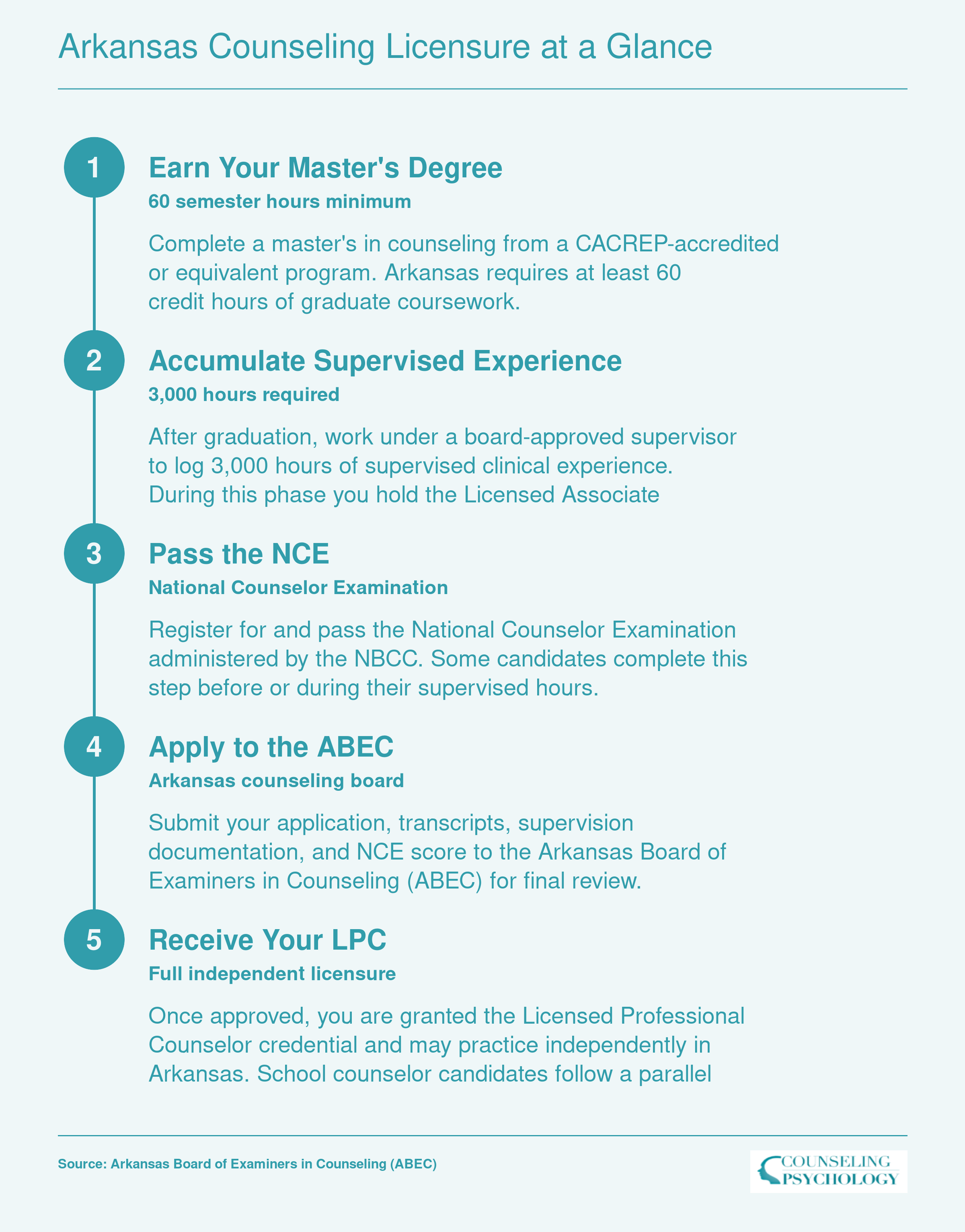
To become a Licensed Professional Counselor in Arkansas, you must meet the following requirements set by the ABEC:3
- Graduate credits: 60 semester hours, including at least 9 hours of practicum and internship credit and a 1-credit-hour course in technology in counseling.
- Supervised post-master's hours: 3,000 total, with at least 1,000 hours of direct client contact and 100 hours of formal supervision.
- Exams: Pass the National Counselor Examination (NCE) and an Arkansas Jurisprudence Exam administered orally by the board.
- Application fee: $200 submitted with the ABEC application.
If you fail the NCE, you must wait three months before retaking it. Two failures trigger a two-year waiting period before another attempt, so adequate exam preparation matters.2
Arkansas School Counselor Certification
School counselor licensure follows a separate path through the Arkansas Department of Education (ADE). You need a master's degree in school counseling from a CACREP-accredited or ADE-approved program, a passing score on the Praxis Professional School Counselor exam, and a completed ADE licensure application.2 Because the ADE recognizes CACREP-accredited school counseling programs, graduating from UofA or A-State satisfies that program-approval requirement directly.
Arkansas Counseling Licensure at a Glance
Arkansas offers two main credentialing tracks for counseling graduates: the Licensed Professional Counselor (LPC) path and the School Counselor path. Below is the LPC credentialing ladder, followed by a note on the school counselor alternative.
Cost Comparison: Tuition and Net Price by Program
Tuition varies significantly across Arkansas counseling programs, and the public vs. private divide is the single biggest cost driver. The table below is sorted by graduate tuition (in-state where applicable) from lowest to highest. Keep in mind that the net price column reflects an institution-wide average after financial aid for all students, not a guaranteed quote for your specific counseling program. Your actual out-of-pocket cost will depend on the aid package you receive.
| School | Type | Graduate Tuition (In-State) | Graduate Tuition (Out-of-State) | Avg. Net Price (Institution-Wide) | Median Graduate Debt |
|---|---|---|---|---|---|
| Southern Arkansas University | Public | $7,380 | $10,656 | $14,027 | $18,750 |
| University of Central Arkansas | Public | $7,446 | $12,985 | $16,511 | $20,346 |
| Henderson State University | Public | $7,497 | $9,855 | $23,405 | $19,500 |
| Arkansas Tech University | Public | $7,670 | $7,670 | $12,970 | $21,000 |
| University of Arkansas at Little Rock | Public | $7,915 | $15,547 | $17,248 | $22,000 |
| University of Arkansas | Public | $12,470 | $30,892 | $18,209 | $21,500 |
| Harding University | Private | $14,572 | $14,572 | $22,130 | $26,500 |
| John Brown University | Private | $14,880 | $14,880 | $20,397 | $21,250 |
| Ouachita Baptist University | Private | $17,188 | $17,188 | $22,409 | $21,050 |
Online vs. Hybrid vs. On-Campus Options Near Fayetteville
Choosing a delivery format shapes everything from your weekly schedule to how you secure practicum placements. Among the ranked programs near Fayetteville, the University of Arkansas, Harding University, University of Central Arkansas, UA Little Rock, and Henderson State University offer on-campus programs. John Brown University, Arkansas Tech University, Southern Arkansas University, and Ouachita Baptist University use hybrid models that blend online coursework with periodic in-person sessions.
Pros
- Online and hybrid formats offer scheduling flexibility, year-round pacing, and no need to relocate, helping working professionals finish faster.
- On-campus programs like the University of Arkansas and Harding University provide direct faculty mentorship and a cohort community that strengthens professional identity.
- Hybrid options such as John Brown University and Ouachita Baptist University combine the convenience of remote learning with structured face-to-face intensives for clinical skill building.
- Campus-based programs typically coordinate practicum placements through established local partnerships, reducing the burden on students to find their own sites.
Cons
- Fully online or mostly online coursework demands strong self-discipline, and students are often responsible for locating and arranging their own practicum sites.
- Networking opportunities tend to be more limited in online formats, making it harder to build peer and professional connections organically.
- On-campus programs at schools like UA Little Rock or Henderson State require commuting, which adds time and cost, especially for students living in Fayetteville.
- Traditional campus schedules are generally less flexible, with fewer accelerated course sequences compared to hybrid or online counterparts.
Career Outcomes and Earnings After Graduation
A counseling career in Arkansas can pay off quickly, especially for graduates of accelerated programs who enter the workforce with less time out of the job market. While program-level earnings data is not yet reported for these schools, regional wage data and institutional debt figures paint a clear picture of strong returns.
Earnings Benchmarks for Counselors in Northwest Arkansas
In the Fayetteville-Springdale-Rogers metropolitan area, the mean annual wage for mental health counselors (including substance abuse and behavioral disorder counselors) is $72,220, or $31.04 per hour.1 School and career counselors in the same area earn a mean of $61,220 annually, with an hourly mean of $29.78.1 For additional context, BLS data for school counselors statewide shows a median of $60,110 (2024), with the bottom tenth earning $42,030 and the top tenth earning $81,920.2 This spread suggests that even at entry level, wages can cover living expenses and loan payments comfortably. For a broader look at how these figures compare nationally, see our counselor salary guide.
School counselors typically work a 9- to 10-month contract aligned with the school year. That shorter schedule means the annual salary understates the effective hourly rate when compared to 12-month positions. Many use the summer break for additional income or professional development, making direct salary comparisons across roles less straightforward.
Weighing Debt Against Expected Income
Median federal student loan debt for graduates of these universities sits in a narrow range, from $18,750 at Southern Arkansas University to $26,500 at Harding University. On a standard 10-year repayment plan, a $25,000 loan at 5% interest equates to roughly $265 per month, less than 6% of a starting salary at the state's median for school counselors. Institutional earnings data shows that the typical graduate from these schools earns between 2.0 and 2.7 times their total debt within a few years of leaving campus. While these figures are not specific to counseling majors, they indicate that programs at these universities generally lead to financial uplift.
Is a Counseling Master's Worth the Investment?
For the majority of students, the answer is yes. With a master's in counseling, graduates can expect starting salaries in the $50,000s for school settings and higher in clinical mental health roles, while total debt often stays under $25,000. Accelerated programs further shorten the time to licensure and employment, meaning graduates begin earning and repaying loans sooner. A simple break-even analysis suggests that, given typical living costs in the region, a counseling graduate can recoup their educational investment within 1 to 3 years of full-time work.
The outlook is reinforced by local demand: the Fayetteville metropolitan area already employs 470 school and career counselors and 250 mental health counselors, with both fields projected to grow.1 Program-specific employment and placement rates are not yet available, but several programs boast strong licensure exam pass rates. Arkansas Tech University, for example, reports a 100% Praxis pass rate for its school counseling candidates, which signals effective preparation for the workforce. Students exploring counseling programs Arkansas will find these outcomes consistent across the region's accredited options.
Steps to Apply to an Accelerated Counseling Program
Landing a spot in an accelerated master's in counseling program near Fayetteville, Arkansas requires more than meeting minimums. It demands a deliberate timeline and a close reading of each program's unique application requirements. The following five steps map a clear path from research to enrollment.
Step 1: Verify CACREP Status
Start by confirming that the program holds CACREP accreditation, especially if you plan to pursue Arkansas LPC or school counseling licensure. Most accelerated programs in the region, including the University of Arkansas's M.S. in Counseling and Harding University's MFT track, are CACREP-accredited. If you are considering CACREP accredited online school counseling programs, confirming this status early is essential. Choosing a non-accredited program can create extra hurdles during the licensure process, so check the program's website or the CACREP directory before you assemble materials.
Step 2: Confirm Prerequisite Coursework
All programs require a bachelor's degree from a regionally accredited institution, but some may expect specific undergraduate courses in psychology, statistics, or human development.123 Review each school's admission page carefully: while a psychology major is not mandatory, a missing prerequisite could delay your start. If you are unsure, contact the program coordinator to evaluate your transcripts before you apply.
Step 3: Gather Transcripts and Recommendation Letters
Request official transcripts early, since processing delays at your previous schools can bottleneck your application. Most programs also ask for two or three letters of recommendation. Harding University, for instance, requires three letters, while John Brown University expects references as part of the faculty interview stage. GPA thresholds vary: the University of Arkansas at Fayetteville sets a 3.0 minimum5, John Brown University requires a 2.75, and UA Little Rock asks for a 2.7.3 A competitive application will exceed the minimum when possible.
Step 4: Craft a Targeted Personal Statement
Your personal statement should align with the program's philosophy. John Brown University's counseling track integrates a Christ-centered perspective, whereas the University of Arkansas emphasizes clinical mental health counseling programs and evidence-based practice. Explain why the accelerated format fits your goals and how you plan to manage the rigorous pace.
Step 5: Submit Before the Cohort Deadline and Secure a Practicum Site
Accelerated programs often lock to a fixed cohort calendar. Harding University's MFT cohort starts only in August; the University of Arkansas's application deadline for fall is January 15.6 Missing these windows can mean waiting a full year. After acceptance, begin coordinating your practicum placement immediately. Many programs boast a 100% clinical placement rate, but sites fill quickly, and your proximity to Fayetteville may influence which agencies are available.
Selective Programs Reward Early Preparation
Most schools in the area have waived the GRE for 2025-2026, but verify each program's policy because requirements can shift.53 The overall admission rates at these institutions give a general sense of selectivity: John Brown University admits about 76% of applicants, while the University of Arkansas hovers near 74%. These are not hypercompetitive numbers, but a polished application still matters. Because not every school clearly labels its accelerated option online, call the admissions office directly to confirm fast-track availability and any additional entrance steps.
Frequently Asked Questions About Fast-Track Counseling Degrees in Arkansas
Choosing an accelerated counseling program raises practical questions about timelines, costs, accreditation, and format. Below are answers drawn from current Arkansas program data and state licensure rules to help you plan your next steps.