
What you’ll learn in this article…
- Ten CACREP-accredited counseling master's programs near Nashville rank among the most affordable in Tennessee.
- Tennessee's 429 to 1 student-to-school-counselor ratio signals strong demand for new graduates statewide.
- LPC-MHSP licensure requires 3,000 supervised hours, while school counselor endorsement follows a separate credentialing track.
- Federal loan forgiveness programs and Tennessee-specific scholarships can significantly reduce total out-of-pocket costs.
A master's in counseling is the entry-level credential for school counselor licensure and LPC-MHSP eligibility in Tennessee. The demand is tangible: Tennessee's student-to-counselor ratio stood at 429 to 1 in 2021-2022, almost twice the recommended level, and the Nashville metropolitan area has added counseling positions consistently as schools and mental health agencies expand.
The 18 programs in this ranking carry net prices (after grants and scholarships) from under $10,000 at public campuses to nearly $34,000 at private Nashville institutions, with median graduate debt following similar contours. That cost spread means program selection can heavily influence a graduate's financial flexibility in a field where early-career salaries are modest. For a broader look at accredited options statewide, our best master's in counseling Tennessee rankings apply a similar affordability lens.
Because Tennessee splits counseling into two licensure tracks, school counseling and clinical mental health, the program you choose shapes your supervised hours, exam, and eventual practice settings. Aligning accreditation, net cost, and career goals early avoids costly detours later.
Best Affordable Master's in Counseling Programs Near Nashville
Tennessee offers some of the most cost-effective paths to a counseling career in the Southeast, and several programs within driving distance of Nashville (or fully online) hold CACREP accreditation, the gold standard for licensure-track counseling degrees. The ten programs below are ranked primarily on affordability, but each one also meets Tennessee's requirements for school counselor licensure, LPC/LPC-MHSP credentialing, or both. A statewide Behavioral Health Pathways Scholarship can add up to $15,000 per year for students willing to work in community behavioral health settings after graduation, making these already-affordable options even more accessible.
- Net price and tuition costs
- CACREP or national accreditation status
- Program breadth and specializations
- Institutional graduation outcomes
- Licensure alignment for Tennessee
- Internal program database
- NCES-IPEDS federal institutional data — nces.ed.gov
- College Scorecard graduate earnings — collegescorecard.ed.gov
- Independent program research

Tennessee Tech
Tennessee Tech's counseling department in Cookeville delivers CACREP-accredited master's programs in both School Counseling and Clinical Mental Health Counseling, giving students two licensure-aligned tracks at one of the state's lowest tuition rates. The school's overall graduation rate is 57.7%, and graduates carry a median debt of just $15,650, well below the Tennessee average for public universities. Both programs are campus-based and require a minimum 2.75 undergraduate GPA, with K-12 school counseling and LPC-MHSP preparation built directly into the curriculum.
- CACREP nationally accredited program
- Prepares graduates for K-12 school counselor licensure in Tennessee
- On-campus delivery in Cookeville, about 80 miles east of Nashville
- Requires 2.75 minimum undergraduate GPA and three recommendation letters
- Curriculum covers academic, social, and personal development counseling
- Supports diverse student populations across elementary and secondary settings
- CACREP nationally accredited, 60-credit-hour program
- Designed to meet LPC and MHSP licensure requirements in Tennessee
- On-campus format with supervised practicum and internship hours
- Emphasis on mental health service provider preparation
- Requires 2.75 minimum undergraduate GPA for admission
- Three recommendation letters required as part of the application
Master of Arts in School Counseling — On-Campus
Master of Arts in Clinical Mental Health Counseling — On-Campus

The University of Tennessee-Martin
UT Martin stands out as the only school on this list offering a fully online School Counseling master's degree, a major advantage for Nashville-area students who want to avoid relocation costs. Both the school counseling and clinical mental health tracks are CACREP accredited (and also hold CAEP recognition), and the university does not require GRE scores for the clinical mental health concentration. The school's overall graduation rate is 52.5%, and in-state tuition for graduate programs is among the lowest in the UT system. An addictions counseling concentration rounds out a notably broad set of specialization options.
- 100% online coursework with CACREP and CAEP accreditation
- Full degree requires 60 credit hours; licensure-only option at 30 credits
- 12:1 student-to-faculty ratio for personalized mentoring
- Tennessee school counselor licensure eligible upon completion
- Advanced counseling preparation with multicultural emphasis
- No relocation required for Nashville-area residents
- CACREP accredited, 60-credit-hour clinical concentration
- No GRE required for admission
- Flexible elective options to tailor the degree
- Prepares graduates for LPC licensure in Tennessee
- Diverse course offerings in assessment, ethics, and treatment
- Online coursework available with campus-based components
- 60-credit-hour campus-based specialization
- Includes supervised practicum and internship experiences
- Focus on ethical, legal, and multicultural issues in addiction treatment
- Prepares graduates for licensure in Tennessee
- Comprehensive examination required for completion
- Three-day residency component included
M.S.Ed. in Counseling, School Counseling Concentration — Online
M.S.Ed. in Counseling, Clinical Mental Health Counseling Concentration — On-Campus
M.S.Ed. in Counseling, Addictions Counseling Concentration — On-Campus

East Tennessee State University
East Tennessee State University in Johnson City provides CACREP-accredited counseling programs across four distinct concentrations, including school counseling, clinical mental health, couple and family counseling, and college counseling and student affairs. That breadth is unusual at this price point. The school's overall graduation rate is 53.2%, and graduates benefit from licensure reciprocity with Virginia and North Carolina, an asset for students open to practicing outside Tennessee. All tracks are delivered on campus and emphasize multicultural competence and social justice advocacy.
- CACREP-accredited K-12 school counseling preparation
- Tennessee licensure eligible with reciprocity in VA and NC
- On-campus format with multicultural counseling focus
- Professional ethics and developmental counseling emphasized
- Supervised field experiences in public school settings
- Prepares graduates for elementary, middle, and high school roles
- CACREP accredited with LPC-MHSP licensure preparation
- Specialization available in couple and family counseling
- Serves both full-time and part-time students
- Focus on social justice advocacy and ethical practice
- Opportunity to sit for the National Counselor Examination
- Diverse employment settings post-graduation, from agencies to private practice
- CACREP-accredited concentration for higher education settings
- Supports LPC licensure preparation alongside student affairs training
- Multicultural and diverse learning environment
- Comprehensive therapeutic skills development
- Campus-based delivery with supervised practicum hours
- Prepares for roles in university counseling centers and student services
M.A. in Counseling, School Counseling Concentration — On-Campus
M.A. in Counseling, Clinical Mental Health Counseling — On-Campus
M.A. in Counseling, College Counseling and Student Affairs — On-Campus

University of Memphis
The University of Memphis offers CACREP-approved master's programs in school counseling, clinical mental health counseling, and addiction counseling, making it one of the most versatile counseling departments in the state. The school counseling track stands out for requiring 750 hours of supervised field experience, exceeding many competitors. The school's overall graduation rate is 50.9%, and its Memphis location positions students for urban practicum placements in a diverse metropolitan area. Graduates qualify for Tennessee Department of Education licensure and LPC credentialing.
- CACREP-approved with 750 hours of field experience
- Aligned with ASCA National Model standards
- Prepares for Tennessee Department of Education licensure
- Full-time and part-time enrollment options available
- Optional counseling certificates to broaden credentials
- Practicum placements in public, private, and charter school settings
- CACREP-approved, 60-credit-hour graduate program
- Eligible for LPC and MHSP credentials in Tennessee
- Practicum and internship in multiple professional settings
- On-campus delivery with evening scheduling flexibility
- Comprehensive mental health assessment and treatment training
- Prepares for careers in agencies, hospitals, and private practice
- 60-semester-hour program focused on evidence-based interventions
- Prepares graduates for LADC certification in Tennessee
- Person-centered treatment approach emphasized
- Comprehensive clinical training with supervised hours
- Campus-based instruction in Memphis
- Integrates counseling theory with substance use disorder practice
M.S. in School Counseling — On-Campus
M.S. in Clinical Mental Health Counseling — On-Campus
M.S. in Addiction Counseling — On-Campus

The University of Tennessee-Chattanooga
The University of Tennessee at Chattanooga delivers a 60-credit-hour Master of Education in School Counseling alongside a CACREP-accredited Clinical Mental Health Counseling program, giving students a clear choice between K-12 and clinical pathways. The school counseling track includes internship placements in both elementary and secondary settings, while the CMHC concentration requires 700 hours of clinical placement. The school's overall graduation rate is 50.2%, and a 3.0 GPA is the minimum admission standard for the clinical track. UTC's location makes it accessible for students in southeastern Middle Tennessee.
- 60-credit-hour program preparing for school counselor licensure
- Internship experiences in both elementary and secondary schools
- Training in crisis intervention and mental health assessment
- Multicultural counseling and professional ethics coursework
- Child and adolescent development focus
- Practical skill-building through supervised field placements
- CACREP accredited, 60-credit master's program
- 700 hours of required clinical placement experience
- Prepares for LPC licensure in Tennessee
- Multiple elective courses to customize the degree
- 3.0 GPA admission requirement
- Comprehensive exit examination for program completion
M.Ed. in School Counseling — On-Campus
M.S. in Clinical Mental Health Counseling — On-Campus

Tennessee State University
Tennessee State University is the only HBCU and the only Nashville-based public university on this list, giving local students a commuter-friendly path to both school counseling and clinical mental health counseling credentials. The Pre-K-12 School Counseling concentration does not require a teaching license for admission, removing a barrier that some programs impose. TSU's clinical mental health track offers evening and part-time scheduling, a practical advantage for working professionals in the Nashville metro. The school's overall graduation rate is 34%, though its 13:1 student-to-faculty ratio supports close mentorship.
- Pre-K through 12th grade counseling preparation
- No teaching license required for admission
- Culturally aware approach to diverse student populations
- Minimum 2.75 undergraduate GPA for entry
- Prevention-focused counseling philosophy
- Nashville campus eliminates relocation costs for local students
- Two-year full-time or flexible part-time completion options
- Evening class scheduling available for working professionals
- Practicum and internship experiences in Nashville-area agencies
- Thesis and non-thesis tracks offered
- Multicultural counseling and professional ethics coursework
- Advanced clinical skills development with supervised hours
M.S. in Professional School Counseling, Pre-K-12 Concentration — On-Campus
M.S. in Counseling, Clinical Mental Health Counseling Concentration — On-Campus

The University of Tennessee-Knoxville
The University of Tennessee at Knoxville brings flagship-level resources and CACREP accreditation to its counseling master's programs, with concentrations in school counseling and clinical mental health counseling. The school counseling track requires 700 hours of supervised practicum and internship in school settings and prepares graduates for PreK-12 licensure in Tennessee and most other states. The CMHC track is more intensive at 1,000 clinical hours and targets LPC-MHSP licensure. The school's overall graduation rate is 73.9%, the highest among public institutions on this list. Admission is competitive and includes a face-to-face interview.
- CACREP accredited with 60 credit hours required
- 700 hours of supervised practicum and internship
- PreK-12 licensure preparation recognized in most states
- Full-time completion in two years, including summers
- Face-to-face instruction emphasizing cultural sensitivity
- Admissions process includes GRE scores and in-person interview
- CACREP accredited, 60-credit-hour graduate degree
- 1,000 hours of supervised clinical experience required
- Prepares for LPC-MHSP licensure in Tennessee
- Customized individual learning paths available
- Diverse clinical settings for practicum placements
- Approximately 2.5 years for full-time completion
M.S. in Counseling, School Counseling Concentration — On-Campus
M.S. in Counseling, Clinical Mental Health Counseling Concentration — On-Campus

Trevecca Nazarene University
Trevecca Nazarene University sits in Nashville proper and offers a CACREP-accredited Master of Marriage and Family Counseling that prepares graduates for both LPC-MHSP and LMFT licensure in Tennessee. The 60-credit-hour program uses a face-to-face cohort model with small class sizes and draws on more than 60 Nashville-area practicum and internship partner agencies. The school's overall graduation rate is 53.2%. Tuition runs approximately $775 per credit hour (about $46,500 total), and the program accepts students in fall, spring, and summer cycles. Note that this program focuses on marriage and family counseling rather than school counseling.
- CACREP accredited, 60-credit-hour program
- Prepares for both LPC-MHSP and LMFT licensure
- Face-to-face cohort model with small class sizes
- Internship placements at over 60 Nashville-area agencies
- Covers family systems theory, crisis intervention, and ethics
- Fall, spring, and summer admission cycles available
- GRE may be waived under certain conditions
- Approximately $46,500 total tuition cost
Master of Marriage and Family Counseling — On-Campus

Lee University
Lee University in Cleveland, Tennessee, offers both a Master of Science in Marriage and Family Therapy and a Master of Science in School Counseling, making it one of only a few faith-based institutions on this list with dual counseling tracks. The MFT program requires 500 direct client contact hours and 100 supervision hours across a two- or three-year timeline. The school counseling degree is built on the ASCA National Model and prepares graduates for elementary and secondary settings. The school's overall graduation rate is 62.6%, and a 13:1 student-to-faculty ratio supports individualized attention. Both programs are campus-based.
- 60-credit-hour program with 2-year or 3-year completion tracks
- 500 direct client contact hours and 100 supervision hours required
- Courses in ethics, psychopathology, family therapy, and human sexuality
- Relational and systemic therapeutic approach
- Background check and liability insurance required
- Comprehensive examination and final project for completion
- Prepares for MFT licensure examinations in Tennessee
- 60-credit-hour program based on the ASCA counseling model
- Preparation for elementary and secondary school counselor roles
- Professional counseling skills training with field experience
- Campus-based delivery in Cleveland, Tennessee
- Focus on academic, career, and social-emotional student development
- Recognized by Tennessee's licensure board for school counselor credentials
Master of Science in Marriage and Family Therapy — On-Campus
Master of Science in School Counseling — On-Campus

Lincoln Memorial University
Lincoln Memorial University in Harrogate rounds out this list with a hybrid Master of Education in Professional Counseling that combines online coursework with in-person components. The mental health counseling concentration totals 60 credit hours and includes 700 hours of field experience. The school's overall graduation rate is 49.7%, and the hybrid format reduces travel frequency for students who live farther from campus. LMU does not currently offer a dedicated school counseling track, so this option is best suited for students focused on clinical mental health practice and LPC licensure in Tennessee.
- Hybrid online and in-person delivery format
- 60 total credit hours with 700 hours of field experience
- CAEP accredited with Tennessee licensure preparation
- Focus on interpersonal skills, therapeutic techniques, and ethics
- Serves students across Tennessee without full relocation
- Curriculum addresses diverse client populations and complex counseling challenges
M.Ed. in Professional Counseling, Mental Health Counseling Concentration — On-Campus
How We Ranked These Nashville-Area Counseling Programs
Affordability, not prestige, drives every placement in this ranking. That distinction matters because counseling graduates enter a field where starting salaries are modest and student loan payments can strain a career in its early years. A program's name recognition rarely shows up on an LPC licensing exam or in a client intake form.
What We Measured and Why
Five factors shaped the rankings, each chosen because it speaks directly to the financial reality counseling students face.
- Net price: The actual cost after grants and scholarships are applied, not the sticker tuition. A program that looks expensive can rank well if it delivers strong aid; a cheaper-looking program can rank lower if most students pay close to full freight.
- Pell grant share: The proportion of students receiving federal Pell grants signals how accessible a program is to students without family wealth. In a field built on serving others, programs that genuinely serve first-generation and lower-income students earn weight here.
- Graduation rate: Finishing the degree is the prerequisite for licensure. A low completion rate is a financial risk, not just an academic one. Students who leave without a degree carry debt without the credential that unlocks higher earnings.
- Program-level earnings: Post-graduation earnings inform whether graduates can realistically manage loan repayment. Where this data is available, it adds precision; where it is not yet published, that absence is noted plainly.
- Median debt at graduation: Borrowing less matters more in counseling than in higher-earning fields. A program with moderate tuition but generous aid can leave graduates in a far stronger position than a nominally cheaper program where most students borrow heavily.
A Transparency Note on the Data
Graduation rates and net price figures are institution-wide averages drawn from the College Scorecard. They reflect the full student body, not counseling enrollees specifically. Program-level data at the graduate level is limited across the industry, and any ranking that claims otherwise deserves scrutiny. For comparison, our list of the best masters in mental health counseling programs applies a similar methodology at the national level. This framework is stated openly here because most competing lists publish no framework at all. Readers deserve to know exactly what is being measured before they trust a ranked list with a career decision.
School Counseling vs. Clinical Mental Health Counseling in Tennessee
The counseling field in Tennessee has seen growing demand on both tracks, with school districts facing counselor shortages and community mental health agencies expanding caseloads at the same time. Choosing between school counseling and clinical mental health counseling (CMHC) is less about prestige and more about where you want to spend your working hours and who you want to serve.
What Each Track Is Built Around
Both programs in Tennessee typically require 60 credit hours, so the time commitment on paper looks identical.1 The real difference lives inside the curriculum. School counseling programs concentrate on child and adolescent development, school-based interventions, and the structural realities of K-12 settings. CMHC programs go deep on psychopathology, diagnosis, and clinical treatment, preparing graduates to work with a broader adult and adolescent population across a range of presenting concerns.2
Think of it this way: a school counseling student learns how a 10-year-old processes a learning disability within a public school system; a CMHC student learns how to assess a 35-year-old with a mood disorder and develop a treatment plan.
Practicum Settings Shape Your Training
The supervised experience each track requires reflects that same split. School counseling students complete their practicum and internship hours embedded in K-12 schools, working alongside teachers, administrators, and families. CMHC students complete theirs at clinical sites: community mental health centers, private practices, hospital outpatient programs, or nonprofit agencies.3 For students interested in the clinical path, understanding how to become a mental health counselor can help clarify the steps beyond graduation.
This distinction matters for the Nashville metro specifically, because the practicum site you use often becomes a professional network. Where you train is where you meet future colleagues and, frequently, future employers.
Credentials and Licensure After Graduation
The two tracks lead to entirely different credentials. Completing a school counseling program positions graduates to pursue the Tennessee School Counselor Endorsement, which is required to work in public K-12 schools. CMHC graduates pursue the Licensed Professional Counselor with Mental Health Service Provider designation (LPC-MHSP), Tennessee's standard license for independent clinical practice.4 If you are leaning toward the school-based route, our overview of school counseling programs Tennessee covers accredited options across the state.
CACREP, the primary accrediting body for graduate counseling programs, maintains separate specialty standards for School Counseling and Clinical Mental Health Counseling.5 A program accredited in one area is not automatically covered for the other, so verify that the specific track you plan to enroll in carries its own CACREP recognition, not just the department as a whole.
If you are still weighing which path fits your goals, the Tennessee State Government's graduate counseling program resources outline licensure steps for both credentials in plain terms.4
Questions to Ask Yourself
Tennessee Licensure Requirements for School Counselors and LPCs
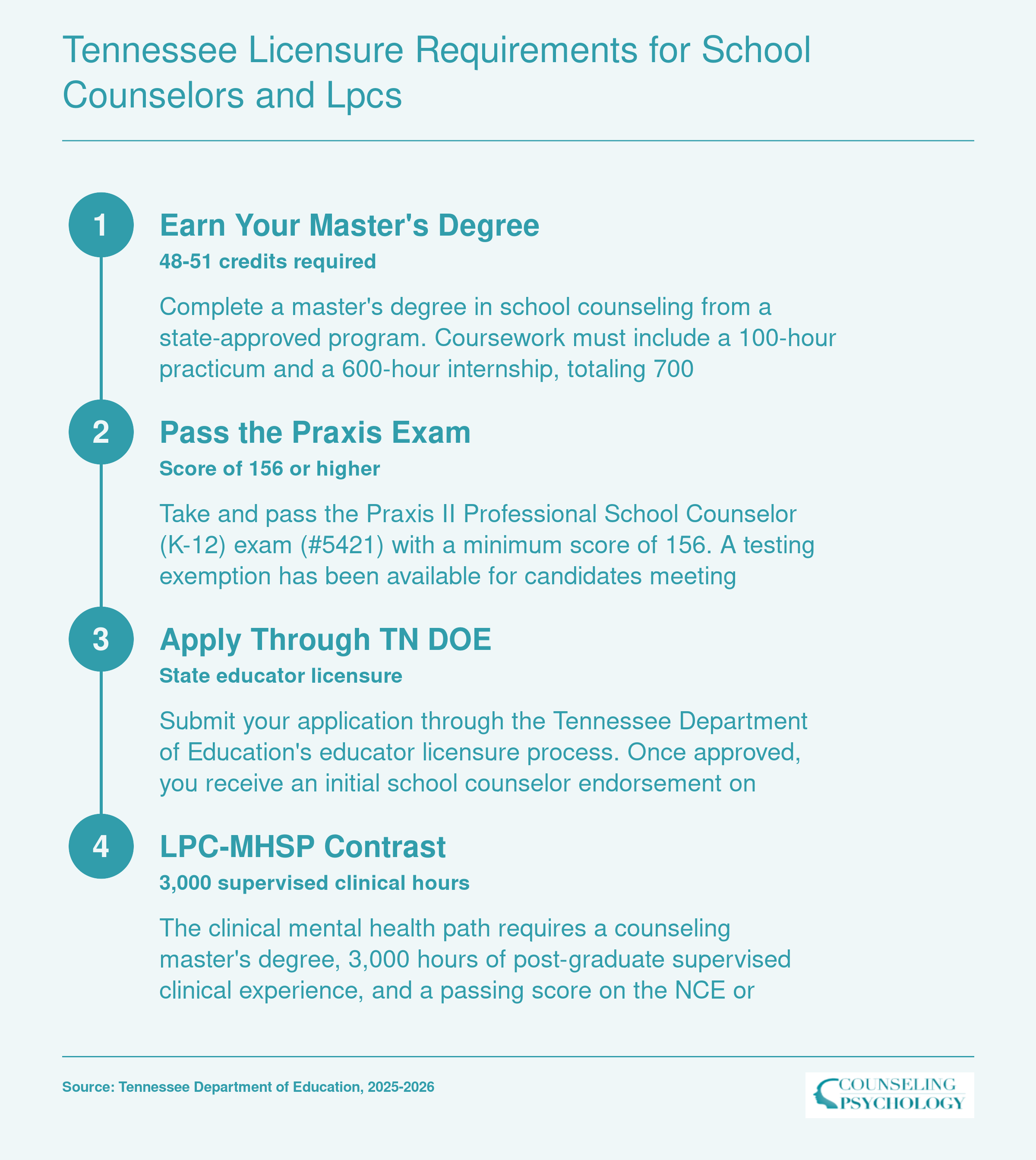
Tennessee offers two distinct credentialing tracks for counseling graduates: the school counselor endorsement through the Tennessee Department of Education and the Licensed Professional Counselor with Mental Health Service Provider designation (LPC-MHSP). Both require a master's degree, but the supervised hours, exams, and oversight bodies differ significantly. Here is the step-by-step credentialing ladder for the school counselor endorsement, followed by a brief contrast with the LPC-MHSP pathway.
Tuition Comparison and Total Cost of Attendance
The table below compares annual tuition rates, average net price after aid, and median graduate debt across counseling master's programs near Nashville. Net price reflects what students actually pay on average after grants and scholarships, making it a more reliable indicator of true cost than sticker price. All figures are drawn from IPEDS and College Scorecard data and represent institution-level averages, not program-specific totals.
| School | In-State Tuition | Out-of-State Tuition | Avg. Net Price | Median Graduate Debt | Student-to-Faculty Ratio |
|---|---|---|---|---|---|
| Austin Peay State University | $10,518 | $15,702 | $9,735 | $20,547 | 14:1 |
| Trevecca Nazarene University | $10,537 | $10,537 | $16,813 | $18,744 | 20:1 |
| The University of Tennessee, Martin | $11,916 | $12,978 | $10,701 | $21,024 | 16:1 |
| University of Memphis | $11,628 | $15,840 | $12,397 | $23,300 | 16:1 |
| Tennessee State University | $11,188 | $23,808 | $15,796 | $27,000 | 13:1 |
| The University of Tennessee, Chattanooga | $11,110 | $19,174 | $14,265 | $19,500 | 18:1 |
| East Tennessee State University | $11,366 | $26,486 | $15,983 | $19,442 | 15:1 |
| Tennessee Tech | $12,386 | $15,746 | $14,246 | $15,650 | 16:1 |
| The University of Tennessee, Knoxville | $15,972 | $34,760 | $18,976 | $20,500 | 18:1 |
| Lee University | $17,480 | $17,480 | $18,878 | $25,750 | 13:1 |
| Lincoln Memorial University | $22,154 | $22,154 | $20,406 | $20,000 | 10:1 |
| Freed-Hardeman University | $11,970 | $11,970 | $21,574 | $21,500 | 10:1 |
| Johnson University | $8,305 | $8,305 | $22,063 | $21,500 | 12:1 |
| Milligan University | $8,358 | $8,358 | $21,365 | $25,219 | 10:1 |
| Vanderbilt University | $57,868 | $57,868 | $15,846 | $14,000 | 8:1 |
| Lipscomb University | $17,334 | $17,334 | $24,739 | $19,500 | 13:1 |
| Southern Adventist University | $13,760 | $13,760 | $24,345 | $24,500 | 19:1 |
| Belmont University | $27,810 | $27,810 | $33,147 | $20,500 | 12:1 |
Related Articles
Career Outcomes and Salary Expectations for Counselors in the Nashville Metro
Salary expectations vary significantly depending on whether you pursue school counseling or clinical mental health work. The table below draws on May 2023 Bureau of Labor Statistics data for both Tennessee statewide figures and, where available, the Nashville metro area. Keep in mind that school counselors typically earn on a district salary schedule tied to years of experience and education level, so BLS figures represent a useful baseline rather than a ceiling. Many veteran school counselors with advanced step placements earn well above the median. For clinical mental health counselors, program-level earnings reported one year and four years after completion often look modest compared to BLS occupational medians because early-career graduates may still be accumulating supervised hours toward full licensure, which limits their billing authority and, in turn, their income. Once fully licensed, counselors in the Nashville metro tend to see meaningful salary gains that track closer to (or above) the occupational median.
| Occupation | Geographic Scope | Total Employment | 25th Percentile Wage | Median Wage | 75th Percentile Wage | Mean Wage |
|---|---|---|---|---|---|---|
| Educational, Guidance, and Career Counselors and Advisors | Nashville Metro (MSA) | 1,510 | N/A | N/A | N/A | $58,330 |
| Educational, Guidance, and Career Counselors and Advisors | Tennessee (Statewide) | 6,090 | $49,630 | $59,090 | $68,780 | $60,390 |
| Substance Abuse, Behavioral Disorder, and Mental Health Counselors | Tennessee (Statewide) | 7,310 | $36,910 | $48,170 | $60,900 | $51,480 |
| Marriage and Family Therapists | Tennessee (Statewide) | 2,590 | $38,600 | $45,660 | $51,210 | $46,510 |
Tennessee's student-to-school-counselor ratio stood at 429 to 1 in the 2021-2022 school year, according to the American School Counselor Association. That is nearly double the ASCA-recommended ratio of 250 to 1, making Tennessee one of the most underserved states in the country for school counseling support.
Financial Aid, Scholarships, and Loan Forgiveness for Counseling Students in Tennessee
Paying for a counseling master's can be daunting, but multiple federal, state, and private funding streams exist to reduce your out-of-pocket cost. Understanding which schools serve higher shares of aided students, where to find competitive scholarships, and which loan-forgiveness programs align with your career track will help you plan a realistic budget.
Which Programs Serve More Financially Aided Students?
Pell Grant recipiency at the undergraduate level offers a rough proxy for how many students at an institution come from lower-income backgrounds and how familiar the financial-aid office is with serving aided populations. Among the ranked programs, Tennessee State University reports 81 percent of undergraduates receiving Pell, Austin Peay State University 74 percent, and the University of Memphis 72 percent. East Tennessee State University (70 percent) and the University of Tennessee at Martin (68 percent) also exceed two-thirds. Private institutions Lincoln Memorial University (66 percent) and Trevecca Nazarene (63 percent) serve significant shares as well. Higher Pell populations often correlate with more robust financial-aid advising and a campus culture experienced in working with students who rely on grants, loans, and assistantships.
Tennessee State Aid: Limited Graduate Options
The Tennessee HOPE Scholarship is frequently discussed in undergraduate contexts but does not extend to graduate programs. Tennessee currently operates no broad, need-based state grant for master's students in counseling. However, the Tennessee State Loan Repayment Program (TSLRP) does support Licensed Professional Counselors (LPC-MHSP) who commit to practice in federally designated Health Professional Shortage Areas or other underserved communities.1 Awards vary by funding cycle and typically require a multi-year service commitment. Check the Tennessee Department of Health website annually for application windows and eligible service sites.
National Scholarships for Counseling Graduate Students
Several national organizations award merit- and need-based scholarships specifically for counseling students:
- NBCC Foundation Minority Fellowship Program (Master's level): Awards $12,000 to up to 32 full-time students enrolled in CACREP-accredited or CACREP-pending programs each year. Recipients must be U.S. citizens or permanent residents with no prior master's in a behavioral health field, commit to serving underserved communities for at least two years post-graduation, and apply for National Certified Counselor (NCC) status before graduation. Paid travel to required trainings is also included.2
- NBCC Foundation Military and Rural Scholarships: Additional $5,000 awards for students with military affiliation or those committed to rural practice. Past cycles have funded both tracks; consult the NBCC Foundation scholarships portal for current availability.3
- Chi Sigma Iota (CSI) Scholarships: The international counseling honor society offers multiple awards ranging from $500 to $2,000 for student members. Criteria vary by award but typically emphasize academic achievement, leadership, and service.4
- American Counseling Association (ACA) Foundation Grants: The ACA Foundation awards several small scholarships ($500 to $2,000) annually, often tied to specific populations or practice areas. Application cycles open in late fall.4
All four organizations publish detailed eligibility criteria and deadlines on their websites. Applying broadly across these opportunities increases your odds of support.
Federal Loan Forgiveness and Grants
Public Service Loan Forgiveness (PSLF) is the most robust federal pathway for counselors. School counselors employed full-time by public K-12 districts or public universities qualify; after making 120 qualifying monthly payments under an income-driven repayment plan while working for an eligible employer, your remaining federal Direct Loan balance is forgiven tax-free.1 Clinical mental health counselors working in nonprofit community mental health centers also qualify. Track your employment annually using the PSLF Help Tool and submit the employer certification form each year to avoid surprises at the 10-year mark.
The federal TEACH Grant ($4,000 per year) is sometimes cited for school counselors, but eligibility depends on whether your program is formally designated as a TEACH-eligible teacher-preparation program. Most counseling master's programs are not, and accepting a TEACH Grant that converts to an unsubsidized loan if service requirements are not met can be risky.1 Verify your specific program's TEACH status with the financial-aid office before committing.
Teacher Loan Forgiveness, a separate program that forgives up to $17,500 for teachers in Title I schools, generally does not extend to school counselors unless they also serve as a teacher of record in a qualifying subject. Do not conflate this with PSLF.
Graduate Assistantships and Employer Tuition Benefits
Many public universities offer graduate assistantships that provide tuition remission plus a modest stipend in exchange for 10 to 20 hours per week of teaching, research, or administrative support. Availability varies by department and cohort size, and most assistantships are awarded during the admissions process or within the first few weeks of enrollment. Ask each program's admissions coordinator directly about assistantship openings, application deadlines, and typical award amounts.
If you already work in education or a related field, check whether your employer offers tuition reimbursement or professional-development funds. Some Tennessee school districts have launched Grow Your Own initiatives that subsidize master's degrees for paraprofessionals, teachers, or substitutes willing to transition into school counseling roles and commit to several years of service in the district.
Plan Early and Apply Widely
Funding for graduate education rarely arrives in a single award. Most students piece together federal loans, one or two external scholarships, an assistantship or part-time job, and employer support. Start researching scholarship cycles at least six months before your intended start term, and maintain a spreadsheet of deadlines, required essays, and recommendation-letter requests. Early planning maximizes your access to competitive aid and reduces your reliance on unsubsidized loans.
How to Choose the Right Counseling Program Near Nashville
CACREP-accredited programs versus non-accredited alternatives. That single distinction shapes your licensure path, job prospects, and career flexibility far more than most applicants realize. In Tennessee, choosing a program with the right accreditation, practical experience, and format can be the difference between a smooth entry into the field and years of extra coursework.
Accreditation: Start with CACREP
CACREP accreditation is the single most important factor when evaluating counseling master's programs. Tennessee licensing boards and employers across the Nashville metro prioritize graduates from CACREP-accredited programs. If you attend a non-CACREP program, you may need to complete additional coursework, document extra supervised hours, or face delays during the licensure application process, especially for the Licensed Professional Counselor (LPC) or school counselor endorsement. Portability to other states also becomes simpler with a CACREP degree. Before enrolling, confirm a program's current CACREP status directly on the council's directory, because provisional or expired recognition can create unexpected hurdles later. If you are exploring school-focused tracks specifically, our guide to CACREP accredited online school counseling programs covers what to look for in program directories.
Practicum Partnerships: Your Bridge to a Job
Practical fieldwork is where counseling theory becomes clinical skill, and programs with established relationships give you a meaningful head start. For school counseling candidates, connections with Metro Nashville Public Schools and surrounding districts like Williamson, Rutherford, and Sumner Counties are invaluable.1 Middle Tennessee State University, for example, routinely places advanced school counseling students in those very districts through faculty networks and a university job and internship board.2 These partnerships often translate into smoother site placements, stronger mentoring, and sometimes even job offers after graduation. Outside the K-12 track, look for programs that have active ties with local mental health agencies, hospitals, and the Tennessee Department of Mental Health and Substance Abuse Services.3 Ask admissions staff how they match students with sites and what their placement rate has been over the past three years.
Format Flexibility: Study on Your Schedule
Many counseling students in the Nashville area are career changers or working adults with full-time jobs and family obligations. Evening cohort models, hybrid options that blend online coursework with in-person intensives, and fully online programs can make the difference between finishing your degree and stopping out. However, flexibility should not come at the expense of clinical training quality. Verify that any online or hybrid program still provides robust, supervised practicum and internship experiences in settings near your community. A program that claims to be flexible but leaves you to find your own site without support may delay your timeline significantly.
Class Size and Supervision Quality
Cohort size and faculty-to-student ratio directly affect the quality of clinical supervision you will receive, especially during the intensive practicum and internship sequences. Smaller cohorts mean more individualized attention from experienced faculty who can observe your work, offer direct feedback, and guide your professional growth. When evaluating programs, ask about typical class sizes for core clinical courses, the average number of students assigned to each faculty supervisor, and how often you will receive on-site supervision during fieldwork. These details matter more than prestige or a university's overall reputation.
Curriculum Alignment with Tennessee Endorsement Rules
Before you enroll, map the program's course list against the Tennessee Department of Education (DOE) endorsement requirements if you plan to become a school counselor. Some programs cover all necessary content seamlessly, while others may require you to take additional electives or post-master's coursework to meet the state's specific standards for school counseling licensure. Contact the DOE's educator licensing office or your prospective program's advisor to review the current checklist. A few minutes of verification now can save a semester of catch-up later.
Frequently Asked Questions About Counseling Master's Programs Near Nashville
Prospective students often have similar questions when weighing counseling master's programs in the Nashville area. The answers below draw on program details, licensure rules, and cost data discussed throughout this article.
More Counseling Master's Programs Near Nashville to Consider
Beyond the top 10 most affordable programs, several other Tennessee schools offer strong counseling master's degrees worth exploring. These options range from Nashville-based universities to programs in other parts of the state, each with unique strengths in format, specialization, or cost.
Henderson
- Master of Science in School Counseling
Nashville
- Master of Marriage and Family Therapy
- School Counseling
- Clinical Mental Health Counseling
- Clinical Mental Health Counseling (Addiction)
- Clinical Mental Health Counseling (Play Therapy)
- Human Development Counseling (School Counseling)
- Human Development Counseling (Clinical Mental Health Counseling)
- Master of Arts in Mental Health Counseling (School Counseling)
- Master of Arts in Mental Health Counseling (Clinical Mental Health Counseling)
- Master of Arts in Mental Health Counseling (Marriage, Couples, and Family Counseling)
- Master of Arts in Mental Health Counseling (Clinical Pastoral Therapy)
Clarksville
- Counseling (School Counseling)
- Master of Science in Counseling (Clinical Mental Health Counseling)
Knoxville
- Master of Arts in Counseling (School Counseling)
- Master of Arts in Counseling (Clinical Mental Health Counseling)
- Master of Arts in Counseling
Chattanooga Area
- M.S. in School Counseling
- M.S. in Clinical Mental Health Counseling
- Master of Ministry (Biblical Counseling)
Tri-Cities Area
- School Counseling
- Clinical Mental Health Counseling
- Master of Science in Counseling (Addictions Counseling)
- Clinical Mental Health Counseling (Addictions Counseling)