
What you’ll learn in this article…
- Five of six ranked programs near Winston-Salem are public universities with in-state tuition under 9,000 dollars annually.
- Assistantships at top NC programs often cover full tuition plus stipends of roughly 18,000 to 22,000 dollars per year.
- Winston-Salem's lower cost of living stretches doctoral stipends further than Raleigh, Durham, or Charlotte.
- NC State's I-O psychology Ph.D. still requires the GRE, while several of its other doctoral tracks have dropped it.
How do you find a psychology Ph.D. that doesn't require taking on five years of debt? In North Carolina, in-state tuition at public universities runs under $9,000 annually, and many students land assistantships covering tuition plus a stipend. Winston-Salem's cost of living is lower than Raleigh or Charlotte, stretching an $18,000 to $22,000 stipend further. Near Winston-Salem, programs span educational, clinical, and I-O psychology, with net prices after aid dipping below $11,000 at some public institutions. The deciding factor isn't the sticker price: it's which funding packages keep a long doctoral track financially workable. Below, we break down tuition comparisons, assistantship structures, ROI calculations, and admission requirements to help you identify the most affordable path to becoming a psychologist.
Best Affordable Ph.D. in Psychology Programs Near Winston-Salem
When comparing doctoral programs, sticker price rarely tells the whole story. The figures below use institution-wide net price after financial aid, which accounts for grants, scholarships, and tuition waivers the typical student actually receives. For fully funded Ph.D. students, the real cost can be even lower, since most of these programs offer assistantships that cover tuition and provide a stipend on top of institutional aid. Ranked by net price from lowest to highest, these six North Carolina schools represent the strongest options within reasonable reach of Winston-Salem.
- Net price after financial aid
- In-state and out-of-state tuition
- Institutional graduation and retention rates
- Program-level funding availability
- Regional relevance to Winston-Salem
- NCES-IPEDS federal institutional data — nces.ed.gov
- College Scorecard graduate earnings — collegescorecard.ed.gov
- Internal program database
- Independent program research

University of North Carolina at Greensboro
UNCG sits roughly 30 minutes east of Winston-Salem, making it the closest public research university on this list and arguably the most practical choice for Triad-area residents who want to minimize relocation costs. With an institution-wide net price of $10,965, it is also the most affordable entry point. The university houses multiple psychology doctorates, an APA-accredited clinical program that offers full tuition waivers for funded students, and NIH-funded faculty labs in its School of Health and Human Sciences. None of the psychology Ph.D. programs currently require GRE scores, which removes another cost barrier.
- APA-accredited scientist-practitioner training model
- Full tuition waiver available for funded students
- No GRE score required for admission
- Running Start summer research for incoming cohort
- Clinical practica across Greensboro and the Triad
- Five-year program plus predoctoral internship
- Summer DREAM Camp community engagement experience
- Mentor-apprentice model with individualized advising
- Research spans cognitive, social, and applied development
- No GRE required, holistic admissions review
- Strong community connections and local applied research
- Collaborative opportunities across university departments
- Prepares graduates for academic and non-academic careers
- Examines cognitive, emotional, and social factors in sport
- Access to specialized psychophysiology laboratories
- Faculty hold NIH-funded research grants
- Located in the School of Health and Human Sciences
- Prepares students for academic research and faculty roles
- Interdisciplinary collaboration across health disciplines
Ph.D. in Clinical Psychology — On-Campus
Ph.D. in Psychology, Developmental Psychology Concentration — On-Campus
Ph.D. in Kinesiology, Sport and Exercise Psychology Concentration — On-Campus

University of North Carolina at Charlotte
UNC Charlotte anchors the state's largest city and brings a strong health-psychology identity to doctoral training. Its APA-accredited Health Psychology Ph.D. offers three concentrations (Clinical, Community, and General) under one program umbrella, giving students flexibility to pivot between applied and research tracks. Doctoral cohorts typically receive tuition remission plus a stipend through teaching or research assistantships, and some cohorts benefit from federal training grant funding that also covers health insurance. The GRE requirement has been waived for recent admissions cycles, lowering application costs.
- APA-accredited with 100% internship match rate
- Scientist-practitioner model with interdisciplinary focus
- GRE requirement waived for recent application cycles
- Clinical practica in Charlotte-area hospitals and VA centers
- Addresses biological, psychological, and social health factors
- Licensure-eligible upon completion
- Prepares graduates for health disparities research
- Community-focused interventions and partnerships
- Campus-based with interdisciplinary research teams
- Open to master's holders and undergraduates
- Emphasis on social determinants of health
- Supervised practicum in community settings
- Three concentration options under one APA umbrella
- Master's degree required for admission
- Interdisciplinary research across health disciplines
- Faculty mentorship with multiple research labs
- Comprehensive intervention research opportunities
- Competitive assistantship funding available
- STEM-designated doctoral program
- Focus on data analysis and program evaluation
- Applicable to K-12 districts, nonprofits, and government
- Master's degree in a related field required
- Career transition pathways into higher education
- Rigorous quantitative research curriculum
Health Psychology Ph.D., Clinical Concentration — On-Campus
Health Psychology Ph.D., Community Concentration — On-Campus
Health Psychology Ph.D., General Concentration — On-Campus
Ph.D. in Educational Research, Measurement, and Evaluation — On-Campus

Appalachian State University
Appalachian State is one of only a handful of public universities nationwide offering an APA-accredited Psy.D. in Clinical Psychology, making it a cost-effective alternative to pricier private Psy.D. programs. Located in the Blue Ridge mountain town of Boone, the program deliberately trains practitioners to serve rural and underserved populations across North Carolina. Cohorts are small (six to eight students), which translates into close faculty mentoring and high-quality practicum placements at regional community mental health centers, rural clinics, and school systems. Graduate stipend support helps offset the already modest living costs in the area.
- APA-accredited practice-focused doctoral program
- Small cohorts of 6 to 8 students admitted annually
- Graduate stipend support for enrolled students
- Three-year supervised practicum sequence included
- Rural and underserved population training emphasis
- On-campus Psychology Clinic for hands-on experience
- Nine core faculty members guiding student research
- Evidence-based practice and applied research training
Psy.D. in Clinical Psychology — On-Campus

North Carolina State University at Raleigh
NC State combines Research Triangle resources with public university affordability, and its psychology department fields two distinct Ph.D. concentrations alongside a doctoral track in educational psychology. The Industrial-Organizational Psychology concentration is especially notable because I-O doctorates are relatively rare at public institutions in the Southeast. All three programs follow a 72-credit structure and routinely fund students through teaching and research assistantships. Raleigh's proximity to state agencies and private sector employers gives I-O and educational psychology students practical consulting and internship access that translates directly into career placement.
- 72 credit hours with comprehensive quantitative training
- Practicum in industrial and organizational settings
- Advanced statistical and research methods courses
- Specialized personnel selection coursework
- Access to Triangle-area industry and state agencies
- Campus-based with faculty-mentored research
- 72 credit hours with core psychology coursework
- Quantitative methods and specialized concentration courses
- Faculty collaboration and mentored research opportunities
- Financial aid and assistantship options available
- Prepares graduates for academia and research careers
- Bachelor's degree with psychology background preferred
- On-campus doctoral program, 72 graduate credits
- Multiple research focus areas in educational psychology
- Specialized research methods training included
- Inter-university collaboration across UNC system
- Dissertation research support and mentoring
- Targeted at educators and education researchers
Ph.D. in Psychology, Industrial-Organizational Psychology Concentration — On-Campus
Ph.D. in Psychology, Lifespan Developmental Psychology Concentration — On-Campus
Ph.D. in Teacher Education and Learning Sciences, Educational Psychology Concentration — On-Campus

University of North Carolina Wilmington
UNCW's psychology department runs two accredited doctoral tracks on North Carolina's coast: a General Clinical Psychology Ph.D. (APA-accredited) and a Psychology Ph.D. with an Applied Behavior Analysis concentration (ABAI-accredited). The clinical program follows a scientist-practitioner model across 94 credit hours and prepares graduates for licensure, while the ABA track feeds a growing statewide demand for Board Certified Behavior Analysts. Assistantships with tuition remission and stipends keep net costs manageable, and Wilmington's moderate cost of living stretches funding further than in larger metro areas.
- APA-accredited scientist-practitioner program
- 94 total credit hours over four to six years
- Comprehensive assessment and intervention training
- Practica in regional hospitals and community clinics
- Empirically supported intervention focus throughout
- Prepares graduates for doctoral-level NC licensure
- Professional development embedded in curriculum
- Accredited by the Association for Behavior Analysis
- Supervised practicum with local schools and agencies
- Prepares graduates for BCBA certification at doctoral level
- Strong research and teaching focus in ABA methods
- Leadership training for autism and disability services
- Campus-based program in Wilmington, NC
Ph.D. in General Clinical Psychology — On-Campus
Ph.D. in Psychology, Applied Behavior Analysis Concentration — On-Campus

Duke University
Duke's published tuition of $66,523 looks daunting, but its psychology Ph.D. students receive full funding packages that cover tuition, a competitive stipend, and health insurance for the duration of training, bringing real out-of-pocket costs well below those at many nominally cheaper schools. The Developmental Psychology program sits within the Department of Psychology and Neuroscience and emphasizes lifespan social-emotional and cognitive development. A collaborative certificate with UNC-Chapel Hill and cross-registration across Research Triangle universities amplify the value of a single tuition line, and GRE scores are optional.
- Full funding package includes tuition, stipend, and insurance
- GRE optional with holistic admissions review
- Collaborative certificate program with UNC-Chapel Hill
- Research practicum outside primary lab required
- Cross-registration across Research Triangle institutions
- Focus on social-emotional and cognitive lifespan development
- Active developmental working groups and annual reviews
- 5:1 student-to-faculty ratio across the university
Ph.D. in Developmental Psychology — On-Campus
NC Psychology Ph.D. Tuition Comparison: Public vs. Private, In-State vs. Out-of-State
The table below lines up all six ranked programs so you can compare sticker-price tuition and the institution-wide average net price in one place. Five of the six schools are UNC System or other public universities, which keeps in-state annual tuition below $12,200. Duke, the lone private institution, charges a single tuition rate regardless of residency but offsets it with generous doctoral funding. Note: the net price shown is an institution-wide average reported to IPEDS and reflects all degree levels combined. Individual doctoral students' actual costs will vary depending on assistantship packages, tuition remission, fellowships, and other program-specific funding.
| School | Sector | In-State Tuition | Out-of-State Tuition | Avg. Net Price (Institution-Wide) |
|---|---|---|---|---|
| UNC Greensboro | Public | $8,614 | $23,329 | $10,965 |
| UNC Charlotte | Public | $8,037 | $23,072 | $15,435 |
| Appalachian State University | Public | $8,570 | $25,241 | $16,836 |
| NC State University | Public | $12,101 | $32,874 | $17,303 |
| UNC Wilmington | Public | $8,112 | $24,198 | $20,109 |
| Duke University | Private | $66,523 | $66,523 | $29,612 |
Questions to Ask Yourself
Assistantship and Funding Opportunities at NC Psychology Ph.D. Programs
Funding packages at North Carolina psychology doctoral programs can cover most or all of your expenses, transforming a multi-year commitment into a financially manageable pursuit. Understanding how these packages work, and which programs offer the strongest guarantees, is essential for making an informed decision about where to apply.
The Three Main Funding Levers
Doctoral funding typically combines three components that work together to reduce your total cost:
- Tuition remission: Many programs waive tuition entirely for funded students, eliminating the largest expense line. Full tuition remission means you pay nothing toward course credits while maintaining good academic standing.
- Teaching assistantships (TAs): These positions have you leading discussion sections, grading assignments, or assisting faculty in undergraduate courses. TA stipends provide living expenses while building skills you will use throughout an academic career.
- Research assistantships (RAs): Working on faculty research projects, you gain hands-on experience in your specialization while earning a stipend. RA positions often align directly with your dissertation interests, making them especially valuable for career preparation.
The combination of all three can result in zero out-of-pocket tuition costs plus an annual stipend that covers housing, food, and basic living expenses in a city like Winston-Salem or Charlotte.
Program-Specific Funding Structures
UNC Charlotte's Health Psychology Ph.D. program offers one of the more transparent funding models in the region. According to the program's published information, admitted students receive an annual stipend of approximately $20,000, full tuition remission, and health insurance coverage.1 The program guarantees this package for four years, with a fifth year of eligibility available. This structure provides predictability that helps students plan their finances across the typical program timeline.
Other NC programs vary in their approaches. Some offer guaranteed multi-year packages similar to UNC Charlotte's model, while others operate on year-by-year renewal cycles that depend on satisfactory progress and available departmental funds. When evaluating programs, ask directly whether funding is guaranteed for a set number of years or subject to annual reapplication. The difference significantly affects your financial security during the dissertation phase, when many students face the greatest time pressure.
External Funding Worth Pursuing
Beyond institutional support, NC doctoral students can compete for prestigious external awards that supplement program funding:
- NSF Graduate Research Fellowship Program (GRFP): This highly competitive fellowship provides three years of support, including an annual stipend of $37,000 plus a $16,000 cost-of-education allowance paid to your institution. Winners gain both financial freedom and a credential that strengthens future applications for academic positions.
- APA Dissertation Research Awards: The American Psychological Association offers grants specifically supporting dissertation research in psychology. These smaller awards (typically a few thousand dollars) help cover data collection costs, participant compensation, or specialized equipment.
- Ford Foundation Fellowships: For students from underrepresented backgrounds pursuing research careers, these fellowships provide substantial multi-year support.
Applying for external funding early in your doctoral career, even if your program already provides a stipend, can free you from teaching obligations and accelerate your research timeline. Many students underestimate the value of this time savings when weighing whether the application effort is worthwhile. If you are still exploring doctorate in health psychology options more broadly, comparing funding structures across institutions is one of the most impactful steps you can take.
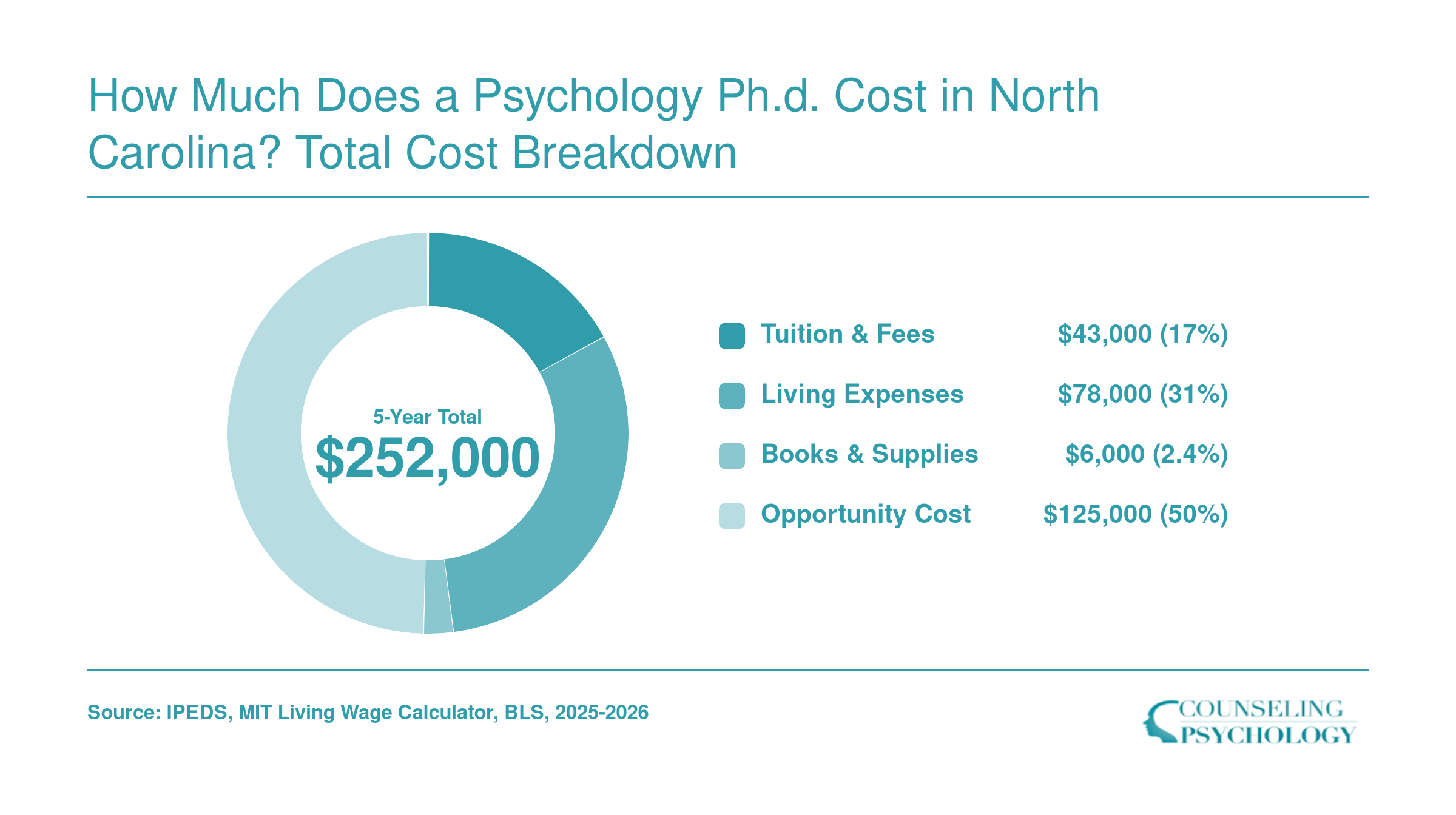
How Much Does a Psychology Ph.D. Cost in North Carolina? Total Cost Breakdown
The sticker price of a psychology Ph.D. tells only part of the story. Below is an estimated total cost for an unfunded in-state student completing a five-year doctoral program at a typical NC public university, using Winston-Salem living expenses as the baseline. A funded student with a full tuition waiver and stipend may pay only books, supplies, and incidental fees out of pocket, cutting the total burden by roughly 75-80%.
Industrial-Organizational Psychology Ph.D. Programs in and Near North Carolina
Industrial-Organizational (I-O) psychology is a specialized field, and doctoral programs are less common than general clinical or counseling psychology tracks. Within North Carolina and the surrounding region, dedicated I-O psychology Ph.D. programs are limited, making thorough research essential for prospective students.
Programs Within North Carolina
As of 2026, North Carolina does not host a standalone, APA-accredited Ph.D. program exclusively in Industrial-Organizational psychology. NC State University and UNC Charlotte both offer psychology doctoral programs, but these institutions do not maintain dedicated I-O psychology Ph.D. tracks. Students interested in I-O psychology within North Carolina may need to explore related emphases within organizational behavior, human resources, or business psychology programs, or consider programs in neighboring states. Those drawn to other psychology specializations may want to review the best clinical psychology programs in North Carolina for additional options.
Regional Programs Within 150 Miles of Winston-Salem
Several universities within a reasonable distance of Winston-Salem offer I-O psychology doctoral programs:
- Clemson University (Clemson, SC): Approximately 100 miles from Winston-Salem, Clemson offers a Ph.D. in Applied Psychology with an Industrial-Organizational concentration. This program is listed in the Society for Industrial and Organizational Psychology (SIOP) Graduate Program Directory and emphasizes applied research in workplace settings. It is not APA-accredited, as I-O psychology programs typically do not seek APA accreditation; instead, SIOP alignment is the field standard.
- Virginia Tech (Blacksburg, VA): About 115 miles from Winston-Salem, Virginia Tech offers a Ph.D. in Industrial and Organizational Psychology through its Department of Psychology. The program is SIOP-aligned and focuses on selection, training, and organizational development. Virginia Tech's program benefits from strong assistantship funding and active faculty research portfolios.
- Old Dominion University (Norfolk, VA): Roughly 200 miles from Winston-Salem, Old Dominion offers a Ph.D. in Industrial-Organizational Psychology. The program is SIOP-listed and provides comprehensive training in applied research methods, psychometrics, and organizational consulting.
For a broader look at Virginia-based options, our guide to industrial organizational psychology programs in Virginia covers additional details on funding and faculty strengths.
How to Verify Program Details
Because program offerings, specializations, and funding structures change frequently, prospective students should take these verification steps:
- Consult the SIOP Graduate Program Directory: This resource, maintained by the Society for Industrial and Organizational Psychology, provides the most comprehensive and current list of I-O psychology doctoral programs, including details on faculty, research areas, and funding.
- Review psychology department websites directly: Visit NC State, UNC Charlotte, Clemson, Virginia Tech, and Old Dominion to explore Ph.D. program listings, faculty profiles, and research labs. Program coordinators often post admissions criteria, funding packages, and application deadlines.
- Check APA accreditation status: If you are considering a program that blends I-O psychology with clinical or counseling tracks, verify APA accreditation through the American Psychological Association's official directory of accredited doctoral programs.
- Contact program coordinators directly: Email or call admissions offices to confirm current offerings, assistantship availability, and whether part-time or remote study options exist. Direct contact often reveals unpublished details about recent curriculum changes or upcoming cohort sizes.
Winston-Salem's cost of living runs notably lower than Raleigh, Durham, or Charlotte, meaning a doctoral stipend of around 18,000 to 22,000 dollars per year goes considerably further here. Median apartment rents in Winston-Salem have historically tracked well below the Triangle average, giving Ph.D. students more financial breathing room during a long program.
Career Outcomes and Salary for Psychology Ph.D. Graduates in North Carolina
A psychology Ph.D. earned in North Carolina typically pays back through stable, mid-to-upper five-figure salaries, with a meaningful premium for graduates who specialize in industrial-organizational work or move into private practice. The exact return depends heavily on subfield, sector (academic vs. clinical vs. corporate), and licensure status, but the labor market for doctoral-level psychologists in the state is steady.
What the BLS Says About NC Psychologist Pay
The Bureau of Labor Statistics pegs the 2024 median annual wage for clinical and counseling psychologists in North Carolina at $91,840, modestly below the national median of $95,830 for the same occupation.1 The state range runs from roughly $54,130 at the 10th percentile to $142,120 at the 90th, reflecting the gap between early-career licensed clinicians and seasoned practice owners or AMC-affiliated psychologists.1 BLS does not publish a separate Winston-Salem metro figure for this occupation in current releases, so the state median is the most reliable local anchor.
The broader "Psychologists, All Other" category (SOC 19-3039), which captures applied psychology careers and research roles outside clinical practice, posted a national median of $117,750 in 2023.3 Industrial-organizational psychologists (SOC 19-3032) consistently rank among the highest-paid psychology subfields nationally, often clearing $130,000 at the median in corporate settings.4 NC State's I-O concentration in Raleigh feeds directly into that market through Research Triangle employers, and graduates interested in this path may also want to explore I/O psychology master's programs as a stepping stone or complement.
Program-Level Earnings: A Caveat
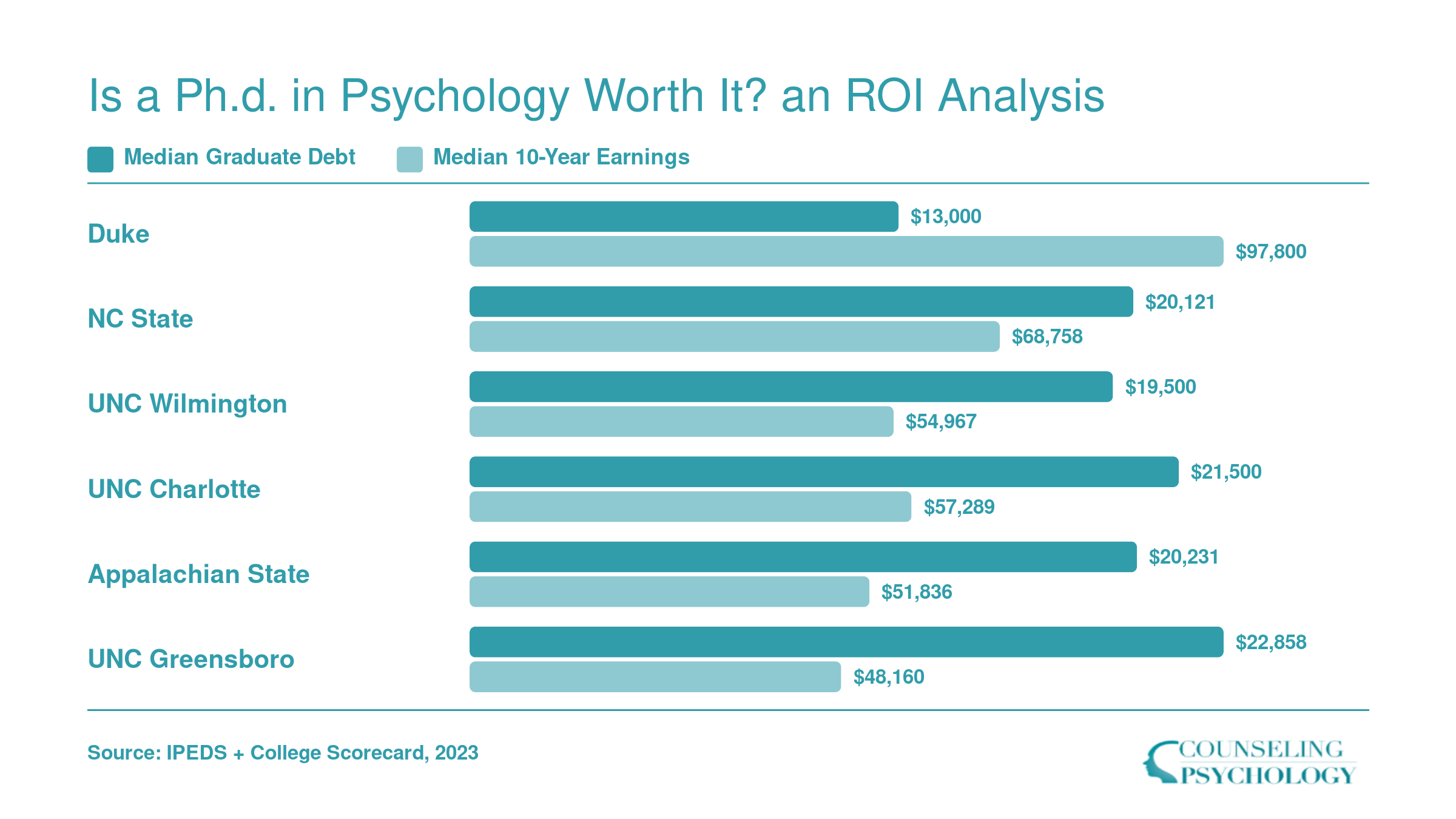
Looking at the ranked NC doctoral programs, institution-wide 10-year post-enrollment earnings give a rough signal: Duke graduates report a median of $97,800, NC State $68,758, and UNC Charlotte $57,289. These figures aggregate all alumni across an institution, not psychology Ph.D.s specifically, so treat them as floor estimates rather than program-specific outcomes. Discipline-level earnings for these doctoral programs are not currently published in federal outcome datasets, a common gap for small-cohort Ph.D.s.
Labor Market Absorption
Licensed psychologists in North Carolina face a tight labor market on the demand side: community mental health centers, VA facilities, academic medical centers (Wake Forest Baptist, Duke Health, Atrium Health), and school systems all hire doctoral-level clinicians. I-O graduates near Charlotte and the Triangle place into talent analytics, organizational development, and HR consulting roles. Employment within a year of credential completion is generally strong for APA-accredited program graduates, though formal program-level employment shares are not reported in public federal data.
Is a Ph.D. in Psychology Worth It? An ROI Analysis
One of the most practical ways to evaluate a doctoral program is to compare what you borrow against what you earn afterward. Using institution-level College Scorecard data, we calculated an ROI ratio (median 10-year earnings divided by median graduate debt) for each program near Winston-Salem. A higher ratio means every dollar of debt is backed by more earning power. Duke's ratio of roughly 7.5 to 1 stands far above the rest, largely because its generous funding keeps median graduate debt remarkably low at $13,000 while its graduates report the highest median earnings. Among the public universities, NC State delivers the strongest debt-to-earnings balance at about 3.4 to 1, thanks to solid post-graduation earnings of $68,758. To put this in cash-flow terms, a graduate carrying the median $20,121 in debt from NC State would owe roughly $210 per month on a standard 10-year repayment plan, against an estimated monthly gross income of about $5,730, a comfortable ratio. Even at UNC Greensboro, where the ratio is lowest at roughly 2.1 to 1, the monthly payment on $22,858 in debt (about $238 per month) remains manageable relative to estimated monthly earnings of roughly $4,013.
Admission Requirements and Competitiveness at NC Psychology Ph.D. Programs
NC State University requires GRE scores for its Industrial-Organizational Psychology Ph.D. but has dropped the requirement entirely for its Applied Social Psychology, Human Factors, and School Psychology doctoral tracks as of 2024.1 This split approach reflects a broader trend across North Carolina institutions, where test-optional and test-free policies have reshaped the doctoral admissions landscape.
Understanding Institutional Selectivity
Institutional admission rates offer a rough sense of overall competitiveness, though doctoral psychology programs typically accept far fewer applicants than these figures suggest. Duke University admits just 5.7% of undergraduate applicants, signaling an intensely competitive environment across all programs. NC State accepts about 42% at the institutional level, while UNC Charlotte and UNC Greensboro admit 80% and 89% of applicants respectively. These numbers can mislead prospective doctoral students: clinical psychology Ph.D. programs nationally accept between 5% and 15% of applicants in a typical year, and funded cohorts at research universities often admit fewer than ten students annually. If you are wondering how hard is it to get into grad school for psychology, these acceptance rates help frame the challenge.
GRE Policies and GPA Expectations
The GRE landscape has shifted dramatically since 2020. UNC Charlotte's Health Psychology Ph.D. does not require GRE scores for Fall 2026 admission2, and UNC Wilmington's Psychology Ph.D. program does not consider GRE scores at all.3 Wake Forest's Psychology M.A., which can serve as a stepping stone to doctoral work, treats the GRE as optional.4 NC State presents a mixed picture: the I-O Psychology concentration still requires scores, while the Lifespan Developmental track treats them as optional.1
GPA thresholds vary, but competitive applicants typically present undergraduate records well above 3.5. UNC Charlotte's Health Psychology program reports an average admitted GPA of 3.50.2 Prerequisite coursework matters as much as grades: UNC Charlotte requires 18 credits of psychology including Introductory Psychology, Research Methods, and undergraduate statistics.2
Research Experience and Application Materials
Substantive research experience often matters more than test scores at research-intensive Ph.D. programs. Admissions committees look for applicants who have worked in faculty labs, presented at conferences, or contributed to publications. Strong letters of recommendation, typically three, should come from faculty who can speak directly to your research skills and potential. Personal statements must articulate clear research interests aligned with specific faculty mentors. Students interested in workplace-focused research may also want to explore industrial organizational psychology Ph.D. programs at the national level.
Time-to-Completion and Financial Implications
Most psychology Ph.D. programs require five to seven years of full-time study, encompassing coursework, qualifying exams, dissertation research, and clinical practica for applied tracks. This timeline directly affects total financial commitment. Even with assistantship funding covering tuition and providing a stipend, students forgo half a decade or more of full-time earnings.
Economic Diversity Across Institutions
Pell grant share offers context for socioeconomic diversity within each student body. UNC Greensboro reports that 68% of undergraduates receive Pell grants, indicating a student population with significant financial need. UNC Charlotte follows closely at 61%, while Appalachian State sits at 54% and NC State at 47%. Duke's 32% Pell share reflects a different economic profile. These figures describe undergraduate populations rather than doctoral cohorts specifically, but they suggest institutional cultures and potential support systems for students from modest economic backgrounds.
How to Choose the Right Affordable Psychology Ph.D. Program
Selecting a doctoral program requires balancing cost against quality, fit, and long-term career outcomes. A systematic approach helps you avoid overpaying for a program that looks affordable on paper but leaves you underserved in mentorship or career preparation.
Start With Accreditation and Specialization
For clinical, counseling, or school psychology tracks, APA accreditation is non-negotiable if you plan to pursue licensure or work in settings that require it (VA hospitals, academic medical centers, many state agencies). Programs without APA accreditation may cost less but can severely limit your career options. For industrial-organizational psychology, APA accreditation is less common and less critical, so focus instead on SIOP membership among faculty and alumni placement in consulting or corporate roles.
Confirm that your intended specialization is available before diving into cost comparisons. Understanding the different types of psychology degrees can clarify which program structure best matches your goals. A program might offer a general psychology Ph.D. but lack the faculty, practicum sites, or coursework for your specific area of interest.
Compare Net Price, Not Sticker Tuition
The tuition comparison earlier in this article shows dramatic differences between public and private institutions, and between in-state and out-of-state rates. However, sticker price tells only part of the story. A program charging $28,000 per year but offering full tuition remission and a $22,000 stipend costs you nothing out of pocket and pays you to attend. A $12,000 program with no funding might require loans or outside employment that extends your time to degree.
When calculating true costs, factor in:
- Tuition waivers: Full, partial, or none
- Stipend amounts: Livable in Winston-Salem may not be livable in a high-cost metro
- Guaranteed years: Some programs fund only three or four years, leaving you to scramble for support during dissertation
- Health insurance: Coverage varies widely and can add $3,000 to $6,000 annually if not provided
- Fees: Mandatory fees sometimes exceed $1,500 per semester even when tuition is waived
Evaluate Fit Beyond the Numbers
Cost efficiency means nothing if you struggle to complete the program or enter the workforce unprepared. Consider:
- Faculty research alignment: You will spend years collaborating closely with one or two advisors. Review their recent publications and active grants.
- Cohort size: Smaller cohorts often mean more individualized mentorship but fewer peer collaborations. Larger cohorts may offer richer networks but less faculty attention.
- Practicum and internship placements: Ask where recent students completed their clinical hours or I-O internships. Strong placements in hospitals, schools, consulting firms, or research labs signal program reputation.
- Mentor availability: High faculty-to-student ratios look good on paper but matter only if your preferred mentor is accepting students and not nearing retirement.
Ask the Questions Programs Rarely Publish
Program websites emphasize strengths and downplay weaknesses. Contact admissions coordinators or program directors directly to ask:
- How many years of funding do most students receive?
- What percentage of students complete the program within six years?
- Where did graduates from the last three cohorts take their first positions?
- How many students are currently seeking dissertation chairs versus actively working with mentors?
These conversations reveal operational realities that brochures omit. A program with excellent funding but 40 percent attrition may indicate structural problems worth avoiding, regardless of price.
Frequently Asked Questions About Psychology Ph.D. Programs in North Carolina
Prospective doctoral students regularly ask about cost, timelines, and funding before committing to a psychology Ph.D. in North Carolina. The answers below draw on data from the programs and tuition figures discussed earlier on counselingpsychology.org.