

What you’ll learn in this article…
- Portland offers one regionally based forensic psychology program, so most students also consider accredited online options.
- Oregon licensure as a forensic psychologist typically requires 10 to 14 years of education, supervised hours, and examinations.
- Psychologists in the Portland metro area earn salaries that vary significantly by experience, setting, and specialization level.
- Key practicum sites include Oregon State Hospital, Multnomah County courts, and federal correctional facilities nearby.
Oregon requires doctoral-level training for independent forensic psychology practice, and only a handful of APA-accredited programs in the Pacific Northwest meet that standard. Portland sits adjacent to Oregon State Hospital, Multnomah County's busy circuit court system, and a corrections infrastructure that has become a focal point for criminal justice reform, creating a practice environment that is both consequential and professionally demanding.
Local doctoral program options are limited. That reality pushes many Portland-area students toward online or hybrid programs, which can satisfy Oregon licensure requirements when accreditation and supervised hours are structured correctly. Master's-level practitioners can enter forensic roles under LPC or LMHP credentials, but scope-of-practice boundaries are strict. Students exploring that route may want to review forensic psychology master's programs before committing to a doctoral timeline.
The narrowness of the local training market is not a barrier so much as a filter: students who understand Oregon's licensure sequence, choose programs with verified clinical placements, and position early for competitive practicum sites at institutions like Oregon State Hospital tend to emerge with credentials that are genuinely competitive in this region.
Best Forensic Psychology Programs in Portland, OR
Portland-area students interested in forensic psychology face a limited local landscape. Only one regionally based program met our criteria for this ranking, which reflects the specialized nature of forensic psychology training in Oregon. Many Portland students supplement local options with nationally available online programs or hybrid formats offered by accredited universities elsewhere. Below, we profile the top eligible program and explain what it offers prospective forensic psychologists.
- Program accreditation and clinical rigor
- Internship placement outcomes
- Graduate debt and net cost
- Institutional graduation and retention rates
- Relevance to forensic psychology practice
- Internal program database
- College Scorecard graduate earnings — collegescorecard.ed.gov
- Independent program research
- NCES-IPEDS federal institutional data — nces.ed.gov

George Fox University
George Fox University is a private institution in Newberg, Oregon, roughly 25 miles southwest of Portland. Its APA-accredited PsyD program provides a spiritually integrated clinical psychology education with multiple specialization tracks, strong mentorship, and a 100% internship placement rate. The school-wide graduation rate is 72%, and 85% of doctoral students receive graduate assistantships, which can meaningfully offset costs. While the university does not advertise a standalone forensic psychology track, students can direct elective coursework and practicum placements toward forensic assessment, criminal justice consultation, and related competencies.
- APA-accredited, five-year in-person doctoral program
- 125 semester credit hours at $1,150 per credit
- 100% internship placement rate for recent cohorts
- 85% of students receive graduate assistantships
- Spiritually integrated curriculum with multicultural focus
- Multiple clinical specialization tracks available
- Located in Newberg, OR, near Portland metro area
- Median graduate debt of $24,250 (institution-wide)
Doctor of Psychology (PsyD) in Forensic Psychology — On-Campus
Why Study Forensic Psychology in Portland?
What does Portland actually offer forensic psychology students that a larger or more generic market does not?
A Region Dense with Forensic Practice Opportunities
Portland sits within a short radius of some of Oregon's most consequential forensic institutions. Oregon State Hospital, the state's primary forensic psychiatric hub, operates campuses in Salem and Junction City, roughly 45 minutes south of the city.1 Its Forensic Evaluation Services unit handles aid-and-assist evaluations and Guilty Except for Insanity commitments referred by courts across the state, including Multnomah County.2 Students and early-career clinicians in Portland can realistically access field placements tied to that pipeline without relocating.
The Multnomah County Circuit Court and adjacent county mental health services generate a steady volume of competency, civil commitment, and juvenile forensic referrals. Federal court activity in the District of Oregon adds another layer of case complexity rarely available in smaller metros. Oregon Department of Corrections facilities in the region further expand the range of correctional psychology exposure.
A Policy Environment That Is Actively Shaping Demand
Oregon's criminal justice landscape has been unusually dynamic. Measure 110, passed in 2020, decriminalized small-amount drug possession, but a partial rollback in 2023 and 2024 restored misdemeanor charges for those cases.3 The practical effect has been a growing volume of defendants with co-occurring substance use and mental health disorders cycling through the courts, driving demand for competency and criminal responsibility evaluations. For forensic evaluators, that policy turbulence translates directly into caseload.
The Northwest Forensic Institute, operating under a state contract since 2012, runs Oregon's formal training program for court-ordered competency and criminal responsibility evaluators.4 That infrastructure gives Portland-area trainees a clear path into credentialed forensic evaluation work. Anyone exploring forensic psychologist requirements should note that Oregon mandates a doctoral degree in clinical psychology, 1,500 supervised hours, and passage of both the EPPP and a state-specific exam before independent licensure.3
A Professional Community Worth Joining Early
Oregon has a small but established board-certified forensic psychology presence (currently five ABFP diplomates statewide), and private practices like Lithia Forensics and Consulting reflect the depth of the local specialist community.5 The Oregon Psychological Association maintains a forensic division, and connecting with local diplomates during graduate training is genuinely feasible here in a way it would not be in a market saturated with competing trainees.
That combination of substantial institutions, active policy reform, and an accessible professional community makes Portland a strategically strong base for forensic training rather than just a convenient geographic choice.
On-Campus vs. Online Forensic Psychology Programs for Portland Students
Portland students weighing on-campus and online forensic psychology programs face a genuine tradeoff between local immersion and flexibility. Both formats can lead to Oregon licensure, but the path looks different depending on your program's accreditation status and how you plan to complete supervised clinical hours. Here is what matters most when choosing between them.
Pros
- On-campus Portland programs offer built-in practicum networks connected to Oregon courts, state hospitals, and juvenile justice agencies.
- Faculty at local institutions often serve as forensic evaluators in Multnomah County, giving students direct mentorship and professional introductions.
- Cohort-based on-campus programs foster peer support and accountability, which matters during intensive doctoral training.
- Online programs open access to a wider pool of APA-accredited forensic psychology options that may not exist locally.
- Flexible scheduling in online programs lets working professionals, including those already in criminal justice roles, continue earning while they study.
- Online tuition can run lower than comparable on-campus doctoral programs, especially at out-of-state public universities offering distance rates.
Cons
- On-campus programs in the Portland metro area are limited in number, narrowing your choices for specialized forensic concentrations.
- Relocating or commuting for a full-time on-campus program is not practical for every student, particularly those with family or career obligations.
- Online programs that lack APA accreditation require extra documentation when applying for Oregon licensure through the Board of Psychologist Examiners, and future rule changes could tighten requirements further.
- Fully online programs with no residency component are problematic under current Oregon licensing rules, so most online students still need in-person training phases.
- Practicum and internship hours must be completed face to face regardless of program format, meaning online students need to arrange local supervised placements on their own.
- Graduates of non-APA online programs face greater scrutiny during the Oregon licensing review, which can delay the timeline to independent practice.
How to Become a Forensic Psychologist in Oregon
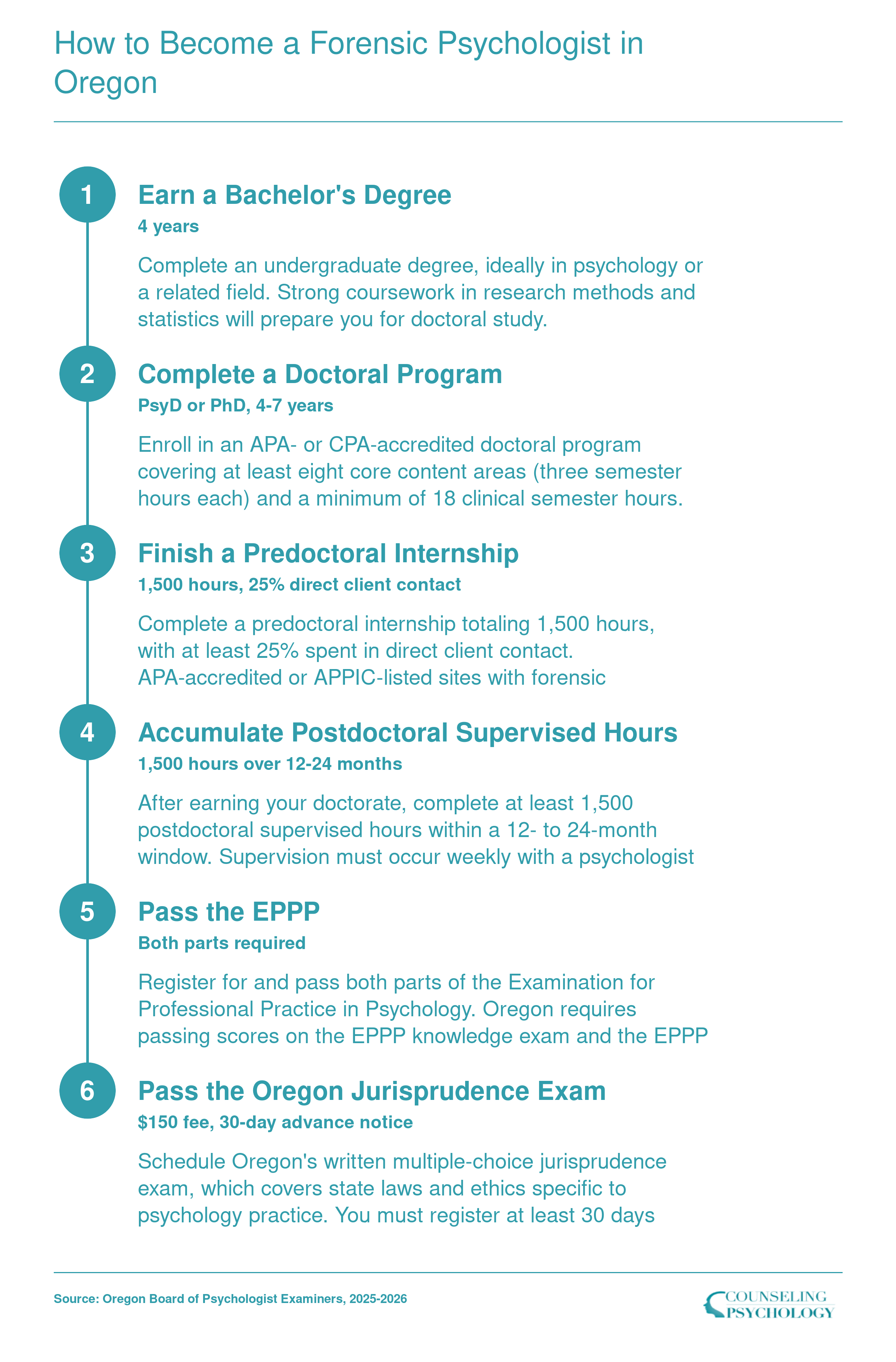
Oregon's path to forensic psychologist licensure is rigorous but clearly defined. The full sequence typically spans 10 to 14 years of education, supervised practice, and examination. Master's-level practitioners can pursue LPC or LMHP credentials for certain forensic roles, but only doctoral-level professionals may use the title 'psychologist' in Oregon.
Questions to Ask Yourself
Portland Practicum and Internship Opportunities in Forensic Psychology
Securing competitive clinical training in forensic psychology requires early positioning, particularly in a smaller metro where the number of specialized sites trails large coastal hubs. Portland offers a concentrated but competitive set of practicum and predoctoral internship placements, and successful applicants typically begin networking with site supervisors and program coordinators during the first year of doctoral study.
Court-Based and Civil Commitment Rotations
Multnomah County courts host competency-to-stand-trial evaluations, civil commitment hearings, and mental health treatment court rotations. Portland's Mental Health Treatment Court, serving Multnomah and Washington counties, offers practicum students supervised exposure to diversion programming and forensic assessment within a therapeutic jurisprudence framework.1 Students in these placements complete competency evaluations under the supervision of licensed psychologists and observe court proceedings where their reports inform judicial decision-making.
Oregon State Hospital maintains a forensic psychiatric unit that has historically accepted trainees from doctoral programs for rotations in inpatient forensic assessment and treatment. Placements at the hospital's forensic ward typically involve evaluating defendants found unfit to proceed to trial and participating in restoration-of-competency programming. Availability of psychology-specific rotations fluctuates with staffing and administrative priorities, so students should confirm current openings directly with the hospital's training coordinator.
Correctional and Juvenile Justice Sites
Coffee Creek Correctional Facility, Oregon's only women's prison, offers practicum opportunities in correctional psychology that include forensic assessment, sex offender treatment programming, and general mental health services. Multnomah County Juvenile Services provides placements focused on juvenile risk assessments, dispositional evaluations for youth court, and intervention planning for adolescents adjudicated delinquent. These sites expose trainees to forensic work with populations underrepresented in many academic training clinics.
APA-Accredited Predoctoral Internships
The VA Portland Healthcare System operates an APA-accredited psychology internship with forensic evaluation rotations, including violence risk assessment and competency determinations for veterans involved in the criminal justice system. Oregon Health & Science University (OHSU) hosts APA-accredited internships and fellowships; while its Forensic Psychiatry Fellowship is psychiatry-focused, OHSU's broader internship consortium occasionally includes forensic psychiatry clinical rotations coordinated through community partners.1
Private firms such as the Northwest Forensic Institute, directed by Michelle Guyton, PhD, ABPP and Alex Millkey, PsyD, provide advanced practicum placements for students nearing internship readiness. These private-practice settings emphasize independent report writing, courtroom testimony preparation, and exposure to civil forensic work including parenting evaluations and personal injury assessments.
Strategy for Securing Placements
Oregon's relatively small pool of forensic-specific training sites makes early outreach essential. Students should initiate contact with prospective supervisors during the spring of their first doctoral year, attend regional forensic psychology conferences, and join the American Psychology-Law Society's student division to build visibility. Understanding the full scope of education requirements for forensic psychologist careers can help applicants tailor their training plans to meet both licensure and specialization benchmarks. Programs with established pipelines into Portland-area sites offer a structural advantage, but unaffiliated applicants who demonstrate sustained interest and relevant volunteer experience remain competitive.
Career Outlook and Salaries for Forensic Psychologists in Portland
Forensic psychology sits at one of the more specialized intersections in the field, and Portland's labor market reflects that. While dedicated forensic psychologist salary data for the Portland metro area is not broken out separately by the Bureau of Labor Statistics, broader psychologist wage figures give a useful frame of reference.
What Psychologists Earn in Oregon
According to the most recent Oregon-specific data available (2024), the median annual wage for clinical and counseling psychologists in Oregon is $98,110, with a mean wage of $132,550. That mean-to-median gap is significant: it suggests a portion of psychologists in the state, including those in specialized roles like forensic evaluation, earn considerably more than the midpoint. For context, the 2023 national median for clinical and counseling psychologists was $96,100, placing Oregon slightly above the national figure.2 A separate BLS category, psychologists in "all other" roles, carried a national median of $117,750 in 2023, which may better approximate earnings in forensic-specific positions.3 Treat these comparisons as directional rather than precise, since forensic roles can vary widely by setting, credential level, and caseload.
Common Job Titles and Employers in the Portland Area
Forensic psychologists in the Portland region work under a range of titles depending on their setting:
- Forensic evaluator: typically contracted or staff-employed by courts, public defenders, or district attorneys to assess competency and criminal responsibility
- Correctional psychologist: provides assessment and treatment within correctional facilities
- Juvenile forensic specialist: works with youth in detention, dependency court, or diversion programs
- Competency evaluator: conducts court-ordered competency-to-stand-trial assessments
- Trial consultant: assists attorneys with jury selection and case strategy, usually in private practice
Major Portland-area employers include the Oregon Department of Corrections, Oregon State Hospital (which houses the state's forensic evaluation units), the Oregon Judicial Department, the Multnomah County District Attorney's office, and VA Portland Healthcare System. A growing number of forensic psychologists also run independent evaluation practices, taking referrals directly from attorneys and courts.
Job Growth and Oregon-Specific Demand
Nationally, the Bureau of Labor Statistics projects approximately 6% growth for psychologists overall through 2034, with around 12,900 job openings per year during that period.4 Clinical and counseling psychologists are projected to grow at roughly 11% through 2034, a faster-than-average pace. Oregon-specific demand is shaped by several ongoing factors: a well-documented backlog in court-ordered forensic evaluations, expansion of mental health courts in Multnomah and other counties, and continued investment in diversion programs that require qualified evaluators. Those structural pressures make the Portland market reasonably active for candidates with the right credentials, particularly a doctorate in forensic psychology and licensure as a psychologist in Oregon.
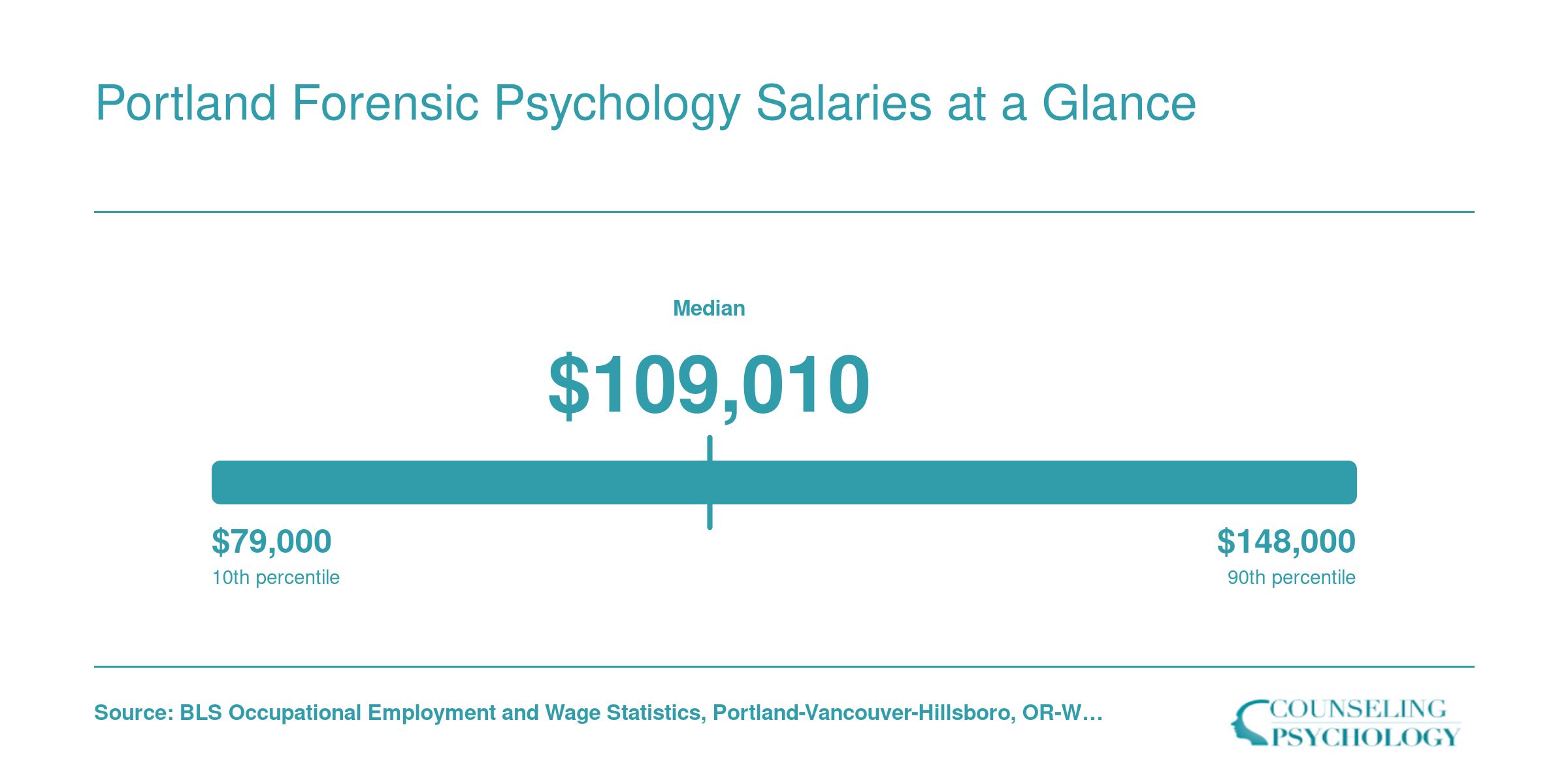
Portland Forensic Psychology Salaries at a Glance
Forensic psychologists in the Portland-Vancouver-Hillsboro metro area earn salaries that vary significantly with experience and setting. Early-career professionals completing postdoctoral work typically fall near the lower percentiles, while mid-career clinicians cluster around the median. Senior practitioners and those in private forensic consulting or expert-witness roles often reach the upper end of the pay scale.
How to Choose the Right Forensic Psychology Program
Forensic psychology has shifted from a niche subspecialty to a credentialed track with its own board certification, and that maturation means program choice matters more than it did a decade ago. The wrong fit can lock you out of Oregon licensure or leave you scrambling for forensic placements your school cannot guarantee. Here is what to weigh before you commit.
Accreditation Is Non-Negotiable
The Oregon Board of Psychologist Examiners (OBPE) effectively requires APA accreditation for doctoral licensure, and forensic employers in courts, state hospitals, and corrections almost universally screen for it. A program without APA accreditation, no matter how compelling its forensic coursework, will close doors at Oregon State Hospital, the Oregon Youth Authority, and federal forensic settings. For any out-of-state or online program, contact OBPE directly before enrolling and ask whether the specific degree meets Oregon's educational requirements.
PhD vs. PsyD: Funding and Focus
PhD programs in clinical psychology with a forensic emphasis are typically funded through assistantships and lean research-heavy, which suits students aiming for academic, policy, or expert-witness work built on a publication record. PsyD programs front-load clinical training and produce strong practitioners, but tuition is rarely covered and student debt can exceed $200,000. Neither path is wrong; the question is whether your career goal justifies the financial trade. If you are still exploring broader options, our guide to different types of psychology degrees can help you map the landscape before committing to a doctoral track.
Practicum Pipelines and Faculty Expertise
Ask specifically: does the program have standing affiliation agreements with forensic sites, or will you cold-email placements yourself? Programs with established pipelines into competency evaluations, juvenile forensic units, or correctional mental health give you supervised forensic hours that count toward board certification later.
Also look at cohort size, the number of faculty actively publishing or practicing in forensic areas, and whether the curriculum is a true forensic concentration with sequenced coursework or simply a general clinical degree dressed up with two forensic electives. The difference shows up on your CV.
Frequently Asked Questions About Forensic Psychology in Portland
Prospective students often have overlapping questions about program quality, licensure pathways, and costs. The answers below draw on the program details, salary data, and career information covered throughout this article.