What you’ll learn in this article…
- Alliant International University CSPP is the primary APA-accredited PsyD program based in San Diego, with no GRE requirement and a 3.0 minimum GPA.
- PsyD programs in the region emphasize clinical practice over research, while nearby PhD programs prioritize funded lab work.
- California licensure after a PsyD typically takes one to two years post-graduation, including supervised hours and two exams.
- San Diego offers predoctoral internship placements at VA centers, university hospitals, and community clinics across the metro area.
San Diego's unique position as both a major military hub and a culturally diverse metro area creates unusually rich training opportunities for clinical psychology doctoral students, but the metro itself is home to just one dedicated PsyD program. Alliant International University's California School of Professional Psychology (CSPP) anchors the local training landscape, while most other Southern California PsyD programs sit an hour or more north in Los Angeles, Riverside, or the Inland Empire.
That limited local footprint makes choosing carefully essential. The programs serving this region vary widely in cost, accreditation status, clinical focus, and post-graduation outcomes. Some emphasize faith integration or depth psychology; others lean heavily on evidence-based practice and APA-accredited internship placement. Tuition spans from under $13,000 to over $50,000 per year, and median graduate debt ranges from $18,000 to more than $26,000.
The military treatment facilities, VA centers, and safety-net hospitals scattered across San Diego County draw PsyD trainees from across Southern California, making the region's clinical training sites as relevant to students in La Verne or Riverside as they are to those enrolled at CSPP. Students drawn to the military population in particular may want to explore what it takes to become a military psychologist before committing to a program track.
Best PsyD Programs in San Diego for 2026
Most of these California doctoral programs sit outside San Diego proper, but each one draws heavily from the greater Southern California talent pool and places graduates across the region's hospitals, VA centers, and community clinics. Where a school is not physically in San Diego, we note that clearly so you can weigh commute, relocation, or hybrid options. Program-level earnings and debt figures are not yet published for these clinical psychology doctorates, so the institution-wide data below gives you a starting cost-outcome frame rather than a program-specific guarantee.
- APA accreditation and clinical training depth
- Institutional graduation and retention metrics
- Tuition, median debt, and earnings context
- Concentration breadth and practicum hours
- Faculty ratio and cohort structure
- NCES-IPEDS federal institutional data — nces.ed.gov
- College Scorecard graduate earnings — collegescorecard.ed.gov
- Internal program database
- Independent program research

Pepperdine University
Pepperdine's PsyD in Clinical Psychology is a four-year, APA-accredited practitioner-scholar program based in Malibu. With a reported 97% internship placement rate and 100% alumni licensure, the program pairs rigorous evidence-based coursework with training across four university clinics and diverse Southern California sites. The institution posts an 83.4% school-wide graduation rate, median graduate debt of $23,510, and median earnings of $82,939 ten years after entry (all figures institution-wide, not program-specific). A 12:1 faculty-student ratio keeps mentorship accessible, while multicultural competence runs through every phase of the curriculum.
- APA-accredited through 2027 with practitioner-scholar model
- Four-year campus-based program in Malibu, CA
- 97% internship placement rate reported by the program
- Training across four university-based clinics
- Emphasis on multicultural understanding and evidence-based care
- Tuition listed at $1,970 per unit
- Science-informed clinical practice orientation
Doctor of Psychology in Clinical Psychology — On-Campus

Loma Linda University
Loma Linda University's five-year PsyD in Clinical Psychology operates from its health-sciences campus in Loma Linda, roughly 90 minutes from San Diego. The APA-accredited program follows a practitioner-scholar model with a remarkably low 3:1 student-faculty ratio, giving students close mentorship throughout multidisciplinary practica. Concentration options in clinical child psychology, health psychology, and neuropsychology let students specialize early. Institution-wide, Loma Linda graduates carry a median debt of $20,854 and report median earnings of $89,816 ten years out. Graduation rate data is not reported at the institutional level for this school.
- Five-year APA-accredited practitioner-scholar program
- 3:1 student-faculty ratio for intensive mentoring
- Concentrations in child psychology, health psych, neuropsych
- Multidisciplinary practicum sites with diverse populations
- Embedded professional self-care curriculum
- Christian healthcare learning environment
- Tuition of $34,460 (IPEDS reported rate)
Clinical Psychology (PsyD) — On-Campus

University of Southern California
USC's Ph.D. in Clinical Science is a research-driven doctorate housed in Los Angeles, not San Diego, and awards a PhD rather than a PsyD. It earns a place here because of its APA and PCSAS dual accreditation, life-span developmental framework, and strong placement of graduates into Southern California clinical and research roles. The institution carries a 91.8% school-wide graduation rate, median graduate debt of $18,000, and median earnings of $92,498 at ten years (all institution-wide figures). A 9:1 student-faculty ratio and sub-specialties in clinical geropsychology and couples, child, and family psychology broaden training options.
- APA and PCSAS dual-accredited research doctorate
- Life-span developmental approach to clinical training
- Sub-specialties in clinical-aging and child/family psychology
- Campus-based in Los Angeles with a 9:1 faculty ratio
- Diverse research opportunities across developmental stages
- Prepares graduates for academia, medical settings, and industry
Ph.D. in Clinical Science — On-Campus

Azusa Pacific University
Azusa Pacific's PsyD in Clinical Psychology is a practitioner-scholar program in Azusa, about two hours north of San Diego. The curriculum meets California licensure requirements and requires at least 1,500 practicum hours plus a year-long predoctoral internship. Concentrations in forensic psychology and psychodynamic systems of psychotherapy give students tailored tracks. School-wide, APU has a 61.8% graduation rate, median graduate debt of $23,219, and median ten-year earnings of $66,677. The program weaves cultural competence, diversity, and faith integration throughout its coursework.
- Practitioner-scholar model aligned with APA standards
- Minimum 1,500 practicum hours required before internship
- Concentrations in Forensic Psychology and Psychodynamic Systems
- Year-long predoctoral internship included
- Tuition remission opportunities up to $36,000
- Emphasis on diversity, systems thinking, and faith integration
- Meets California psychology licensure requirements
- Five- or six-year academic plan options
Doctor of Psychology (PsyD) in Clinical Psychology — On-Campus

University of San Francisco
The University of San Francisco offers a campus-based PsyD in Clinical Psychology in San Francisco, with concentrations in child clinical psychology and neuropsychology. The practice-oriented program spans five to six years and culminates in a full-time clinical internship. Institution-wide metrics include a 70.1% graduation rate, median debt of $23,000, and median ten-year earnings of $89,812. Students work across diverse populations and prepare for California licensure through hands-on assessment, treatment, and intervention training.
- Five- to six-year practice-oriented doctoral program
- Concentrations in child clinical psychology and neuropsychology
- Full-time clinical internship required
- Campus-based training in San Francisco
- Prepares graduates for California psychology licensure
- Tuition of $29,960 (IPEDS reported graduate rate)
- Multiple clinical specialization options available
Clinical Psychology, PsyD — On-Campus

California Lutheran University
California Lutheran University's APA-accredited PsyD in Clinical Psychology is a five-year program based in Thousand Oaks, about three hours from San Diego. The curriculum blends advanced research skills with clinical training in two on-site clinics and community placements, with particular attention to serving underserved populations. Institutional figures show a 69.6% graduation rate, $21,669 in median graduate debt, and $68,712 in median earnings at ten years. Small entering cohorts keep the experience personalized.
- APA-accredited five-year doctoral program
- Two on-site training clinics plus community placements
- 114 total program units with fall and spring coursework
- Focus on serving underserved and diverse populations
- Small entering class sizes for close mentoring
- Prepares for licensure in medical centers and counseling settings
- Optional concentration areas available
PsyD in Clinical Psychology — On-Campus

Biola University
Biola University's PsyD in Clinical Psychology, based in La Mirada, integrates Christian theological perspectives with evidence-based clinical training. APA-accredited since 1980, the program features an 8:1 student-faculty ratio and 123 total credit hours completed over five to six years. Institution-wide, Biola reports a 67.6% graduation rate, $23,875 in median graduate debt, and $56,778 in median ten-year earnings. GRE scores are optional, and students earn a master's degree after two years as a built-in milestone.
- APA-accredited since 1980 with WSCUC accreditation
- 123 credit hours over five to six years
- 8:1 student-faculty ratio for close mentorship
- Christian theological integration throughout curriculum
- GRE scores optional for admission
- Master's degree awarded after two years of study
- Estimated total program cost around $179,826
Doctor of Psychology in Clinical Psychology — On-Campus

Palo Alto University
Palo Alto University partners with Stanford University School of Medicine to offer the PAU-Stanford PsyD Consortium, a four-year APA-accredited practitioner-scholar program in Palo Alto. Students train under faculty from both institutions and complete a 2,000-hour APA-accredited internship, covering nine core professional competency areas. Institution-wide, PAU shows median graduate debt of $20,500 and median ten-year earnings of $83,187. Graduation rate data is not reported for this institution.
- Four-year APA-accredited practitioner-scholar program
- Collaborative training with Stanford Medicine faculty
- 2,000-hour APA-accredited clinical internship
- Nine professional competency areas covered
- Evidence-based practice and research emphasis
- Tuition of $50,166 (IPEDS reported rate)
- Comprehensive preparation for diverse clinical careers
PAU-Stanford PsyD Consortium — On-Campus

University of La Verne
The University of La Verne's APA-accredited PsyD is a five-year, full-time program in La Verne that uses a cohort model to build peer collaboration from day one. Students complete 1,500 clinical training hours and a dissertation, with a personal psychotherapy requirement woven into the experience. Institutional data shows a 63.1% graduation rate, $23,500 in median debt, and $65,464 in median ten-year earnings. Graduate assistantships and scholarships help offset costs.
- APA-accredited five-year full-time program
- Cohort model for collaborative learning
- 1,500 clinical training hours required
- Dissertation and personal psychotherapy requirements
- Graduate assistantships and scholarships available
- Prepares for California psychology licensure
- Diverse student and faculty backgrounds
Doctorate in Clinical Psychology (PsyD) — On-Campus

California Baptist University
California Baptist University in Riverside offers a five-year, APA-accredited PsyD that blends scientific psychological practice with a Christian worldview. The 128-unit program includes three years of practicum experience and a full-time internship, with multiple elective tracks allowing some flexibility. School-wide metrics show a 61.9% graduation rate, $26,063 in median graduate debt, and $61,504 in median ten-year earnings. Culturally sensitive training and research competence are core themes.
- APA-accredited with 128 total program units
- Five-year training plan with full-time internship
- Three years of supervised practicum experience
- Multiple elective tracks for specialization
- Christian faith integration throughout coursework
- Culturally sensitive and evidence-based approach
- Tuition approximately $1,100 per unit
Clinical Psychology, PsyD — On-Campus

California Institute of Integral Studies
CIIS offers a distinctive Psy.D. in Clinical Psychology rooted in depth psychology, psychodynamic methods, and holistic inquiry. This five-year, 90-credit-hour program in San Francisco does not hold APA accreditation, which is an important consideration for licensure portability and internship matching. Institution-wide, median graduate debt is $18,750 and median ten-year earnings are $48,848. Graduates gain clinical experience through Bay Area practicum and internship placements with a strong social-justice lens.
- Five-year doctoral program, 90 semester credit hours
- Depth-oriented and holistic integrative approach
- Two practicums plus a predoctoral internship
- Social justice perspective throughout curriculum
- Does not hold APA accreditation (important for portability)
- Campus-based in San Francisco
- Research and dissertation focus included
Psy.D. in Clinical Psychology — On-Campus

Fielding Graduate University
Fielding Graduate University in Santa Barbara offers an APA-accredited PhD in Clinical Psychology through a distributed (hybrid) learning model built for working professionals. With no GRE requirement, flexible online and residential components, and concentrations in forensic psychology, neuropsychology, and health psychology, it suits career changers and mid-career clinicians. Tuition runs $10,385 per term over a five- to six-year timeline. Institutional earnings and debt data are not currently reported for Fielding.
- APA-accredited hybrid (online plus residential) format
- No GRE required for admission
- Concentrations in forensic, neuro, and health psychology
- Designed for working professionals and adult learners
- $10,385 per term tuition
- Five- to six-year completion timeline
- Social justice values embedded in curriculum
PhD in Clinical Psychology — Hybrid
PsyD vs PhD in San Diego: Which Doctorate Is Right for You?
The split between practitioner-focused PsyD training and research-focused PhD training has sharpened over the past decade, and San Diego happens to offer a clean illustration of both tracks side by side. Alliant International University's California School of Professional Psychology (CSPP) anchors the PsyD option, while the joint doctoral program run by SDSU and UC San Diego represents the PhD path.12 They serve different career goals, and choosing between them comes down to honest self-assessment about what you want your workdays to look like a decade from now. Students weighing broader options across the discipline may also want to explore clinical psychology doctorate programs before narrowing their search to a single metro.
Does SDSU Offer a PsyD?
No. San Diego State University does not offer a PsyD in clinical psychology. What SDSU does offer is the SDSU/UCSD Joint Doctoral Program in Clinical Psychology, which awards a PhD.2 The program is APA-accredited, jointly administered with UC San Diego, and built around the clinical science model. If you have been searching for an SDSU PsyD specifically, Alliant CSPP is the local PsyD provider; SDSU's doctoral offering is research-intensive by design.
Six Dimensions to Compare
- Primary focus: PsyD programs train practitioner-scholars whose core work is direct clinical service. PhD programs train clinical scientists who conduct research and often also practice.3
- Funding model: The SDSU/UCSD PhD is fully funded, typically covering tuition plus a living stipend tied to teaching or research assistantships.4 The Alliant PsyD is self-funded, meaning students carry tuition through loans, savings, or outside aid.1
- Cohort size: PhD cohorts at SDSU/UCSD admit single digits per year, which means heavy competition and close mentorship. Alliant's PsyD admits dozens per year, producing larger classes and a broader peer network.
- Time to degree: Both run roughly 5 to 7 years including internship, though PhD timelines often stretch longer due to dissertation research demands.
- Dissertation expectations: PhD dissertations are original empirical research, often tied to a faculty lab. PsyD doctoral projects are typically applied, clinically oriented, and shorter in scope.
- Career trajectory: PhDs commonly land in academic medical centers, VA systems, university faculty roles, or research positions, alongside clinical work. PsyDs more often move directly into private practice, community mental health, hospitals, and group practices.3
How to Self-Select
If your goal is full-time clinical practice and you want to start seeing clients as your central professional identity, the PsyD is the better structural fit. If you want to run studies, publish, teach at a university, or work in settings where research productivity matters, pursue the PhD and accept the longer odds at admission in exchange for the funding.
Questions to Ask Yourself
Tuition, Financial Aid, and ROI for San Diego PsyD Programs
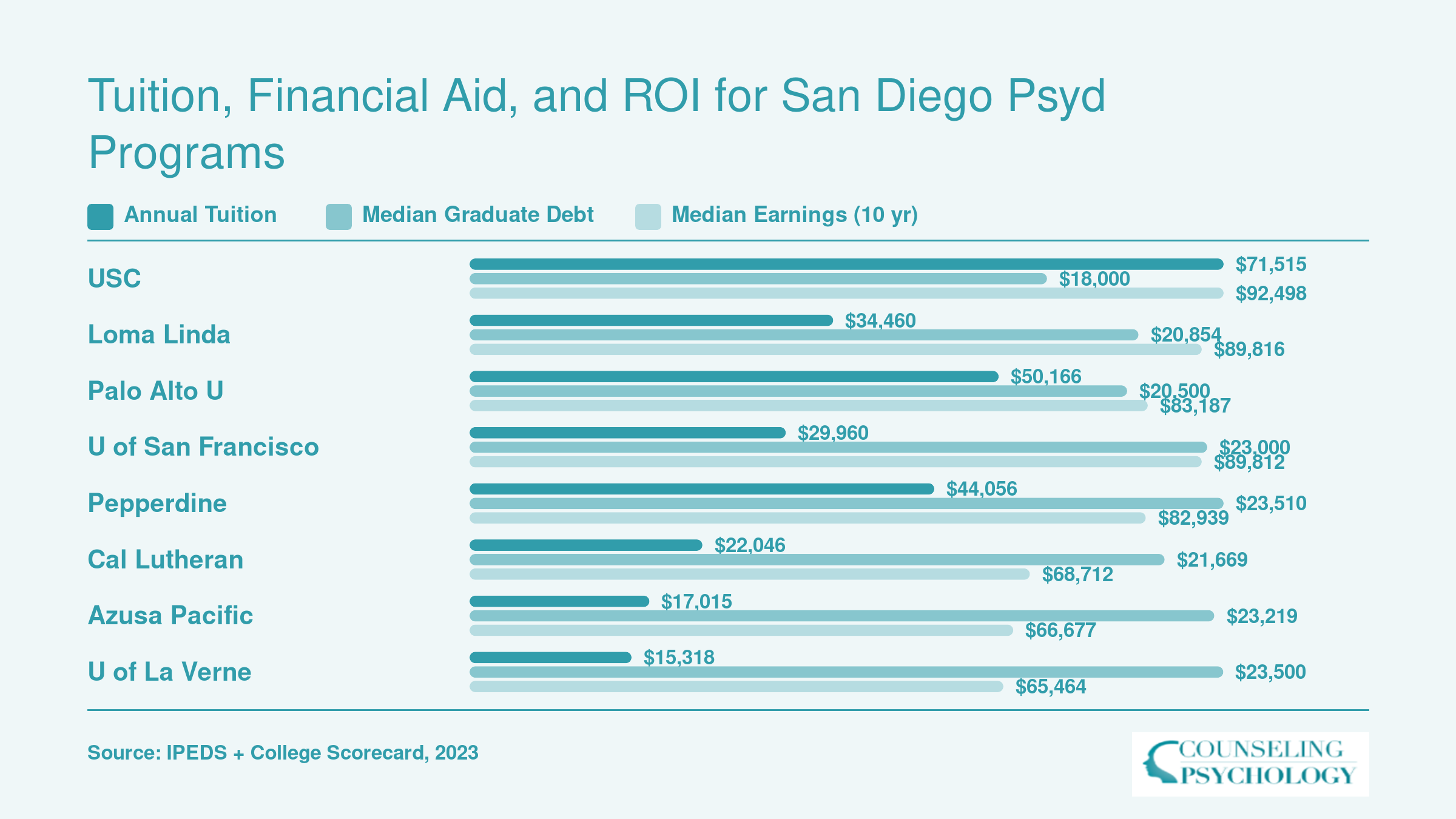
Understanding the cost-to-earnings picture is essential when evaluating PsyD programs in the San Diego region and broader Southern California. The chart below places annual tuition alongside median graduate debt and institutional median earnings at ten years post-entry for each school. Program-level earnings shortly after completion are not yet published for these programs, so the institution-wide ten-year earnings figure serves as the best available proxy. Schools with lower tuition and debt relative to earnings, such as USC and Loma Linda, show the strongest return on investment, while programs at smaller institutions may carry a comparable debt load but yield lower median earnings.
Admissions Requirements and How to Get Into a San Diego PsyD Program
A minimum GPA of 3.0 is the standard floor at Alliant International University's California School of Professional Psychology (CSPP) in San Diego, and the GRE is not required for admission.1 This combination lowers one common barrier while still demanding strong academic credentials and a genuine commitment to clinical work. The program admits a cohort of 20 to 35 students each year, making selectivity a real factor even without a standardized test score.2
Prerequisites and Academic Preparation
Applicants must hold a bachelor's degree from a regionally accredited institution.3 While published prerequisite coursework lists are not rigid for Alliant's San Diego PsyD, most competitive candidates enter with undergraduate or post-baccalaureate courses in abnormal psychology, statistics, and research methods. These subjects form the backbone of the doctoral curriculum and help admissions committees gauge readiness for graduate-level scientific thinking. If your transcript lacks one or more of these areas, consider completing them at a community college or through extension programs before applying.
The Application Package
Alliant uses its own online application portal rather than PsychologyCAS.4 The submission requires a personal essay, letters of recommendation, and official transcripts.1 Non-native English speakers must submit TOEFL iBT scores of at least 80 or IELTS scores of 6.5.1 Recommendations should ideally come from academic mentors or clinical supervisors who can speak to your potential as a practitioner-scholar. The personal statement is your chance to articulate a clear, practice-oriented career vision. Avoid generic language about wanting to help people; instead, describe the populations or clinical problems you want to address and why a PsyD, rather than a PhD, fits your goals. For broader advice on crafting a competitive application, our guide on how to apply to graduate school for counseling psychology walks through each component in detail.
The Interview Process
Interviews are a required step for finalists.1 Alliant's CSPP San Diego program typically conducts interviews that may include individual sessions with faculty members, group exercises, and opportunities to interact with current students. The format allows evaluators to assess interpersonal skills, ethical reasoning, and alignment with the program's practitioner emphasis. Prepare by reviewing your reasons for pursuing clinical training in San Diego specifically, and be ready to discuss how you handle feedback, ambiguity, and the demands of intensive clinical work.
Competitiveness and Cohort Size
With a cohort limited to roughly 20 to 35 individuals, the program remains selective even though acceptance rates are not publicly disclosed. The relatively intimate class size ensures close mentoring and strong cohort cohesion, but it also means every component of the application carries weight. If you are wondering how hard is it to get into grad school for psychology, keep in mind that APA-accredited PsyD programs typically attract several hundred applicants for far fewer seats, so treat every element, from GPA to interview presence, as an opportunity to differentiate yourself.
Strengthening Your Application
- Clinical volunteer hours: Direct experience with vulnerable populations, such as crisis hotlines, shelters, or community mental health centers, signals genuine commitment and exposes you to the realities of clinical work. Even a few hundred hours can make a difference.
- Research experience: While PsyD programs emphasize practice over research, demonstrating the ability to consume and contribute to scientific literature strengthens your file. A senior thesis, lab assistantship, or data-analysis project shows you can handle the doctorate's scholarly demands.
- Personal statement framing: Ground your essay in specific professional goals. Mention the populations, settings, or treatment modalities you hope to master, and connect those aspirations to what Alliant's San Diego program delivers, such as its multicultural training emphasis or ties to local internship sites.
Related Articles
Clinical Training and Internship Sites in San Diego
San Diego has quietly become one of the more competitive metro areas for clinical training placements, driven by a dense concentration of federal, academic, and community health systems that actively recruit doctoral trainees.
Major Predoctoral Internship Sites
Several large institutions in the region participate in the APPIC match and host predoctoral interns from PsyD programs nationwide. The sites most commonly associated with San Diego-area training include:
- VA San Diego Healthcare System: One of the most sought-after federal placements in Southern California, offering rotations in PTSD, neuropsychology, and health psychology, among others.
- Naval Medical Center San Diego: A major military treatment facility that trains interns in a range of clinical areas, with particular depth in trauma and family systems work given the surrounding military population.
- Rady Children's Hospital: The region's primary pediatric hospital and a strong option for students interested in pediatric psychology, neuropsychology, or child and adolescent clinical work.
- UCSD Health: Academic medical center rotations here expose interns to integrated behavioral health, consultation-liaison psychology, and specialty medical populations.
- San Diego County Behavioral Health Services: County-operated clinics serve a high-need, diverse population and offer community mental health training that is difficult to replicate in hospital settings.
Practicum Training Before the Internship Match
Before applying to internships, PsyD students accumulate supervised practicum hours across multiple years of training. The clinical training office at your program maintains a current list of affiliated practicum sites, and that list shifts from year to year as affiliations change. Reaching out directly to the training director at your program for an updated list of placements, along with data on where recent graduates actually matched, gives you a much clearer picture than any published overview can. Students interested in the broader landscape of clinical psychology degree programs in California may also find it useful to compare practicum networks across institutions statewide.
Researching Match Rates and Site Fit
APPIC match rate data for specific programs, including Alliant International University's California School of Professional Psychology in San Diego, is best obtained directly from the program's training director or from the program's official training page. Rates are updated annually and can vary meaningfully from one cycle to the next.
The APPIC Internship Directory at appic.org allows you to search accredited internship programs by location and specialty, compare match statistics across sites, and review selection criteria. Spending time in that database early in your training, not just during application season, helps you build a realistic target list and identify any experience gaps while you still have time to address them.
Specializations Available Across San Diego PsyD Programs
Choosing a PsyD program often comes down to whether it offers the clinical emphasis that aligns with your career goals. The table below maps key specialization tracks across programs in and around San Diego, giving you a side-by-side view that is difficult to find elsewhere. Note that some programs offer formal concentrations (listed on transcripts), while others provide informal emphasis areas through elective coursework and practicum placements.
| Program | Forensic Psychology | Child / Family | Health Psychology | Multicultural / Community | Neuropsychology | Other Notable Tracks |
|---|---|---|---|---|---|---|
| Alliant CSPP San Diego (PsyD) | Informal emphasis | Informal emphasis | Informal emphasis | Core curriculum focus | Informal emphasis | Military / veterans psychology (informal) |
| Azusa Pacific University (PsyD) | Formal concentration | N/A | N/A | Cultural competence emphasis | N/A | Psychodynamic Systems of Psychotherapy (formal concentration) |
| Pepperdine University (PsyD) | N/A | N/A | N/A | Multicultural emphasis | N/A | Practitioner-scholar model with science-informed practice |
| California Lutheran University (PsyD) | N/A | N/A | N/A | Focus on underserved populations | N/A | Optional concentration areas available |
| Loma Linda University (PsyD) | N/A | N/A | Multidisciplinary clinical experiences in healthcare setting | N/A | N/A | Embedded professional self-care curriculum |
| Biola University (PsyD) | N/A | N/A | N/A | N/A | N/A | Christian theological integration |
| University of La Verne (PsyD) | N/A | N/A | N/A | Diverse student and faculty focus | N/A | Personal psychotherapy requirement |
| California Baptist University (PsyD) | N/A | N/A | N/A | Culturally sensitive approach | N/A | Christian faith integration; multiple elective tracks |
| Palo Alto University (PAU-Stanford PsyD) | N/A | N/A | N/A | N/A | N/A | Evidence-based practice focus across nine competency areas |
| CIIS (PsyD) | N/A | N/A | N/A | Social justice perspective | N/A | Depth-oriented, holistic integrative approach |
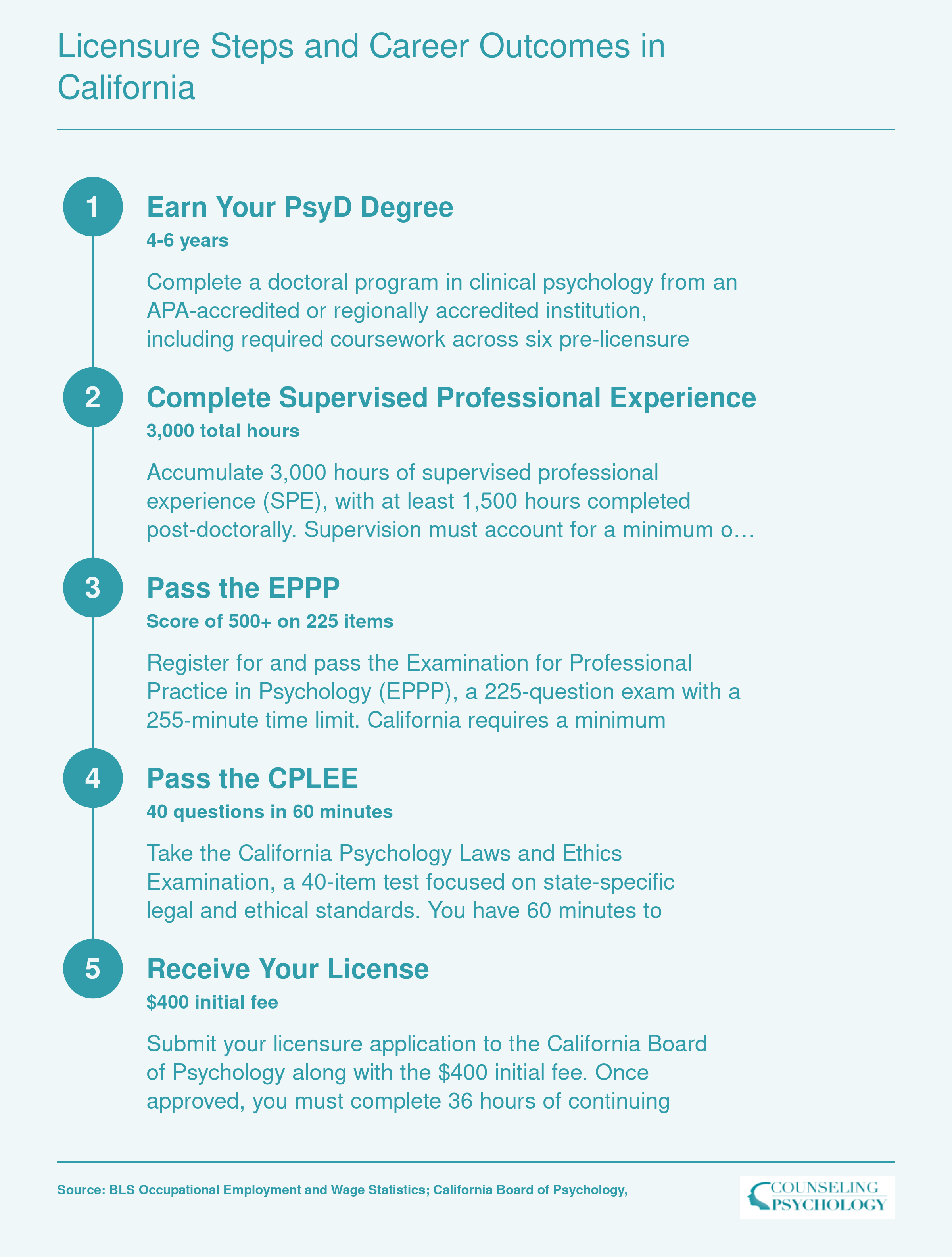
Licensure Steps and Career Outcomes in California
After earning your PsyD, California's Board of Psychology requires a structured credentialing sequence before you can practice independently. Most graduates complete the full pathway within one to two years of graduation, depending on how quickly they accumulate supervised hours and pass both exams. Publicly reported EPPP pass rates for individual San Diego PsyD programs are not currently available, so prospective students should request this data directly from programs during the admissions process. Licensed clinical and counseling psychologists in the San Diego-Carlsbad metropolitan area earned a mean annual wage of $122,450 as of 2024, compared to the California statewide mean of $114,520.
How We Ranked These San Diego PsyD Programs
Ranking doctoral programs means weighing factors that actually affect your life after graduation: what you pay, what you earn, how much debt you carry, and whether the credential you receive opens the doors you need it to open.
Data Sources and What They Measure
This ranking draws on data from the U.S. Department of Education's College Scorecard, which publishes institution-level figures on earnings after graduation, federal student loan debt at graduation, and completion rates. APA accreditation status is verified directly through the APA's publicly maintained list of accredited programs.
Two important caveats are worth stating plainly. Graduation rates in the Scorecard reflect institution-wide outcomes, not outcomes specific to a PsyD program, because program-level completion data is rarely published at that granularity. Similarly, net price figures represent an institutional average across all enrolled students, not a quote you can take to the financial aid office.
What the Ranking Actually Weighs
Four factors drive the ordering:
- APA accreditation: Programs without APA accreditation are excluded entirely, since licensure in California and most other states requires a degree from an accredited program.
- Tuition and net price: Lower cost-to-credential ratios carry meaningful weight, especially given the length of most PsyD programs.
- Post-graduation earnings relative to debt: A program that produces graduates with high earnings and manageable loan balances ranks more favorably than one where the gap runs the other way.
- Program format: On-campus, hybrid, and cohort-based structures affect both completion rates and clinical training quality, so format is noted as a contextual factor rather than a simple plus or minus.
If you are also exploring broader counseling doctoral programs, many of the same accreditation and outcome metrics apply.
Keeping the Data Current
Scorecard data is updated each academic year, and the figures used here reflect the most recent release available as of 2026. APA accreditation status is checked at the time of publication. Because program details change, the accreditation and tuition information for any specific school should always be confirmed directly with that institution before you apply.
The goal is transparency: you should be able to understand why a program appears where it does, and use that logic to weigh the ranking against your own priorities.
Frequently Asked Questions About PsyD Programs in San Diego
Choosing a doctoral program raises plenty of practical questions, from salary expectations to admissions competitiveness. Below are answers to the questions prospective PsyD students in San Diego ask most often, drawn from program data, licensing requirements, and regional labor market figures.