
Key Takeaways
- Three affordable addiction counseling programs near Ann Arbor range from roughly $7,400 to $18,700 in average net price.
- Michigan's CADC credential through MCBAP requires supervised clinical hours and a standardized exam beyond coursework alone.
- The BLS national median wage for substance abuse and behavioral disorder counselors sits at approximately $53,710 per year.
- Washtenaw County opioid overdose death rates vary tenfold across neighborhoods, underscoring local demand for trained addiction counselors.
Most students weighing an addiction counseling certificate near Ann Arbor face the same tradeoff: pay more for a name-brand program close to home, or stretch dollars further through a state university with hybrid scheduling and a longer commute.
Southeast Michigan's demand for credentialed addiction professionals has outpaced supply, driven by sustained opioid mortality across Washtenaw and Wayne counties and by Michigan's tightening enforcement of CADC and CAADC credentialing standards through MCBAP. No graduate certificate program sits inside Ann Arbor's city limits, so candidates compare offerings statewide on net price, credit alignment with MCBAP education requirements, practicum logistics, and how the format fits around full-time work. Students exploring online graduate certificate in addiction counseling options nationally will find some of the same trade-offs apply, but Michigan-specific credentialing rules add an extra layer of due diligence.
Best Affordable Addiction Counseling Programs Near Ann Arbor
None of these Michigan programs are located in Ann Arbor itself, but all three serve students across the state and offer formats that work for commuters or distance learners based in the Ann Arbor area. Rankings are ordered by net price after financial aid, with credential alignment and program quality factored in. Treat this list as a starting point: cross-reference it with the credentialing pathways and career outcomes sections below to see how each option fits your professional goals.
- Net price after financial aid
- Credential and licensure alignment
- Delivery format flexibility
- Institutional graduation outcomes
- Program depth and practicum quality
- Internal program database
- NCES-IPEDS federal institutional data — nces.ed.gov
- College Scorecard graduate earnings — collegescorecard.ed.gov
- Independent program research

University of Detroit Mercy
University of Detroit Mercy is a private institution in Detroit whose Master of Arts in Addiction Counseling is widely regarded as one of Michigan's premier programs in the field. Despite a listed tuition of $22,544 per year, its average net price drops to $15,232 after aid, making it the most affordable option on this list. The 12:1 student-to-faculty ratio and hands-on clinic training give students extensive supervised experience, and the school reports strong placement outcomes for graduates entering addiction therapy, clinical supervision, and program development roles.
- 60-credit, three-year program covering prevention, assessment, and intervention
- On-campus delivery at the Detroit location with small class sizes
- Training in the university's no-cost counseling clinic included
- Prepares graduates for professional licensure and addiction certification
- Faculty hold terminal degrees and active clinical licenses
- Curriculum spans substance and behavioral addiction treatment
Master of Arts with a major in Addiction Counseling — On-Campus

Western Michigan University
Western Michigan University in Kalamazoo offers two graduate certificate tracks in addiction studies, giving students the flexibility to pursue either an 18-credit Clinical Addiction Certificate or a shorter 9-credit Addiction Specialization Certificate. Both use a hybrid format that pairs online coursework with weekend on-campus sessions, a structure that suits working professionals commuting from Ann Arbor or elsewhere in Michigan. Coursework addresses substance use, co-occurring disorders, and cultural humility, and both certificates align with Michigan credentialing requirements for addiction professionals.
- 18-credit hour graduate certificate designed for post-bachelor's students
- Hybrid format combining online coursework and weekend campus sessions
- Covers substance use, cultural humility, and co-occurring disorders
- Field practicum or capstone project provides supervised experience
- Meets Michigan educational requirements for CADC credentialing
- Financial aid eligible for qualifying students
- 9-credit hour graduate certificate for faster completion
- Hybrid online and weekend delivery in Kalamazoo
- Designed to align with CAADC credentialing requirements
- Flexible scheduling built for adult learners
- Coursework complements broader counseling or clinical degrees
Clinical Addiction Certificate — Hybrid
Addiction Specialization Certificate — Hybrid

Central Michigan University
Central Michigan University in Mount Pleasant offers a CACREP-accredited Master's in Counseling with a dedicated Addiction Counseling concentration. This 60-credit hybrid program blends online learning with on-campus components, and required practicums and internships provide direct clinical hours. The institution-wide graduation rate is 58.7% (note: this reflects all undergraduates, not the counseling program specifically). CMU's net price of $17,597 is slightly higher than the other two schools on this list, but the CACREP seal and built-in clinical training add significant value for students planning to pursue full licensure.
- 60-credit CACREP-accredited program with addiction focus
- Hybrid format with online and on-campus components in Mount Pleasant
- Required practicum and internship build supervised clinical hours
- Faculty are licensed counselors with active practice experience
- Part-time and full-time study options accommodate varied schedules
- Access to CMU's Center for Community Counseling for training
- Prepares graduates for diverse roles in addiction prevention and care
Master's in Counseling, Addiction Counseling Concentration — Hybrid
How We Ranked These Addiction Counseling Certificates
What We Prioritized: Affordability First
We weighted net price after grant and scholarship aid as the single most important factor, because what you actually pay matters more than sticker tuition. We also examined published per-credit or per-term tuition rates and the median federal student loan debt of completers. Programs that combined low net price with modest debt burdens scored higher in our affordability dimension.
How We Factored in Graduate Outcomes
Beyond cost, we care about what graduates earn. Using data from the College Scorecard, we looked at median earnings one year after leaving the institution where available. For certificates specifically, the Scorecard often reports earnings pooled at the institution or broad CIP-code level. Where program-level earnings were unavailable, we relied on institution-wide medians as a general indicator of return on investment. We gave extra weight to programs whose graduates demonstrated earnings meaningfully above typical service-sector benchmarks. If you are exploring options beyond Michigan, our national ranking of online graduate certificates in addiction counseling provides a broader comparison.
A Note on Graduation Rates
Graduation rates in this ranking are institution-wide figures, not program-specific completion rates. While a university's overall graduation rate is not a direct measure of how many addiction counseling certificate students finish, it serves as a proxy for the quality of student support services, academic advising, and the likelihood that students persist. Treat this data point as an institutional context clue rather than a precise program performance metric.
Why Licensure Alignment Wasn't a Ranking Input
Michigan's Certified Alcohol and Drug Counselor (CADC) and Certified Advanced Alcohol and Drug Counselor (CAADC) credentials require specific coursework and supervised experience hours. We map these requirements in detail in a dedicated section below, but we did not use credential alignment as a sorting criterion. All programs featured here already meet foundational curricular standards for certification; the nuances of how each fulfills Michigan's exact course specifications are best evaluated individually based on your career goals and prior coursework.
Cost Comparison: Tuition and Net Price Breakdown
The sticker price of a program rarely tells the full story. Net price, which factors in grants and institutional aid, gives you a more realistic picture of what you will actually pay. Below is a side-by-side look at tuition, net price, median graduate debt, and long-term earnings for the three Michigan schools offering addiction counseling pathways near Ann Arbor. Program-level earnings data is not yet available for these specific programs, so the median earnings figure shown reflects institution-wide outcomes ten years after enrollment.
| School | Program Type | In-State Tuition | Out-of-State Tuition | Average Net Price | Pell Grant Recipients | Median Graduate Debt | Median Earnings (10 yr, Institution-Wide) | Student-to-Faculty Ratio |
|---|---|---|---|---|---|---|---|---|
| University of Detroit Mercy | Master's (60 credits) | $22,544 | $22,544 | $15,232 | 48.8% | $23,250 | $71,030 | 12:1 |
| Western Michigan University | Graduate Certificate (18 credits) | $20,103 | $29,681 | $15,273 | 55.5% | $26,188 | $53,562 | 16:1 |
| Central Michigan University | Master's, Addiction Counseling Concentration (60 credits) | $17,187 | $17,187 | $17,597 | 52.8% | $27,000 | $55,874 | 16:1 |
Questions to Ask Yourself
Michigan Credentialing Pathways for Addiction Counselors
Michigan offers two primary addiction-counselor credentials through the Michigan Certification Board for Addiction Professionals (MCBAP): the Certified Alcohol and Drug Counselor (CADC) and the Certified Advanced Alcohol and Drug Counselor (CAADC).1 Understanding the requirements for each is essential when selecting a graduate certificate program, because not all credentials are created equal, and the pathway you choose today determines which clients you can serve and how you practice tomorrow.
CADC Requirements and Timeline
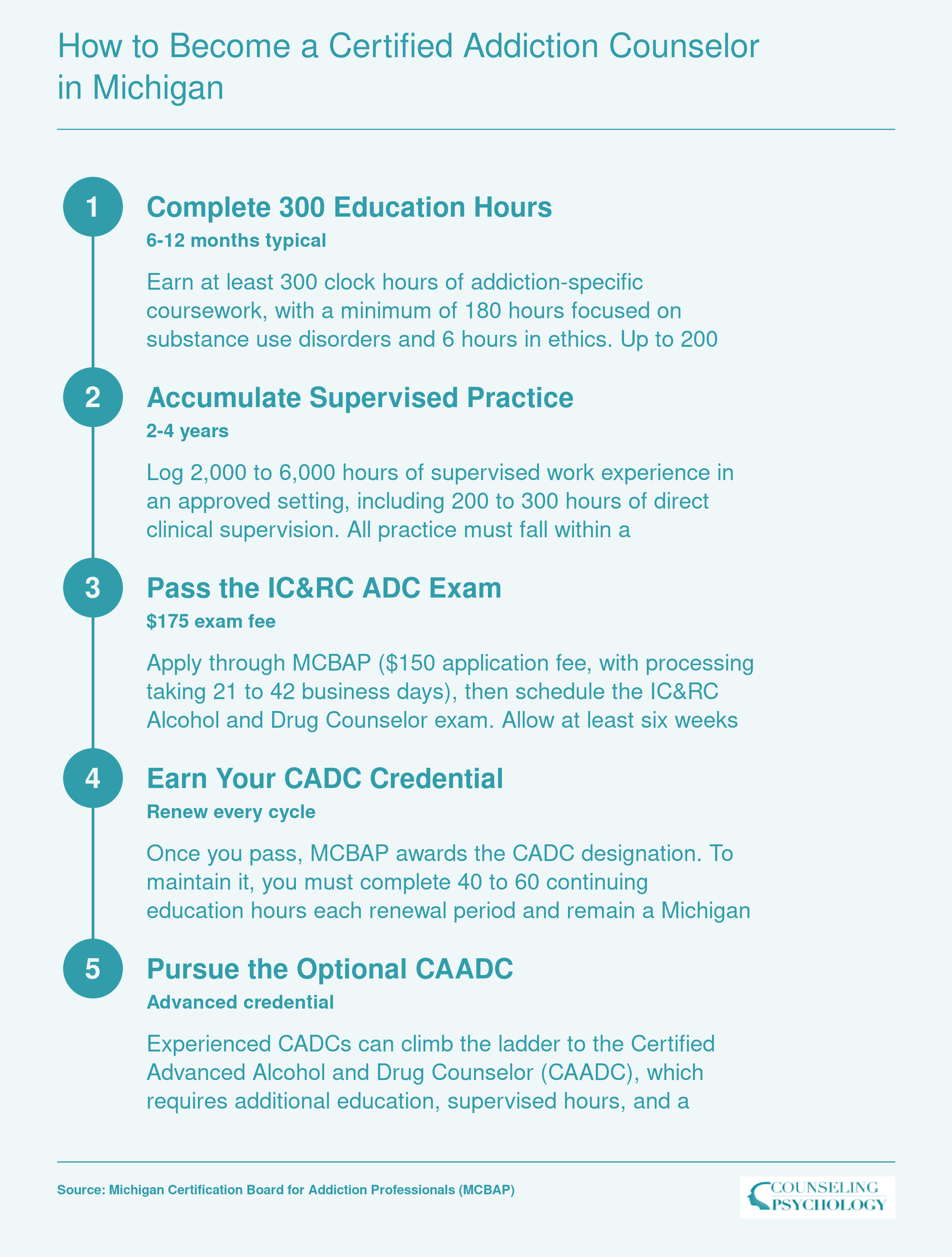
The CADC is Michigan's foundational addiction-counselor credential. It requires 300 total education hours, including 180 hours specific to substance use disorders and six hours in ethics.2 You must also complete between 2,000 and 6,000 supervised practice hours (the typical minimum is 2,000) with 300 hours of face-to-face supervision, then pass the International Certification and Reciprocity Consortium (IC&RC) Alcohol and Drug Counselor exam.3 Distance learning can cover up to 200 of the required education hours, making online certificate programs viable for many candidates.4 From the day you complete an MCBAP-approved graduate certificate to the day you sit for the CADC exam, expect a timeline of at least two to three years if you work full-time in a qualifying supervised setting. Part-time employment or gaps in supervision extend that window considerably. For a broader look at the profession, our guide on how to become a substance abuse counselor outlines the national landscape and typical career steps.
Which Programs Satisfy MCBAP Education Requirements
All the graduate certificates ranked in this article can satisfy the CADC education component if the program holds MCBAP approval and your transcript documents the required hours.2 Before enrolling, confirm that the institution has submitted the program for MCBAP review and that credits translate into clock hours that meet or exceed the 180-hour substance-use-disorder core. Most 12- to 18-credit certificates deliver 180 to 270 contact hours, putting you well within range. Programs that weave ethics coursework into the curriculum also cover the six-hour ethics mandate. Always request a program-completion transcript and course syllabus to submit with your MCBAP application, because the board reviews curricula on a case-by-case basis. If you are comparing options beyond the Ann Arbor area, our directory of online graduate certificates in addiction counseling covers nationally available programs.
CAADC: The Advanced Credential
The CAADC is Michigan's master's-level credential. It requires a master's degree in a clinical behavioral health field, 180 hours of substance-use-disorder education, six hours of ethics, 2,000 supervised practice hours, 100 hours of supervision, and passage of the IC&RC Advanced Alcohol and Drug Counselor exam.23 A graduate certificate alone does not qualify you for the CAADC because the credential demands a full master's degree. However, stacking a certificate onto an existing counseling or social work master's is a common strategy: the certificate supplies the SUD-specific education, and your prior degree meets the master's-degree requirement. If you hold an MSW, an MA in clinical mental health counseling, or a related credential, adding an addiction-focused graduate certificate positions you to apply for CAADC without returning to school for a second master's.
Practical Considerations
Both credentials require supervised experience in an MCBAP-approved setting under a qualified supervisor. Start accumulating hours as soon as you begin coursework, not after graduation. Many certificate students work in residential treatment centers, outpatient clinics, or community mental health agencies while completing their education, effectively running the classroom and fieldwork tracks in parallel. This approach compresses the timeline and ensures you meet supervision requirements without a prolonged post-certificate waiting period.
How to Become a Certified Addiction Counselor in Michigan
Michigan's Certified Alcohol and Drug Counselor (CADC) credential, issued by the Michigan Certification Board for Addiction Professionals (MCBAP), follows a clear ladder. Most candidates complete the full process in roughly three to five years, depending on how quickly they accumulate supervised practice hours.
Online vs. On-Campus Options Near Ann Arbor
Students near Ann Arbor can choose from hybrid and fully on-campus addiction counseling programs at Michigan institutions. The trade-offs come down to flexibility, practicum logistics, and total cost. Here is how three programs stack up across the key factors that matter most when deciding between online, hybrid, and traditional formats.
| Factor | Western Michigan University (Hybrid Graduate Certificate) | Central Michigan University (Hybrid Master's) | University of Detroit Mercy (On-Campus Master's) |
|---|---|---|---|
| Delivery Format | Hybrid: online coursework with weekend or on-campus sessions in Kalamazoo | Hybrid: mix of online and on-campus courses in Mount Pleasant | Primarily on-campus in Detroit |
| Program Length | 18 credit hours (certificate level) | 60 credit hours (full master's degree) | 60 credit hours, typically three years (full master's degree) |
| In-State Tuition (Institutional) | $20,103 | $17,187 | $22,544 (private, same rate for all students) |
| Average Net Price | $15,273 | $17,597 | $15,232 |
| Student-to-Faculty Ratio | 16:1 | 16:1 | 12:1 |
| Clinical Training Component | Field practicum or capstone option | Required practicum and internship; access to Center for Community Counseling | Clinical experience at an on-site counseling clinic at no extra cost |
| Scheduling Flexibility | High: online courses plus weekend class options, designed for working adults | Moderate to high: part-time and full-time tracks, online components for working professionals | Lower: primarily in-person attendance required in Detroit; small cohort structure |
| Best Fit For | Working professionals who already hold a bachelor's degree and need a focused credential quickly | Students seeking a CACREP-accredited master's with some online flexibility and an addiction counseling concentration | Students who prefer hands-on, face-to-face mentorship and want access to a nationally recognized addiction counseling faculty |
Related Articles
Career Outcomes and Earning Potential After Graduation
Weighing a certificate program's cost against what you'll actually earn afterward is the central calculation for most prospective students. Unfortunately, program-level earnings data for addiction counseling certificates near Ann Arbor are not yet available in federal College Scorecard records. The institutions in this comparison either do not report early-career earnings for their addiction counseling graduates, or their programs are too new to have post-completion wage data published. That means we cannot present median earnings one or two years after graduation for these specific certificates.
Regional Wage Context for Addiction Counselors
Without program-specific outcomes, the best proxy is occupational wage data for substance abuse, behavioral disorder, and mental health counselors across Michigan. According to 2024 Bureau of Labor Statistics figures, counselors in this occupation earn a mean annual wage of $59,530 statewide.1 The 10th percentile earns approximately $37,200, while the 90th percentile reaches $84,640.1 Those figures reflect the full spectrum of experience levels, credentials, and practice settings, from entry-level residential technicians to seasoned clinical supervisors.
Metro-level data for the Detroit-Warren-Dearborn area, which includes parts of the Ann Arbor catchment, would provide a more granular picture, but those figures are not broken out separately in the available datasets.2 Statewide medians remain the most reliable benchmark for new certificate holders entering Michigan's behavioral health workforce in 2026.
Employment Outcomes and Economic Mobility
Program-level employment share and share of graduates earning above the poverty threshold are also not reported for the certificates in this comparison. These metrics, when available, offer critical insight into whether a credential translates into stable, living-wage employment. Their absence does not mean the programs are ineffective, only that the data have not been collected or published.
What we do know is that Michigan's demand for addiction counselors remains robust. The state's opioid epidemic and expanding Medicaid coverage for substance use disorder services have driven steady hiring in outpatient clinics, residential treatment centers, and community mental health agencies. Certificate holders who secure a state credential and accumulate supervised hours typically find employment within months of completing their programs.
Return on Investment Without Earnings Data
Assessing ROI when program-level earnings are unavailable requires comparing tuition and median debt to statewide occupational wages. Western Michigan University's graduate certificate costs approximately $20,103 for in-state students and carries a median debt of $26,188 across all programs. University of Detroit Mercy's master's program lists tuition at $22,544, with median debt of $23,250. Central Michigan's hybrid master's runs $17,187, with median debt of $27,000.
If we assume a certificate graduate enters the field near the statewide 10th percentile ($37,200), the debt-to-income ratio ranges from 0.62 to 0.73, a manageable burden if employment is stable. Counselors who advance to the mean wage ($59,530) within a few years see that ratio drop below 0.5, a sign of positive ROI. The absence of precise program-level earnings means you should budget conservatively and plan for several years of wage growth before the credential pays for itself.
What Graduates Actually Do
Most certificate holders work as unlicensed counselor assistants, case managers, or prevention specialists while accumulating the 2,000 to 4,000 supervised hours required for state credentialing. Once credentialed as a Certified Advanced Alcohol and Drug Counselor (CAADC) or Licensed Master Social Worker with an addiction specialty, earning potential climbs toward the statewide mean and beyond. The certificate is a gateway, not a terminal credential, and your earning trajectory depends heavily on how quickly you complete supervised hours and pursue advanced licensure.
Addiction Counselor Earnings at a Glance
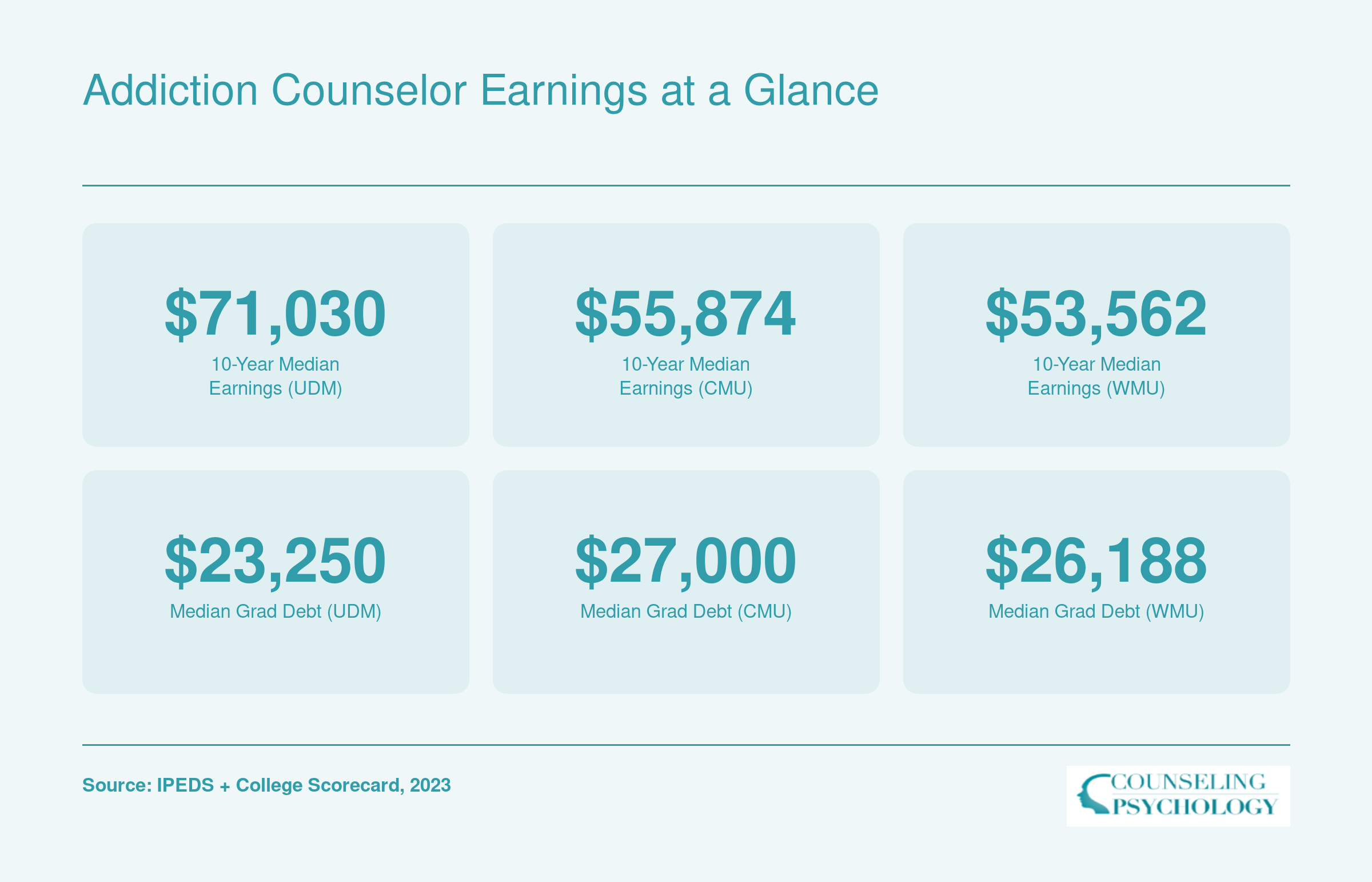
Program-level post-completion earnings are not yet published for these addiction counseling programs, so the figures below draw on institution-wide outcomes and median graduate debt to give you a ballpark sense of value. The BLS national median wage for substance abuse, behavioral disorder, and mental health counselors was approximately $53,710 as of May 2024; Michigan-specific metro figures may differ.
Financial Aid and Tuition Assistance for Certificate Students
Paying for a graduate certificate in addiction counseling rarely follows a single path. Some students piece together employer tuition reimbursement and state workforce grants, while others rely entirely on federal loans and institutional aid. Understanding which sources you can actually tap, and the trade-offs attached to each, will help you keep your total cost manageable.
Unpacking Pell Grant Eligibility
Pell Grants are primarily an undergraduate resource, but they can cover a graduate certificate in limited circumstances, usually when the program leads to initial teacher certification or is required for licensure in certain high-need fields. For most addiction counseling certificates, Pell eligibility is very rare. That said, an institution's Pell share serves as a good proxy for its overall financial aid culture. Schools with higher percentages of Pell recipients often invest more in need-based institutional aid and support services. Among ranked programs near Ann Arbor, Western Michigan University reports a Pell Grant recipient share of 55%, Central Michigan University sits at 53%, and University of Detroit Mercy at 49%. While these figures mainly reflect undergraduate populations, they signal a campus climate that understands economic diversity, and that can translate into stronger advising and emergency grants for certificate students.
State and Federal Workforce Development Support
The federal Substance Abuse and Mental Health Services Administration (SAMHSA) distributes nearly $800 million in block grants each year, funneling over $14.3 million to Michigan's Department of Health and Human Services in 2026 alone.1 While these funds don't go directly to individual students, they support agency-based training and can create tuition-remission opportunities for employees at partner clinics.2 For Michigan residents, the Reconnect program pays in-district community college tuition for eligible adults, and Michigan Works! agencies, funded through the Workforce Innovation and Opportunity Act (WIOA), often cover tuition, books, and fees for those pursuing high-demand credentials like addiction counseling. You'll generally need to meet age, residency, and education requirements, but the application process is straightforward.
Employer Tuition Reimbursement in Southeast Michigan
If you're already working in a healthcare system or community mental health agency, check your benefits manual. Many Southeast Michigan employers cap annual reimbursement between $3,000 and $5,250, with a waiting period of three to six months before eligibility kicks in.3 Be prepared for a retention requirement: most organizations ask you to stay one to two years after the last payment. Major health networks in the Ann Arbor and Detroit area routinely fund credentialing for addiction counselors because it expands their service capacity. Even if your current employer doesn't offer full reimbursement, a partial benefit can shrink your out-of-pocket cost significantly, making a certificate far more accessible.
Comparing Net Price, Not Sticker Price
Published tuition rates rarely tell the full story. Western Michigan's graduate certificate carries a sticker price above $20,000 for out-of-state students, but the institution's undergraduate net price, a rough indicator of how discounting works, is about $15,273. Detroit Mercy, a private university, lists tuition near $22,500 per year for its master's program, yet its institutional net price for traditional students hovers close to $15,232. Always use the net price calculator on each school's website. Federal student loans are available for graduate certificate programs that meet credit-hour thresholds; unsubsidized Direct Loans and Grad PLUS loans can bridge funding gaps. After completing the certificate, you may qualify for the Michigan State Loan Repayment Program (MSLRP), which pays down up to two years of educational debt in exchange for service in a Health Professional Shortage Area.3 Weigh these options carefully: a low net price paired with loan forgiveness can make a certificate not just career-smart but financially sustainable.
Earning a graduate certificate builds the educational foundation you need, but it is not the finish line. Michigan's Certified Alcohol and Drug Counselor (CADC) credential also requires supervised clinical experience hours and a passing score on a standardized exam. Plan for roughly one to two years of additional credentialing time after you complete your coursework.
How to Choose the Right Program for Your Goals
Demand for credentialed addiction counselors in Michigan has grown faster than the supply of trained professionals, which means the programs you choose now will shape your options for years to come.
Start With Your Personal Constraints
Before comparing programs, be honest about two things: your schedule and your budget. Working full-time in healthcare, social services, or any demanding field makes format the first filter, not an afterthought. Online and hybrid certificate programs let you complete coursework around shift schedules and family commitments without sacrificing the clinical preparation you need. Once you identify programs that fit your life, compare net price rather than published tuition. Scholarships, employer tuition benefits, and institutional aid can make a higher-sticker program cost less out of pocket than a cheaper-looking option that offers little aid to certificate students.
Align the Certificate With Your Long-Term Credential
Not all certificate programs are built the same way, and the differences matter most if you eventually want to pursue the Certified Alcohol and Drug Counselor (CADC) or, further down the road, the Certified Advanced Alcohol and Drug Counselor (CAADC). Some certificate programs are designed as stackable credentials, meaning the completed coursework transfers into a master's degree sequence at the same institution or a partner school. Students exploring related clinical psychology certificate programs will notice that many graduate certificates follow this same stackable model. If the CAADC is on your horizon, this kind of pathway saves both time and money compared to starting a graduate program from scratch.
Confirm Education Hours With MCBAP Before You Commit
The Michigan Certification Board for Addiction Professionals (MCBAP) determines which education hours count toward CADC credentialing. Program websites do not always reflect the most current approval status. Contacting MCBAP directly before you enroll is the single most practical step you can take to avoid completing coursework that does not satisfy the requirements. Ask specifically whether the program's education hours are pre-approved and whether any curriculum changes are pending.
A Simple Decision Framework
When you are weighing your final options, run through these four questions:
- Format: Can you realistically attend every required session or complete online modules on your current schedule?
- Cost: After aid, what will you actually pay, and does the institution offer payment plans for certificate students?
- Credential alignment: Does this certificate satisfy MCBAP education hours for the CADC, and does it stack toward a master's if you want the CAADC later?
- Career timeline: How quickly do you need to enter or advance in the field, and does the program's length match that window?
Answering these before you apply keeps the decision grounded in your goals rather than in a program's marketing materials.
In 2024, opioid overdose death rates in Washtenaw County ranged from 6.5 to 54.7 per 100,000 residents, according to the Washtenaw Health Initiative. This tenfold variation within one county highlights how unevenly the substance use crisis impacts neighboring communities.
Frequently Asked Questions About Addiction Counseling Programs in Michigan
Prospective addiction counseling students near Ann Arbor tend to ask many of the same questions about program length, clinical content, and credentialing. Below are straightforward answers grounded in current professional and academic sources.