
What you’ll learn in this article…
- Most bachelor's-level counseling roles pay between $38,000 and $48,000 nationally, with master's degrees required for full licensure.
- Net prices at top online counseling programs range from roughly $6,000 to $18,000 per year after financial aid.
- Counseling majors emphasize applied skills like motivational interviewing, while psychology majors lean toward research methods.
- Specializations such as substance abuse counseling or family services let students focus their bachelor's degree early on.
Demand for mental health professionals is outpacing the workforce supply, and online bachelor's programs in counseling have expanded to meet that pressure. The U.S. Bureau of Labor Statistics projects faster-than-average job growth for substance abuse, behavioral disorder, and mental health counselors through 2033, and a bachelor's in counseling is the minimum credential many employers require for entry-level case management and community support roles.
The degree itself does not confer licensure. Independent clinical practice requires a master's degree in most states, so students should treat a bachelor's program as foundational preparation rather than a finishing credential. That distinction shapes every cost-benefit calculation a prospective student makes, whether the next step is a counseling degree at the graduate level or direct entry into the workforce.
With tuition at online programs ranging from roughly $6,000 to over $30,000 per year before aid, the financial spread is wide. Accreditation status, specialization options, and transfer credit policies vary just as sharply, making direct program comparisons essential before committing.
Best Online Bachelor's in Counseling Programs
The following online bachelor's counseling programs are ranked using a quality composite that weighs graduation rates, net price, and post-graduation outcomes rather than any single metric. Each program was evaluated for its online delivery options, curriculum depth, and alignment with state licensure or certification pathways. Note that graduation rates reflect institution-wide figures, not program-specific completion data.
- Graduation and retention rates
- Net price after financial aid
- Post-graduation earnings outcomes
- Online delivery and program quality
- Licensure and certification alignment
- Internal program database
- NCES-IPEDS federal institutional data — nces.ed.gov
- College Scorecard graduate earnings — collegescorecard.ed.gov
- Independent program research

The University of Texas Rio Grande Valley
A public UT System institution in South Texas, UTRGV combines affordable tuition with a strong focus on serving bilingual and border-region communities. Its online addiction studies program prepares graduates for Texas chemical dependency counselor licensure, and the university's Hispanic-Serving Institution designation reflects the culturally responsive training embedded across its curriculum.
- 100% online format with 120 total credit hours
- Curriculum aligned with Texas LCDC licensure requirements
- Multiple practicum experiences in real-world treatment settings
- Emphasis on bilingual and border-region community counseling
- Minimum 2.4 GPA required in major coursework
- Criminal background check required for program entry
- Prepares graduates for substance abuse prevention and treatment roles
Bachelor of Science in Addiction Studies — Online

University of Cincinnati
The University of Cincinnati pairs a strong 75% institution-wide graduation rate with a counseling program designed around Ohio's Chemical Dependency Counselor Assistant (CDCA) credentialing requirements. Greater Cincinnati's robust network of treatment providers and community agencies gives students access to practicum placements that can transition into post-graduation employment.
- Fully online, flexible degree format
- Meets Ohio CDCA certification academic requirements
- Addresses substance abuse screening, assessment, and intervention
- State licensure pathway available for Ohio and beyond
- Prepares for counseling roles in treatment and recovery services
- Students urged to verify out-of-state board requirements
Bachelor of Science in Substance Abuse Counseling — Online

Empire State University
Part of the SUNY system, Empire State University offers generous credit-for-prior-learning policies that benefit working professionals already in the addiction services field. The 124-credit online program aligns with New York's Credentialed Alcoholism and Substance Abuse Counselor (CASAC) standards, and completing the degree can reduce the supervised work-experience hours required for that credential.
- 124-credit online program with flexible course delivery
- Aligned with U.S. Department of Health and Human Services competencies
- May reduce supervised work hours needed for CASAC certification
- Accepts credits for prior learning and approved addiction trainings
- Standard undergraduate admissions with SUNY transfer pathways
- Prepares graduates for diverse addiction treatment settings
Bachelor of Science in Addiction Studies — Online

The University of Texas at Arlington
UT Arlington delivers a multidisciplinary substance use program that blends biological, psychological, and social perspectives. The curriculum meets Texas LCDCi academic requirements and feeds directly into UTA's Master of Social Work program, giving students a clear advanced-practice pipeline. Dallas-Fort Worth internship placements connect learners to one of the state's largest treatment markets.
- Available online and on campus with 120 credit hours
- Meets Texas Licensed Chemical Dependency Counselor Intern requirements
- Includes a required field internship in treatment settings
- Multidisciplinary curriculum spanning biopsychosocial perspectives
- Elective coursework and minor options available
- Designed as a direct feeder into UTA's MSW program
- DFW-area internship ecosystem for local placement opportunities
Bachelor of Science in Substance Use and Treatment — Online

New Mexico State University
NMSU's Global Campus delivers a 100% online counseling and community psychology degree focused on addressing New Mexico's behavioral health workforce shortages, especially in rural and tribal communities. Asynchronous classes and affordable per-credit pricing make the program accessible for working adults, and the curriculum includes coursework applicable toward Substance Abuse Associate licensure.
- 100% online, asynchronous classes with flexible pacing
- 120 credit hours with full-time and part-time options
- Emphasis on multicultural competence and diversity
- Internship opportunities in community behavioral health
- Coursework applicable toward Substance Abuse Associate licensure
- Military benefits accepted alongside financial aid and scholarships
- Strong foundation for graduate study in clinical mental health counseling
Bachelor of Science in Counseling and Community Psychology — Online

University of Mary
A private Catholic university in Bismarck, the University of Mary offers an accelerated online addiction counseling degree completable in as few as 2.6 years. The program is built around North Dakota's Licensed Addiction Counselor requirements and connects graduates to treatment centers, hospitals, and tribal health programs across the Upper Midwest region.
- Online format at $495 per credit hour
- Program completable in approximately 2.6 years
- Aligned with North Dakota LAC licensure requirements
- Covers assessment, treatment planning, and intervention strategies
- Transfer-friendly with a minimum 2.0 GPA requirement
- Career paths include substance abuse counseling, prevention, and case management
- Catholic mission emphasis on service to rural and Native communities
Bachelor of Science in Addiction Counseling — Online

Grand Canyon University
Grand Canyon University offers an online counseling bachelor's with a dedicated emphasis in addiction, chemical dependency, and substance abuse. The faith-integrated curriculum covers psychopharmacology, co-occurring disorders, multicultural counseling, and trauma, preparing graduates for entry-level roles in recovery settings. GCU accepts up to 90 transfer credits and delivers courses in convenient 7-week terms.
- 120 credit hours delivered in 7-week online course terms
- Up to 90 transfer credits accepted
- Faith-integrated Christian worldview woven throughout curriculum
- Covers psychopharmacology, trauma, relapse prevention, and ethics
- May qualify graduates for Licensed Substance Abuse Technician credential
- Accredited by the Higher Learning Commission since 1968
- Foundation for advanced graduate study in counseling
Bachelor of Science in Counseling (Addiction, Chemical Dependency and Substance Abuse) — Online

Arizona State University
Arizona State University's Counseling and Applied Psychological Science program is notable as the first counseling-focused bachelor's degree at a major research university. Faculty include APA Fellows and Fulbright scholars, and courses run in 7.5-week terms. Students can choose from three distinct concentrations, including substance abuse and addictions, and a military-focused track designed for careers in the VA system.
- 120 credit hours with 135-hour capstone clinical experience
- 7.5-week course terms with asynchronous delivery
- Faculty include APA Fellows and Fulbright scholars
- Test-optional admissions with an Earned Admission pathway
- Diploma does not specify online delivery
- Prepares for behavioral health technician and case management roles
- Concentration prepares for Licensed Addiction Counselor Technician roles
- Focus on addiction assessment, treatment planning, and group work
- 45 required clinical hours in substance abuse settings
- Rolling admissions with multiple start dates
- Full-time and part-time options available
- No thesis or capstone required for this concentration
- Tailored for careers in VA system and veteran-serving organizations
- Hands-on internship requirement with military support agencies
- Asynchronous online classes starting in spring term
- Capstone required alongside 120 credit hours
- Faculty include Fulbright scholars with military counseling expertise
- Designed for students near military installations or planning VA careers
Counseling and Applied Psychological Science — Online
Counseling and Applied Psychological Science (Substance Abuse and Addictions) — Online
Counseling and Applied Psychological Science (Counseling Military Members and Veterans) — Online

Washburn University
Washburn University in Topeka delivers a hybrid addiction counseling concentration within its Family and Human Services program. The curriculum meets both NAADAC and Kansas Behavioral Sciences Regulatory Board standards, creating a direct academic pathway to Kansas Licensed Addiction Counselor credentials. Local agency partnerships across northeast Kansas provide hands-on internship opportunities.
- Hybrid format blending online coursework with on-campus components
- NAADAC approved and Kansas BSRB compliant
- Direct pathway to Kansas LAC and LMAC credentials
- Local internship placements with Topeka-area treatment agencies
- Associate-to-master's career ladder for stackable credentials
- Flexible scheduling with financial aid available
- Accepts Kansas community college transfer credits in human services
Bachelor of Science in Family and Human Services (Addiction Counseling) — Hybrid

University of Central Arkansas
The University of Central Arkansas offers the only Bachelor of Science in Addiction Studies in the state, available in both treatment and prevention concentrations. Accredited through a national addiction-specific body, the program meets Arkansas counselor certification requirements and connects students with field experiences across the state's treatment centers, prevention coalitions, and community health organizations.
- Only BS Addiction Studies program in Arkansas
- Online delivery with national addiction-specific accreditation
- Graduates eligible for Arkansas Alcohol and Drug Counselor certification
- Clinical training in hospitals, clinics, and criminal justice settings
- Minimum 2.0 GPA required for admission
- Combines educational technology with hands-on treatment skills
- Prevention-focused concentration unique in the state
- Online format with NASAC accreditation
- Prepares for Arkansas prevention specialist credentials
- Field experiences with state prevention coalitions and health organizations
- Skills applicable across diverse community and agency settings
- Blends educational training with practical prevention strategies
Bachelor of Science in Addiction Studies (Treatment) — Online
Bachelor of Science in Addiction Studies (Prevention) — Online
What Can You Do With a Bachelor's in Counseling?
A bachelor's degree in counseling prepares you for entry-level positions in helping professions where you support individuals facing mental health challenges, substance use issues, or difficult life transitions. While this degree does not qualify you for independent licensed practice as a counselor, it opens doors to meaningful work that makes a real difference in people's lives.
Realistic Entry-Level Career Paths
Graduates with a bachelor's in counseling typically pursue roles that involve direct client contact, case coordination, or community outreach. Common job titles include:
- Substance Abuse Counselor: Works in treatment facilities helping clients recover from addiction. The national median annual wage for substance abuse, behavioral disorder, and mental health counselors is $59,190, with projected job growth of 17% through 2034.1
- Community Health Worker: Connects underserved populations with healthcare resources and social services, often serving as a cultural liaison between communities and providers.
- Case Manager: Coordinates services for clients in social service agencies, hospitals, or nonprofit organizations, ensuring individuals receive appropriate care and support.
- Residential Advisor: Supports residents in group homes, transitional housing, or treatment facilities, providing supervision and helping clients develop life skills.
- Behavioral Health Technician: Assists licensed clinicians in psychiatric facilities or outpatient settings, monitoring client behavior and implementing treatment plans.
Social and human service assistants, a category that includes many of these roles, earn a national median annual wage of $47,090, with 9% projected job growth through 2034.2
State-Specific Opportunities
Some states permit bachelor's-level professionals to provide counseling services in specific settings. Substance abuse treatment facilities, in particular, may allow graduates to work as counselors under supervision or with a state-issued certification rather than full licensure. Requirements vary significantly by state, so researching your local regulations is essential before committing to this career path. For a deeper look at this route, explore our guide on how to become a substance abuse counselor.
The Master's Degree Reality
Be aware that most licensed counselor roles, including Licensed Professional Counselor and Licensed Marriage and Family Therapist credentials, require a master's degree plus supervised clinical hours. A bachelor's in counseling positions you well for graduate study if you decide to pursue full licensure later. In the meantime, entry-level positions provide valuable hands-on experience working with clients, which strengthens graduate school applications and helps you confirm that counseling is the right long-term fit. You can review the full range of counseling careers to see where a bachelor's degree fits within the broader profession.
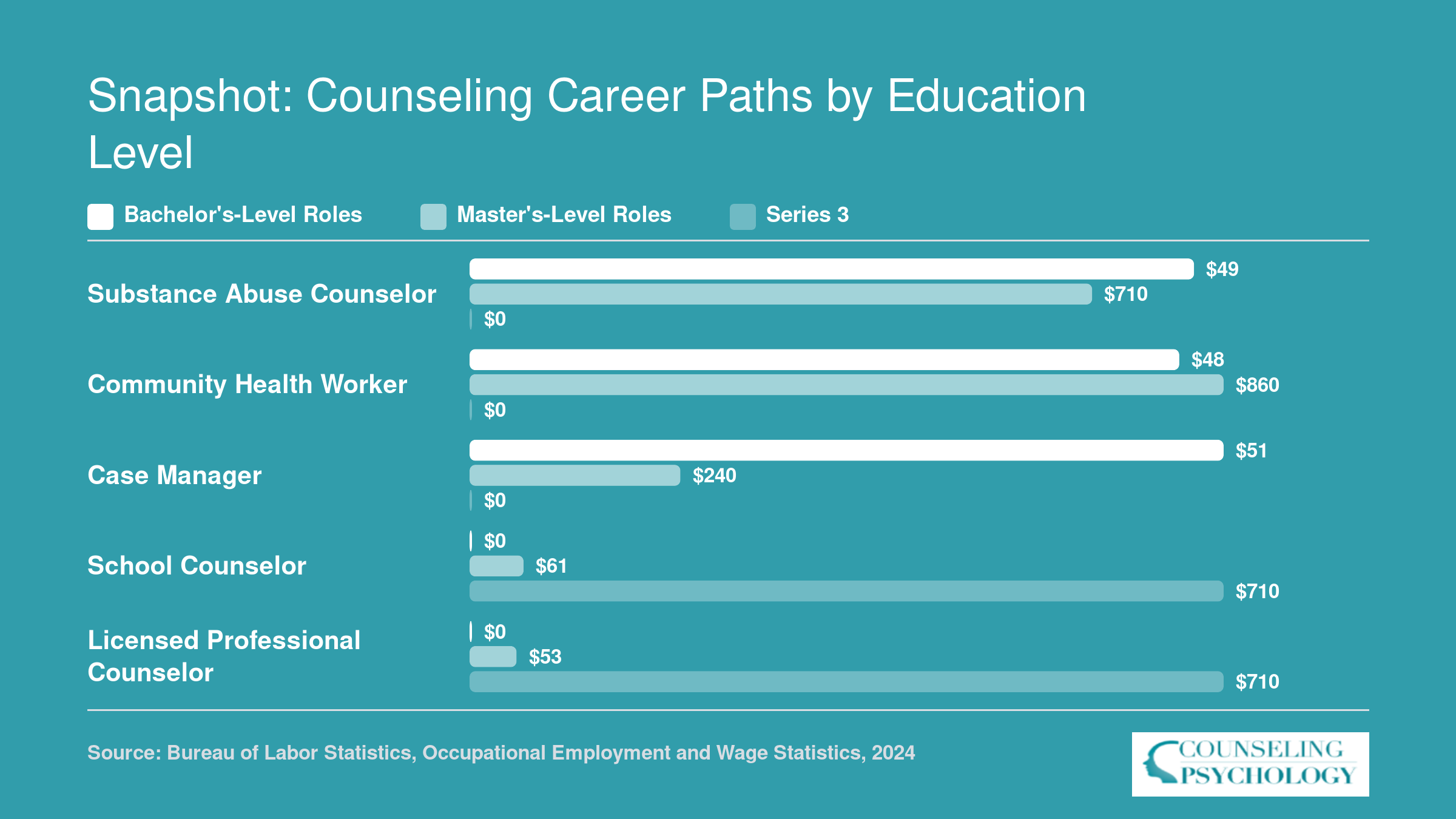
Snapshot: Counseling Career Paths by Education Level
Your earning potential in counseling rises significantly with additional education. Here is how national median salaries compare across common counseling-related roles, grouped by the minimum degree typically required for entry.
Bachelor's in Counseling Vs. Psychology: Key Differences
Should you major in counseling or psychology if you want to help people with mental health challenges? While both degrees open doors to graduate training and human services careers, they differ significantly in curriculum focus, skill development, and the pathways they best support.1 Understanding these distinctions can help you choose the bachelor's program that aligns with your career goals and learning preferences.
Curriculum and Core Coursework
Counseling bachelor's programs emphasize applied helping skills and direct preparation for human services work. Core courses typically include helping skills, counseling theories, human behavior and development, ethics, and crisis intervention. The curriculum is designed to teach you how to communicate effectively with clients, conduct intake interviews, and understand the social systems that shape people's lives.
Psychology bachelor's programs take a broader, more scientific approach to understanding behavior and mental processes. Required courses emphasize research methods, statistics, and foundational areas of psychological science: biological psychology, cognitive processes, social psychology, and abnormal psychology. The curriculum trains you to think like a scientist, designing studies and analyzing data to answer questions about why people behave the way they do.
Skills and Fieldwork Expectations
Counseling majors develop practical communication skills, interviewing techniques, case management abilities, and cultural competence through coursework and often through required practicum or internship placements in human services agencies. This hands-on experience with real clients or community members provides direct preparation for entry-level roles after graduation.
Psychology majors build scientific reasoning, data analysis, research design, and critical thinking skills. Lab or research experience is standard, giving you exposure to the methodologies used to study behavior. Clinical practicums are sometimes available as electives but are not typically required at the bachelor's level.
Graduate School Pathways and Licensure Alignment
Both bachelor's degrees align very well with master's programs in clinical mental health counseling or school counseling, which lead to Licensed Professional Counselor (LPC) or Licensed Mental Health Counselor (LMHC) credentials. A counseling bachelor's may give you a slight head start in applied coursework, but admissions committees value either major as strong preparation. For a deeper look at the full credential process, see our guide on how to become a mental health counselor.
For students considering a PhD in clinical or counseling psychology, a psychology bachelor's provides stronger alignment. The research training and broader exposure to psychological science create a more direct foundation for doctoral study. A counseling bachelor's can still lead to a PhD, but you may need to strengthen your research background through additional coursework or research assistant experience.
Direct Entry-Level Preparation
If your goal is to begin working in human services immediately after your bachelor's degree, a counseling degree typically offers stronger direct preparation for roles such as case manager, residential counselor, or community support specialist. Psychology majors are well prepared for these roles too, but may need to supplement their scientific training with more applied experience through internships or volunteer work.
Questions to Ask Yourself
How to Become a Counselor With a Bachelor's Degree
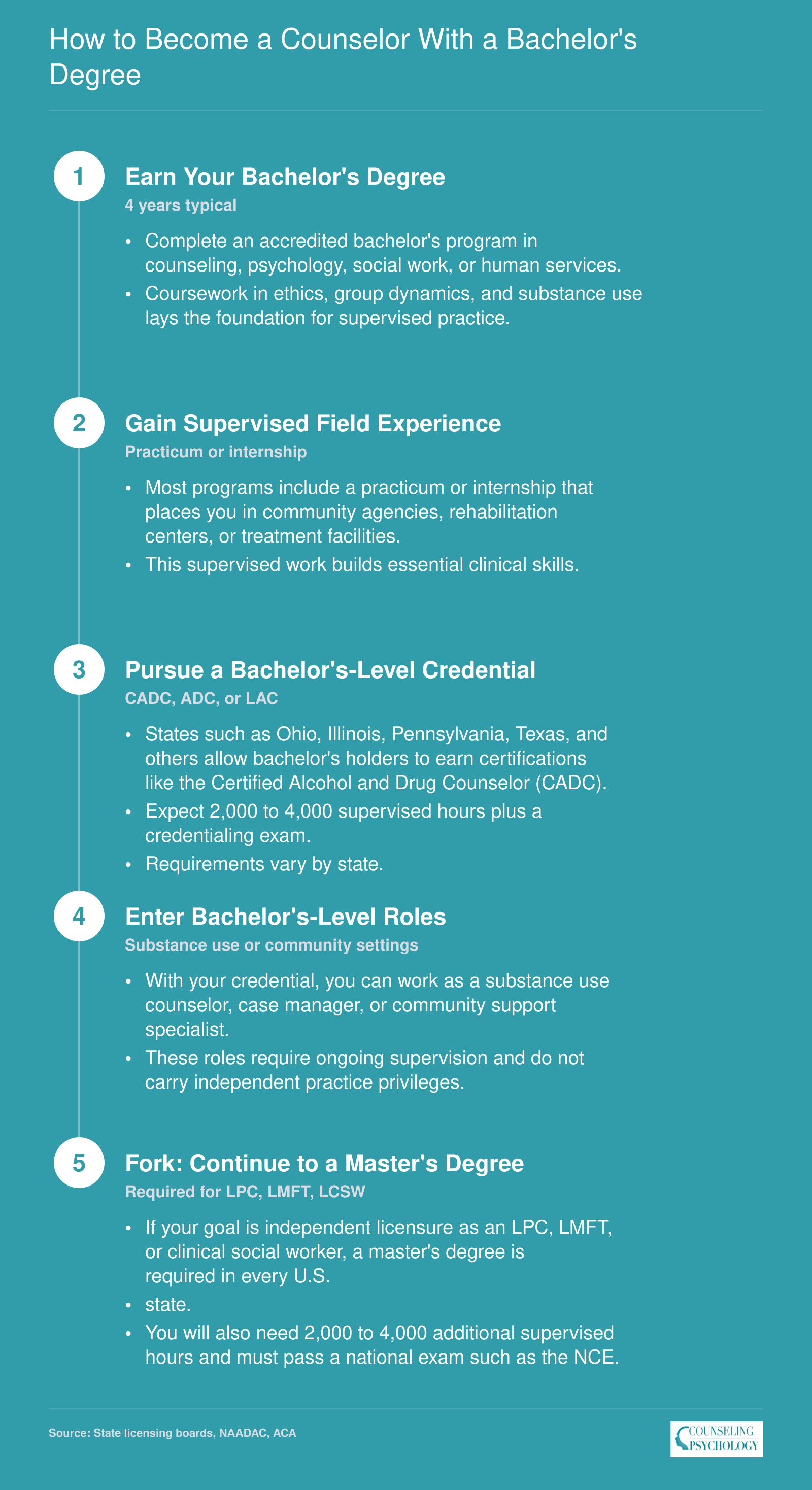
A bachelor's in counseling opens the door to entry-level roles, but the path you take after graduation depends on whether you aim for bachelor's-level work or plan to pursue full clinical licensure. Here is a clear roadmap covering both tracks.
What to Expect in an Online Counseling Bachelor's Program
An online bachelor's in counseling is a structured undergraduate program that introduces the foundational theories and skills needed to support individuals facing mental health, behavioral, or relational challenges. Delivered primarily through digital learning platforms, these programs mirror on-campus rigor while accommodating students who need location flexibility. Most curricula blend psychological theory, interpersonal skill-building, and practical fieldwork to prepare graduates for entry-level human-services roles or graduate study.
Program Length and Structure
Full-time students typically complete a bachelor's degree in counseling in four years, accumulating around 120 semester credits.1 Many online programs accept transfer credits, particularly from associate degrees, which can reduce the timeline to as few as three years. Quarter-system programs, such as those offering 180 quarter credits, are equivalent to the standard 120 semester credits.2 A typical program divides coursework into general education, major core, and electives, with upper-division requirements often exceeding 45 credits.1
Core Counseling Coursework
While specific course titles vary, most programs anchor the major with a consistent set of foundational classes. Students can expect to encounter: - Introduction to Counseling: an overview of the profession's history, roles, and scope of practice. - Abnormal Psychology: study of psychological disorders, their classification, and diagnostic criteria. - Human Development: exploration of cognitive, social, and emotional growth across the lifespan. - Ethics in Counseling: examination of professional standards, confidentiality, and ethical decision-making. - Multicultural Counseling: strategies for working effectively with diverse populations and addressing cultural influences. - Group Counseling Techniques: principles of group dynamics and facilitation skills.
Fieldwork and Hands-On Experience
Online programs do not skimp on practical training. Most require a practicum or internship component, typically worth 3 to 6 credits and involving 120 to 150 hours of supervised, on-site experience. Because students are geographically distributed, they usually collaborate with a program placement coordinator to identify a local agency, school, or clinic that meets approval criteria. The site provides a qualified supervisor, while faculty oversee learning objectives and academic reflection remotely. This model ensures real-world application of classroom concepts without requiring relocation. For students drawn to school settings, understanding how to become a school counselor early on can help shape practicum choices.
Accreditation Considerations
Programmatic accreditation for counseling at the bachelor's level does not exist; the Council for Accreditation of Counseling and Related Educational Programs (CACREP) accredits only master's and doctoral degrees. Consequently, the primary quality marker for an online bachelor's program is regional or national institutional accreditation.1 Many undergraduate programs, however, align their curriculum with CACREP standards as a way to prepare students for eventual graduate study in CACREP-accredited master's tracks. When researching schools, verify the institution's accreditation status and ask how the program's coursework maps to graduate admission prerequisites.
Admission Requirements and Program Costs
The table below compares annual tuition and average net price for ten online counseling bachelor's programs, sorted from lowest to highest net price. The net price column reflects an institution-wide average for first-time, full-time students receiving financial aid; it is not a guaranteed quote for any individual student. Pell Grant share and admission rate columns offer a quick snapshot of financial access and selectivity. Most online counseling programs require a high school diploma or GED and a minimum GPA of around 2.0 to 3.0. Standardized test scores (SAT or ACT) are typically not required for admission to online programs, and many schools evaluate transfer credits on a case-by-case basis.
| School | State | In-State Tuition | Out-of-State Tuition | Avg. Net Price (After Aid) | Pell Grant Recipients | Admission Rate |
|---|---|---|---|---|---|---|
| UT Rio Grande Valley | TX | $9,799 | $19,645 | $4,831 | 88.6% | 94.2% |
| Purdue University Global | IN | $10,101 | $14,412 | $7,770 | 86.2% | N/A |
| Great Basin College | NV | $3,923 | $11,996 | $8,471 | 86.8% | N/A |
| New Mexico State University | NM | $8,183 | $25,307 | $8,889 | 84.5% | 89.0% |
| Edmonds College | WA | $4,810 | $10,875 | $11,010 | 82.2% | N/A |
| Midwestern State University | TX | $9,950 | $11,770 | $11,656 | 65.7% | 93.5% |
| Empire State University | NY | $7,648 | $17,558 | $11,676 | 73.3% | N/A |
| Pueblo Community College | CO | $5,049 | $17,649 | $12,045 | 84.7% | N/A |
| Northwestern State University of Louisiana | LA | $8,864 | $19,652 | $13,606 | 70.7% | 92.5% |
| UT Arlington | TX | $11,950 | $29,582 | $13,951 | 61.6% | 79.9% |
The net price at top-ranked online counseling programs ranges from around $6,000 to $18,000 per year, depending on the institution. Students with Pell Grant eligibility typically pay far less than the published sticker price, often cutting their out-of-pocket costs in half or more through federal and institutional aid.
Counseling Degree Specializations at the Bachelor's Level
While many online bachelor's in counseling programs provide a broad foundation, a handful offer distinct specializations that let you tailor your degree to a specific population or practice area early on. These focused tracks can shape not only your coursework but also your practicum experiences and career trajectory.
Specializations You Can Pursue
A few concentrations stand out in today's online bachelor's programs. The most common include:
- Addiction and substance abuse counseling: Programs like the BS in Addiction Studies at The University of Texas Rio Grande Valley or the BS in Substance Abuse Counseling at the University of Cincinnati prepare you for entry-level roles in detox centers, rehabilitation facilities, and community outreach. Courses cover topics like psychopharmacology, co-occurring disorders, and relapse prevention.
- Biblical or pastoral counseling: Faith-integrated degrees, such as the B.S. Addictions Counseling at Indiana Wesleyan University or the BA in Substance Abuse Counseling at Ohio Christian University, weave Christian theology into counseling theory. They equip graduates for church-based counseling roles, faith-based treatment programs, or further seminary training. Students drawn to this path may also want to explore spiritual counseling certification requirements.
- Youth and family counseling: While rarer, some programs embed family systems or child development content. Washburn University's Family & Human Services degree with a concentration in Addiction Counseling, for example, touches on family dynamics as part of a broader human services curriculum. True specializations in child and adolescent counseling are more common at the master's level, but an undergraduate focus on related coursework can be valuable for those aiming to become a child counselor.
Specializations Are Less Common at the Bachelor's Level
At the undergraduate stage, most students are still building core competencies in psychology, human development, and counseling techniques. Professional licensure in counseling almost always requires a master's degree, so a generalist bachelor's is typically sufficient. Programs that do offer concentrations often design them to meet specific state certification requirements (such as Ohio's CDCA credential) or to align with a strong institutional mission, like the Christian worldview seen in several of the options above.
How a Concentration Can Feed Your Graduate Plans
Choosing a specialization now can give you a head start on graduate school. If you plan to pursue a master's in mental health counseling, for instance, undergraduate coursework in abnormal psychology and therapeutic approaches can smooth your transition. For those interested in addiction counseling, a bachelor's concentration may reduce the number of prerequisite courses needed later. Explore our guide on online addiction counseling degrees to see how these paths unfold at the next level.
Common Questions About Online Counseling Degrees
Choosing an online bachelor's degree in counseling raises practical questions about cost, timelines, and career outcomes. Below are answers to the questions prospective students ask most often, drawn from program data and current licensure requirements.
How We Ranked These Programs
Ranking methodologies in higher education have grown more transparent as students demand clearer information about what they are actually paying for. Our approach reflects that shift by combining multiple indicators rather than relying on any single measure of quality.
Building the Quality Composite
Each program in our rankings receives a composite score drawn from four key factors:
- Graduation rate: The percentage of students who complete their degree within 150% of normal time, signaling institutional support and student success.
- Net price: The average cost after financial aid, helping you understand real out-of-pocket expenses.
- Post-graduation earnings: Salary outcomes for graduates, providing insight into career return on investment.
- Online delivery: Confirmation that the program offers fully online or primarily online coursework for the degree.
These factors work together to surface programs that balance affordability, completion support, and career preparation.
Where the Data Comes From
We draw from two federal sources: the Integrated Postsecondary Education Data System (IPEDS) and the College Scorecard. IPEDS provides institution-level information on graduation rates and costs. The College Scorecard supplies program-level earnings data where federal reporting requirements make it available.
Understanding the Limitations
No ranking system is perfect, and transparency about constraints matters. Graduation rates and net prices reflect institution-wide averages, not figures specific to counseling programs. This means a university's overall completion rate may differ from what counseling majors experience.
Earnings data from the College Scorecard typically reflects outcomes one to two years after graduation, and reporting timelines mean the most recent figures may lag by several years. Smaller programs sometimes lack published earnings data entirely because federal privacy thresholds prevent disclosure when cohort sizes are small.
We present these rankings as one tool among many. Prospective students should also investigate accreditation status, faculty credentials, fieldwork opportunities, and alignment with their state's licensure pathway when making enrollment decisions.
Additional Online Counseling Programs to Consider
Beyond the top-ranked programs, many other accredited online counseling bachelor's degrees are available. Below is a directory of additional programs worth exploring.
- B.S. Addictions Counseling
- Bachelor of Science in Addiction Counseling
- Substance Abuse Counseling
- Bachelor of Applied Science in Human Services (Behavioral Health, Substance Abuse and Addictions Medicine)
- Bachelor of Science in Addiction Studies
- Bachelor of Science in Psychology in Addictions
- Bachelor of Science in Psychology in Addictions (Business Foundations)
- Bachelor of Science in Psychology in Addictions (Practicum Track)
- Behavioral Health Mental Health & Wellness BAS
- Human Services (Substance Use Disorder Counseling)
- B.S. Addictions Counseling
- Foundations of Alcohol & Drug Abuse Counseling
- Bachelor of Arts in Human Services (Substance Abuse)
- Bachelor's in Mental Health Counseling
- Behavioral Science
- Alcohol and Drug Counseling
- Bachelor of Science in Addiction Counseling
Explore Programs
- Best Online Addiction Counseling Degree
- Best Online Biblical Counseling Degree
- Best Online Clinical Mental Health Counseling
- Best Online Licensed Professional Clinical Counseling
- Best Online Master's in Counseling
- Best Online MFT
- Best Online Pastoral Counseling
- Best Online Ph.D. in Counseling
- Best Online School Counseling
- Counseling vs Psychology vs Social Work
- Online Genetic Counseling