
What you’ll learn in this article…
- Most biblical counseling degrees do not qualify graduates for state licensure as an LPC, LMHC, or LMFT.
- ACBC certification requires three sequential phases and typically takes 18 to 30 months to complete.
- Biblical counseling and Christian counseling differ sharply in their relationship to secular psychology and credentialing paths.
- Graduates commonly work as pastoral counselors, church staff, or ministry directors rather than in licensed clinical roles.
Seminary-based or fully online, the path to a biblical counseling degree no longer requires relocating to a residential campus. Churches, rescue missions, and faith-based nonprofits increasingly seek counselors trained to integrate Scripture with care for the whole person, and accredited online programs from bachelor's through doctoral levels now serve that demand.
The practical tension is real, though. Most biblical counseling degrees do not lead to state licensure as a professional counselor, which limits clinical practice and insurance billing. Choosing the right program means weighing ACBC certification alignment, tuition costs, and whether your career goals sit inside the church or extend into licensed clinical work. That single distinction, licensure eligibility, shapes nearly every downstream decision.
Best Online Biblical Counseling Degree Programs
The programs below span master's and graduate certificate levels, each grounding counseling practice in Scripture while differing sharply in whether they prepare you for state licensure or ministry-focused credentials such as ACBC certification. We ranked them using a composite that weighs academic quality indicators, affordability, student outcomes, and program fit for the biblical counseling field rather than relying on any single metric. Because most of these degrees are delivered online or in a hybrid format, geography is rarely a barrier, but you should still verify that a given program meets your state's requirements if licensure is your goal.
- Institutional graduation and retention rates
- Net price and graduate debt levels
- Program relevance to biblical counseling
- Online or hybrid delivery flexibility
- Graduate earnings outcomes
- Independent program research
- NCES-IPEDS federal institutional data — nces.ed.gov
- Internal program database
- College Scorecard graduate earnings — collegescorecard.ed.gov

Cedarville University
Cedarville University pairs a strong institutional graduation rate of 72.5% with an online Master of Theological Studies in Biblical Counseling that can be completed in as little as one year. The program explicitly positions itself as a foundation for pursuing biblical counseling certification (such as ACBC), offering six start dates annually. Cedarville has also been expanding its online theological pipeline with a new BA-to-MTS dual-degree pathway, signaling sustained investment in distance biblical counseling education.
- 36-credit-hour program completable in one year
- Fully online with optional in-class sessions available
- Six annual start dates for flexible enrollment
- Designed as a foundation for ACBC certification
- Core theology courses paired with counseling training
- Financial aid available; institution-wide net price around $24,468
- No state licensure preparation; ministry-focused track
- Bachelor's degree in any field accepted for admission
Master of Theological Studies in Biblical Counseling — Online

The Southern Baptist Theological Seminary
The Southern Baptist Theological Seminary offers a 60-credit MA in Biblical Counseling and Practical Theology built around a hybrid format at just $322 per credit hour. Coursework is intentionally mapped to satisfy a significant portion of ACBC training requirements, making it one of the most certification-aligned options on this list. With practicum components woven into the curriculum, graduates leave prepared for counseling roles in churches, missions organizations, and counseling centers.
- 60 credit hours with a two-year completion target
- Hybrid delivery blending online and on-campus learning
- Tuition of $322 per credit hour
- Structured to align with ACBC certification requirements
- Practicum courses provide supervised counseling experience
- No specific undergraduate major required for admission
- Prepares graduates for church, missions, and counseling center roles
- Institution-wide graduation rate is 40.3% (seminary-wide figure)
Master of Arts in Biblical Counseling and Practical Theology — Hybrid

Moody Bible Institute
Moody Bible Institute pairs rigorous clinical training with biblical integration, offering two hybrid master's programs: Clinical Mental Health Counseling and Counseling Psychology. The Clinical Mental Health Counseling track boasts a reported 99% job placement rate and a 96% pass rate on the National Counselor Examination. At $539 per credit hour with a median graduate debt of $18,149, Moody delivers licensure-track preparation at a price point below many peers.
- Hybrid format with virtual and on-campus options
- Reported 99% job placement rate for graduates
- 96% pass rate on the National Counselor Examination
- $539 per credit hour tuition
- Prepares students for Illinois licensure and beyond
- Group interview required as part of admissions
- Integrates faith perspectives with clinical practice
- Supervised clinical training embedded in curriculum
- Hybrid delivery at $539 per credit hour
- Requires 12 to 15 months of supervised experience
- Prepares graduates for professional licensure
- Integrates biblical foundations with psychological theory
- Flexible scheduling for working professionals
- Clinical and research skill development
MA in Clinical Mental Health Counseling — Hybrid
MA in Counseling Psychology — Hybrid

Ottawa University-Kansas City
Ottawa University's MA in Counseling with a Christian and Spiritual Counseling concentration is a 60 to 63 credit-hour hybrid program that includes 900 client contact hours through practicum and internship placements. It is designed to meet licensure requirements in Kansas, Arizona, and Wisconsin, giving graduates a clear path to licensed practice in those states. A notably low 6:1 student-to-faculty ratio supports individualized mentoring throughout the program.
- 60 to 63 credit hours with practicum and internship
- 900 client contact hours required for completion
- Hybrid format combining online and campus learning
- Meets licensure educational requirements in three states
- 6:1 student-to-faculty ratio for personalized support
- Bachelor's degree in any field accepted
- Financial aid available to offset costs
- Accredited by the Higher Learning Commission
Master of Arts in Counseling, Christian and Spiritual Counseling Concentration — Hybrid

Liberty University
Liberty University's fully online MA in Pastoral Counseling integrates mental health principles with spiritual guidance through eight-week course blocks. The program is non-licensure, preparing graduates for roles in churches, hospitals, and nonprofit organizations rather than clinical practice. Liberty accepts up to 50% transfer credits and offers military tuition discounts, making it one of the more accessible options for working ministry professionals and veterans.
- Fully online with eight-week course modules
- Non-licensure program focused on ministry settings
- Integrates theology with psychotherapy approaches
- 150-hour supervised internship required
- Accredited by the Association of Theological Schools
- Transfer up to 50% of required credits
- Military tuition discounts available
- Courses cover crisis intervention and multicultural counseling
- 36 credit hours delivered fully online
- Deepens systematic theology alongside pastoral care
- Eight-week courses designed for working adults
- No standardized testing required for admission
- ATS-accredited credential
- Flexible start dates throughout the year
MA in Pastoral Counseling — Online
MA in Pastoral Counseling, Theology Concentration — Online

Regent University
Regent University's online MA in Human Services with a Christian Counseling focus is a compact 30-credit-hour program at $615 per credit hour. It is a non-licensure track aimed at church-based counseling, lay counseling, and parachurch ministry roles. The format blends real-time virtual interaction, small-group projects, and asynchronous lectures, giving students a variety of learning modalities without requiring campus visits.
- 30 credit hours completed fully online
- $615 per credit hour tuition
- Non-licensure track for ministry and parachurch roles
- No GRE required for admission
- Blends synchronous interaction with asynchronous lectures
- Small-group projects foster peer collaboration
- Net price of approximately $19,923 (institution-wide)
- Prepares for roles such as pastoral or lay counselor
M.A. in Human Services, Christian Counseling — Online

Bethany Lutheran College
Bethany Lutheran College's Clinical Mental Health Counseling program is a 60-credit hybrid MA grounded in a Christian worldview. Students choose between a two-year or three-year study plan and complete on-campus residencies alongside online coursework. Graduates are eligible for both national counselor certification and state licensure, including in Minnesota, making this a strong pick for students who want clinical credentials from a faith-based institution.
- 60 credit hours in a hybrid delivery format
- Two-year or three-year completion options available
- Christian worldview integrated into counseling curriculum
- Eligible for national certification and state licensure
- On-campus residencies supplement online coursework
- 12:1 student-to-faculty ratio
- Undergraduate degree in any field accepted
- Net price of approximately $20,148 (institution-wide)
Clinical Mental Health Counseling (MA) — Hybrid

Dallas Baptist University
Dallas Baptist University's 36-hour MA in Christian Counseling is a non-licensure hybrid program designed for those serving in churches, denominational agencies, and ministry-based organizations. The curriculum merges biblical principles with psychological theory, and experienced faculty bring real-world ministry perspectives into coursework. With institution-wide median earnings of roughly $56,807 ten years after enrollment, DBU graduates show solid long-term outcomes.
- 36-hour non-licensure graduate program
- Hybrid format combining online and classroom learning
- Integrates biblical principles with psychological theory
- Faculty with active ministry and counseling experience
- Flexible scheduling for working professionals
- Designed for church and denominational agency roles
- Institution-wide median graduate debt around $21,591
- Net price of approximately $28,516 (institution-wide)
Master of Arts in Christian Counseling — Hybrid

Southern Adventist University
Southern Adventist University introduced the first biblical counseling concentration within the Adventist higher-education system through its hybrid Master of Ministry degree. The program blends religious studies with psychological insights, equipping pastors and ministry leaders to offer gospel-centered guidance and appropriate referrals. Southern Union church employees may qualify for free tuition, a distinctive financial benefit for Adventist-affiliated students.
- Hybrid format with online and on-campus components
- First biblical counseling concentration in Adventist institutions
- Combines religion coursework with psychological insights
- Free tuition possible for Southern Union church employees
- Aimed at pastors and ministry leaders
- Not designed for state clinical licensure
- Institution-wide net price of approximately $24,345
- 83% first-year retention rate (institution-wide)
Master of Ministry, Biblical Counseling Concentration — Hybrid

Campbellsville University
Campbellsville University offers a fully online Master of Theology with three emphasis areas, including pastoral leadership and theological studies. At $324 per credit hour and only 30 required credit hours, it is one of the most affordable graduate options on this list. The program accepts up to 12 transfer credits and requires no GRE or GMAT, lowering barriers for working adults already active in ministry.
- Fully online, 30-credit-hour program
- $324 per credit hour tuition
- Three emphasis areas including pastoral leadership
- Accepts up to 12 transfer credits
- No GRE or GMAT required for admission
- Accredited by SACSCOC
- Flexible pacing for working ministry professionals
- Institution-wide median graduate debt around $17,156
Master of Theology — Online
Biblical Counseling vs. Christian Counseling: Key Differences
The terminology in this field has shifted noticeably over the past decade, with "biblical counseling" and "Christian counseling" often used interchangeably in marketing copy even though they represent meaningfully different models of practice. Understanding the distinction matters because it shapes what your degree prepares you to do after graduation: minister inside a church, or pursue state licensure as a clinical counselor.
The Nouthetic and Biblical Counseling Tradition
Nouthetic counseling traces back to Jay Adams and his 1970 book *Competent to Counsel*, which argued that Scripture alone is sufficient to address the non-organic problems people bring to counseling.1 The approach is directive and confrontational by design, calling counselees to repentance and obedience as the path to change.2 David Powlison, long associated with the Christian Counseling and Educational Foundation (CCEF), later refined this model into what is more commonly called biblical counseling today: still grounded in the sufficiency of Scripture from start to finish, but typically more pastoral in tone, emphasizing listening and empathy before confrontation.2
The Association of Certified Biblical Counselors (ACBC) is the primary credentialing body in this tradition. Programs in this lineage are most often found in Reformed and Baptist institutions, and graduates typically serve in churches, parachurch ministries, or freestanding biblical counseling centers rather than in licensed clinical settings.
The Integrative Christian Counseling Tradition
Integrative Christian counseling, associated with figures like Larry Crabb, takes a different posture. Scripture remains authoritative, but psychology and clinical science are considered necessary tools for addressing mental health concerns. Practitioners use standard psychotherapeutic techniques alongside prayer and biblical reflection. Programs in this tradition more often align with CACREP-style curricula and prepare graduates to sit for state licensure as Licensed Professional Counselors (LPCs) or Licensed Marriage and Family Therapists (LMFTs). The American Association of Christian Counselors (AACC) represents this wing of the field.4 Broader evangelical and nondenominational schools tend to favor this model.
Reading Past the Label
A degree titled "biblical counseling" at one school may be functionally nouthetic, while the same title elsewhere may include substantial coursework in personality theory, developmental psychology, and clinical assessment. Before enrolling, examine the course catalog, the program's doctrinal statement, and whether the curriculum is built toward ACBC certification, state licensure, or ministry preparation without an external credential in view. The label on the diploma will not answer that question for you.
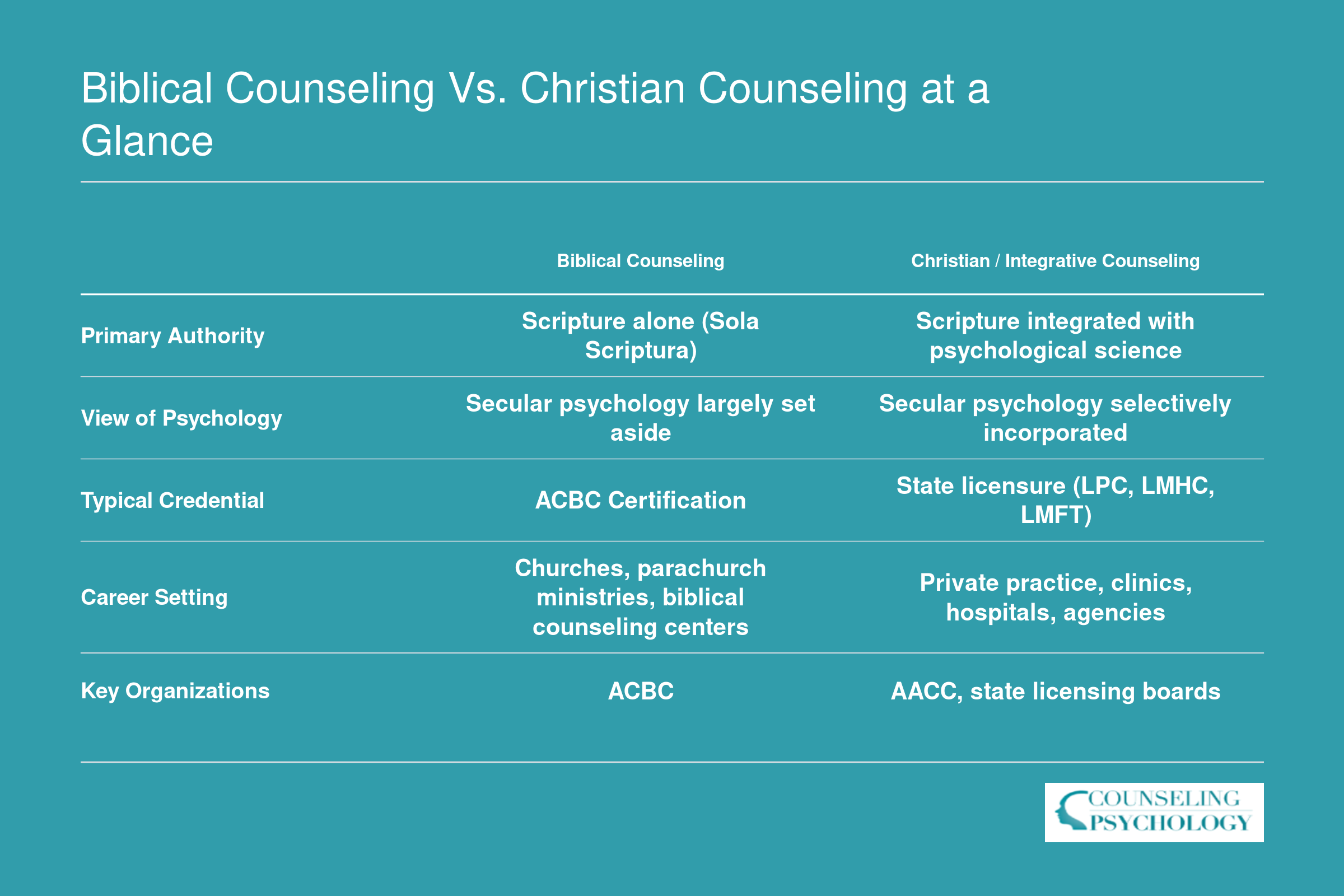
Biblical Counseling vs. Christian Counseling at a Glance
These two approaches share a faith foundation but differ sharply in how they relate to secular psychology, what credentials graduates pursue, and where they typically practice. The comparison below highlights the core distinctions across five key attributes.
Types of Biblical Counseling Degrees
Biblical counseling programs span four primary degree levels, each designed for different career stages and professional goals. Understanding the distinctions helps prospective students align their educational investment with their ministry or counseling objectives.
Bachelor's Degrees in Biblical Counseling
Undergraduate programs typically require 120 to 127 credits and take four years of full-time study to complete. Mission University, Grace Mission University, Manna University, Liberty University, and Mid-America College of Biblical Studies all offer bachelor's programs in the 120 to 121 credit range, with Western Michigan University's Christian Ministries program requiring 126 credits and Judson College's BA in Christian Counseling totaling 127 credits.1234567 These degrees prepare graduates for entry-level ministry roles such as lay counselor, pastoral assistant, youth minister, or paraprofessional positions in church-based counseling settings. While a bachelor's degree alone does not qualify graduates for professional licensure as a counselor or therapist, it establishes a foundation in biblical theology and pastoral care principles. Students exploring broader counseling degrees may want to compare these faith-based options with secular programs.
Master's Degrees in Biblical Counseling
Master's programs represent the standard credential for serious biblical counseling practice and typically require 36 to 60 or more credits over two to three years. Southern Baptist Theological Seminary's Master of Arts in Biblical Counseling and Practical Theology, for example, requires 60 credits and is designed for completion in 24 months.8 A master's degree is the minimum educational requirement for most Association of Certified Biblical Counselors (ACBC) certification pathways and positions graduates for pastoral counseling roles, director-level ministry positions, and full-time biblical counseling practice in church and parachurch settings. Many master's programs also satisfy prerequisites for doctoral study. Graduates interested in integrating pastoral care with faith-based practice may also explore paths to spiritual counseling certification.
Graduate Certificates
Graduate certificate programs in biblical counseling generally require 12 to 18 credits and can be completed in under one year. These condensed credentials serve as add-ons for ministry professionals who already hold a master's degree in theology, divinity, or a related field and want to specialize in counseling without pursuing a second full degree. Certificates are also useful for licensed mental health professionals seeking to integrate biblical perspectives into their existing practice.
Doctoral Degrees
Doctor of Ministry (D.Min.) and Ph.D. programs in biblical counseling typically require three to five years of study beyond the master's level. These terminal degrees position graduates for seminary teaching, authorship, organizational leadership, and advanced research roles. A doctorate is generally necessary for tenure-track faculty positions and executive ministry leadership.
Credit-hour requirements and completion timelines vary by institution, delivery format, and student enrollment status. Prospective students should verify specific program requirements directly with schools. The rankings featured on this page include programs across all four degree levels, allowing readers to filter by the tier that matches their current educational background and career objectives.
Related Articles
Licensure vs. Non-Licensure: What a Biblical Counseling Degree Qualifies You For
Most biblical counseling degrees do not qualify graduates for state licensure as a Licensed Professional Counselor (LPC), Licensed Mental Health Counselor (LMHC), or Licensed Marriage and Family Therapist (LMFT).1 This is not a minor technicality. It is the single most consequential distinction prospective students need to understand before enrolling.
Why Biblical Counseling Programs Fall Short of Licensure Requirements
State licensing boards require a graduate degree from a program that meets specific curricular and clinical benchmarks. In Florida, for example, the LMHC credential demands coursework in counseling theories, human growth and development, diagnosis, individual and group counseling, appraisal, and ethics, all within a master's from an institutionally accredited program in mental health counseling or a closely related field.2 Texas requires a graduate degree in counseling from an accredited program plus 3,000 hours of supervised experience, including 1,500 hours of direct client contact.3 Illinois mandates a master's that satisfies defined counseling curriculum standards.4
Biblical counseling programs typically lack the clinical coursework these boards require.5 Courses in psychopathology, psychological assessment, and evidence-based treatment modalities are either absent or addressed only through a theological lens. Most programs also do not include the 600 hours of supervised practicum (with at least 240 direct-contact hours) that licensure candidates must complete during their degree. By contrast, ACBC certification requires only 50 supervised counseling hours.1 The gap is substantial.
The Bridge Path to Licensure
Some graduates choose to close that gap by pursuing additional coursework or a second master's in clinical mental health counseling. Students interested in this route should understand how to become a licensed mental health counselor, since the missing pieces usually include:
- Practicum and internship hours
- Coursework in psychopathology and diagnosis
- Standardized assessment training
- Preparation for the National Counselor Examination (NCE) or the National Clinical Mental Health Counseling Examination (NCMHCE)
Completing a CACREP-accredited clinical program after a biblical counseling degree is a viable, if time-intensive, route. Graduates should also expect 2,000 or more post-graduate supervised hours before earning full licensure, depending on their state.
Hybrid Programs: The Exception, Not the Rule
A small number of programs are designed as hybrid models that aim to satisfy both ACBC certification prerequisites and state licensure requirements. These programs embed clinical coursework alongside biblical counseling content and include the practicum hours state boards expect. They exist, but they are rare. Students considering one of these programs should verify directly with their state counseling board that the specific degree and coursework will be accepted, because requirements vary significantly from state to state. Never assume a program's marketing language substitutes for board confirmation.
Non-Licensure Does Not Mean Non-Career
Many states have religious exemptions that allow counselors to practice within church and ministry settings without holding a state license. These exemptions permit unlicensed practice but do not grant billing authority with insurance companies or the legal protections that come with licensure.1 ACBC-certified counselors serve productively in churches, biblical counseling centers, and parachurch ministries across the country. For graduates whose calling centers on congregational care and discipleship rather than clinical diagnosis and treatment, a biblical counseling degree paired with ACBC certification provides a recognized and respected credential within that ecosystem.
The bottom line: know before you enroll whether your goal is ministry-based counseling or clinical practice, and choose your program accordingly. Checking your state counseling board's approved program and coursework lists is a step no prospective student should skip.
A biblical counseling degree prepares you for ministry-based roles and ACBC certification, but it typically does not meet the clinical requirements for private practice or insurance billing. If those are your goals, you will likely need a licensed clinical mental health counseling degree or additional clinical coursework. Always verify requirements with your state licensing board before enrolling.
ACBC Certification Alignment by Program
Completing a biblical counseling degree and earning ACBC certification are related goals, but they are not the same thing. Understanding how the two fit together, and where a given program accelerates or only partially satisfies certification requirements, can save you a significant amount of time and money.
The Three Phases of ACBC Certification
ACBC certification moves through three distinct phases, each with concrete requirements.1
- Phase 1 (Learning): Candidates must complete 30 hours of training, 10 hours of observation (each observation session must be at least one hour), and 1,000 pages of assigned reading, with at least 300 of those pages drawn from biblical or theological sources.2 Training must be delivered through an ACBC Certified Training Center or at official ACBC events.3
- Phase 2 (Exams and Evaluations): Candidates sit for two written exams covering Counseling and Theology. Phases 1 and 2 together must be completed within a four-year window.4
- Phase 3 (Supervised Counseling): Candidates complete 50 supervised counseling sessions, each lasting at least one hour, with a minimum of 10 sessions conducted with the same counselee. Phase 3 carries its own one-year completion window.5
How Seminary Programs Align with Phase 1
This is where program selection matters most. Some seminary programs hold ACBC Certified Training Center designation, which means their curriculum is structured to satisfy Phase 1 requirements in full.3 Enrolling in one of those programs essentially completes your first certification phase as a byproduct of your coursework. Other programs cover overlapping content but do not carry the designation, meaning graduates still need to complete Phase 1 separately after finishing their degree.
When comparing programs, look explicitly for ACBC Training Center status rather than assuming that any biblically focused curriculum will qualify. The ACBC certification training centers list maintains current approved training centers, and cross-referencing that list against your program shortlist is a straightforward step that carries real consequences for your certification timeline.
Phase 3 and Online Compatibility
The supervised counseling requirement in Phase 3 does not have to happen at your degree-granting institution.5 ACBC allows candidates to fulfill those 50 sessions through a local church or counseling center, which makes the requirement genuinely compatible with online degree formats. Students who study remotely can typically arrange supervision through a biblically grounded church in their home community, as long as the supervisor meets ACBC standards.
Why ACBC Certification Matters
ACBC certification is widely regarded as the benchmark credential within the Scripture-sufficiency tradition of biblical counseling. It signals to churches, ministries, and ministry-based organizations that a counselor has met a defined standard of theological knowledge and supervised practice. It is entirely separate from state licensure and does not confer the legal standing to practice as a licensed professional counselor. For graduates oriented toward church-based or parachurch ministry roles rather than clinical settings, however, ACBC certification often carries more weight than any state credential.
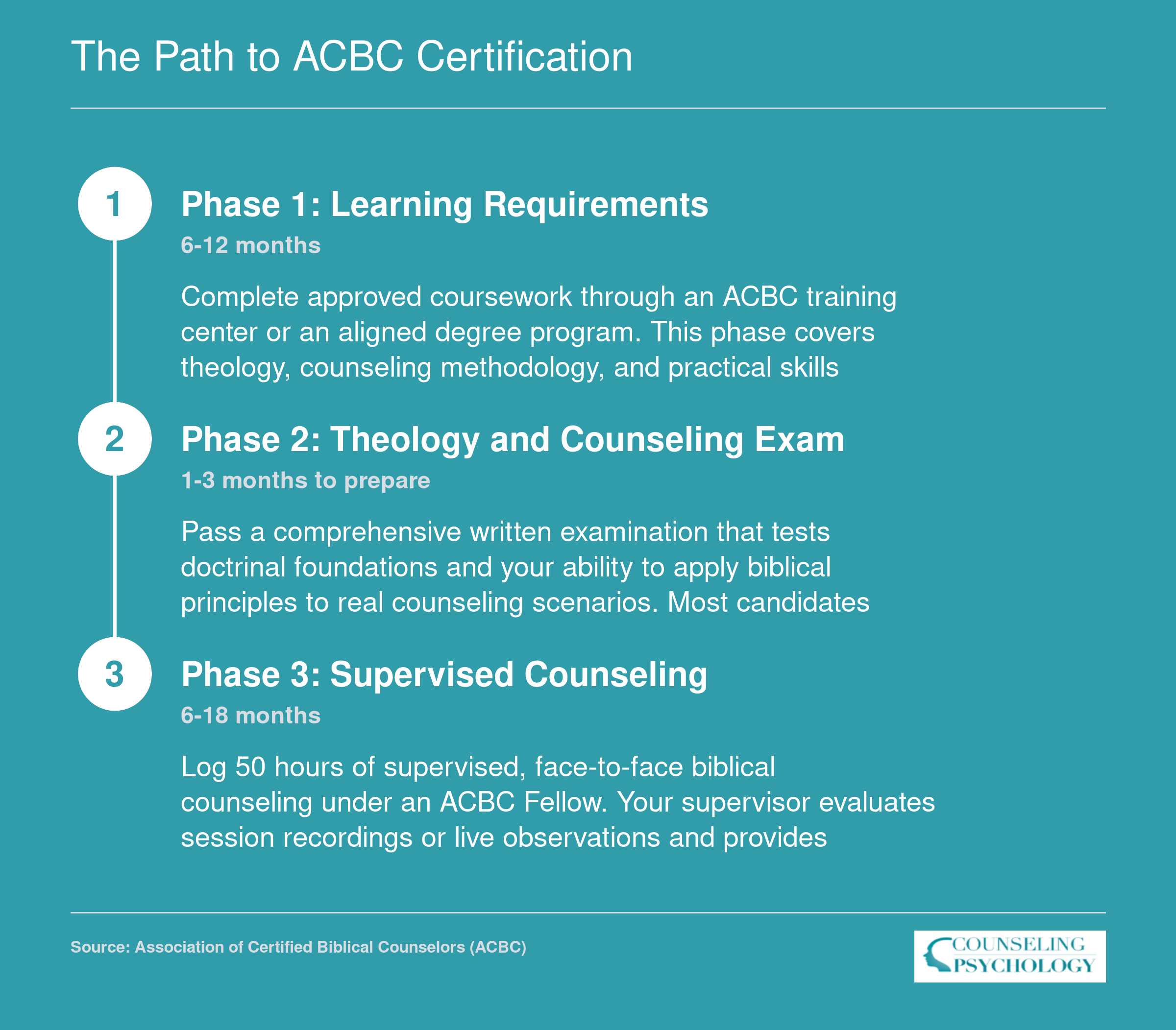
The Path to ACBC Certification
The Association of Certified Biblical Counselors (ACBC) offers the field's most widely recognized credential. Earning certification requires completing three sequential phases, typically spanning 18 to 30 months depending on your pace and program format.
Biblical Counseling Degree Costs and ROI
The table below sorts programs by lowest institution-wide net price, a figure that reflects the average cost after grants and scholarships for all students at each school (not specific to the biblical counseling program). Keep in mind that program-level earnings data is not yet available for these programs, so the 10-year median earnings shown are institution-wide figures from College Scorecard. Because net prices span from roughly $10,000 to $24,000 and median graduate debt ranges from about $17,000 to $26,000, monthly loan payments for most graduates will fall between $150 and $275 on a standard 10-year repayment plan. That said, ROI for a biblical counseling degree should be weighed differently than for a secular counseling program. Many graduates enter church ministry, nonprofit chaplaincy, or mission work where compensation is modest by design. The calling to serve often matters more than salary maximization, so affordability and low debt at graduation can be more meaningful indicators of value than raw earnings figures.
| School | Net Price (Institution-Wide) | Median Graduate Debt | 10-Year Median Earnings (Institution-Wide) | Est. Monthly Loan Payment |
|---|---|---|---|---|
| Baptist University of Florida | $10,372 | $23,590 | $42,836 | ~$248 |
| Hobe Sound Bible College | $12,074 | N/A | $39,863 | N/A |
| Campbellsville University | $19,341 | $17,156 | $41,583 | ~$180 |
| Regent University | $19,923 | $24,534 | $44,498 | ~$258 |
| Bethany Lutheran College | $20,148 | $23,000 | $46,110 | ~$242 |
| Life Pacific University | $20,898 | $22,395 | $43,299 | ~$235 |
| Mission University | $21,383 | $26,168 | $38,641 | ~$275 |
| Faulkner University | $22,085 | $23,000 | $43,457 | ~$242 |
| Moody Bible Institute | $22,221 | $18,149 | $45,399 | ~$191 |
| Southern Adventist University | $24,345 | $24,500 | $53,723 | ~$257 |
Questions to Ask Yourself
Careers and Salary Outlook for Biblical Counseling Graduates
Common Career Paths for Biblical Counseling Graduates
Biblical counseling degrees open doors to a wide range of helping professions, many of which do not require state licensure. Graduates commonly serve in church-based or ministry-oriented roles such as pastoral counselor, church-based biblical counselor, chaplain, college ministry director, or missionary care coordinator. With additional licensure, some move into clinical positions like substance abuse counselor or community health worker. While these roles vary in responsibility and setting, they share a common thread: integrating biblical truth with compassionate care.
Ministry-Track vs. Clinical-Track Careers
Career outcomes diverge significantly between ministry-focused and clinically licensed paths. Ministry-track roles, including pastoral counselors and church-based biblical counselors, are typically funded by religious organizations. Salaries in these positions can fluctuate dramatically based on congregation size, denomination, and geographic region. In contrast, clinical-track careers, such as licensed substance abuse counselors or those pursuing paths to become a marriage and family therapist, tend to follow more standardized pay scales and often come with employer-sponsored benefits.
- Ministry roles: Broad salary ranges; often tied to church budgets.
- Clinical roles: More predictable compensation; governed by state licensure and insurance reimbursement.
Salary Snapshot: What the Data Shows
Because biblical counseling programs are often non-licensure, program-specific federal earnings data is not yet published. However, institutional data from the U.S. Department of Education offers a rough proxy. For graduates of the schools featured in this ranking, median earnings 10 years after entering range from about $46,000 to $57,000, though these figures include all majors and levels, not solely biblical counseling graduates.
For broader context, the Bureau of Labor Statistics reports 2024 median annual wages of $59,190 for substance abuse, behavioral disorder, and mental health counselors, a field projected to grow 17% through 2034, far outpacing the 3.1% average for all occupations.12 Marriage and family therapists earn a median of roughly $58,500, while community health workers see medians near $48,200. These clinical benchmarks highlight the enhanced earning potential that comes with licensure, which most biblical counseling programs do not directly provide.
The Bivocational and Volunteer Reality
It is essential to note that many biblical counseling graduates serve in bivocational or unpaid capacities. Some work full-time in other fields while offering counseling through their local church, while others serve as lay counselors without remuneration. Consequently, standard salary figures do not capture the full picture of how these degrees are used. The true value often lies in ministry impact, personal calling, and community transformation rather than a paycheck.
How to Choose an Online Biblical Counseling Program
Most online biblical counseling programs hold institutional accreditation through the Higher Learning Commission (HLC) or the Association for Biblical Higher Education (ABHE), and CACREP accreditation, the standard tied to state licensure for professional counselors, does not apply to biblical counseling degrees. That single distinction shapes nearly every other choice you will make.
Verify Accreditation Carefully
Institutional accreditation (SACSCOC, HLC, TRACS, ABHE, ATS) confirms that the school itself meets recognized academic standards and that credits will generally transfer. Programmatic accreditation, such as CACREP, evaluates a specific counseling program against licensure-oriented benchmarks. Biblical counseling programs typically sit at regionally or nationally accredited Christian institutions but do not pursue CACREP, because the curriculum is built around Scripture-based counseling rather than the clinical mental health framework most state boards require.2 If you are unsure how clinical licensure works, reviewing the steps to become a counselor can clarify what CACREP-accredited tracks involve. Confirm the accreditor before you enroll.
Examine the Theological Tradition
Read the school's doctrinal statement and the counseling department's stated model. Some programs are strictly nouthetic, drawing on Jay Adams and the ACBC tradition. Others are broadly Reformed, and still others take an integrative approach that incorporates psychological research alongside biblical principles. The curriculum, recommended texts, and counseling methodology you learn will flow directly from this choice, so the fit matters more than the school's name recognition.
Understand the Online Format
- Synchronous: Live class sessions meet on a set schedule and require real-time attendance.
- Asynchronous: Coursework is self-paced within weekly deadlines, which suits working students.
- Hybrid: Mostly online with brief on-campus intensives, often once or twice per term.
Ask how exams, group discussions, and counseling role-plays are conducted before assuming a program will fit your schedule.
Confirm Practicum and Transfer Policies
Nearly every program requires a supervised practicum, and most online programs expect you to arrange a local placement at a church, ministry, or counseling center. Ask whether the program provides placement support or leaves it entirely to you, and whether the supervisor must hold a specific credential.
Finally, check transfer policies. Mission University, for example, accepts up to 50 percent of credits from prior coursework, and some schools recognize ACBC Phase 1 training toward elective credit.3 Programs at Mission University and Light University are designed for ministry roles rather than state licensure, so confirm that the credential matches the work you want to do.
Frequently Asked Questions About Biblical Counseling Degrees
Choosing a biblical counseling degree raises practical questions about credentials, career paths, and program logistics. Below are straightforward answers to the questions prospective students ask most often.
More Online Biblical Counseling Programs to Consider
Below are additional online biblical counseling programs worth exploring. These schools offer a range of degree levels and formats, providing further opportunities for students seeking faith-integrated counseling education.
- Master of Arts in Counseling
- M.S. in Christian Counseling - Philadelphia (Marriage and Family Counseling, Professional Counseling, Electives)
- Master of Arts in Counseling (Christian and Spiritual Counseling)
- Master of Arts in Biblical Counseling
- M.A. in Counseling (Christian Counseling)
- M.A. in Pastoral Counseling
- MS in Pastoral Care & Counseling
- Master of Arts in Clinical Mental Health Counseling
- Master of Arts in Christian Counseling and Family Ministry
- Master of Counseling (Christian Counseling)
- Master of Arts in Counseling (Clinical Mental Health Counseling, Couple and Family Counseling, School Counseling)
- Master of Arts in Christian Counseling
- Master of Arts in Christian Counseling
- Master of Pastoral Theology (Pastoral Counseling)
- MS Family Studies | Christian Counseling Specialization
- Master of Arts in Pastoral Care and Counseling (Chaplaincy and Spiritual Care, Clinical Track)
Explore Programs
Explore Programs
- Best Online Addiction Counseling Degree
- Best Online Bachelor's in Counseling Degrees
- Best Online Clinical Mental Health Counseling
- Best Online Licensed Professional Clinical Counseling
- Best Online Master's in Counseling
- Best Online MFT
- Best Online Pastoral Counseling
- Best Online Ph.D. in Counseling
- Best Online School Counseling
- Online Genetic Counseling