
What you’ll learn in this article…
- No fully online doctorate is currently titled specifically as a Ph.D. in Autism Spectrum Disorders, so students choose related specializations.
- Annual tuition for relevant online doctorates ranges from roughly $10,000 to over $30,000 depending on institution type and residency status.
- Most online programs require on-campus residencies and local practicum hours totaling several hundred supervised contact hours.
- BLS reports national median salaries near $96,100 for clinical and counseling psychologists, the closest tracked occupation.
Research or practice, clinical or educational: the degree you choose shapes not just your career track but which doors actually open after graduation. Demand for doctoral-level autism specialists is outpacing supply in school districts, research centers, and healthcare systems, yet the credential landscape remains tangled. Ph.D., PsyD, EdD, and DHSc programs each serve different professional goals, and "online" can mean anything from asynchronous coursework to mandatory multi-week residencies.
Adding to the complexity, no APA-accredited doctorate in clinical or counseling psychology currently operates in a fully online format. That constraint steers many candidates toward hybrid structures or applied degrees outside traditional licensure pathways. Program costs range from under $40,000 at some public universities to well over $100,000 at private institutions, with career outcomes varying just as widely.
Best Online Doctorate Programs in Autism Spectrum Disorders
No accredited doctorate is currently titled "Ph.D. in Autism Spectrum Disorders" in a fully online format. The programs below are online or hybrid doctorates whose coursework, research infrastructure, or professional credentials overlap meaningfully with autism practice and scholarship. They are ordered by a composite quality score that weighs institutional outcomes, affordability, and program relevance. Net price figures shown are institution-wide averages after financial aid and should not be read as guaranteed quotes for any doctoral student.
- Institutional graduation and retention rates
- Average net price after aid
- Program relevance to autism practice
- Graduate earnings outcomes
- Student-to-faculty ratio
- Independent program research
- College Scorecard graduate earnings — collegescorecard.ed.gov
- Internal program database
- NCES-IPEDS federal institutional data — nces.ed.gov

Simmons University
Simmons University in Boston offers a fully online PhD in Behavior Analysis built around the science most directly tied to autism intervention. The 48-credit curriculum centers on experimental research, with faculty projects spanning stimulus equivalence and behavioral medicine. Admission requires a relevant master's degree plus existing licensure or certification, so the cohort typically consists of seasoned practitioners, many already serving autistic clients. Graduates are positioned to pursue the BCBA-D credential, the field's top research-practice designation in ABA.
- Fully remote, 48 credit hours required
- Leads to eligibility for the BCBA-D credential
- Experimental research collaboration with faculty
- Requires master's degree plus licensure or certification
- Designed for working behavior analysts
- Focus areas include stimulus equivalence and behavioral medicine
- 9:1 student-to-faculty ratio institution-wide
PhD in Behavior Analysis — Online

University of Southern Maine
The University of Southern Maine's PsyD in School Psychology trains practitioners in comprehensive assessment and intervention for diverse learners, including children on the autism spectrum. The 111-credit hybrid program requires 600 practicum hours and a 1,500-hour predoctoral internship, giving students extensive clinical contact with neurodevelopmental populations. Graduates meet national and state credentialing standards for school psychology, a role that routinely involves autism evaluation and support planning.
- Hybrid format with 111 total graduate credits
- 600 hours of supervised practica
- 1,500-hour predoctoral internship required
- Meets national and state certification standards
- Dissertation research component included
- Optional embedded MS in Educational Psychology
- 14:1 student-to-faculty ratio institution-wide
School Psychology, PsyD — Hybrid

George Mason University
George Mason University's hybrid PhD in Education with an Educational Psychology specialization pairs rigorous research methodology training with personalized study plans. While no formal autism track exists, Mason's broader campus houses multiple autism-focused research initiatives and community outreach programs that doctoral students can leverage. The program requires a master's degree and includes practical internships alongside coursework in cognition, learning, and motivation.
- Hybrid delivery with personalized study plans
- Requires a completed master's degree for admission
- Practical internships embedded in the curriculum
- Research methodologies and theory emphasis
- Financial aid options available
- Interdisciplinary elective opportunities
- 16:1 student-to-faculty ratio institution-wide
PhD in Education, Educational Psychology Specialization — Hybrid

Northern Arizona University
Northern Arizona University's PsyD in Clinical Psychology is a 107-unit hybrid program preparing graduates for professional licensure. Clinical training spans 2,000 hours across diverse populations, so students encounter a range of neurodevelopmental presentations, though autism is not carved out as a named emphasis. NAU's Hispanic-Serving Institution designation reflects the diverse communities its graduates serve, an important consideration for culturally competent autism assessment.
- Hybrid format, 107 total units
- 2,000 hours of clinical practice required
- Leads to psychology licensure eligibility
- Comprehensive diagnostic assessment training
- Individualized research component
- Located on North Valley, Phoenix campus
- 19:1 student-to-faculty ratio institution-wide
Doctor of Psychology in Clinical Psychology — Hybrid

University of Memphis
The University of Memphis offers an online PhD in Educational Psychology and Research with customizable electives that allow students to steer their plan of study toward autism-related topics. The 54-credit program uses a faculty research-apprenticeship model and accepts both part-time and full-time students. Assistantship funding is available, and entry points occur in both fall and spring semesters.
- Available fully online or face-to-face
- 54 credit hours, including dissertation
- Faculty research apprenticeship model
- Part-time and full-time enrollment options
- Assistantship funding opportunities
- Customizable elective courses
- Fall and spring admission deadlines
PhD in Educational Psychology and Research — Online

Wichita State University
Wichita State University's EdD in Educational Leadership with an Educational Psychology Track is a hybrid program designed for a three-year completion timeline. The 55-credit curriculum does not require GRE scores and allows students to build a customizable interdisciplinary emphasis, which could include autism-related coursework. A dissertation is required, and the collaborative learning environment pairs students with mentors throughout the program.
- Hybrid delivery, three-year completion design
- 55 total graduate hours required
- No GRE required for admission
- Customizable interdisciplinary emphasis areas
- Advanced research methodology training
- Dissertation and mentorship components
- 19:1 student-to-faculty ratio institution-wide
EdD in Educational Leadership, Educational Psychology Track — Hybrid

Liberty University
Liberty University fields three fully online PhD in Psychology tracks: Industrial/Organizational, Developmental Psychology, and Behavioral Health Leadership. The Developmental Psychology concentration is the most adjacent to autism scholarship, covering lifespan theory and human development. All tracks require 60 credit hours delivered in eight-week course blocks, and up to 50% of credits may transfer in. The university integrates a Christian worldview across the curriculum.
- 100% online, 60 credit hours
- Eight-week accelerated course format
- No standardized test scores required for admission
- Transfer up to 50% of doctoral credits
- Lifespan developmental theory focus
- Optional on-campus intensives available
- 100% online with 60 credit hours
- 150 hours of field experience required
- Focus on workplace behavior and leadership
- Eight-week course blocks for flexibility
- Military tuition discounts available
- Biblical perspective integrated into curriculum
- Fully online, 60 credit hours
- Focus on leadership and applied research
- SACSCOC-accredited institution
- Flexible course selection each term
- Prepares for academic and administrative roles
- Affordable tuition with no increase in nine years
PhD in Psychology, Developmental Psychology — Online
PhD in Psychology, Industrial/Organizational — Online
PhD in Psychology, Behavioral Health Leadership — Online

University of the Pacific
University of the Pacific's hybrid PsyD in Counseling Psychology is a four-year program requiring in-person attendance one to two days per week. Guaranteed internship placements expose students to diverse counseling settings, and while no formal autism emphasis exists, clinical rotations may involve neurodevelopmental populations. The program's 13:1 student-to-faculty ratio supports close mentorship, and Pacific holds Hispanic-Serving Institution status.
- Hybrid format, in-person one to two days weekly
- Four-year doctoral program structure
- Guaranteed internship experience included
- Comprehensive clinical training curriculum
- Expert practitioner faculty
- 13:1 student-to-faculty ratio institution-wide
- Diverse counseling placement settings
PsyD in Counseling Psychology — Hybrid

Western Michigan University
Western Michigan University's PhD in Industrial Organizational Behavior Management is a hybrid program blending behavior analysis with organizational performance research. Although WMU has notable ABA and autism research in other departments, this particular doctorate centers on workplace applications. The 30-credit coursework plus 12 dissertation hours prepare graduates for consulting, teaching, and organizational leadership roles.
- Hybrid delivery format
- 30 credit hours of coursework plus 12 dissertation hours
- Organizational performance and behavior analysis focus
- Minimum 3.0 GPA required for admission
- Prepares for consulting, teaching, and research careers
- Comprehensive research training methodology
- 16:1 student-to-faculty ratio institution-wide
PhD in Industrial Organizational Behavior Management — On-Campus

Regent University
Regent University's online PhD in Counseling and Psychological Studies with an Industrial-Organizational concentration covers workplace dynamics and employee performance through a Christian lens. The 51-credit program includes 150 hours of field experience. Although the I/O focus does not directly address autism, students interested in neurodiversity in the workplace could shape independent research around that theme.
- Fully online doctoral program
- 51 total credit hours required
- 150 hours of field experience
- Christian worldview integration
- Workplace psychology and leadership emphasis
- Competitive admission rate of 38%
- 18:1 student-to-faculty ratio institution-wide
PhD in Counseling & Psychological Studies, Industrial-Organizational — Online
Ph.D. Vs. Psyd Vs. EDD Vs. Dhsc: Which Autism Doctorate Is Right for You?
The growing demand for specialized autism services has prompted doctoral programs to branch into research, clinical, educational, and health leadership tracks. Within autism studies, four terminal degrees serve different ambitions. The Ph.D. is research-intensive, preparing graduates for academic, research, and high-level clinical roles. The PsyD emphasizes direct clinical practice, with a strong focus on assessment and intervention. The EdD concentrates on educational leadership, policy, and program development, while the DHSc addresses advanced clinical and administrative leadership in health sciences.1 Each degree's structure, clinical training requirements, and licensure eligibility shape which career doors it opens.
Research vs. Practice: Ph.D. and PsyD
Both the Ph.D. and PsyD can lead to psychologist licensure, but their cores differ.2 Ph.D. programs require a hands-on research dissertation and often include APA-accredited practicum and internship experiences, making them the standard for tenure-track faculty and research director positions. These programs often take five to seven years, while PsyD programs typically span four to six. PsyD programs are practice-oriented: they still include substantial supervised clinical hours but typically culminate in a clinical capstone or doctoral project rather than a traditional thesis. Graduates of both are eligible for state psychologist licensure, which requires post-doctoral supervised hours and passing the EPPP. If your goal is to provide direct therapy or lead autism diagnostic teams, the PsyD's applied focus can be a faster route to licensure. If you aim to design studies or teach at a university, the Ph.D. is the clearer path. Either way, these degrees open a wide range of careers in psychology beyond autism-specific roles.
Educational and Health Systems Leadership: EdD and DHSc
Neither the EdD nor the DHSc qualifies graduates for psychologist licensure; these degrees are built for leadership roles instead. EdD programs commonly integrate fieldwork or internships and focus on systems change within schools and districts. An EdD in autism might prepare you to direct special education services, shape policy, or lead university autism centers. The DHSc is an applied health sciences doctorate, with practicum experiences that bridge clinical insight and operational oversight.4 DHSc holders often move into administrative positions in hospitals, behavioral health organizations, or government agencies guiding autism services. Both programs replace the traditional dissertation with a practice-based capstone or project, making the timeline shorter, typically three to five years.
The ABA-Specific Ph.D. Track
A distinct subset of autism Ph.D. programs is designed with Board Certified Behavior Analyst-Doctoral (BCBA-D) certification in mind. These programs blend advanced research skills with deep applied behavior analysis coursework and supervised experience. While the BCBA-D designation does not confer independent practice authority, it positions graduates to supervise BCBAs, lead large-scale ABA services, or teach at universities with ABA programs. If your primary interest is behavior analysis rather than broader psychological assessment, an ABA-focused Ph.D. can be a targeted alternative to a traditional clinical or school psychology doctorate.
Psychology Vs. Education: Choosing the Right Department for Your Autism Doctorate
The department that houses your autism doctorate shapes nearly every dimension of your training, from the research questions you explore to the credentials you earn and the career paths available after graduation. Autism-focused doctoral programs generally sit within one of three academic homes: psychology departments, special education departments, or health sciences divisions.1 Understanding what each brings to the table can save you years of misaligned coursework and fieldwork.
Psychology Departments: Clinical Research and Licensure
Doctoral programs in psychology departments tend to emphasize clinical research, diagnostic assessment, and licensure-oriented training.2 If your goal is to become a licensed psychologist who conducts autism evaluations, designs clinical interventions, or leads research on the neurodevelopmental underpinnings of autism, a psychology-housed program is likely your strongest fit. These programs are more likely to connect your autism study with supervised practica, diagnostic training, and APA-accredited internship pipelines.2 Faculty in these departments are often active diagnosticians and clinical researchers, which means your mentorship and dissertation work will reflect that orientation. Students who are still weighing clinical psychology doctorate programs against other tracks should consider whether licensure eligibility is a non-negotiable outcome before choosing a departmental home.
Special Education Departments: School Systems and Leadership
Programs housed in education departments typically center on school-based interventions, inclusive education models, instructional design, transition planning, and educational leadership.3 Students drawn to improving outcomes within school systems, designing individualized supports for autistic learners, or leading special education programs at the district or state level will find the strongest alignment here. Fieldwork placements in these programs tend to be school-based, and faculty expertise often spans curriculum development, policy, and applied classroom strategies. Programs at institutions such as Teachers College at Columbia University2 and the University of Kansas3 illustrate this approach. For those weighing role distinctions in school settings, the comparison between a BCBA versus special education teacher is worth reviewing before committing to a departmental track.
Health Sciences and ABA Departments: Clinical Service Delivery
A growing number of autism doctorates are housed within health sciences or applied behavior analysis divisions.5 These programs focus on ABA methodology, intervention delivery in hospitals or clinics, and supervision within service organizations. Students pursuing the BCBA-D credential or aiming to lead ABA-based clinical teams often gravitate toward this path. Faculty in these departments are typically board-certified behavior analysts or researchers specializing in behavior-analytic interventions. Prospective students can also explore graduate programs in autism at multiple degree levels to understand how an ABA-focused doctorate fits into a longer educational sequence.
Interdisciplinary Programs: Blending Multiple Perspectives
Some programs intentionally draw faculty from clinical psychology, developmental psychology, education, speech pathology, and occupational therapy to create an interdisciplinary training model.6 These blended programs can offer broader exposure, but it is worth investigating where the program officially sits on the university's organizational chart. The departmental home still influences practical matters: which internship pipelines are available to you, whether your coursework qualifies you for psychologist licensure versus a school-based role versus a behavior-analytic credential, and what kind of research mentorship you can access.
Before committing, ask prospective programs directly about where graduates typically complete fieldwork, which faculty are actively publishing on autism-related topics, and what licensure or certification pathways their curriculum supports. The answers will vary significantly depending on the department, and that distinction matters more than almost any other factor in choosing the right program.
Questions to Ask Yourself
How Much Does an Online Autism Doctorate Cost?
Doctoral program costs vary widely depending on whether a school is public or private, whether you qualify for in-state rates, and how much institutional aid you receive. The net price column below reflects the institution-wide average cost after financial aid (not a graduate-specific figure), while in-state and out-of-state tuition figures are drawn from graduate tuition schedules. Median graduate debt and the resulting estimated monthly payment on a standard 10-year repayment plan can help you gauge the real financial burden of each program. For context, doctoral programs in adjacent fields like clinical psychology or special education often carry total costs well above $100,000 at private institutions, so several of these options compare favorably.
| School | State | Net Price (Avg. After Aid) | In-State Tuition | Out-of-State Tuition | Median Graduate Debt | Est. Monthly Payment (10-Year) |
|---|---|---|---|---|---|---|
| University of Memphis | TN | $12,397 | $11,628 | $15,840 | $23,300 | ~$260 |
| Wichita State University | KS | $13,194 | $7,986 | $16,873 | $20,500 | ~$229 |
| University of Southern Maine | ME | $13,596 | $9,918 | $26,676 | $19,060 | ~$213 |
| Northern Arizona University | AZ | $14,158 | $13,023 | $19,306 | $19,000 | ~$212 |
| Bay Path University | MA | $14,271 | $15,162 | $15,162 | $24,901 | ~$278 |
| Western Michigan University | MI | $15,273 | $20,103 | $29,681 | $26,188 | ~$293 |
| University of the Southwest | NM | $16,927 | $11,682 | $11,682 | $21,303 | ~$238 |
| George Mason University | VA | $17,915 | $17,964 | $40,308 | $19,500 | ~$218 |
| Capella University | MN | $17,956 | $15,092 | $15,092 | $14,968 | ~$167 |
| Georgian Court University | NJ | $19,285 | $15,850 | $15,850 | $21,816 | ~$244 |
Related Articles
What Can You Do With a Doctorate in Autism?
A doctorate in autism qualifies you for leadership, research, and specialized clinical roles that master's-level professionals cannot hold. The specific career paths align closely with your degree type: PsyD and Ph.D. graduates often pursue licensure as clinical or counseling psychologists, EdD holders move into school district leadership and policy positions, and Ph.D. graduates in applied behavior analysis advance into BCBA-D supervisory roles or academic faculty positions. Across all pathways, median earnings ten years after program completion range from $56,899 to $87,434 among the programs ranked here, with early-career earnings typically starting lower as clinicians build practices and academics complete postdoctoral fellowships.
Clinical and Therapeutic Roles
PsyD and Ph.D. graduates in clinical or counseling psychology frequently work as licensed psychologists specializing in autism assessment and intervention. These practitioners conduct diagnostic evaluations, develop individualized treatment plans, and provide evidence-based therapies in hospitals, university medical centers, private practices, and community mental health clinics. The Bureau of Labor Statistics reports a national median salary of $96,100 for clinical and counseling psychologists as of May 2024, though early-career figures and state-specific medians vary significantly. School psychologists, who often hold doctoral credentials and work directly within K-12 systems, earned a national median of $84,340 in the same period. Graduates from University of the Pacific's hybrid PsyD program show median ten-year earnings of $78,445, reflecting a mix of clinical and institutional employment. Students weighing related counseling doctoral programs may find overlapping clinical competencies, particularly in diagnostic assessment.
Academic and Research Careers
Ph.D. holders in educational psychology, developmental psychology, or behavior analysis typically pursue tenure-track faculty positions or research scientist roles at universities, medical schools, and research institutes. These scholars design and lead studies on autism interventions, neural mechanisms, or educational outcomes, while also teaching graduate and undergraduate courses. Golden Gate University's research-focused Ph.D. alumni report median ten-year earnings of $87,434, among the highest in this dataset. Many combine academic appointments with part-time clinical consulting, grant-funded research labs, or leadership in nonprofit organizations dedicated to autism advocacy and family support.
Applied Behavior Analysis and BCBA-D Leadership
Doctorate programs in applied behavior analysis prepare graduates for the BCBA-D credential, the terminal designation in the field. BCBA-D professionals supervise teams of BCBAs and behavior technicians in private ABA practices, school districts, and state agencies. They design large-scale intervention programs, train new practitioners, and conduct applied research on behavioral interventions. Simmons University's fully online Ph.D. in Behavior Analysis, which explicitly leads to BCBA-D eligibility, reports median ten-year alumni earnings of $63,494. Endicott College's online Ph.D. program in the same discipline shows a similar profile at $58,336, reflecting the mix of private practice, clinical supervision, and consultation work typical of BCBA-D professionals.
Educational Leadership and Policy
EdD and DHSc graduates frequently step into administrative positions such as director of special education, autism program coordinator, or district-level compliance officer. These roles involve budgeting for autism services, training teachers and paraprofessionals, and ensuring compliance with federal and state special education law. Graduates also serve as policy advisors for state departments of education, nonprofit advocacy organizations, and federal agencies. George Mason University's hybrid Ph.D. in Educational Psychology, with a median ten-year earnings figure of $76,343, exemplifies the overlap between research competencies and applied leadership in school systems.
Blended and Hybrid Careers
Many autism doctorate holders combine roles to maximize impact and income. A university professor might also run a private assessment practice two days per week. A BCBA-D supervisor in a private clinic may teach adjunct courses or serve on state licensing boards. A school district autism coordinator often maintains a small clinical caseload for direct service hours required for licensure renewal. This flexibility allows professionals to diversify income streams, stay current with clinical skills, and influence policy while contributing to the research base. Employment sectors span universities, hospitals, school systems, government agencies, private ABA practices, and nonprofits, each offering distinct compensation structures, benefits, and advancement timelines.
Autism Doctorate Career Salary Overview
The Bureau of Labor Statistics does not track a separate category for autism specialists, so the two closest standard occupational classifications are Clinical and Counseling Psychologists and School Psychologists. The national figures below reflect these broader occupations; professionals who specialize in autism spectrum disorders may earn more or less depending on their specific setting, geographic region, employer type, and years of experience. All figures are national estimates and should not be read as representative of any single state.
| Occupation | Total National Employment | 25th Percentile Wage | Median Annual Wage | 75th Percentile Wage | Mean Annual Wage |
|---|---|---|---|---|---|
| Clinical and Counseling Psychologists | 72,190 | $67,470 | $95,830 | $131,510 | $106,850 |
| School Psychologists | 63,830 | $73,240 | $86,930 | $108,210 | $93,610 |
Licensure, BCBA-D, and Certification: What an Autism Doctorate Qualifies You For
The credentials an autism doctorate qualifies you for hinge on whether your program meets the standards of state licensing boards or national certification bodies. Not all doctorates in autism lead to the same professional practice rights, and understanding these distinctions is the single most important factor in choosing a program.
The Psychologist Licensure Path
If you aim to practice as a licensed psychologist specializing in autism, you need a doctoral degree that meets the requirements of the state where you plan to work. In every jurisdiction, this means graduating from a program accredited by the American Psychological Association (APA), typically a Ph.D. or PsyD in clinical, counseling, or school psychology. You must also complete a predoctoral internship and a period of postdoctoral supervised experience (often one to two years), then pass the Examination for Professional Practice in Psychology (EPPP).3 EdD and DHSc degrees, even with a focus on autism, do not satisfy these licensure prerequisites because they are not housed within psychology departments with APA accreditation. Those interested in the clinical psychology route can review the steps to become a clinical psychologist for a broader overview of the licensure timeline. Before enrolling, check your state board's list of accepted degree types and supervised hour totals, as requirements vary.
BCBA-D: Board Certification at the Doctoral Level
Behavior analysis is another widely used approach in autism support, and many clinicians pursue board certification. The Behavior Analyst Certification Board (BACB) offers the Board Certified Behavior Analyst, Doctoral (BCBA-D) designation. This is not a separate scope of practice from the BCBA; rather, it recognizes doctoral-level training.1 To earn the BCBA-D, you must:
- Doctoral degree: hold a doctoral degree from an ABAI-accredited or qualifying institution.1
- Coursework: complete behavior-analytic coursework at the master's or doctoral level with a minimum grade of C.2
- Supervised fieldwork: accrue 2,000 hours of supervised fieldwork (or 1,500 hours in a concentrated supervised fieldwork arrangement).1
- Exam: pass the BCBA certification examination.2
Online programs can qualify for BCBA-D if they meet the BACB's coursework and degree criteria, but you must ensure the program's content aligns with the BACB's Fifth Edition Task List.1 The supervised fieldwork hours cannot be waived and typically require you to arrange an in-person supervisor, even for online degrees.
State Credentials and the Online Program Reality
Beyond national certification, many states require behavior analysts to hold a state license, and some even offer autism-specific endorsements for psychologists or educators. These state-level credentials may carry additional supervised experience or exam requirements beyond the BCBA-D. For prospective psychologists, the challenge is that an online doctorate, even if APA-accredited, must include in-person practicum and internship placements that meet the state board's geographic and supervision standards. A fully remote program that cannot arrange an approved clinical site in your state may leave you unable to apply for licensure. Always verify with the licensing board before committing to a program.
Matching the Doctorate to the Credential
The assumption that any autism doctorate leads to the same professional credentials is the most common misstep in program selection. A Ph.D. or PsyD in clinical psychology with an autism research emphasis sets you on a path to psychologist licensure; an EdD in special education with a focus on autism does not. A doctoral program in behavior analysis may lead to the BCBA-D, but unless it contains APA-accredited psychology coursework, it will not satisfy psychologist licensure. The title of the degree matters far less than the accreditation and curriculum it carries. To avoid costly detours, map your intended credential to the program's outcomes before applying. The BCBA Handbook, state licensing board websites, and program disclosures are your best starting points.1
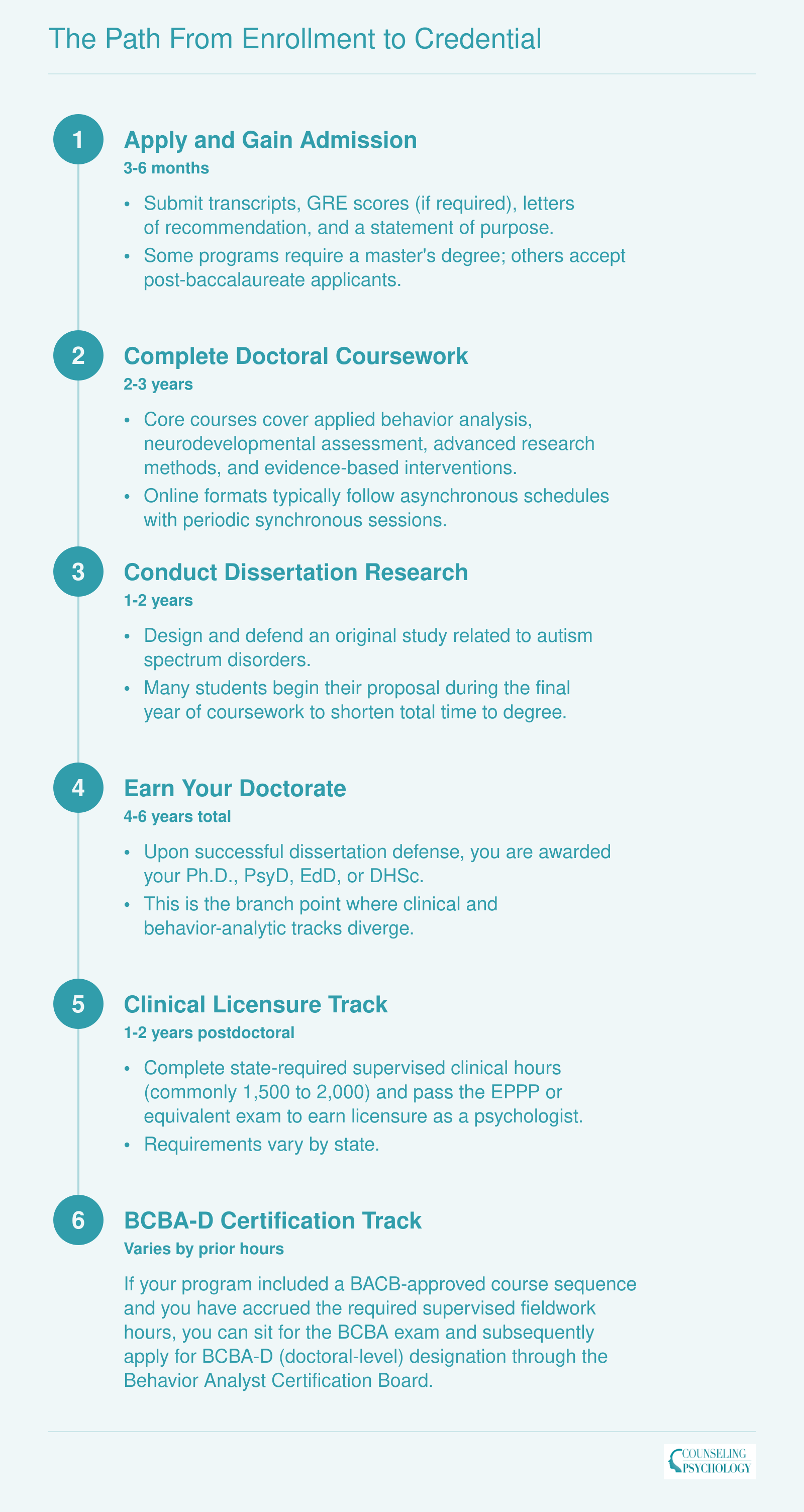
The Path From Enrollment to Credential
Earning a doctorate in autism spectrum disorders is a multi-year commitment that branches into distinct credentialing tracks after graduation. The timeline below outlines the typical sequence, from your first application through final certification or licensure.
Curriculum and Research in Autism Doctorate Programs
What courses are actually in an autism doctorate program, and how much hands-on work does an online degree really require?
The answer depends heavily on degree type, but most programs share a recognizable core before diverging into research, clinical, or applied tracks.
Core Coursework Across Degree Types
Regardless of whether a program leads to a Ph.D., PsyD, EdD, or DHSc, students typically move through a common foundation:
- ASD assessment and diagnosis: Evaluation frameworks, diagnostic criteria, and culturally responsive assessment practices
- Evidence-based interventions: Applied behavior analysis, developmental and naturalistic models, and emerging approaches like ESDM
- Neuroscience of autism: Neurobiological underpinnings, genetic research, and sensory and cognitive profiles
- Research methods and statistics: Quantitative, qualitative, and single-case designs
- Ethics and professional practice: Disability rights frameworks, informed consent, and practitioner boundaries
Towson University's hybrid Ph.D. in Autism Studies illustrates how credits are distributed in a research-focused program: 16 credits in core autism content, 18 in research methods, 9 in a cognate area, and 17 in dissertation work.1 That kind of weighting toward research and methodology is typical of a research doctorate and contrasts sharply with programs built around clinical training.
Dissertation, Capstone, and Clinical Projects
The terminal requirement separates degree types more than any other element. Ph.D. programs require an original empirical dissertation; Teachers College Columbia's program, for example, culminates in a formal dissertation seminar sequence.2 Cambridge College's distance-learning Ph.D. in Applied Behavior Analysis follows a similar path, requiring an applied dissertation alongside two one-week summer residencies in the first two years.3
PsyD programs typically replace the traditional dissertation with a clinical dissertation or formal capstone project grounded in practice rather than original research. EdD and DHSc programs generally require an applied or professional capstone focused on organizational, policy, or programmatic problems.
Practicum and Fieldwork Hours
Online format does not reduce the clinical or fieldwork burden. PsyD programs with an autism specialization commonly require a minimum of 1,500 supervised practicum hours, and those hours must be completed in approved clinical settings regardless of how coursework is delivered.4 Ph.D. programs structured around research may substitute lab placements and supervised research hours, while EdD programs often count professional leadership or teaching experience toward applied requirements.
Students should budget significant time for these placements well before the final year.
Autism-Specific Research Opportunities
Many programs maintain affiliations with autism centers, university-based clinics, or community partner organizations that open doors to specialized research experiences. Community-based participatory research, in which autistic individuals and families help shape study design and outcomes, has grown considerably in prominence. Lab placements through affiliated research centers give Ph.D. students direct access to ongoing longitudinal studies, neuroimaging projects, and intervention trials that would be difficult to access independently.
The practical takeaway: a Ph.D. in ABA and a PsyD with an autism specialization may cover overlapping content in the first year, but by the midpoint of each program they look and feel like different disciplines. Clarifying which terminal requirement and which fieldwork model fits your goals is one of the most important decisions you will make before applying.
Many programs marketed as online require one to three week annual residencies on campus, plus local practicum placements totaling hundreds of supervised hours. Always confirm residency and in-person practicum requirements before enrolling, especially if geography or work schedules constrain your ability to travel.
Online Vs. Hybrid: Understanding Program Formats
Fully online doctorates in psychology are rare because the American Psychological Association (APA) does not currently accredit distance-based PsyD or Ph.D. programs in clinical, counseling, or school psychology. That single fact shapes nearly every format decision in this field: most reputable doctorates marketed as online are actually hybrid, with required intensives, residencies, or practicum hours completed in person.
What "Online" Usually Means in Practice
When a program advertises an online PsyD or Ph.D. with an autism focus, expect a blended structure. Coursework is delivered asynchronously or through scheduled virtual sessions, but you will likely travel several times per year for residencies, attend a multi-day orientation, and complete clinical hours at an approved site near you. California Southern University, Capella, and Walden have historically offered distance-based doctoral psychology tracks with varying residency expectations, but specialization availability shifts cohort to cohort. Treat any third-party list as a starting point, not a current catalog.
How to Verify Format Details Yourself
Before you apply, do four things:
- Go to the source: Open each university's doctoral psychology page directly and read the residency, practicum, and internship requirements line by line. Marketing pages summarize; program handbooks govern.
- Confirm accreditation: Search the APA's accredited programs database. If a program is not APA-accredited, ask the admissions office what that means for licensure in your state, because many state psychology boards require APA accreditation for licensure as a psychologist.
- Check professional bodies: The Autism Society and APA Division 33 (Intellectual and Developmental Disabilities) sometimes publish recommended training pathways that flag legitimate hybrid options versus marketing-only "specializations."
- Call admissions: Email or phone the program coordinator to confirm whether the autism track is enrolling for the current cycle, how many in-person days are required per year, and whether you can complete practicum hours in your home state.
The answer to "is this program really online?" is almost always nuanced. Verifying directly protects you from discovering a five-day-a-quarter residency requirement after you have already paid a deposit.
Admissions Requirements for Autism Doctorate Programs
Doctoral programs in autism and related specializations share a common set of admissions expectations, but the details shift depending on whether you are applying to a Ph.D., PsyD, EdD, or practice-focused doctorate. Understanding those differences early can save you months of preparation.
Standard Requirements Across Program Types
Most online autism doctorates expect the following:
- Master's degree: The vast majority of programs require a completed master's in special education, psychology, applied behavior analysis, or a closely related field. The University of Utah's Ph.D. in Special Education, for example, requires a master's in special education or a closely related discipline.1 The University of Alabama's EdD carries a similar requirement and adds a minimum of three years of professional experience.2
- Minimum GPA: A cumulative GPA of 3.0 is the baseline for most programs, though competitive applicants typically hold a 3.5 or above. Ball State's online Ph.D. in Special Education sets its floor at 3.2.3
- GRE scores: The trend toward test-optional admissions continues in 2026. Ball State and Cambridge College both waive the GRE, while Texas A&M still requires scores but evaluates them through a holistic review process.4 The University of Alabama does not offer a GRE waiver for its EdD.2
- Letters of recommendation: Two to three letters from faculty or professional supervisors are standard.
- Statement of purpose: Programs want to see a clearly defined research agenda or clinical focus tied to autism spectrum disorders.
How Requirements Differ by Degree Type
PsyD programs lean heavily on clinical experience. Applicants are generally expected to have logged supervised practicum or internship hours before enrollment. Ph.D. programs, by contrast, prioritize research experience; admissions committees look for evidence of involvement in published studies, conference presentations, or independent research projects. EdD programs tend to cast a wider net, welcoming professionals from teaching, school administration, and related human services backgrounds, provided they meet the degree and experience thresholds.
Prerequisite Coursework
Even if you hold a master's degree, some programs require specific foundational coursework before admission or during your first year. Common prerequisites include:
- Graduate-level statistics and research methods
- Psychology foundations (developmental psychology, abnormal psychology)
- Applied behavior analysis coursework, particularly for ABA-focused doctorates like Cambridge College's Ph.D. in Applied Behavior Analysis, Autism Intervention5
If your master's degree did not cover these areas, you may need to complete bridge courses before full admission.
Bachelor's-to-Doctorate Pathways
A small number of programs accept students directly from a bachelor's degree into a doctoral track. These pathways are uncommon in autism-specific programs and typically require a higher credit load; Ball State's Ph.D., for instance, runs 91 credits.3 If you are considering this route, confirm whether the program integrates master's-level competencies into the early curriculum or expects you to earn a master's along the way.
A Note on Admissions Selectivity
Where institutions report admissions data, keep in mind that published acceptance rates reflect the university as a whole, not a specific doctoral program. Individual program cohorts, especially in niche specializations like autism, are often much smaller and more competitive than the institution-wide numbers suggest. Contact the program director directly for the most accurate picture of cohort size and selectivity.
Frequently Asked Questions About Autism Doctorate Programs
Prospective doctoral students often have overlapping questions about program format, cost, and career outcomes. The answers below draw on details covered throughout this article to give you a quick reference point before you dig deeper into any single topic.
Additional Online Autism Doctorate Programs to Consider
Beyond the top-ranked programs, several other institutions offer online doctorates relevant to autism spectrum disorders. While not all programs carry an explicit autism specialization, many provide concentrations in applied behavior analysis, educational psychology, or counseling that can be tailored to autism-focused research and practice. Below is a directory of additional programs worth exploring, organized alphabetically by state.
- Doctor of Education in Educational Psychology (Mental Health Counseling)
- Doctor of Education in Educational Psychology (School Psychology)
- Doctoral Program in Counseling Psychology (Social Justice)
- School Psychology, Psy.D.
- PhD in Psychology, General Psychology
- PhD in Psychology, Educational Psychology
- PhD in Developmental Psychology
- Health Science Doctorate (Behavior Analysis)
- PhD Specialization in Sport and Performance Psychology
- PhD-PSY in General Psychology
- Doctor of Philosophy in Psychology (Counseling Psychology)
- PhD in Psychology – specialization Health Psychology
- PhD in Industrial/Organizational Psychology
- Ph.D. Counselor Education & Supervision
- Counseling & Psychology: Transformative Leadership, Education, & Applied Research
- Counselor Education & Supervision, PhD
- Doctor of Philosophy in Applied Behavior Analysis
- Doctor of Psychology in Educational Psychology
- Psy.D. in Counseling and School Psychology
- Doctor of Philosophy in Counseling (Marital, Couple, and Family Counseling/Therapy)
- Doctor of Education in Educational Psychology