

What you’ll learn in this article…
- Every U.S. state requires an MSW from a CSWE-accredited program before granting LCSW licensure, so a psychology master's alone will not qualify.
- Advanced standing MSW programs let psychology graduates finish in roughly one year for $15,000 to $40,000.
- A master's in psychology already qualifies you for LPC or LMHC licensure in most states, no additional degree required.
- Healthcare social workers earn the highest median among social work specialties, while unlicensed psychology roles can still match or exceed $61,330 nationally.
All 50 states, the District of Columbia, and U.S. territories require a CSWE-accredited Master of Social Work for LCSW licensure, meaning a master's degree in psychology does not qualify. No state offers an alternative pathway, a waiver, or a substitution process.
The confusion is understandable. Clinical psychology and clinical social work programs share significant coursework overlap: psychopathology, assessment, evidence-based interventions, ethics. Both degrees lead to careers in mental health treatment. But licensure boards draw a hard line between the two fields, and that line determines which credential you can hold.
Psychology master's holders do have options. Advanced standing MSW programs can shorten the transition to roughly one year. Alternatively, the LPC and LMHC credentials remain fully accessible and command competitive salaries.
LCSW Licensure Requirements: Why an MSW Is Non-Negotiable
If you hold a master's in psychology and wonder whether you can pursue Licensed Clinical Social Worker (LCSW) status without going back to school, the short answer is no. Every U.S. state, the District of Columbia, and all U.S. territories require candidates to hold a Master of Social Work (MSW) from a program accredited by the Council on Social Work Education (CSWE). No state currently accepts a master's in psychology, a master's in counseling, or an MSW from a non-CSWE-accredited program as a qualifying degree for LCSW licensure.
The CSWE Accreditation Requirement
The Association of Social Work Boards (ASWB), which develops the national licensing exams used across all jurisdictions, publishes model regulatory standards that specify a CSWE-accredited MSW as the minimum educational credential. Individual state boards adopt these standards into their own administrative codes, sometimes adding requirements but never loosening the degree standard. When you check your state's social work licensing board website, you will find the same baseline: the degree must come from a CSWE-accredited program.
Before enrolling in any MSW program, confirm its accreditation status directly on the CSWE website. Then cross-reference with your state licensing board's list of approved programs. A handful of newer programs hold candidacy status rather than full accreditation, and some states treat candidacy differently, so verifying both sources protects you from a costly misstep.
Supervised Clinical Experience
Beyond the degree, every state mandates a period of post-master's supervised clinical practice before you can sit for the ASWB Clinical exam and earn the LCSW credential. The typical range falls between 3,000 and 4,000 hours of direct client contact under an approved clinical supervisor, accumulated over roughly two to three years of full-time work. Some states set the floor at 3,000 hours while others require 4,000 or more, and the definition of "approved supervisor" varies as well. If you are curious how analogous professions handle this step, our guide to LMFT supervision hours breaks down a comparable process for marriage and family therapists.
Because these details differ by jurisdiction, always pull up the specific administrative code or regulations published by your state's licensing board rather than relying on summary charts alone. The BLS Occupational Outlook Handbook page for social workers offers a helpful overview of general licensure expectations, but it is not a substitute for the jurisdiction-specific rules that will govern your application.
Verifying Your State's Rules
A practical checklist for confirming requirements:
- ASWB model rules: Review the current model statute on the ASWB website to understand the national framework.
- State licensing board: Locate your state board through the ASWB's directory, then read the full text of your state's practice act and administrative rules.
- CSWE program search: Use the CSWE accreditation search tool to verify that any MSW program you are considering holds full accreditation, not just candidacy.
- Supervised-hours detail: Look for specifics on total hours required, acceptable supervision ratios, and whether hours earned in one state transfer to another if you plan to relocate.
The bottom line is straightforward: a master's in psychology, however rigorous, does not satisfy the educational requirement for LCSW licensure in any U.S. jurisdiction. If the LCSW is your goal, the path runs through a CSWE-accredited MSW program, and there is no workaround.
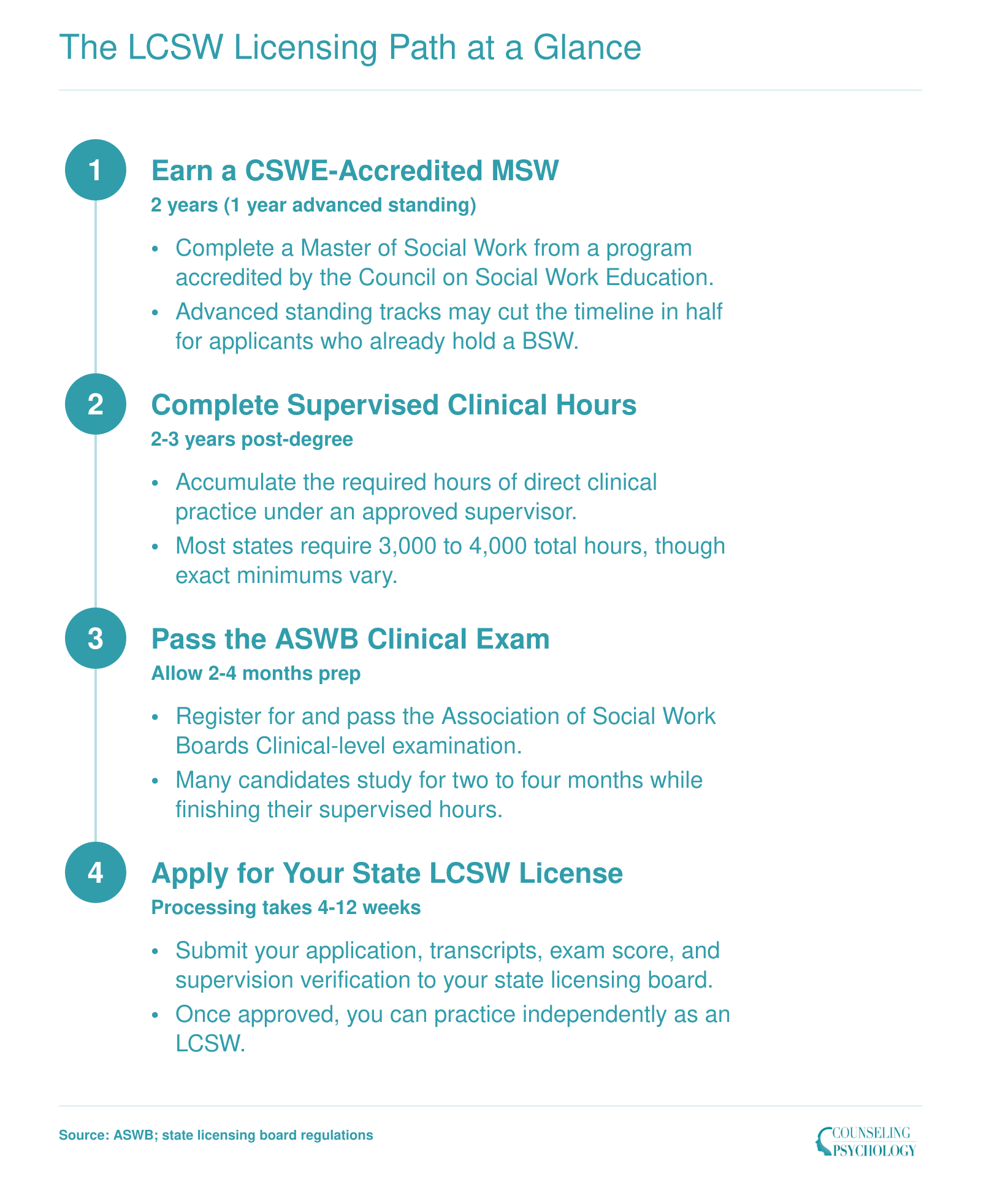
The LCSW Licensing Path at a Glance
Earning the Licensed Clinical Social Worker credential follows a fixed sequence. Each stage builds on the last, and skipping steps is not an option. Here is the typical timeline from enrollment to license.
How to Transition From a Psychology Master's to an MSW
Earning a second master's degree may seem inefficient, but the MSW is the only gateway to LCSW licensure. The choice is whether to complete a full two-year program or explore accelerated tracks that recognize your prior graduate training. Advanced standing programs exist, but they are designed primarily for holders of a BSW, not a master's in psychology. Still, a small number of programs evaluate applicants with related graduate degrees on a case-by-case basis, and understanding your options can save time and tuition dollars.
Advanced Standing MSW Programs: Limited but Worth Investigating
Advanced standing MSW programs are typically reserved for graduates of CSWE-accredited bachelor's programs in social work. These pathways waive foundational coursework and focus on concentration-year material, cutting program length to 12 to 16 months. Some institutions, however, have begun evaluating candidates with a master's in psychology, counseling, or other human services fields for partial waivers of foundation courses.
Simmons University offers a CSWE-accredited online MSW that can be completed in 16 months by students who hold a BSW or demonstrate equivalent coursework.3 Capella University allows up to 12 quarter credits of transfer from graduate study, reducing its 48-credit online MSW.4 Florida State University's 60-credit online MSW evaluates transcripts individually and may grant elective credit for graduate courses in human behavior, research methods, or psychopathology. None of these programs guarantee automatic advanced standing for psychology master's graduates, but they signal a willingness to review prior learning.
Timeline and Cost: Plan for One to Two Years
If you qualify for advanced standing or significant transfer credit, expect to complete your MSW in 12 to 18 months. Without any credit transfers, most programs require two academic years. Tuition at public institutions ranges from approximately $12,000 to $25,000 per year, while private universities often charge $30,000 to $45,000 annually. Online programs and state residency status can lower costs substantially.
Credit Transfer Realities: Electives, Not Core Courses
MSW programs evaluate transcripts on a case-by-case basis. Graduate coursework in areas such as developmental psychology, abnormal psychology, and research methods may satisfy elective requirements, but core social work practice courses, field placement prerequisites, and policy seminars are rarely waived. Social work education emphasizes a distinct professional identity rooted in person-in-environment frameworks, social justice, and systems theory. Even closely related psychology courses do not substitute for social work practice foundations.
Post-Master's Certificates: A Rare and Risky Path
A handful of universities have explored post-master's certificate programs in social work for holders of related degrees. However, these certificates do not meet CSWE requirements for an MSW and therefore do not qualify graduates for LCSW licensure. State licensing boards uniformly require a master's degree in social work from a CSWE-accredited program. Certificates may support career development in non-licensed social service roles, but they are not a substitute for the MSW.
Questions to Ask Yourself
Alternative Licenses for a Master's in Psychology: LPC, LMHC, and More
Pursuing an LCSW versus pursuing an LPC or LMHC represents two fundamentally different licensing tracks, and a master's in psychology positions you much more naturally for the second one. If the LCSW door requires going back for an MSW, the counselor license may already be within reach with the degree you have.
LPC and LMHC: The Natural Fit for a Psychology Master's
Most states allow holders of a master's in psychology to qualify for the licensed professional counselor (LPC) or Licensed Mental Health Counselor (LMHC) credential, though the specific title and requirements differ by jurisdiction. The general framework looks like this:
- Degree: A master's of at least 60 semester hours in counseling, psychology, or a closely related field. The 60-credit standard has become the prevailing benchmark nationally, though some states set a lower bar (South Carolina, for instance, requires 48 semester hours for its LPC).
- Practicum and internship: Programs typically include 100 to 150 practicum hours and 600 to 900 internship hours of supervised clinical training.
- Post-master's supervision: States require anywhere from roughly 2,000 to 4,000 hours of supervised clinical experience after graduation. Massachusetts, as one example, requires 3,360 total supervised hours, including 960 hours of direct client contact, for the LMHC.3
- Examination: Candidates must pass the National Counselor Examination (NCE) or the National Clinical Mental Health Counseling Examination (NCMHCE), depending on the state.
State-by-State Flexibility
Not every state treats a psychology degree identically to a counseling degree. Georgia accepts degrees in applied psychology or a related discipline for its LPC.4 Florida's LMHC allows degrees from a "closely related field," which typically includes clinical or counseling psychology programs.5 California permits psychology graduates to pursue the LPCC and even allows applicants to complete remedial coursework to fill any gaps.6
On the restrictive end, some states insist the degree title itself include the word "counseling" or require specific coursework that psychology programs do not always cover. Group counseling is one of the most common gaps psychology graduates encounter. Before committing to any application, pull up your target state's licensing board requirements and compare them course by course against your transcript.
Other Credential Paths Worth Considering
If your psychology program included marriage and family therapy coursework, the Licensed Marriage and Family Therapist (LMFT) credential may also be an option. Reviewing marriage and family therapy master's programs can help you gauge whether your existing coursework aligns with LMFT requirements in your state.
For those who decide clinical licensure is not the right fit, a master's in psychology still opens several careers in psychology that do not require a clinical license:
- Research roles in academic, government, or private-sector settings
- Applied behavior analysis (with appropriate ABA-specific coursework and BCBA certification)
- Industrial-organizational psychology positions in human resources, consulting, or workforce development
- Academic and teaching roles at the community college or adjunct level
The bottom line: a master's in psychology is far from a dead end. The LPC or LMHC path keeps you in clinical work without requiring a second master's degree, while non-clinical careers offer viable alternatives if you decide to step away from direct client contact entirely.
LCSW Vs. LPC Vs. LMHC: Scope, Salary, and Career Comparison
Choosing among the LCSW, LPC, and LMHC is not purely an academic question. It shapes which employers will hire you, which insurance panels will credential you, and whether Medicare will reimburse your services at all. Each credential opens some doors and closes others.
Degree and Supervised Hours
All three licenses require a master's degree, but the field of study matters enormously:
- LCSW: Requires a Master of Social Work (MSW). Supervised post-degree hours typically range from 2,000 to 3,000 hours depending on the state, followed by the ASWB Clinical exam.
- LPC: Requires a master's in counseling or a closely related field. Hour requirements vary widely by state, generally 2,000 to 4,000 hours, with the NCE or NCMHCE as the most common licensing exam.
- LMHC: Also requires a counseling-based master's. It is the licensure title used in states such as New York and Florida, while other states use LPC for the same credential category. Requirements mirror those for the LPC in most respects.
A master's in psychology does not satisfy the degree requirement for any of these licenses directly, but it is a far shorter bridge to the LPC or LMHC than many applicants assume.
Medicare Billing: A Practical Dividing Line
As of 2024, LCSWs can bill Medicare directly for mental health services. LPCs and LMHCs cannot, in most states and settings. This distinction is not a technicality. Hospitals, Federally Qualified Health Centers, and VA medical centers rely heavily on Medicare and Medicaid reimbursement to fund clinical positions. An inability to bill Medicare limits where those credentials generate revenue, which in turn limits where those clinicians are hired into salaried roles.
This is one reason VA systems and large hospital networks consistently prefer or outright require the LCSW. If your career goals center on inpatient psychiatry, integrated primary care, or veteran services, the LCSW carries a concrete structural advantage.
Employer Preferences by Setting
Setting shapes credential value in concrete ways:
- Hospitals and VA systems: Strong preference for LCSWs; some positions are restricted to social work licensure by federal or accreditation rules.
- Community mental health centers: Accept all three credentials; LCSW often preferred for case management and benefits navigation roles that require social work training.
- Private practice: All three credentials are viable. LPCs and LMHCs practice comfortably in outpatient therapy, though Medicare limitations mean a smaller potential client base without supplemental payer contracts.
- School settings: School counselor licensure is a separate credential, but LPCs and LMHCs working in therapeutic roles adjacent to schools are common.
Employment Scale and Salary Context
The workforce data reflects real differences in scale. According to 2024 Bureau of Labor Statistics figures, mental health and substance abuse social workers hold roughly 620,000 positions nationally, compared to approximately 284,000 for mental health counselors. These are national totals; state-level figures vary considerably.
BLS reports median annual wages for each occupation at the national level, and those figures differ. Social workers in clinical roles tend to earn somewhat more than mental health counselors at the median nationally, though geography, setting, and specialization close that gap in many markets. For a deeper look at pay by degree level and specialty, see our counselor salary breakdown. State-by-state salary data also appears in the tables elsewhere in this article.
If you want to understand the full landscape of counseling licensure acronyms, a quick reference can help clarify how titles like LPC, LMHC, LCPC, and LPCC relate to one another across state lines.
The bottom line: if you hold a master's in psychology and are weighing which license to pursue, the LPC or LMHC path requires less additional schooling, but the LCSW unlocks a broader range of employer settings and direct Medicare billing that the counseling credentials currently do not.
Related Articles
Social Worker Salaries by State
The table below draws from BLS 2024 occupational employment and wage estimates for three core social work categories: healthcare social workers, child/family/school social workers, and mental health and substance abuse social workers. Keep in mind that these medians capture the full range of experience and credential levels within each category. Licensed clinical social workers (LCSWs) typically earn at the higher end of these ranges, particularly those with several years of post-licensure experience. A clear geographic pattern emerges: coastal states and the District of Columbia consistently rank among the top earners, while states with lower costs of living tend to report lower medians.
| State | Specialty | Total Employment | Median Annual Salary | 25th Percentile | 75th Percentile |
|---|---|---|---|---|---|
| California | Healthcare Social Workers | 19,680 | $92,970 | $67,880 | $122,200 |
| District of Columbia | Healthcare Social Workers | 490 | $92,600 | $77,790 | $105,750 |
| Oregon | Healthcare Social Workers | 2,050 | $85,150 | $66,650 | $102,390 |
| Hawaii | Healthcare Social Workers | 680 | $84,640 | $58,270 | $95,520 |
| Connecticut | Healthcare Social Workers | 2,010 | $81,900 | $73,200 | $97,140 |
| New Jersey | Healthcare Social Workers | 4,390 | $81,710 | $66,100 | $100,200 |
| Rhode Island | Healthcare Social Workers | 570 | $79,460 | $63,450 | $91,510 |
| Vermont | Healthcare Social Workers | 300 | $78,390 | $65,340 | $92,780 |
| New Hampshire | Healthcare Social Workers | 530 | $78,000 | $69,710 | $89,790 |
| Alaska | Healthcare Social Workers | 290 | $77,990 | $60,200 | $88,440 |
| Nevada | Healthcare Social Workers | 1,070 | $76,280 | $61,150 | $89,990 |
| Washington | Healthcare Social Workers | 4,970 | $75,670 | $58,330 | $95,170 |
| New York | Mental Health and Substance Abuse Social Workers | 14,180 | $80,230 | $63,720 | $98,100 |
| Connecticut | Mental Health and Substance Abuse Social Workers | 1,350 | $78,820 | $51,250 | $92,270 |
| Minnesota | Mental Health and Substance Abuse Social Workers | 3,430 | $77,100 | $61,300 | $89,470 |
| California | Mental Health and Substance Abuse Social Workers | 18,020 | $75,320 | $55,440 | $105,020 |
| District of Columbia | Mental Health and Substance Abuse Social Workers | 640 | $72,720 | $55,360 | $106,720 |
| Oregon | Mental Health and Substance Abuse Social Workers | 2,160 | $71,830 | $57,990 | $86,080 |
| New Jersey | Mental Health and Substance Abuse Social Workers | 3,140 | $70,420 | $48,170 | $88,000 |
| Connecticut | Child, Family, and School Social Workers | 5,360 | $78,940 | $63,730 | $98,060 |
| District of Columbia | Child, Family, and School Social Workers | 2,800 | $78,920 | $59,280 | $95,820 |
| New Jersey | Child, Family, and School Social Workers | 6,410 | $78,150 | $59,590 | $98,920 |
| Washington | Child, Family, and School Social Workers | 10,570 | $72,290 | $58,250 | $84,180 |
| Maryland | Child, Family, and School Social Workers | 5,030 | $70,840 | $52,350 | $93,810 |
| California | Child, Family, and School Social Workers | 55,220 | $69,250 | $54,890 | $88,190 |
| New York | Child, Family, and School Social Workers | 27,220 | $65,430 | $57,950 | $82,980 |
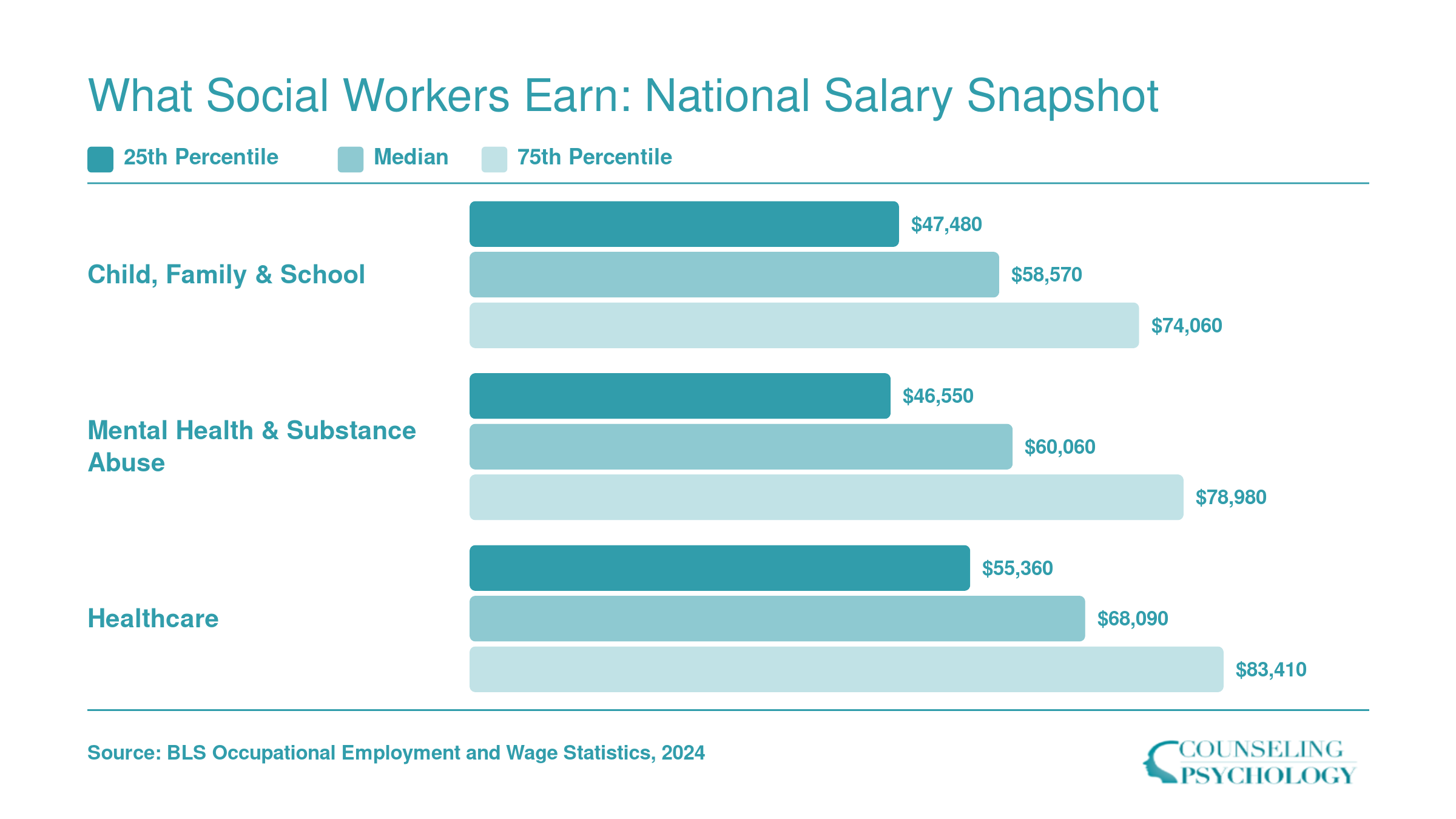
What Social Workers Earn: National Salary Snapshot
Roughly 759,740 social workers are employed across the United States, but pay varies significantly by specialty. Healthcare social workers command the highest wages, while child, family, and school social workers sit at the lower end. The grouped comparison below shows how the three largest specialty groups stack up at the 25th percentile, median, and 75th percentile.
Highest-Paying Metro Areas for Social Workers
If you are weighing a psychology-to-MSW career change, location matters. The table below ranks the top 10 highest-paying metro areas for social workers across three BLS occupational categories: healthcare social workers, mental health and substance abuse social workers, and child, family, and school social workers. Pay attention to employment volume alongside median salary. Some metros offer premium compensation but far fewer positions, which can mean stiffer competition for openings.
| Metro Area | Social Work Specialty | Median Salary | Total Employment |
|---|---|---|---|
| San Francisco, Oakland, Fremont, CA | Healthcare Social Workers | $103,440 | 2,730 |
| Los Angeles, Long Beach, Anaheim, CA | Healthcare Social Workers | $85,770 | 7,960 |
| New York, Newark, Jersey City, NY, NJ | Mental Health and Substance Abuse Social Workers | $83,490 | 12,050 |
| San Francisco, Oakland, Fremont, CA | Mental Health and Substance Abuse Social Workers | $78,660 | 1,630 |
| Minneapolis, St. Paul, Bloomington, MN, WI | Mental Health and Substance Abuse Social Workers | $77,540 | 2,420 |
| Washington, Arlington, Alexandria, DC, VA, MD, WV | Mental Health and Substance Abuse Social Workers | $77,600 | 2,310 |
| Seattle, Tacoma, Bellevue, WA | Mental Health and Substance Abuse Social Workers | $77,360 | 2,020 |
| New York, Newark, Jersey City, NY, NJ | Healthcare Social Workers | $77,210 | 18,860 |
| Los Angeles, Long Beach, Anaheim, CA | Child, Family, and School Social Workers | $76,600 | 23,100 |
| Washington, Arlington, Alexandria, DC, VA, MD, WV | Child, Family, and School Social Workers | $75,780 | 6,800 |
An advanced standing MSW typically costs $15,000 to $40,000 and takes just one year, often delivering stronger ROI than remaining in unlicensed psychology roles. Licensed clinical social workers command significantly higher salaries than unlicensed master's-level psychology positions, making the short-term investment in an MSW a strategic financial pivot for many psychology graduates.
What Can You Do With a Master's in Psychology Without a License?
The national median salary for social workers sits at $61,330 as of May 2024, yet many master's-level psychology roles that do not require clinical licensure offer earnings that match or exceed this figure.1 Graduates often feel trapped between a desire to practice clinically and the reality of returning to school for an MSW or doctorate, but alternative paths exist that leverage a psychology background in meaningful, well-compensated ways.
Career Paths That Don't Require Licensure
- Applied behavior analysis (BCBA): Earning the Board Certified Behavior Analyst credential opens doors in schools, autism treatment centers, and private practice. Typical salaries range from $60,000 to $80,000 nationally, with experienced practitioners earning more.
- UX research: Technology companies hire psychology master's graduates to study user behavior and improve digital products. UX researchers often earn median salaries between $85,000 and $120,000, with strong demand across industries.
- Industrial-organizational psychology roles: While a doctorate is standard for full I/O psychologist titles, master's holders work as talent management consultants, training specialists, or human capital analysts, with salaries frequently between $80,000 and $100,000 depending on sector.
- Market research analyst: BLS data shows a median wage of $68,230 for market research analysts, and a psychology background provides a sharp edge in understanding consumer decision-making. Advanced degree holders often command higher starting pay.
- Academic and research positions: Universities and think tanks hire research coordinators, lab managers, and data analysts. Salaries vary widely, but many roles fall in the $50,000 to $75,000 range, with benefits that can be strong.
The Emotional Reality: More Than a Plan B
It is common to feel that a master's in psychology should naturally lead to therapy, and seeing classmates pursue LPC or LCSW paths can sting. This section is not a consolation prize. Many licensed clinicians later transition into these same unlicensed roles for better work-life balance or higher pay. UX research and I/O psychology, for instance, consistently rank high in job satisfaction surveys. If direct client interaction remains the draw, consider that applied behavior analysis still delivers meaningful behavior change without a counseling license.
Those interested in the BCBA track can explore online applied behavior analysis programs to find CACREP-aligned or BACB-approved coursework that fits around a working schedule.
Working Under Supervision Without a License
Some states allow psychology master's graduates to work in community mental health agencies under licensed supervision, performing duties like intake assessments, case management, or skills training. This can provide clinical exposure and a paycheck while you decide on next steps. However, career advancement is capped without independent licensure, and supervised roles rarely offer salaries above the low $40,000s. Treat them as a stepping stone, not a destination.
Each alternative path uses the same psychological principles that drew you to the field, often with less regulatory burden and surprising financial upside.
Frequently Asked Questions
These are the questions prospective LCSW candidates with a psychology background ask most often. Each answer reflects current licensure standards and labor market data as of 2026.