
Key Takeaways
- UPenn's Master of Applied Positive Psychology remains the flagship program, but several strong online alternatives cost significantly less.
- This degree does not qualify graduates for clinical licensure in any U.S. state without additional coursework in a counseling or clinical program.
- Graduates typically enter coaching, organizational development, or corporate wellness roles, with national median salaries ranging from roughly $50,000 to over $100,000.
- ROI hinges on career track: applied graduates who pivot into organizational consulting or executive coaching recoup tuition faster than those entering nonprofit roles.
Corporate wellness spending in the United States reached $56.2 billion in 2023, with a growing share of that budget directed toward positive psychology practitioners, executive coaches, and organizational development specialists trained in well-being science. Demand for positive psychology expertise now extends well beyond academic research into coaching, human resources, employee engagement, and mental health advocacy roles that value strengths-based frameworks and applied flourishing models.
The programs featured here are all online or hybrid formats, evaluated on affordability, curriculum rigor, and career outcomes. Most positive psychology master's programs cost between $16,000 and $48,000 and take 18 to 24 months to complete part-time, though the distinction between applied and general tracks can shift both timeline and job readiness significantly.
Positive psychology degrees occupy an unusual space in graduate education. They do not lead to licensure as a therapist or counselor, nor do they guarantee a single job title upon graduation. Instead, they position graduates for practitioner roles that draw on well-being research, strengths assessment, and organizational consulting rather than clinical intervention or diagnosis.
2026 Best Master's in Positive Psychology Programs
Positive psychology master's programs remain a niche but growing corner of graduate education, and the handful of strong options available in 2026 differ meaningfully in format, cost, and career orientation. The four programs below range from a flagship hybrid degree founded by the field's pioneer to fully online options that integrate life coaching or health behavior change. Program-level earnings data is not yet available for these specific degrees, so we include institution-wide figures to help frame the financial picture.
- Graduate earnings and debt outcomes
- Tuition and net price affordability
- Program format and flexibility
- Curriculum depth and applied focus
- Institutional graduation and retention rates
- Independent program research
- College Scorecard graduate earnings — collegescorecard.ed.gov
- Internal program database
- NCES-IPEDS federal institutional data — nces.ed.gov

University of Pennsylvania
The University of Pennsylvania is widely recognized as the birthplace of applied positive psychology, and its Master of Applied Positive Psychology (MAPP) remains the field's flagship degree. Founded by Dr. Martin Seligman, the program draws a global cohort of working professionals (ages 21 to 73) and operates as a low-residency hybrid so students need not relocate to Philadelphia. Penn's institution-wide graduation rate of 96.5% and median earnings of $111,371 ten years after enrollment reflect the broader university's strength, while median graduate debt sits at a comparatively modest $15,715.
- Hybrid low-residency format with Philadelphia on-sites
- One-year full-time program with summer capstone project
- Founded by Dr. Martin Seligman, pioneer of the field
- Curriculum spans theory, research methods, and applied practice
- Global alumni network across education, business, and nonprofits
- Capstone tests real interventions in workplaces or communities
- Tuition listed at $47,844; net price approximately $28,699
Master of Applied Positive Psychology — Hybrid

Arizona State University
Arizona State University's MS in Psychology with a Positive Psychology focus offers an accessible, fully online pathway grounded in evidence-based interventions and research methods. The 30-credit curriculum covers happiness science, resilience training, and strength-based interventions across 7.5-week sessions, with completion possible in three to five semesters. ASU's institution-wide graduation rate is 68%, median graduate debt is $19,500, and median earnings ten years out reach $62,668. No GRE is required, and the program welcomes applicants from psychology, business, education, and other human-centered fields.
- Fully online, 30 credits across 7.5-week sessions
- Completable in 3 to 5 semesters
- No GRE required; minimum 3.00 GPA to apply
- Only one letter of recommendation required
- Statistics or research methods course strongly recommended
- Covers resilience training and strength-based interventions
- In-state tuition around $13,587; out-of-state about $27,521
- Net price approximately $14,967 per IPEDS data
Psychology (Positive Psychology), MS — Online

Philadelphia College of Osteopathic Medicine
Philadelphia College of Osteopathic Medicine brings a distinctive health-oriented lens to its Master of Applied Positive Psychology, integrating positive psychology with clinical health psychology and health behavior change. The fully online, one-year program trains students in motivational interviewing, mindfulness, psychoeducation, and culturally sensitive group facilitation. PCOM also positions the degree as a preparation pathway for doctoral programs in clinical or health psychology, including its own. Institution-wide median earnings ten years after enrollment are $138,767, though this figure reflects PCOM's large medical and health-sciences student body rather than this specific program.
- Fully online, completable in one year (September to August)
- Grounded in a culturally sensitive human flourishing model
- Trains motivational interviewing and mindfulness skills
- Hands-on practicum builds coaching and facilitation ability
- Explicit preparation pathway for doctoral psychology programs
- Tuition approximately $32,281 per year
Master of Applied Positive Psychology — Online

Indiana Wesleyan University
Indiana Wesleyan University pairs positive psychology with life coaching through a faith-integrated online MA in Psychology. The 30-credit program costs $499 per credit hour, with a locked tuition rate upon enrollment, and can be completed in roughly 15 months. IWU's institution-wide graduation rate is 66.7%, median graduate debt is $24,250, and median earnings ten years out are $59,986. Graduates pursue roles in business, nonprofits, government, and independent consulting, applying positive psychology principles through a Christ-centered framework.
- Fully online, 30 credits at $499 per credit hour
- Approximately 15+ months to complete
- Tuition rate locked at enrollment for predictable cost
- Christian worldview integration throughout curriculum
- Life coaching specialization with positive psychology focus
- Minimum 2.5 undergraduate GPA required for admission
- No specific prerequisite courses needed
- Comprehensive student support services included
MA in Psychology, Life Coaching and Positive Psychology — Online
Applied Positive Psychology vs. General Positive Psychology: What's the Difference?
Should you pursue an applied positive psychology degree or a general one? The answer depends almost entirely on what you plan to do with the credential, and the distinction between the two tracks is sharper than most program directories suggest.
The Applied Track: Built for Practitioners
Applied positive psychology programs, often formatted as a Master of Applied Positive Psychology (MAPP), are designed for people who want to put evidence-based principles to work immediately. The University of Pennsylvania launched its MAPP program and effectively defined what "applied" means in this field: a curriculum centered on translating psychological research into real-world interventions for coaching, organizational development, and wellness program design.1 The focus is on application rather than generating new theory.
Structurally, applied programs reflect that priority. Coursework tends to run roughly 12 months and culminates in a capstone applied project rather than a traditional thesis. Coaching practicums and field placements are common components, giving students hands-on experience before they graduate. Penn's MAPP, for instance, spans nine courses and is delivered in a hybrid format, drawing heavily from mid-career professionals who want to integrate positive psychology into leadership, HR, or coaching practices.1 Most online positive psychology master's programs follow a similar applied model. Students interested in the broader landscape of practice-oriented credentials can also explore an applied psychology degree.
One important note: applied programs like Penn's MAPP do not confer professional licensure.1 If your goal is clinical practice as a licensed counselor or therapist, a different degree path is required.
The General Track: Theory, Research, and the PhD Pipeline
General positive psychology master's programs operate on a different logic. They are typically campus-based, run 12 to 24 months, and place significant weight on research methodology, psychological theory, and original inquiry.2 The capstone is usually a thesis. Students in these programs are more likely to be earlier in their careers and oriented toward doctoral study or academic research positions.
Choosing the Right Fit
The clearest way to decide between the two tracks:
- Practitioner path: If you want to work as a coach, design corporate wellness programs, or lead organizational interventions, an applied program aligns directly with those goals.
- Research or PhD path: If you are building toward a doctorate or want to contribute to the science of well-being, a thesis-based general program gives you the methodological foundation graduate programs expect.
- Career-changers mid-career: The applied format, often hybrid and compressed, tends to accommodate working professionals far better than a traditional campus-based research track.
Positive psychology itself is defined as the scientific study of strengths that enable individuals and organizations to thrive.3 Both tracks draw from that same science. The difference is whether you are learning to conduct it or to apply it. For a closer look at the career trajectory this research can open, see our guide on positive psychology training.
Questions to Ask Yourself
Online vs. On-Campus Positive Psychology Master's Programs
Choosing between an online and on-campus format is one of the most consequential decisions you'll make when selecting a positive psychology graduate program. Most of the programs ranked on this page are offered online or in a hybrid format, which reflects strong market demand from working professionals. Here's how the two delivery modes compare across the factors that matter most.
Pros
- Online programs offer scheduling flexibility that lets working professionals complete coursework on evenings and weekends without relocating.
- Studying online opens access to a broader selection of accredited positive psychology programs regardless of where you live.
- Total cost is often lower online because you avoid housing, relocation, and commuting expenses that add up quickly in on-campus programs.
- On-campus cohorts build stronger peer networks through regular face-to-face interaction, shared study sessions, and informal mentorship.
- Brick-and-mortar programs typically arrange structured practicum placements through established local partnerships, reducing the burden on students.
- In-person students benefit from direct faculty mentorship and hands-on access to campus research labs, which matters if you plan to pursue doctoral work.
Cons
- Online students generally have fewer organic networking opportunities and must be more intentional about building professional relationships remotely.
- Self-directed practicum placement is common in online programs, meaning you are responsible for finding and securing your own fieldwork site.
- Online learners rarely have access to campus research labs, which can limit experiential learning in empirical research methods.
- On-campus programs constrain you geographically, often requiring you to live near a specific university for one to two years.
- The total cost of attending on campus is typically higher once you factor in housing, meal plans, and potential lost income from reduced work hours.
- On-campus schedules are less flexible, with fixed class times that can conflict with full-time employment or caregiving responsibilities.
What You'll Learn in a Positive Psychology Master's Program
Coursework-only programs versus applied, practicum-intensive ones represent the central design choice you will encounter when comparing positive psychology master's degrees. Most programs lean heavily toward the applied side, embedding real-world projects, coaching practicums, and capstone work alongside the theoretical foundation. Here is what that curriculum typically looks like from the inside.
The PERMA Framework as a Curriculum Spine
Martin Seligman's PERMA model gives most programs their organizing logic. The five pillars (positive emotions, engagement and flow, positive relationships, meaning, and accomplishment) are not just topics covered in a single lecture. They thread through nearly every course in the sequence. A foundations course, such as "The Foundation and Future of Positive Psychology" that opens the University of Pennsylvania's Master of Applied Positive Psychology (MAPP) program, frames these pillars early so that subsequent courses on character strengths, well-being science, and positive interventions can build on a shared vocabulary.1
Core Courses You Can Expect
Across programs, the required curriculum typically includes:
- Foundations of positive psychology: History, key theories, and the science behind well-being research.
- Research methods and statistics: Most programs require at least one methods course, since graduates are expected to evaluate intervention evidence critically.
- Character strengths and virtues: Drawing on the VIA Classification, students learn to assess and apply strengths in coaching and organizational settings.
- Positive interventions: Evidence-based practices ranging from gratitude exercises to strengths-based feedback, with attention to what the research actually supports.
- Well-being science: A deeper look at measurement, psychological capital, and the biological and social correlates of flourishing.
Applied Components: Practicums, Consulting, and Capstones
Theory alone does not carry a professional credential in this field. Most programs include a coaching practicum where students work with real clients under supervision, and many add an organizational consulting component that places students inside companies or nonprofits. A capstone project or thesis is standard; UPenn's MAPP, for example, requires one as part of its 12-month, nine-course-unit sequence delivered in a hybrid low-residency format across fall, spring, and summer terms.2 Graduates who want to pursue the organizational track further may also explore how to become an industrial organizational psychologist.
Elective Tracks and Specializations
Where programs offer elective flexibility, the most common tracks cluster around health and wellness coaching, positive education (applying well-being science in K-12 or higher education settings), organizational development and leadership, and resilience science. Not every program offers elective tracks. UPenn's MAPP, for instance, runs a fixed curriculum with no formal electives, prioritizing depth and cohort cohesion over breadth.3 Students interested in shorter credentials before committing to a full degree might consider an applied positive psychology certificate.
How Long Does It Take?
Full-time, campus-based or low-residency programs typically run 12 to 24 months. Online programs designed for working professionals generally extend the timeline to two or three years part-time. Credit loads vary, but most programs fall in the range of 30 to 36 semester credits. If finishing quickly matters to your situation, confirming whether the program offers an accelerated track or a summer intensive is worth a direct conversation with the admissions office.
What Can You Do With a Master's in Positive Psychology?
A master's in positive psychology opens doors to practitioner-focused careers rather than clinical practice, positioning graduates for roles in coaching, organizational development, corporate wellness, and applied research. Unlike clinical psychology or counseling degrees, positive psychology master's programs do not typically lead to licensure as a psychologist or therapist. Instead, they prepare professionals to apply well-being science in business, education, healthcare, and nonprofit settings.
Common Career Paths and Job Titles
Graduates step into roles that blend psychology with organizational performance, human development, and wellness promotion. Common job titles include:
- Executive and Life Coach: Guiding individuals and leaders through goal-setting, resilience-building, and strengths-based development, often in tandem with credentials from the International Coaching Federation (ICF) or the National Board for Health and Wellness Coaching (NBC-HWC).
- Organizational Development Specialist: Designing and implementing programs that enhance employee engagement, culture, and performance.
- Corporate Wellness Program Manager: Leading employee well-being initiatives, from mental health support to physical fitness and financial wellness.
- Positive Education Consultant: Partnering with schools and districts to integrate social-emotional learning, character strengths, and resilience curricula.
- Health and Wellness Coach: Supporting clients in behavior change related to stress management, lifestyle habits, and chronic disease prevention.
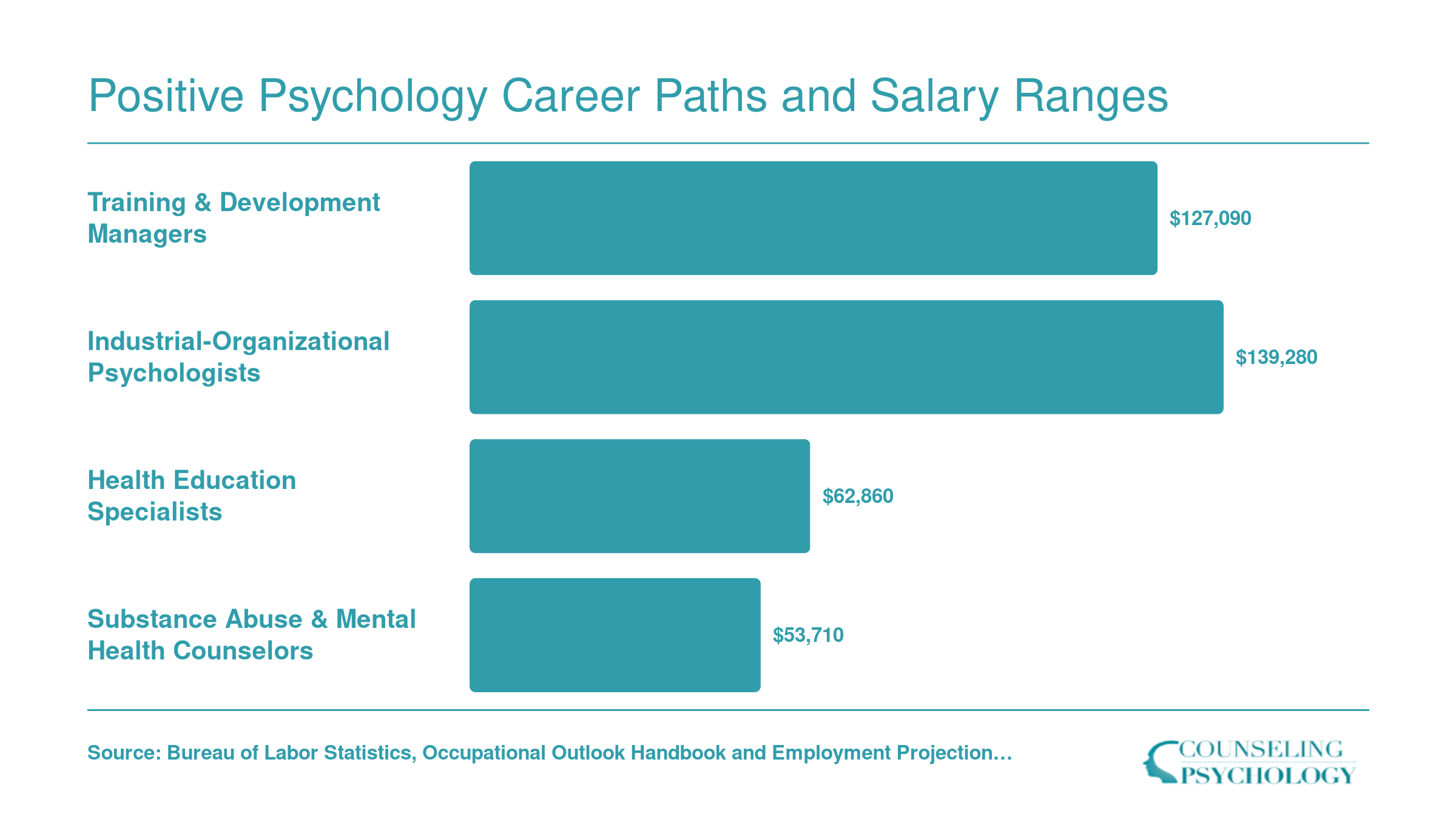
- Training and Development Manager: Overseeing leadership training, onboarding, and professional development programs. The Bureau of Labor Statistics reports a national median annual wage of approximately $130,000 to $135,000 for this occupation, with 5 to 7 percent projected job growth through 2034.1
- UX Researcher (Well-being Focus): Investigating user experience through the lens of mental health, flow states, and positive engagement in technology and product design.
Emerging Roles in Well-Being and Organizational Strategy
The corporate wellness landscape is evolving rapidly. New titles include Chief Well-being Officer (responsible for enterprise-wide mental health and resilience strategy), DEI and Belonging Strategist (integrating psychological safety and inclusion frameworks), and Employee Experience Designer (architecting touchpoints that foster engagement and meaning at work). Graduates interested in the intersection of psychology and business may also explore paths as a personnel psychologist, where strengths-based assessment and talent development are central to the role.
Salary Outlook and Credential Stacking
Health education specialists, another common path for graduates, earn a national median of $60,000 to $65,000 annually, with projected growth of 7 to 10 percent.1 Many positive psychology master's holders strengthen their market position by pairing the degree with professional coaching certifications, which can elevate earning potential and client credibility. The degree alone does not confer clinical licensure, so graduates seeking therapy or counseling roles typically need additional training and supervised clinical hours. For a broader look at what the field offers, the BLS reports that psychologists overall earn a median annual wage of $94,310, with 6 percent projected growth.2
Positive Psychology Career Paths and Salary Ranges
Positive psychology graduates move into a range of roles that draw on strengths-based frameworks, well-being science, and organizational development. The positions below are common landing spots, not roles exclusive to the degree. National median wages and projected growth rates from the Bureau of Labor Statistics give you a realistic salary benchmark for each path.
Licensure and Credentials: What a Positive Psychology Master's Can (and Can't) Qualify You For
Does a master's in positive psychology qualify you for licensure as a therapist or counselor? For most graduates, the answer is no, and understanding that distinction early saves time, money, and frustration. Positive psychology programs focus on well-being, flourishing, and strengths-based applications, not on diagnosing or treating mental health disorders. This degree opens doors to coaching, consulting, and education roles, but it does not automatically lead to a clinical license.
The Licensing Reality
State licensure as a Licensed Professional Counselor (LPC), Licensed Marriage and Family Therapist (LMFT), or psychologist requires a master's or doctoral degree in a clinical field, typically counseling, clinical psychology, or a closely related discipline, along with thousands of hours of supervised clinical experience and a passing score on a recognized exam. A standard master's in positive psychology does not include the required clinical coursework, practica, or supervised internships, so it will not satisfy licensure prerequisites in most states. However, a handful of programs build in clinical curricula through dual-degree tracks or carefully designed electives. These are the exception, not the rule, so examine individual program plans closely if your ultimate goal is a clinical license.
Credentials This Degree Supports
While positive psychology alone is not a clinical license pathway, it does align well with several respected professional credentials:
- ICF Coaching Credentials: Many graduates pursue certification through the International Coaching Federation. The Associate Certified Coach (ACC) level requires 60 hours of coach-specific training, 100 hours of client coaching, 10 hours of mentor coaching, and passing the ICF Credentialing Exam.1 The Professional Certified Coach (PCC) requires 125 training hours, 500 client hours, and 10 mentor hours plus the exam.1 A master's in positive psychology can provide a strong foundation in strengths-based coaching approaches that complement these requirements.
- National Board Certified Health & Wellness Coach (NBC-HWC): This credential requires a bachelor's degree, completion of an approved health and wellness coach training program, 50 coaching sessions after training, and passing a national board exam. Positive psychology training often integrates well with health and wellness coaching competencies.
- Certified Applied Positive Psychology Practitioner (CAPP): Offered by the International Positive Psychology Association (IPPA), this credential requires completion of an approved applied positive psychology program and passing a certification exam. A master's in positive psychology from a qualifying institution can make you eligible.
A Note for Licensure Seekers
If your goal is to become a licensed therapist, start by researching state licensing board requirements for LPC, LMFT, or psychologist licensure. Then look for positive psychology master's programs that explicitly state they are CACREP-accredited or that contain all required clinical coursework and fieldwork. Some schools offer a master's in counseling with a concentration in positive psychology, which may satisfy both interests and licensure needs. Always confirm with the program and your state's licensing board, as requirements vary and change over time. For those drawn to clinical work, learning how to become a counselor is the more direct route if clinical practice is your calling.
Is a Master's in Positive Psychology Worth It? ROI Analysis
The central tension here is straightforward: positive psychology master's programs carry real tuition costs, but they do not lead to a single, clearly defined job title the way a licensed counselor degree does. Whether the investment pays off depends heavily on what you plan to do with the credential.
What the Numbers Look Like
Program-level earnings data for specific positive psychology master's tracks are not yet available through federal reporting, so any salary projection draws on occupational data and institutional context rather than graduate-specific outcomes. What we do have is tuition and, for some programs, typical graduate debt figures.
The contrast across programs on this list is striking. Indiana Wesleyan University's online Life Coaching and Positive Psychology concentration lists tuition around $10,620, and graduates who borrow carry a median debt around $24,250 when institutional averages are considered. Arizona State University's online MS comes in at roughly $13,587 for in-state students, with comparable graduate debt around $19,500. At the other end of the investment spectrum, UPenn's Master of Applied Positive Psychology runs approximately $47,844 in tuition, though the university's median graduate debt sits around $15,715, reflecting the financial aid Penn distributes. PCOM's fully online one-year program is priced at about $32,281.
Where ROI Is Strongest
The return is clearest for career changers moving into coaching, corporate wellness, employee engagement, or organizational consulting. In those roles, a positive psychology master's can be the primary credential that opens doors, and the degree's applied focus translates directly to the work. Life coaches with graduate training can build independent practices or join wellness-focused companies without needing additional licensure.
By comparison, an MBA at a regional school might cost $40,000 to $80,000 and targets a different career lane entirely. A master's degree in psychology with an industrial-organizational focus typically runs $20,000 to $50,000 and overlaps considerably with positive psychology's organizational applications, though I/O programs tend to carry stronger name recognition in HR and consulting hiring pipelines. A clinical mental health counseling master's often costs $30,000 to $60,000 and does lead to licensure eligibility, but also requires supervised post-graduation hours before full practice.
Where ROI Is Weaker
If your goal is clinical work, including therapy or licensed counseling, a positive psychology master's alone will not qualify you for licensure in any state. You would still need a separate CACREP-accredited counseling or COAMFTE-accredited online MFT program. Using a positive psychology program as a stepping stone to clinical work adds time and cost rather than reducing them, and that math rarely works in your favor.
Minimizing the Debt Burden
The affordability-focused programs on this list, particularly ASU and Indiana Wesleyan, are worth a close look precisely because they keep borrowing manageable relative to realistic post-graduation earning potential in coaching and wellness roles. A $15,000 to $25,000 debt load is serviceable on a coaching income; a $50,000 debt load on the same income requires a much more deliberate repayment plan. Choosing a lower-cost program does not automatically diminish the credential's value, especially in fields where practical skills, client outcomes, and professional network matter more than institutional prestige.
Admissions Requirements and How to Apply
Getting into a positive psychology master's program is straightforward compared to many graduate fields, but knowing what to prepare before you apply saves time and prevents last-minute scrambles. For a broader look at graduate admissions in the discipline, see our guide on how hard it is to get into grad school for psychology.
GPA Expectations
Most programs set a 3.0 undergraduate GPA as the minimum, and that figure holds across the three programs examined here: Arizona State University, Philadelphia College of Osteopathic Medicine, and Life University all use 3.0 as their baseline.123 That said, some programs are more flexible for applicants who bring substantial professional experience in coaching, counseling, education, healthcare, or a related field. Indiana Wesleyan University, for example, accepts applicants with a 2.5 GPA for its positive psychology concentration, which reflects how programs aimed at working professionals often weigh career history alongside academic record.
What You Will Submit
A typical application package includes:
- Personal statement: Almost every program requires one. Treat it as a chance to explain why positive psychology specifically, not just "I want to help people."
- Letters of recommendation: Requirements range from one or two (ASU) to three (PCOM and Life University). Choose recommenders who can speak to your academic ability or professional work, ideally both.123
- Resume or CV: Life University explicitly requires one; most other programs expect it even when not formally listed.3
- Writing sample: PCOM asks for a writing sample; ASU and Life University do not. Check individual program pages carefully.2
- Interview: PCOM conducts selective interviews for some applicants. ASU and Life University do not require one.2
GRE and Other Standardized Tests
This is one of the more applicant-friendly aspects of the field: none of the programs reviewed here require the GRE or any other standardized admissions exam.123 That is consistent with the broader trend across applied psychology master's programs, where test scores have largely been dropped in favor of holistic review.
Prerequisite Coursework
Background requirements vary more than GPA thresholds do. ASU prefers applicants with a degree in psychology or a closely related field, and recommends a statistics course.1 PCOM specifies Introduction to Psychology, a research methods or statistics course, and at least one intermediate or advanced psychology course.2 Life University accepts any bachelor's degree, making it the most open option for career changers.3 Several programs will consider professional experience as partial substitution for formal psychology coursework, so if your undergraduate background is in education, social work, nursing, or business, contact the admissions office directly to discuss your fit.
Institutional Selectivity
For context, ASU admits roughly 90 percent of undergraduate applicants institution-wide, which signals an accessible environment, though graduate program selectivity can differ from undergraduate rates. The University of Pennsylvania, home to the original Master of Applied Positive Psychology, admits only about 5 percent of applicants institution-wide, reflecting its position as one of the most selective research universities in the country. Institutional admission rates cover all programs at a school and should not be read as program-specific acceptance figures, but they do give a general sense of the academic culture you would be entering.
Frequently Asked Questions About Positive Psychology Master's Programs
Prospective students often have similar questions when evaluating a masters in positive psychology. Below are concise, fact-grounded answers to the most common ones.