What you’ll learn in this article…
- Georgia offers CSWE-accredited MSW programs with in-state tuition starting as low as roughly $15,000 at schools like Albany State University.
- Clinical, macro, and community practice concentrations shape both your LCSW eligibility and long-term career trajectory.
- Georgia uses a two-tier licensure system: LMSW for entry-level practice, then LCSW after supervised clinical hours.
- BLS projects nationwide social work employment to grow 6 percent from 2024 to 2034, outpacing the average for all occupations.
Georgia's in-state graduate tuition at public universities can run as low as roughly $5,000 per year, making the state one of the more affordable places in the Southeast to earn a CSWE-accredited MSW. Seven accredited programs currently operate across the state, spanning campus, hybrid, and fully online formats, with three HBCUs (Savannah State, Fort Valley State, and Albany State) among them.
The practical challenge is sorting through real cost differences, field placement logistics, and specialization tracks that vary significantly from one program to the next. Georgia requires both an LMSW and, for clinical independence, an LCSW, so every program choice feeds directly into a multi-year licensure timeline. This guide ranks every accredited option on affordability, outcomes, and format flexibility to help you make that decision with confidence.
Best MSW Programs in Georgia: Rankings & Comparison
Georgia offers a range of CSWE-accredited Master of Social Work programs spanning online, hybrid, and campus formats, with several historically Black colleges and universities (HBCUs) among the strongest options. The programs below are ranked on a blend of affordability, graduate outcomes, program flexibility, and institutional strength. Every school on this list prepares graduates for LMSW licensure in Georgia, and several also position students for the clinical LCSW pathway.
- Net price and tuition affordability
- Online and hybrid delivery options
- Graduate earning potential
- Institutional graduation and retention rates
- Program concentrations and flexibility
- Independent program research
- Internal program database
- College Scorecard graduate earnings — collegescorecard.ed.gov
- NCES-IPEDS federal institutional data — nces.ed.gov

Valdosta State University
Valdosta State University's MSW stands out as one of the most affordable CSWE-accredited options in the entire country, regularly cited in national cost comparisons as a top pick for budget-conscious students. Its hybrid Advanced Generalist concentration lets students complete substantial coursework online while arranging local field placements, making it accessible across the state. With an institution-wide graduation rate of about 42% and a 17-to-1 student-faculty ratio (the smallest among public universities on this list), VSU balances low cost with relatively close faculty contact.
- 33-credit Advanced Standing program for BSW graduates
- Hybrid format blends online coursework with local practicum
- Completable in one year full-time or two years part-time
- No GRE or MAT required for admission
- Requires BSW from a CSWE-accredited program within five years
- Minimum 3.0 GPA in final two undergraduate years
- Portfolio-based exit examination at completion
Master of Social Work, Advanced Generalist — Hybrid

Albany State University
Albany State University is an HBCU that delivers its 64-credit MSW entirely online, making it one of the most accessible and affordable paths to licensure for Georgia residents. The program focuses on clinical practice with vulnerable populations across the lifespan and offers both a standard two-year track and a four-year part-time option. Albany State's net price of roughly $11,898 and its HBCU designation create a strong value proposition for students who want culturally grounded education without relocating.
- 64-credit online program, CSWE-accredited
- Standard 2-year or part-time 4-year completion tracks
- Advanced Standing available for BSW graduates with 3.0 GPA
- Clinical focus on vulnerable populations across the lifespan
- Field education internships integrated into curriculum
- Personal interview and narrative statement required for admission
- Criminal background check part of admissions process
Master of Social Work — Online

Savannah State University
Savannah State University, Georgia's oldest public HBCU, offers a campus-based MSW with the lowest net price on this list at approximately $8,172. The 60-credit program features dual specializations in Social Administration and Advanced Clinical Practice, along with 900 hours of daytime field practicum. With 85% of undergraduates receiving Pell Grants, the institution has deep experience serving students who rely on financial aid. The institution-wide graduation rate is 28%, a figure that reflects the university's open-access mission rather than MSW-specific completion.
- 60-credit campus program accredited by CSWE
- Social Administration and Advanced Clinical Practice specializations
- 900 clock hours of daytime field practicum required
- Advanced Standing track (33 credits) for BSW graduates
- No GRE needed with a 2.8 GPA or higher
- Up to 27 transfer credits accepted
- Emphasizes cultural competence in diverse practice settings
Master of Social Work — On-Campus

Fort Valley State University
Fort Valley State University, another Georgia HBCU, launched its online MSW specifically to address rural workforce shortages in mental health and addiction services. The program concentrates on mental health, addiction, and clinical behavioral health, preparing graduates for both LMSW and LCSW licensure tracks. Available both online and in person, it is frequently highlighted in state affordability guides as a lower-cost option for students in underserved communities. The institution-wide graduation rate stands at about 41%.
- Available online and in person for maximum flexibility
- Concentrations in mental health, addiction, and clinical behavioral health
- Internship and fieldwork placements built into the curriculum
- Designed to serve rural and underserved Georgia communities
- Prepares graduates for both LMSW and LCSW licensure
- In-state tuition approximately $5,790 per year
- HBCU with strong community engagement mission
Master of Social Work, Mental Health, Addiction, and Clinical Behavioral Health — Online

Georgia State University
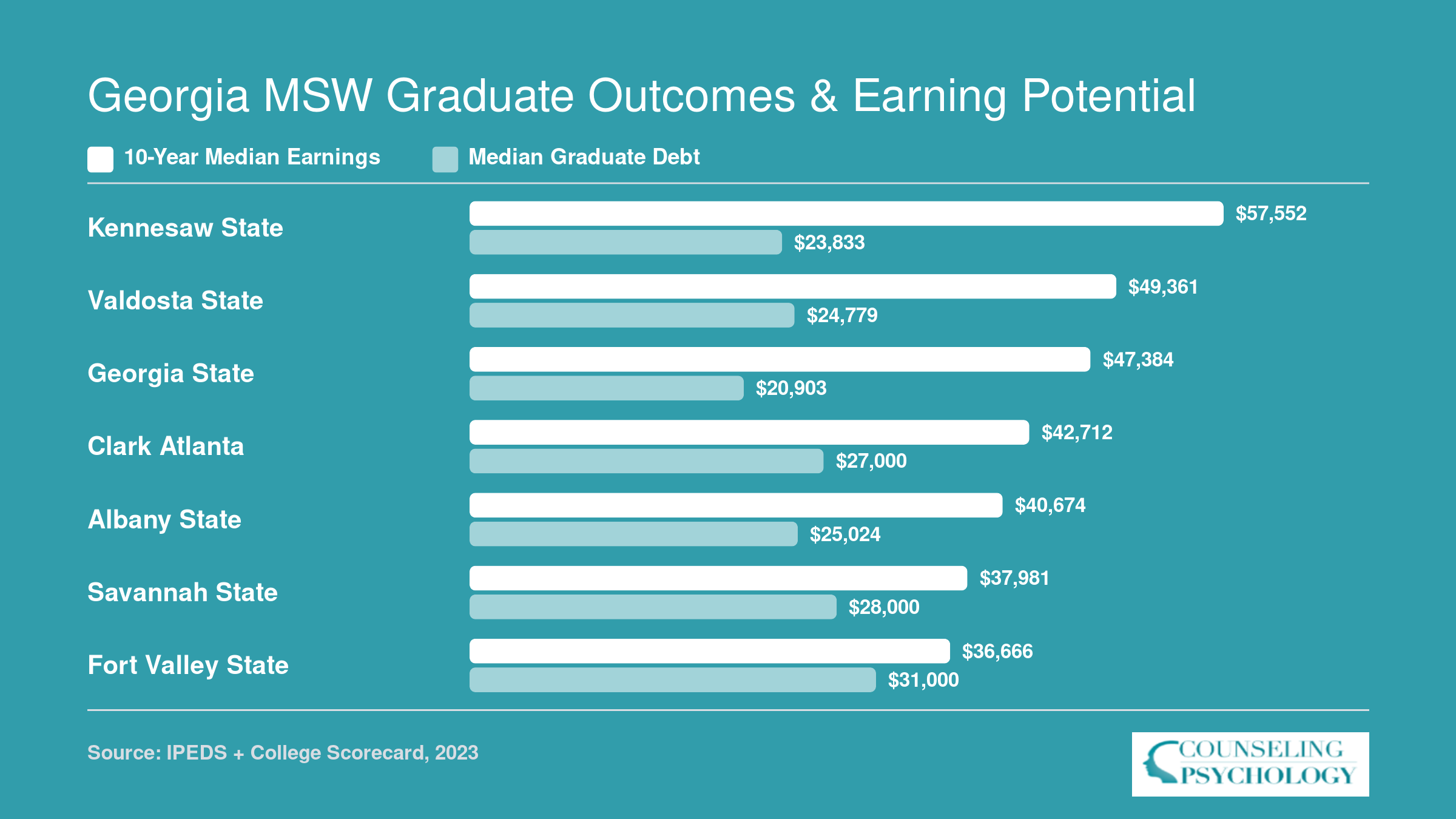
Georgia State University brings the resources of a major Atlanta research institution to its MSW program. The Community Partnerships specialization emphasizes advocacy, nonprofit leadership, and policy, and now includes an online Advanced Standing track that BSW holders can finish in one year. A capstone project partnering with Georgia community agencies anchors the curriculum in real-world practice. With an institution-wide graduation rate above 53% and median alumni earnings of roughly $47,384 ten years after enrollment, Georgia State delivers strong long-term outcomes.
- 60-credit program with campus and online Advanced Standing options
- Online Advanced Standing completable in one year for BSW graduates
- 900 hours of practicum in Atlanta-area community settings
- Capstone project with a Georgia-based community agency
- Cohort-based structure with fall-only start dates
- Graduate assistantships available to offset costs
- Curriculum covers community organizing, coalition building, and policy analysis
Master of Social Work, Community Partnerships — On-Campus

Kennesaw State University
Kennesaw State University's campus-based MSW focuses squarely on clinical social work practice, with 12 of its 60 credit hours devoted to supervised field practicum across the greater Atlanta metro. KSU also offers an MSW/MBA dual degree for students interested in nonprofit or healthcare administration. The institution-wide graduation rate of about 52% and median alumni earnings near $57,552 are the highest on this list, reflecting the university's broad economic footprint in suburban Atlanta. Note that no online or hybrid MSW option is currently available here.
- 60-credit campus program, CSWE-accredited
- 48 classroom hours plus 12 supervised field practicum hours
- Advanced Standing option for qualified BSW graduates
- Atlanta-area field placements for hands-on clinical training
- Prepares graduates for LMSW exam and LCSW pathway
- Four-semester, full-time completion timeline
- Dual degree combining clinical social work and business skills
- School social work specialization track available
- Supported by a Department of Education grant
- Focus on rural and underserved population service
- Traditional and Advanced Standing entry points
- Scholarship assistance available for admitted students
Master of Social Work, Clinical Social Work Practice — On-Campus
Master of Social Work / Master of Business Administration — On-Campus

Clark Atlanta University
Clark Atlanta University is a private HBCU whose MSW curriculum integrates Afrocentric perspectives, social justice frameworks, and humanistic values in ways few other programs replicate. Students choose between Child and Family or Health/Mental Health specializations across 59 credits, with full-time, part-time, and one-year Advanced Standing tracks. The 16-to-1 student-faculty ratio is the lowest on this list, and the GRE is waived. Because Clark Atlanta is a private institution, its net price is higher (roughly $37,702), but the culturally centered training and Atlanta location offer a distinctive educational experience. The institution-wide graduation rate is approximately 49%.
- 59-credit campus program with Afrocentric perspective
- Two-year full-time or three-year part-time completion
- One-year Advanced Standing for BSW graduates (38 credits)
- GRE waived for all applicants
- Requires 27 undergraduate liberal arts credits
- Emphasizes culturally competent practice and social justice
- Focuses on behavioral health and clinical intervention
- Same 59-credit structure with flexible pacing options
- Ecological and developmental theory foundations
- 16-to-1 student-faculty ratio, lowest among ranked schools
- No credit awarded for life or work experience
- Three letters of recommendation and personal statement required
Master of Social Work, Child and Family — On-Campus
Master of Social Work, Health/Mental Health — On-Campus
Georgia MSW Tuition & Cost Comparison
The table below puts every Georgia MSW program side by side on the numbers that matter most: annual in-state tuition, out-of-state tuition, and the institution-wide average net price after financial aid. Albany State University posts the lowest in-state sticker price at $5,008 per year, while Clark Atlanta University, the only private institution on the list, tops out at $22,474. That gap of roughly $17,400 per year adds up fast across a two-year program. Keep in mind that the net price figures reflect an institution-wide average for all students receiving aid; they are not guaranteed MSW-specific costs, and your actual out-of-pocket expense will depend on the aid package you receive.
| School | Format | In-State Tuition | Out-of-State Tuition | Avg. Net Price (Institution-Wide) |
|---|---|---|---|---|
| Albany State University | Online | $5,008 | $15,880 | $11,898 |
| Fort Valley State University | Online | $5,790 | $18,268 | $10,338 |
| Valdosta State University | Hybrid | $6,316 | $18,934 | $10,945 |
| Savannah State University | Campus | $6,398 | $19,862 | $8,172 |
| Kennesaw State University | Campus | $6,702 | $21,390 | $15,048 |
| Georgia State University | Campus | $8,664 | $25,116 | $15,931 |
| Clark Atlanta University | Campus | $22,474 | $22,474 | $37,702 |
Questions to Ask Yourself
Online vs. Campus MSW Programs in Georgia
Synchronous lectures on a physical campus versus asynchronous coursework completed from your living room: the delivery format shapes nearly every aspect of your MSW experience, from scheduling flexibility to commute costs. Yet one thing stays constant regardless of which path you choose: the accreditation standard.
Accreditation Is the Same Either Way
The Council on Social Work Education (CSWE) applies identical accreditation standards to online and on-campus MSW programs. A degree earned fully online from an accredited program carries the same weight with Georgia licensing boards as one earned in a classroom. That said, accreditation status can change, so confirm each school's current standing directly in CSWE's online program directory before you apply. Do not assume that because a program was accredited last year it still holds that status today.
Field Placement: The Detail That Matters Most
CSWE requires MSW graduates to complete a supervised field practicum, and the Educational Policy and Accreditation Standards (EPAS) set minimum hour thresholds that all accredited programs must meet. How a program like those at UGA, Valdosta State, or Savannah State arranges those hours for online students varies considerably.
Some programs maintain agency partnerships across Georgia and neighboring states, allowing distance learners to complete their practicum close to home. Others coordinate placements more centrally and may expect students to travel. Before enrolling, visit each program's official website and search specifically for terms like "field placement" or "practicum requirements" to find total hour counts and agency partnership details.
Then go one step further: contact the field education office directly. Ask two concrete questions:
- Geographic flexibility: Can you arrange your placement near your current address, or are you expected to use partner agencies in a specific region?
- Local agency network: What types of agencies does the program have agreements with, and are any located in your county or region?
This conversation often reveals details that program websites do not publicize.
Confirming Licensure Alignment
The Bureau of Labor Statistics (BLS.gov) provides a useful overview of social work licensure requirements nationally, but Georgia-specific field hour requirements are governed by the Georgia Composite Board of Professional Counselors, Social Workers, and Marriage and Family Therapists. If you are also weighing a counseling degree or mft degree, note that licensure boards in Georgia oversee those credentials separately. For the most precise practicum hour counts tied to LMSW or LCSW eligibility, cross-reference program catalogs with CSWE's EPAS guidelines rather than relying on any single secondary source.
MSW Specializations & Concentrations at Georgia Schools
Georgia's MSW programs vary widely in how they structure their concentrations, and the track you choose has direct implications for your licensure path and career trajectory. Clinical or micro concentrations prepare you for the supervised practice hours required for LCSW licensure, while macro and community practice tracks position graduates for policy, administration, and nonprofit leadership roles. Below is a side-by-side look at what each school offers.
| School | Concentration(s) Offered | Clinical/LCSW Track | Macro/Policy Track | Noteworthy Details |
|---|---|---|---|---|
| University of Georgia | Micro, Macro, Integrated/Combined | Yes (Micro) | Yes (Macro) | Athens campus and Advanced Standing students can choose Micro, Macro, or an Integrated option that blends both. Gwinnett and online extended programs offer Micro only. |
| Georgia State University | Community Partnerships (Community Practice) | No dedicated clinical track | Yes | One of the few Georgia MSW programs built around community organizing, coalition building, and social policy analysis. Ideal for students targeting program development or advocacy careers. |
| Kennesaw State University | Clinical Social Work Practice | Yes | No | Exclusively clinical focus with a clear LCSW licensure pathway. Field placements concentrated in the metro Atlanta area. 60 credit hours with 12 dedicated to field practicum. |
| Clark Atlanta University | Child and Family; Health/Mental Health | Yes (Health/Mental Health) | No | The Child and Family specialization is uncommon across Georgia programs. Curriculum integrates an Afrocentric perspective and social justice framework. 59 credits required. |
| Fort Valley State University | Mental Health, Addiction, Clinical Behavioral Health | Yes | No | The only Georgia MSW program with an explicit addiction and clinical behavioral health concentration, serving rural and underserved communities. Available online and in person. |
| Valdosta State University | Advanced Generalist | Generalist (covers clinical foundations) | Generalist (covers macro foundations) | Hybrid delivery format. The Advanced Generalist model trains students across micro and macro domains rather than requiring a single track. Advanced Standing option is 33 credit hours. |
| Albany State University | Clinical Practice (generalist clinical) | Yes | No | Online delivery with a focus on clinical work with vulnerable populations. 64 credit hour program with both standard two year and part time four year schedules. Advanced Standing available for BSW graduates. |
| Savannah State University | Advanced Clinical Practice; Social Administration | Yes (Advanced Clinical Practice) | Yes (Social Administration) | Dual specialization option lets students combine both tracks. 60 credit hours with 900 clock hours of field practicum. Advanced Standing path available at 33 credits. |
Georgia MSW Graduate Outcomes & Earning Potential
Program-level earnings shortly after MSW completion are not yet published for these Georgia schools. However, institution-wide median earnings ten years after enrollment and median graduate debt provide a useful ROI snapshot. Lower debt relative to long-term earnings generally signals a stronger return on your investment.
What Social Workers Earn in Georgia: Salary & Job Outlook
An MSW can cost anywhere from $15,000 to $50,000 depending on the program, so the real question is whether Georgia salaries justify that investment. The short answer is yes, but the specifics depend heavily on which practice area you enter and whether you land in Atlanta or a smaller market.
Salary by Specialization
Not all social work roles pay the same in Georgia. According to Bureau of Labor Statistics occupational wage data, the statewide picture breaks down roughly like this (figures reflect 2023 estimates):
- Child, family, and school social workers (SOC 21-1021): Median annual wage in the range of $52,000 to $55,000 statewide, with an estimated 8,000 to 9,000 positions across Georgia.1
- Healthcare social workers (SOC 21-1022): The highest-paying category, with a statewide median in the $60,000 to $63,000 range and 4,000 to 5,000 employed workers.1
- Mental health and substance abuse social workers (SOC 21-1023): Median wages fall between $50,000 and $54,000 statewide, across a workforce of roughly 3,000 to 4,000 in Georgia.1
These figures represent statewide Georgia estimates, not national figures. The BLS national medians for these same occupations differ and should not be substituted here.
The Atlanta Premium
Working in the Atlanta metro area typically pushes wages noticeably higher. In the Atlanta-Sandy Springs-Roswell metropolitan area, BLS metro wage data shows:2
- Child, family, and school social workers: Median wages climb to roughly $55,000 to $58,000, with 3,500 to 4,000 positions concentrated in the metro.
- Healthcare social workers: Median wages reach $63,000 to $67,000, making Atlanta one of the stronger markets in the Southeast for clinical hospital and healthcare roles.
- Mental health and substance abuse social workers: Median wages of $52,000 to $56,000, supported by 1,500 to 2,000 positions in the metro area.
For graduates who can work in Atlanta, the wage premium across all three specializations is meaningful, often several thousand dollars annually above the state median. Those interested in comparing compensation across related helping professions may find our breakdown of counselor salary with masters useful context.
Job Growth Through 2032
Demand is rising. Georgia DOL projections covering the 2022 to 2032 period show child, family, and school social work growing at roughly 8 to 12 percent. Healthcare social work and mental health and substance abuse social work are both projected to grow at 15 to 20 percent over the same window, well above average for all occupations.3
Connecting Cost to Return
Put those numbers alongside the tuition figures discussed earlier. An in-state online MSW from a Georgia public university can run under $20,000 total. At a healthcare social worker median starting somewhere around $60,000 to $63,000 statewide, a motivated graduate could recover tuition costs within two to three years of licensure, particularly if they pursue the LCSW credential, which typically unlocks private practice and higher-billing clinical roles. Even at the lower end of the mental health and substance abuse wage range, the math holds reasonably well for graduates who choose affordable programs and avoid unnecessary debt.
According to the Bureau of Labor Statistics, employment of social workers nationwide is projected to grow 6 percent from 2024 to 2034, faster than the average for all occupations. Georgia’s Department of Labor and professional associations like NASW-GA can provide more localized shortage data.
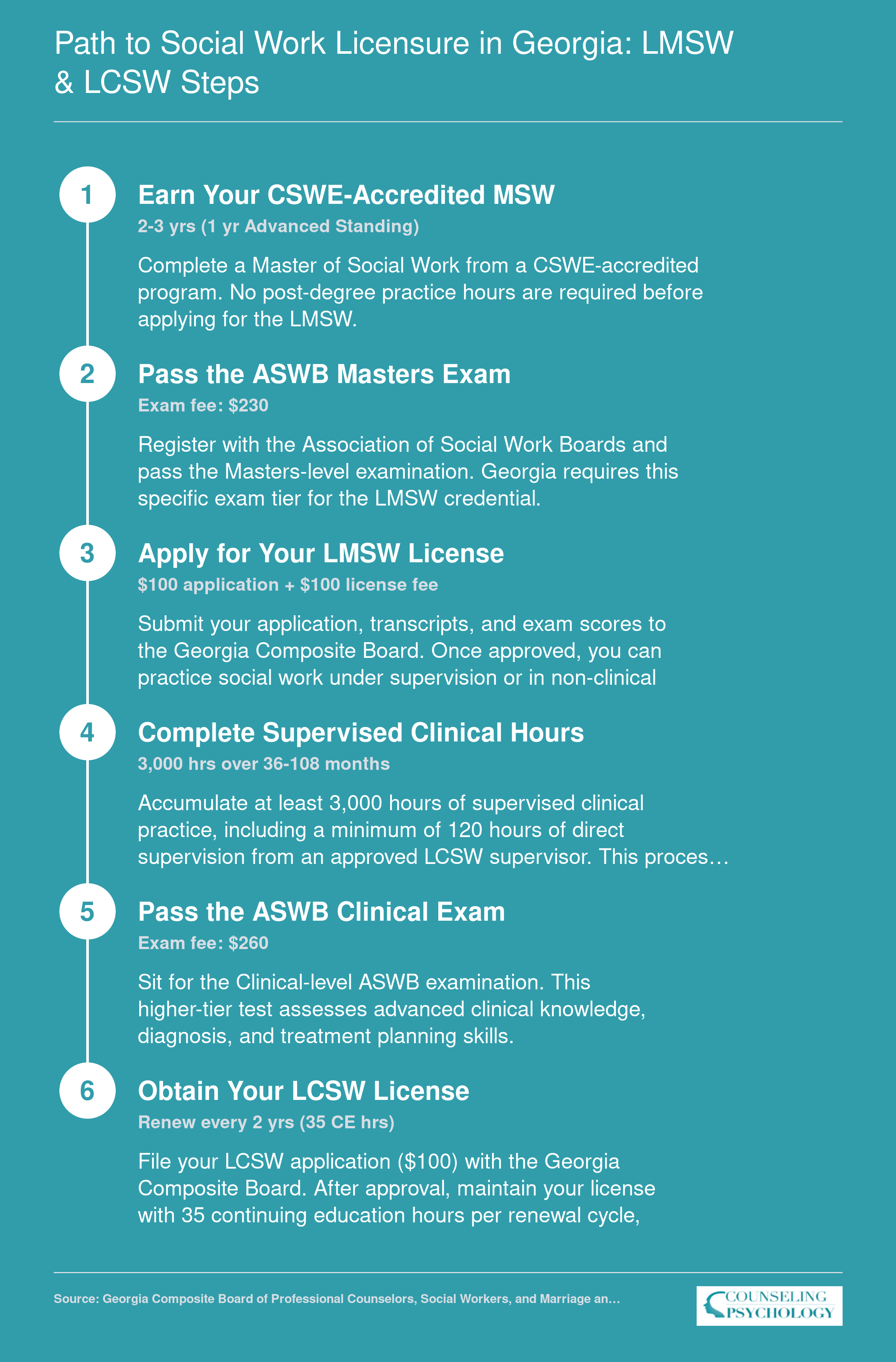
Path to Social Work Licensure in Georgia: LMSW & LCSW Steps
Georgia's two-tier social work licensure system lets you begin practicing right after earning your MSW, then advance to independent clinical practice over time. Here is the credentialing ladder as defined by the Georgia Composite Board of Professional Counselors, Social Workers, and Marriage and Family Therapists for 2025-2026.
Admissions Requirements for Georgia MSW Programs
Earning admission to a Georgia MSW program requires more than meeting a GPA threshold. Schools evaluate your complete application package, including professional experience, writing samples, and references that demonstrate readiness for graduate-level social work practice.
GPA and Academic Prerequisites
Most Georgia MSW programs expect applicants to hold a minimum cumulative GPA of 3.0 on a 4.0 scale.1 At the University of Georgia, the standard MSW track requires a 3.0 GPA, while advanced standing applicants must present at least a 3.2.1 You can apply with any bachelor's degree, though programs look favorably on coursework in psychology, sociology, human development, or related behavioral sciences.2 Unlike some graduate programs that mandate specific prerequisite classes, Georgia MSW programs generally accept students from diverse academic backgrounds.
Application Materials
Georgia programs typically require the following components:
- Personal or narrative statement: UGA asks for a 3 to 5 page essay addressing your motivations, relevant experiences, and professional goals in social work3
- Letters of recommendation: Three references are standard, ideally from professors, supervisors, or professionals who can speak to your interpersonal skills and commitment to service3
- Resume or CV: Highlighting volunteer work, internships, or employment in human services strengthens your candidacy
- Official transcripts: From all postsecondary institutions attended
BSW vs. Non-BSW Pathways
If you hold a Bachelor of Social Work from a CSWE-accredited program, you may qualify for advanced standing. At UGA, this pathway compresses the degree timeline to approximately one year rather than the standard two-year program.1 Advanced standing students typically enter in summer rather than fall, allowing them to complete foundational coursework at an accelerated pace.2 To qualify, your BSW must have been earned within five years of enrollment.1
Students without a social work undergraduate degree follow the regular pathway, which provides comprehensive foundation content before moving into specialized practice courses.
Deadlines and Admission Models
Georgia programs generally operate on fixed cohort admissions rather than rolling enrollment.4 UGA's priority deadline for the 2026 cohort falls on January 9, with standard applications due by mid-March.14 After posted deadlines, admission continues on a space-available basis, though competitive applicants benefit from applying early.4
GRE Requirements
The GRE is not required for admission to UGA's MSW program, a policy that has become increasingly common across Georgia schools.4 This shift allows programs to evaluate candidates holistically, placing greater emphasis on professional experience and personal statements than standardized test performance.
How We Ranked These Georgia MSW Programs
As social work education costs climb, affordability has become the deciding factor for many prospective students, and the central lens for this ranking.
Affordability Takes Center Stage
Every program included here holds CSWE accreditation, the non-negotiable baseline for licensure-eligible social work degrees. Beyond that, our methodology prioritizes net price and financial aid metrics. We examined published tuition and fee data from IPEDS, then adjusted for average grant and scholarship aid to estimate what students typically pay out of pocket. Online and part-time pathways, which allow students to keep working and reduce opportunity costs, also factored into the affordability calculation.
Measuring Student Success
Cost alone doesn't tell the whole story. We incorporated institution-wide graduation rates as a proxy for student support and timely completion. Post-graduation earnings, drawn from the College Scorecard's program-level outcomes, offer a real-world glimpse of financial returns. Because social work earnings vary by specialization and geography, these figures are best understood as a broad benchmark rather than a personal guarantee.
Data Sources and Their Limits
The numbers come from the U.S. Department of Education's IPEDS and College Scorecard databases. Net price is an institution-level average that may not reflect every student's situation. Graduation rates cover all undergraduate and graduate students, not MSW cohorts alone. Earnings data bundles all program completers in the social work field, meaning individual outcomes will differ based on career path, experience, and licensure status. These data points provided a consistent, evidence-based framework to compare Georgia's MSW options, but they should be used as a starting point, not a crystal ball.
Frequently Asked Questions About MSW Programs in Georgia
Choosing an MSW program involves weighing cost, format, specialization, and licensure preparation. Below are answers to the questions Georgia-based students ask most often when comparing accredited programs across the state.