What you’ll learn in this article…
- The University of Oklahoma offers Oklahoma's only CSWE-accredited online MSW at $645 per credit hour.
- Both OU and NSU have dropped the GRE requirement, and BSW holders can finish in roughly one year.
- Oklahoma LCSW licensure typically requires four to six years from initial MSW enrollment to completion.
- BLS reports a national median salary of $58,510 for social workers, though Oklahoma-specific figures tend to run lower.
Oklahoma offers only one fully accredited online MSW option, the University of Oklahoma, which runs $645 per credit hour and can be completed in as little as 30 months for advanced-standing students. That flat-rate tuition, combined with the program's CSWE accreditation and preparation for licensure in all 50 states, makes OU one of the most cost-effective pathways to clinical social work practice available to Oklahoma residents. For applicants in rural areas, online delivery removes the barrier of relocating to Norman or Tahlequah while still meeting the 900 hours of supervised field placement required by the state board.
In-state tuition at Oklahoma's public universities hovers well below the national average for graduate social work programs, a meaningful advantage for students weighing return on investment against rising graduate debt. OU's total program cost sits at approximately $38,700, with rolling admissions and no GRE requirement for most applicants. Students exploring related helping professions in the state, such as MFT programs in Oklahoma, will find similarly accessible admissions standards.
Oklahoma's MSW graduates face a regional job market shaped by healthcare expansion and underserved rural communities, but salary outcomes depend heavily on sector, setting, and whether you pursue the LCSW credential after graduation.
Best MSW Programs in Oklahoma: Rankings & Comparison
Oklahoma currently has one CSWE-accredited online MSW program, offered by the University of Oklahoma. OU's online MSW stands out for its transparent flat-rate tuition, flexible pacing for working professionals, and preparation for licensure in all 50 states. Below, we break down both the standard and advanced standing tracks so you can compare costs, timelines, and requirements side by side.
- Net price and affordability
- Financial aid availability
- Accreditation and licensure prep
- Graduation and retention rates
- Program flexibility and format
- Internal program database
- NCES-IPEDS federal institutional data — nces.ed.gov
- Independent program research
- College Scorecard graduate earnings — collegescorecard.ed.gov

University of Oklahoma-Norman Campus
The University of Oklahoma delivers a fully online, CSWE-accredited MSW through its Norman campus, targeting working professionals nationwide with a cohort-based model that blends asynchronous coursework and optional live sessions. With an institutional net price of roughly $15,300 (undergraduate baseline from IPEDS), a 75.3% overall graduation rate, and a flat $645-per-credit tuition structure that applies regardless of residency, OU removes much of the cost uncertainty that plagues out-of-state online learners. The program coordinates personalized field placements under licensed social workers and explicitly prepares graduates to pursue licensure in every U.S. state.
- CSWE-accredited 60-credit program, $38,700 total tuition
- Flat $645 per credit hour for all students, no residency surcharge
- Completable in as few as 30 months with full-time enrollment
- 900 hours of field work across two personalized placements
- Cohort-based model with asynchronous and live online sessions
- Rolling admissions with no application fee
- Transfer up to 12 eligible credits toward the degree
- Financial aid, scholarships, and employer tuition assistance accepted
- Designed for BSW graduates; 33 credit hours, $21,285 total
- Accelerated 15-month completion timeline
- 500 hours of supervised field work required
- Same flat $645 per credit rate as the standard track
- CSWE accredited; prepares graduates for licensure in all states
- Rolling admissions, no application fee, $350 deposit upon acceptance
Online Master of Social Work — Online
Online Master of Social Work, Advanced Standing — Online
OU vs. NSU: Side-by-Side MSW Comparison
Oklahoma's two primary MSW options, the University of Oklahoma and Northeastern State University, serve different student profiles. OU's online MSW is a well-established, CSWE-accredited program with detailed published cost and outcome data, while NSU offers an accessible pathway with a lower GPA threshold and advanced standing for eligible BSW graduates. The table below consolidates confirmed data points; where program-specific figures have not been independently verified, cells are noted accordingly.
| Feature | University of Oklahoma (OU) | Northeastern State University (NSU) |
|---|---|---|
| CSWE Accreditation | Yes | Yes |
| Total Credit Hours (Standard Track) | 60 | Approximately 60 (confirm with program) |
| Advanced Standing Option | Not currently advertised for the online program | Yes, available for qualifying BSW graduates |
| Tuition Per Credit Hour | $645 | Contact program for current per-credit rate |
| Estimated Total Tuition | Approximately $38,700 | Not publicly confirmed at time of writing |
| Institutional Net Price (all programs) | $15,300 (IPEDS) | Not available in current dataset |
| Minimum GPA Requirement | 3.0 | 2.7 |
| GRE Requirement | Not required for online MSW admission | Not required (per current catalog) |
| Delivery Format | Primarily asynchronous with some live sessions | Online; confirm synchronous vs. asynchronous details with advisor |
| Field Placement Hours | 900 hours across two placements | Follows CSWE standards (typically 900 hours for standard track) |
| Program Length | As few as 30 months (standard track) | Varies; advanced standing may shorten timeline |
| Institutional Graduation Rate | 75.3% (IPEDS, institution-wide) | Not available in current dataset |
| Additional Application Materials | Three recommendation letters, five essay responses, resume | Bachelor's degree required; check catalog for full list |
Online vs. On-Campus MSW Programs in Oklahoma
Asynchronous coursework versus fixed class schedules represents the core distinction between Oklahoma's online and on-campus MSW tracks, and that difference shapes everything from weekly routines to career feasibility for working adults.
How Online MSW Formats Work in Oklahoma
The University of Oklahoma delivers its MSW program in a largely asynchronous format, meaning students access lectures, discussion boards, and assignments on their own schedule rather than logging in at set times.1 Some synchronous components appear periodically for group projects or live faculty sessions, but the bulk of learning adapts to students' existing work and family commitments. Northeastern State University also offers an online MSW with similar flexibility. Both programs hold CSWE accreditation, the credential Oklahoma requires for licensure eligibility.3
On-campus cohorts, by contrast, follow fixed weekly class meetings in Norman or Tahlequah. Students benefit from face-to-face peer interaction and immediate faculty feedback, but they must live within commuting distance and arrange schedules around daytime or evening class blocks.
Field Placement Logistics for Distance Learners
Every CSWE-accredited MSW requires a minimum of 900 supervised field hours, regardless of delivery format.3 At OU, that breaks down into 400 foundation hours and 500 concentration hours. Advanced-standing students who already hold a BSW complete 500 hours total.
OU's centralized Field Education Office coordinates placements for online students, matching learners with approved agencies in their home communities. Out-of-state placements are permitted when students live beyond Oklahoma's borders, but most in-state distance learners complete hours locally.3 Rural students can often secure placements at regional hospitals, community mental health centers, or tribal service agencies without relocating to an urban hub. NSU similarly supports rural learners by connecting them with agencies near their residences.
Placement sites must meet CSWE supervision standards, so students should expect some back-and-forth with the field office to finalize agency agreements before hours begin.
Weekly Time Commitment Expectations
Full-time online MSW students typically budget 15 to 20 hours weekly for coursework alone, covering video lectures, readings, written assignments, and discussion posts. Field hours layer on top of that. During semesters with active placements, students may log 16 to 24 hours per week at their agency site, pushing total weekly commitments to 35 hours or more.
On-campus cohorts face similar academic loads but add commuting time and rigid class schedules. For professionals balancing employment, the asynchronous model removes the logistical barrier of midday classes, allowing them to study early mornings, evenings, or weekends.
Who Benefits Most From Online MSW Options
Online delivery opens graduate social work education to populations who historically struggled to access it. Working professionals can maintain income while earning their degree. Parents managing childcare can study after bedtime. Residents of rural western or southeastern Oklahoma, hours from Norman or Tahlequah, no longer face relocation costs or lengthy commutes. Students drawn to adjacent helping professions, such as clinical mental health counseling online programs, will find that the same asynchronous model has expanded access in those fields as well. The flexibility does not reduce rigor: students still complete identical field requirements, pass the same licensing exams, and graduate with the same CSWE-accredited credential as their on-campus peers.5
Questions to Ask Yourself
How Much Does an Online MSW Cost in Oklahoma?
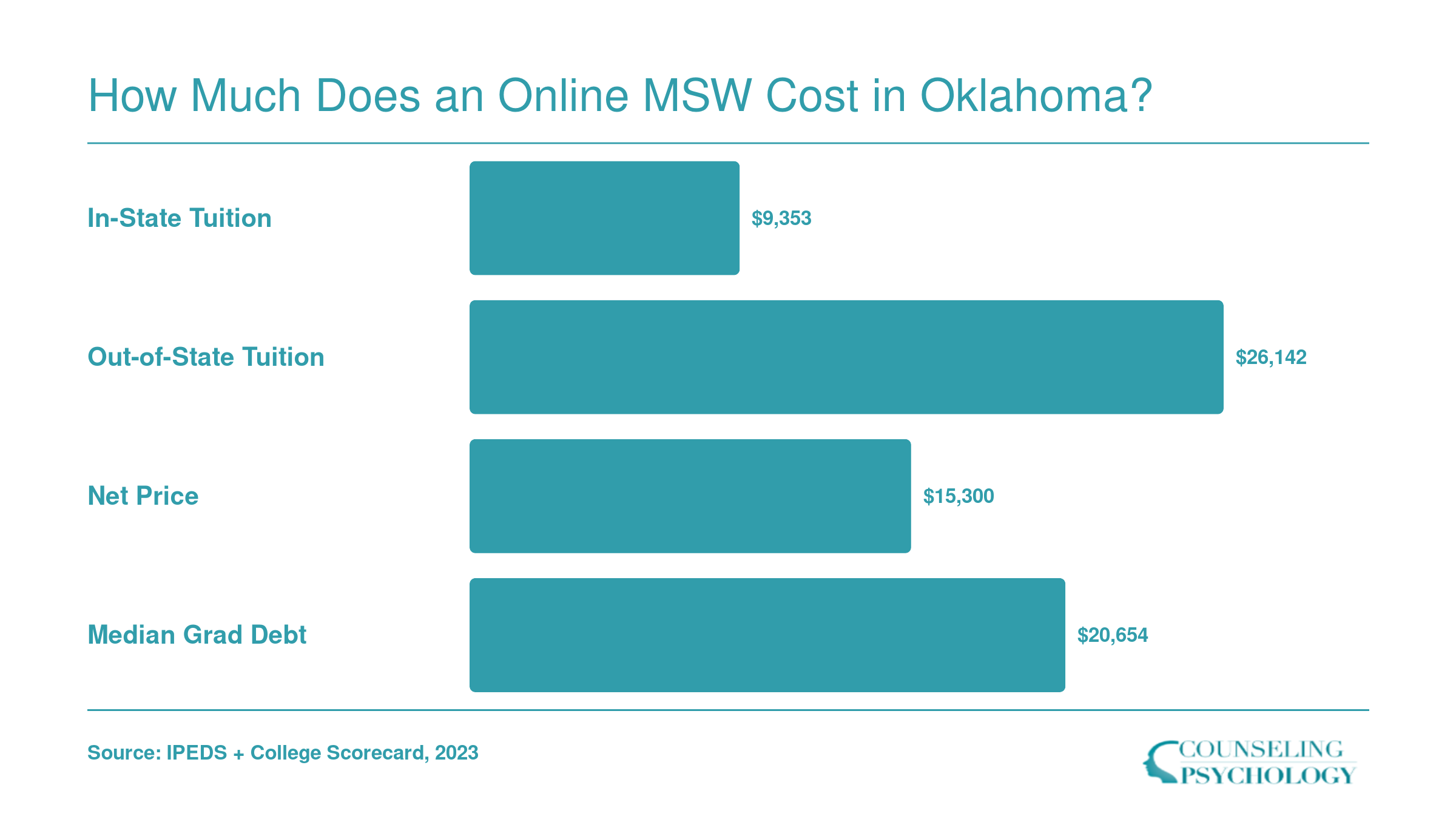
Oklahoma's public-university tuition is well below the national average for graduate social work programs, making it one of the more affordable paths to an MSW. The University of Oklahoma's online MSW runs $645 per credit hour, with a total program cost of roughly $38,700 for 60 credit hours. At the institutional level, OU's median graduate debt is $20,654 (per College Scorecard), which translates to a manageable monthly payment on a standard 10-year repayment plan. Compared to national MSW tuition averages that frequently exceed $40,000-$60,000 at peer institutions, Oklahoma's pricing represents a genuine value, especially for in-state residents.
MSW Admissions Requirements & No-GRE Options in Oklahoma
Traditional applicants and those with a BSW in hand face two very different admissions paths when applying to Oklahoma's MSW programs. Understanding which materials you need, whether standardized testing is required, and whether you qualify for advanced standing can save months of preparation time.
GPA Thresholds and Application Materials
The University of Oklahoma's MSW program sets a minimum cumulative GPA of 3.0 for the 2025-2026 admissions cycle.1 Northeastern State University's MSW program also evaluates applicants holistically but generally expects a competitive undergraduate GPA in a similar range. Both programs require standard application materials:
- Official transcripts: From all colleges and universities attended.
- Personal statement: Explaining your interest in social work, relevant experiences, and career goals.
- Letters of recommendation: Typically two to three professional or academic references who can speak to your readiness for graduate-level work.
- Resume or CV: Highlighting any human services, volunteer, or social work-related experience.
Application deadlines vary by term. OU typically accepts applications on a rolling basis for fall admission, with priority deadlines in early spring. NSU may offer both fall and spring start dates depending on the cohort, so checking the program's admissions page well in advance is essential.
Can You Get an Online MSW in Oklahoma Without Taking the GRE?
Yes. Neither the University of Oklahoma nor Northeastern State University requires the GRE for MSW admission. This makes both CSWE-accredited options in the state genuinely GRE-free rather than merely GRE-optional. You will not need to budget time or money for standardized test preparation, which removes a common barrier for working professionals and career changers looking to enter social work.
Advanced Standing Eligibility
If you hold a BSW from a CSWE-accredited program, you may qualify for advanced standing at both OU and NSU. Advanced standing typically allows students to waive foundation-year coursework, reducing the total credit requirement by roughly 20 to 30 credits depending on the program. This can shorten your timeline from the standard two years to approximately one year of full-time study. Eligibility usually hinges on graduating from an accredited BSW program within a set number of years (often seven) and meeting a GPA threshold that may be slightly higher than the standard admissions minimum. At OU, expect to demonstrate at least a 3.0 GPA in your BSW coursework.1
Prerequisite Coursework and Professional Experience
Neither Oklahoma program mandates specific prerequisite courses for the traditional (non-advanced-standing) track, though a background in social or behavioral sciences strengthens your application. Some applicants without a social work or related undergraduate degree may be asked to complete introductory coursework in areas like human biology, statistics, or social welfare policy before or during their first semester. Professional experience in human services is valued but not universally required. Volunteer hours, internships, or paid work in community agencies, healthcare, child welfare, or similar settings will bolster your candidacy and help you articulate a clear purpose in your personal statement.
How Long Does an Online MSW Take in Oklahoma?
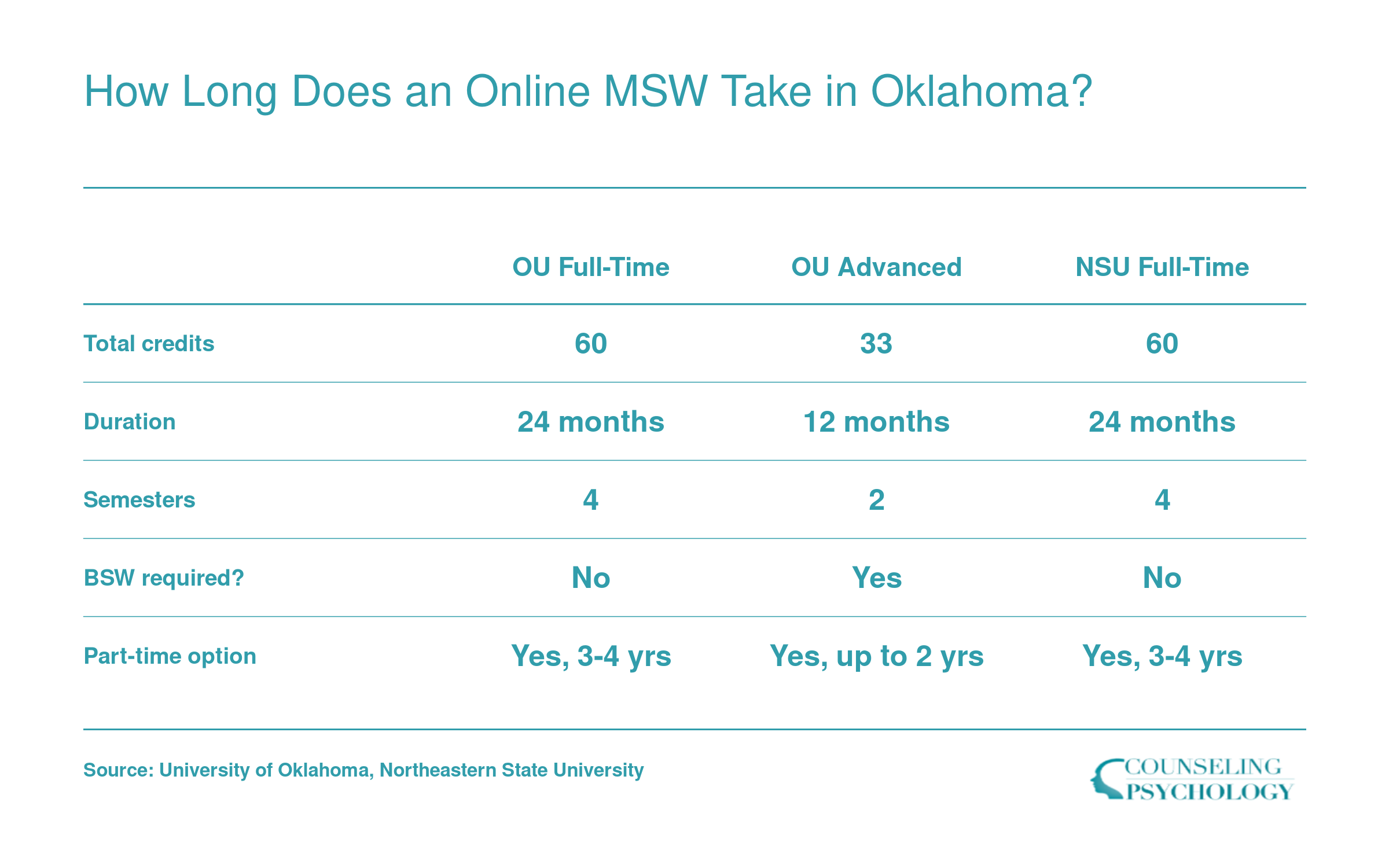
Timeline is one of the biggest variables when choosing an MSW program. Both the University of Oklahoma and Northeastern State University offer three pacing options. Advanced standing, reserved for applicants who already hold a BSW from a CSWE-accredited program, typically shaves a full year off the degree. Part-time schedules can stretch to 3 or even 4 years, but they let working professionals in Oklahoma maintain employment and income while earning their degree.
Oklahoma Social Work Licensure: LMSW & LCSW Steps
Oklahoma's social work licensure pathway follows a structured progression from MSW graduate to independent clinical practitioner. Understanding each step and requirement ensures you can plan your timeline and meet all state board criteria efficiently.
Earning Your LMSW: The First License
The Licensed Master Social Worker (LMSW) is Oklahoma's entry-level professional license for MSW graduates. To qualify, you must hold an MSW from a CSWE-accredited program and pass the ASWB Master's examination.1 Oklahoma does not require post-degree supervised hours before applying for the LMSW, allowing you to sit for the exam and apply for licensure immediately after graduation.1
The ASWB Master's exam consists of 170 multiple-choice questions covering human development, assessment, direct and indirect practice, and professional values. While the Association of Social Work Boards does not publish a single passing score (the exam is scaled), candidates typically need to answer approximately 93 to 106 questions correctly to pass, depending on exam form difficulty.
Advancing to LCSW: Clinical Licensure Requirements
The Licensed Clinical Social Worker (LCSW) credential authorizes independent clinical practice and third-party billing. To qualify, you must first hold an LMSW or LSWA (the state's associate license) and complete supervised clinical experience.1
Oklahoma offers two supervised practice pathways:
- Standard track: 3,000 hours of supervised clinical social work practice
- Alternative track: 4,000 hours of supervised practice
Supervision must be provided by a board-approved LCSW.4 While the state board does not specify a rigid supervision ratio or minimum weekly frequency in statute, supervision must be ongoing, documented, and aligned with clinical competency development. Most supervisors meet with supervisees one to two hours per week or bi-weekly, depending on caseload intensity.
After completing your supervised hours, you must pass the ASWB Clinical examination, which tests advanced clinical knowledge, diagnosis, treatment planning, and therapeutic interventions.2 The Clinical exam also uses scaled scoring, with candidates generally needing to answer correctly on approximately 93 to 106 of 170 questions.
Renewal and Continuing Education
Oklahoma social work licenses expire annually on December 31.1 To renew, you must complete 16 hours of continuing education each year, including at least 3 hours in ethics and 8 hours in live or interactive formats.2 Dual licensees (holding both LMSW and LCSW) must complete 22 hours annually. Licensees must retain CE documentation for three years in case of audit.2
No legislative changes to Oklahoma social work licensure requirements were enacted in 2025 or early 2026.1 The Oklahoma State Board of Licensed Social Workers governs all licensure processes, examination approvals, and disciplinary matters. Applicants should verify current application forms, fees, and processing timelines directly with the board before submitting materials.
From enrollment to full LCSW licensure, Oklahoma social workers should plan for a four to six year timeline. This includes roughly two years for the MSW degree plus two to three years of supervised clinical experience required by the state board. Early planning around field placements and supervision arrangements helps streamline the path to independent clinical practice.
Career Outcomes & Salaries for MSW Graduates in Oklahoma
Social work employment in Oklahoma is shaped by the state's growing healthcare and mental health needs, but current wage data remains limited. While national trends offer some context, Oklahoma-specific figures often require digging into state and local sources. The U.S. Bureau of Labor Statistics (BLS) publishes occupational wage estimates that include social workers, but the most recent state-level details for Oklahoma are not yet fully updated in the Occupational Employment and Wage Statistics tool.1 As of May 2026, the BLS has released 2025 national estimates, and the Oklahoma Employment Security Commission provides 2024 data, but direct median, 10th, and 90th percentile wages for the three key social work categories (child, family, and school social workers; healthcare social workers; mental health and substance abuse social workers) have not been aggregated in the supplied research. This means anyone evaluating salary prospects in the state should consult the OEWS query system directly, filtering by Oklahoma and metro areas like Oklahoma City and Tulsa, to pull the latest available figures rather than relying on static reports.
Where to Find Oklahoma Social Work Wage Data
The BLS OEWS homepage is the go-to starting point for wage and employment statistics.2 You can select "Oklahoma" as the state and drill down to metropolitan and nonmetropolitan areas. Reports typically include annual mean and median wages, as well as employment numbers. For a broader state overview, the Oklahoma Employment Security Commission's OEWS page offers 2024 data that breaks out metro and non-metro regions, though it may not always pre-populate the social worker rows in a summary table, requiring a bit of manual searching.3 National medians, like the 2025 BLS national median for mental health and substance abuse social workers (around $51,240) or for child, family, and school social workers (around $50,390), should not be mistaken for Oklahoma's numbers, as cost of living and service demand vary significantly between states.
State and Local Salary Surveys
Beyond federal BLS data, the Oklahoma Board of Licensed Social Workers and the Oklahoma State Department of Health occasionally release workforce surveys or reports that highlight employment trends and salary ranges specific to the state's licensed social workers. These can be especially useful for understanding the difference between LMSW and LCSW earning trajectories. In metropolitan centers like Oklahoma City and Tulsa, wages tend to run higher, but community-based agencies or rural areas may offer loan repayment incentives that offset lower base pay. Checking the Oklahoma Employment Security Commission's long-term occupational projections can also give insight into expected job growth, which for social workers often outpaces the average for all occupations.
Program Graduate Employment Outcomes
Most CSWE-accredited MSW programs in Oklahoma publish outcome data on their websites, including graduation rates, licensure exam pass rates, and post-graduate employment statistics. For example, the University of Oklahoma and Oklahoma State University typically share annual reports or summaries that show the percentage of graduates employed in social work positions within six months to a year. These program-specific figures, while not a guarantee of individual salary, offer a realistic snapshot of how alumni fare in the job market. When the information is not easily found online, contacting the program's field education office can yield more detailed employment and salary surveys conducted among alumni.
Tapping into Professional Resources
The National Association of Social Workers (NASW) Oklahoma Chapter is a valuable resource for localized salary data and career guidance. The chapter may conduct its own member surveys or compile regional wage information that isn't published publicly. Joining or contacting the chapter can give aspiring and current MSW graduates access to salary negotiation workshops, job boards with salary ranges, and networking opportunities that reveal what employers in the state are actually offering. Combining these real-world insights with official BLS figures, when they become available for the latest year, paints the clearest picture of what to expect after earning an MSW in Oklahoma.
FAQ: Online MSW Programs in Oklahoma
Below are answers to the most common questions prospective students ask about earning an MSW online in Oklahoma. Each answer draws on program data, tuition figures, and licensure details covered earlier in this article.