What you’ll learn in this article…
- Virginia's median social worker salary of $55,530 exceeds the national median, with Northern Virginia metro areas paying significantly more.
- CSWE accreditation is required for Virginia licensure, and programs in candidacy status can delay your eligibility for the ASWB exam.
- In-state graduate tuition across Virginia MSW programs ranges from roughly $9,000 to over $20,000 per year depending on the school.
- Online and campus MSW programs carry equal weight with employers and licensing boards when both hold CSWE accreditation.
Graduate tuition for MSW programs in Virginia ranges from roughly $13,400 at Norfolk State University to over $40,000 at George Mason University for out-of-state students, a spread that can reshape a career's financial trajectory before it even begins. That cost gap matters because demand for licensed social workers across the commonwealth continues to outpace supply, particularly in behavioral health, child welfare, and aging services.
CSWE accreditation, licensure exam eligibility, field placement logistics, and realistic salary outcomes all factor into choosing a program. With the statewide median wage for social workers sitting at $55,530 according to BLS data, the math between debt load and earning power deserves serious attention, not assumptions.
Best MSW Programs in Virginia: Rankings Overview
Virginia has a small but meaningful selection of CSWE-accredited MSW programs, and affordability was the primary lens for this ranking. Net price, tuition rates, and financial aid metrics drove the order, so the schools that stretch your dollar furthest rise to the top. All three programs below are accredited by the Council on Social Work Education, and each offers a distinct path into professional social work practice. Graduation rates cited are institution-wide figures, not MSW-specific.
- Net price and tuition costs
- Financial aid and grant access
- Institutional graduation and retention
- Program format and flexibility
- CSWE accreditation status
- NCES-IPEDS federal institutional data — nces.ed.gov
- College Scorecard graduate earnings — collegescorecard.ed.gov
- Independent program research
- Internal program database

George Mason University
George Mason University's MSW program, housed in the College of Public Health, trains advanced practitioners through a curriculum grounded in empowerment, systems transformation, and social justice. Two concentrations (Children, Youth, and Families; Adults and Healthy Aging) are available in both on-campus and fully online formats, and the online track uses a single per-credit rate that keeps costs competitive even for out-of-state students. With an institution-wide graduation rate of 67.8% and a 16:1 student-to-faculty ratio, Mason balances the scale and resources of a large public research university with manageable class sizes.
- Available 100% online or on campus in Fairfax
- Focus on advocacy, social action, and child welfare
- Integrates micro and macro theory throughout coursework
- Emphasizes culturally diverse, ethical practice
- Prepares graduates for schools, nonprofits, and agencies
- In-state tuition around $17,964; out-of-state around $40,308
- Part-time online track spans roughly 10 semesters
- Same dual-format delivery: fully online or on campus
- Advanced skills in direct and clinical practice
- Promotes social and economic justice in aging services
- Interprofessional learning tied to public health resources
- Practice with diverse populations across the lifespan
- Prepares ethical leaders for positive social change
Master of Social Work (Children, Youth, and Families) — On-Campus
Master of Social Work (Adults and Healthy Aging) — On-Campus

Norfolk State University
Norfolk State University, a public HBCU in Norfolk, offers one of the most budget-friendly CSWE-accredited MSW options for Virginia residents, with in-state tuition near $13,412 and a net price of roughly $15,282. The 60-credit program is delivered in a hybrid format that blends online coursework with access to more than 100 field placement agencies concentrated in Hampton Roads and the broader Virginia region. Multiple completion tracks (standard two-year, advanced standing for BSW holders, and a three-year extended plan) give students real scheduling flexibility, and no GRE is required for admission.
- Hybrid format: online coursework plus in-person practicum
- 60 credit hours; two-year, one-year, or three-year tracks
- Over 100 agency placements across Hampton Roads and Virginia
- No GRE or entrance exam required for admission
- Courses in trauma-informed practice and military policy
- CSWE-accredited pathway to LCSW and school social work licensure
- In-state tuition near $13,412; out-of-state near $25,826
- Advanced standing option for BSW graduates (one year)
- Clinical concentration within the same hybrid MSW framework
- Prepares students for licensed clinical social worker roles
- Trauma-informed and social justice curriculum emphasis
- Field education in mental health and community agencies
- Financial aid and child welfare stipend programs available
- Research methods and social welfare policy coursework
Master of Social Work — Hybrid
Master of Social Work (Clinical Mental Health) — Hybrid

Virginia Union University
Virginia Union University, a private HBCU in Richmond, distinguishes itself with a trauma-focused MSW specialization built on anti-racist and social justice principles. The 51-credit campus-based program can be completed in two years full-time, while BSW graduates may qualify for Advanced Standing and finish in one year with just 24 credits. As a private institution, VUU charges a flat tuition of roughly $17,518 regardless of residency, and a net price near $13,235 makes it the lowest effective cost on this list after financial aid is factored in.
- Campus-based program in Richmond, Virginia
- 51 credits full-time; 24 credits for Advanced Standing
- Trauma-informed, anti-racist practice at the core
- Micro, mezzo, and macro level practice preparation
- Field education components integrated into the curriculum
- Flat tuition of ~$17,518 for all students regardless of state
- 3.0 GPA required for continued enrollment
- Prepares advanced generalist social work practitioners
Master of Social Work (Trauma-Focused Specialization) — On-Campus
Virginia MSW Program Costs and Affordability Comparison
Tuition for MSW programs in Virginia varies widely depending on the institution, residency status, and delivery format. The table below compares published graduate tuition rates alongside an institution-wide average net price after financial aid. Note that the net price figure reflects the overall undergraduate and graduate student body and is not an MSW-specific estimate; your actual cost will depend on the aid package you receive at the graduate level. Financial aid, graduate assistantships, and MSW-specific scholarships can reduce the sticker price significantly. VCU, for example, offers the Frank and Patricia Baskind Scholarship, child welfare stipend programs, and research assistantships for MSW students. External awards such as the NASW Foundation's Consuelo W. Gosnell Memorial MSW Scholarship and the Virginia Gormley Masters in Social Work Scholarship are also worth pursuing. For in-state value, Norfolk State University stands out with the lowest published in-state tuition among these programs, while George Mason University combines moderate in-state tuition with strong long-term earnings outcomes. Out-of-state and online learners should note that Virginia Union University charges the same tuition regardless of residency, which may simplify the cost calculation for non-residents.
| School | City | Type | In-State Graduate Tuition | Out-of-State Graduate Tuition | Institution-Wide Avg. Net Price | Median Graduate Debt | Program Format |
|---|---|---|---|---|---|---|---|
| Virginia Union University | Richmond | Private (HBCU) | $17,518 | $17,518 | $13,235 | $29,000 | Campus |
| Norfolk State University | Norfolk | Public (HBCU) | $13,412 | $25,826 | $15,282 | $29,000 | Hybrid |
| George Mason University | Fairfax | Public | $17,964 | $40,308 | $17,915 | $19,500 | Campus |
What Do MSW Graduates Earn in Virginia?
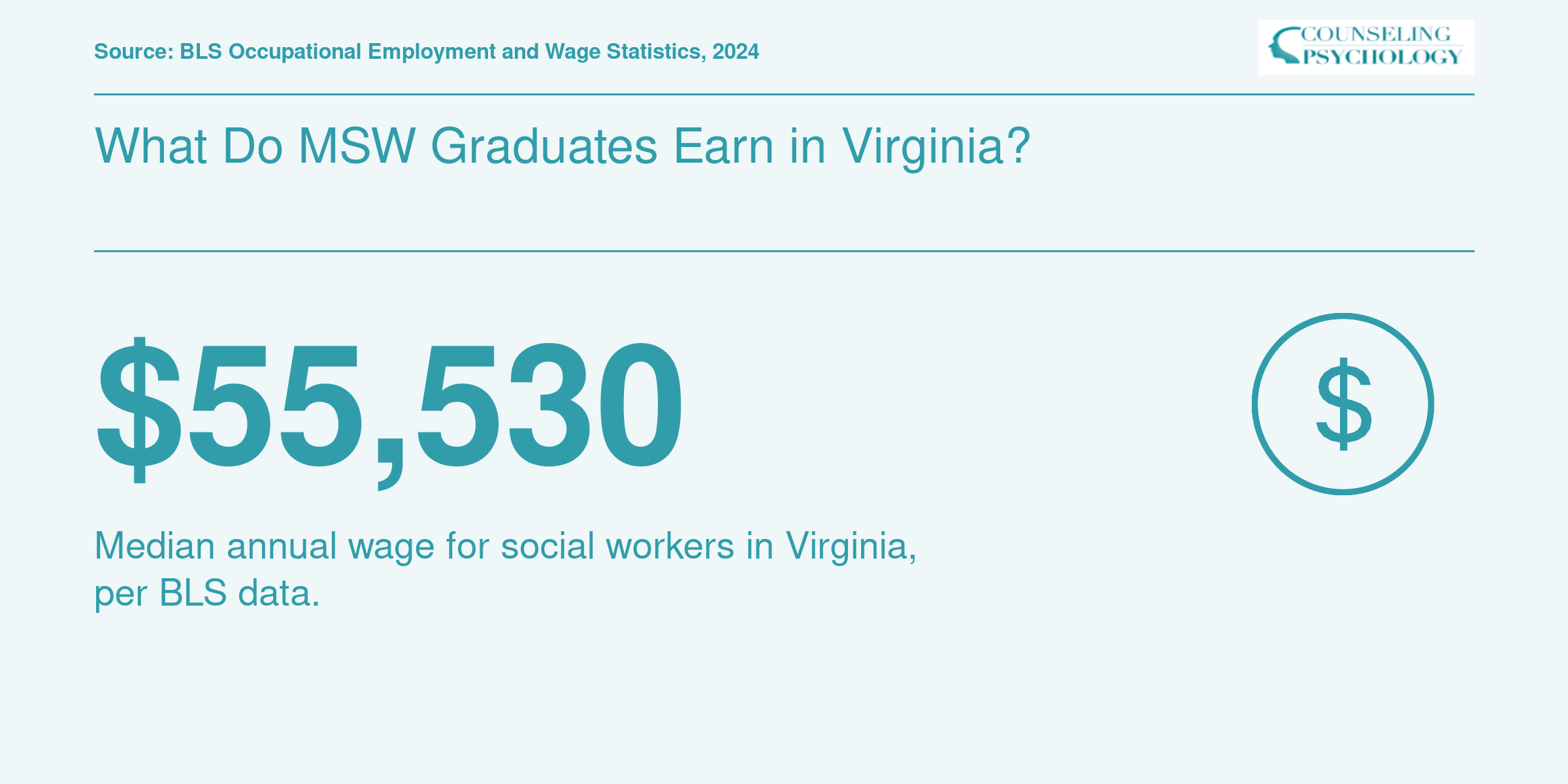
Program-level median earnings one year after completion are not yet available for Virginia MSW programs in published federal data. However, BLS figures offer useful context: the median annual wage for social workers in Virginia was $55,530, which sits above the national median of $55,350 for the same occupation. Earnings vary considerably by specialization, with clinical social workers and healthcare social workers typically commanding higher pay than those in child and family services.
Online vs. Campus MSW Programs in Virginia
One of the most common questions prospective students ask is whether online MSW programs carry the same weight as campus-based ones. The short answer: if a program holds CSWE accreditation, it meets identical standards regardless of delivery format, and graduates qualify for the same licensure pathways. Your choice really comes down to how you learn best and what logistical constraints shape your schedule.
Pros
- Online MSW programs offer scheduling flexibility that lets working professionals in Virginia complete coursework on their own time.
- CSWE-accredited online programs use the same curriculum and satisfy the same licensure requirements as their on-campus counterparts.
- Students anywhere in Virginia can access top-ranked programs without relocating; Norfolk State, for example, offers a hybrid format combining online and in-person elements.
- VCU's online MSW includes five distinct pathways and an accelerated full-time option completable in roughly 16 months for regular-standing students.
- Part-time online tracks, such as VCU's 48-month option, let students spread out a 60-credit workload while maintaining employment.
- Campus programs foster a built-in cohort community that can strengthen peer support and long-term professional networks.
- In-person formats at schools like George Mason and Virginia Union provide direct faculty mentorship and face-to-face classroom discussion.
- On-campus students often build stronger local field placement connections through in-person networking with agency supervisors and alumni.
Cons
- Online students should expect a substantial weekly workload; VCU's online MSW estimates 14 to 22 hours per week of coursework and field responsibilities.
- Remote learners may miss spontaneous peer collaboration and the social bonding that naturally develops in a campus cohort.
- Campus-based programs demand a fixed schedule and commute, which can be difficult for students balancing full-time jobs or caregiving duties.
- In-person programs may limit your school options geographically; campus-only MSW programs like those at George Mason and Virginia Union require attendance in Fairfax or Richmond.
- Field placement hours are required in both formats (typically 750 to 900 hours at VCU), so even online students must arrange supervised, in-person practicum experiences locally.
Related Articles
CSWE Accreditation and Licensure Exam Pass Rates at Virginia MSW Programs
Choosing an MSW program with CSWE accreditation versus one still in candidacy determines whether you can sit for the ASWB licensure exam immediately after graduation or face delays that can derail your career timeline by months or even years. In Virginia, where the Board of Social Work requires graduation from a CSWE-accredited program to qualify for LMSW or LCSW licensure, this distinction is not academic. It is the difference between starting supervised practice on schedule and waiting on the sidelines while your cohort advances.
Virginia MSW Programs with CSWE Accreditation
As of 2026, approximately six MSW programs operate in Virginia, the majority holding full CSWE accreditation.1 These include George Mason University, Virginia Commonwealth University, Radford University, Norfolk State University, Old Dominion University, and James Madison University. Full accreditation means the program has met the Council on Social Work Education's educational standards and undergone a rigorous site review. Graduates from fully accredited programs are immediately eligible to apply for the ASWB Masters exam, the gateway to LMSW licensure in Virginia.
Programs listed as "in candidacy" have applied for initial accreditation but have not yet completed the full review cycle. Students enrolled during candidacy status typically receive retroactive recognition once the program achieves full accreditation, but this is not guaranteed. If you are considering a newer or restructured program, confirm its accreditation timeline directly with the school and verify your cohort's eligibility window with the Virginia Board of Social Work before enrolling.
ASWB Exam Pass Rates: What the Data Shows
The Virginia Board of Social Work publishes a Pass/Fail Summary of the Clinical Examination that tracks ASWB performance by MSW program. As of the most recent reporting cycle, four Virginia programs provided enough candidate volume to generate representative pass-rate statistics.2 The national first-time pass rate for the ASWB Masters exam stood at 73 percent in 2024, offering a benchmark against which to evaluate individual programs.3
ASWB itself publishes Exam Performance Reports for social work programs that break down pass rates by school, exam type, and attempt number. These reports are public and searchable, though ASWB cautions that programs with fewer than 200 cumulative test-takers may show statistical volatility.3 Virginia Commonwealth University School of Social Work has issued a statement acknowledging the value of pass-rate transparency while noting that cohort size, exam timing relative to graduation, and state-specific score cut-offs can all influence year-to-year results.4
The Accreditation-to-Licensure Pipeline
The pathway is linear but time-sensitive. CSWE accreditation qualifies you to take the ASWB Masters exam. Passing that exam in Virginia grants you LMSW licensure, which authorizes supervised clinical practice. After accumulating the required hours under an approved clinical supervisor, you become eligible for the ASWB Clinical exam and, upon passing, the LCSW credential that opens independent practice, insurance reimbursement, and higher-responsibility roles.
If your MSW program lacks full CSWE accreditation at the time of your graduation, the Virginia Board will not accept your application for exam authorization. That delay compounds: you cannot log supervised hours without the LMSW, so your timeline to LCSW stretches accordingly. For students financing their degree with the expectation of entering the workforce on a predictable schedule, accreditation status is non-negotiable.
How to Verify Accreditation and Interpret Pass Rates
Check the CSWE Directory of Accredited Programs online and confirm that your program of interest holds full, not candidacy, status. Cross-reference the Virginia Board of Social Work's published exam summary to see how recent cohorts performed on the ASWB Masters and Clinical exams. Programs that consistently approach or exceed the 73 percent national benchmark signal strong curriculum alignment with the exam's competency domains. Those that fall short may still offer excellent field placements and faculty mentorship, but you will want to understand what remedial support or exam-prep resources they provide to close the gap.
Questions to Ask Yourself
MSW Specializations and Concentrations at Virginia Schools
Virginia's CSWE-accredited MSW programs each carve out distinct concentration areas, so choosing the right school often comes down to matching your career goals with available tracks. Students aiming for direct clinical practice, child welfare, military-connected populations, or trauma work will find meaningfully different options across the state. The table below maps each program's primary concentration and notable specialization areas to help you zero in on the best fit.
| School | Primary Concentration | Additional Tracks or Specialization Areas | Format | Best Fit For |
|---|---|---|---|---|
| VCU | Clinical Social Work Practice | School Social Work certificate available | Campus | Students pursuing clinical licensure (LCSW) or school social work careers |
| George Mason University | Children, Youth, and Families (CYF) | Advocacy, social action, empowerment and systems transformation focus; culturally diverse practice | Campus and Online | Those drawn to child welfare, family services, or policy advocacy roles |
| Radford University | Community-Based Family Practice (CBFP) | Emphasis on rural and community settings; 1,010 field placement hours | Campus | Students interested in family-centered, community-level practice, especially in rural Virginia |
| Norfolk State University | Military Social Work | Child welfare, mental health, health care, and trauma-informed practice courses available | Hybrid (in-person and online) | Students targeting work with military populations, veterans, or health care settings |
| Virginia Union University | Trauma-Focused Specialization | Micro, mezzo, and macro practice; anti-racist and culturally aware approaches; social justice emphasis | Campus | Students seeking trauma-informed clinical skills with a social justice orientation |
MSW Admissions Requirements and Field Placement in Virginia
Traditional MSW applicants and advanced standing applicants face two very different admissions tracks in Virginia, and the field placement structure that follows can look just as different depending on whether you're full-time on campus, online, or arranging an employer-based practicum. Knowing where to look (and who to call) saves weeks of guesswork.
Admissions Requirements: What to Verify Directly
Virginia MSW programs at VCU, George Mason, Radford, and Norfolk State each set their own admissions thresholds, and those thresholds change. Rather than rely on third-party summaries, pull the current requirements from each program's official admissions page. Look specifically for:
- GPA minimums: Most programs publish a minimum undergraduate GPA, often with a higher bar for advanced standing applicants.
- Prerequisites: Liberal arts breadth requirements, statistics, and human biology coursework are common, but exact lists vary.
- Advanced standing eligibility: This track is reserved for applicants holding a BSW from a CSWE-accredited program, typically earned within the last five to seven years. The accreditation piece is non-negotiable, so confirm your undergraduate program's status through CSWE before applying.
- Application materials: Personal statement prompts, reference requirements, and resume expectations differ by school.
Field Placement: Hours, Partnerships, and Employer-Based Options
Field education is the spine of any MSW, and the details live in the "Field Education" or "Practicum" section of each program's website, not the admissions page. CSWE requires a minimum of 900 field hours for the MSW, but how those hours are structured (concurrent vs. block, generalist vs. specialized year) is program-specific.
For the most current and detailed information, contact the field education office directly by email or phone. Field directors can tell you:
- Which agencies they partner with in your region of Virginia (Richmond, Northern Virginia, Hampton Roads, and Southwest Virginia all have different placement landscapes).
- Whether employer-based placements are permitted, what approval looks like, and whether your current job can host hours.
- How online students are placed and what geographic radius the program supports.
Broader Context
Social work shares professional territory with several allied fields. If you are weighing your options, you may also want to explore clinical mental health counseling online programs, which prepare graduates for a different but complementary licensure pathway. For career outlook data on social work roles, the Bureau of Labor Statistics publishes occupational projections at BLS.gov. For accreditation standards (and the rules that govern advanced standing eligibility), the Council on Social Work Education maintains the authoritative list of accredited programs.
Social Worker Salaries in Virginia by Metro Area and Role
How much can you actually earn with an MSW in Virginia, and does the investment pay off compared to the debt you take on?
The answer depends heavily on where you practice and what type of social work you pursue. Virginia's salary landscape varies considerably across metro areas and specializations, so understanding these differences is essential before you commit to a program.
Statewide and National Wage Context
At the national level, BLS data from May 2023 places the median annual wage for child, family, and school social workers at $53,940.1 Earners at the 25th percentile brought in about $45,120, while those at the 75th percentile reached $68,450, and the top 10% earned $85,590 or more.1 Virginia-specific BLS figures for social workers have historically tracked above these national medians, though state-level data should be confirmed against the most current release for precision.
Clinical social workers (those holding an LCSW) and healthcare social workers tend to command higher salaries than child and family practitioners. Nationally, healthcare social workers and mental health/substance abuse social workers carry median wages several thousand dollars above the child and family category. In Virginia, the same pattern holds, with clinical roles in hospital systems and behavioral health agencies offering some of the strongest compensation.
Metro Area Differences Across Virginia
Northern Virginia and the broader Washington-Arlington-Alexandria metro area consistently report the highest social work salaries in the state. Wages in this corridor can run 15% to 25% above the statewide median depending on the role, reflecting both federal agency demand and the region's high cost of living. Housing, transportation, and childcare costs in Northern Virginia significantly offset the salary premium, so take-home purchasing power may not stretch as far as it appears.
Richmond offers a more moderate salary range with a notably lower cost of living, making it attractive for new MSW graduates seeking a reasonable balance. The Hampton Roads area (Virginia Beach, Norfolk, Newport News) provides steady demand through its military installations and healthcare systems, though wages tend to sit closer to or slightly below statewide medians. Roanoke and southwestern Virginia generally report the lowest wages among major metros, but the cost of living there is among the most affordable in the state. Professionals in the DC metro area who are also weighing counseling programs in Virginia may find it useful to compare compensation trajectories across both fields.
Is an MSW Worth It Financially?
Program-level earnings data for Virginia MSW graduates is not yet available through federal reporting for most schools, which makes a precise ROI calculation difficult. However, you can frame the question using what is known. In-state tuition for Virginia MSW programs ranges from roughly $13,000 to $18,000 for the full degree at public institutions like George Mason University or Norfolk State University. Median graduate debt at these schools falls between about $19,500 and $29,000.
Compare that debt load against a starting salary in the mid-$40,000s for entry-level roles, with a realistic trajectory toward $55,000 to $70,000 within five to ten years for those who obtain clinical licensure. For graduates entering the Northern Virginia or DC metro job market, the ceiling is higher still. The debt-to-income ratio at most Virginia public MSW programs is manageable, particularly if you qualify for in-state tuition or pursue loan repayment programs available to social workers in public service.
Salary by Role Type in Virginia
- Child, family, and school social workers: Typically the entry point for MSW holders; salaries cluster around the national median of $53,940, with Virginia often slightly above.1
- Healthcare social workers: Hospital and health system positions tend to pay more, especially in urban medical centers in Richmond and Northern Virginia.
- Clinical social workers (LCSW): The highest-earning track for MSW graduates; private practice and behavioral health agencies in the DC metro area offer the strongest compensation.
- Community and nonprofit roles: Often the lowest-paid positions, but many qualify for Public Service Loan Forgiveness after ten years of eligible payments.
The bottom line: an MSW from a Virginia program represents a solid financial investment for most students, particularly those who plan to pursue clinical licensure and practice in higher-paying metro areas. Just be realistic about the timeline. The biggest salary jumps come after you complete supervised hours and earn your LCSW.
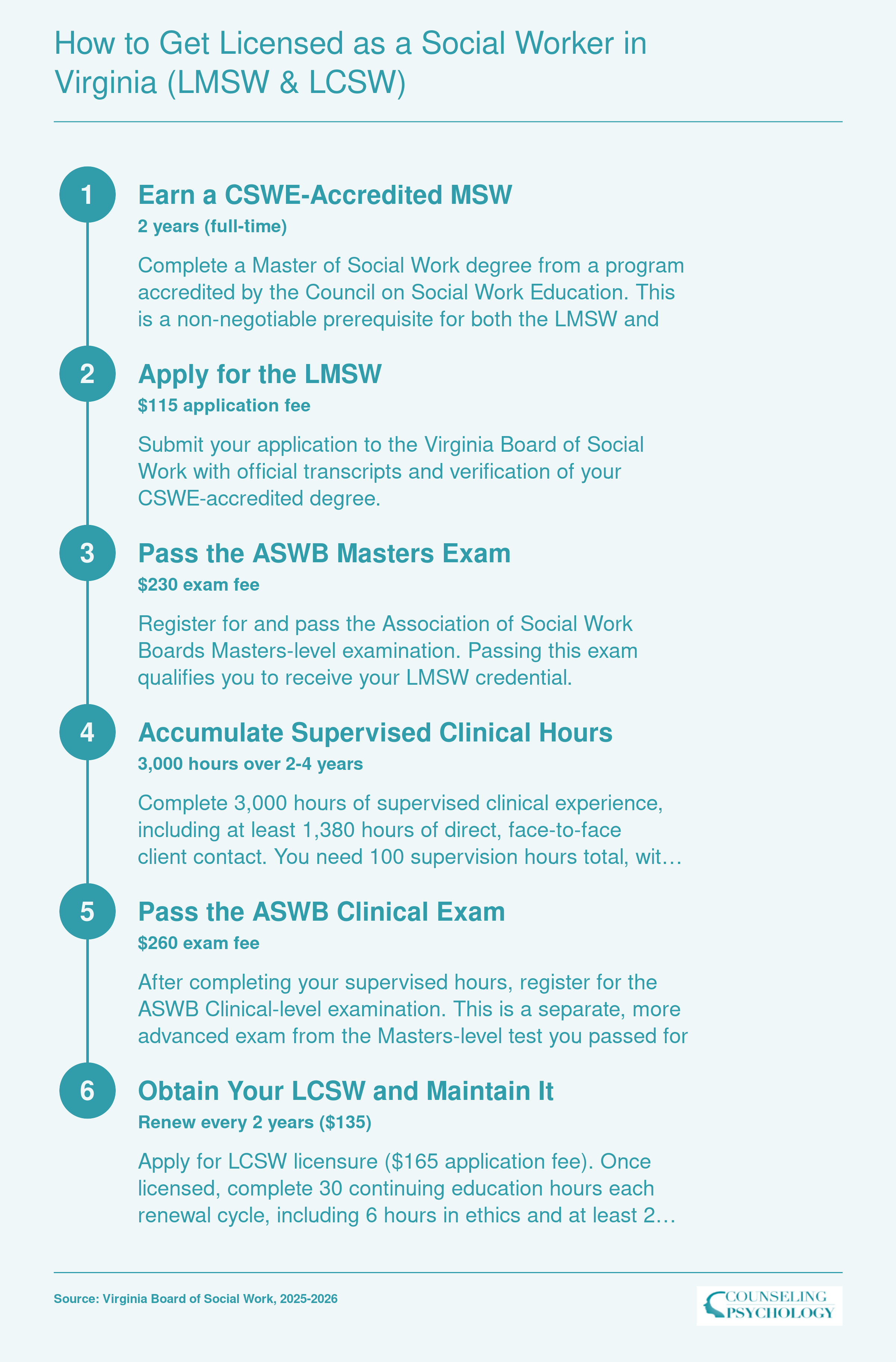
How to Get Licensed as a Social Worker in Virginia (LMSW & LCSW)
Virginia requires all social work licensure candidates to hold an MSW from a CSWE-accredited program. Without that accreditation, you cannot sit for the required ASWB exams or apply to the Virginia Board of Social Work. The pathway from new graduate to fully licensed clinical social worker typically takes two to four years of post-degree supervised practice.
Frequently Asked Questions About Virginia MSW Programs
Below are answers to the questions prospective MSW students in Virginia ask most often. Each response draws on data and details covered in the sections above.