
What you’ll learn in this article…
- Philadelphia-area developmental psychology programs span bachelor's through doctoral levels at schools like Penn State, Pitt, and Albright College.
- Pennsylvania licenses developmental psychologists under its general psychologist credential, requiring a doctorate, supervised hours, and a 500 EPPP score.
- Clinical and counseling psychologists in the Philadelphia metro area earn a mean annual wage above the national median, per 2023 BLS data.
- Developmental, child, and school psychology differ sharply in training focus and career outcomes, so choosing the right track early matters.
Research-focused doctoral programs and undergraduate entry points sit at opposite ends of the developmental psychology pipeline, and Pennsylvania offers both within reach of Philadelphia. The University of Pittsburgh and Penn State run doctoral programs with structured mentorship and assistantship funding, while Albright College's Child Development Track provides a bachelor's-level foundation for students not yet ready for graduate admissions. That spread matters because the credential required to practice independently as a psychologist in Pennsylvania is a doctorate, making program selection an early and consequential commitment. Students exploring their options can review different types of psychology degrees to understand how developmental tracks compare with related fields.
Philadelphia's density of academic medical centers, children's hospitals, and research universities creates clinical training infrastructure that is unusually concentrated for a regional market. That advantage is tempered by competitive doctoral admissions and licensure requirements that include supervised postdoctoral hours and a passing score on the EPPP. Students weighing careers in psychology should factor in a training timeline that typically runs five to seven years beyond the bachelor's degree before independent licensure is within reach.
Best Developmental Psychology Programs Near Philadelphia
Philadelphia-area students interested in how humans grow, learn, and adapt from infancy through adolescence have several strong Pennsylvania programs to consider. The schools below range from a doctoral research powerhouse to a small-college bachelor's track, each offering a distinct entry point into developmental psychology. Program-level earnings and debt figures are not yet available for these specific programs, so we include institution-wide financial benchmarks to help frame the investment.
- Graduate earnings and student debt
- Graduation and retention rates
- Faculty mentorship ratios
- Program specialization depth
- Practical training opportunities
- College Scorecard graduate earnings — collegescorecard.ed.gov
- NCES-IPEDS federal institutional data — nces.ed.gov
- Internal program database
- Independent program research

University of Pittsburgh-Pittsburgh
The University of Pittsburgh pairs rigorous doctoral training with a research-intensive environment, offering two distinct PhD pathways in developmental psychology. Its 13:1 student-to-faculty ratio supports close mentorship, and the institution posts an 85.5% graduation rate, one of the strongest in the state. Median graduate debt sits at $24,250 institution-wide, while median earnings ten years after enrollment reach $66,125, though these figures reflect the university overall rather than this program alone.
- Campus-based doctoral program centered on developmental theory and empirical research
- Covers socio-emotional, cognitive, and language development across the lifespan
- Close faculty mentorship with collaborative lab opportunities
- Multiple methodological approaches including experimental and observational designs
- Full-time enrollment required; assistantship support available
- Strong academic background expected for competitive admission
- 90-credit doctoral program housed in the School of Education
- In-person format with full-time and part-time enrollment options
- No GRE required for admission
- Specializations in Infant Mental Health, Child and Youth Development, and Behavioral Health
- Five-year expected completion with a December 1 application deadline
- Hybrid evening and online coursework options support working professionals
- Prepares graduates for community mental health and school-based roles in Pennsylvania
PhD in Developmental Psychology — On-Campus
PhD in Applied Developmental Psychology — On-Campus

Pennsylvania State University
Penn State's developmental psychology doctoral program trains students across multiple research concentrations, making it one of the more flexible options in the state. In-state tuition of roughly $24,650 gives Pennsylvania residents a cost advantage, and the institution reports median earnings of $63,435 ten years post-enrollment and median graduate debt of $25,000 at the school level. Note that the institution-wide graduation rate of 34.1% reflects the World Campus entity's largely nontraditional student population and should not be read as a measure of this specific doctoral program's completion outcomes.
- Campus-based doctoral training at the University Park flagship campus
- In-depth study from infancy through adolescence
- Research collaboration opportunities with developmental faculty
- Applications due December 1; must meet Penn State graduate standards
- Ideal preparation for careers in research, academia, or applied settings
- Covers perceptual, cognitive, and biological bases of development
- Concentration zeroes in on how children perceive and process information
- Research spans infancy to adolescence across cognitive domains
- Campus-based with access to Penn State's developmental labs
- Strong methodological training in experimental paradigms
- Faculty-led research projects available from the first year
- December 1 application deadline
- Concentration focused on emotional regulation and temperament across childhood
- Examines adjustment outcomes from social-ecological perspectives
- Campus-based program with active cross-disciplinary research
- Multiple thematic areas available for dissertation work
- Applications due December 1
- Designed for students targeting research or clinical-academic careers
Developmental Psychology PhD — On-Campus
Developmental Psychology PhD, Perceptual and Cognitive Development — On-Campus
Developmental Psychology PhD, Emotion, Temperament, and Adjustment — On-Campus

Albright College
Albright College stands out as the only bachelor's-level option on this list, offering a psychology major with a dedicated Child Development Track. Situated in Reading, about an hour northwest of Philadelphia, the small liberal arts environment delivers an 11:1 student-to-faculty ratio and hands-on experiences through its Early Learning Center. Sticker tuition is $29,082, but the average net price drops to around $20,024 after aid. Institution-wide median graduate debt is $27,000, and median earnings ten years out are $58,700; the 50.7% graduation rate reflects the full undergraduate population, not this track specifically.
- Campus-based BA with a focused Child Development concentration
- Explores physical, cognitive, social, and emotional growth from conception through adolescence
- Hands-on research opportunities with personalized faculty mentoring
- Internship placements in child-serving organizations across southeastern PA
- Early Learning Center access provides direct experience with young children
- Designed to prepare students for graduate programs in child psychology or social services
- Small class sizes supported by an 11:1 student-to-faculty ratio
Bachelor's in Psychology, Child Development Track — On-Campus
Developmental vs. Child vs. School Psychology: Key Differences
Students often use the terms developmental psychology, child psychology, and school psychology interchangeably, but the three tracks differ sharply in training focus, degree pathways, and career outcomes.1 Understanding these distinctions early helps you match your interests to the right program and licensure credential.
Developmental Psychology: Research-Focused and Lifespan Oriented
Developmental psychology examines how people grow, learn, and change from infancy through older adulthood. Programs typically lead to a research-oriented PhD and emphasize experimental design, statistical modeling, and theory development. You will study cognitive, social, emotional, and physical development across the lifespan, but clinical training is minimal or absent. Students interested in this route can explore developmental psychology masters programs as a stepping stone toward doctoral research.
Because developmental programs do not provide supervised health-service experience, graduates rarely qualify for Pennsylvania psychologist licensure unless they pursue additional clinical coursework and practicum hours.1 Career paths center on academic research, faculty positions, policy analysis, and applied-research roles in government agencies or nonprofit research institutes.
Child Psychology: A Specialization, Not a Standalone Degree
Child psychology is not a separate accredited track. Rather, it appears as a concentration within clinical psychology or developmental psychology programs.2 If you enroll in a clinical psychology PhD or PsyD with a child track, you will complete the same core clinical curriculum as other students, then add specialized coursework and practica in child assessment, family therapy, and developmental psychopathology.
Clinical child and adolescent psychology programs hold APA accreditation under the broader clinical psychology umbrella.2 Graduates pursue Pennsylvania licensure as clinical psychologists and may later seek board certification through the American Board of Clinical Child and Adolescent Psychology. If you want to learn more about the career trajectory, our guide on how to become a child psychologist outlines the full degree and licensure sequence. Common settings include pediatric hospitals, outpatient clinics, private practice, and integrated-care teams.
School Psychology: Practitioner Training for Educational Settings
School psychology trains practitioners to assess learning difficulties, design behavior interventions, and consult with teachers and families in K-12 schools.3 Specialist-level programs (EdS or MA plus School Psychology Specialist certificate) require 60 to 70 credits and culminate in a 1,200-hour internship. Graduates earn Pennsylvania school psychologist certification from the state Department of Education, not psychologist licensure from the State Board of Psychology.4
Doctoral school psychology programs (PhD or PsyD) may qualify you for both school certification and psychologist licensure, expanding your scope to private practice and community mental health work.4 School psychology holds separate APA accreditation (Division 16) and parallel accreditation from the National Association of School Psychologists (NASP), reflecting its distinct standards and competencies.
If your goal is educational consultation and assessment within schools, school psychology is the direct path. If you want to provide psychotherapy or diagnostic services in clinical settings, a clinical program with a child track is the better match. If you aim to conduct research on developmental processes without pursuing clinical licensure, a developmental PhD aligns with your objectives.
Questions to Ask Yourself
How to Become a Licensed Developmental Psychologist in Pennsylvania
Pennsylvania does not issue a separate "developmental psychologist" license. Developmental psychologists are credentialed under the general psychologist title through the PA State Board of Psychology. The pathway below outlines the major milestones from doctoral study through board approval.
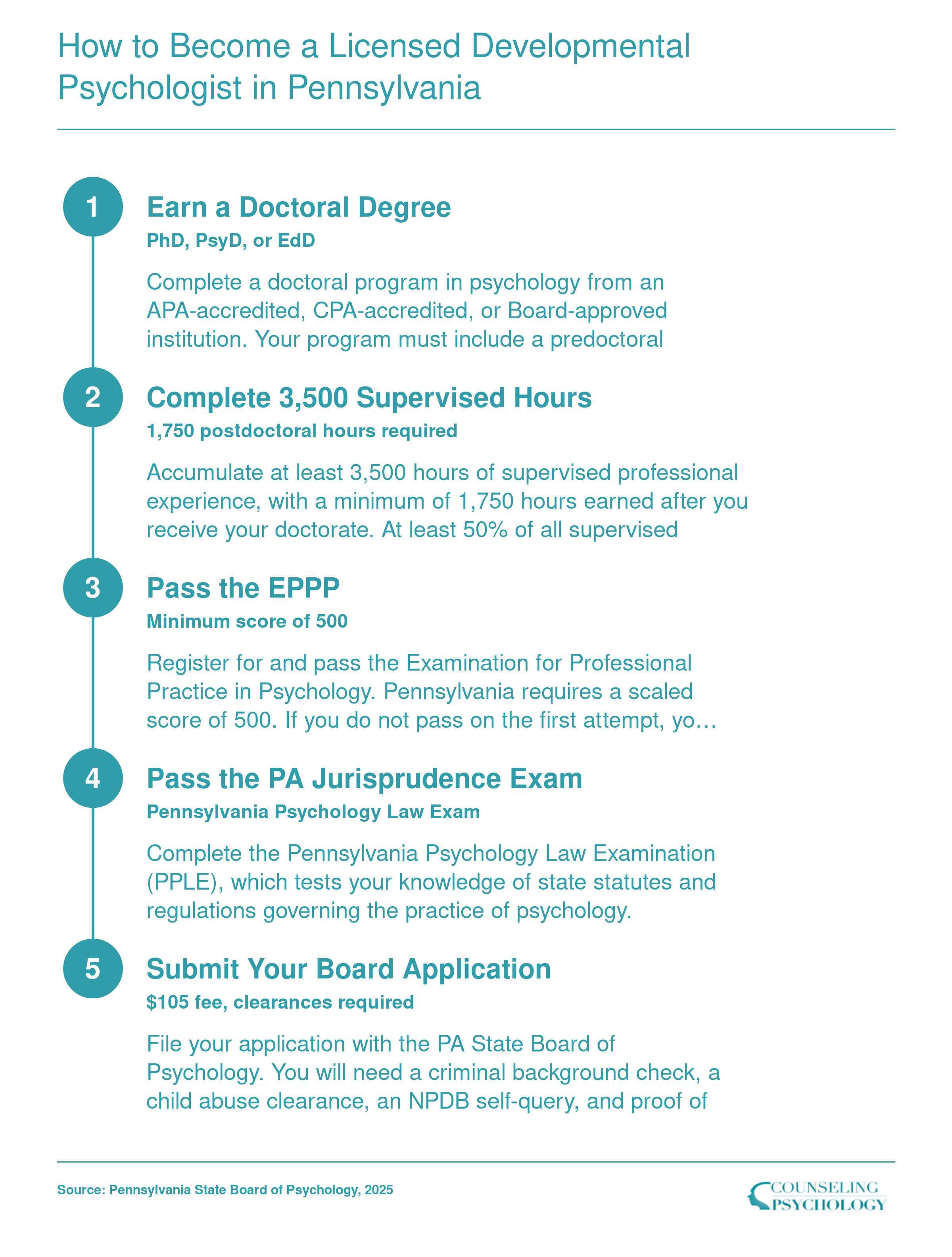
PA Licensure Step-by-Step: Education, Supervised Hours, and the EPPP
Pennsylvania requires a passing score of 500 on the Examination for Professional Practice in Psychology (EPPP), but reaching that milestone requires a sequenced path of education and supervised experience.1
Education: The Doctoral Foundation
Before you can begin accruing supervised hours or sit for the EPPP, you must hold a doctoral degree in psychology from an APA-accredited or regionally accredited program.2 Developmental psychology programs qualify when they are part of a broader psychology department or accredited school psychology track. A master's in developmental psychology, while valuable in its own right, does not satisfy the educational requirement for psychologist licensure in Pennsylvania. For a broader look at the full credentialing process, see our guide on how to become a psychologist.
Supervised Experience Hours
Pennsylvania mandates two tiers of supervised experience. Pre-doctoral supervised hours cap at 1,750 and must span at least 12 months. This internship typically occurs during the final year of a doctoral program. Post-doctoral supervision then requires an additional 1,750 hours over a minimum of 12 months.3 During this phase, you receive at least two hours of individual, face-to-face supervision per week. The entire supervised experience window, from the start of pre-doctoral hours to the completion of post-doctoral hours, must fall within a 10-year period.
The EPPP and State Law Exam
After your degree and supervised hours are documented, the Pennsylvania State Board of Psychology authorizes you to take the EPPP. A scaled score of 500 is required to pass.1 The exam covers biological bases of behavior, cognitive-affective bases, social and cultural factors, assessment, treatment, and professional ethics. Many candidates prepare using structured study programs from the Association for Advanced Training in the Behavioral Sciences (AATBS) or Academic Review.
Pennsylvania also requires the Pennsylvania Psychology Law Examination, a state-specific test on the board's regulations and the Psychology Practice Act. You must score at least 75% to pass.3 This open-book exam is typically taken after the EPPP.
Continuing Education and License Renewal
Once licensed, you must renew your license every two years and complete 30 hours of continuing education (CE).4 At least three of those hours must address ethical issues, two must cover child abuse recognition and reporting, and one must focus on suicide prevention. New licensees must also complete an initial three-hour child abuse CE as part of the first renewal cycle.
Options for Master's-Level Graduates
Master's-level developmental psychology graduates cannot obtain independent licensure as psychologists in Pennsylvania. However, they may pursue related credentials, such as the licensed professional counselor or behavior specialist license, that allow them to provide therapeutic services under supervision or in school-based settings. Each pathway carries its own degree, supervision, and examination requirements.
Program Costs, Graduate Earnings, and Return on Investment
The table below compares tuition, median graduate debt, and institution-wide earnings for the developmental psychology programs ranked in this guide. Net price figures reflect institution-wide averages after financial aid, not program-specific guarantees, so your actual cost may differ depending on aid packages, residency, and enrollment status. Program-level post-completion earnings are not yet available for these programs, so the 10-year median earnings shown are institution-wide figures from the College Scorecard. Even so, median earnings at all three schools comfortably outpace their respective median debt loads, with graduates at the University of Pittsburgh earning roughly 2.7 times their median debt within a decade, a strong signal that the investment can pay off over time.
| Institution | Degree Level | Tuition (In-State) | Tuition (Out-of-State) | Avg. Net Price (Institution-Wide) | Median Graduate Debt | Median Earnings (10 Yr, Institution-Wide) | ROI Ratio (Earnings to Debt) |
|---|---|---|---|---|---|---|---|
| University of Pittsburgh | Doctorate | $27,580 | $46,786 | $30,434 | $24,250 | $66,125 | 2.73 |
| Pennsylvania State University | Doctorate | $24,650 | $24,650 | $19,550 | $25,000 | $63,435 | 2.54 |
| Albright College | Bachelor's (Child Development Track) | $29,082 | $29,082 | $20,024 | $27,000 | $58,700 | 2.17 |
Related Articles
Degree Levels: Bachelor's, Master's, and Doctorate Options in Developmental Psychology
Three institutions in our Pennsylvania ranking represent the full degree pipeline: Albright College offers a bachelor's-level Child Development Track, while the University of Pittsburgh and Penn State both run doctoral programs in developmental psychology. That spread mirrors the broader reality of the field: developmental psychology is a layered credential pathway, not a one-degree career.
Bachelor's Degrees: The Foundation
A child psychology degree with a developmental or child development focus, like Albright's track in Reading, opens doors to entry-level work but does not qualify you for clinical practice. Graduates typically land roles as research assistants in university labs, behavioral technicians, early intervention specialists, case aides in social services, paraprofessionals in school settings, or program staff at organizations like Head Start. Albright's program embeds internship placements and Early Learning Center experience, which matters because graduate admissions committees expect hands-on hours alongside coursework. Treat the bachelor's as a launchpad: useful work, but a stepping stone toward graduate training if you want to call yourself a developmental psychologist.
Master's Options: Applied and Specialized
Child psychology masters programs in applied developmental psychology or child psychology concentrations prepare graduates for program evaluation, curriculum design, child life work, community-based research, and supervisory roles in youth services. Some master's-trained professionals work in counseling-adjacent positions under licensed supervisors. What a master's in developmental psychology does NOT do in Pennsylvania is qualify you for independent psychologist licensure; the state requires a doctorate for that title. If your goal is clinical counseling rather than research, a master's in clinical mental health counseling or social work is usually the more direct route.
Doctoral Programs: Ph.D. vs. Psy.D.
Both Pitt and Penn State offer Ph.D. programs, which is typical for developmental psychology specifically. Ph.D. tracks emphasize research methodology, dissertation work, and academic or research-scientist careers. Pitt highlights faculty mentorship and multiple methodological approaches, while Penn State's program spans infancy through adolescence with research in cognitive, emotional, and biological development. Psy.D. programs, more common in clinical psychology than in pure developmental tracks, emphasize practitioner training over research output. Both degree types satisfy the educational requirement for Pennsylvania psychologist licensure.
The Lifespan and Aging Niche
One underrecognized branch: developmental psychology is not just about children. Lifespan and aging-focused tracks study cognitive change, adjustment, and well-being across adulthood and older age, a growing niche as the U.S. population ages. Students interested in gerontology, dementia research, or adult transitions may want to explore geropsychology doctorate programs, and should ask programs directly about lifespan faculty, since not every developmental department covers the full age range.
Career Paths and Salary Expectations for Developmental Psychologists in Philadelphia
Salary Data for Psychologists in the Philadelphia-Camden-Wilmington MSA
Understanding earning potential is critical when planning your career in developmental psychology. According to Bureau of Labor Statistics data for the Philadelphia-Camden-Wilmington MSA (2023), clinical and counseling psychologists earn a mean annual wage of $106,610, with approximately 1,430 professionals employed in the region.1 School psychologists in the same metro area earn a mean of $95,120 annually, representing a workforce of about 1,810.1 The catch-all "Psychologists, All Other" category, which includes many developmental specialists working in research or applied settings, reports a mean wage of $110,050 for roughly 330 positions.1
These figures reflect mean rather than median values, so actual salaries will vary based on experience, credentials, and employer type. Entry-level positions typically fall below these averages, while senior research directors, licensed practitioners with specialized certifications, and those in leadership roles often exceed them. The data encompasses the broader Philadelphia metropolitan area, including Camden, New Jersey, and Wilmington, Delaware, offering flexibility in where you work.
Concrete Career Paths in Developmental Psychology
Developmental psychology graduates pursue diverse roles across clinical, research, and applied settings:
- Research psychologist: Conduct studies on cognitive, social, or emotional development at university labs or medical centers. Positions at Penn Medicine, the Children's Hospital of Philadelphia (CHOP), Temple University, and Drexel University anchor this track.
- Clinical child psychologist: Provide assessment and therapy for children and adolescents facing developmental delays, learning disorders, or behavioral challenges. Licensure as a psychologist is required (doctorate plus supervised hours).
- Early intervention specialist: Work with infants and toddlers (birth to three) and their families, often through county or state-funded programs. Bachelor's-level roles exist, though master's degrees improve advancement prospects.
- Program evaluator: Assess the effectiveness of educational or social-service initiatives for youth. Local school districts, Devereux Advanced Behavioral Health, and nonprofit organizations regularly hire evaluators.
- Developmental consultant: Advise schools, daycare centers, or community organizations on age-appropriate curricula, behavioral strategies, and inclusion practices.
Bachelor's vs. Graduate-Level Career Access
A bachelors in developmental psychology opens doors to entry-level research assistant, case management, and direct-service positions, but independent practice and advanced roles require graduate training. Master's programs prepare you for specialist roles in early intervention, program coordination, and applied settings. Doctoral degrees (PhD or PsyD) are mandatory for licensure as a psychologist in Pennsylvania and enable independent clinical practice, university faculty appointments, and senior research roles. Those interested in working directly with young clients may also explore pathways as a child counselor, which typically requires a master's degree and licensure.
Long-Term Job Growth and Demand
Nationally, the BLS projects 11 to 12 percent job growth for clinical and counseling psychologists between 2022 and 2032, faster than the average for all occupations.2 School psychologists are expected to see 5 to 6 percent growth, and other psychology specialties approximately 4 to 5 percent.2 These projections reflect steady demand for mental health services, early childhood support, and evidence-based interventions across the lifespan. For a broader look at the field, our guide to developmental psychology covers program options and degree structures in more detail.
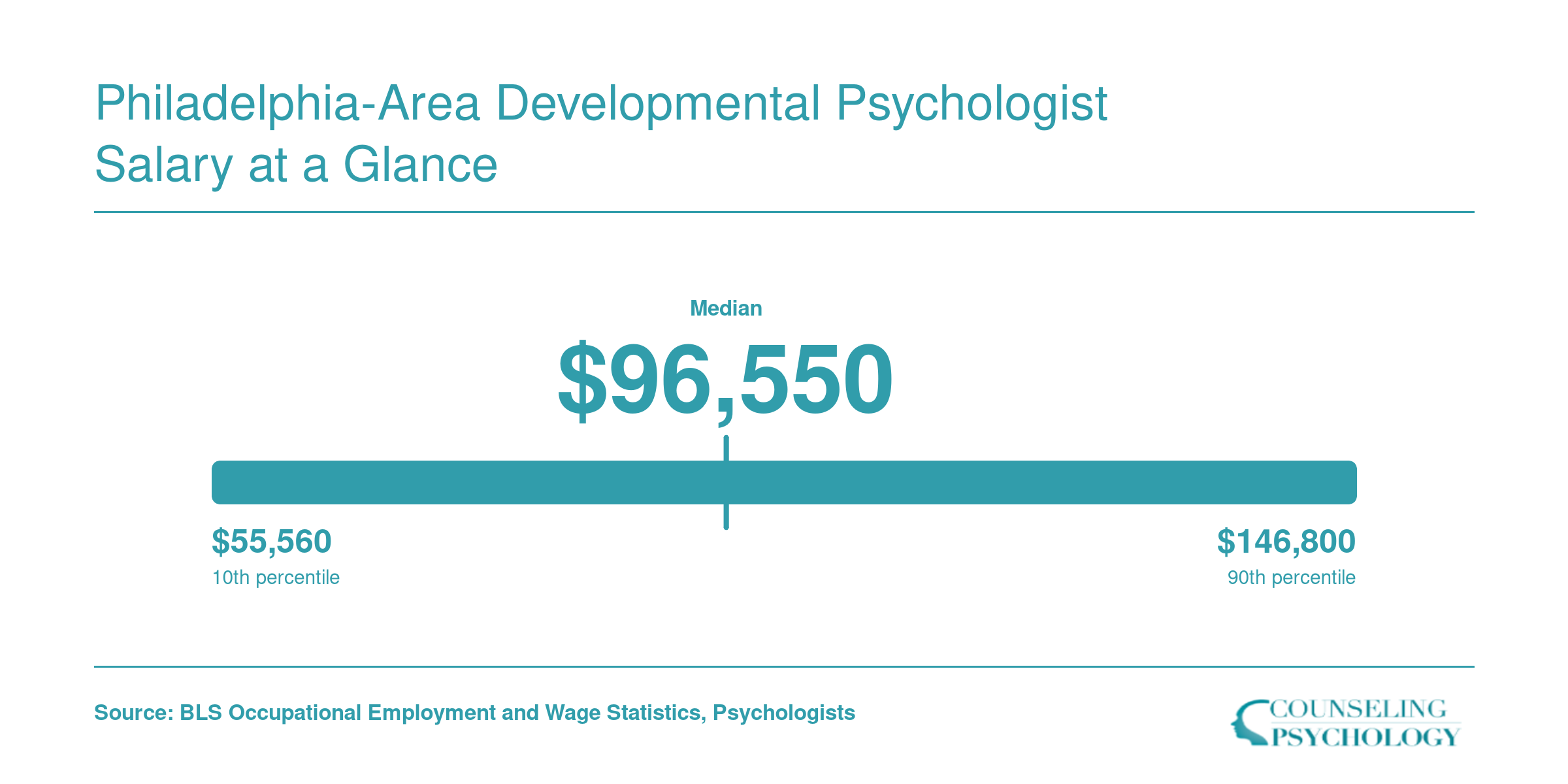
Philadelphia-Area Developmental Psychologist Salary at a Glance
Salaries for psychologists in the Philadelphia metropolitan area span a wide range depending on experience, specialization, and work setting. Early-career professionals typically earn near the lower percentiles, while seasoned developmental psychologists with doctoral credentials and established research or clinical portfolios can reach the upper end of this distribution.
Admissions Requirements and How to Apply
Graduate admissions in psychology have shifted noticeably since 2020, with many programs adopting test-optional policies while still maintaining rigorous academic standards. For prospective developmental psychology students in the Philadelphia area, understanding what each program expects will help you build a competitive application. If you're wondering how hard it is to get into grad school for psychology, the answer depends heavily on program type and your preparation.
GPA Expectations
Most master's programs in developmental psychology require a minimum undergraduate GPA of 3.0, while doctoral programs typically expect 3.3 or higher.1 These thresholds represent floors rather than targets. Competitive applicants often exceed minimums by a significant margin, particularly for research-focused Ph.D. programs. Temple University's School Psychology program, for example, lists a 3.0 minimum but uses holistic review that weighs academic performance alongside other factors.2
GRE Requirements: Verify Before You Apply
The GRE landscape varies considerably across programs. The University of Pennsylvania's Psychology Ph.D. program lists the GRE as optional for Fall 2026 admission3, while Temple University's School Psychology program still requires scores.2 This program-by-program variation makes it essential to check current requirements directly with each institution. If you have strong GRE scores, submitting them to test-optional programs can still strengthen your application.
Standard Application Components
Expect to submit the following materials for most developmental psychology graduate programs:
- Transcripts: Official records from all undergraduate and graduate institutions attended
- Personal statement: A narrative explaining your research interests, career goals, and fit with the program
- Letters of recommendation: Typically three, with at least two from faculty who can speak to your academic and research abilities3
- CV or resume: Documenting research experience, publications, presentations, and relevant work
- Writing sample: Required primarily for Ph.D. programs, often a research paper or honors thesis
- Prerequisite coursework: Programs commonly require introduction to psychology, developmental psychology, statistics, and sometimes research methods2
International applicants should note that English proficiency exams like TOEFL or IELTS are standard requirements for non-native speakers.3
Application Timelines
Doctoral programs in developmental psychology often set early December deadlines.1 UPenn's Psychology Ph.D. deadline for Fall 2026 entry was December 1, 2025, which is typical for competitive doctoral programs.3 Master's programs may offer rolling admissions or later spring deadlines, providing more flexibility.
Research Fit Matters for Ph.D. Applicants
For doctoral applicants, identifying faculty whose research aligns with your interests is not optional. Review faculty publications, note ongoing projects, and reference specific professors in your personal statement. Our guide to the best developmental psychology Ph.D. programs offers a broader look at what top programs value. Programs like Temple's School Psychology consider commitment to social justice as part of their holistic review2, so demonstrating alignment with program values strengthens your candidacy. Interviews are conducted by invitation only at many programs, including UPenn3, making your written materials your primary opportunity to convey fit.
How to Choose the Right Developmental Psychology Program
Choosing a developmental psychology program means evaluating more than just the school's reputation. The right program aligns with your career goals, preferred learning format, and the licensure requirements of the state where you plan to practice. Five key factors, from accreditation to mentorship, can make the difference between a degree that opens doors and one that falls short.
Accreditation: The Foundation of a Credible Degree
Accreditation is the baseline for any legitimate program. For doctoral programs leading to licensure as a psychologist, the gold standard is APA accreditation. Regionally accredited schools, the most common institutional accreditation, ensure credits transfer and degrees are recognized by employers and licensing boards. Master's-level programs in developmental psychology may not have programmatic accreditation, but the institution itself must hold regional accreditation. Before applying, verify the program's status: an accredited degree is essential for licensure eligibility and professional credibility.
Research or Clinical: Aligning Program Philosophy with Career Goals
The orientation of a program shapes your daily experience and long-term opportunities. Research-focused Ph.D. programs, typically found at large universities, emphasize original scholarship and prepare you for academic or research careers. If you are weighing those options, exploring doctoral programs in educational psychology can offer useful comparisons. Practice-oriented Psy.D. programs, often housed in professional schools, dedicate more time to clinical training. A master's degree can lean either way: some prioritize applied skills for school or community settings, while others serve as a stepping stone to a doctorate. Reflect on whether you want to design studies, teach, or work directly with clients, and choose a program philosophy that matches.
Format Flexibility: Online, Hybrid, and Campus-Based Options
Program format dramatically affects accessibility, especially if you are balancing work or family. Several institutions near Philadelphia now offer hybrid or fully online pathways. Drexel University's EdS in School Psychology uses a hybrid model with in-person core courses on campus, designed for students in the greater Philadelphia area.1 Duquesne University delivers its M.S.Ed. in Child Psychology (30 credits) in a hybrid format2, and the University of Pittsburgh offers a hybrid MS in Applied Developmental Psychology (36 credits). If you need maximum flexibility, consider fully online options: National University's MS in Child and Adolescent Developmental Psychology3, Walden University's MS in Developmental Psychology4, and Southern New Hampshire University's MS in Psychology with a Child and Adolescent Development concentration are available to Pennsylvania residents.5 Online programs eliminate the commute but may limit local networking and in-person mentorship opportunities.
Licensure Alignment: Meeting Pennsylvania's Requirements
A degree alone does not guarantee licensure. Pennsylvania's licensing board mandates specific coursework, supervised clinical hours, and a passing score on the EPPP for psychologist licensure. Students who plan to work with couples and families should also review MFT programs in Pennsylvania, since those credentials carry their own distinct requirements. Before enrolling, confirm that the program's curriculum and practicum placements satisfy these requirements. In-state programs are often designed with local regulations in mind, but out-of-state or online programs may require extra steps to verify alignment. Speak with the program director and review the board's current criteria to avoid surprises after graduation.
Mentorship and Cohort Size: The Learning Environment
The size and structure of a program influence your access to faculty and peers. Smaller cohorts may offer closer mentorship, easier access to research assistantships, and more individualized feedback, all of which are critical for clinical training. Larger programs can provide broader networking opportunities and a wider range of research labs. Consider how you learn best: a tight-knit community or a diverse, bustling department. Reach out to current students to gauge whether faculty are responsive and supportive, as this relationship often shapes your professional identity.
Frequently Asked Questions About Developmental Psychology Programs in Philadelphia
Below are answers to the most common questions prospective students ask about developmental psychology programs in the Philadelphia area. Each response draws on details covered elsewhere in this article, so you can jump to the relevant section for a deeper look.