
What you’ll learn in this article…
- Becoming an equine-assisted therapist typically takes seven to nine years, combining a master's degree, clinical licensure, and specialized certification.
- Eagala, PATH Intl, and AAET offer the three most recognized equine-assisted therapy certifications in the United States.
- BLS does not track this role separately, so salary benchmarks rely on proxy categories like recreational therapists and counselors.
- A 2025 systematic review by Stergiou et al. analyzed 15 studies, providing some of the strongest quantitative evidence for equine-assisted therapy outcomes.
Equine-assisted therapy (EAT) is a clinical mental health modality in which licensed therapists use horses as co-facilitators in structured therapeutic sessions, not as a vehicle for riding instruction. The distinction matters practically: becoming an equine-assisted therapist requires a master's degree in counseling, social work, or a related field, full clinical licensure, and a separate equine-specific certification, a credential stack that typically takes seven to nine years to complete.
Therapeutic riding, by contrast, focuses on mounted activity for recreational and physical outcomes and is governed by separate certification bodies with different eligibility requirements.
Because no single licensing board governs equine-assisted therapy as its own profession, practitioners must satisfy the standards of both their clinical licensing board and whichever equine certification body they pursue. Like other specialized modalities such as artistic therapeutic career pathways, equine-assisted therapy layers niche training on top of a traditional clinical foundation. That dual-credentialing reality creates cost and timeline pressures that catch many prospective practitioners off guard.
Equine-Assisted Psychotherapy Vs. Therapeutic Riding: Key Differences
Eagala, the global leader in equine-assisted psychotherapy credentialing, requires mental health clinicians to work alongside equine specialists in ground-based sessions only, while PATH Intl certifies adaptive riding instructors who conduct mounted lessons for recreational and physical therapy outcomes.1 These two modalities are frequently confused, but their goals, practitioners, and session structures diverge significantly.
Primary Goals and Outcomes
Equine-assisted psychotherapy (EAP) is a mental health treatment modality. Sessions target anxiety, depression, trauma, relationship issues, and behavioral health outcomes. The work is clinical, often integrating talk therapy with experiential learning through horse interaction.
Therapeutic riding, sometimes called adaptive riding or hippotherapy when prescribed by a licensed therapist, focuses on recreational participation and physical benefits.2 Riders may work on balance, core strength, coordination, and adaptive recreation skills. Mental health gains are secondary and incidental, not the primary objective.
Practitioner Qualifications
EAP sessions require a dual team: a licensed mental health clinician (social worker, counselor, psychologist, or couples counselor) and a certified equine specialist who manages horse safety and behavior. Neither practitioner works alone, and the clinician must hold an active clinical license in their state.1
Therapeutic riding instructors earn PATH Intl certification after completing coursework, practicum hours, and a riding skills assessment. They do not need mental health credentials, though they must understand adaptive equipment, lesson planning, and physical safety protocols.2
Role of the Horse and Session Structure
In EAP, the horse acts as a co-facilitator. Clients perform ground-based activities such as grooming, leading, obstacle courses, or liberty work (unmounted exercises that mirror interpersonal dynamics). The horse's nonverbal feedback provides real-time metaphors for relational patterns, emotional regulation, and self-awareness. Clinicians working with populations affected by childhood trauma counseling often find these metaphors especially powerful.
Therapeutic riding places the client on horseback. The horse serves as mount and partner, and the session follows a lesson format with instructor-directed exercises. Physical movement and sensory input are central, not psychotherapeutic processing.
Governing Bodies
Eagala governs EAP certification and maintains a directory of certified practitioners.1 PATH Intl oversees therapeutic riding, hippotherapy, and equine services for individuals with disabilities.2 The two organizations do not cross-certify, and their standards reflect their distinct clinical and recreational missions.
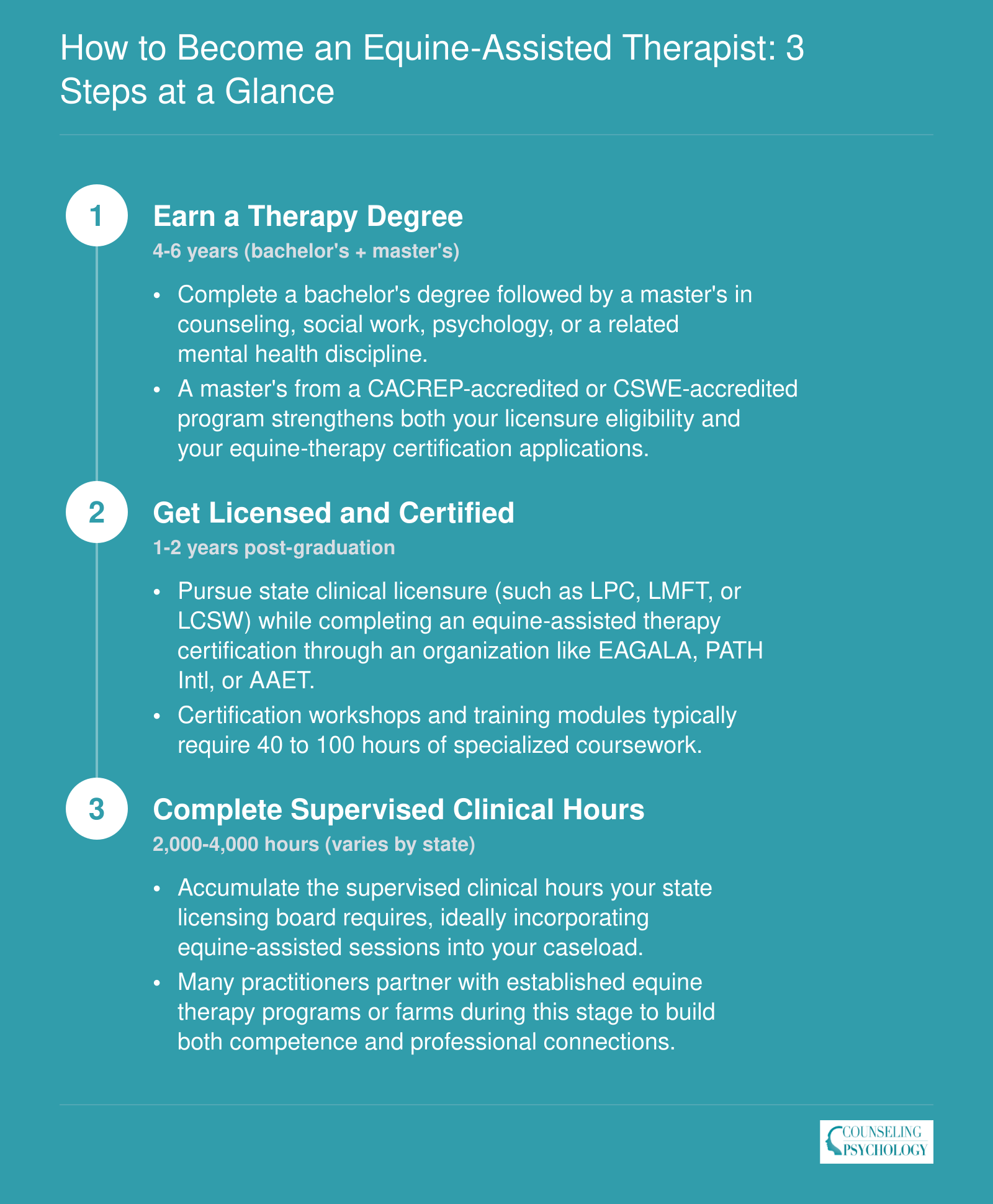
How to Become an Equine-Assisted Therapist: 3 Steps at a Glance
Breaking into equine-assisted therapy requires stacking three distinct credentials on top of each other. The total timeline typically runs seven to nine years from your first day of college to independent practice, though exact requirements vary by state and certification body.
Step 1: Earn a Degree in a Therapy Discipline
What degree do you need to become an equine-assisted therapist? The short answer: a licensed clinical credential comes first, and equine-specific training layers on top of that foundation. Most practicing equine-assisted therapists hold a master's degree in counseling, social work, marriage and family therapy, or psychology. Without that clinical base, you cannot obtain the licensure that equine therapy certifying bodies require as a prerequisite.3
Start With an Accredited Graduate Program
Your first task is finding a regionally accredited graduate program in a recognized therapy discipline. Accreditation matters because licensure boards in nearly every state require degrees from accredited institutions. Programs accredited by CACREP (for counseling) or CSWE (for social work) are the most widely recognized pathways. If you are weighing different counseling degrees at the graduate level, prioritize programs that offer flexibility in practicum placements and elective coursework.
A smaller number of schools have begun weaving equine-assisted content directly into graduate coursework. When researching programs, search the school's graduate program pages using terms like "equine-assisted therapy" or "equine specialization." Schools such as Prescott College and Naropa University have offered nature-based and somatic approaches within their counseling programs; contacting their admissions offices directly is the most reliable way to confirm current equine-specific offerings, since program details change.
Two undergraduate programs worth knowing about: Emory & Henry University offers an Equine Assisted Therapy major1, and Asbury University offers a B.A. in Equine Assisted Services.2 These undergraduate tracks can build valuable foundational knowledge and hands-on horse experience, but neither substitutes for the graduate clinical degree you will need for licensure and certification.
How to Research Programs Effectively
Because equine concentrations remain relatively rare, a targeted search strategy saves significant time:
- Program directories: EAGALA and PATH Intl. both maintain resources that identify training programs and certification-aligned coursework. Browsing their sites gives a practical sense of which schools are active in the field.
- BLS.gov as a starting point: The Bureau of Labor Statistics outlines the education requirements for mental health counselors, social workers, and marriage and family therapists. Use those baseline requirements to identify which degree type to pursue, then cross-reference with schools that offer equine specializations.
- Direct outreach: Email program coordinators at universities with counseling, social work, or psychology departments. Ask plainly whether equine-assisted therapy electives, practicums, or certificate tracks exist. Many programs have informal pathways that never appear on a public webpage.
What to Look for in a Program
Beyond accreditation, evaluate programs on clinical hours offered, practicum placement flexibility (can you complete hours at an equine facility?), and faculty experience with nature-based or somatic modalities. Students considering marriage and family therapy master's programs should confirm that their chosen school permits off-site practicum hours at equine therapy centers, as this gives you a meaningful head start before pursuing formal certification in Step 2.
Step 2: Get Licensed and Earn an Equine-Assisted Therapy Certification
Clinical licensure in a base therapy discipline and specialized equine-assisted certification represent two distinct credential layers. Every equine-assisted therapist must first hold a professional license (Licensed Professional Counselor, Licensed Marriage and Family Therapist, Licensed Clinical Social Worker, or equivalent) before adding equine-specific training. No certification body permits unlicensed practitioners to deliver psychotherapy alongside horses, and every major program explicitly requires proof of an active, unrestricted clinical license at enrollment.
Base Licensure Comes First
Before pursuing any equine-assisted therapy certification, secure your state license in counseling, social work, psychology, or marriage and family therapy. Each state board sets its own supervised-hour thresholds (typically 2,000 to 4,000 post-master's hours) and administers a national exam (NCE, NCMHCE, or clinical social work exam). If you are pursuing the counseling track, our guide on how to become a licensed professional counselor walks through requirements state by state. Only after you hold an active, independently practicing license can you enroll in most equine-assisted psychotherapy programs. Check your state board's website for timelines and supervision requirements; those vary widely and directly affect when you can begin equine training.
Choosing an Equine-Assisted Therapy Certification
Three major organizations dominate the field. Eagala (Equine Assisted Growth and Learning Association) offers the most widely recognized equine-assisted psychotherapy credential; the program requires two in-person training sessions over six days, costs approximately $3,000 to $3,500 including materials, and mandates 40 hours of continuing education every two years to maintain certification. PATH International (Professional Association of Therapeutic Horsemanship) certifies equine specialists in mental health and learning, requiring a week-long on-site workshop, a written exam, and demonstrated equine-handling competency; total cost runs $2,200 to $2,800, with annual membership renewal at $175. AAET (American Association of Equine Assisted Therapy) focuses on integrative models and requires a three-day intensive, clinical case submissions, and mentored supervision; fees range from $1,800 to $2,400, with biennial renewal.
Verification Steps
Visit each certification body's official website directly to confirm current prerequisites, costs, program length, and renewal fees. These details shift annually. Contact accredited programs or counseling schools offering equine-assisted therapy training to verify whether your specific clinical license qualifies and to understand the workshop structure and any pre-training requirements. Search for continuing education requirements on the American Counseling Association or your state board's site to ensure equine coursework counts toward mandatory CE hours. Many states accept specialized animal-assisted therapy training within the broader clinical-practice CE category, but verification before enrollment saves time and expense.
Eagala Vs. PATH Intl Vs. AAET: Certification Comparison
A certification in equine-assisted therapy is a credential that documents your training to integrate horses into a clinical or therapeutic practice. The three most widely recognized issuers in the United States are Eagala (Equine Assisted Growth and Learning Association), PATH Intl. (Professional Association of Therapeutic Horsemanship International), and AAET (American Association of Equine-Assisted Therapy). They differ in philosophy, prerequisites, cost, and whether clients ever sit on a horse.
Eagala Certification
Eagala uses a ground-only model, meaning no mounted work is involved.1 The program has two tracks that work as a team: the Mental Health Professional and the Equine Specialist.
- Cost: Around $995 for the core training, plus a $195 renewal fee.23
- Mental Health track prerequisites: A current clinical license. No prior horse experience is required.1
- Equine Specialist track prerequisites: Roughly 6,000 hours of hands-on horse experience and 100 hours of related continuing education.4
- Training format: A 5-day intensive for the Mental Health track.1
- Renewal: Every 2 years, with 20 CEUs required and an in-person training every 4 years.5
PATH Intl. CTRI
PATH Intl.'s Certified Therapeutic Riding Instructor (CTRI) credential is built around mounted work, so it is structurally different from Eagala.6 It is oriented toward riding instruction with therapeutic goals rather than psychotherapy delivered from the ground. The CTRI application fee is $175 for PATH members and $275 for non-members, with additional costs for workshops, the required teaching hours, and the certification exam.6
AAET
AAET offers credentialing aimed at licensed mental health professionals incorporating equines into clinical practice. Specific current figures for AAET training hours, fees, and renewal cycles can shift, so confirm directly with the organization before enrolling.
Choosing Between Them
If you are a licensed therapist focused on mental health outcomes, Eagala or AAET typically align better. Professionals who already hold counseling master's programs online credentials often find the Eagala Mental Health track a natural next step. If your interest sits closer to adaptive riding and instruction, PATH Intl.'s CTRI is the more direct path.
Questions to Ask Yourself
Step 3: Gain Practicum and Supervised Clinical Experience
Certification in equine-assisted therapy and clinical licensure both hinge on supervised experience, but the two requirements run on different timelines and sometimes overlap. Most equine-assisted therapy certification bodies require documented supervised hours working with both horses and clients, while your core mental health or counseling license mandates a much larger total of clinical supervision. Understanding how these two tracks intersect can accelerate your path to independent practice.
Equine-Specific Practicum Requirements
Eagala requires a minimum of 100 hours of supervised equine-assisted psychotherapy work before granting certification, and those hours must be documented and verified by an Eagala-credentialed supervisor. PATH International's equine-assisted learning standards typically call for similar supervised contact time, though the exact threshold varies by program track. The American Association of Equine Assisted Therapy (AAET) specifies 100 to 150 supervised hours depending on the credential level you pursue. These hours are distinct from the broader clinical supervision your state demands for LPC, LCSW, or LMFT licensure, though many states allow equine-assisted sessions to count toward your total clinical hours if they are delivered within your scope of practice and supervised by a qualified licensee.
Finding Practicum Sites
Securing a placement at an established equine therapy center is the most common entry point. Start by searching the member directories maintained by Eagala and PATH International; these list hundreds of certified centers across the country that regularly host interns and volunteers. Veterans Affairs equine programs, residential treatment ranches serving adolescents, and university-affiliated therapy farms also accept practicum students, particularly those enrolled in accredited counseling or social work programs. Outreach should begin at least six months before you plan to start hours; competitive sites may require letters of recommendation, proof of liability insurance, and evidence of baseline horsemanship skills.
Many practitioners volunteer 10 to 20 hours per week for six to twelve months at an existing center before transitioning to paid part-time work or launching their own independent practice. This apprenticeship model allows you to observe client sessions, participate in team-based interventions, and refine your safety protocols under the guidance of a credentialed senior therapist.
Clinical Licensure Hours and Overlap
Your underlying clinical license requires 2,000 to 4,000 supervised hours depending on your state and credential type. If you are pursuing the LPC pathway, reviewing the broader steps for how to become a mental health counselor can help you map out the full supervision timeline alongside your equine-specific requirements. Most states require at least 1,900 hours of direct client contact within that total, and they permit specialized modalities like equine-assisted psychotherapy to count toward the direct-contact requirement as long as your supervisor holds the same or a higher-level license and is approved by your state board. This means the 100-plus hours you log for Eagala or PATH certification can simultaneously satisfy a portion of your state's clinical supervision mandate, provided your supervisor meets both sets of criteria. Always confirm dual-credit eligibility with your state board before starting hours to avoid retroactive disqualification.
Equine-Assisted Therapist Salary: National Overview
Because the Bureau of Labor Statistics does not track equine-assisted therapists as a standalone occupation, salary expectations depend on the underlying clinical license a practitioner holds. The two BLS categories most relevant to this niche are Recreational Therapists and Occupational Therapists. Licensed counselors and marriage and family therapists who specialize in equine-assisted psychotherapy fall under separate BLS codes; their national wage data is discussed in the state-level salary section that follows. Keep in mind that actual earnings vary with setting, caseload, geographic location, and whether a practitioner owns a private equine therapy practice or works for a treatment center.
| BLS Occupation | National Employment | 25th Percentile | National Median Salary | 75th Percentile | National Mean Salary |
|---|---|---|---|---|---|
| Recreational Therapists | 15,060 | $48,230 | $60,280 | $77,680 | $65,350 |
| Occupational Therapists | 152,280 | $80,490 | $98,340 | $110,460 | $98,240 |
Highest-Paying States for Equine-Assisted Therapists
The BLS does not track equine-assisted therapists as a standalone occupation. The table below draws on state-level data for Recreational Therapists (SOC 29-1125), one of the closest proxy categories, since many equine-assisted therapy practitioners hold this classification. Actual earnings will vary based on your clinical license, specialization, practice setting, and whether you operate a private equine therapy program. States with higher costs of living tend to report higher median wages, so weigh these figures against local expenses.
| State | Median Annual Wage | 25th Percentile | 75th Percentile | Approximate Employment |
|---|---|---|---|---|
| California | $96,530 | $82,920 | $102,640 | 1,780 |
| District of Columbia | $92,010 | $70,340 | $103,050 | 60 |
| Washington | $78,620 | $64,730 | $89,360 | 200 |
| Nevada | $77,450 | $61,340 | $82,270 | 410 |
| New Hampshire | $74,780 | $56,850 | $83,260 | 130 |
| Minnesota | $67,300 | $59,280 | $77,880 | 240 |
| New Jersey | $64,880 | $53,790 | $79,160 | 360 |
| Oregon | $64,000 | $54,370 | $70,320 | 250 |
| Illinois | $63,610 | $51,960 | $81,490 | 290 |
| New York | $63,520 | $53,300 | $75,650 | 1,310 |
Where Equine-Assisted Therapists Work
Common Employment Settings
Equine-assisted therapists work in a variety of environments, from private clinics to large residential programs. Many practitioners establish their own private equine therapy practices, often partnering with stables or farms to host sessions. Residential treatment centers employ therapists to integrate equine work into comprehensive mental health and addiction recovery programs. VA medical centers and military-focused initiatives, such as the Horses for Heroes program, increasingly incorporate equine-assisted therapy to address PTSD and combat-related stress. Practitioners interested in serving military populations may also explore the veterans counselor pathway, which shares significant overlap with equine-assisted work for service members. Addiction recovery ranches combine animal-assisted modalities with traditional treatment, while a growing number of school-based programs bring equine work to children and adolescents with emotional or behavioral challenges.
The Entrepreneurial Path
For therapists with an independent streak, self-employment offers flexibility but requires careful business planning. Most self-employed equine-assisted therapists lease barn or arena space, which can include costs for stall rental, arena maintenance, and liability insurance. Overhead considerations extend beyond facility fees: specialized equine liability insurance is essential, and providers such as Ark Agency, Equisure, and Equine Insurance Group offer policies tailored to equine-assisted therapy operations.1 Building a referral base often involves networking with local clinicians, community organizations, and first-responder units. While the path demands business acumen, it allows therapists to design programs that align closely with their clinical philosophy.
Growing Demand in Trauma-Informed Care
Trauma-informed care has become a cornerstone of modern mental health, and equine-assisted therapy is gaining recognition for its effectiveness with populations that have experienced acute stress. Veterans and first responders, in particular, are driving demand. Horses provide nonverbal feedback and a sense of safety that can help clients process traumatic memories without retraumatization. Programs like Horses for Heroes have contributed to wider acceptance, and many therapists pursue specialized training to serve these groups. This career specialization often involves collaboration with military hospitals, police departments, and fire agencies, creating robust referral networks. Professionals drawn to this type of work may also consider a role as an army behavioral health specialist, which pairs well with equine-assisted modalities.
Insurance and Reimbursement Realities
Insurance coverage for equine-assisted psychotherapy remains limited. As of 2026, no widely adopted commercial policy lists equine-assisted therapy as a named benefit.2 Major insurers like Aetna classify it as experimental or investigational3, and in states such as Ohio, most insurers do not cover it.4 However, licensed therapists can bill for services under standard psychotherapy CPT codes (90832, 90834, 90837, 90846, 90847) when the equine component is part of a diagnosable treatment plan.2 The key is to avoid equine-specific language on claim forms; documentation should emphasize medical necessity and clinical goals.3 Many practices operate on a cash-pay model, providing superbills that clients can submit for potential out-of-network reimbursement.4 A notable exception is Illinois, which will mandate coverage for equine-assisted psychotherapy starting January 1, 2027, making it one of the first states to require such benefits.5 Therapists in other states should monitor legislative trends while building sustainable practice models that do not rely on direct insurance reimbursement.
Is Equine-Assisted Therapy Evidence-Based?
A 2025 systematic review and meta-analysis by Stergiou et al., published through NCBI, screened 27 studies and included 15 in its final analysis, offering some of the most rigorous quantitative evidence to date on equine-assisted therapy outcomes.1 That scope matters when you are evaluating whether this modality has real clinical standing or whether it is simply a popular but unproven add-on.
What the Research Actually Shows
The Stergiou et al. review focused primarily on motor disorders, and the results for physical outcomes were statistically meaningful. Elderly participants showed an improvement of 0.60 seconds on the Timed Up and Go test (p = 0.007), and post-stroke participants showed a nearly identical improvement of 0.61 seconds (p = 0.006).1 Both results crossed the threshold for statistical significance, suggesting that equine-assisted interventions can produce measurable gains in balance and mobility for these populations.
Not every outcome reached significance. One measure showed a 3.82-point improvement that did not meet the threshold (p = 0.175), which is worth noting because it illustrates an honest picture: equine-assisted therapy shows real promise in specific domains while other outcomes remain inconclusive.1 That distinction is exactly the kind of nuance a clinician needs before recommending the approach to a client.
The Gap Between Physical and Mental Health Evidence
Most of the well-controlled research to date has focused on physical and motor outcomes rather than mental health conditions like PTSD, anxiety, or depression. Studies in those areas exist and are growing, but the meta-analytic base is thinner. Organizations like Gallop NYC have compiled research on equine-assisted therapies that track emerging findings across both physical and psychosocial domains, and those resources are worth reviewing as you build your clinical rationale.
The broader professional landscape is also still evolving. Neither the American Psychological Association nor SAMHSA has issued a formal designation of equine-assisted psychotherapy as an evidence-based practice in the way they have for treatments like cognitive processing therapy or motivational interviewing. That does not disqualify the modality, but it does mean practitioners should be transparent with clients about the current state of the evidence. Professionals in adjacent roles, such as health psychologists, often face similar challenges when integrating newer modalities into traditional clinical frameworks.
How to Evaluate the Evidence Yourself
If you are building a case for integrating equine-assisted therapy into your clinical work, or simply want to understand where the research stands, here is a practical approach:
- PubMed and NCBI: Search for systematic reviews and randomized controlled trials using terms like "equine-assisted therapy" or "hippotherapy" alongside your population of interest.
- Professional associations: EAGALA, PATH Intl, and the American Association of Equine-Assisted Therapy each maintain research sections on their websites that track relevant publications.
- University libraries: If you are enrolled in a graduate program, your institution's database access will surface peer-reviewed journals that free searches sometimes miss.
- Gallop NYC's research hub: This organization aggregates studies across populations and outcomes, making it a practical starting point before diving into individual papers.2
The evidence base for equine-assisted therapy is real but still developing. Understanding its strengths and limitations positions you as a more credible, ethical practitioner, and that transparency is ultimately what builds trust with clients and referral sources alike.
These are two entirely different careers. An equine massage therapist works on the horse itself, using bodywork techniques to address the animal's physical health. An equine-assisted therapist is a licensed mental health or counseling professional who works with human clients, using horses as partners in a structured therapeutic process. Different training, different credentials, different goals.
Frequently Asked Questions About Equine-Assisted Therapy Careers
Equine-assisted therapy careers sit at the intersection of clinical mental health practice and hands-on work with horses, which naturally raises a lot of questions. Below are answers to the most common ones prospective therapists ask.