
Key Takeaways
- Most counseling psychology master's programs require 60 credits and take two to three years to complete.
- MPCAC and CACREP accreditation directly affects whether your degree satisfies state licensure requirements.
- Post-degree supervised hours range from 2,000 in Texas to 3,000 in California before you can practice independently.
- Clinical and counseling psychologists earn a national median of $96,100 per year according to BLS May 2024 data.
A master's in counseling psychology sits between a research-heavy clinical psychology PhD and a narrowly scoped counseling specialty like school counseling or MFT, offering a 60-credit practitioner pathway that typically takes two to three years.
The degree prepares graduates to work with individuals navigating emotional, behavioral, developmental, and life-adjustment challenges, usually leading to LPC, LMHC, or LPCC licensure depending on the state. It overlaps with clinical mental health counseling (CMHC), marriage and family therapy, and school counseling, but the counseling psychology framing tends to emphasize wellness, prevention, and human development over pathology. For those earlier in their educational journey, a bachelor's degree in counseling provides the foundational coursework most programs expect.
The practical tension for applicants is that program titles, accreditation bodies (MPCAC, CACREP, APA), and state licensure rules do not line up neatly. A program that qualifies you for licensure in Texas may not in California without supplemental coursework.
Counseling Psychology vs. Clinical Psychology: Key Differences
Both counseling psychology and clinical psychology train students to provide mental health services, but they approach that work from different philosophical starting points, and those differences shape what your daily practice looks like after graduation.
Training Philosophy
Counseling psychology is built on a strengths-based, wellness-oriented framework. Programs emphasize human development, resilience, and helping people navigate life transitions alongside diagnosable conditions.1 Clinical psychology programs, by contrast, lean toward the medical model, placing greater weight on identifying and treating moderate-to-severe psychopathology.1 In practice, the overlap is substantial, but the lens each field uses to interpret a client's struggles differs in meaningful ways. Students who want to explore the full clinical psychologist career path should understand that it typically requires doctoral-level training.
Practicum Populations
During supervised training hours, counseling psychology students typically see a broad range of clients, including people dealing with adjustment issues, relationship problems, anxiety, and depression, as well as more serious mental illness. Clinical psychology trainees work with a similar range, but programs tend to route them more often into settings where complex psychopathology and medical contexts are the norm, such as inpatient units or neuropsychology clinics.2 Neither population is exclusive to one track, but the emphasis differs.
Licensure and Scope of Practice
At the master's level, graduates of both tracks most commonly pursue licensure as a Licensed Professional Counselor (LPC) or Licensed Mental Health Counselor (LMHC), depending on the state. Both credentials authorize psychotherapy, diagnosis, and treatment planning.1 Assessment authority exists in both tracks as well, though state boards impose varying limits on the instruments and contexts involved.
A few states offer a limited licensed psychologist title that master's-level clinical psychology graduates may qualify for in certain circumstances. Counseling psychology graduates can access that designation in some states too, though the pathway is narrower. In most states, neither a counseling nor a clinical psychology master's degree qualifies someone to use the title "psychologist" without a doctorate in counseling psychology and full licensure.
What You Can Call Yourself
Once licensed as an LPC or LMHC, graduates of either program can professionally identify as a counselor.3 The psychologist title remains off-limits at the master's level in virtually every state. For students who want to remain at the master's level, the practical difference in what you can do day-to-day is often smaller than the marketing language around each degree suggests. The real distinctions show up in program culture, supervision intensity, and where you do your training hours.
Typical Curriculum and Coursework
The clearest trend in counseling psychology curricula over the past five years is the steady expansion of required multicultural and social justice coursework, with most accredited programs now treating cultural competence as a thread woven through every class rather than a single standalone elective. That shift reflects both updated accreditation standards from MPCAC and CACREP and changing licensure expectations across most states.
The Core Courses You Will Take
Whether you enroll in an MPCAC-aligned or CACREP-accredited program, the foundational coursework looks remarkably similar. Expect to complete the following core areas, usually within the first three to four semesters:
- Professional ethics and legal issues: Covers the ACA and APA ethics codes, mandated reporting, confidentiality limits, and dual-relationship boundaries.
- Multicultural and social justice counseling: Examines how race, gender, sexuality, disability, religion, and socioeconomic status shape the therapeutic relationship.
- Psychopathology and diagnosis: Trains students in DSM-5-TR criteria, differential diagnosis, and treatment planning.
- Research methods and program evaluation: Builds statistical literacy and the ability to read, critique, and apply peer-reviewed evidence.
- Human growth and lifespan development: Traces cognitive, emotional, and identity development from infancy through later adulthood.
- Group counseling theory and practice: Includes both didactic instruction and an experiential group component most students find genuinely challenging.
- Assessment, appraisal, and testing: Introduces standardized instruments, intake interviewing, and the ethical use of psychological measures.
Practicum, Internship, and Clinical Hours
The clinical training requirements are where the workload gets serious. Most master's programs require between 600 and 1,000 supervised clinical hours before graduation, typically split into a 100-hour practicum followed by a 600-hour internship under CACREP standards, with MPCAC programs landing in a similar range. These hours are completed at community agencies, college counseling centers, hospitals, or private practices, and they count toward (but do not satisfy) the post-graduate hours required for state licensure. For a full breakdown of those post-degree steps, see our guide on how to become a licensed mental health counselor.
Electives and Concentrations
After the core, programs typically offer focused tracks that let you build a clinical identity. Common concentrations include substance use and addiction counseling, trauma and crisis intervention, child counseling, couples and family therapy, career counseling, and college student development.
Where curricula diverge most noticeably is in their accreditation lineage. CACREP programs follow a more prescriptive 60-credit counselor-identity model, while MPCAC programs hew closer to a scientist-practitioner framework, a distinction worth understanding before you apply.
Accreditation Explained: MPCAC, CACREP, and APA
Accreditation is the single most consequential variable in whether your master's degree leads to a smooth licensure process or a frustrating paperwork battle. Understanding the three accrediting bodies that touch counseling and psychology programs will save you time, money, and headaches down the road.
What Each Accrediting Body Covers
The confusion usually starts here, so let's be precise:
- CACREP (Council for Accreditation of Counseling and Related Educational Programs): Accredits master's and doctoral programs in counseling specialties such as clinical mental health counseling programs, school counseling, and rehabilitation counseling. Its 2024 Standards, now in effect, place explicit emphasis on licensure preparation and clinical training benchmarks.1
- MPCAC (Masters in Psychology and Counseling Accreditation Council): Accredits master's-level counseling psychology and psychology-adjacent programs specifically. MPCAC programs typically emphasize a psychological science identity alongside clinical training.2
- APA (American Psychological Association): Accredits only doctoral programs in professional psychology. APA does not accredit any master's program, period. If a school implies otherwise, treat that as a red flag.3
All three accreditations are voluntary. A program can operate without any of them, but the practical consequences of attending a non-accredited program are significant.
Why Accreditation Matters for Licensure
Many state licensing boards have moved toward requiring graduation from a CACREP-accredited program as a condition for counselor licensure. As of 2026, states including Kentucky, New Hampshire, North Carolina, Ohio, and Utah have codified CACREP accreditation into their licensing requirements. Other states may not mandate CACREP by name but use language closely aligned with CACREP standards when evaluating transcripts.
MPCAC accreditation does not satisfy CACREP-specific state requirements. There are currently no reciprocity agreements between MPCAC and CACREP, so graduates of MPCAC-accredited programs in those states typically face additional steps: petitioning the licensing board, submitting detailed transcript reviews, or documenting that their coursework and clinical hours meet the state's standards through an alternative pathway. These workarounds are possible but add time and uncertainty to the process.
Choosing Based on Your Priorities
Think of this as a decision with two axes: professional identity and geographic flexibility.
If you plan to practice in multiple states or anticipate relocating, CACREP alignment offers the smoothest licensure path. Boards recognize these programs readily, and the portability advantage is difficult to overstate in a profession where state-by-state rules vary widely. Exploring best online master's in counseling programs can help you compare CACREP-accredited options across institutions.
If the counseling psychology training model resonates with you, meaning the integration of psychological research, assessment, and strengths-based intervention, an MPCAC-accredited program may offer a curriculum more closely matched to your goals. Just go in with realistic expectations: you may need to advocate for your credentials during the licensing process, especially if you cross state lines.
A practical middle ground exists at some institutions that hold both CACREP and MPCAC accreditation, or that align their coursework with CACREP standards even under an MPCAC umbrella. Ask programs directly how their graduates have fared with licensing boards in your target state. Accreditation status is only part of the picture; eligibility also depends on specific coursework, supervised clinical hours, and passing a licensing exam such as the NCE or NCMHCE.
Related Articles
Questions to Ask Yourself
Admissions Requirements and Program Length
Getting into a counseling psychology master's program is competitive but achievable if you understand what admissions committees are actually looking for. If you are wondering how hard it is to get into grad school for psychology, the answer depends largely on the factors outlined below.
Academic Benchmarks and Prerequisites
Most programs set a minimum undergraduate GPA of 3.0, though applicants with a 3.3 or higher tend to be the most competitive. A psychology major is not always required, but nearly every program expects foundational coursework in introductory psychology, abnormal psychology, and statistics. Some also look for a research methods course or a developmental psychology class. If your undergraduate transcript is missing these prerequisites, you can often complete them through a local university or an accredited online provider before applying.
GRE Trends: Test-Optional Is Now the Norm
The standardized testing landscape has shifted significantly since 2020. A large majority of counseling psychology programs have moved to test-optional or test-free admissions, reflecting broader trends in graduate education. That said, a handful of highly competitive programs still require or recommend GRE scores, particularly those housed in research-oriented psychology departments. If you already have strong scores, submitting them can still work in your favor. If a program does not mention the GRE in its admissions criteria, contact the department directly to confirm the current policy rather than assuming.
Time to Degree
Full-time students typically finish a counseling psychology master's in two to three years, with the range depending on how the program structures its practicum and internship hours. Part-time tracks generally extend that timeline to three or four years. A growing number of programs now offer accelerated cohort formats that compress the curriculum into 20 to 24 months, often through summer coursework and intensive residency weekends. These formats appeal to career-changers who want to enter the field quickly, though the pace demands significant weekly time commitments. You can compare program structures and timelines by browsing counseling psychology masters programs directly.
Rounding Out Your Application
Beyond grades and test scores, programs evaluate several qualitative components:
- Personal statement: This is your chance to articulate why you want to become a counseling professional and what draws you to a particular program's approach or specialization.
- Letters of recommendation: Expect to submit two to three letters, ideally from faculty who can speak to your academic abilities and from supervisors who have observed you in helping roles.
- Relevant experience: Volunteer hours at a crisis hotline, case management work, peer counseling, or employment in behavioral health settings all strengthen an application. Programs want evidence that you have spent meaningful time in environments where people seek help, not just classroom exposure to the concepts.
Admissions committees read applications holistically. A slightly lower GPA paired with strong clinical exposure and a compelling personal statement can outweigh a perfect transcript with no real-world experience.
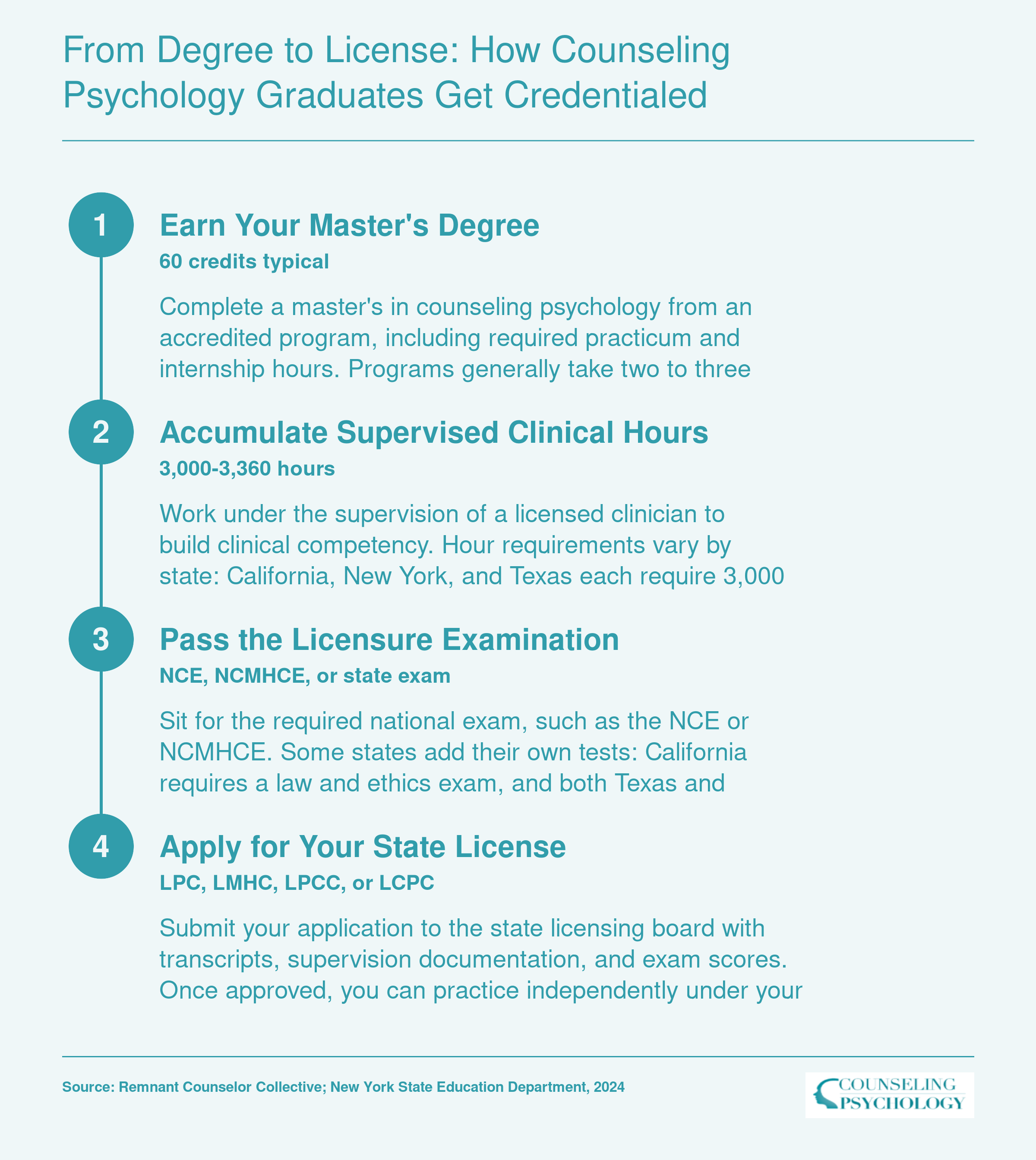
From Degree to License: How Counseling Psychology Graduates Get Credentialed
After earning a master's in counseling psychology, graduates follow a structured credentialing path before they can practice independently. The license title you earn depends on your state: LPC in Texas, LMHC in New York, LPCC in California, or LCPC in Illinois, among other designations. Here is the standard sequence most graduates follow.
Licensure Requirements: How Three Major States Compare
State licensure is where a counseling psychology master's degree becomes a working credential, and the rules diverge sharply once you cross state lines. The license title, the hour count, the exam slate, and even whether your program's accreditation counts at all change from one board to the next. Below is how California treats master's-level counselors; New York and Texas comparisons follow the same structure for side-by-side review.
California: Licensed Professional Clinical Counselor (LPCC)
California's master's-level counseling credential is the Licensed Professional Clinical Counselor, regulated by the Board of Behavioral Sciences.1 Candidates must complete a regionally accredited master's degree of at least 60 semester units covering specific content areas mandated by the Board. Notably, California does not require CACREP accreditation, which gives graduates of MPCAC-aligned and other regionally accredited programs a viable path, provided the coursework matches the Board's content list.
Supervised Experience and Registration
After the degree, applicants must accumulate 3,000 hours of supervised professional experience, completed over a minimum of 104 weeks (two years).1 Before any of those hours can count, candidates have to register with the Board as an Associate Professional Clinical Counselor (APCC). Hours logged prior to APCC registration are not creditable, which is the single most common procedural mistake new graduates make. If you are pursuing a marriage and family therapy track in California instead, the supervised experience structure differs; our guide to LMFT supervision hours covers those requirements in detail.
Exams
California requires two exams: the California Law and Ethics Exam, taken during the associate period, and the National Clinical Mental Health Counseling Examination (NCMHCE) for full licensure.1 Both must be passed before the LPCC is issued.
Reciprocity
California does not offer general reciprocity for out-of-state LPCs or LMHCs. Counselors moving in from New York, Texas, or anywhere else must apply through the standard pathway and demonstrate that their education, hours, and exams meet California's specific standards. For graduates who need to close coursework gaps quickly, a counseling graduate certificate can sometimes address missing content areas. Plan for a credential review well before relocating, because gaps in coursework or supervision documentation can add months to the process.
Counseling Psychology Salary: National and State Pay Data
Compensation for counseling psychology graduates varies significantly by role and location. The table below shows state-level median annual wages for clinical and counseling psychologists, a category that typically requires doctoral-level training but captures the upper earning range in the field. Job growth across mental health occupations remains strong: the Bureau of Labor Statistics projects 18% growth for substance abuse, behavioral disorder, and mental health counselors and 11% growth for clinical and counseling psychologists through 2032, both characterized as much faster than average.
| State | Median Annual Wage | 25th Percentile | 75th Percentile | Total Employment |
|---|---|---|---|---|
| New York | $99,910 | $78,500 | $132,520 | 7,190 |
| Iowa | $98,580 | $73,520 | $124,640 | 760 |
| Maine | $97,630 | $86,180 | $117,120 | 180 |
| Illinois | $97,470 | $66,570 | $138,890 | 3,470 |
| Mississippi | $92,390 | $64,390 | $101,360 | 200 |
| Tennessee | $92,320 | $81,790 | $120,450 | 780 |
| North Carolina | $91,840 | $68,660 | $117,060 | 2,420 |
| Oklahoma | $91,140 | $71,810 | $119,830 | 360 |
| Pennsylvania | $90,450 | $67,450 | $124,990 | 3,850 |
| Utah | $88,990 | $68,080 | $121,980 | 1,000 |
| Virginia | $87,110 | $68,990 | $110,970 | N/A |
| Massachusetts | $87,060 | $73,670 | $132,840 | 3,470 |
| Missouri | $86,340 | $60,710 | $115,130 | 1,490 |
| South Dakota | $85,790 | $62,300 | $105,890 | 100 |
| Florida | $84,020 | $49,690 | $126,460 | 3,230 |
Highest-Paying Metro Areas for Counseling Professionals
Where you practice can influence your paycheck as much as your credential. The BLS data below highlights the top-paying metropolitan areas for clinical and counseling psychologists, a category that captures many counseling psychology master's graduates who go on to earn licensure. Cost of living varies significantly across these metros, so weigh salary against local expenses before relocating.
| Metro Area | Total Employment | 25th Percentile | Median Salary | 75th Percentile | Mean Salary |
|---|---|---|---|---|---|
| San Francisco, Oakland, Fremont, CA | 2,220 | $104,640 | $160,210 | $173,270 | $150,060 |
| Denver, Aurora, Centennial, CO | 1,430 | $110,600 | $126,260 | $152,810 | $134,760 |
| San Diego, Chula Vista, Carlsbad, CA | 1,510 | $60,270 | $99,990 | $155,420 | $129,220 |
| Philadelphia, Camden, Wilmington, PA/NJ/DE/MD | 2,090 | $75,150 | $106,330 | $138,720 | $119,060 |
| New York, Newark, Jersey City, NY/NJ | 7,610 | $78,180 | $101,400 | $135,810 | $119,340 |
| Los Angeles, Long Beach, Anaheim, CA | 3,760 | $80,340 | $100,330 | $134,820 | $116,920 |
| Washington, Arlington, Alexandria, DC/VA/MD/WV | 2,160 | $72,410 | $99,590 | $131,520 | $118,760 |
| Chicago, Naperville, Elgin, IL/IN | 2,980 | $66,570 | $98,240 | $149,140 | $108,730 |
| Boston, Cambridge, Newton, MA/NH | 2,600 | $79,560 | $87,060 | $132,850 | $102,550 |
| Miami, Fort Lauderdale, West Palm Beach, FL | 1,970 | $49,640 | $77,140 | $111,200 | $87,600 |
How to Choose the Right Counseling Psychology Program
Selecting a counseling psychology master's program is one of the most consequential decisions you will make in your career. The field has enough variation in accreditation types, delivery formats, costs, and specialization tracks that two programs with similar-sounding names can lead to very different professional outcomes. Organize your search around four pillars.
Accreditation Type: MPCAC vs. CACREP Alignment
This is the single highest-stakes factor. Before you fall in love with any program, verify that your target state's licensing board accepts the accreditation it carries. Some state boards require graduation from a CACREP-accredited program (or one that meets CACREP standards) for licensure as a professional counselor, while others accept MPCAC-accredited programs or programs that align with counseling psychology training models.12 Getting this wrong can mean additional coursework, a delayed license, or the need to relocate. Pull up your state board's website and read the specific language around approved program types before you apply anywhere.
Format: Online, Hybrid, or On-Campus
CACREP-accredited programs currently offer the widest selection of fully online formats.2 Northwestern University, for example, delivers an online M.A. in Counseling with synchronous class sessions, and Colorado Christian University runs a fully online M.A. in Clinical Mental Health Counseling with concentrations in Marriage and Family Therapy and Substance Use Disorders. MPCAC-accredited programs have historically been campus-based, though options are expanding. Eastern University now offers its MPCAC-accredited M.A. in Counseling in both fully online and hybrid formats, with concentrations in Clinical Mental Health Counseling, Marriage and Family, and School Counseling.3 Chatham University's MPCAC-accredited M.S. in Counseling Psychology remains primarily on-campus with hybrid elements, and Boston College's M.A. in Mental Health Counseling, known for its social justice focus, is also MPCAC-accredited and campus-based.1 Consider how practicum and internship coordination works in online programs, since those clinical hours will still be completed in person in your local community.
Cost and Funding
Total tuition for a counseling psychology master's degree typically falls between $30,000 and $80,000, with private institutions and shorter-residency programs often landing at the higher end. Look beyond the sticker price:
- Assistantships: Some on-campus programs offer graduate assistantships that cover partial tuition and provide a stipend.
- Scholarships: Both institutional and external scholarships exist, though they are competitive. Ask admissions offices for data on what percentage of students receive aid.
- ROI reality check: Salary bands for licensed counselors are relatively flat compared to fields like nursing or engineering. A program costing $75,000 may not translate into meaningfully higher earnings than one costing $40,000, so weigh debt load carefully against expected starting pay.
Specialization Options
Programs vary widely in the concentration tracks they offer. If you already know you want to focus on substance use counseling, marriage and family therapy, or school-based work, prioritize programs that embed those tracks into the curriculum rather than treating them as elective add-ons. Dedicated concentrations typically include tailored practicum placements, which strengthens both your training and your resume.
A final piece of practical advice: request each program's most recent licensure exam pass rates and employment outcomes for graduates. These numbers, more than any marketing copy, reveal how well a program prepares students for the realities of entering the profession.
A counseling psychology master's degree delivers strong return on investment for those pursuing licensure. Clinical and counseling psychologists earn a national median of $96,100, while school and career counselors earn $61,710 (BLS, May 2024). With total program costs of $30,000 to $80,000, most licensed practitioners recoup tuition within two to four years. However, value depends on your goal: licensure-track roles demand accredited degrees and supervised hours, while organizational or research positions may not require clinical credentials. Align your program choice with your intended career path, not prestige alone.
Frequently Asked Questions About Counseling Psychology Master's Degrees
Choosing a graduate program raises practical questions about cost, time, and career outcomes. Below are answers to the questions prospective students ask most often about earning a master's in counseling psychology.