Key Takeaways
- The NYC metro area hosts ten standout doctoral programs, with CUNY in-state tuition near $11,500 compared to roughly double at private schools.
- APA and PCSAS accreditation directly affects licensure eligibility, APPIC match rates, and long-term career mobility.
- New York requires a doctoral degree for clinical psychologist licensure, and the full path from enrollment to license typically spans seven or more years.
- BLS data show New York state median wages for clinical and counseling psychologists exceed the national median by a notable margin.
New York State requires a doctoral degree for clinical psychologist licensure, which means the stakes on program selection are high: six or more years of training, significant tuition variation (CUNY programs run near $11,500 per year in-state while private options can exceed $57,000), and an internship match that determines when you actually finish.
The NYC metro area concentrates that decision considerably. Dozens of hospital systems, forensic settings, and community mental health centers sit within commuting range, and programs based here can place students in clinical sites that few regions can match. That density shapes what APA-accredited PhD and PsyD programs here offer in ways that matter at the application stage, not just after graduation.
The tension most applicants underestimate is not prestige versus cost, but funding structure versus timeline. Fully funded PhD programs typically take five to seven years; self-funded PsyD programs can move faster but carry more debt. In a high cost-of-living metro, that distinction has real financial consequences.
Best Clinical Psychology Graduate Programs Near New York City
New York State is home to some of the most respected clinical psychology doctoral programs in the country, and the NYC metro area offers unmatched access to diverse clinical populations, major hospital systems, and forensic settings. The ten programs below span PhD and PsyD options at public and private universities, with tuition ranging from under $8,000 per year for in-state CUNY students to over $70,000 at elite private institutions. Program-level earnings data is not yet available for these programs, so we highlight institution-wide financial indicators and the distinctive training advantages each school provides.
- Accreditation and program quality
- Institutional graduation and retention rates
- Net price and financial accessibility
- Clinical training model and specializations
- Regional clinical placement networks
- Internal program database
- NCES-IPEDS federal institutional data — nces.ed.gov
- Independent program research
- College Scorecard graduate earnings — collegescorecard.ed.gov

Columbia University in the City of New York
Columbia University's clinical psychology PhD, housed at Teachers College, follows a scientist-practitioner model that blends rigorous research training with supervised clinical work across New York City's vast hospital and community agency network. The program requires 95 credits, a clinical internship, and a dissertation, with faculty connections to Columbia University Irving Medical Center offering exposure to complex, urban clinical populations. A 6:1 student-to-faculty ratio and a 96% institution-wide graduation rate reflect the university's investment in close mentorship and student completion.
- APA-accredited scientist-practitioner doctoral program
- 95 credits required including dissertation and internship
- Training access through Columbia-affiliated NYC medical centers
- Interdisciplinary partnerships with NYC schools and agencies
- Campus-based program in Morningside Heights, Manhattan
- Financial aid available; institution net price around $21,590
- 6:1 student-to-faculty ratio supports close mentorship
Ph.D. in Clinical Psychology — On-Campus

CUNY John Jay College of Criminal Justice
CUNY John Jay College offers one of the only clinical psychology PhD programs in New York with a formal forensic emphasis, leveraging the city's courts, correctional facilities, and forensic hospitals as practicum and research sites. The APA-accredited program follows a scientist-practitioner model, requires 90 credits, and prepares graduates for New York State licensure with a strong social-justice orientation. As a public CUNY institution, in-state tuition starts at about $11,500 per year, making this one of the most affordable doctoral options in the city, with an average net price near $3,200.
- APA-accredited with a forensic psychology concentration
- Scientist-practitioner model requiring 90 credits
- In-state tuition approximately $11,500; out-of-state around $20,960
- Average net price near $3,200 for aid-eligible students
- Practica in NYC courts, jails, and forensic hospitals
- Campus-based program in Midtown Manhattan
- Emphasizes social justice and community-engaged research
Ph.D. Program in Clinical Psychology — On-Campus

CUNY City College
CUNY City College's PhD in Clinical Psychology is a psychodynamically informed program that stands apart from more CBT-oriented NYC options, emphasizing how family, community, and societal inequities shape psychological development. Students complete a four-year practicum at The Psychological Center, which serves over 300 community members annually in surrounding Harlem neighborhoods. First-year tuition is fully covered, and ongoing CUNY in-state rates (about $11,400 per year) keep costs remarkably low, with an average net price near $3,780.
- APA-accredited psychodynamic and community mental health focus
- First-year tuition fully covered for admitted students
- In-state tuition approximately $11,400; out-of-state around $20,830
- Four-year on-site practicum at The Psychological Center
- Training in multiple evidence-based treatment modalities
- Serves diverse, underserved NYC neighborhoods
- 15:1 institution-wide student-to-faculty ratio
PhD Program in Clinical Psychology — On-Campus

Stony Brook University
Stony Brook University's PhD in Clinical Psychology is frequently cited as New York State's top-ranked clinical doctoral program and one of the top three nationally. Accredited by PCSAS, the program follows a clinical-science model with extensive research training at the Krasner Psychological Center and affiliated facilities. Located on Long Island with commuter rail access to New York City, Stony Brook offers SUNY in-state tuition (about $14,220) while providing students proximity to NYC-area externships and post-doctoral networks.
- PCSAS-accredited clinical-science training model
- Nationally ranked in the top three for clinical psychology
- No GRE score required for admission
- In-state tuition approximately $14,220; out-of-state around $29,240
- Six-year typical completion with research and clinical tracks
- Training at Krasner Psychological Center and partner sites
- Long Island campus with train access to NYC
- Average net price around $18,780 for aid-eligible students
Ph.D. in Clinical Psychology — On-Campus

Binghamton University
Binghamton University's Clinical Psychology PhD holds dual accreditation from both APA and PCSAS, a distinction shared by only a handful of programs nationally. The program offers concentrations in psychopathology and trauma, emphasizing empirically grounded interventions and preparing graduates for research-intensive careers. Although located upstate in Vestal, NY, the program's SUNY in-state tuition (about $13,950) and strong national ranking make it an appealing option for New York residents planning to pursue licensure and practice anywhere in the state.
- Dual APA and PCSAS accreditation
- Concentrations available in psychopathology and trauma
- In-state tuition approximately $13,950; out-of-state around $27,140
- Average net price near $21,620 for aid-eligible students
- Science-centered, research-focused training model
- Ranked in the top 40 nationally for clinical psychology
- Campus-based program in Vestal, NY
- Institution-wide graduation rate of about 82%
Clinical Psychology PhD — On-Campus

Touro University
Touro University's PsyD in Clinical Psychology with a Health Emphasis is a five-year, practitioner-scholar program designed for students who want to work in integrated healthcare settings. Located in Manhattan, the program accepts roughly 15 students per cohort and requires over 1,350 hours of externship fieldwork across NYC hospital systems and medical centers. Published tuition is about $14,980 per year, though the average net price runs closer to $29,630 when all costs are factored in.
- Practitioner-scholar model with integrated healthcare focus
- Five-year, full-time campus-based program in Manhattan
- Approximately 15 students admitted per cohort
- Over 1,350 externship hours in NYC health systems
- Published tuition around $14,980; net price near $29,630
- Evidence-based clinical training with licensure preparation
- 10:1 institution-wide student-to-faculty ratio
Doctor of Psychology (PsyD) in Clinical Psychology, Health Emphasis — On-Campus

Yeshiva University
Yeshiva University's Ferkauf Graduate School operates both a PsyD and a PhD in Clinical Psychology from its Bronx campus, with the PsyD program APA-accredited since 1985 and the PhD carrying its own APA accreditation since 2005. Students train in cognitive-behavioral and psychodynamic approaches, with optional concentrations in geropsychology and health emphasis. A 97% internship match rate and extensive externship networks across NYC hospitals and community clinics make Ferkauf a strong choice for students building a New York City career.
- APA-accredited since 1985 with 97% internship match rate
- Four-year full-time campus program in the Bronx
- Cognitive-behavioral and psychodynamic dual training
- Geropsychology concentration available
- Extensive NYC hospital and clinic externship network
- Published tuition around $32,630; net price near $49,970
- 7:1 institution-wide student-to-faculty ratio
- APA-accredited since 2005; scientist-practitioner model
- 99-credit doctoral program with health psychology focus
- 97% internship match rate across NYC training sites
- Multiple specialized minor options available
- Full-time, campus-based training in the Bronx
- Research-focused with emphasis on diversity and inclusion
Doctor of Psychology in Clinical Psychology — On-Campus
Doctor of Philosophy in Clinical Psychology with Health Emphasis — On-Campus

University at Buffalo
The University at Buffalo's Clinical Psychology PhD follows a clinical-science training model with concentrations in adult and child psychopathology, substance misuse, and anxiety and mood disorders. Accredited by both APA and PCSAS, the program uses mentorship-based admissions and prepares students for New York State licensure. Located in western New York, UB offers SUNY in-state tuition (about $14,530) and strong research infrastructure, making it a cost-effective path for students who plan to return to the NYC metro area for practice.
- Dual APA and PCSAS accreditation
- Concentrations in psychopathology, substance misuse, and mood disorders
- Clinical-science training model with mentorship-based admissions
- In-state tuition approximately $14,530; out-of-state around $28,210
- Average net price near $20,990 for aid-eligible students
- Prepares students for New York State licensure
- 11:1 institution-wide student-to-faculty ratio
- Campus-based program in Buffalo, NY
Clinical Psychology PhD — On-Campus

University of Rochester
The University of Rochester's Clinical Psychology PhD is a four-year, scientifically oriented program accredited by both APA and PCSAS. Students complete 90 credit hours alongside extensive research projects and supervised clinical practica. Although located in upstate New York, Rochester's reputation as one of the strongest clinical programs in the state, combined with its regional hospital and clinic training networks, makes it relevant for students targeting licensure and practice anywhere in New York.
- Dual APA and PCSAS accreditation
- Four-year doctoral program requiring 90 credit hours
- Clinical-scientist training model with research emphasis
- Published tuition around $39,310; net price near $29,280
- MA and PhD awarded on a dual track
- Supervised clinical internship required for completion
- 9:1 institution-wide student-to-faculty ratio
- Institution-wide graduation rate of about 85%
Clinical Psychology PhD Program — On-Campus

CUNY Queens College
CUNY Queens College's PhD in Clinical Psychology stands out for its formal neuropsychology specialization, one of the few such concentrations among APA-accredited programs in New York City. The program emphasizes brain-behavior relationships, cultural humility, and evidence-based practice, with practicum partnerships across NYC hospitals and rehabilitation centers. CUNY in-state tuition (about $11,610) and an average net price near $4,200 make this one of the most affordable doctoral training paths for aspiring neuropsychologists in the region.
- APA-accredited with formal neuropsychology specialization
- Focus on brain-behavior relationships and cultural humility
- In-state tuition approximately $11,610; out-of-state around $21,040
- Average net price near $4,200 for aid-eligible students
- Practicum partnerships with NYC hospitals and rehab centers
- Campus-based program in Queens, NY
- Diverse faculty with varied research expertise
Ph.D. Program in Clinical Psychology, Neuropsychology — On-Campus
Why Study Clinical Psychology in the New York City Metro Area?
Choosing where to train as a clinical psychologist often comes down to a tradeoff between cost of living and clinical depth. New York City sits firmly on the expensive side of that equation, but what you get in return is a training environment that few other metros can match: more patients, more conditions, more languages, and more institutions per square mile than almost anywhere in the country.
A Clinical Population You Cannot Replicate Elsewhere
The five boroughs and surrounding metro serve roughly 20 million people across hundreds of nationalities and dozens of primary languages. For a clinical psychology trainee, that translates into caseloads that include recently arrived immigrants navigating acculturation stress, multilingual families needing culturally responsive assessment, and underserved neighborhoods in the Bronx, Brooklyn, and Newark where access to care has historically been limited. You will work with diagnostic presentations and cultural contexts that a trainee in a smaller market may only read about.
Density of Practicum and Externship Sites
Few regions offer this concentration of training settings within commuting distance:
- Major academic medical centers including NewYork-Presbyterian, Mount Sinai Health System, Montefiore, and NYU Langone
- The 11-hospital NYC Health + Hospitals public system, which runs some of the busiest psychiatric services in the country
- VA facilities in Manhattan, Brooklyn, the Bronx, and East Orange
- Community mental health centers, forensic settings at Rikers and Bellevue, and a long list of outpatient clinics affiliated with university training programs
Specialization Tracks That Smaller Markets Cannot Sustain
Because the patient base supports it, NYC-area doctoral programs offer focused tracks in child and adolescent psychology, clinical neuropsychology, health psychology, forensic psychologist requirements, and trauma. Smaller cities often consolidate these into a single generalist track. Here, you can build a five-year training arc around one population.
Networking and Research Adjacency
New York also puts you near the headquarters of professional and policy organizations, well-funded research institutions, and journal editorial offices. Conference travel is shorter, dissertation collaborations are easier to arrange, and faculty connections tend to be national rather than regional. For students still weighing their options, exploring clinical psychology work experience opportunities early can help clarify which specialization track fits best.
PhD vs. PsyD in Clinical Psychology: Which Path Fits Your Goals?
Should you spend more years in a funded PhD program with a research focus, or invest in a shorter, practice-oriented PsyD and enter the clinical workforce sooner? That is the single most consequential fork in the road for aspiring clinical psychologists, and the answer depends on how you see your career playing out after graduation.
Research Depth vs. Clinical Immersion
PhD programs in clinical psychology are research-intensive by design.1 Students typically spend 5 to 8 years completing coursework, a dissertation, and supervised clinical hours, all while contributing to faculty-led research.2 Cohorts are deliberately small, which means close mentorship but fierce competition: national acceptance rates for PhD programs hover around 10 to 15 percent.
PsyD programs, by contrast, are practice-intensive.1 The curriculum prioritizes clinical skill-building from day one, and most students finish in 4 to 6 years.2 Cohorts tend to be larger, and the national acceptance rate sits near 40 percent, reflecting a broader admissions philosophy aimed at training a high volume of clinicians.
Funding and Cost
This is where the two paths diverge most sharply in practical terms.
- PhD funding: Most APA-accredited PhD programs offer a tuition waiver plus a stipend in exchange for research or teaching assistantships. While the stipend is modest, graduates often finish with little or no educational debt.
- PsyD funding: PsyD programs are largely tuition-driven. Merit scholarships and assistantships exist but rarely cover the full cost. Nationally, PsyD graduates carry significantly higher student loan balances than their PhD counterparts, a gap that can reach six figures.
If minimizing debt is a priority, fully funded PhD programs deserve serious consideration, even if the longer timeline feels daunting.
Career Outcomes
PhD graduates are well-positioned for academic appointments, research positions at hospitals or federal agencies, and clinical practice.2 A PhD can also open doors to policy work, program evaluation, and grant-funded research.
PsyD graduates overwhelmingly enter direct clinical practice, whether in private practice, community mental health centers, hospitals, or school systems.2 If your primary goal is to provide therapy and psychological assessment rather than to pursue a tenure-track professorship, the PsyD route gets you there faster.
Making the Decision
Neither degree is categorically better. The right choice hinges on a few honest self-assessments:
- Do you genuinely enjoy designing and conducting research, or does research feel like an obstacle between you and patient care?
- Are you comfortable with a longer training period if it means graduating debt-free?
- Do you see yourself teaching at the university level, or does full-time clinical work appeal more?
New York City's metro area offers strong options on both sides of this divide, from highly selective, funded PhD programs at research universities to well-regarded PsyD programs with robust practicum networks across the city's hospitals and clinics. For a broader look at nationally ranked options, explore our guide to clinical psychology doctorate programs. Whichever path you choose, confirming APA accreditation is essential for licensure eligibility in New York State.
Related Articles
APA and PCSAS Accreditation: What It Means for Your Career
Accreditation is an outside review process that confirms a clinical psychology program meets agreed-upon standards for curriculum, faculty, training hours, and student outcomes. For doctoral programs in clinical psychology, two accreditors matter: the American Psychological Association (APA) Commission on Accreditation and the Psychological Clinical Science Accreditation System (PCSAS).
APA vs. PCSAS: What Each One Signals
APA accreditation is the broader, longer-established credential. It covers both PhD and PsyD programs and evaluates the full range of doctoral training, from coursework and clinical practica through internship preparation. Most licensing boards, employers, and federal training sites (including the VA and many academic medical centers) are built around APA-accredited credentials. Students exploring related doctoral paths, such as APA accredited counseling psychology PhD programs, will find that APA accreditation carries the same weight across psychology specialties.
PCSAS is newer, smaller, and intentionally narrow. It accredits PhD programs that follow a clinical science model with heavy emphasis on research methodology and empirically supported practice. Programs that hold PCSAS accreditation are almost always APA-accredited as well, so for students, PCSAS functions as a signal of research intensity rather than a replacement for APA.
Why It Matters for New York Licensure
The New York State Education Department requires that applicants for psychologist licensure graduate from a doctoral program that is either APA-accredited or judged by the department to be substantially equivalent. Attending a non-accredited program can stall or entirely block licensure in New York and in most other states. This is not a paperwork formality. It determines whether you can legally practice.
Verify Status Before You Apply
A few practical cautions:
- Accreditation is program-level, not institution-level. A nationally known university can house a clinical psychology program that is on probation or not accredited at all.
- Status can change. Programs are placed on probation, suspended, or withdrawn from the accreditor's roster more often than prospective students realize.
- Confirm current standing directly on the APA Office of Program Consultation and Accreditation site before submitting applications, not from a school brochure or third-party ranking page.
Questions to Ask Yourself
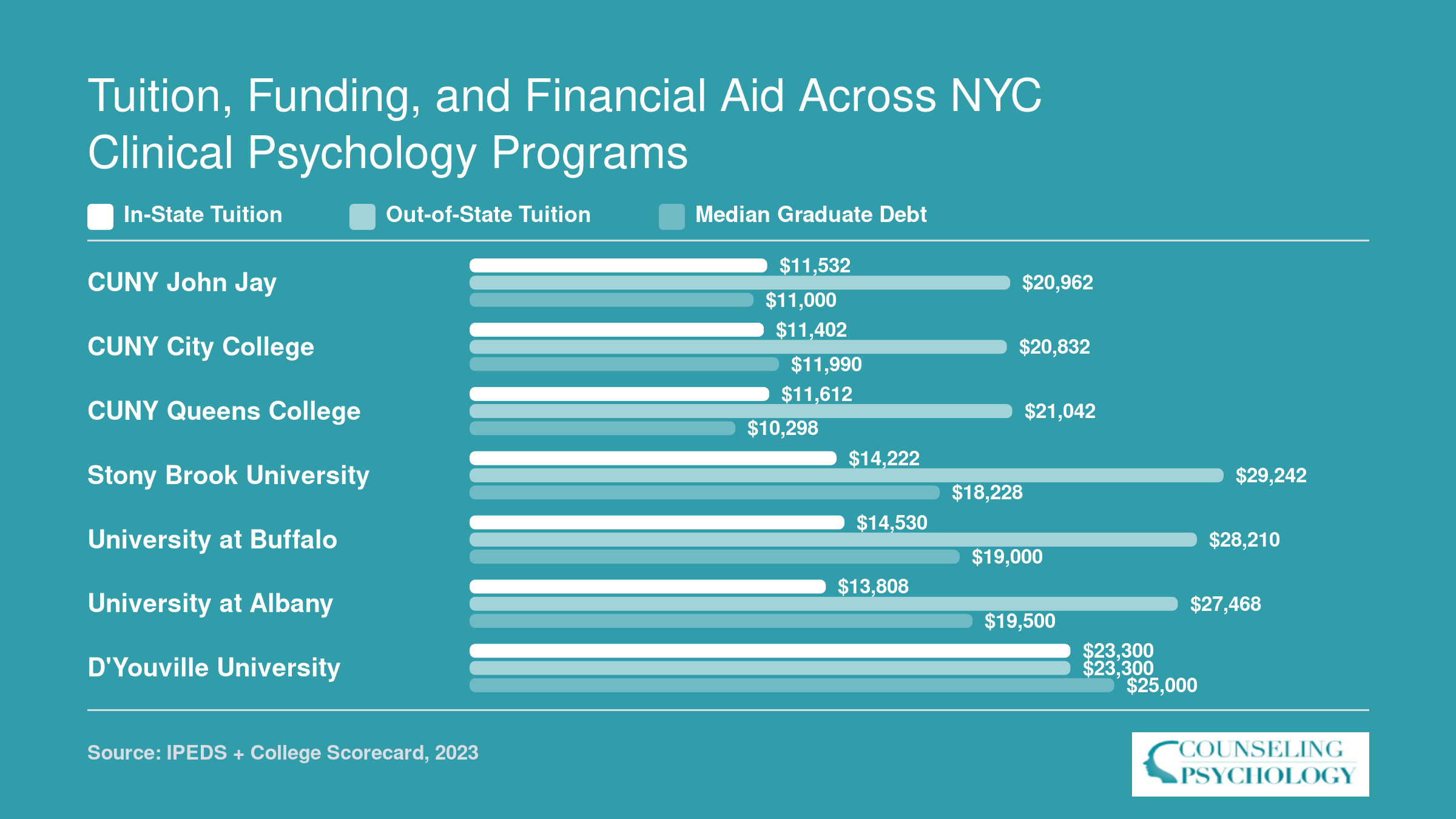
Tuition, Funding, and Financial Aid Across NYC Clinical Psychology Programs
The cost gap between public CUNY/SUNY schools and private institutions is one of the most important factors in choosing a clinical psychology program. CUNY campuses offer in-state graduate tuition near $11,500, while private programs like D'Youville University charge roughly double. Keep in mind that most funded PhD programs cover tuition entirely and provide a living stipend, whereas PsyD programs rarely offer the same level of support, making median graduate debt a critical number to watch.
How to Become a Licensed Clinical Psychologist in New York
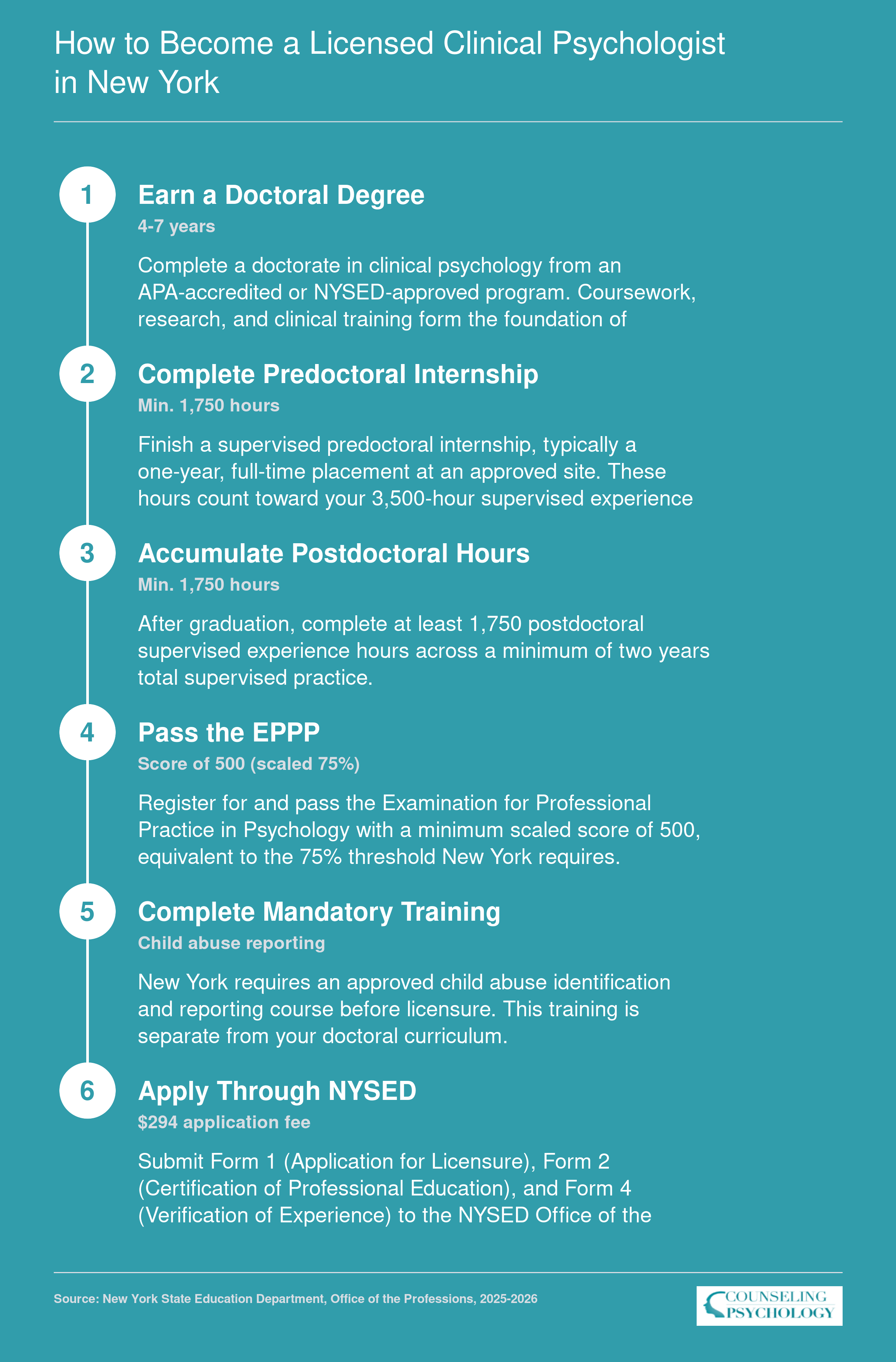
New York requires a doctoral degree for clinical psychologist licensure under NY Education Law §7605. A master's degree alone does not qualify; master's-level practitioners pursue separate credentials such as the LMHC, LMFT, or LMSW. The full path from enrollment to license typically spans seven to ten years, and every step below must be completed before the New York State Education Department (NYSED) Office of the Professions will grant your license.
Clinical Psychologist Salary in New York: What the Data Shows
Compensation for clinical and counseling psychologists varies significantly depending on geography, experience, and work setting. The tables below draw on the most recent BLS Occupational Employment and Wage Statistics (May 2023) for SOC 19-3033 at the national, New York state, and New York City metro levels. Keep in mind that while NYC-area wages tend to run above both the state and national medians, the region's cost of living is also substantially higher. Before comparing offers, look at net purchasing power (what your paycheck actually buys after rent, taxes, and commuting costs) rather than the top-line salary alone.
| Geographic Area | Total Employment | Median Annual Wage | 25th Percentile | 75th Percentile | 90th Percentile | Mean Annual Wage |
|---|---|---|---|---|---|---|
| United States (National) | 71,730 | $96,100 | $66,050 | $129,020 | $168,870 | $106,600 |
| New York State | 7,190 | $99,910 | $78,500 | $132,520 | N/A | $112,980 |
| New York, Newark, Jersey City MSA | 7,070 | $104,560 | N/A | N/A | N/A | $123,900 |
Program-level earnings data for clinical psychology doctoral programs near New York City are not yet published in the federal Scorecard system, so direct comparisons of what graduates earn right out of training are currently unavailable. The salary table in this guide draws on BLS occupation figures instead, which reflect broader labor market conditions rather than specific program outcomes.
Frequently Asked Questions About Clinical Psychology Programs in NYC
Choosing a clinical psychology program in the New York City area involves sorting through details about accreditation, degree types, timelines, and career outcomes. Below are answers to the questions prospective students ask most often, grounded in current program data and licensing requirements.
More Clinical Psychology Graduate Programs Near New York City
If you are exploring additional options beyond the top-ranked programs, the following directory lists other clinical psychology graduate programs in New York. These schools offer various degree levels and specializations, from doctoral to master's, and are organized by region for easy browsing.
Capital Region
- PsyD School Psychology
- PhD Clinical Psychology
Central New York
- Mental Health Counseling
- Master of Science in Clinical Mental Health Counseling
Western New York
- Doctor of School/Clinical Psychology (Clinical/School Psychology)
- Doctor of Clinical Psychology (PsyD)
- Doctor of Clinical Psychology (PsyD) (Health Psychology Emphasis)
- Doctor of Clinical Psychology (PsyD) (Child and Family Emphasis)
- Psychology (MA) (Clinical Psychology with applied emphasis)
- Psychology (MA) (Clinical Psychology with research emphasis)
- Clinical Mental Health Counseling, M.S.
New York City
- PhD in Clinical Psychology
- Ph.D. Program in Clinical Psychology (Forensic Psychology)
- Clinical Psychology (Health Care Emphasis)
- Doctoral Program in Clinical Psychology (Adult)
- Doctoral Program in Clinical Psychology (Child and Adolescent)
- PhD in Clinical Psychology
- Master of Arts in Psychology in Education
- Ph.D. in Clinical Psychology
Long Island
- PhD Program in Clinical Psychology
- Clinical Psychology Doctoral Program
- Ph.D. Program in Clinical Psychology
- Clinical Psychology Doctoral Program (High-Risk Families)
- Clinical Psychology Doctoral Program (Treating Addictions)
- Ph.D. Program in Clinical Psychology (Clinical Neuropsychology)
- Ph.D. Program in Clinical Psychology (Child Pathology and Child Therapy)