
What you’ll learn in this article…
- Hawaii's Act 93, effective July 1, 2026, creates provisional licenses for psychologists, MFTs, and counselors.
- The Counseling Compact enables licensed counselors to practice across 34+ states with one privilege.
- Over 148 million Americans live in mental health professional shortage areas, driving licensure reform.
- Washington maintains strict licensing requirements, contrasting with Hawaii's new provisional pathway.
More than 148 million Americans live in areas with a shortage of mental health professionals, according to the Health Resources and Services Administration. That pressure is fueling the most significant licensing reforms in a generation. In 2026, Hawaii launched provisional associate licenses under Act 93 to accelerate the pipeline for psychologists, marriage and family therapists, and mental health counselors. Washington took a different path, reinforcing its licensure standards while actively participating in the Counseling Compact, a multistate agreement that streamlines cross-border practice. The result is a fractured but focused movement: states are rethinking every step from exam requirements to supervised hours in a race to meet demand. Understanding how insurance changes affect mental health counselors alongside these licensure shifts gives practitioners a fuller picture of the policy landscape reshaping the profession in 2026.
What Hawaii's Act 93 Means for Mental Health Professionals
Effective July 1, 2026, Hawaii will launch three new provisional licenses for associate psychologists, associate marriage and family therapists, and associate mental health counselors under Act 93.1 Applications opened on June 1, 2026, and the Department of Commerce and Consumer Affairs (DCCA) has allocated additional staff and resources to process the anticipated influx.
Provisional Licenses for Three Professions
Act 93 establishes a structured pathway for emerging professionals who have completed their education but still need supervised experience to qualify for full licensure. The new provisional licenses cover: - Associate Psychologist: For those who have met the educational and exam requirements for psychologist licensure but still need to accrue supervised hours. - Associate Marriage and Family Therapist: Designed for graduates of qualifying MFT programs who are working toward independent practice. - Associate Mental Health Counselor: For individuals who have completed a master's or doctoral degree in counseling or a related field and are accumulating post-degree clinical hours. These categories mirror the pre-licensure tiers found in most states, but Hawaii's move codifies them under a single legislative framework, making the path clearer for both licensees and supervisors.
Reducing Barriers and Expanding the Workforce
The law's primary goal is to reduce barriers for emerging professionals and strengthen Hawaii's mental health workforce shortage. Before Act 93, the state lacked a formal provisional license structure, which could leave recent graduates in regulatory limbo while they pursued supervision. By creating a designated licensure tier, the DCCA aims to standardize the transition from education to independent practice, encouraging more graduates to stay in the state and serve its diverse communities.
Streamlined Supervision Verification
One notable feature of Act 93 is the simplified process for supervisors. Current supervisors only need to complete supervision verification forms for applicants , they do not face additional training or credentialing requirements beyond what is already mandated for their own licenses. This reduces administrative burden and is expected to increase the pool of willing supervisors, a key bottleneck in many licensure pipelines. Practitioners navigating early-career therapist supervision struggles may find Hawaii's streamlined verification a meaningful improvement over the fragmented processes common in other states.
CACREP Accreditation and the Counseling Compact Status
Practitioners should note that Hawaii does not require CACREP accreditation for mental health counselor licensure.2 Instead, the state accepts degrees from regionally accredited institutions, with a minimum of 48 semester credits and a practicum of at least 300 hours spanning two academic terms.2 However, because many other states do mandate CACREP-accredited programs, licensees planning future interstate practice may want to consider this when selecting educational programs. Hawaii has not yet joined the Counseling Compact, which allows licensed counselors to practice across state lines with a multistate privilege. As of 2026, the state has no enacted compact legislation, and reciprocity mechanisms remain absent. Professionals holding a Hawaii provisional license should therefore plan to pursue full licensure in Hawaii or meet the requirements of individual states if they intend to relocate.
How to Apply and Get More Information
Applications are processed by the Professional and Vocational Licensing Division. For questions, call 1-844-808-3222 ext. 1 or visit https://cca.hawaii.gov/pvl.4 Detailed guidance and an FAQ specific to Act 93 are not yet published, so applicants should monitor the DCCA site for updates.4 The source article from MauiNow.com (June 21, 2026) provides initial official confirmation of these changes.
Who Needs a Provisional License Under Act 93 (and Who Is Exempt)
Act 93 introduces provisional licenses for three distinct mental health disciplines, each governed by its own section of Hawaii Revised Statutes. Understanding when a license is required versus when an exemption applies is critical for emerging professionals and their supervisors. The table below clarifies the triggers for licensure and the common exemptions that may apply.
| Discipline | Protected Title / Practice Trigger | Relevant HRS Sections | Common Exemptions |
|---|---|---|---|
| Marriage and Family Therapist (MFT) | Using a protected title under HRS §451J-5 | Licensure: HRS §451J-5; Exemptions: HRS §451J-6 | Students in supervised training, government employees, individuals licensed under other professional statutes |
| Mental Health Counselor (MHC) | Using a protected title or engaging in the practice of mental health counseling under HRS §453D-5 | Licensure: HRS §453D-5; Exemptions: HRS §453D-6 | Students in supervised training, government employees, individuals licensed under other professional statutes |
| Psychologist | Representing oneself as a psychologist or engaging in the practice of psychology under HRS §465-2 | Licensure: HRS §465-2; Exemptions: HRS §465-3 | Students in supervised training, government employees, individuals licensed under other professional statutes |
Questions to Ask Yourself
Washington State's Counseling Licensure Updates in 2026
Some states are lowering barriers to licensure, while others are reinforcing long-standing requirements. Washington and Hawaii offer a study in contrasts: Hawaii rolled out new provisional licenses in 2026 to widen the pipeline, while Washington has held firm to its rigorous associate licensing model and opted not to participate in the Counseling Compact.
Washington's Compact Status: Still on the Sidelines
As of mid-2026, Washington is not a member of the Counseling Compact.1 The compact went into effect on September 30, 2025, with Arizona and Minnesota as the initial participating states.1 Washington has not enacted legislation to join, meaning licensed counselors in Washington cannot use compact privileges to practice across state lines, and out-of-state counselors cannot use a compact privilege to practice in Washington. This absence remains a notable gap, especially as other states advance legislation. The compact requires enactment by states' legislatures, and with Washington's 2026 session producing no bill, the status quo persists for at least another year.
Supervision and Examination Requirements Remain High
Washington's pathway to independent licensure is one of the most demanding in the country. The state requires 3,000 total supervised hours, including at least 1,200 hours of direct clinical contact, and at least 100 hours of immediate supervision.2 All hours must be completed over a minimum of 36 months. The associate-level credential, Licensed Mental Health Counselor Associate (LMHCA), must be renewed annually, and candidates must pass either the National Counselor Examination (NCE) or the National Clinical Mental Health Counseling Examination (NCMHCE).2 No legislative or regulatory changes altered these requirements in 2025 or 2026, reflecting a deliberate choice to maintain rigorous standards.
Telehealth Practice: No Blanket Cross-Border Authorization
Washington does not offer a blanket cross-state telehealth practice allowance for counselors.3 Unless a counselor holds a Washington license or qualifies for a narrow exception, providing telehealth to clients in Washington is not permitted. This contrasts with states that have adopted temporary telehealth waivers or have compact privileges that streamline cross-border practice. An out-of-state counselor seeking to see Washington clients via telehealth must apply for full Washington licensure, a process that can be time-consuming and may deter workforce mobility. While the Counseling Compact would provide a structured, expedited mechanism, Washington's non-participation leaves the state without that tool.
Different Strategies, Same Goal: Comparing Washington and Hawaii
Both Washington and Hawaii face significant mental health professionals shortage, but their policy responses diverge sharply. Hawaii's Act 93 creates provisional licenses for associate psychologists, marriage and family therapists, and mental health counselors, directly expanding the pipeline of practitioners who can gain supervised experience. Washington, by contrast, has not modified its associate framework or supervision thresholds, nor has it joined the Counseling Compact to facilitate interstate practice. Hawaii's approach is an immediate, regulatory expansion of entry points, while Washington's strategy emphasizes gatekeeping and quality assurance, betting that high standards will ultimately attract committed professionals. Both states aim to increase access to care, but they are pulling different levers: one lowers initial barriers, the other upholds a strict threshold. For those weighing where to pursue licensed professional counselor credentials, understanding these state-by-state differences is essential.
How the Counseling Compact Works and Where It Stands in Mid-2026
The Counseling Compact is an interstate agreement that lets licensed professional counselors practice across state lines without earning an additional license in each state. Instead of a cumbersome multi-state application process, eligible counselors obtain a "privilege to practice" in remote states that also belong to the compact.
What Is a Privilege to Practice?
A privilege to practice is not a standalone license. It is a legal authorization tied to a counselor's existing, unrestricted license in their home state. Once granted, it permits face-to-face or telehealth services in any compact member state where the privilege is recognized, as long as the counselor follows that remote state's scope-of-practice rules.1 Privileges can be obtained for multiple states simultaneously, and they are renewed periodically, often alongside the home license.
Eligibility: Who Qualifies for Compact Privileges?
To apply, a counselor must hold a fully independent, highest-level license from a compact member state, with no encumbrances, current discipline, or pending investigations. Common titles that qualify include Licensed Professional Counselor (LPC), Licensed Mental Health Counselor (LMHC), or Licensed Professional Clinical Counselor (LPCC), depending on the state. Provisional, associate, temporary, or supervised-status licenses do not meet the compact's eligibility threshold. The compact commission charges a flat fee of $30 per privilege, covering both initial applications and renewals. Applications are processed through the compact's online system or a designated state portal.
Which States Are Live in Mid-2026?
As of June 2026, six states are actively issuing and recognizing compact privileges: Arizona, Georgia, Indiana, Louisiana, Minnesota, and Ohio.3 These states have completed the rule-making and system testing required to go live. Washington, D.C., has joined the compact as a member but is not yet operational; its implementation timeline is still pending.3 Thirty-eight jurisdictions have enacted compact legislation, meaning the agreement will continue to expand as more states meet the technical and regulatory milestones needed to begin issuing privileges.4
How Does Hawaii's Act 93 Fit In?
Hawaii's new Act 93 creates provisional licenses for associate-level mental health professionals, but those licenses fall squarely into the category that the Counseling Compact excludes. A provisional licensee cannot apply for compact privileges or use a privilege to practice in another compact state. Compact privileges are reserved for fully licensed, independent practitioners. This means that emerging professionals under Act 93 will need to complete supervised experience and achieve full licensure before they can leverage the compact for multi-state practice. If you are still working toward that independent credential, reviewing counseling licensure requirements by state can help you map the fastest route to compact eligibility.
Telehealth and the Compact: A Nationwide Reach
The compact is a powerful tool for telehealth. A counselor physically located in Ohio, for instance, can use a compact privilege to provide tele-mental health services to a client in Arizona without holding an Arizona license. The counselor must adhere to Arizona's scope of practice, confidentiality laws, and professional standards, but the administrative burden is dramatically reduced. As more states go live, the compact will create a seamless network of cross-border mental health care, directly addressing the workforce shortages that many states, including Hawaii, are trying to solve.
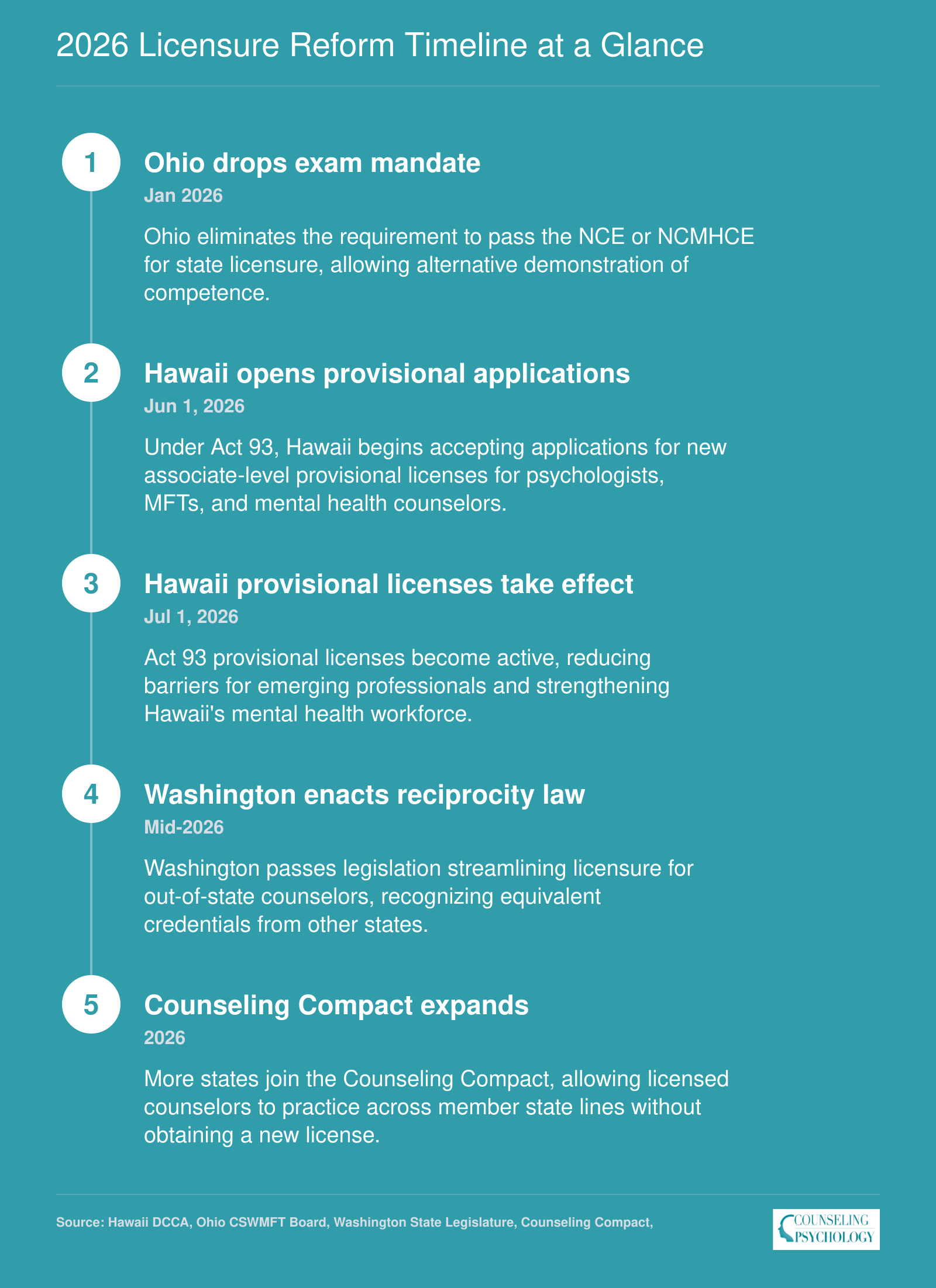
2026 Licensure Reform Timeline at a Glance
Several states took major steps in 2026 to modernize counseling licensure and address mental health workforce shortages. Here are the milestones that are reshaping the field.
Other States Driving Licensure Reform: Montana, Ohio, California, and More
States are weighing speed against rigor as they redesign counseling licensure to meet a deepening mental health professionals shortage. The common driver is a mental health crisis that demands more practitioners quickly, without diluting the competence that protects the public. Hawaii and Washington are not alone , in 2026, multiple states are advancing reforms that change how counselors get licensed.
Ohio's Exam Reforms Take Effect
Ohio's Counselor, Social Worker, and Marriage and Family Therapist Board introduced new exam policies in January 2026. Graduates can now take the National Counselor Examination (NCE) as an alternative to the National Clinical Mental Health Counseling Examination (NCMHCE) for licensure. This gives candidates more flexibility, especially in rural counties where NCMHCE testing centers are scarce. The board also reduced the post-degree waiting period, allowing applicants to sit for exams after completing 60% of their supervised hours rather than 100%. The goal is to shrink the timeline from graduation to independent practice by 4 to 8 months.
Montana's Task Force Recommends Direct Licensure
Montana's licensure task force published its findings in early 2026, calling for the elimination of the provisional license tier. The report recommends that graduates of CACREP-accredited programs be eligible for full licensure after 2,500 hours of supervised practice, down from 3,000. It also urges the state to accept telehealth supervision hours at parity with in-person hours, a critical adjustment for Montana's vast rural communities. A bill encapsulating these recommendations is expected in the 2027 legislative session.
California and Utah Refine Exam Sequencing and Supervision
The California Board of Behavioral Sciences now allows marriage and family therapy masters candidates and clinical counselor candidates to take the clinical exam before the California Law and Ethics Exam. This sequencing change removes a common bottleneck, as the law and ethics exam is administered less frequently. Utah's updated supervision regulations, effective in 2026, let supervisors use a hybrid model of in-person and synchronous video meetings. Group supervision hours also now carry more weight toward the total requirement, expanding the pool of available supervisors.
Exam Choices Reflect a 2026 Trend
As states reexamine licensure requirements, the debate between the NCMHCE and NCE has intensified. The NCE's multiple-choice format offers broader access, while the NCMHCE's clinical simulations are prized for assessing decision-making depth. In 2026, boards are more willing to accept either exam, reflecting a pragmatic shift to speed up licensure without sacrificing minimal competency standards. This trend aligns with Counseling Compact portability, which benefits from greater exam consistency across states.
Telehealth demand is accelerating adoption of the Counseling Compact. As more clients choose remote sessions, counselors must be legally able to serve individuals who travel or relocate across state lines. The compact provides that authority without requiring multiple state licenses, making it a direct response not just to workforce shortages but to the everyday realities of modern teletherapy.
How These Reforms Affect the Mental Health Workforce Shortage
The mental health workforce shortage in the United States is both staggering and persistent, and the licensure reforms emerging in 2026 are designed to attack its root causes. According to the Health Resources and Services Administration (HRSA), over 148 million people currently live in designated Mental Health Professional Shortage Areas (HPSAs),1 and the nation would need more than 7,393 additional practitioners just to meet minimum provider-to-population ratios.1 Against that backdrop, state-level action like Hawaii's Act 93 and Washington's evolving licensure rules is not isolated policy tinkering; it is a direct attempt to expand the pipeline of qualified clinicians and get care to communities that lack it.
Workforce Numbers Reveal the Scale of the Gap
Nearly 26.78% of the U.S. population, roughly 148.6 million people, lives in an area where mental health care is scarce,1 and the shortage is worst in rural and low-income regions. Geographic HPSAs alone account for about 88.8 million of those individuals,1 yet the existing workforce is disproportionately concentrated in urban centers. The behavioral health workforce shortage is not easing: the number of HPSAs grew from 6,807 in December 2025 to 6,959 by March 2026, and the population affected increased by over 11 million people in the same period.2
How Provisional Licenses Speed Up Workforce Entry
One of the most direct ways reforms tackle the shortage is by shortening the path from graduation to independent practice. Hawaii's Act 93, effective July 1, 2026, creates provisional licenses for associate psychologists, MFTs, and mental health counselors. Previously, aspiring clinicians in those fields faced a confusing and lengthy post-degree licensing process that could add years before they could legally practice. Now, they can begin work under supervision immediately after meeting educational requirements, accelerating their own career timelines while injecting more practitioners into the workforce faster. Even a reduction of six to twelve months in the pre-licensure phase can meaningfully increase the number of available clinical hours statewide.
Interstate Compacts and Telehealth Redistribute Care
Interstate licensure compacts, like the Counseling Compact, are another powerful lever. By allowing licensed counselors to practice across state lines, whether in person or via telehealth, compacts break down the geographic barriers that strand mental health providers in well-served urban areas. A counselor in a state with surplus capacity can now treat clients in a remote HPSA anywhere in the compact using telehealth platforms. This redistributes care without requiring costly relocation, and it makes the mental health workforce far more elastic. As of 2026, the compact includes a growing number of states, and its impact is amplified by permanent telehealth flexibilities that many states adopted during and after the pandemic.
Reforms Address Multiple Workforce Bottlenecks Simultaneously
The combined effect of provisional licensure, compact portability, and ongoing exam modernization addresses several choke points at once: the long and uncertain wait between degree and license, state-specific requirements that trap professionals in one jurisdiction, and one-size-fits-all testing that can filter out otherwise effective clinicians. Each reform alone might make a small dent, but together they promise to ease a shortage that HRSA data shows is not improving. HRSA's shortage area designations are used by 34 federal programs,3 underscoring how deeply the gap shapes national health policy. For states, the message is clear: reforming licensure is no longer a matter of professional convenience; it is a public health imperative.
What Pre-Licensed and Associate Counselors Should Do Now
If You're in Hawaii: Apply for Your Provisional License Now
The clock is ticking for Hawaii's new provisional licenses. Applications opened June 1, 2026, and the law takes full effect July 1. If you are pursuing licensure as an associate psychologist, associate marriage and family therapist, or associate mental health counselor, submit your application immediately to avoid processing backlogs. The Department of Commerce and Consumer Affairs has added staff and resources, but early applicants will have the smoothest path. Verify that your supervisor is prepared to complete the supervision verification form, which is the only documentation required from them under the new streamlined rules. The provisional license allows you to accrue supervised hours for counseling licensure while working under a qualified supervisor. For marriage and family therapists and mental health counselors, note that licensure is triggered only if you use a protected title or engage in the specific practice defined by statute; review your state's scope-of-practice exemptions carefully.
If Your State Has Joined the Counseling Compact: Prepare for Mobility
The Interstate Counseling Compact is operational in over half of U.S. states as of mid-2026, with more joining each legislative session. If you reside in a compact member state, you are eligible to apply for a privilege to practice once you hold a full, unrestricted license, but not while you are still pre-licensed or associate-level. That means your immediate priority is to complete all supervised experience and pass the required exam. Some states are beginning to allow examination and supervision hours to occur concurrently, so check with your board to see if you can double up. Plan your timeline so that as soon as your license is issued, you can immediately pursue compact privileges if you intend to practice across state lines or via telehealth.
For All Pre-Licensed Counselors: Practical Steps to Stay Ahead
- Verify your program's accreditation status: Compact eligibility generally requires graduation from a CACREP-accredited program or its equivalent. Even in non-compact states, many licensing boards are moving toward requiring CACREP accreditation. If your program is not accredited, consult your board about alternate pathways or necessary remediation.
- Talk to your supervisor about documentation: Hawaii's reform shows a trend toward lighter administrative burdens for supervisors. Still, make sure your supervisor understands whatever verification processes your state mandates, especially if you may later need documentation for compact applications or licensure by endorsement.
- Track your state's legislative calendar: Compact adoption bills, changes to exam requirements, and expansions of associate licensure are moving rapidly through state legislatures. Follow your state board or a professional advocacy group to stay informed about pending reforms that could directly affect your path.
- Keep a portfolio of your supervised hours: Even if your state does not yet participate in the compact, detailed logs will be invaluable if you move or seek endorsement later. Use a format that includes dates, activities, and supervisor signatures.
The licensure landscape is shifting; acting proactively now will prevent delays later.
Counseling Salaries in States Leading Reform
For mental health professionals considering practice in states that are modernizing licensure, earnings data from the Bureau of Labor Statistics (2024) can help inform career decisions. The table below shows employment and median wages for relevant occupations in select reform-leading states; data for Hawaii, Ohio, Montana, California, Georgia, Indiana, and Louisiana was suppressed or unavailable in 2024.
| State | Occupation | Employment | Median Annual Wage |
|---|---|---|---|
| Washington | Substance Abuse, Behavioral Disorder, and Mental Health Counselors | 13,150 | $64,220 |
| Utah | Substance Abuse, Behavioral Disorder, and Mental Health Counselors | 4,720 | $65,920 |
| Utah | Marriage and Family Therapists | 1,980 | $81,170 |
| Arizona | Substance Abuse, Behavioral Disorder, and Mental Health Counselors | 8,970 | $63,830 |
| Minnesota | Marriage and Family Therapists | 3,780 | $72,370 |
Frequently Asked Questions About Counseling Licensure Reform in 2026
Licensing changes across states can be overwhelming. Here are clear answers to the most pressing questions about Hawaii's provisional licenses, compact privileges, telehealth rules, and exam standards in 2026.
Related Articles
2026 marks a turning point where states are diverging sharply: Hawaii created provisional licenses to widen the pipeline, while Washington held to its distinct supervisory requirements. These experiments, alongside the Counseling Compact's growth, show that licensure is no longer a one-size-fits-all system. For those exploring how to become a counselor in this shifting landscape, the practical step is clear: check your state board's latest rules and monitor the Counseling Compact Commission for new member states. The momentum isn't slowing; 2027 will likely bring more compact adoptions and provisional license models as policymakers push to get practitioners into underserved communities faster.