
What you’ll learn in this article…
- UNM’s new MSW offers New Mexico’s first medical social work concentration, funded by a $10.5 million endowment.
- Applications for the two-year program are open until August 31, 2026, with clinical and medical tracks.
- Since accreditation is pending, licensure candidates should confirm retroactive coverage with the state board.
Where can you earn an MSW with a medical social work concentration in New Mexico? As of June 2026, the answer is the University of New Mexico Health Sciences Center, which just opened applications for its inaugural Master of Social Work cohort.1
Applications run from June 15 to August 31, 2026, for a January 2027 start. The program offers two concentrations: clinical social work, focusing on mental and behavioral health including substance-use disorders, and medical social work, which provides advanced case management in medical settings. The medical concentration is a first for New Mexico.
Housed within the School of Medicine and backed by a $10.5 million state endowment, the program underscores growing demand for social workers trained to collaborate across medical and behavioral health teams, a need that licensed counselors and psychologists will recognize in dual degree MSW programs and integrated care settings.
What Is Unm's New MSW Program?
Choosing an MSW program often means weighing whether to train in a standalone school of social work or inside a larger health sciences center, where interdisciplinary exposure can shape your practice for years.
A Social Work Degree Inside a Medical School
Unlike most MSW programs that grow out of independent colleges of social work, the University of New Mexico's new degree sits within the School of Medicine's Health Sciences Center (HSC). This placement is deliberate and practical: students learn alongside future physicians, nurses, and other health professionals, mirroring the team-based care they will later provide in hospitals, integrated primary care clinics, and specialty outpatient centers. The program's concentration in medical social work, the first of its kind in the state, leans heavily on this environment, embedding field experiences in UNM's own clinical system and community partners.1 For mental health counselors and psychologists curious about medical settings, this structure offers a built-in introduction to interprofessional collaboration that a standalone school might only simulate.
Leadership and Institutional Investment
The program's leadership reflects a blend of social work scholarship and hands-on health care experience. Program director Jen Panhorst, DSW, LCSW, is joined by associate dean Shelly McLaughlin, MS, EMT-I, and field director Janelle Torres-Groover, LCSW, MPH. Their backgrounds sit at the crossroads of behavioral health, public health, and emergency medicine. Institutional support comes from the top: Michael Richards, MD, MPA, the HSC executive vice president, has publicly endorsed the degree, noting that as the state's only academic medical center, UNM is "uniquely positioned to train social workers who can address the most complex health challenges."1 A $10.5 million endowment from the New Mexico Higher Education Department, announced alongside the program, signals that state policymakers see direct return on investing in social work education to close behavioral health workforce shortage gaps, particularly in rural and medically underserved communities.
Why Counselors, Psychologists, and MFTs Should Take Note
For professionals in clinical psychology, counseling, and marriage and family therapy, this MSW represents more than a new degree option. Its medical social work concentration aligns with a nationwide push toward integrated care, where behavioral health providers sit inside medical teams to address the whole person. Graduates will leave prepared to navigate hospital systems, discharge planning, chronic illness support, and substance-use treatment, roles that often overlap with the work of licensed counselors and psychologists. Moreover, the program's clinical concentration in mental and behavioral health (including substance-use disorders) directly addresses the state's shortage of licensed clinical social workers. For those already holding a counseling or therapy license, understanding this pathway can open collaborative referral networks and job opportunities in settings that are increasingly hiring social workers for care coordination and therapy roles.
Clinical Vs. Medical Social Work Concentrations: What's the Difference?
UNM's medical social work concentration is the first of its kind in New Mexico, offering a distinct pathway alongside the more familiar clinical track.
Defining the Clinical Social Work Concentration
The clinical track centers on mental and behavioral health, with specialized training in substance-use disorders. This is the conventional MSW route that prepares students to provide psychotherapy, conduct assessments, and develop treatment plans. Graduates often pursue LCSW licensure to practice independently in settings such as community mental health agencies, private practices, or integrated behavioral health clinics. In a state struggling with provider shortages, clinical social workers are essential to expanding access to mental healthcare.
What Sets Medical Social Work Apart
The medical concentration shifts the focus to advanced case management within healthcare systems. Instead of ongoing therapy, healthcare social workers in this role handle crisis intervention, discharge planning, resource navigation, and interdisciplinary care coordination. A typical day might involve arranging home health services for a patient leaving the hospital, mediating between families and medical teams, or advocating for a patient's social needs in a fast-paced ICU. This role requires fluency in medical terminology, insurance systems, and community resources, skills not always covered in a generalist MSW.
Career Pathways and the LCSW Distinction
Both tracks lead to eligibility for the LCSW, but their day-to-day work diverges significantly. Clinical graduates become therapists, while medical graduates often take titles like hospital case manager, palliative care social worker, or transplant coordinator. Medical social workers may not provide regular psychotherapy but instead focus on psychosocial assessment and linkage to support services. Understanding how to get a social work license is critical for applicants deciding whether they want to deliver counseling or practice within a medical team environment.
Why This Differentiator Matters
Prior to UNM's program, no New Mexico institution offered a dedicated medical social work concentration. The $10.5 million state endowment funding the program underscores a deliberate investment in addressing both behavioral health and medical workforce gaps. For students interested in health systems, UNM now provides a unique in-state option that historically existed only in larger states. As the healthcare landscape increasingly values integrated care, this concentration positions graduates at the forefront of a growing niche.
Questions to Ask Yourself
How to Apply to the UNM MSW Program
The application for UNM's new Master of Social Work is open until August 31, 2026. Here's what you need to know to submit a complete application.
- Application WindowApplications are accepted from June 15 through August 31, 2026, for the inaugural cohort starting in Spring 2027.
- Program Start and LengthThe program begins in January 2027 and is designed as a two-year, full-time course of study.
- Academic PrerequisitesA bachelor's degree is required, but a BSW is not. Applicants should have at least 12 upper-level credits in humanities or social sciences. A minimum undergraduate GPA of 3.0 is expected.
- Application PortalSubmit your application through the UNM Health Sciences Center online portal. All supporting materials, including transcripts and personal statements, must be uploaded there.
- Tuition and Financial SupportDetailed tuition and fee schedules are not yet published. The program is backed by a $10.5 million state endowment to grow New Mexico's social work workforce; prospective students are encouraged to inquire about future scholarship and assistantship opportunities as the program launches.
Related Articles
Who Should Consider Unm's MSW Program?
For Licensed Mental Health Professionals
The UNM MSW is a strategic move for counselors, psychologists, and marriage and family therapists who already hold clinical licenses and want to deepen their medical social work expertise. Adding Licensed Clinical Social Worker (LCSW) credentials can broaden your scope of practice, opening doors to new reimbursement models, supervisory roles, and the ability to practice independently across a wider range of healthcare settings. Because the program is housed within a School of Medicine, graduates emerge with a distinct understanding of integrated behavioral health and case management in medical contexts, skills that complement existing therapeutic training.
Addressing New Mexico's Behavioral Health Workforce Shortage
New Mexico faces a persistent mental health professionals shortage in rural and tribal communities, and this MSW program was designed in direct response to that gap, backed by a $10.5 million state endowment. Entering a field with such high demand means strong job security and opportunities for loan repayment, state incentives, and rapid career advancement. Graduates will be positioned to fill critical roles in integrated care teams, federally qualified health centers, VA hospitals, tribal health organizations, and school-based health programs, all settings where the need for medical social workers is acute.
Interdisciplinary Career Pathways
An MSW from a medical school naturally aligns with interdisciplinary practice. Courses and fieldwork emphasize collaboration with physicians, nurses, hospital administrators, and community health workers. For professionals already versed in mental and behavioral health, adding advanced case management in medical settings creates a rare dual competency. Whether you aim to work in a Level I trauma center, a primary care clinic, or a state public health agency, this degree signals readiness to lead on integrated care teams. The medical social work concentration, the first of its kind in New Mexico, offers specialized training in navigating complex healthcare systems, discharge planning, and patient advocacy that general clinical programs may not provide.
Practicing Social Workers Seeking LCSW Licensure
For substance abuse social workers and others currently practicing with a BSW or a non-clinical master's degree, this program provides a direct route to LCSW eligibility. Even applicants without a bachelor's in social work are welcome, as long as they hold a degree in a humanities or social science field. The two-year format allows full-time students to move quickly into advanced practice, while the clinical concentration meets all coursework and internship requirements for New Mexico licensure. Pairing the clinical track with electives from the medical concentration can also make you a uniquely versatile candidate for employers in hospital systems and managed care organizations.
How Unm's MSW Compares to Other New Mexico Programs
When evaluating MSW programs in New Mexico side by side, accreditation status is the first factor to verify.
Start with Accreditation Status
A program's accreditation status determines eligibility for state licensure and influences hiring preferences with many employers. Students should visit the Council on Social Work Education (CSWE) website and use its directory to check whether a program is fully accredited, in candidacy, or in pre-candidacy. Fully accredited programs have completed a rigorous peer-review process, while candidacy indicates the program is on track toward accreditation. For newly launched programs, including UNM's MSW, you may see a pre-candidacy or candidacy designation. Verifying this directly with CSWE before applying ensures you understand how the program's timeline aligns with your licensure goals.
Compare Program Formats and Concentrations
New Mexico offers several MSW pathways through public universities. Programs such as those at NMSU, NMHU, ENMU, and WNMU each have distinct structures. When comparing, look at delivery format (online, on-campus, or hybrid), program length, and whether part-time or advanced-standing tracks are available. Concentration options also vary: a clinical social work focus may prepare you for mental and behavioral health practice, while an advanced generalist concentration can offer broader preparation. UNM's program distinguishes itself with the state's first medical social work concentration, which builds skills for case management and interdisciplinary work in healthcare environments. How to evaluate online counseling degree programs can serve as a useful framework when reviewing each university's official MSW program page for the clearest picture of what is currently offered.
Look at Tuition and Financial Aid Directly
Tuition can differ widely based on residency, credit load, and program modality. Because rates are subject to change, the most reliable source is the university's own tuition and fees schedule or the admissions office. Request current per-credit or per-semester costs, and ask about any differential tuition for online sections. Also check whether program participation qualifies you for in-state rates if you are an out-of-state student. Understanding these numbers early helps you compare total degree costs across institutions.
Weigh Costs Against Career Outcomes
The Bureau of Labor Statistics (BLS) publishes New Mexico-specific wage and employment outlook information for social workers. Reviewing BLS data lets you assess typical earnings for medical social workers, mental health social workers, and generalist practitioners in the state. While precise salary figures fluctuate, many New Mexico communities show demand for behavioral health and healthcare social workers, making career outlook a useful consideration when evaluating program cost and specialization. Pairing BLS data with each program's placement rates and health-system partnerships gives you a fuller sense of return on investment.
Accreditation Status and What It Means for Licensure
When you apply to a new Master of Social Work program, accreditation status is one of the most important details to understand. It directly affects your ability to become a licensed social worker after graduation. The University of New Mexico's MSW program is brand new in 2026, so here is what you need to know.
How CSWE Accreditation Works for New Programs
The Council on Social Work Education (CSWE) is the only accrediting body for social work degrees in the United States. For a new MSW program, the path to full accreditation has several stages. First, the program submits a benchmark report and receives pre-candidacy status. This means the program has met initial eligibility requirements and is moving toward review for candidacy. Candidacy is the next stage: the program demonstrates that it has the resources, curriculum, and field placement capacity to meet CSWE standards. Once a program achieves candidacy, its graduates are generally considered to have graduated from a CSWE-accredited program for licensure purposes in most states. Full initial accreditation is granted after the program has been in candidacy and has graduated its first cohort.
UNM's Current CSWE Status
As of 2026, the University of New Mexico MSW program holds pre-candidacy status with CSWE.1 This is the earliest stage for a new program. It means UNM has begun the accreditation process but has not yet reached candidacy. The program is expected to progress through the stages in the coming years.
Licensure Eligibility in New Mexico
In New Mexico, the Regulation and Licensing Department's Board of Social Work Examiners requires that graduates hold an MSW from a program that is fully accredited by CSWE. The state does not accept degrees from programs in pre-candidacy or candidacy status for licensure eligibility. This is critical: even if UNM's program moves into candidacy during your enrollment, New Mexico currently only recognizes degrees from fully accredited programs. The earliest students who graduate from UNM's MSW will therefore need to verify the program's accreditation status at the time of their graduation. If the program achieves initial accreditation before or immediately after the first cohort graduates, those graduates become eligible for licensure. However, if the accreditation timeline is delayed, graduates may face a waiting period.
Does the University of New Mexico Have a Social Work Program?
Yes, as of 2026, the University of New Mexico now offers a Master of Social Work degree through its School of Medicine.1 This is the first MSW program at UNM and the first in New Mexico to include a medical social work concentration. The program is currently in pre-candidacy accreditation status with CSWE.
What Prospective Students Should Verify
Before enrolling in any new MSW program, especially one in pre-candidacy, here are steps to protect your licensure path:
- Confirm the program's timeline: Ask the program direct questions about when it expects to achieve candidacy and initial accreditation. Check that these dates align with your expected graduation date.
- Contact the New Mexico Board of Social Work Examiners: Verify directly with the board whether a degree from a program in candidacy or pre-candidacy will be accepted for licensure. Regulations can change, and having written confirmation is essential.
- Consider alternative programs: If licensure eligibility upon graduation is a priority, MSW programs in New Mexico that are already fully accredited include New Mexico Highlands University, New Mexico State University, and Western New Mexico University.3 These programs offer a more certain pathway to licensure.
- Monitor CSWE updates: The CSWE website publishes a directory of accredited and candidacy programs. Check it regularly for UNM's status changes.3
Students enrolling before full CSWE accreditation should proactively confirm with the New Mexico Board of Social Work Examiners that their degree will be retroactively covered once accreditation is granted, per standard CSWE policy. This verification ensures your path to licensure remains clear.
Social Worker Salaries in New Mexico
For prospective MSW students, salary expectations are a key factor. The table below shows 2024 state-level wages for social work occupations in New Mexico, based on U.S. Bureau of Labor Statistics data. Note that these figures represent all workers in each category, not program-specific earnings, and actual income may vary based on licensure, experience, and setting.
| Occupation | Employment | Mean Annual Wage | 25th Percentile | Median Annual Wage | 75th Percentile |
|---|---|---|---|---|---|
| Social Workers, All Other | 550 | $74,630 | $62,550 | $68,950 | $83,720 |
| Child, Family, and School Social Workers | 2,850 | $58,650 | $44,010 | $49,530 | $69,580 |
| Healthcare Social Workers | 730 | $66,150 | $48,080 | $66,090 | $80,130 |
Social Worker Salaries by Metro Area in New Mexico
Social worker salaries in New Mexico differ by metro area and specialty, according to 2024 data from the U.S. Bureau of Labor Statistics. The table below provides a snapshot of median annual wages and total employment for several social work occupations across key cities.
| Metro Area | Social Worker Category | Total Employment | Median Annual Wage |
|---|---|---|---|
| Albuquerque, NM | Social Workers, All Other | 250 | $71,860 |
| Albuquerque, NM | Child, Family, and School Social Workers | 1,400 | $49,260 |
| Albuquerque, NM | Healthcare Social Workers | 360 | $67,170 |
| Las Cruces, NM | Social Workers, All Other | 50 | $70,010 |
| Las Cruces, NM | Child, Family, and School Social Workers | 310 | $54,550 |
| Las Cruces, NM | Healthcare Social Workers | 70 | $65,320 |
| Santa Fe, NM | Social Workers, All Other | 170 | $66,250 |
| Santa Fe, NM | Child, Family, and School Social Workers | 190 | $48,670 |
| Santa Fe, NM | Healthcare Social Workers | 30 | $60,380 |
| Farmington, NM | Child, Family, and School Social Workers | 140 | $46,040 |
| Farmington, NM | Healthcare Social Workers | 30 | $61,870 |
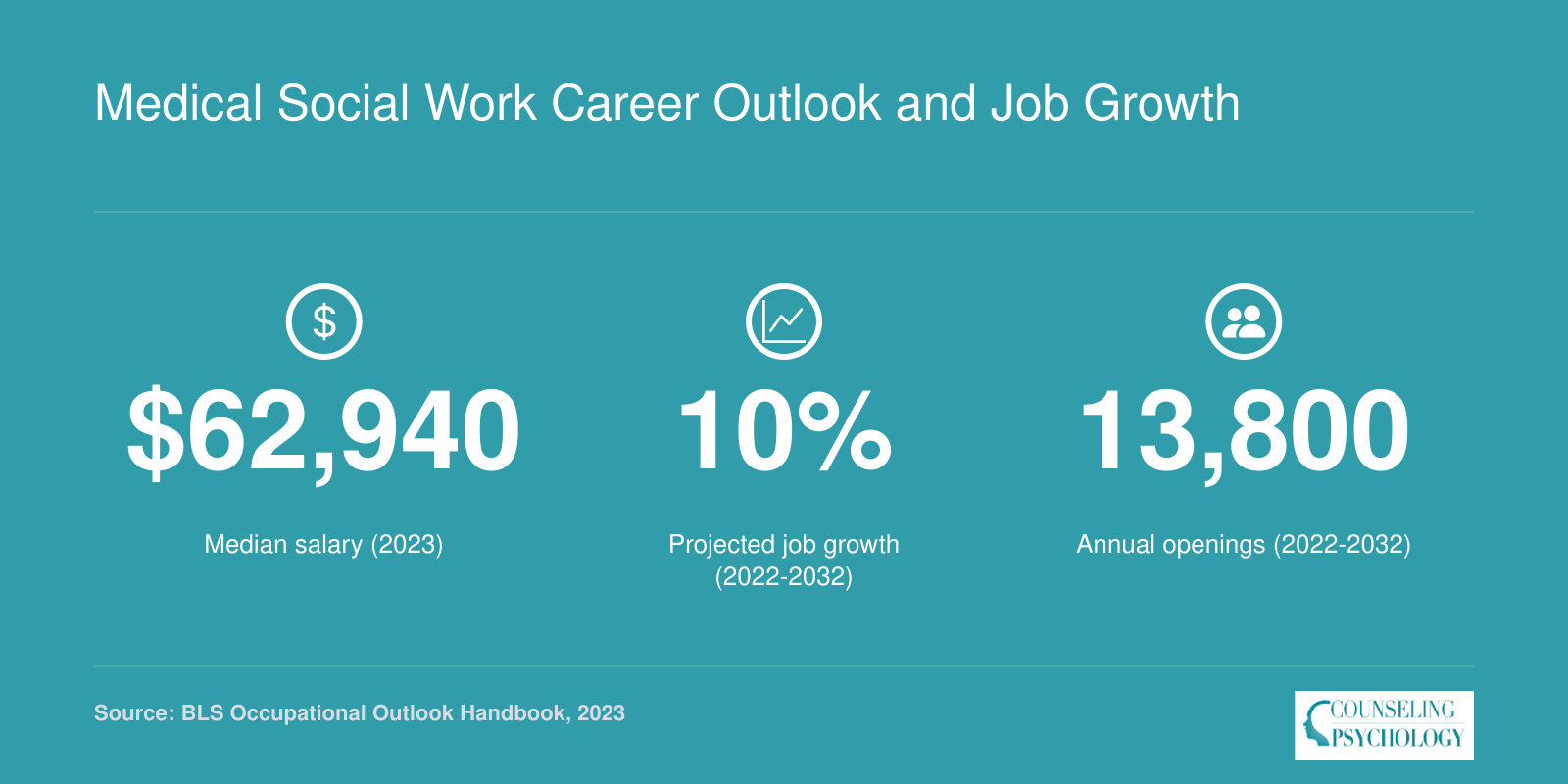
Medical Social Work Career Outlook and Job Growth
Medical social workers practice in fast-paced hospital and health system settings, including discharge planning, oncology, transplant coordination, emergency departments, and palliative care. The growing emphasis on integrated behavioral health is driving strong demand for professionals with this specialization.
Frequently Asked Questions About the UNM MSW Program
We answer common questions about the University of New Mexico's new Master of Social Work program, including application requirements, concentrations, and what makes it unique in New Mexico.