
What you’ll learn in this article…
- The APA's 2026 Model Licensing Act introduces a master's-level pathway for psychology licensure.
- More than 169 million Americans reside in areas lacking sufficient mental health professionals.
- PSYPACT facilitates interstate telepsychology for doctoral psychologists, excluding master's-level clinicians.
- The title protection debate questions whether master's-level practitioners may use psychology-related professional titles.
The American Psychological Association's 2026 Model Licensing Act revision proposes a new master's-level licensure track, ending 50 years of doctoral-only entry. This single change reshapes who can be called a psychologist and what master's-level practitioners can do, raising immediate questions for counselors and doctoral students alike.
The proposal pits access to care against title protection: states gain a blueprint to license master's-level psychology practitioners, but the overlap with existing counselor licensing creates uncertainty about scope and identity. Early-career professionals now face a licensure landscape where a master's degree may carry psychologist-level practice authority in some jurisdictions, while others hold the line on doctoral standards. The mental health workforce shortage makes this debate especially urgent, as policymakers weigh whether a broader licensing structure can close persistent gaps in care.
What Is the Model Licensing Act for Psychologists?
The Model Licensing Act (MLA) is a template statute created by the American Psychological Association (APA) that provides recommended legislative language for states to use when regulating the practice of psychology. Think of it as a master blueprint: it defines who can call themselves a psychologist, what education and supervised experience are required for licensure, and what services licensees can provide. States are free to adopt the MLA in whole, adapt it to local needs, or ignore it entirely. In practice, the MLA carries immense influence because it shapes the national conversation around psychology licensure requirements. As of mid-2026, the most recent APA-approved version was released in 2010, but a significant revision is now under consideration.1
A Template for State Psychology Laws
The primary purpose of the APA's MLA is to serve as a policy prototype for state legislators and advocates.3 It aims to modernize and standardize licensure requirements, enhance mobility for practitioners, and clarify scope of practice boundaries. The current 2010 MLA has been adopted in some form by 17 states, a process that typically takes about 1.5 years from introduction to enactment.2 Each adoption helps align a state's laws with nationally recommended norms, making it easier for psychologists to move across state lines and for the public to identify qualified professionals.
APA vs. ASPPB: Two Different Model Acts
A common source of confusion arises because there are actually two major model acts in psychology: the APA's Model Licensing Act and the ASPPB Model Act for Licensure and Registration, developed by the Association of State and Provincial Psychology Boards. While they sound similar, their emphases differ. The APA MLA is crafted primarily as a professional advocacy document, setting a vision for the field and influencing legislation. The ASPPB Model Act, on the other hand, is a detailed regulatory framework used by licensing boards to draft administrative rules.4 It includes provisions for multiple license types, including psychologists, psychological associates, behavior analysts, and prescriptive authority psychologists. Both exist alongside each other, and states may borrow from either when writing laws and regulations.
A Timeline of Revisions
The APA first published a model licensing act in 1987, with major revisions occurring in 2010. The 2010 version focused on doctoral-level licensure and did not include a pathway for master's-level practitioners. Recognizing evolving workforce needs, the APA began a new revision process, and a draft was released for public comment in early 2026. The comment period closed on March 3, 2026, and the APA Council of Representatives is expected to vote on the final revised MLA later in 2026.5 This draft proposes the most substantial changes in decades, notably creating a master's-level licensure category.
Why the Model Act Influences Your Career
Even if your state never formally adopts the MLA, its provisions often trickle into legislative debates and court decisions that define psychology practice. The act establishes what many consider the gold standard for education, supervised hours for counseling licensure, and continuing education. For students, it signals which degrees and internships will likely satisfy licensure boards in the future. For early-career professionals, it clarifies the services you can perform independently. The 2026 revision, if approved, will directly affect whether master's-prepared practitioners can conduct therapy and assessments independently, and under what title they may do so.5 Understanding the MLA helps you make informed choices about your training and career path.
Key Changes in the Revised Model Licensing Act
What specific changes are in the revised Model Licensing Act, and how might they reshape the profession? The American Psychological Association's 2026 revision introduces two headline proposals that have sparked both hope and debate: a new master's-level licensure pathway for health service psychology, and a renewed conversation about whether the title "psychologist" should remain reserved exclusively for doctoral-level practitioners.
A New Master's-Level Practitioner Category
The most talked-about shift is the creation of a formal master's-level health service psychology license. This new category would allow graduates of accredited master's programs to practice under a distinct title, separate from "psychologist," and deliver a defined scope of clinical services. Proponents highlight data showing that 60% of psychologists are not accepting new patients1 and that the average wait time for behavioral health services is 48 days.1 With 169 million people living in federally designated mental health professional shortage areas,2 a new tier of providers could expand access, especially in rural and underserved communities.
The Title "Psychologist" and Doctoral Protection
The MLA's draft maintains that the title "psychologist" is protected for those with doctoral training, but this position is far from settled. Some advocates push to allow master's-level clinicians to use the title, arguing it would improve recognition and access. Opponents warn that blurring the title could confuse consumers and dilute the rigorous standards that define doctoral education and training. This tension has become a flashpoint in the profession, reflecting broader questions about licensure hierarchy and scope of practice.
Updated Training, Supervision, and Technology Standards
Beyond licensure tiers, the revised act proposes several operational updates: - Supervision hours: Revised requirements for pre-licensure supervision aim to balance rigor with feasibility, addressing concerns that current mandates slow workforce entry without clear benefit. - Continuing education: Mandates have been restructured to emphasize competency-based learning and emerging topics such as telehealth and cultural responsiveness. - Telehealth provisions: The act formalizes telehealth practice standards for psychology students, recognizing its permanent role post-pandemic and the need for interstate consistency. - Scope of practice: Some expanded activities under the master's license, such as certain assessment and intervention roles, are defined to avoid duplication with existing professions.
Addressing the Mental Health Access Crisis
APA's workforce modeling predicts a substantial shortage of psychologists over the next decade, with projections extending through 2038 for psychologists, addiction counselors, marriage and family therapists, mental health counselors, and school counselors.1 The MLA revision is rooted in these forecasts, aiming to build a broader, more diverse pipeline. However, critics note that the existing workforce is already heavily concentrated in urban areas and is 86% White,2 raising questions about whether the master's pathway alone can solve deep-seated access and equity issues.
Controversy and Opposition
Not everyone within psychology endorses the changes. Doctoral-level psychologists express concern that a master's license could undermine training standards and fragment the field. Established master's-level professions, including licensed professional counselors, marriage and family therapists, and clinical social workers, see potential overlap and worry about encroachment on their scope. The public comment period closed on March 3, 2026,3 and state adoption will hinge on how each jurisdiction navigates these competing views. As the debate continues, early-career professionals have a unique stake in how licensure pathways evolve.
More than 169 million Americans live in areas with a shortage of mental health professionals (HRSA, 2024), and approximately 30 percent of U.S. counties have no practicing psychologist (APA, 2022). These gaps drive the push for licensure reform to expand the workforce.
Master's Vs. Doctoral Licensure: Scope of Practice Compared
The scope of practice for licensed psychologists refers to the professional activities a practitioner is legally authorized to perform, which is tightly linked to education, supervised experience, and exam requirements. Under the revised APA Model Licensing Act, a new master's-level psychology licensure category is proposed alongside the traditional doctoral-level license. This creates two distinct scopes, each with its own training thresholds and permitted activities. Understanding these thresholds is easier with a clear look at educational requirements for psychology careers side by side.
Educational and Supervised Experience Requirements
- Doctoral level: Requires a doctoral degree (PhD, PsyD, or EdD) in psychology from an accredited program, plus roughly 3,000 to 4,000 hours of supervised professional experience (SPE), including a predoctoral internship. The Association of State and Provincial Psychology Boards (ASPPB) provides detailed exam and credentialing standards for this pathway.
- Master's level: The proposed master's license would require a master's degree in psychology from an accredited program and a lower total of supervised hours, likely in the range of 1,500 to 2,500 hours, though exact figures will vary by state statute.
Assessment and Testing Authority
Doctoral-level psychologists are trained to administer, score, and interpret a wide range of psychological assessments, including projective tests, neuropsychological batteries, and complex diagnostic instruments. Master's-level licensure would generally restrict assessment activities to less complex, well-validated instruments; projective or neuropsychological testing would likely remain within the doctoral scope. Some states may allow master's practitioners to conduct certain assessments under supervision or with additional certification.
Therapy Modalities and Client Populations
Both master's and doctoral psychologists can deliver psychotherapy, but the depth and breadth of modalities differ. Doctoral training typically covers a broader array of evidence-based therapies and prepares practitioners to work with severe and chronic mental health conditions. Master's-level practitioners will likely be competent in core modalities such as CBT, motivational interviewing, and brief interventions, but may need to refer out for specialized treatments like dialectical behavior therapy (DBT) or trauma-focused interventions that exceed their training.
Independent Practice and Prescriptive Authority
Doctoral psychologists can practice independently after meeting licensure requirements and passing the Examination for Professional Practice in Psychology (EPPP). The master's-level license may permit independent practice but with limitations on the types of assessments and treatments offered. Neither license grants prescriptive authority for psychotropic medications; that requires additional training and certification available in a few states (e.g., Illinois, Louisiana, New Mexico), and practitioners interested in that pathway can explore psychopharmacology degree programs as a separate credential track.
Overlap with Other Master's-Level Professions
The emerging master's in psychology license overlaps with existing LPC, LMFT, and LCSW scopes, as these professions also provide psychotherapy. However, psychological testing and evaluation remain a differentiator. Master's psychology training emphasizes assessment, research methods, and psychopathology more heavily than many counseling or social work programs. State licensing boards are expected to provide comparison tables or FAQs as legislation evolves; prospective practitioners should monitor their state board's website for guidance.
Questions to Ask Yourself
Which States Have Adopted the Model Licensing Act?
The Model Licensing Act provides a recommended framework, but each state decides whether and how to translate it into law. The result is a patchwork that can complicate relocation and interstate practice, even among states that have drawn from the same model. For practitioners and students, this uneven adoption means that licensure portability depends not just on national agreements like PSYPACT, but also on the specific version of the model act a state has embraced.
Current State Adoption Snapshot
As of 2026, at least five states have enacted psychology licensing laws directly grounded in the 2021 APA Model Licensing Act: Connecticut, Washington, Ohio, Pennsylvania, and Wyoming.1 These states were early adopters, incorporating provisions around competency-based examinations, continuing education standards, and initial licensure pathways before the 2026 revision introduced the master's-level pathway. It is important to note that these five states represent a starting point, not an exhaustive list; many other states have older psychology practice acts that were originally modeled on earlier versions of the APA Model Act or ASPPB guidelines. However, direct alignment with the most recent model remains limited.
The Legislative Timeline for Adoption
Model acts serve as blueprints, not mandates. Once the APA releases a revision, state psychological associations and licensing boards must decide whether to introduce legislation based on the update. This process typically unfolds over several years: drafting a bill, securing sponsors, holding committee hearings, and eventually passing both legislative chambers. The timeline from model act publication to enactment can range from three to five years, and some states never adopt the latest version, preferring to maintain their existing regulatory frameworks. Therefore, the 2021 adoptions listed above resulted from efforts that began shortly after that edition's release, and the 2026 revision is just beginning its journey through state legislatures. Understanding how to get a psychology license in your target state is an important first step, given that requirements vary depending on which version of the model act a state has implemented.
Looking Ahead: The 2026 Revision
The newly revised Model Licensing Act, published in 2026, has sparked fresh legislative interest due to its recognition of a master's-level licensure pathway and updated telehealth provisions. As of mid-2026, no state has yet fully adopted the 2026 revisions, but study committees and preliminary hearings are forming in several states identified by APA advocacy channels. Students and early-career professionals should track these developments, as adoption of the 2026 model could reshape practice opportunities and licensure pathways in the coming years. State board websites and the APA's advocacy office are the best sources for real-time updates on which states introduce legislation aligned with the latest model.
Related Articles
Model Licensing Act Vs. Counselor Licensing Frameworks
Understanding Parallel Licensing Models
Counseling and psychology share common ground in mental health services, but their licensing frameworks have evolved along distinct paths. The American Counseling Association (ACA) and the National Board for Certified Counselors (NBCC) have developed model legislation and credentialing standards tailored to the counseling profession. These documents are publicly available on their respective websites and serve as benchmarks for state licensing boards. In contrast, the American Psychological Association's (APA) Model Licensing Act has historically focused on doctoral-level preparation. The current revision, which includes a proposed master's-level practitioner category, introduces new dynamics that warrant careful comparison with existing counselor frameworks.
Key Structural Differences to Examine
When reviewing the Model Licensing Act alongside counselor licensing models, several areas consistently emerge as points of divergence. Educational prerequisites are a primary distinction: counselor licensure universally requires a master's degree in counseling or a closely related field, whereas psychology licensure has long required a doctoral degree. The APA's proposal to create a master's-level psychology license challenges that tradition and raises questions about how it would coexist with counselor licensing. CACREP vs. APA accreditation standards are another layer of this complexity, since accreditation frameworks shape program requirements long before a candidate ever applies for licensure. Supervised experience hours also differ, with counselors typically completing post-degree clinical hours under board-approved supervision, while psychologists follow a more extensive pre- and post-doctoral supervised practice regimen. Scope of practice definitions vary as well; counselors are trained to provide assessment and psychotherapy, while psychologists have historically held broader authority in psychological testing and diagnosis. Title protection laws further complicate the landscape, as many states restrict the use of "psychologist" and related terms to doctoral-level licensees.
Navigating the Comparison Process
To evaluate these frameworks side by side, start by reviewing the full model acts: the APA Model Licensing Act, the ACA's model legislation, and the NBCC's licensure standards. State licensing board websites are an essential next stop; they often post statutes and administrative rules online, allowing for direct comparison of title protection language and scope-of-practice provisions. The Bureau of Labor Statistics (BLS) website can provide contextual information on state-by-state occupational regulations, though it may not capture the nuances of proposed changes. Additionally, professional journals and conference proceedings from both the counseling and psychology fields frequently publish position papers and legislative updates on the master's-level psychology practitioner debate. Contacting state professional associations directly can yield real-time information on how these issues are unfolding in specific jurisdictions.
Implications for Interprofessional Practice
The introduction of a master's-level psychology license could affect the counseling profession in notable ways. Overlap in client populations and service settings may lead to marketplace confusion if title protection and scope boundaries are not clearly delineated. Counselor licensing boards and professional organizations have raised concerns about the potential for fragmentation and the need for consistent standards. Understanding how insurance changes affect mental health counselors adds yet another dimension to this debate, since reimbursement eligibility often follows licensure title and scope determinations. Staying informed through official channels, such as the ACA, NBCC, and APA websites, helps practitioners and students understand how these policy shifts could reshape career pathways and collaborative practice opportunities.
The heart of the controversy: if master's-level professionals can use titles containing "psychology" (e.g., "licensed psychology practitioner"), it reshapes public perception and professional identity. Counselor groups contend this generates consumer confusion, not clarity, by obscuring the training differences between doctoral psychologists and master's practitioners.
What the MLA Means for Current Students and Early-Career Professionals
The psychology licensure landscape is undergoing its most significant structural debate in decades, with the revised Model Licensing Act injecting real uncertainty into graduate training timelines. For students and early-career professionals, the practical question is not whether the MLA will reshape the field, but how quickly its provisions will reach your state board and what you should do in the meantime.
Choosing a Program Path When Rules Are in Flux
If you are currently weighing a master's versus a doctoral program, the MLA's formal recognition of a master's-level pathway creates a new variable. However, the model act is just that: a model. No state adopts it as written, and even enthusiastic states typically take several years to move from introduction to enacted legislation, followed by a rulemaking phase that can add another one to two years. Realistically, a newly available master's-level psychology credential is unlikely to be accessible in most states before 2028 or later. Current applicants should make enrollment decisions based on the licensure rules that exist in the states where they plan to practice, not on a reform that has no legal force yet. If you intend to work in a state that already licenses master's-level psychologists under a recognized title, the MLA may eventually bring parity; if you are set on a state with no such pathway, do not bank on the MLA to create one in time for your graduation.
Grandfathering: What Happens to Licenses Already Earned?
The APA and ASPPB have consistently proposed robust grandfathering provisions in model act revisions. Professionals who hold a valid license at the time new rules take effect would typically retain that license and its full scope of practice, without being required to meet the updated educational or supervised experience requirements. Similarly, a student already enrolled in a qualifying doctoral program when new legislation passes would likely be allowed to complete licensure under the rules in place at the time of enrollment, provided they progress continuously. These protections are critical because licensure is a state-level property right, and boards generally avoid disrupting the practice of existing licensees. The exact language will vary by state, but the principle is well established: if you are already licensed or are legitimately in the pipeline, you will almost certainly not be forced backward.
Internship Hours and Supervised Practice: Staying Flexible
Proposed adjustments to supervised experience requirements in the MLA could affect how students plan practicum, internship, and postdoctoral hours. Some revisions explore reducing the total number of required hours or allowing a portion to be completed at the master's level to count toward doctoral licensure. For students currently accumulating hours, the safest approach is to document everything meticulously and follow the requirements set by their program and current state regulations. Understanding clinical supervision hours for licensure is especially useful here, as the categories of direct versus indirect hours often differ between current state rules and proposed MLA language. Do not prematurely cut hours short in anticipation of a rule change that has not been enacted. If your board does ultimately adopt new hour totals, you will likely have a transition window that allows you to submit under the prior standards if you are near completion.
Staying Informed Without Overreacting
Practical steps protect your career trajectory far better than speculation. Monitor your state psychology board's website and sign up for any email announcement lists. Join APA's Education Advocacy updates and ASPPB's listserv for licensure mobility news. These sources will give you the earliest reliable signal when model act language turns into proposed legislation in your state. Above all, avoid making irreversible program decisions, such as leaving a funded doctoral program for a master's track, solely on the basis of a model act that has not been adopted in your state. The mental health workforce shortage context does make reform feel urgent, but the MLA is an important compass, not yet a map of your individual licensing route.
Interstate Practice, PSYPACT, and the Model Licensing Act
PSYPACT has become the dominant mechanism for interstate psychology practice, but the revised Model Licensing Act's introduction of a master's-level pathway exposes a critical gap in telepsychology eligibility that will shape the careers of future practitioners.
How PSYPACT Enables Interstate Telepsychology
The Psychology Interjurisdictional Compact (PSYPACT) is an agreement among states that allows licensed psychologists to practice across state lines, either via telepsychology or temporary in-person services, without obtaining a separate license in each state. As of 2026, PSYPACT includes 42 jurisdictions: 40 states, the District of Columbia, and the Commonwealth of the Northern Mariana Islands.1 A psychologist with a valid license in any member state can apply for an Authority to Practice Interjurisdictional Telepsychology (APIT) and an E.Passport from the Association of State and Provincial Psychology Boards (ASPPB).3 This streamlines access to care and eliminates costly, duplicative licensing processes. The compact has grown rapidly, with only a handful of states and territories still outside its coverage, though bills are pending in Hawaii, Iowa, Massachusetts, and New York.2
The Master's-Level Exclusion Under PSYPACT
PSYPACT eligibility is tied to doctoral-level licensure. The compact explicitly covers "licensed psychologists," a term defined by state law to require a doctoral degree, supervised experience, and passage of the EPPP.3 The revised APA Model Licensing Act, however, proposes a new category of master's-level licensure for psychological practice. Under current PSYPACT rules, these licensed master's-level practitioners would not qualify for telehealth practicum hours or temporary practice across compact states.2 This creates a significant limitation: even in states that adopt the MLA's master's pathway, those professionals will be confined to in-person practice within their own state unless separate interstate agreements are developed. The result is a two-tier mobility system that could inadvertently restrict access to psychological services in underserved areas that might otherwise benefit from a broader provider pool.
Preparing for a Two-Track Future
The landscape of interstate practice is evolving on two parallel but unaligned tracks. PSYPACT continues to expand geographically, while the MLA revision pushes for a restructured licensure ladder. For current students and early-career professionals, this means keeping a close eye on both developments. Careers in psychology will increasingly depend on which track a practitioner pursues: doctoral candidates can rely on PSYPACT's established framework, while those pursuing or holding master's degrees should watch for state-level adoption of the MLA and any subsequent efforts to negotiate interstate compacts for master's-level practitioners. Until then, telepsychology practice across state lines will remain the exclusive domain of doctoral psychologists within PSYPACT member states.
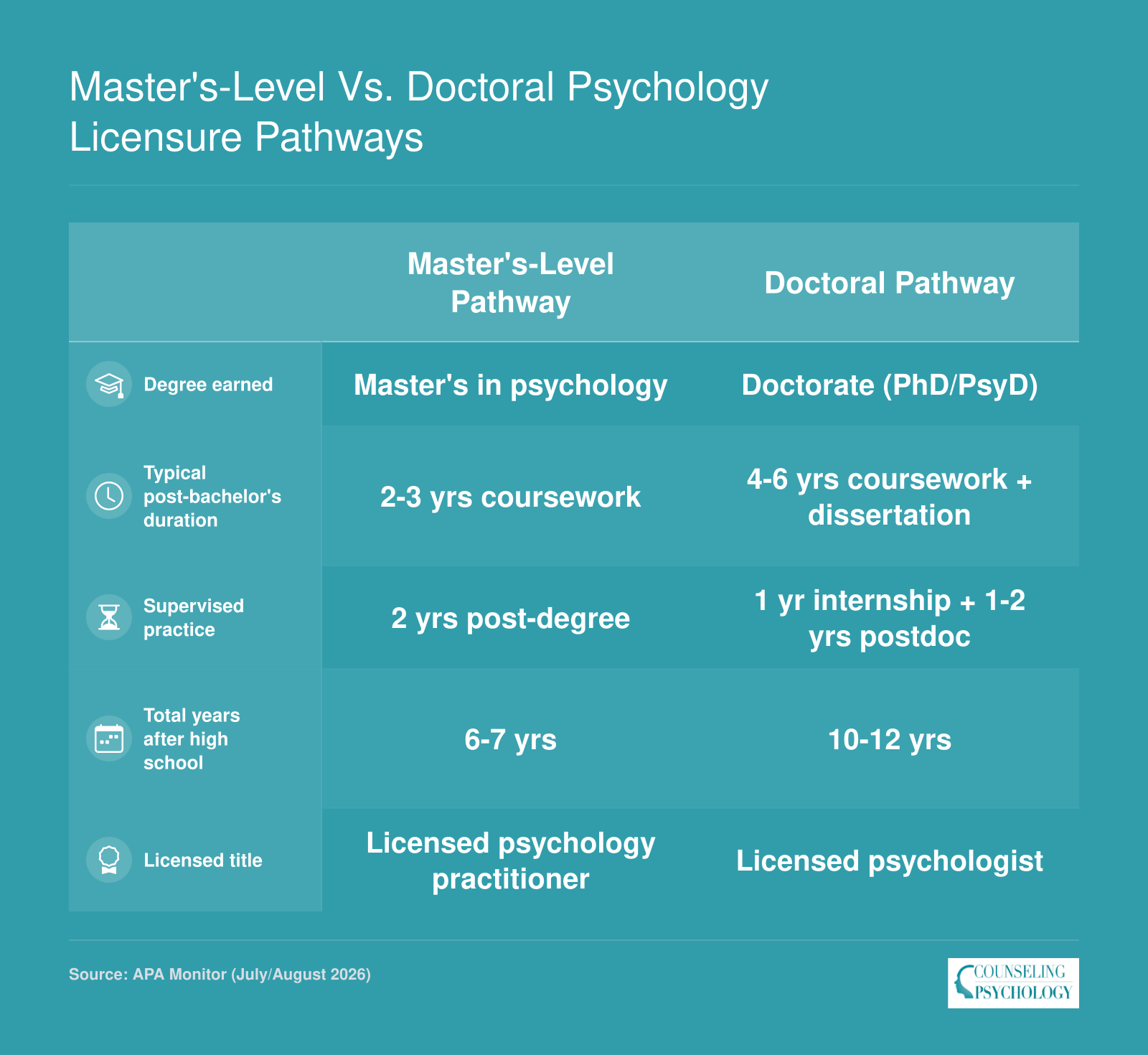
Master's-Level Vs. Doctoral Psychology Licensure Pathways
The revised APA Model Licensing Act introduces a master's-level licensure track for psychology practitioners. This new pathway shortens the time to independent practice by several years compared to the traditional doctoral route.
Salary and Employment Outlook for Counselors and Psychologists
While the BLS occupational categories do not align perfectly with the proposed MLA credential tiers, they offer insight into the current compensation gap between master’s-level and doctoral-level mental health professionals. The data illustrate the financial stakes of the master’s vs. doctoral debate for those planning their career paths.
| Occupation | Annual Median Wage | 25th Percentile | 75th Percentile | Total Employment |
|---|---|---|---|---|
| Substance Abuse, Behavioral Disorder, and Mental Health Counselors | $59,190 | $47,170 | $76,230 | 440,380 |
| Clinical and Counseling Psychologists | $95,830 | $67,470 | $131,510 | 72,190 |
Frequently Asked Questions About the Model Licensing Act
The Model Licensing Act (MLA) is a frequently updated blueprint that shapes psychology regulation across the United States. Below are direct answers to common questions about what it contains, who it affects, and when changes may arrive in your state.