
What you’ll learn in this article…
- Hawaii's Act 93 creates provisional licenses for mental health counselors, marriage and family therapists, and psychologists starting July 1, 2026.
- Supervisors only need to complete a verification form, eliminating the requirement for a full application on behalf of supervisees.
- The provisional license allows emerging professionals to bill insurance, ending the reliance on unpaid roles during training.
- National median annual salary for mental health counselors reached $59,190 in 2026 according to the BLS.
The mental health workforce in Hawaiʻi has faced a persistent bottleneck: years of supervised experience necessary for licensure were hard to come by without a provisional credential. That changes on July 1, 2026, when Act 93 (2024) takes full effect, creating three new provisional licenses: associate psychologist, associate marriage and family therapist, and associate mental health counselor.1 Applications opened early, on June 1, 2026, and the Department of Commerce and Consumer Affairs has added staff to process them quickly.
For emerging clinicians, the most immediate relief is administrative: supervisors no longer need to complete a full application, only a verification form. This streamlined process makes supervised practice more accessible, responding directly to Hawaii's behavioral health workforce shortage with a licensure pathway that aligns training with urgent workforce demand.
What Is Act 93 and Why Does It Matter for Hawaii's Mental Health Workforce?
Act 93 (2024) is Hawaii's most significant legislative move to date to address its escalating mental health provider shortage, creating a structured pathway for emerging professionals to enter the workforce while completing supervised practice. Signed by the Governor and set for implementation on July 1, 2026, the law was formally announced in a June 19, 2026 press release outlining how the Department of Commerce and Consumer Affairs (DCCA) will streamline licensure for associate psychologists, associate marriage and family therapists, and associate mental health counselors.1
A Legislative Response to a Growing Need
The driving force behind Act 93 is clear: Hawaii faces a deepening mental health workforce shortage that shows no signs of easing. According to 2025 data from the Kaiser Family Foundation, the state has 32 designated Mental Health Professional Shortage Areas (HPSAs), covering over 500,000 residents.2 Only about 33 percent of the mental health care need in these areas is currently met.2 National Health Service Corps data further indicates that at least 22 additional providers are needed to close the gap.3 Compounding the issue, a 2010 National Institutes of Health report placed Hawaii's psychiatrist supply at just 11.86 full-time equivalents per 100,000 population, a per-capita shortage that ranked 9th most severe nationwide.4 The need for accessible, supervised mid-level providers has never been more urgent.
How Act 93 Builds a Workforce Bridge
Act 93 creates three new provisional license categories that allow pre-licensed professionals to practice under the supervision of a fully licensed clinician while they accrue the supervised experience hours required for independent licensure. These provisional licenses cover associate psychologists, associate marriage and family therapists, and associate mental health counselors. The DCCA has dedicated additional staff and resources to process applications efficiently, opening submissions on June 1, 2026, and readying systems for a July 1 effective date. Supervisors now only need to complete verification forms, a reduction in administrative burden that encourages more experienced clinicians to take on supervisees.
For forensic psychologists, clinical psychologists, mental health counselors, social workers, and marriage and family therapists, this means a faster, more predictable route from graduation to billable practice. Provisional licensees can deliver services, bill insurance, and fill critical service gaps, particularly in rural and underserved communities, while working toward full licensure. The policy directly tackles the shortage by letting trained graduates contribute immediately, rather than waiting in administrative limbo, and it positions Hawaii's behavioral health system to retain homegrown talent who might otherwise leave the state for quicker licensure pathways elsewhere.
Who Qualifies for the New Provisional License?
The new provisional license framework defines three separate categories: associate mental health counselor, associate marriage and family therapist, and associate psychologist. Each track is tailored to a specific professional path, and understanding the distinctions is crucial for a smooth application.
Degree and Accreditation Standards
- Associate Mental Health Counselor: A master's or doctoral degree in mental health counseling from an accredited institution is required.1 The program must include at least 48 semester hours of graduate coursework. While CACREP accreditation is not required by statute, the degree must be from a CHEA- or USDE-recognized accreditor.3
- Associate Marriage and Family Therapist: Applicants need a master's or doctoral degree in marriage and family therapy from an accredited institution. COAMFTE accreditation is not mandated, but the degree must meet Hawaii's curriculum standards for MFT licensure.3
- Associate Psychologist: A doctoral degree in psychology from an APA-accredited program or one that meets equivalent standards is required.4 The institution must be regionally accredited. All core educational and exam requirements must be completed before applying for the associate psychologist credential.
Required Supervised Experience Hours
Each provisional license requires a minimum number of pre-degree clinical hours. These hours are a prerequisite for entering the associate track, not a post-licensure requirement. For a fuller picture of what qualifies, clinical supervision hours for licensure vary in how they are counted across states, so Hawaii applicants should confirm program specifics with their institution.
- Associate Mental Health Counselor: 300 hours of supervised clinical experience, completed as part of the graduate program.5 After obtaining the associate license, the licensee must accrue 3,000 post-graduate supervised hours to qualify for full LMHC licensure.1
- Associate Marriage and Family Therapist: Also 300 hours of pre-degree supervised clinical experience.5 The associate then works toward the additional supervised hours needed for full MFT licensure.
- Associate Psychologist: No specific pre-degree clinical hour minimum is set for the associate application itself; however, all required education and exam milestones must be met.4 The associate psychologist accrues post-doctoral supervised hours while practicing under the provisional license.
Examination Requirements
Exam requirements vary across the three tracks. Notably, the associate mental health counselor license does not require a national exam at the provisional stage, while the other two tracks do.
- Associate Mental Health Counselor: No exam is required to obtain the associate license. The NCE or NCMHCE is taken later, when applying for full LMHC licensure after supervised hours are complete.
- Associate Marriage and Family Therapist: The National Marriage and Family Therapy Exam must be passed before the associate license can be issued.5
- Associate Psychologist: Applicants must pass the Examination for Professional Practice in Psychology (EPPP) and any Hawaii-specific psychology exams before receiving the associate psychologist credential.3
Title Protection and Scope of Practice
Hawaii law protects titles and clearly defines what provisional licensees can call themselves and what services they may provide.
- Associate Mental Health Counselor: May use the title "Associate Mental Health Counselor" and practice mental health counseling under supervision of a fully licensed mental health counselor. The scope includes assessment, diagnosis, and treatment of mental and emotional disorders within a professional counseling relationship.
- Associate Marriage and Family Therapist: Uses the title "Associate Marriage and Family Therapist" and provides marriage and family therapy services under supervision of a licensed MFT. The practice focuses on relational and systemic interventions.
- Associate Psychologist: Holds the title "Associate Psychologist" and can deliver psychological services, including testing and therapy, while under the supervision of a licensed psychologist. All services must fall within the supervised practice arrangement approved by the board.4
Eligibility at a Glance: Associate MHC Vs. Associate MFT Vs. Associate Psychologist
Act 93 introduces three distinct provisional licenses, each tailored to a specific branch of mental health practice. Although all three are designed to help early-career professionals accrue supervised hours, the entry requirements, scope of work, and typical work settings differ significantly. Understanding these differences is the first step to choosing the path that fits your graduate training and career goals.
Associate Mental Health Counselor
- Degree requirement: A master's in counseling or a closely related field from an accredited program.
- Supervised hours: 3,000 post-degree clinical hours under a licensed supervisor.1
- Primary expertise: Broad-based mental health counseling, including individual and group therapy for anxiety, depression, trauma, and life transitions.
- Common employers: General outpatient clinics, community mental health centers, and private group practices.
- Autonomy: Practice must occur under an approved clinical supervisor; the associate cannot operate independently.
Associate Marriage and Family Therapist
- Degree requirement: A master's in marriage and family therapy, often with specialized coursework in systems theory and relational dynamics.
- Supervised hours: Typically 1,500 to 3,000 hours, with at least half involving direct contact with couples or families, depending on the program and state guidelines.2
- Primary expertise: Relational and systemic therapy focused on couples, families, and other relationship structures.
- Common employers: Family service agencies, behavioral health organizations with family programs, and private practices that emphasize systemic work.
- Autonomy: Fully supervised practice; the associate must have a supervisor who is a licensed marriage and family therapist or an equivalent qualified professional.
Associate Psychologist
- Degree requirement: A master's in psychology, sometimes as part of a doctoral track. In Hawaii, this license serves those with a master's who are not yet at the doctoral level.
- Supervised hours: A minimum of 600 hours, which is considerably lower than the counseling and MFT tracks because the role is often more focused on testing and assessment rather than ongoing psychotherapy.3
- Primary expertise: Psychological testing, assessment of cognitive and emotional functioning, and report writing under supervision.
- Common employers: Testing centers, neuropsychology clinics, forensic settings, and specialty clinics that require standardized evaluations.
- Autonomy: More restricted than the other associate licenses; the scope of practice is typically limited to assessment-related tasks under direct supervision, with less emphasis on long-term therapeutic intervention.
Selecting the right associate license is not merely about which degree you hold. It is also about the population you intend to serve and the clinical activities you want to perform. Prospective licensees should review their graduate transcripts, verify that their program meets the educational requirements for psychology careers, and consult the DCCA's application checklists carefully. According to Northeastern University's comparison of mental health professions, the titles of counselor, therapist, and psychologist are often used interchangeably by the public, but the licensing rules and scopes of practice are legally distinct.1 The National Board for Certified Counselors similarly emphasizes that counselors and marriage and family therapists train in different theoretical models, a distinction that directly affects the supervision they must receive. For those weighing the associate psychologist route, a breakdown of Kentucky's Licensed Psychological Associate role illustrates that a master's-level psychology license is typically a step toward full doctoral licensure rather than a terminal clinical credential.3 In Hawaii, each of these associate licenses acts as a structured bridge, but the bridge looks different depending on where you start and where you hope to land.
The DCCA has confirmed that under Act 93, supervisors only need to complete a supervision verification form for their supervisee. There is no requirement to submit a full application on their behalf, which significantly cuts the usual administrative workload and makes it easier for experienced professionals to support new clinicians.
How to Apply: Step-By-Step Application Checklist
Section content unavailable.
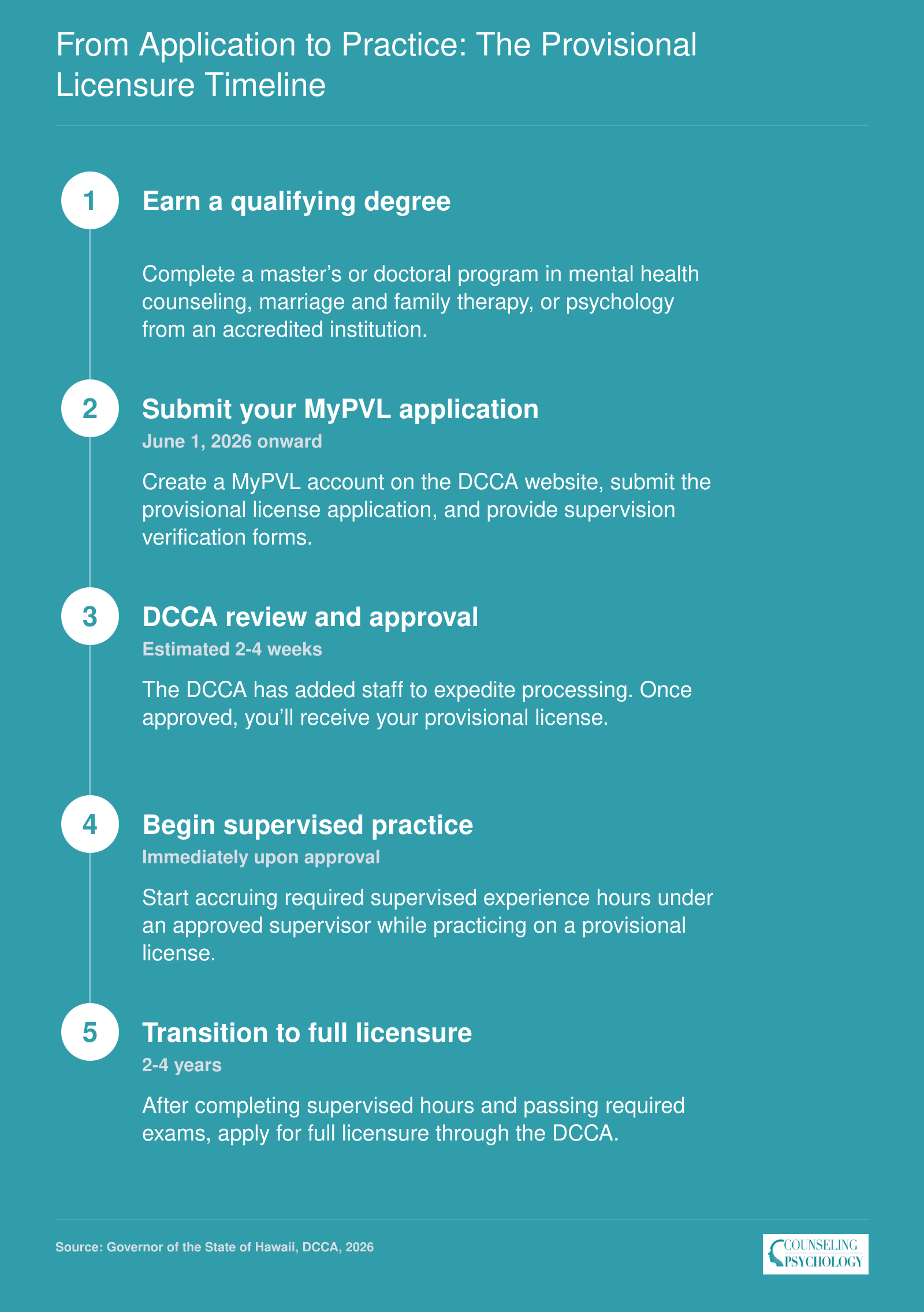
From Application to Practice: The Provisional Licensure Timeline
Starting July 1, 2026, Hawaii’s Act 93 opens a structured provisional licensure pathway for mental health professionals. Below is the typical timeline from degree completion to full licensure.
Supervised Practice and Insurance Reimbursement Under the Provisional License
Before Act 93, aspiring mental health professionals in Hawaii faced a grinding economic reality during their supervised experience: they were clinicians in training, yet they could not bill insurance and were often limited to unpaid or low-paying roles. The new provisional license flips that reality, allowing associate-level licensees to generate revenue for their practices through insurance reimbursement.1
Scope of Practice Under Supervision
Associate mental health counselors, associate marriage and family therapists, and associate psychologists may provide clinical services within the scope of their profession, but only under the direct oversight of an approved supervisor.1 These provisional licensees can conduct assessments, deliver psychotherapy, and develop treatment plans, mirroring many of the same duties they will perform as fully licensed practitioners. They cannot, however, practice independently. All client work must occur under the supervision agreement, and the provisional licensee may not advertise services as being independently provided or solicit clients outside the employment or training setting. The law is clear: the provisional license is a training credential, not a substitute for full licensure.
Supervision Structure and Requirements
The DCCA mandates that each associate-level professional maintain a formal supervision contract with a qualified supervisor who holds an active, unrestricted license in the same discipline.1 While specific hour ratios and frequency requirements are defined by each professional board, the general expectation is that supervision is regular, documented, and sufficient to protect the public. Supervisors must verify the provisional licensee's work and complete periodic evaluation forms for the board. For those pursuing the marriage and family therapy pathway, LMFT supervision hours and requirements vary by board and merit careful review before entering a placement. In many cases, the supervisor must also be a contracted provider with the same insurance plans under which the associate bills, ensuring continuity of care and compliance with payer policies.
The Insurance Reimbursement Advantage
Perhaps the most transformative provision of Act 93 is that insurance reimbursement is now permitted for services rendered by associate-level practitioners.1 Historically, pre-licensed clinicians in Hawaii could not bill third-party payers, leaving them dependent on agency stipends or client self-pay. Under the new law, commercially insured clients can be billed for services provided by provisional licensees, provided the supervisor meets the payer's requirements as a contracted provider and the billed rate is commensurate with the associate's level of training.1 The legislation does not specify particular CPT codes, so providers should confirm coding and billing protocols with each insurance company.2 It is also important to note that Medicaid implementation has not yet been finalized, and guidance from the state's Med-QUEST division is pending.2
Economic Ripple Effects
This change fundamentally alters the financial calculus for both provisional licensees and their employers. Associates can now earn a livable wage tied to billable hours rather than relying solely on grant-funded stipends or sliding-scale client payments. Clinics and agencies gain the ability to expand their caseloads by bringing on provisional licensees who generate revenue, helping to address Hawaii's persistent mental health workforce shortages. The shift also encourages early-career professionals to remain in the state rather than pursuing licensure in jurisdictions with more lenient billing rules, strengthening the local pipeline of providers.
Questions to Ask Yourself
Provisional Vs. Full Licensure: Key Differences and Transition Path
The provisional license opens the door to immediate supervised practice, but it comes with a ticking clock. Candidates must carefully navigate the requirements to convert to full licensure before time runs out.
Understanding Provisional License Duration and Renewals
The provisional license is a time-limited credential designed to give associate-level practitioners a structured window to complete supervised experience. The Department of Commerce and Consumer Affairs (DCCA) has not published an absolute cap on renewals, but the intent is clear: the license should not be a permanent status. Typically, provisional licenses are issued for a two-year period and may be renewed as long as the applicant remains in active supervision and demonstrates satisfactory progress toward the required hours. Candidates should verify the exact number of renewals permitted and the maximum total duration directly with the licensing board.
Converting from Provisional to Full Licensure
To transition from provisional to full licensure, you must complete three key steps. First, finish all required supervised hours for counseling licensure, which vary by profession (for mental health counselors, this is typically 2,000 to 3,000 post-degree hours). Second, pass the relevant national examination, such as the National Counselor Examination (NCE) or the Examination in Marital and Family Therapy. Finally, submit a conversion application to the DCCA, along with verification of supervision, exam scores, and any other required documentation. Once fully licensed, you can practice independently and drop the "associate" designation.
What Happens If the Provisional License Expires?
If the provisional license expires before you meet full licensure requirements, you must immediately stop practicing under that credential. In most cases, if you are still within the maximum allowable renewal period, you can apply for a renewal, but you should avoid any gap in active status. If you exceed the total time permitted or fail to renew in time, you may have to reapply for the provisional license, or in some cases start a new application from scratch. This could delay your career and reset your progress, so planning ahead is critical.
Do Prior Supervised Hours Count?
Yes, supervised experience hours earned before July 1, 2026, can count toward the provisional pathway if they were obtained in a setting that now meets Act 93 standards. The DCCA will evaluate prior hours on a case-by-case basis. To ensure credit, submit detailed supervision logs, attestations, and verification forms from your supervisor. Hours must have been accrued post-degree under a qualified supervisor to be considered.
Your Transition Roadmap
- Obtain provisional license: Apply as soon as you are eligible, ensuring all forms and fees are complete.
- Secure a supervisor: Your supervisor must meet board qualifications and agree to complete verification forms.
- Start logging hours: Document all direct and indirect client contact meticulously from day one.
- Prepare for exams: Study for the required national exam parallel to your supervised practice.
- Apply for full licensure: Once hours and exam are complete, submit your conversion packet promptly.
This path is designed to be linear and supportive, but it requires proactive planning. Reach out to the DCCA or your professional association if you encounter roadblocks.
Mental Health Counselor Salary and Employment Outlook in Hawaii
According to the U.S. Bureau of Labor Statistics (BLS) May 2024 Occupational Employment and Wage Statistics, substance abuse, behavioral disorder, and mental health counselors in Hawaii earned the wages shown below. These figures represent fully licensed professionals; individuals holding a provisional license under Act 93 may earn less during the supervised experience period, but the new licensure pathway is designed to help them reach these career-level salaries. Metro-area breakdowns are not yet available, but statewide data provides a reliable benchmark for career expectations.
| Metric | Value |
|---|---|
| Total Employment (Statewide) | 1,580 |
| Mean Annual Wage | $75,610 |
| 25th Percentile | $49,630 |
| Median Annual Wage (50th Percentile) | $54,390 |
| 75th Percentile | $76,220 |
Hawaii Mental Health Counselor Salary by Metro Area
Salaries for substance abuse, behavioral disorder, and mental health counselors in Hawaii vary significantly by location, with the two largest metro areas showing distinct pay profiles. While the state’s high cost of living is universal, wage differences reflect local demand and concentration of providers. The table below draws on 2024 data from the U.S. Bureau of Labor Statistics Occupational Employment and Wage Statistics program.
| Metro Area | Employment | Annual Mean Wage | 25th Percentile | Median | 75th Percentile |
|---|---|---|---|---|---|
| Urban Honolulu, HI | 1,080 | $75,410 | $49,550 | $50,090 | $76,220 |
| Kahului-Wailuku, HI | 190 | $85,680 | $54,390 | $59,350 | $77,790 |
The national median salary for mental health counselors reached $59,190 per year in 2026 (BLS). Hawaii's new provisional license is the first step: it lets you begin accruing supervised experience and income while working toward full licensure and competitive wages.
How Hawaii's Provisional License Compares to Other States
Provisional licensure is increasingly used by states to strengthen the mental health workforce, and Hawaii's Act 93 mirrors this trend by creating a dedicated pathway for associate-level counselors, marriage and family therapists, and psychologists. The following comparison highlights how Hawaii's new provisional mental health counselor license stacks up against similar programs in California and New York, two states with recent legislative updates.
How State Requirements Stack Up
- California's Associate Professional Clinical Counselor (APCC): Requires a master's degree with 60 semester units and 3,000 supervised hours, valid for up to 72 months; insurance reimbursement varies by payer.1
- New York's Limited Permit: Requires a master's degree (48, 60 semester credits) and 3,000 supervised hours, valid for 24 months; insurance billing is not specified in the permit itself.2
- Hawaii's Provisional Mental Health Counselor: Requires a master's degree with 48 semester hours and 3,000 supervised hours; renewal periods and billing authority are not yet defined in the initial Act 93 framework.2
All three states mandate 3,000 clinical hours, but the underlying degree credit requirements and permit durations differ significantly. Hawaii's 48-semester-hour minimum aligns closely with New York's lower credit threshold, while California demands a heavier academic load.1 When it comes to time limits, California's generous 72-month window offers the most flexibility for part-time supervision, while New York's 24-month permit pushes candidates toward full-time practice. Hawaii has yet to announce a maximum validity period, leaving applicants to await guidance from the DCCA.
Navigating Insurance Reimbursement
A critical practical difference is whether provisional licensees can bill insurance. insurance changes affecting mental health counselors remain a broader concern across all three states, and the contrast here is instructive. California explicitly leaves reimbursement up to payers, meaning some providers will cover associate-level clinicians and others will not.1 Hawaii and New York have not specified billing authority, which can create uncertainty for both practitioners and clients.2 Professionals relocating to or from these states should verify with individual insurers before assuming coverage.
Oregon also offers a registered associate pathway, but detailed comparisons were not available at the time of this writing. Overall, Hawaii's new provisional license brings it in line with other states that recognize the need to create an intermediate step toward full licensure, though nuances in duration and insurance access remain important considerations.
Frequently Asked Questions About Hawaii's Provisional Mental Health License
Act 93 introduces associate-level provisional licenses for psychologists, marriage and family therapists, and mental health counselors, launching July 1, 2026. Below are answers to common questions about these new licensure pathways.