
What you’ll learn in this article…
- In 2024, 16.8% of Americans had a substance use disorder but only 23% received treatment.
- Project BEST offers three intensive summer courses for provisional addiction counselor licensure in Nebraska.
- 28 states rely solely on the IC&RC exam for addiction counselor licensure; others accept NAADAC credentials.
- Graduate certificates require just 12–21 credit hours for state education compliance.
Can you become a licensed addiction counselor without a master's degree? For the 16.8% of Americans who had a substance use disorder in 2024 but could not access treatment (only 23% received care), the answer matters urgently. The bottleneck isn't limited facilities; it's a persistent mental health professionals shortage of qualified counselors. If you are a career changer, an allied mental health professional, or someone with a background outside the traditional counseling pipeline, entry may look blocked. In reality, most states now offer formal alternative routes to addictions licensure that bypass the standard master's-in-counseling requirement. These accelerated paths are quietly reshaping who can provide treatment, and how quickly.
Standard Vs. Alternative Addiction Counseling Licensure Pathways
The tension is plain: do you commit two or three years to a master's program and supervised hours for full licensure, or can you start working sooner through a shorter, more focused pathway? The answer shapes your near-term income, long-term career ceiling, and the clients you serve right away.
The Traditional Licensure Route
- Degree requirement: A master's in counseling, social work, or a closely related behavioral health field from an accredited program.
- Supervised experience: You complete 2,000 to 4,000 hours of post-degree supervised clinical practice, depending on the state.
- Examination: You pass a state-approved exam, typically the NCAC (National Certified Addiction Counselor) levels, the ADC exam, or a state-specific test.
- Full licensure: You earn the Licensed Alcohol and Drug Counselor (LADC) or Licensed Clinical Alcohol and Drug Counselor (LCADC) credential, allowing independent practice.
This route is thorough but time-intensive. It produces clinicians who can diagnose, treat co-occurring disorders, and often supervise others.
What Makes a Pathway 'Alternative'?
An alternative pathway substitutes or supplements part of that pipeline. It can mean:
- Earning a certification first and working under supervision while completing academic requirements later.
- Using a graduate certificate in addiction studies instead of a full master's to qualify for licensure.
- Entering at a technician or associate level (e.g., Certified Alcohol and Drug Counselor, CADC) and then progressing through tiered credentials.
- Participating in intensive cohort programs that compress coursework and supervision into a structured, accelerated timeline.
These are not loopholes. They are intentional entry points created by states facing a workforce shortage.
Why Alternative Pathways Are Expanding
The primary driver is a crisis: in 2024, 16.8% of Americans had a substance use disorder, yet only 23% received treatment.1 The mental health workforce shortage has prompted federal agencies and state legislatures to respond with grant funding for training, streamlining licensure tiers, and recognizing experiential knowledge. Programs like Project BEST in Nebraska illustrate how grant dollars can build intensive, supervised tracks that bypass the traditional master's prerequisite.
Tiered Systems: A Different Starting Line, Not a Lesser One
Many states now use tiered licensure: typically, a counselor begins with a provisional or associate credential (e.g., PLADC, CADC-Intern) that requires only a bachelor's or an associate degree plus specific coursework. After supervised practice and additional education, they advance to independent licensure. For professionals exploring how to become a substance abuse counselor, this structure acknowledges that competency can be built sequentially, and that the field needs skilled clinicians now, not just in three years.
Certification Vs. Licensure: Key Differences and How They Interact
In 28 states, the IC&RC exam is the exclusive pathway to addiction counselor licensure; the rest accept NAADAC credentials, either alone or alongside IC&RC.1 This patchwork underscores a central distinction: national certification, a voluntary professional benchmark, and state licensure, a legal requirement to practice independently.
Certification: The Voluntary National Credential
Certification demonstrates that you have met predetermined standards of education, clinical experience, and examination performance. Two major bodies govern addiction counseling certifications: NAADAC (the Association for Addiction Professionals) and IC&RC (International Certification & Reciprocity Consortium). NAADAC offers three tiered credentials. The NCAC I requires a high school diploma, 270 education hours, 6,000 clinical hours, and three years of work experience.1 NCAC II builds on that with a bachelor's degree, 450 education hours, 10,000 clinical hours, and five years of experience.1 The Master Addiction Counselor (MAC) credential requires a relevant master's degree, 500 education hours, 6,000 clinical hours, and three years of experience.1 IC&RC's credentials include the CADC/ADC (high school diploma or higher, 150 to 350 education hours, 4,000 to 6,000 clinical hours) and the AADC (master's degree typically, 180 to 350 education hours, 2,000 to 6,000 clinical hours).1 Both organizations' exams and education providers are widely recognized, but certification itself does not confer legal authority to practice.
Licensure: The State-Issued Permit to Practice
Licensure is a state government function. It grants the legal right to use a protected title (such as Licensed Alcohol and Drug Counselor, or LADC) and to provide independent addiction counseling services. Without a license, you cannot lawfully practice outside supervised or exempt settings. Counseling licensure requirements vary but generally demand an advanced degree, supervised clinical hours, and passage of a state-approved exam.2 In many jurisdictions, holding a national certification can satisfy one or more of those requirements. For example, some states accept the MAC or AADC as proof of competency, while others mandate their own content exams but waive certain education requirements if you hold an equivalent national credential.
How National Certifications Streamline State Licensure
Certification and licensure often work in tandem. The tiered structure of NAADAC's credentials (NCAC I, NCAC II, MAC) maps roughly to increasing levels of state licensure. An aspiring counselor with a high school diploma might first earn the NCAC I, then pursue an associate or bachelor's degree and qualify for NCAC II. This incremental approach builds a portfolio that makes the transition to a state-issued license far smoother. IC&RC's formal reciprocity system ensures that a credential earned in one member state is recognized by all others, eliminating redundant testing or hours in some cases.1 Even where reciprocity is not automatic, state licensing boards frequently accept NAADAC-approved education hours and exams (12 states accept NAADAC exclusively, while 10 accept both NAADAC and IC&RC).1 This interplay means a national certification often serves as the educational and examination backbone for a state license.
The Career-Change Advantage: Certify First, Work While You License
For career changers, certification offers a fast on-ramp. Because certifications like the CADC or NCAC I require fewer educational prerequisites than a full license, you can earn them while still completing a degree or accumulating supervised hours. Many community agencies and court-mandated treatment programs hire certified counselors to work under supervision. This enables you to draw a paycheck, log required clinical hours, and practically apply classroom learning, all while working toward the independent practice license that unlocks insurance billing and private practice. In this model, certification is not an end in itself but a stepping stone that bridges the gap between your prior career and full-fledged addiction counseling.
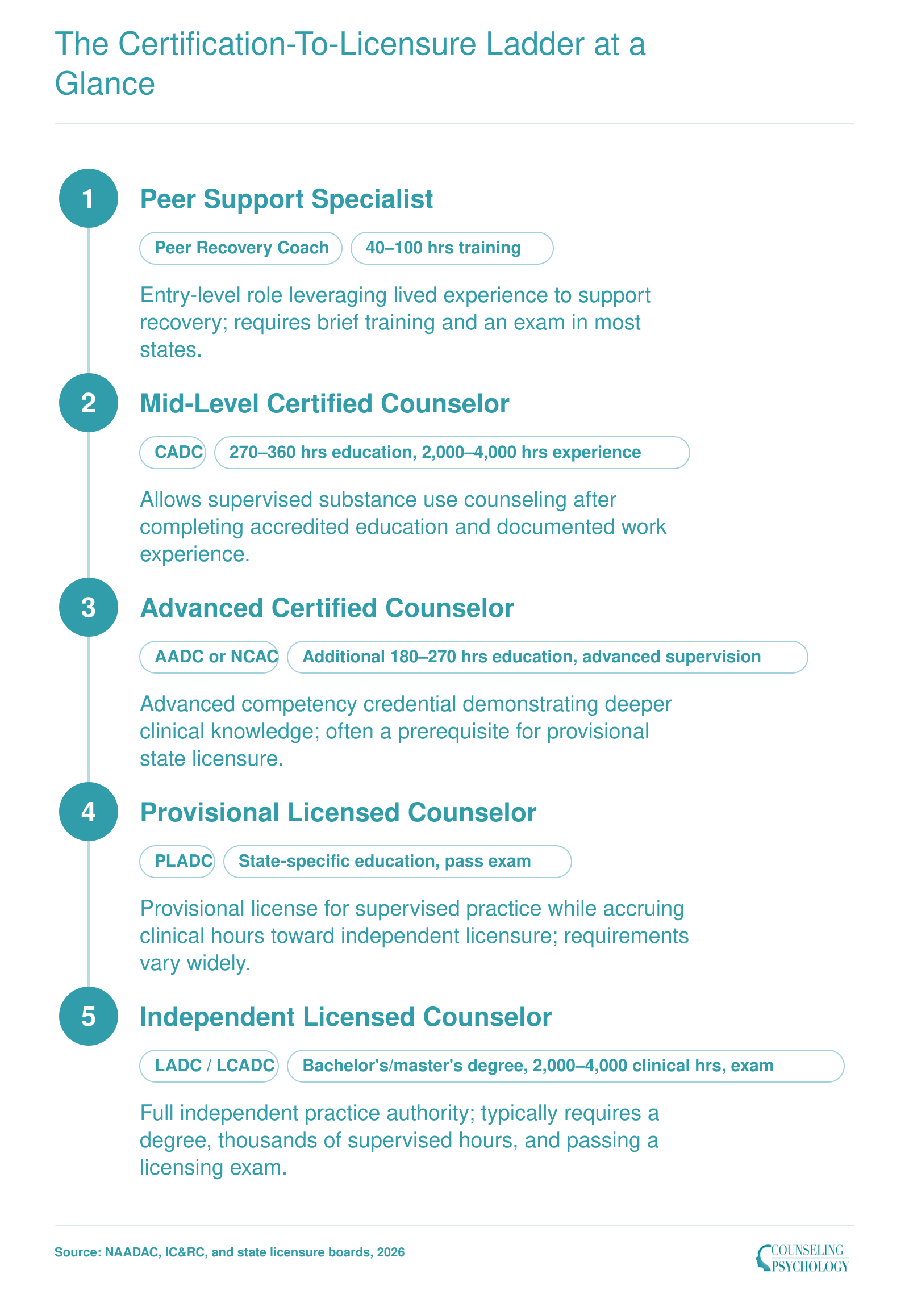
The Certification-To-Licensure Ladder at a Glance
Practitioners can work at every tier while advancing toward full licensure. Each step builds on the last, with approximate education hours and supervised experience noted below.
How to Become an Addiction Counselor Without a Counseling Degree
You can build a licensed addiction counseling career without ever completing a counseling-specific degree program. Behavioral health systems across the United States recognize that competence comes from targeted education and supervised experience, not just from a degree title. What matters most is that you understand how to map your existing education onto state requirements and fill any gaps strategically.
Leveraging Your Existing Degree Credits
If you already hold a bachelor's or master's degree in psychology, criminal justice, nursing, social work, or a related behavioral science, you likely have a head start. Most state licensing boards will accept relevant coursework from these fields toward the education component of addiction counselor licensure. Request an official transcript review from your intended licensing board as early as possible. You will typically find that courses in human development, abnormal psychology, and ethics already satisfy core requirements. Identify exactly which substance use disorder (SUD)-specific topics are missing , these are the gaps you will need to fill.
Filling the Credit Gap with Targeted Coursework
States commonly mandate between 200 and 350 hours of addiction-focused education for full licensure. Rather than pursuing a second degree, you can meet this requirement through graduate certificates in addiction counseling or individual university courses. Many institutions offer stackable certificates that cover the required subjects: pharmacology of abused substances, assessment and diagnosis, treatment planning, and case management. Some programs even package these into intensive formats, including one- to two-week residential courses, that satisfy educational requirements quickly while connecting you with the required practicum supervisors.
- Audit your transcript early: Compare every completed course against the state's education checklist.
- Identify the remaining credit hours: Count exactly how many substance use-specific credits you still need.
- Select a program that fills only the gap: Avoid retaking courses you have already passed.
Entry Points Without a Bachelor's Degree
A handful of states still offer a pathway to practice at the technician or associate level with only a high school diploma or an associate degree. These roles typically require a certification, such as a Certified Alcohol and Drug Technician or Associate Counselor credential, plus a designated number of supervised work experience hours. While these positions carry a narrower scope of practice, they allow you to gain documented client-contact hours that can later be applied toward advanced licensure. Check the state comparison table later in this article for the specific entry points available in your jurisdiction.
Fast-Track for Licensed Professionals
If you are already practicing as a Licensed Clinical Social Worker (LCSW), Licensed Mental Health Counselor (LMHC), or registered nurse, your existing license can shorten the addiction counselor credentialing process dramatically. Many states waive core clinical supervision hours or accept your current board-approved supervision hours toward the addiction specialty. In some cases, you only need to complete the SUD-specific education modules and pass a jurisprudence or ethics exam. Contact your state's dual-licensure board for the specific reciprocity or accelerated pathway that applies to your professional background.
Related Articles
Graduate Certificates as a Licensure Pathway
For many aspiring addiction counselors, a graduate certificate provides the fastest route to meeting state-level education requirements without committing to a second full degree. These programs typically require 12 to 21 credit hours and can be finished in two to four semesters, stacking neatly on top of an existing bachelor's or master's degree in virtually any field. The result: a targeted, licensure-aligned credential that unlocks counselor roles in a fraction of the time and cost of a traditional master's program.
How Graduate Certificates Bridge the Education Gap
State licensing boards mandate specific coursework in addiction studies, and a carefully chosen addiction counseling certificate online can satisfy those credit-hour thresholds directly. Instead of repeating generalist graduate coursework, you build exactly the specialty knowledge that regulators look for: pharmacology, ethics, assessment, and treatment planning. Many certificate curricula are designed in consultation with state boards, so the course titles and learning objectives mirror the application checklist. That alignment means fewer appeals, faster approvals, and a clear path to the supervision and exam phases of licensure.
Program Examples That Map Directly to Licensure
- Arizona: Arizona State University offers a fully online Addiction and Substance-Use Related Disorders Graduate Certificate. At 21 credits, it covers the required domains for Arizona licensure and implicitly addresses behavioral addictions through its broader substance-use framework.1
- Florida: The University of Florida's online Addiction and Recovery Graduate Certificate requires 18 credits and prepares graduates for the state's Certified Addiction Professional (CAP) or Certified Addiction Counselor (CAC) exam. The curriculum aligns explicitly with Florida's coursework mandates.2
- North Carolina: For post-master's clinicians, UNC Charlotte delivers a 15-credit campus-based certificate that includes 300 clinical hours, mapping directly to the Licensed Clinical Addictions Specialist (LCAS) credential.3
- Indiana: Indiana Wesleyan University's online Addictions Counseling Graduate Certificate is accredited by the National Addiction Studies Accreditation Commission (NASAC), satisfying Indiana's educational requirements for licensure.4
- Capella University: The online Contemporary Theory in Addictive Behavior Graduate Certificate requires 20 quarter credits and is notable for its explicit coverage of behavioral addictions, a response to evolving state mandates like Nebraska's SB1062.5
Cost, Format, and Clinical Hours: What to Expect
Tuition varies significantly: Capella charges $525 per quarter credit ($10,500 total)5, while Florida's per-credit rate is $590 ($10,620 total)2. Most programs operate entirely online, except where clinical placements demand on-site attendance, as with UNC Charlotte's 300-hour practicum3. Before enrolling, verify whether the certificate includes supervised clinical hours or if you must arrange a separate field placement. Some programs embed practicum; others leave that to your employer or a separate internship. Additionally, ask whether earned credits can later transfer into a full online addiction counseling degree, a flexibility that can extend your career options without starting over.
The SB1062 Shift: A New Focus on Process and Behavioral Addictions
Recent legislative moves, such as Nebraska's SB1062, are pushing state boards to require training in process and behavioral addictions (gambling, gaming, internet use). Certificate programs are adapting quickly. Capella has built explicit behavioral addiction modules into its curriculum, while other programs weave the content into existing diagnosis and treatment courses. As more states follow suit, choosing a certificate that already addresses these emerging mandates future-proofs your licensure eligibility and deepens your clinical readiness for modern caseloads.
Questions to Ask Yourself
Spotlight: Project BEST and Accelerated Intensive Models
A persistent shortage of licensed addiction counselors has pushed states and universities to rethink how professionals enter the field. One of the most concrete recent examples is Project BEST, a collaboration between the University of Nebraska Omaha's Grace Abbott School of Social Work and Region 6 Behavioral Healthcare.1 Funded by a grant, this program directly targets workforce gaps in five Nebraska counties (Cass, Dodge, Douglas, Sarpy, and Washington) with the stated goal of raising the number of Licensed Alcohol and Drug Counselors (LADCs) by 10%.
What is Project BEST?
Project BEST is an accelerated pathway to Nebraska's Provisional Licensed Alcohol and Drug Counselor (PLADC) credential. It is designed for individuals who already hold a relevant bachelor's or master's degree and can commit to three intensive, one-week summer courses. By condensing the required education into a compact timeline, the program removes a major time barrier for career changers and existing mental health professionals considering a career change to mental health counseling in addiction specialization.
Structure and Support
The three courses cover the core PLADC domains: Medical and Psychosocial Aspects of Addiction, Assessment and Case Management in Substance Use Disorders, and Treatment Issues in Chemical Dependency. The final course runs July 20-24, 2026, and was still accepting applications at the time of writing.1 Instructors include Laura Sanchez (LICSW, LADC), Corey Johnson (BSW, LADC, SAP), and Kersten Borer (LIMHP, LADC, CMSW), who brings over 25 years of dual-diagnosis treatment experience. Beyond academics, Project BEST provides stipends, on-campus housing, continuing education units, and academic credit. Most critically, it tackles the practicum bottleneck: more than 50 licensed counselors have committed to supervising participants, which means graduates do not have to search for a supervisor on their own.1
Why This Model Matters for Mental Health Professionals
For licensed clinicians in forensic psychology, clinical psychology, substance abuse social work, or marriage and family therapy, adding addiction counseling competencies is increasingly vital. In 2024, 16.8% of Americans had a substance use disorder, but only 23% received treatment.1 An intensive program like Project BEST allows these professionals to earn dual licensure without interrupting their careers for a lengthy degree program. The built-in supervision network is especially valuable for those whose current workplaces may not offer specialized addiction supervision. As integrated care and court-mandated treatment expand, the ability to address both mental health and substance use disorders in one practice setting becomes a distinct professional advantage.
The Broader Landscape of Accelerated Programs
Project BEST is not an isolated initiative. Similar grant-funded, intensive certificate programs have emerged in Minnesota, Iowa, Kansas, Colorado, and other states. They typically take the form of addiction studies certificates delivered in compressed formats: two to four semester-long courses, evening and weekend sessions, or multi-week modules. While each state's licensure board sets its own requirements, the trend reflects a growing recognition that alternative pathways can quickly build a qualified workforce. Project BEST's outcomes have not yet been formally evaluated, and future cohorts beyond 2026 are unconfirmed, but its design offers a blueprint for bridging treatment gaps in underserved regions.
State-By-State Alternative Pathway Comparison
Licensure requirements for addiction counselors vary dramatically from state to state, and understanding this patchwork is the first critical step for anyone pursuing alternative pathways. While some states maintain strict master's degree mandates, others offer multiple entry points through certification-only practice or expedited routes for allied professionals. To navigate this maze effectively, you need reliable, up-to-date information from authoritative sources, not hearsay from online forums.
Start with National Overviews
The Bureau of Labor Statistics Occupational Outlook Handbook provides a broad snapshot of the addiction counseling profession, including typical education levels, job duties, and employment projections. It is a useful starting point to grasp the general landscape, but it cannot substitute for state-specific details. Use it to frame your expectations, then immediately pivot to primary sources within your target state.
Zero In on Your State Board
Every state has a licensing board responsible for alcohol and drug counselors, usually under the umbrella of a health department or professional regulation agency. For example, California's Department of Health Care Services oversees certification for alcohol and drug counselors, while Texas Health and Human Services manages licensure. Visiting your state board's official website (look for .gov domains) is non-negotiable. Search for the exact credential title used, such as Licensed Alcohol and Drug Counselor (LADC), Certified Alcohol and Drug Counselor (CADC), or Chemical Dependency Professional (CDP). Pay close attention to the minimum education level accepted, supervised experience hours, and any alternative tracks for individuals holding addiction counseling degrees online in adjacent fields like social work, mental health counseling, or psychology.
Tap Professional Membership Networks
Organizations like NAADAC, the Association for Addiction Professionals, and the International Certification & Reciprocity Consortium (IC&RC) maintain detailed, state-by-state directories of certification and licensure contacts. These resources are invaluable because they often highlight reciprocity agreements and alternative pathways that might not be immediately obvious on a government website. NAADAC's state affiliate pages, for instance, can connect you with local chapters that understand the nuances of provisional licensure, equivalency applications, and portability across state lines. If you are a career changer, these networks also offer guidance on bridging your existing credentials into addiction counseling , and understanding the difference between licensure and non-licensure tracks is a useful framework before you reach out.
Search Smart Online
A simple search for 'addiction counselor licensure [state]' can yield a wealth of information, but it is critical to filter for .gov or .org domains to avoid third-party sites that may present outdated or inaccurate data. As you browse, note whether a state allows certification-only practice, meaning you can work as a CADC or similar without holding a separate state license. This option exists in several states and can be a faster entry point, though it may limit your ability to practice independently or bill certain insurance providers. Always read the statutes or FAQ sections on the board's site to verify such details.
Connect with Academic Programs
University program coordinators in your target state are often underutilized goldmines. They must stay abreast of changing licensure rules to advise students accurately and frequently compile comparability guides for different pathways. Many schools have specific expedited tracks for nurses, social workers, or psychologists transitioning into addictions counseling. A direct call or email to a faculty member can surface information that is not yet publicly documented, including pending legislative changes or pilot programs. Building this relationship early can also help you secure the supervised practicum placements required by many boards.
Don't assume a master's degree is the only path. Several states issue full independent addiction counseling licenses to bachelor's-level practitioners who complete certification and supervised hours. A few even offer entry-level credentials with just a high school diploma and on-the-job training, dispelling the outdated master's-or-nothing myth.
Highest-Paying States for Addiction Counselors
The top-paying states for substance abuse, behavioral disorder, and mental health counselors are led by Alaska, New Mexico, and Oregon. Notably, many of these high-earning states, such as Alaska, New Mexico, and Oregon, also offer accessible alternative licensure pathways, as detailed in the state comparison table earlier. Salary data from the Bureau of Labor Statistics shows median annual wages substantially above the national median in these locations.
| State | Median Annual Salary | Employment |
|---|---|---|
| Alaska | $79,220 | 1,060 |
| New Mexico | $70,770 | 2,070 |
| Oregon | $69,660 | 6,410 |
| North Dakota | $66,450 | 1,180 |
| District of Columbia | $66,140 | 980 |
| Utah | $65,920 | 4,720 |
| Idaho | $65,240 | 2,130 |
| New Jersey | $64,710 | 14,640 |
| Nebraska | $64,410 | 1,980 |
| Washington | $64,220 | 13,150 |
Choosing the Right Alternative Pathway: A Decision Framework
Which alternative pathway fits your background, timeline, and budget? The answer depends on where you are starting from and how quickly you want to begin practicing. Below we map out three common entry points and the most efficient routes for each.
Profile 1: Career Changer with an Unrelated Bachelor's Degree
You already hold a degree but lack addiction-specific coursework. A graduate certificate in addiction counseling is the fastest stand-alone route. These programs typically take 12 to 24 months and cost between $15,000 and $40,000.1 Pair the certificate with a NAADAC national certification (exam fee: $175 to $225)2 to build your credential stack. Most states will then allow you to sit for a provisional license exam and begin earning supervised hours. From start to provisional licensure, budget 1.5 to 2 years; full independent licensure may add another 2 to 3 years depending on clinical hour requirements.
Profile 2: Existing Mental Health Professional (LCSW, LMHC, LPC, MFT)
If you are already licensed in a related field, many states offer abbreviated dual-licensure pathways. You will likely need 6 to 12 additional credit hours in substance use disorders and a set of addiction-specific supervised clinical hours. Programs such as Project BEST's intensive summer courses can compress this coursework into a few weeks. Because you already have a master's degree and a supervision network, the total add-on timeline rarely exceeds 1 to 2 years.1 Costs are substantially lower: graduate-level addiction courses often run $3,000 to $9,000, and exam fees fall between $300 and $1,000.
Profile 3: No Degree / Community College Graduate
Start with an entry-level technician or peer recovery specialist credential, available in 22 and 47 states respectively.3 Earn a state-recognized associate-level certification (e.g., South Carolina CAC I) while working.2 Then, stack an associate or bachelor's degree in addiction studies part time. This "ladder" approach typically requires 4 to 8 years to reach independent clinical licensure, with total education costs ranging from $10,000 to $60,000.1 Certification exams add $300 to $1,500. The pace is controlled by how quickly you accumulate the clinical hours most states mandate for full licensure, which range from 4,000 hours for entry credentials such as South Carolina's CAC I to 10,000 hours for advanced certifications.2
Time to Licensure and Cost Comparison
- Career changer (graduate certificate): 2 to 4 years total; $15,000 to $40,000 plus $300 to $1,000 exam fees.1
- Existing MH professional (add-on): 1 to 2 years; $3,000 to $9,000 plus $300 to $1,000 exam fees.1
- No-degree entrant (technician ladder): 4 to 8 years; $10,000 to $60,000 plus $300 to $1,500 exam fees.1
- Application processing: 2 to 6 months and $100 to $500 across all pathways.1
Action Steps
1. Identify your state's specific requirements using the state comparison table elsewhere in this guide. 2. Audit your existing education and clinical hours against those requirements.4 3. Choose the pathway that fills the smallest gap: a graduate certificate if you have a bachelor's, an add-on if you hold a clinical license, or the technician ladder if you are starting fresh.
Once you have mapped your timeline, connect with your state licensing board or a NAADAC advisor to verify that your planned coursework and supervision will be accepted.
Common Questions About Alternative Addiction Counseling Licensure
Whether you're exploring a career change or seeking to add addiction counseling credentials, these answers address common questions about alternative licensure pathways. For deeper guidance, refer to the linked sections throughout this article.