
What you’ll learn in this article…
- Most online pastoral counseling certificates require 12 to 24 credits and cost roughly $4,000 to $20,000 in total tuition.
- A graduate certificate prepares you for ministry-based counseling roles but does not qualify you for clinical licensure.
- Pastoral care, pastoral counseling, and spiritual care serve different functions, so choosing the wrong credential wastes time and money.
- Regional or ATS accreditation matters most for credit transfer, employer recognition, and eligibility for professional certification.
What credential do you actually need to counsel patients in a hospital chaplaincy, a hospice unit, or a military installation? Demand for trained pastoral counselors has grown steadily across these settings, with the U.S. Bureau of Labor Statistics projecting faster-than-average growth for clergy and counselor-adjacent roles through 2032. Yet the credentialing path is genuinely confusing: graduate certificates, professional certifications, and short training programs all carry similar names and serve very different purposes.
The terminology alone trips up serious students. A graduate certificate from a seminary is an academic credential. A board certification from the Association of Professional Chaplains is a practice credential. A weekend training cohort is neither. Enrolling in the wrong one can cost thousands of dollars and delay your career by a year or more.
For most aspiring pastoral counselors, the practical tension is not motivation but clarity: which credential satisfies the employer, which satisfies the certifying body, and which can realistically be completed while working full time. Online graduate certificates have expanded access considerably, but institutional accreditation and program focus still vary enough to make comparison essential.
Pastoral Care Vs. Pastoral Counseling Vs. Spiritual Care: Key Differences
Three terms appear constantly in this field, and the differences between them determine which credential you actually need. Conflating pastoral care, pastoral counseling, and spiritual care is one of the most common reasons people enroll in the wrong program or pursue the wrong credential path.
Pastoral Care: Ministry of Presence
Pastoral care is the broadest of the three concepts. It refers to the non-clinical ministry of accompanying people through illness, grief, crisis, and significant life transitions. Visiting a hospital patient, offering prayer with a grieving family, or sitting with someone in emotional distress are all acts of pastoral care. This work typically does not require clinical training. A graduate certificate or even a unit of Clinical Pastoral Education (CPE) is often sufficient preparation for this role within a congregational or community context.
Pastoral Counseling: Where Theology Meets Clinical Theory
Pastoral counseling is more clinically informed. It draws on both theological frameworks and established counseling or psychology theory, and practitioners often complete supervised practicum hours as part of their training. In some states, the scope of pastoral counseling overlaps with licensed professional counseling, which creates real regulatory complexity. If you are planning to provide ongoing talk therapy integrated with spiritual direction, you need to research your state's licensure laws carefully. A graduate certificate alone does not authorize clinical practice anywhere in the United States.
Spiritual Care: The Healthcare and Interfaith Setting
Spiritual care is the term most commonly used in hospital systems, VA facilities, and other healthcare environments. It is intentionally interfaith and inclusive, designed to serve patients across religious traditions. In this context, spiritual care is largely synonymous with chaplaincy. The two primary credentialing bodies for this work are the Association of Professional Chaplains (APC) and the National Association of Catholic Chaplains (NACC). Both award the Board Certified Chaplain (BCC) credential. As of 2026, both organizations require a graduate-level degree of 72 semester hours, four units of CPE, 1,600 supervised clinical hours, at least one year of professional work experience, a faith endorsement, and demonstration of competencies through written materials and an interview.1 A graduate certificate does not substitute for the full graduate degree requirement under either body's standards.
Note that the American Association of Pastoral Counselors (AAPC), which historically required 1,500 to 2,000 supervised counseling hours for its own certifications, merged into ACPE and APC in 2020. ACPE continues to offer a psychotherapy track for those interested in integrating clinical counseling with spiritual counseling.
Credential Types: Certificate, Certification, and Licensure
These three terms describe very different things, even though people use them interchangeably.
- Graduate certificate: An academic credential, typically 12 to 24 credits, awarded by a college or university. It signals coursework completion, not professional authorization.
- Professional certification: A credential awarded by a professional body such as APC or NACC after you meet supervised hours, educational, and competency requirements. It is an endorsement of readiness for professional practice.
- Licensure: A state-regulated legal authorization to provide clinical services for compensation. Requirements vary by state and are entirely separate from both academic certificates and professional certifications.
If your search started with terms like "pastoral care certification" or "pastoral counseling certification online," it is worth pausing to identify which of these three outcomes you are actually pursuing. Each has a different entry point, timeline, and cost.
Certificate Vs. Certification Vs. Training: A Side-By-Side Comparison
These three credential types serve different purposes, and confusing them is one of the most common mistakes students make. A graduate certificate is an academic credential, a professional certification is a practice credential, and non-credit training fills gaps without formal credentialing. Where you want to work determines which one you actually need.
| Feature | Graduate Certificate | Professional Certification | Non-Credit Training |
|---|---|---|---|
| What It Is | An academic program (typically 12 to 24 credits) offered by a seminary or regionally accredited university, resulting in a transcript notation | A practice credential awarded by a professional body such as APC, NACC, or ACPE/BCCI after supervised clinical hours, peer review, and a portfolio | Workshops, denominational programs, or CEU-based courses that do not carry academic credit or lead to a recognized credential on their own |
| Typical Requirements | Completion of graduate-level coursework; some programs require a bachelor's degree for admission | A qualifying master's degree, multiple units of Clinical Pastoral Education, documented supervised hours, and a formal review process | Varies widely; may require only registration and attendance, with no formal academic prerequisites |
| VA Hospital Chaplaincy | Not sufficient on its own | Required per VA qualification standards | Not accepted |
| Civilian Hospital Chaplaincy | Supplemental (strengthens an application but does not replace board certification) | Preferred by most healthcare systems | Supplemental only |
| Hospice Chaplaincy | Supplemental | Preferred by most hospice employers | Supplemental only |
| Military Chaplaincy | Not sufficient on its own (a full master's degree is typically required) | Optional, though it can strengthen a candidacy | Supplemental only |
| Congregational Pastoral Care Roles | Supplemental; valued by some denominations as evidence of formal study | Optional; not commonly required for local church ministry | Supplemental; often the most common preparation path in congregational settings |
| Best Suited For | Students building toward a master's degree or adding pastoral counseling competencies to an existing graduate education | Professionals seeking employment in healthcare, VA, or hospice settings where board certification is a hiring standard | Ministry leaders, volunteers, or lay counselors looking for foundational skills without a long-term academic commitment |
What You'll Learn in a Pastoral Counseling Graduate Certificate Program
Graduate certificates in pastoral counseling pack a focused curriculum into a relatively short timeline, typically one to two years of part-time study. The coursework is designed to sit at the intersection of theology and applied psychology, preparing you to offer care that honors both a person's spiritual life and their emotional wellbeing.
Core Curriculum Areas
Most programs organize their required courses around four foundational areas:
- Crisis and grief counseling: Theory and practice for supporting individuals through acute loss, trauma responses, and life transitions within faith communities.
- Theology of suffering and care: Theological frameworks for understanding human pain, lament, and healing, drawing from scripture, pastoral tradition, and systematic theology.
- Integration of psychological models: How evidence-based approaches such as cognitive-behavioral therapy and person-centered counseling intersect with spiritual care, and where the limits of that integration lie.
- Ethics in pastoral settings: Confidentiality, dual relationships, scope of practice, and the particular ethical tensions that arise when a counselor holds both a spiritual authority role and a helping role.
Electives and Specialization Tracks
Beyond the core, many programs offer elective courses that let you tailor your certificate to a specific ministry context. Topics that appear across programs include marriage and family pastoral care, addiction ministry, trauma-informed spiritual care, and multicultural or cross-cultural approaches to spiritual care. Students drawn to addiction ministry, for example, may also want to explore an online graduate certificate in addiction counseling for deeper clinical preparation. Not every program offers all of these electives, so if a particular population or setting matters to you, it is worth reviewing each program's elective list before applying.
Practicum and Field Experience
Most graduate certificates in pastoral counseling require a supervised practicum component, commonly ranging from 100 to 300 hours depending on the program and your prior clinical experience. Online programs handle this by asking students to arrange a local placement, such as a hospital chaplaincy, community ministry site, or congregational counseling center, while supervision sessions take place remotely via videoconference. The program typically provides guidance on how to identify and vet an approved site, but the student is responsible for securing the placement.
Skills You Graduate With
By the time you complete the certificate, you should be equipped to practice active listening with spiritual and emotional attunement, conduct a basic spiritual assessment, apply referral protocols when a situation calls for licensed clinical intervention, and maintain documentation appropriate for healthcare or chaplaincy settings. If you are considering a career path in grief counseling, the crisis intervention training embedded in these programs provides a strong foundation. These skills are practical and transferable across congregational ministry, hospital chaplaincy, nonprofit counseling programs, and community outreach roles. Students who want to pair their pastoral certificate with a broader clinical credential may also consider a graduate certificate in biblical counseling for additional theological depth.
Related Articles
Questions to Ask Yourself
Am I seeking this credential to deepen my existing ministry work, or do I need clinical qualifications for roles like hospital chaplaincy?
Does my denomination require or recognize a specific accrediting body for this certificate to count toward credentialing?
Will the program require supervised practicum hours, and can I secure a local placement site while studying online?
Do I have the prerequisite theological education, or will I need additional foundational coursework first?
How to Choose an Accredited Online Pastoral Counseling Certificate
Understanding the Three Accreditation Types That Matter
When evaluating online pastoral counseling certificates, accreditation is not just a checkbox. It determines whether your credits will transfer, whether your credential will be recognized by employers or certification bodies, and whether the education meets the standards of your faith tradition. Three specific types of accreditation carry weight for pastoral counselors.
First, regional accreditation: this is the broadest form of institutional quality assurance in the United States. Schools like Fuller Theological Seminary, Denver Seminary, or Loyola University Chicago hold regional accreditation through bodies such as the Higher Learning Commission or WASC Senior College and University Commission. Regional accreditation ensures that your certificate credits are generally transferable to other regionally accredited institutions if you later pursue a master's degree. It also signals to employers that your program meets baseline academic standards.
Second, the Association of Theological Schools (ATS) accreditation is the gold standard for graduate-level theological education. ATS-accredited schools, including many seminaries offering pastoral counseling certificates, undergo rigorous evaluation of their curriculum, faculty, and mission alignment. If your certificate is from an ATS-accredited institution, you can be confident it has been vetted for theological depth and professional preparation. For those planning to serve in church or chaplaincy roles, ATS accreditation often carries more immediate recognition than regional accreditation alone.
Third, CACREP (Council for Accreditation of Counseling and Related Educational Programs) accreditation pertains specifically to professional counseling degrees. A standalone pastoral counseling certificate is unlikely to be CACREP-accredited, but this matters if the certificate is designed to feed into a licensed professional counselor (LPC) pathway. Some programs embed pastoral counseling certificates within a CACREP-accredited master's in counseling. If your long-term goal includes state licensure as a mental health counselor, confirm that the certificate aligns with CACREP standards and state board prerequisites. Students exploring the broader landscape of counseling certificate programs will find that CACREP alignment is a recurring consideration across specializations.
The Risks of Unaccredited and Nationally Accredited Programs
Not all online certificates are created equal. Some programs operate with no accreditation at all, or with national accreditation from agencies that primarily accredit trade schools. Credits from nationally accredited schools rarely transfer to regionally accredited institutions, and many professional certification bodies, such as the American Association of Pastoral Counselors (AAPC) or the Board of Chaplaincy Certification Inc., require a degree or certificate from a regionally or ATS-accredited school. Employers in ministry and healthcare systems also frequently screen for these stamps of approval. Before enrolling, verify the program's accreditation status on the U.S. Department of Education's Database of Accredited Postsecondary Institutions and Programs. Do not rely solely on a school's website claims.
Denominational Recognition and Your Judicatory's Approved List
Beyond academic accreditation, many denominations maintain their own approved-program lists for ministerial formation. For example, the Evangelical Lutheran Church in America (ELCA) requires candidates for rostered ministry to complete a program from an ELCA-approved seminary. The United Methodist Church (UMC) similarly reviews programs through the University Senate. The Presbyterian Church (U.S.A.) and many Catholic dioceses have comparable processes. Even if a certificate is accredited, it may not satisfy your denomination's specific requirements for ordination or pastoral care endorsement. Before you enroll, reach out to your judicatory or denominational office and ask whether the program is recognized. This step can prevent costly missteps later. Students weighing a faith-integrated counseling path alongside pastoral care may also want to explore a biblical counseling degree online to compare curricular approaches.
A Quick Accreditation Checklist for Prospective Students
Use this checklist to vet any online pastoral counseling certificate program:
- Verify regional or ATS accreditation: Check the U.S. Department of Education database to confirm that the institution is regionally accredited, and look for ATS accreditation if offered by a seminary.
- Confirm CACREP alignment (if applicable): If your path involves state counseling licensure, ensure the certificate coursework aligns with CACREP core standards, even if the certificate itself is not CACREP-accredited.
- Check denominational approval: Contact your church body or judicatory office to see if the program appears on their approved list, especially if ordination or official pastoral care roles are in view.
- Assess credit transferability: Ask the program directly whether credits can be applied toward a future master's degree at regionally accredited institutions.
- Understand CPE integration: Some certificates include Clinical Pastoral Education (CPE) units within the curriculum, while others require you to complete CPE separately. Know which model the program uses and whether CPE providers in your area will accept the certificate.
Careful attention to these accreditation and recognition layers will help you choose a program that opens doors rather than creates dead ends.
Admissions Requirements and Typical Student Profiles
Most online graduate certificates in pastoral counseling require only a bachelor's degree from a regionally accredited institution, making them accessible entry points for professionals across ministry, healthcare, and human services backgrounds. However, admission requirements vary considerably depending on whether a program targets entry-level learners or experienced clergy seeking advanced specialization.
Three Tiers of Admission Requirements
Programs generally fall into three categories based on educational prerequisites:
- Bachelor's degree required: The most common tier, these certificates welcome applicants with any undergraduate major. They suit lay ministers, second-career adults, and professionals exploring chaplaincy or congregational care roles.
- Master's or MDiv required: Advanced certificates designed for ordained clergy or licensed mental health professionals who want to add a pastoral counseling specialty. These post-graduate credentials often assume prior theological training.
- Ministry experience in lieu of a degree: A small number of programs accept applicants without a college degree if they can document substantial ministry involvement, typically five or more years of active congregational or chaplaincy service.
Common Application Materials
Beyond transcripts, most programs request several additional documents:
- A personal statement describing your call to ministry or motivation for pursuing pastoral counseling
- A letter of recommendation from a pastor, denominational leader, or supervisor familiar with your ministry work
- A background check, standard for any program that includes clinical placements or field education
- A minimum cumulative GPA, usually between 2.5 and 3.0 on a 4.0 scale
Notably, the vast majority of online pastoral counseling certificates do not require GRE or MAT scores. Admissions committees tend to weigh vocational readiness and ministry experience more heavily than standardized test performance.
Who Enrolls in These Programs?
The typical student in an online pastoral counseling certificate program is not a recent graduate. Most enrollees are mid-career professionals adding a specialized credential to existing ministry or counseling work. Common profiles include:
- Ordained clergy seeking structured training in counseling techniques to serve congregants more effectively
- Lay ministers or deacons formalizing skills they have developed through years of informal care work
- Second-career adults transitioning into chaplaincy roles in hospitals, hospices, or correctional facilities
- Licensed professional counselors or social workers adding a spiritual integration credential to broaden their clinical scope
This diversity means online cohorts often include students ranging from their late twenties to their sixties, with widely varying denominational affiliations and professional backgrounds. Licensed counselors interested in faith-based practice may also want to explore a licensed professional counselor online degree to strengthen their clinical foundation. Programs designed for working adults typically structure coursework around asynchronous formats, recognizing that most students balance full-time ministry or employment alongside their studies.
Program Costs, Credit Hours, and Time to Completion
The cost of an online graduate certificate in pastoral counseling comes down to three numbers: credits required, price per credit, and how quickly you can finish. Most programs fall in the 12 to 24 credit range, though a handful sit below or above that window. At a part-time pace, the typical student completes a certificate in six to eighteen months.
What Programs Actually Cost
The range is wide, so benchmarking a few real programs helps. The verified figures below reflect published tuition rates and should be confirmed directly with each institution before you enroll, as rates change.
- Liberty University: 9 credits at $410 per credit, totaling approximately $3,690. Fully online, regionally accredited by SACSCOC. This is one of the lowest-cost options available.1
- Loyola University Chicago: 15 credits at $925 per credit, totaling approximately $13,875. Regionally accredited.2
- Denver Seminary: Offers a Certificate in Pastoral Care and Counseling with a reported completion window of around 12 months for students moving at a steady pace.3
- Oral Roberts University: Offers a Graduate Certificate in Pastoral Counseling and Chaplaincy in an online format.4
For programs where per-credit rates were not available through public sources at the time of publication, contact the admissions or bursar office directly. Many seminaries and faith-based institutions also offer institutional aid, employer tuition assistance, or denominational scholarships that do not appear in the headline tuition figure.
Credits, Format, and Pace
Most certificates in this field require somewhere between 12 and 24 credits. Shorter programs (9 to 12 credits) are typically designed for working ministers or chaplains who already hold graduate credentials and want focused training rather than a full degree. Longer programs (18 to 24 credits) tend to cover more clinical or theoretical ground and may satisfy prerequisites for licensure-track counseling master's programs online.
Delivery is almost entirely asynchronous online at this point, though some programs include brief residencies or synchronous cohort sessions. If your schedule or employer requires a specific format, verify that detail before applying.
Total Investment: The Full Picture
Tuition is only part of the cost. Factor in technology fees, required texts, and any travel costs for residencies. That said, even at mid-range tuition levels, a pastoral counseling certificate represents a substantially smaller investment than a full master's degree, which is part of the appeal for students who want targeted credentials without a two-year commitment.
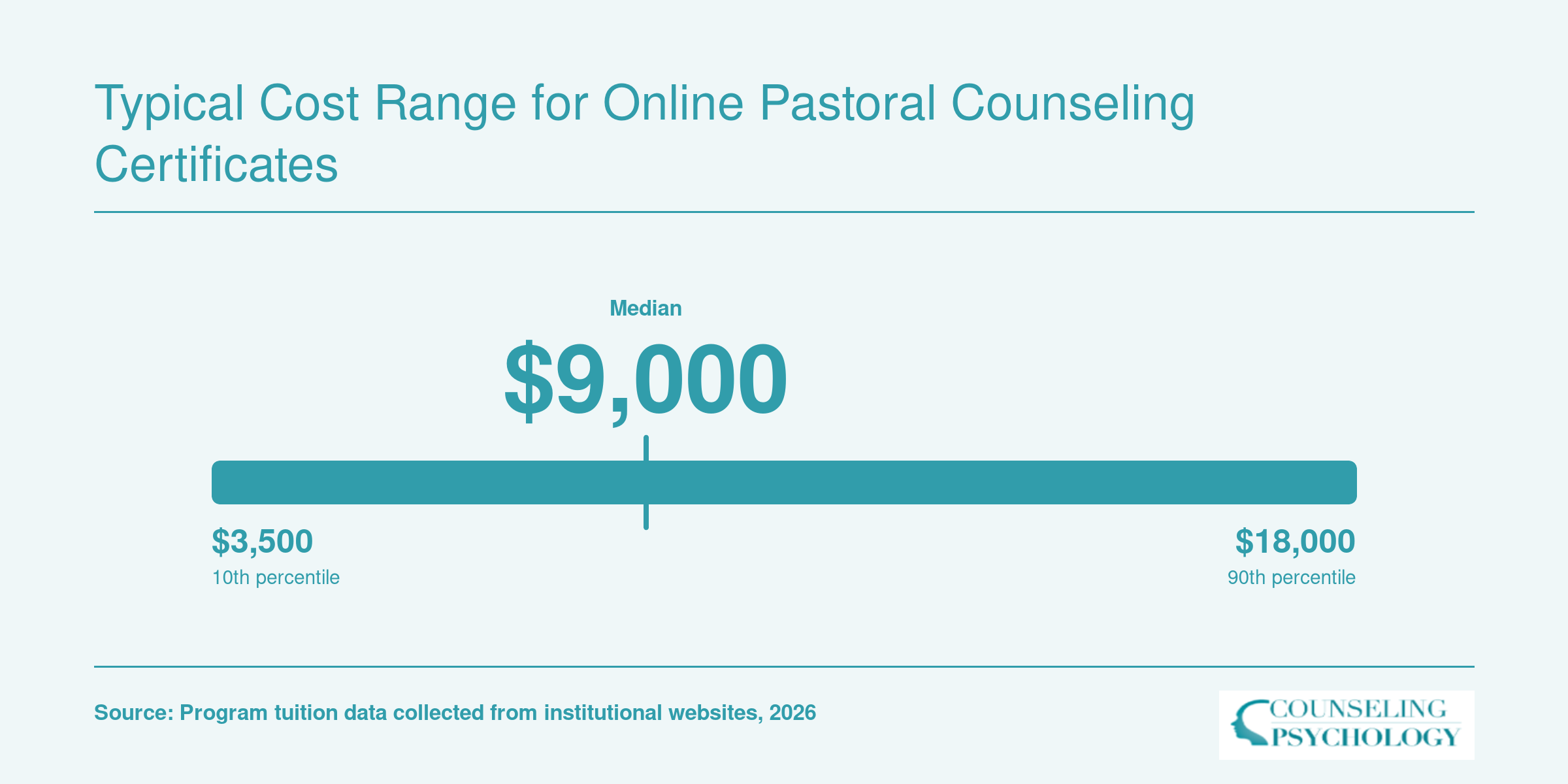
Typical Cost Range for Online Pastoral Counseling Certificates
Online graduate certificates in pastoral counseling span a wide cost range depending on the institution, credit hours, and whether the school is a seminary or university. The figures below reflect total estimated tuition across the programs researched for this guide, giving you a quick sense of where affordable and premium options fall.
What Can You Do With a Pastoral Counseling Certificate?
Where do pastoral counseling certificate graduates actually work, and which roles require additional credentials beyond the certificate itself?
A graduate certificate in pastoral counseling opens doors to a variety of ministry and faith-based care settings, but it is important to understand the distinction between what the certificate qualifies you to do and what roles require additional training, clinical licensure, or denominational endorsement. The certificate is a ministry credential, not a clinical license, and does not substitute for the master's degree and supervised hours required for state-regulated mental health practice.
Common Career Settings for Certificate Holders
Certificate holders typically work in roles that integrate spiritual care with emotional support in faith-based or mission-driven contexts:
- Congregational pastoral care coordinator: Many churches and religious organizations hire certificate holders to lead support groups, coordinate care for congregants in crisis, and provide spiritual companionship during illness or grief. These roles are typically part-time or volunteer positions, though some larger congregations offer full-time salaries.
- Hospice and palliative care spiritual support: Hospice agencies often accept a Master of Divinity plus a pastoral counseling certificate as an alternative to Clinical Pastoral Education (CPE) units for spiritual care roles.1 These positions involve end-of-life companionship, grief counseling, and family support.
- Campus ministry counselor: College and university campus ministries employ certificate holders to provide pastoral support, crisis intervention, and spiritual direction to students. These roles emphasize faith integration and are not regulated as clinical counseling.
- Nonprofit crisis counseling: Faith-based nonprofits, crisis pregnancy centers, and community agencies hire certificate holders to offer short-term emotional and spiritual support. These roles generally do not require state licensure because they are framed as pastoral ministry rather than mental health treatment.
- Hospital chaplaincy: Hospital chaplain positions usually require additional Clinical Pastoral Education units beyond a graduate certificate. A certificate can supplement an M.Div. or serve as continuing education, but most healthcare systems expect at least one to four units of CPE and board certification through organizations like the Association of Professional Chaplains.
- Military chaplaincy: Military chaplain roles require denominational endorsement, a Master of Divinity, and (in most branches) ordination. A pastoral counseling certificate can serve as supplemental training but does not replace the M.Div. requirement.
The Licensure Boundary: What a Certificate Does Not Do
A graduate certificate in pastoral counseling does not qualify you for state licensure as a Licensed Professional Counselor (LPC), Licensed Marriage and Family Therapist (LMFT), or Licensed Clinical Social Worker (LCSW). Those credentials require a master's degree in a clinical discipline, typically 60 credits, plus 2,000 to 4,000 hours of post-degree supervised clinical practice and passage of a national exam. Students interested in that clinical pathway can explore clinical counseling programs that meet state licensure requirements.
Some states have maintained clergy exemptions or pastoral counselor registries that allow faith leaders to offer counseling under a religious title without clinical licensure. For example, North Carolina maintains a Fee-Based Practicing Pastoral Counselor registry that requires ecclesiastical endorsement and at least one unit of CPE.2 However, these exemptions are being tightened in many states, and scope-of-practice boundaries are subject to change. If you plan to offer fee-based counseling, check your state licensing board's current regulations on clergy exemptions and whether a graduate certificate alone is sufficient.
Salary Context
Salary expectations vary widely by role and setting. Hospital chaplains and full-time pastoral care coordinators typically earn between $55,000 and $65,000 annually. Clergy (SOC 21-2011) earned a mean annual wage of $55,470 in 2025.3 Congregational roles are often part-time or volunteer, and compensation may include housing or other benefits rather than a cash salary. For context, licensed Marriage and Family Therapists earned a mean annual wage of $63,780 in 2024, with the 10th percentile at $42,610 and the 90th at $111,610, but those figures require full clinical licensure and are not accessible through a certificate alone. To learn more about what that career track involves, see our guide on how to become a marriage and family therapist.
A graduate certificate in pastoral counseling prepares you for ministry-based counseling roles but does not authorize independent clinical practice or licensure. If your goal is to become a licensed professional counselor, you will need a master's degree in counseling or a related field plus state-mandated supervised clinical hours. The certificate can complement advanced training but cannot replace the licensure pathway.
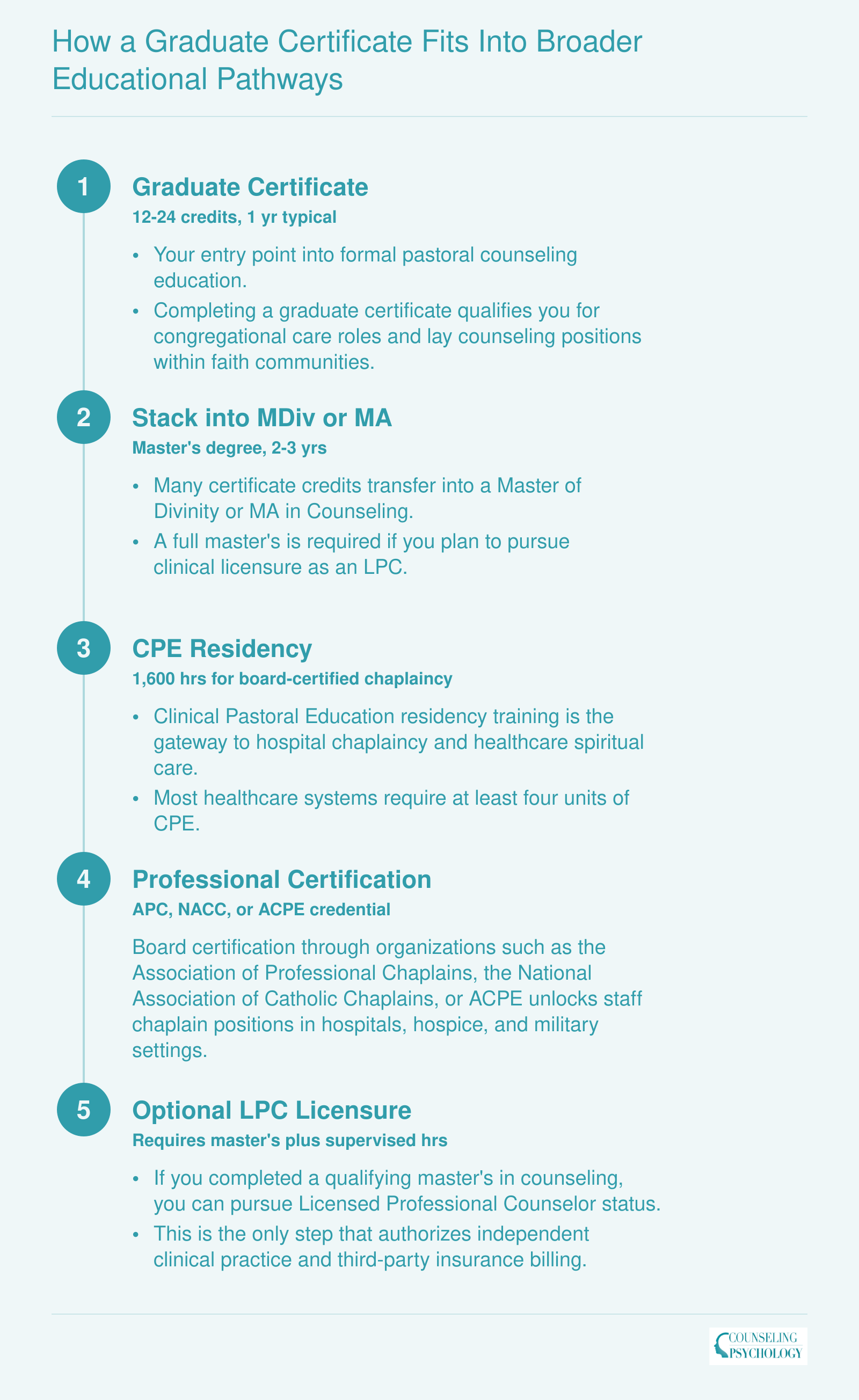
How a Graduate Certificate Fits Into Broader Educational Pathways
Pastoral counseling credentials build on each other in a clear sequence. Not every step is required for every career path, but understanding the full ladder helps you plan ahead and avoid surprises.
Common Questions About Pastoral Counseling Certificates
Prospective students often have practical questions about how pastoral counseling certificates fit into broader credentialing and career pathways. Below are answers to the questions we hear most frequently, grounded in current requirements from the major certifying bodies.
- What is the difference between pastoral care and pastoral counseling?
- Pastoral care is the broad ministry of emotional and spiritual support offered by clergy, chaplains, and lay leaders in congregational or healthcare settings. Pastoral counseling is a more specialized practice that integrates theological training with psychotherapeutic methods to address mental health concerns. Pastoral counseling typically requires formal clinical training and, in many states, a mental health license to practice independently.
- How do I get certified in pastoral counseling?
- The main pathway is through the Association for Clinical Pastoral Education (ACPE), which absorbed the former AAPC in 2019. The ACPE Psychotherapy Commission requires candidates to hold a state mental health license. Alternatively, the Association of Professional Chaplains (APC), through its Board of Chaplaincy Certification Inc., offers the Board Certified Chaplain credential, which requires a graduate theological degree, four units of Clinical Pastoral Education, and a faith group endorsement.
- How long does it take to complete a pastoral counseling graduate certificate?
- Most online graduate certificates in pastoral counseling require 12 to 18 credit hours and can be completed in two to four semesters of part-time study. This is separate from Clinical Pastoral Education (CPE), where a single unit runs 16 to 18 weeks and a full residency spans 12 months. A graduate certificate and CPE serve different purposes, so timelines depend on which pathway you pursue.
- Are online pastoral counseling certificates accredited?
- It depends on the institution. Look for programs offered by schools holding regional accreditation (now called institutional accreditation) and, ideally, additional accreditation from a recognized theological body such as the Association of Theological Schools. ACPE is recognized by the U.S. Department of Education for its CPE programs, but that recognition applies to CPE specifically, not to every graduate certificate a seminary or university may offer.
- Do you need a degree to become a pastoral counselor?
- For most formal credentialing pathways, yes. CPE programs generally require at least a bachelor's degree, with a graduate theological degree preferred. APC board certification requires a graduate theological degree. The National Association of Catholic Chaplains (NACC) similarly requires a graduate degree in theology or ministry plus four CPE units and a church endorsement. Some non-Catholic NACC tracks accept an undergraduate degree or 10 to 15 years of pastoral experience.
- Can a pastoral counseling certificate lead to licensure as a professional counselor?
- A graduate certificate alone does not qualify you for state licensure as a professional counselor. Licensure typically requires a master's degree (usually 60 semester hours in clinical mental health counseling or a related field), supervised clinical hours, and passing a national exam. A pastoral counseling certificate can supplement a master's program or deepen your theological integration, but it is not a substitute for the degree and clinical requirements states mandate.
- What professional organizations certify pastoral counselors?
- The primary bodies are the Association for Clinical Pastoral Education (ACPE), which oversees CPE accreditation and the psychotherapy certification track; the Association of Professional Chaplains (APC), which awards the Board Certified Chaplain credential through the Board of Chaplaincy Certification Inc.; and the National Association of Catholic Chaplains (NACC), which certifies chaplains within Catholic healthcare settings. Each organization has distinct education, CPE, and endorsement requirements.
Online Pastoral Counseling Graduate Certificate Programs to Explore
Online graduate certificates in pastoral counseling vary widely in focus, credit load, and delivery format, and a careful scan of accredited options protects your time and investment. Whether you're a working pastor, a licensed mental health professional, or a ministry leader seeking to deepen your care-giving skills, the following programs represent actual, active graduate certificates as of 2026. This list is organized alphabetically and is not a ranking; it's a research starting point. Every entry is at a regionally accredited institution, with many also holding specialized theological accreditation. As you review, note that credit requirements, admission prerequisites, and modality can significantly affect your experience. Always confirm tuition, application deadlines, and program availability directly with each school.
Accredited Online Certificate Programs for 2026
- Liberty University: Graduate Certificate in Pastoral Counseling. Accredited by SACSCOC and the Association of Theological Schools (ATS). 9 credits, delivered 100% online in 8-week courses. This certificate equips pastors and ministry leaders with biblical and research-based counseling practices grounded in a Christian worldview.1
- Loyola University Chicago: Graduate Certificate in Pastoral Counseling. Accredited by the Higher Learning Commission and ATS (warning status). Requires 15 credits, with fully online or in-person evening options. Designed for mental health professionals and religious leaders holding a master's degree in counseling, divinity/ministry, or a related field, the program offers tailored electives to shape your learning around specific ministry contexts.2
- Oral Roberts University: Graduate Certificate in Pastoral Counseling & Chaplaincy. Accredited by the Higher Learning Commission and ATS. Delivered 100% online with a fast-track two-semester completion option. This dual-focus program bridges pastoral counseling competencies with chaplaincy training for both church and institutional settings.3
- South University: Post-Doctoral Certificate in Pastoral Counseling. Accredited by SACSCOC, delivered online via competency-based education. While designed for those holding a doctoral degree, it emphasizes theological and emotional skills that directly support congregational ministry. Contact the school for credit hour and residency details.4
What to Look for Beyond the Program List
A certificate's value isn't only in its name; it rests on accreditation that licensing boards, employers, and other educational institutions respect. Regional accreditation (such as SACSCOC or the Higher Learning Commission) is a baseline for academic quality. Many pastoral programs also seek theological accreditation, often through the ATS. Be aware that ATS currently lists Loyola University Chicago on warning status, which may warrant further inquiry if you plan to transfer credits or pursue denomination-specific credentialing.
Delivery format matters too. Fully online, asynchronous programs (like those at Liberty and Oral Roberts) suit students with full-time jobs, while hybrid or evening options (like Loyola's) may appeal if you need occasional in-person interaction. Check whether courses run on accelerated 8-week terms or traditional semesters, and ask about cohort models, synchronous or asynchronous, that fit your schedule. If you're also considering a broader faith-based degree, exploring masters in biblical counseling online can help you compare scope and outcomes.
Using This Directory Wisely
The institutions above have met our initial screening for online delivery and recognized accreditation, but you should treat every entry as a launchpad for your own research. Verify program details directly with each school, since tuition, fees, and admission requirements can change between academic years. Confirm whether the certificate aligns with any state-specific licensure or board certification you may eventually pursue. Students interested in broader counseling doctoral programs should evaluate how certificate credits may transfer into a longer degree track. Remember: a graduate certificate alone does not authorize you to practice as a licensed counselor; it builds specialized knowledge within a broader educational and professional pathway. For state licensing rules, consult your state's professional counseling board.