What you’ll learn in this article…
- Four Florida public university graduate certificates near Fort Lauderdale offer in-state tuition well below private alternatives.
- The Florida Certification Board administers CAP and MCAP credentials, which require specific coursework and supervised clinical hours.
- Substance abuse counselor jobs in the Miami and Fort Lauderdale metro area are projected to grow 17 percent through 2034.
- Over 118 addiction counseling positions were posted in Broward County during the 2025 to 2026 hiring cycle.
Broward County reported more than 700 opioid-related overdose deaths in 2023, making it one of Florida's hardest-hit counties for substance use disorder. That level of crisis keeps demand for credentialed addiction counselors consistently high, and the shortage of trained professionals shows no sign of closing on its own.
For career changers and working clinicians in South Florida, addiction counseling certificate online programs at Florida public universities offer a realistic on-ramp. These programs typically run 18 to 30 credit hours, cost far less than a full master's degree, and can satisfy the education requirements for Florida's Certified Addiction Professional (CAP) credential administered by the Florida Certification Board.
The practical tension most students face is format versus proximity. Florida Atlantic University sits in Boca Raton, roughly 20 miles from downtown Fort Lauderdale. The University of Florida's program is fully online. Florida International University and University of South Florida offer campus-based options that require commuting or relocation. Choosing among them means weighing scheduling flexibility, in-state tuition eligibility, and whether the curriculum aligns with CAP or MCAP requirements before you enroll.
Best Addiction Counseling Programs Near Fort Lauderdale: Rankings & Cost Comparison
All four programs below are graduate certificates housed at Florida public universities, which means Fort Lauderdale residents who qualify for in-state tuition can keep costs well below what private or out-of-state alternatives charge. We sorted primarily by affordability after financial aid, but also weighed institutional graduation rates, credential alignment with Florida's CAP and MCAP pathways, and practical accessibility from Broward County. Net price figures listed are institution-wide averages after aid and will vary by student.
- Net price and in-state tuition
- Graduation and retention rates
- Florida certification alignment
- Format and regional accessibility
- Program depth and curriculum scope
- NCES-IPEDS federal institutional data — nces.ed.gov
- College Scorecard graduate earnings — collegescorecard.ed.gov
- Independent program research
- Internal program database

University of Florida
The University of Florida pairs one of the lowest net prices in this list (roughly $6,541 institution-wide after aid) with a 91.1% graduation rate, the highest among these four schools. Its online Graduate Certificate in Addiction and Recovery runs 18 credit hours at $590 per credit, and the fully distance-delivered format means Fort Lauderdale students avoid any relocation or commuting expense. Coursework is developed through UF's College of Medicine, giving the certificate a clinical research backbone that few competitors match.
- Fully online, completable in about one year
- 18 credit hours at $590 per credit ($10,620 total)
- Covers neurobiology of addiction and neuroadaptation
- Prepares students for Florida CAP and CAC exams
- Includes professional ethics and treatment planning
- No campus residency requirement
- Developed by UF College of Medicine faculty
- Flexible pacing for working professionals
Graduate Certificate in Addiction and Recovery — Online

Florida International University
Florida International University's Graduate Certificate in Addictions is a 30-credit, campus-based program housed in its School of Social Work. With an institution-wide net price near $9,288 and in-state tuition of about $6,565, FIU offers solid value for Fort Lauderdale commuters willing to drive to the Miami campus. The curriculum emphasizes addiction assessment, prevention, and clinical intervention with culturally diverse populations, reflecting FIU's designation as a Hispanic-Serving Institution and its deep roots in South Florida's multicultural communities.
- 30-credit campus program in Miami
- Covers addiction assessment, prevention, and treatment
- Clinical intervention training with diverse populations
- Designed for degree-seeking graduate students
- Admissions processed through FIU Graduate School
- Aligns with Florida addiction credentialing standards
- Situated within a Hispanic-Serving Institution
Graduate Certificate in Addictions — On-Campus

Florida Atlantic University
Florida Atlantic University sits in Boca Raton, making it the geographically closest option for most Fort Lauderdale residents. Its Graduate Certificate in Addiction is embedded within the MSW program, so students already pursuing an FAU social work degree can add the credential with minimal extra tuition. The program explicitly targets Florida's MCAP educational requirements, covering most of them except 16 supervision training hours, which can be completed separately at the university. The institution-wide net price averages about $8,752.
- Closest public university campus to Fort Lauderdale
- Embedded in FAU's MSW curriculum for cost efficiency
- Meets most Florida MCAP education requirements
- 16 supervision training hours available on campus
- Prepares graduates for CAP and MCAP credentials
- Campus-based format in Boca Raton
- Certificate application must precede graduation
Graduate Certificate in Addiction — On-Campus

University of South Florida
The University of South Florida's Addictions and Substance Abuse Counseling certificate stands out for its approval by the Certification Board for Addictions Professionals of Florida. Coursework goes beyond traditional substance use to cover process addictions such as gambling and internet overuse, along with brain chemistry and neuroadaptation. While the Tampa campus is farther from Fort Lauderdale, the program offers CEU and licensure credit that Broward County clinicians can apply toward Florida license renewal without relocating. The institution-wide net price is approximately $9,812.
- Approved by the Certification Board for Addictions Professionals of Florida
- Covers substance use disorders and process addictions
- Includes brain chemistry and neuroadaptation coursework
- Offers CEU and licensure renewal credit
- Open to graduate students and working professionals
- Campus-based program in Tampa
- Addresses gambling, internet, and behavioral addictions
Addictions and Substance Abuse Counseling Graduate Certificate — On-Campus
Side-by-Side: Tuition, Format & Key Metrics at a Glance
Before comparing numbers, understand the difference between sticker price and net price. Sticker price (listed tuition) is the published rate before any financial aid is applied. Net price reflects the average annual cost after grants and scholarships, giving you a more realistic picture of what students actually pay. Because these net price figures are institution-wide averages reported to IPEDS, your individual cost for a graduate certificate may differ, but the comparison still highlights which schools tend to be more affordable overall.
| School | Degree Level | Format | In-State Tuition | Out-of-State Tuition | Avg. Net Price | Graduation Rate |
|---|---|---|---|---|---|---|
| University of Florida | Graduate Certificate | Online | $12,737 | $30,130 | $6,541 | 91.1% |
| Florida Atlantic University | Graduate Certificate | Campus | $6,693 | $18,482 | $8,752 | 62.6% |
| Florida International University | Graduate Certificate | Campus | $11,334 | $24,439 | $9,288 | 74.4% |
| University of South Florida | Graduate Certificate | Campus | $10,428 | $21,126 | $9,812 | 76.8% |
Questions to Ask Yourself
How to Become a Certified Addiction Counselor in Florida
Florida uses a certification system administered by the Florida Certification Board (FCB), not state licensure, to regulate addiction counseling practice. This is a key distinction from mental health counseling (LMHC) and clinical social work (LCSW), which do require state licensure. For professionals focused exclusively on substance use and addiction, FCB certification offers two primary pathways: the Certified Addiction Professional (CAP) and the Master's Level Certified Addiction Professional (MCAP). A third credential, MCAP for Licensed Practitioners (MCAP-LP), provides a streamlined route for professionals who already hold an eligible Florida mental health license. If you are exploring the broader field, our guide on how to become an addiction counselor covers national requirements and career outlook.
Certified Addiction Professional (CAP)
The CAP credential is designed for bachelor's-level candidates. Applicants must hold a bachelor's degree or higher in a counseling-related field (Tier I) or a health and human services field (Tier II).1 The FCB requires substantial domain-specific training hours and documented addiction-specific supervised work experience; exact hour totals are detailed in the CAP Standards and Requirements Tables published by the Florida Certification Board.1 Candidates must also pass a written exam covering core addiction-counseling competencies, typically the ADC exam through the International Certification and Reciprocity Consortium (IC&RC).1 Because the CAP is entry-level at the bachelor's tier, graduate certificates alone do not satisfy CAP education prerequisites unless paired with an eligible bachelor's degree.
Master's Level Certified Addiction Professional (MCAP)
The MCAP credential requires a master's degree or higher in a related field.2 As of March 2025, FCB reduced the required training hours from 350 to 161, significantly lowering the barrier for master's-level candidates.3 Applicants must complete the 161-hour curriculum, fulfill minimum work experience and on-the-job supervision hours (detailed in the MCAP Requirements Tables), and pass a 50-item multiple-choice computer-based MCAP certification exam.4 The passing score is 75 percent; candidates who do not pass must wait 30 days before retaking.4 Many graduate certificates in addiction counseling are structured to deliver the full 161-hour curriculum, making them a direct path to MCAP eligibility when combined with a qualifying counseling master's programs online and the required supervised experience.
MCAP for Licensed Professionals (MCAP-LP)
The MCAP-LP pathway is open to professionals who already hold an eligible Florida license in good standing, such as LMHC, LCSW, or LMFT. Applicants must complete the same 161-hour training curriculum and pass the same 50-item MCAP exam, but the FCB accepts licensure-level supervised experience in lieu of additional numeric supervision hours. Candidates submit three letters of recommendation and are subject to annual renewal on June 30. For licensed mental health professionals seeking to expand into addiction counseling, MCAP-LP offers the fastest route, often satisfied by a graduate certificate alone.
Graduate Certificate Coverage
Graduate certificates in addiction counseling typically fulfill the 161-hour education requirement for MCAP and MCAP-LP. They do not, however, replace the master's degree itself (required for MCAP) or the bachelor's degree (required for CAP). Candidates planning to pursue CAP should verify that their bachelor's degree is in an eligible field and then supplement with additional training hours as needed. Those holding or pursuing a master's degree can use a certificate to meet the MCAP or MCAP-LP education threshold directly, provided they also complete the supervised-experience and examination requirements outlined in the FCB standards. Students interested in advanced research or clinical roles may also consider a doctorate in addiction counseling.
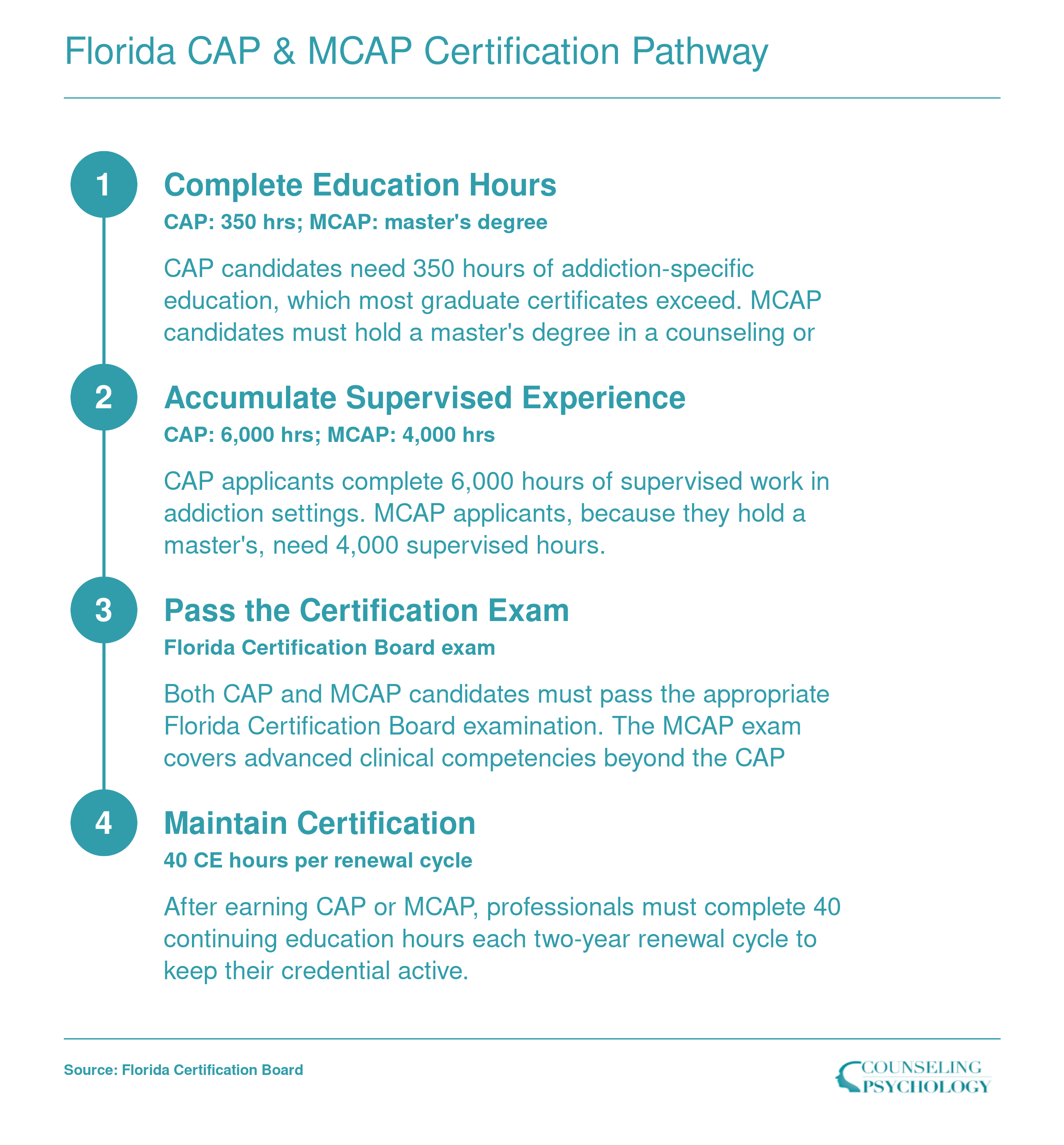
Florida CAP & MCAP Certification Pathway
Florida's addiction counseling credentials follow a clear ladder. A graduate certificate satisfies the education requirement for the Certified Addiction Professional (CAP) level, while the Master's Certified Addiction Professional (MCAP) requires a full master's degree.
Florida Licensure Alignment: Which Programs Meet CAP & MCAP Requirements?
Not every addiction counseling program checks every box for Florida Certification Board (FCB) credentials. The table below maps each ranked program's coursework and clinical hours against what the CAP (Certified Addiction Professional) and MCAP (Master Certified Addiction Professional) credentials require. Because certification standards can change, always confirm current education and hour thresholds directly with the FCB before enrolling.
| Program | Institution | Degree Level | Credits | Meets CAP Education Hours | Meets MCAP Education Hours | Practicum / Clinical Hours Included | Gaps to Fill Independently |
|---|---|---|---|---|---|---|---|
| Graduate Certificate in Addiction and Recovery | University of Florida | Graduate Certificate | 18 | Yes (prepares for CAP exam) | Partial (certificate alone may not cover all MCAP content areas) | Not specified in program materials | Students may need to complete supervised practicum hours and additional coursework outside the certificate to satisfy full MCAP requirements |
| Graduate Certificate in Addictions | Florida International University | Graduate Certificate | 30 | Yes | Partial (covers most but may require supplemental content hours) | Clinical intervention training included; specific hour total not published | Verify total supervised clinical hours against FCB minimums; additional elective content areas may be needed for MCAP |
| Graduate Certificate in Addiction | Florida Atlantic University | Graduate Certificate | N/A | Yes (prepares for CAP credential) | Yes (meets most MCAP educational requirements per program) | Included within MSW coursework; specific hour total not published | 16 hours of supervision training must be completed independently, per the program's own disclosure |
| Addictions and Substance Abuse Counseling Certificate | University of South Florida | Graduate Certificate | N/A | Yes (approved by the Certification Board for Addiction Professionals of Florida) | Partial (CBAPF approved, but full MCAP alignment should be confirmed) | Not specified in program materials | Students should verify practicum hour totals and any supplemental coursework needed for MCAP with USF and the FCB |
| M.S. in Addiction Counseling | Johnson and Wales University | Master's | 60 | Yes | Yes (master's level coursework plus 700 supervised fieldwork hours) | 700 hours (100 practicum + 600 internship) | Few or no gaps expected for CAP or MCAP; confirm elective content areas with the FCB |
| M.A. in Addiction Counseling (Online) | Liberty University | Master's | 48 | Yes | Likely (master's level, but students should verify content area coverage) | Not specified in available program materials | Students must confirm practicum and supervised clinical hour requirements are met; may need to arrange local fieldwork independently |
Tuition, Financial Aid & ROI for Fort Lauderdale Addiction Counseling Students
Cost versus time to credential is the central tension for addiction counseling students in South Florida. A graduate certificate in counseling can launch your career faster and with less debt, but it may limit your earning ceiling compared to a full master's degree that qualifies you for MCAP licensure.
Comparing Program Costs Across Florida Public Universities
In-state graduate certificate tuition varies significantly among the programs profiled here. University of Florida's online certificate runs approximately $12,737 for Florida residents, while Florida Atlantic University's campus-based option costs around $6,693. Florida International University falls near $11,334, and University of South Florida comes in around $10,428 for in-state students. Out-of-state rates climb considerably higher, ranging from roughly $18,000 to over $30,000 depending on the institution.
These figures represent published tuition and do not account for financial aid. Each school's net price, which approximates what students actually pay after grants and scholarships, offers a more realistic picture. For undergraduates, average net prices at these institutions range from about $6,500 at UF to nearly $9,800 at USF. Graduate students should request individualized aid estimates directly from each program, since net price averages are calculated primarily from undergraduate data.
Pell Grant Shares Signal Aid Generosity
One useful indicator of institutional commitment to low-income students is the share of undergraduates receiving Pell Grants. Florida International University leads this group with over 81% of students receiving Pell support, followed by Florida Atlantic University at roughly 72%. University of South Florida and University of Florida both serve substantial Pell populations as well, at approximately 69% and 67% respectively. While Pell Grants apply only to undergraduate study, these figures suggest a campus culture oriented toward financial accessibility.
Scholarships for Addiction Counseling Students
Several targeted funding sources can offset certification and program costs:
- Florida CAP Scholarship Program: Administered by the Florida Certification Board with funding from the Department of Children and Families, this program covers certification-related expenses including application fees, exams, upgrades, and renewals. Applications are accepted from July 1, 2025 through June 30, 2026.1
- NBCC Minority Fellowship Program for Addictions Counseling: Funded by SAMHSA and administered by the NBCC Foundation, this fellowship targets master's and doctoral students committed to serving underserved populations. The April 2026 deadline applies to the current cycle.2
- Institutional Aid: Schools like Palm Beach Atlantic University offer counselor education programs with pathways to CAP certification, and students should inquire about departmental scholarships or graduate assistantships.3
Certificate ROI Versus Full Degree ROI
Program-level earnings data for these specific graduate certificates is not yet published in federal databases, which makes direct ROI calculations speculative. However, the general pattern holds: certificates cost less and take less time, allowing graduates to enter the workforce sooner with minimal debt. The tradeoff is that a standalone certificate typically qualifies you for CAP certification, while MCAP requires a master's degree. MCAP-credentialed counselors often access supervisory roles and higher pay bands.
For students already holding a bachelor's degree and seeking a faster path into addiction counseling, the certificate route offers strong value. Those planning a longer career in clinical leadership may find that investing in a full master's program, despite higher upfront costs, yields better lifetime earnings. The right choice depends on your timeline, existing credentials, and career goals.
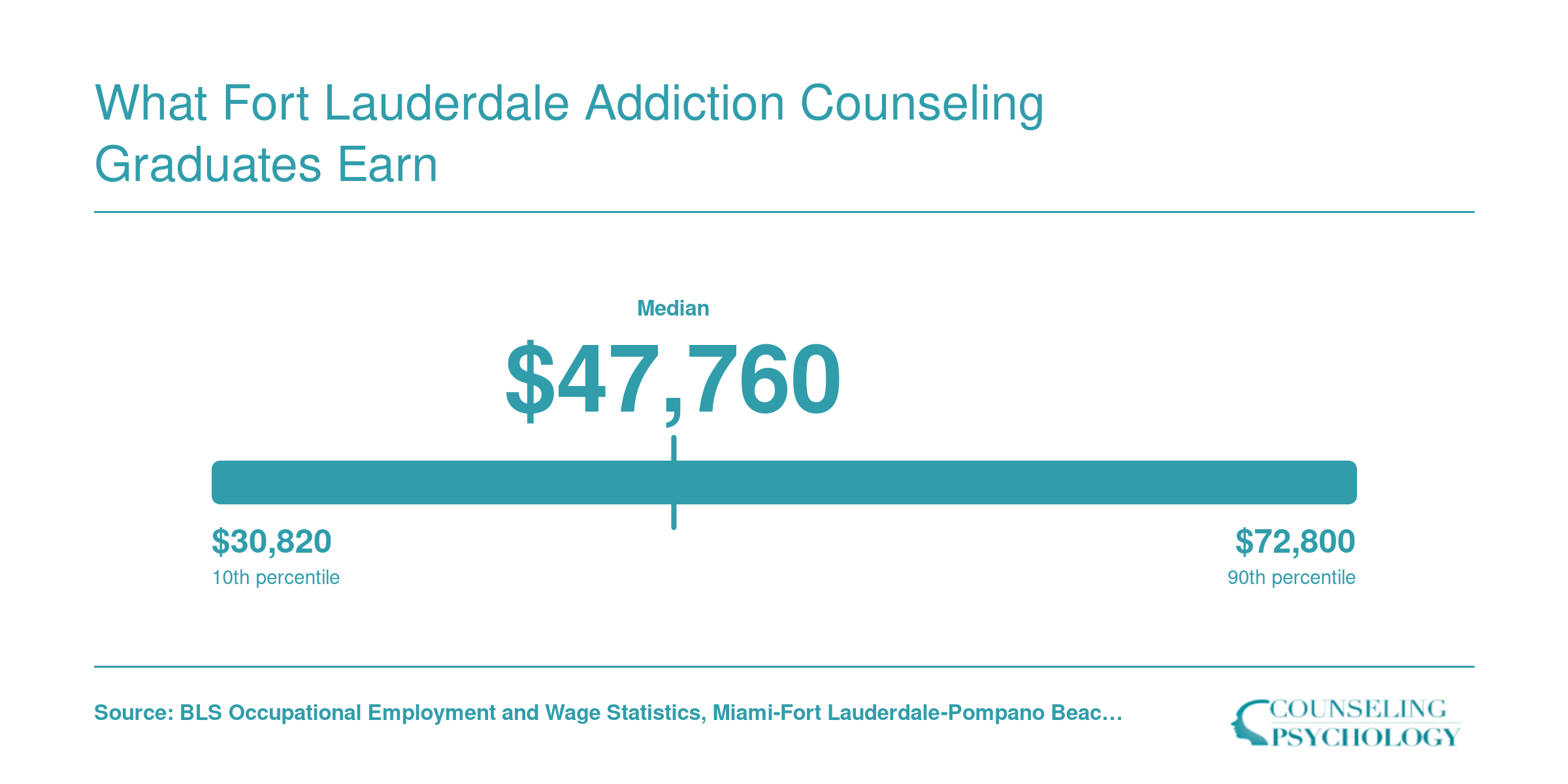
What Fort Lauderdale Addiction Counseling Graduates Earn
BLS wage data for Substance Abuse, Behavioral Disorder, and Mental Health Counselors (SOC 21-1018) in the Miami-Fort Lauderdale-Pompano Beach metro area shows a wide earning range depending on experience, credentials, and employer setting. Entry-level counselors start modestly, while those holding advanced certifications such as the MCAP or working in hospital or government settings can reach the upper percentiles. For the most granular local figures, check the Florida Department of Economic Opportunity at floridajobs.org, which publishes regional wage surveys that often capture high-demand roles more precisely than national datasets.
Career Outcomes & Local Job Market for Addiction Counselors in Broward County
Over 118 addiction counseling positions were posted in Broward County during the 2025-2026 hiring cycle, reflecting sustained demand across the region's behavioral health network.1 For graduates of Fort Lauderdale-area programs, this translates into concrete pathways from classroom to career, particularly at organizations actively recruiting entry-level and mid-career counselors.
Major Employers Hiring Now
Broward County's behavioral health infrastructure includes several anchor employers that consistently hire addiction counseling professionals:1
- Broward Health: The county's public hospital system recruits Behavioral Health Therapists, Substance Abuse Counselors, and Case Managers across its network of facilities.
- Memorial Healthcare System: One of the largest healthcare systems in South Florida, Memorial posts openings for Behavioral Health Therapists, Substance Abuse Counselors, and Peer Recovery Specialists.
- Henderson Behavioral Health: A longstanding community behavioral health provider, Henderson hires therapists and counselors with substance use expertise, along with case managers and peer support staff.
- House of Hope: This residential treatment provider seeks Substance Abuse Counselors, Primary Therapists, Case Managers, and Clinical Supervisors.2 Some senior roles require around five years of experience, but entry-level counseling positions are also available.
Beyond these anchor employers, outpatient and residential addiction programs, telehealth providers, and community agencies round out the hiring landscape.3 The Broward County Public Schools Substance Use Initiative also creates positions for counselors working with adolescents and families.4
Demand Drivers: Why Hiring Remains Strong
South Florida's high rates of substance use disorder treatment create strong entry-level hiring pipelines. Several factors continue to push demand:
- Opioid crisis response funding: Federal and state grants supporting medication-assisted treatment and recovery services have expanded the behavioral health workforce in recent years.
- Medicaid expansion effects: Broader coverage for behavioral health services has increased the number of clients seeking treatment, prompting providers to add clinical staff.
- County and state initiatives: Local behavioral health initiatives, including school-based programs and community outreach, require credentialed counselors to meet service obligations.
What Graduates Can Expect to Earn
Program-level earnings data for the graduate certificates listed in this guide are not yet published by federal sources, so direct outcome comparisons are not available at this time. However, BLS wage data for substance abuse and behavioral disorder counselors in the Miami-Fort Lauderdale-Pompano Beach metro area provides useful context. For a broader look at pay benchmarks across specialties, see our counselor salary breakdown. Starting salaries for entry-level counselors in South Florida typically fall below the metro median, but credentialed professionals with CAP or MCAP certification often see higher compensation, particularly at hospitals and larger treatment systems.
Getting Your Foot in the Door
For students completing an addiction counseling certificate at Broward College5, Florida Atlantic University, or one of the other regional programs, the local job market offers multiple entry points. Community agencies and residential programs tend to hire new graduates with provisional credentials, allowing you to accumulate supervised hours toward full certification while earning a salary. Hospital systems may require more experience, but peer recovery specialist and case management roles can serve as stepping stones toward clinical positions. Students exploring additional credential options may also want to review online addiction counseling degrees to expand their qualifications over time.
The Bureau of Labor Statistics projects substance abuse, behavioral disorder, and mental health counselor jobs will grow 17 percent nationally through 2034, much faster than average. For Florida-specific data, check the BLS Occupational Outlook Handbook state profiles or contact the Florida Certification Board for regional workforce reports and Broward County demand trends.
How to Choose the Right Addiction Counseling Program
The program you choose shapes not just your credential but your entire career trajectory, so the decision deserves more than a tuition comparison.
Degree Level: Certificate or Master's?
The shortest path into addiction counseling is a graduate certificate. Many programs run 12 to 18 credits and can be completed in under a year, making them a practical first step toward Florida's Certified Addiction Professional (CAP) credential. If your goal is the Master's-level Certified Addiction Professional (MCAP), or if you want clinical licensure as an LMHC or LCSW, a full master's degree is the appropriate route. Put simply: certificate for faster CAP-track entry, master's for MCAP and independent clinical practice.
Modality: Online, Hybrid, or Campus?
Format is not a secondary detail, especially if you are already working in a behavioral health setting. Many candidates in the Fort Lauderdale area explore online counseling degree programs to balance work and study.
- Online asynchronous: Best for working professionals who need schedule flexibility. Coursework can be completed around shifts, but you will still need to arrange practicum hours locally.
- Hybrid: Combines online lectures with required on-site sessions, often on weekends. A strong fit if you value peer interaction but cannot commit to a daily commute.
- Campus-based: Useful when your employer is geographically fixed and the school is nearby, or when you want direct access to faculty and on-campus practicum coordination.
For most working adults in the Fort Lauderdale area, an online or hybrid format removes the biggest logistical barrier without sacrificing the supervised hours required for licensure or certification.
A Practical Decision Framework
Before you apply anywhere, run through these five questions:
- Budget: What is the total program cost, and does your employer offer tuition reimbursement? Many Broward County behavioral health agencies have education benefits that go unused.
- Career goal: Are you aiming for CAP, MCAP, or full clinical licensure? Each requires a different level of credential.
- Timeline: How many months or years can you realistically dedicate before you need to advance or change roles?
- Practicum logistics: Does the program help place students, or are you responsible for securing your own supervised hours? This matters more than many applicants realize.
- FCB alignment: Florida's Certification Board (FCB) specifies education-hour requirements for both CAP and MCAP. Verify that any program you are considering explicitly maps its curriculum to those requirements before you enroll. A program that looks affordable up front can become costly if its coursework does not count toward your target credential.
Taking 30 minutes to work through these questions before submitting a single application can save months of remedial coursework later.
Frequently Asked Questions About Addiction Counseling Programs in Fort Lauderdale
Choosing the right addiction counseling program involves sorting through credentials, costs, and format options. Below are answers to the questions prospective students in the Fort Lauderdale area ask most often, along with pointers to the most reliable sources for up-to-date information.