What you’ll learn in this article…
- Several Dayton-area schools, including University of Cincinnati and Ohio Christian University, offer fully online counseling bachelor's degrees.
- Ohio requires a master's degree for independent clinical counseling licensure, making your undergraduate choice a critical first step.
- Transfer pathways from Dayton community colleges can save thousands, but only with careful course planning to avoid lost credits.
- Bachelor's graduates can enter substance abuse counseling and case coordination roles while pursuing advanced credentials.
Dayton employers in behavioral health report difficulty filling case management and intake roles, positions that a counseling bachelor's can prepare you for without a clinical license. In Ohio, independent counseling practice requires a master's and LPCC licensure, so the bachelor's is a critical first step but not the terminal credential. Programs near Dayton differ widely in cost, modality, and curriculum alignment with state addiction counseling certifications like the CDCA.
Transferring from a community college can cut total tuition, but only if prerequisite coursework matches the four-year program's requirements. The undergraduate major you choose shapes how quickly you can meet licensure prerequisites and whether you can work in the field while pursuing a graduate degree. For students still weighing their options, exploring counseling careers can clarify which bachelor's track best fits your goals.
Best Bachelor's in Counseling Programs Near Dayton
Programs in this ranking were evaluated on a combination of net price after aid, institution-wide graduation and retention rates, delivery format, and alignment with Ohio counseling licensure requirements. Each school listed below offers a bachelor's-level pathway relevant to substance abuse or addictions counseling, an area of acute workforce need across southwest Ohio, including the greater Dayton metro.
- Net price after financial aid
- Graduation and retention rates
- Ohio licensure alignment
- Delivery format flexibility
- Regional workforce relevance
- NCES-IPEDS federal institutional data — nces.ed.gov
- College Scorecard graduate earnings — collegescorecard.ed.gov
- Internal program database
- Independent program research

University of Cincinnati
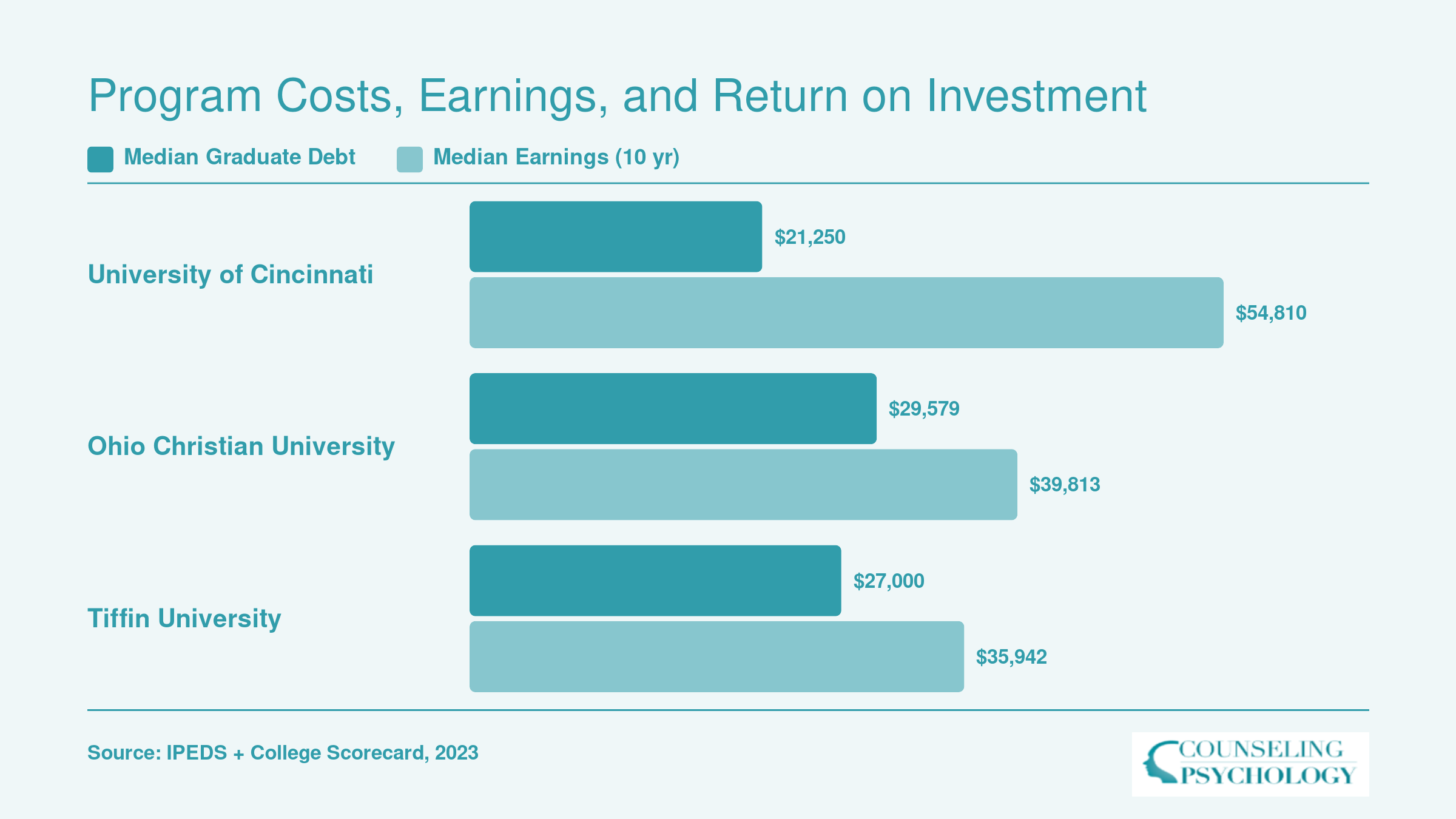
The University of Cincinnati is a large public research institution in southwest Ohio whose graduates report median earnings of roughly $54,810 ten years after enrollment. Its fully online B.S. in Substance Abuse Counseling is designed to meet Ohio's Chemical Dependency Counselor Assistant (CDCA) certification requirements, giving Dayton-area students a clear on-ramp to the state's counseling workforce without relocating. UC also sits at the center of a dense network of CACREP-accredited master's programs across the region, making it a practical first step for students who plan to pursue advanced licensure later.
- Fully online format suits working Dayton-area students
- Curriculum meets Ohio CDCA certification requirements
- Pathway to licensure recognized in multiple states
- Coursework covers assessment, intervention, and recovery
- Feeds into UC's graduate counseling program pipeline
- Institution-wide graduation rate of 75%
- 19:1 student-to-faculty ratio at the university level
Bachelor of Science in Substance Abuse Counseling — Online

Ohio Christian University
Ohio Christian University is a private institution in Circleville that integrates a Christian worldview with evidence-based counseling training. Its B.A. in Substance Abuse Counseling is available both online and on campus, covering 45 credit hours of specialized coursework that aligns with Ohio licensure standards. For Dayton-area students drawn to faith-informed practice, OCU's curriculum pairs well with the many community and church-based counseling providers operating across Montgomery and surrounding counties. The net price after aid sits at roughly $20,607, the lowest among the three programs listed here.
- Available 100% online or on campus
- 45 credit hours of counseling-specific coursework
- Meets Ohio CDCA certification requirements
- Integrates Christian principles with clinical methods
- Covers ethical, legal, and cultural counseling issues
- Includes group and individual counseling techniques
- Practicum or capstone experience required
- 14:1 student-to-faculty ratio university-wide
Bachelor of Arts in Substance Abuse Counseling — Online

Tiffin University
Tiffin University, a private school in north-central Ohio, offers a Psychology major with an Addictions Counseling concentration that emphasizes hands-on clinical training. Students practice through simulated counseling sessions and can complete internship hours that count toward Ohio Chemical Dependency Counselor licensure. Coursework is taught by licensed professionals and aligns with international certification standards. Because this track is campus-based, Dayton-area students should plan for relocation or a significant commute, though graduates are well positioned to return to southwest Ohio's high-demand substance-use treatment market.
- Campus-based program with clinical simulations
- Meets Ohio Chemical Dependency Counselor requirements
- Aligns with international addictions certification standards
- Internship fulfills practical experience hours for licensure
- Taught by licensed counseling professionals
- Covers group counseling techniques and assessment
- Institution-wide graduation rate of about 40%
- Focus on current opioid epidemic response skills
Psychology, Addictions Counseling Concentration — On-Campus
What Bachelor's Degree Should You Get for Counseling?
Which bachelor's degree actually leads to a counseling career in Ohio, and does the major matter?
The short answer: it does matter, and the choice you make now shapes which credentials you can pursue right after graduation and which graduate programs will accept you later.
The Main Degree Tracks
Dayton-area students typically choose from four undergraduate pathways when aiming toward a counseling career:
- Bachelor of Arts or Science in Counseling: Emphasizes applied skills, interviewing techniques, group dynamics, and often includes a supervised practicum. Programs structured this way prepare graduates for direct-service entry-level roles and provide a practical foundation for master's-level counseling programs.
- Bachelor of Arts or Science in Psychology: Leans toward research methods, psychological theory, and statistical analysis. This track suits students who want a strong academic foundation before pursuing graduate study, though it typically includes fewer applied counseling hours.
- Bachelor of Social Work (BSW): A professionally accredited degree that leads directly to the Licensed Social Worker (LSW) credential in Ohio, one of the few bachelor's-level licenses the state issues for direct practice.1
- Human Services: A broad, applied track covering case management, community resources, and advocacy. Graduates often enter support roles in nonprofits, government agencies, and behavioral health settings.
What Ohio Actually Licenses at the Bachelor's Level
This is where expectations and reality need to align early. Ohio's Counselor, Social Worker, and Marriage and Family Therapist Board does not offer any bachelor's-level counseling license.2 Both the Licensed Professional Counselor (LPC) and the Licensed Professional Clinical Counselor (LPCC) require a master's degree, with the LPC also requiring passage of the National Counselor Examination.2
That said, a bachelor's degree does open several credential pathways:
- Licensed Social Worker (LSW): Requires a BSW from an accredited program. This is a full professional license to practice social work in Ohio.1
- Registered Social Work Assistant (SWA): Available to graduates with an associate degree in social service technology or a bachelor's degree in a related field. The SWA allows work in human, social, and community services under direct supervision but does not authorize independent social work practice.3
- Chemical Dependency Counselor Assistant (CDCA): Requires specific addiction-related training hours, background checks, and supervision. Notably, Ohio does not require a degree for this credential, so it is accessible to graduates of counseling, psychology, or human services programs who complete the required training.2
Counseling vs. Psychology: Which Fits Your Goal
The counseling-versus-psychology debate comes down to where you see yourself in five years. If you plan to work directly with clients as soon as possible, a counseling or human services degree builds the practical skills and field hours that entry-level employers look for. If graduate school is the primary goal and you want flexibility to pursue clinical psychology, research, or counseling graduate programs, a psychology degree with strong research methods coursework keeps more doors open. Students exploring broader options may want to review careers in psychology to understand where different undergraduate tracks can lead.
Students interested in online bachelor's in counseling psychology programs should know that many accredited options include the same foundational coursework available at Dayton-area campuses. Meanwhile, students aiming for school counseling should note that Ohio requires a master's degree in school counseling, with licensure handled through the Ohio Department of Education and Workforce, not the CSWMFT Board.2 So the bachelor's choice matters primarily for what comes next, not as a destination in itself.
The practical takeaway: match your undergraduate major to your immediate post-graduation plan. Direct service roles favor counseling and human services degrees. Graduate program preparation, especially for CACREP-accredited counseling master's programs, is well supported by both counseling and psychology degrees, provided your transcript includes coursework in research methods and human development.
Questions to Ask Yourself
Program Costs, Earnings, and Return on Investment
Evaluating return on investment for a bachelor's in counseling requires looking at both what you owe at graduation and what you can expect to earn. Program-level earnings data at one and four years post-completion are not yet available for these programs, so the comparison below uses institution-wide median graduate debt and median earnings ten years after enrollment. Keep in mind that ROI varies significantly depending on whether you enter the workforce right away or continue to a master's program, which is required for most clinical licensure. Graduates who pursue advanced degrees may carry higher short-term debt but typically unlock substantially higher earning potential over time.
Online vs. On-Campus Options for Dayton Students
Dayton-area students pursuing a bachelor's in counseling have both online and on-campus paths to consider. Among programs accessible from Dayton, the University of Cincinnati and Ohio Christian University offer fully online formats, while Tiffin University delivers its Psychology with Addictions Counseling concentration on campus. Ohio Christian University also advertises a campus option alongside its online track. Your choice depends on schedule flexibility, learning style, and how much in-person clinical exposure matters to you at the undergraduate level.
Pros
- Online programs let working or nontraditional students complete coursework on their own schedule without commuting from Dayton.
- Ohio residents can tap in-state tuition rates at public universities like the University of Cincinnati, keeping online costs competitive.
- Online delivery opens access to accredited counseling programs across Ohio, not just those within the Dayton metro area.
- On-campus programs such as Tiffin University's addictions counseling track include simulated counseling sessions and local internship placements.
- Face-to-face mentorship from licensed faculty and direct access to campus career services strengthen professional development early on.
- Campus-based students can build practicum relationships with Dayton-area behavioral health agencies, creating a local professional network before graduation.
Cons
- Online programs may offer limited hands-on clinical training, which can leave graduates less prepared for the supervised fieldwork required at the graduate level.
- On-campus schedules are often rigid, making it difficult for students who work full time or have family responsibilities to attend.
- Some online degrees carry higher total tuition at private institutions, so Dayton students should compare net price carefully before enrolling.
- Campus programs outside the Dayton metro, like Tiffin University in north-central Ohio, require relocation or lengthy commutes for local students.
Admission Requirements and Transfer Pathways from Dayton-Area Community Colleges
Starting a counseling bachelor's degree at a community college and transferring later is a genuinely smart financial move, but only if you plan the coursework carefully from the beginning. The gap between saving money and losing credits comes down to knowing which agreements exist before you register for a single class.
Typical Admission Requirements
Most bachelor's-level counseling and human services programs in the Dayton region share a common baseline for admission:
- GPA: A minimum cumulative GPA of 2.5 to 3.0, with some programs applying a higher threshold for upper-division admission than for initial enrollment.
- Prerequisite coursework: Introduction to Psychology, English Composition, and a college-level Statistics or Research Methods course appear on nearly every program's list. Some programs also require a sociology or human development course.
- Application materials: A personal statement explaining your interest in counseling or human services, two or three letters of recommendation, and occasionally a brief interview or advising appointment before you are formally admitted to the major.
Transfer students generally follow the same requirements but submit transcripts from every institution attended, and some programs require a minimum number of completed credits before reviewing transfer applications.
The Sinclair-Wright State Pathway
For students at Sinclair Community College, the clearest documented route into a Dayton-area four-year program runs through the Wright Path Program, a formalized 2+2 transfer partnership with Wright State University.1 Human Services is included among the transfer-guide areas covered under Wright Path, meaning students who complete an associate's degree in Human Services or a related behavioral science field can map their Sinclair coursework directly to Wright State requirements.2 Sinclair maintains articulation agreements with roughly 20 universities covering more than 100 programs, so advisors there can often identify credit equivalencies even for programs not listed under Wright Path.3
As of 2026, no published articulation or transfer agreement for counseling, human services, or psychology has been confirmed between Sinclair and the University of Dayton, between Sinclair and Cedarville University, or between Clark State College and Wright State.4 That does not mean transfer is impossible at those schools, only that it requires individual evaluation rather than a guaranteed pathway. Students targeting those institutions should contact the receiving school's transfer admissions office early.
Why an Associate's in Human Services or Behavioral Science Gives You an Edge
Programs that accept 60 or more transfer credits make the 2+2 model realistic, and most bachelor's counseling programs in Ohio fall into that category. Students who are still weighing whether to start with a two-year program may want to explore associate degree in psychology options, since many of those credits also feed into counseling-related bachelor's programs. An associate's degree in Human Services or Behavioral Science is the strongest transfer feeder because the core courses align closely with lower-division requirements at four-year programs. General-education credits in English, psychology, and statistics transfer broadly, while electives in case management, diversity, or developmental psychology tend to articulate as direct equivalencies rather than free electives.
Choosing an associate's program with intentionality, and meeting with both a community college advisor and a transfer advisor at your target four-year school before you finish your first semester, dramatically reduces the risk of arriving at your junior year with a pile of credits that do not count toward your degree.
Related Articles
Career Paths with a Bachelor's in Counseling Near Dayton
Direct clinical practice versus support-and-coordination roles: these two broad tracks define the immediate career options for bachelor's graduates in counseling. Ohio law reserves independent clinical counseling to master's-level licensed professional clinical counselors (LPCC) and other advanced credentials, but a bachelor's degree in counseling opens substantial entry-level positions in behavioral health, case management, and community support.
Entry-Level Roles for Bachelor's Graduates
A bachelor's in counseling positions you for several human-services roles across the Dayton metropolitan area:
- Case manager: Coordinate services for clients navigating healthcare, housing, employment, or social-service systems. Hospitals, community mental health centers, and nonprofit agencies hire bachelor's-level case managers to assess needs, connect clients to resources, and track progress.
- Behavioral health technician: Work under clinical supervision in psychiatric hospitals, residential treatment centers, or outpatient clinics. Responsibilities include monitoring client behavior, leading psychoeducational groups, documenting incidents, and assisting with treatment-plan implementation.
- Community health worker: Bridge the gap between healthcare providers and underserved populations. Community health workers conduct outreach, provide health education, help clients navigate insurance and appointment scheduling, and address social determinants of health. The Dayton MSA employed approximately 160 community health workers as of May 2023, with a mean annual wage of $52,690.1
- Substance abuse counselor assistant (CDCA in Ohio): Ohio's Chemical Dependency Counselor Assistant credential allows bachelor's graduates to provide addiction counseling under supervision. CDCA-credentialed staff deliver individual and group counseling, conduct intake assessments, and participate in treatment planning at outpatient and residential substance-use programs. Substance abuse, behavioral disorder, and mental health counselors in the Dayton MSA earned a mean annual wage of $58,380 as of May 2023, though assistants typically start below that figure.1 If you are exploring this path further, our guide on how to become a substance abuse counselor outlines the full credentialing process.
- Residential advisor or youth counselor: Provide direct care and mentorship in group homes, residential treatment facilities, or crisis shelters. Duties include implementing behavior-management plans, facilitating life-skills training, and maintaining safety protocols.
Major Dayton-Area Employers
Several large organizations in the Dayton-Kettering-Beavercreek MSA hire bachelor's-level counseling graduates:
- Dayton VA Medical Center: The Department of Veterans Affairs employs peer-support specialists, outreach coordinators, and case managers to serve veteran populations.
- Kettering Health: This regional health network hires behavioral health technicians, community health workers, and care coordinators across its hospitals and outpatient clinics.
- Montgomery County ADAMHS Board: The Alcohol, Drug Addiction, and Mental Health Services Board contracts with local providers and hires program coordinators and outreach staff to oversee community mental health and addiction services.
- Local school districts: Dayton Public Schools, Centerville City Schools, and Kettering City Schools employ family liaisons, behavior interventionists, and student-support specialists to connect students and families with counseling and wraparound services.
Community and social service occupations overall employed 6,610 workers in the Dayton MSA as of May 2023, with a mean annual wage of $57,390.1
The Bachelor's as a Launchpad
Be clear-eyed about licensure: Ohio requires a master's degree in counseling or a closely related field to sit for the LPCC or LPC exam. The bachelor's is not the destination for independent clinical practice. It is, however, a deliberate launchpad. Entry-level roles build your clinical observation skills, deepen your understanding of client populations, and strengthen your graduate-school application. Many employers offer tuition assistance or flexible schedules to support bachelor's-level staff pursuing counseling master's programs online. For a broader look at compensation benchmarks across specialties, review our counselor salary breakdown.
From Bachelor's to Master's: How Your Undergraduate Degree Prepares You
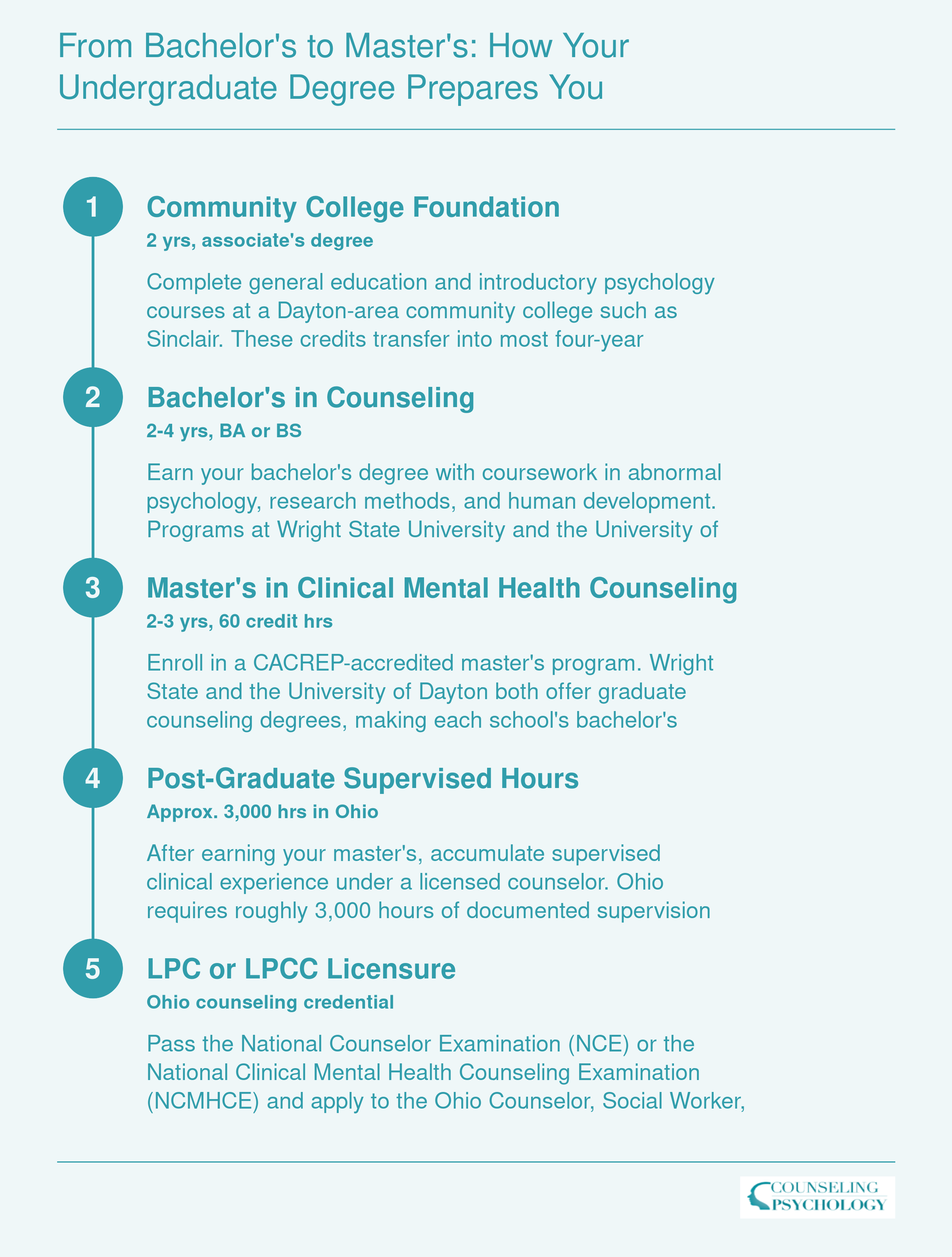
Becoming a licensed professional counselor in Ohio is a sequential process that typically spans eight to ten years from your first college course to full licensure. Each rung of the credentialing ladder builds directly on the one before it, and choosing a bachelor's in counseling track lets you satisfy key graduate prerequisite courses (abnormal psychology, research methods, and human development) before you ever apply to a master's program.
How to Choose the Right Counseling Program Near Dayton
Choosing a counseling program often comes down to a single practical tension: the program that fits your budget may not offer the clinical access or curriculum depth that sets you up for licensure, while the program with the strongest field placement network may carry a steeper price tag. Working through that tradeoff systematically, rather than defaulting to whichever school is closest or cheapest, pays dividends when you reach the graduate level.
Confirm Accreditation First
Every bachelor's program you seriously consider should hold regional accreditation from the Higher Learning Commission, which covers Ohio institutions. Regional accreditation determines whether your credits transfer cleanly, whether your degree is recognized by employers and graduate programs, and whether you can access federal financial aid. CACREP accreditation, which sets the curriculum standard most states use for licensure eligibility, applies at the master's level rather than the bachelor's level. That said, it is worth asking admissions advisors directly whether the undergraduate curriculum is structured to satisfy the prerequisite coursework for CACREP-accredited master's programs. Programs that are intentionally designed as feeders into a graduate track will tell you plainly.
Look Hard at Field Placement Opportunities
For students who plan to attend on campus, Dayton's clinical landscape is a real advantage. The region has VA medical facilities, a network of community mental health centers, and hospital systems that regularly host undergraduate practicum students. Ask each program how placements are arranged: some programs coordinate sites on your behalf, while others expect you to secure your own. The difference matters enormously when you are also managing coursework and, in many cases, part-time work.
Match Program Focus to Your Career Direction
Not all bachelor's-level counseling curricula are identical in emphasis. Some programs center on substance use disorders and recovery support, which aligns well with careers in community health or peer support roles. Students drawn to that specialty should explore online addiction counseling degrees to compare curriculum options. Others lean toward developmental counseling, family systems, or general human services. If you already have a target population in mind, look at the elective track and course descriptions, not just the program name.
Compare Net Cost, Not Sticker Price
Published tuition is rarely what students actually pay. Financial aid, institutional grants, and scholarship packages shift the real cost substantially from one school to the next. Use the net price figures available from each program's financial aid office as your comparison baseline, and factor in whether the school offers aid beyond the first year. A slightly higher-cost program that locks in a renewable scholarship may cost less over four years than a nominally cheaper option with one-time aid.
Frequently Asked Questions About Bachelor's in Counseling Near Dayton
Choosing a bachelor's degree in counseling near Dayton raises practical questions about licensure, career options, and program formats. Below are answers to the questions prospective students ask most often, grounded in current Ohio requirements and regional program details.