

What you’ll learn in this article…
- Ten ranked programs near Fort Worth offer CACREP-accredited or regionally accredited paths to Texas LPC licensure in 2026.
- BLS data projects 18 percent job growth for mental health counselors from 2022 to 2032, well above the national average.
- All top-ranked programs are housed at public Texas universities, keeping tuition comparatively low for in-state residents.
- Texas LPC licensure typically takes four to five years from the first graduate class to full independent practice.
The Dallas-Fort Worth metro is one of the fastest-growing regions in the country for mental health services, and the BLS projects 18 percent national employment growth for substance abuse, behavioral disorder, and mental health counselors through 2032. Texas has responded with a dense cluster of CACREP-accredited clinical mental health counseling programs, several within commuting distance of Fort Worth and others available fully online or in hybrid formats suited to working professionals.
Still, the practical choices are not simple. In-state graduate tuition across ranked Texas programs ranges from roughly $7,100 to over $37,000 per year, and every LPC candidate must complete 60 semester hours plus 3,000 hours of post-graduate supervised experience. Accreditation status, format, and total cost all shape how quickly and affordably you reach licensure. This guide ranks the strongest programs available to Fort Worth students in 2026, breaks down our methodology, and walks through licensure requirements, costs, salary outcomes, and how to choose the right fit.
Best Master's in Counseling Programs Near Fort Worth, Texas
The following 10 programs represent the strongest master's in counseling options available to Fort Worth, Texas students in 2026. Each school was evaluated using a methodology that blends cost, graduate outcomes, accreditation status, and program quality factors. Some are within easy commuting distance of Fort Worth, while others offer fully online or hybrid delivery that makes geography largely irrelevant. Scroll down to the methodology section for a detailed breakdown of how these rankings were determined.
- Accreditation and licensure alignment
- Graduate earnings and debt outcomes
- Tuition affordability and net price
- Program format and accessibility
- Student to faculty ratio
- Internal program database
- College Scorecard graduate earnings — collegescorecard.ed.gov
- NCES-IPEDS federal institutional data — nces.ed.gov
- Independent program research

Texas Tech University Health Sciences Center
Texas Tech University Health Sciences Center delivers a fully online Master of Science in Clinical Mental Health Counseling built around telehealth competencies, making it an ideal fit for Fort Worth students who want to stay in the DFW job market without relocating. With a 7:1 student-to-faculty ratio and a CACREP-accredited 60-credit curriculum, graduates qualify for both LPC licensure in Texas and the Board Certified TeleMental Health credential. The institution reports a median graduate debt of just $12,268 and institution-wide median earnings of $92,348 ten years after enrollment.
- CACREP-accredited 60-credit online program
- Telehealth training integrated throughout coursework
- Eligible for BC-THM credential upon completion
- 12 credits of practicum and internship required
- Prepares graduates for Texas LPC licensure
- Flexible distance format, no relocation needed
- Projected 19% national job growth in the field
Master of Science in Clinical Mental Health Counseling — Online

The University of Texas Rio Grande Valley
The University of Texas Rio Grande Valley offers a hybrid Master of Education in Counseling with a Clinical Mental Health Counseling concentration, featuring coursework available across multiple South Texas locations. Fort Worth residents pay standard in-state graduate tuition with no distance penalty, and the program's deep emphasis on multicultural and border-region counseling translates well to the diverse communities across North Texas. Schools offering this program have a graduation rate of 50.9%, and the institution-level net price sits at just $4,831.
- CACREP-accredited hybrid program format
- Courses offered in Edinburg, Brownsville, and Laredo
- Prepares students for Texas LPC licensure
- School Counselor Certification option available
- Advocacy and leadership training embedded in curriculum
- Strong multicultural community counseling focus
- In-state tuition applies regardless of Texas region
Master of Education in Counseling, Clinical Mental Health Counseling — Hybrid

Southern Methodist University
Southern Methodist University sits in Dallas, placing it within easy commuting distance of Fort Worth and giving students direct access to one of the strongest clinical placement networks in the DFW metroplex. The campus-based Master of Science in Counseling with a Clinical Mental Health specialty lets students specialize in areas like addiction, trauma, child and adolescent counseling, or LGBTQ+ affirmative therapy. Schools offering this program have an 84.3% graduation rate, and institution-wide median earnings reach $78,354 ten years after enrollment.
- Texas LPC licensure preparation track
- Specialty concentrations in addiction and trauma
- Child, adolescent, and LGBTQ+ affirmative electives
- Campus-based program in Dallas near Fort Worth
- Comprehensive clinical training with local placements
- Flexible elective course selection
- 11:1 student-to-faculty ratio across the institution
Master of Science in Counseling, Clinical Mental Health — On-Campus

The University of Texas at San Antonio
The University of Texas at San Antonio offers a 60-credit CACREP-accredited Master of Science in Clinical Mental Health Counseling delivered in a hybrid format. The program emphasizes multicultural competence, creative therapeutic approaches, and evidence-based diagnosis across diverse populations. UTSA's in-state tuition of $10,116 and net price of $10,836 make it one of the more affordable UT System options. Schools offering this program have a graduation rate of 52.6%.
- 60-credit CACREP-accredited hybrid program
- State licensure preparation for Texas LPC
- Multicultural counseling emphasis throughout curriculum
- Minimum 3.0 GPA required for admission
- Diverse clinical training across community settings
- Institutional net price of $10,836
Master of Science in Clinical Mental Health Counseling — Hybrid

University of St Thomas
University of St. Thomas in Houston provides a campus-based, CACREP-accredited Master of Science in Clinical Mental Health Counseling grounded in a Catholic intellectual tradition. At $700 per credit hour, students benefit from small class sizes and a flexible two-year full-time or four-year half-time structure with Monday/Wednesday scheduling. Fort Worth students drawn to a faith-integrated counseling curriculum will find few comparable options in the DFW area. Schools offering this program have a 68.8% graduation rate.
- CACREP-accredited campus program in Houston
- $700 per credit hour tuition rate
- Two-year full-time or four-year half-time options
- Monday/Wednesday class schedule for working adults
- 3.0 GPA admission requirement
- Small class sizes with individualized mentorship
- Prepares graduates for Texas LPC licensure
Master of Science in Clinical Mental Health Counseling — On-Campus

Texas Tech University
Texas Tech University's 60-hour Master of Education in Clinical Mental Health Counseling is a CACREP-accredited, campus-based program in Lubbock that prepares students for LPC licensure and National Board certification. North Texas residents who relocate in-state benefit from affordable tuition ($9,518 in-state) and the option to arrange DFW-area summer internships. Schools offering this program have a 68.7% graduation rate, and institution-wide median earnings reach $62,454 ten years post-enrollment.
- CACREP nationally accredited 60-credit program
- Campus-based instruction in Lubbock
- Prepares for LPC and NCC credentials
- Fall semester is the primary admission term
- Up to 6 to 9 transfer credits accepted
- No GRE requirement for admission
- Career paths in agencies, private practice, and EAPs
Master of Education in Clinical Mental Health Counseling — On-Campus

University of Houston-Clear Lake
University of Houston-Clear Lake's campus-based Master of Science in Clinical Mental Health Counseling stands out for its reported 100% job placement rate and 95% program completion rate, metrics that attract outcome-focused applicants from across Texas. The 60-credit CACREP-accredited curriculum covers psychological assessment, treatment strategies, and ethical practice. Fort Worth students seeking a data-transparent program with strong career outcomes will find UHCL compelling. Schools offering this program have a 51.6% institution-wide graduation rate and a net price of $15,563.
- CACREP-accredited 60-credit campus program
- Reported 100% job placement rate
- 95% program completion rate
- State licensure exam preparation built in
- Covers assessment, ethics, and treatment strategies
- 15:1 student-to-faculty ratio institution-wide
- Three recommended admission pathways available
Clinical Mental Health Counseling, M.S. — On-Campus

Lamar University
Lamar University's fully online Master of Education in Clinical Mental Health Counseling is one of the most budget-friendly LPC-track programs in Texas, with total program tuition around $20,520 and no GRE requirement. Fort Worth residents can complete the 60-credit program without relocating and attend just two five-day residency seminars on campus in Beaumont. Multiple annual start dates and flat online tuition make it a practical choice for working adults. Schools offering this program have a 37.3% institution-wide graduation rate.
- Fully online 60-credit program
- Total tuition approximately $20,520
- No GRE required for admission
- Two five-day residency seminars on campus
- Multiple start dates throughout the year
- Practicum and internship components included
- Texas LPC licensure preparation
Master of Education in Clinical Mental Health Counseling — Online

Texas Woman's University
Texas Woman's University in Denton is one of the closest CACREP-accredited clinical mental health counseling programs to Fort Worth, roughly 35 to 40 miles away. The in-person Master of Science in Counseling and Development features a Clinical Mental Health Counseling concentration with smaller class sizes, individualized faculty mentorship, and flexible evening scheduling. Application deadlines are February 15 for fall and September 15 for spring. Schools offering this program have a 49.1% institution-wide graduation rate.
- CACREP-accredited in-person program in Denton
- Only 35 to 40 miles from Fort Worth
- Smaller class sizes with faculty mentorship
- Flexible evening class options available
- Minimum 3.0 GPA required for admission
- Prepares graduates for Texas LPC exam
- Feb. 15 (fall) and Sept. 15 (spring) deadlines
Master of Science in Counseling and Development, Clinical Mental Health Counseling — On-Campus

Saint Edward's University
Saint Edward's University in Austin offers a three-year, CACREP-accredited Master of Arts in Counseling with a Clinical Mental Health Counseling concentration rooted in social justice and humanistic principles. Students access more than 40 internship partnership agencies across Austin's nonprofit and community mental health networks, skills that transfer well for graduates returning to practice in North Texas. Schools offering this program have a 62.6% institution-wide graduation rate and a net price of $25,578.
- CACREP-accredited three-year campus program
- Social justice oriented counseling curriculum
- On-campus community counseling clinic available
- 40+ internship partnership agencies in Austin
- Humanistic approach to clinical training
- Prepares graduates for Texas LPC licensure
- 12:1 student-to-faculty ratio institution-wide
Master of Arts in Counseling, Clinical Mental Health Counseling — On-Campus
What Makes a Strong CMHC Program: Our Ranking Methodology
A counseling program may promise flexibility or a low sticker price, but the real question is whether it delivers strong graduation rates, manageable debt, and earnings that justify the investment. Our methodology weighs the factors that matter most when choosing a clinical mental health counseling (CMHC) master's program near Fort Worth.
What We Measured
We evaluated each program across five core dimensions. Program cost and net price received the highest weight because affordability directly shapes your ability to complete the degree without excessive financial strain. Graduation rates serve as a proxy for student satisfaction and institutional support. Post-graduation earnings and median student debt levels were examined to gauge return on investment. Finally, we considered format availability, whether the program is offered online, in-person, or in a hybrid model, since flexibility can be essential for working adults. If you are exploring fully remote options, our guide to clinical mental health counseling online programs covers accredited offerings nationwide.
Where the Data Comes From
Transparency about data limitations is important. The graduation rate and net price figures are institution-wide averages from the U.S. Department of Education's College Scorecard, not program-specific metrics. While they give a useful snapshot of overall student outcomes, they may not perfectly reflect the CMHC program itself. Earnings and debt data are likewise drawn from federal sources and represent institutional aggregates. For quality signals like CACREP accreditation and alignment with Texas LPC licensure requirements, we verified status through CACREP's official directory and the Texas Behavioral Health Executive Council.
Why Transparency Matters
Many online lists simply name schools without explaining how they made the cut. By sharing our criteria openly, we aim to help you make a confident decision based on what the data actually shows, not just reputation. This approach prioritizes trust and gives you a clearer sense of which programs balance cost, completion, and career readiness.
Questions to Ask Yourself
CACREP Accreditation and Texas LPC Licensure Requirements
CACREP-accredited programs and regionally accredited programs both lead to Texas licensure, but the choice carries implications for your career mobility and education quality. Understanding the distinction, along with Texas-specific requirements, helps you select a program that aligns with your professional goals.
What CACREP Accreditation Means for Counseling Programs
The Council for Accreditation of Counseling and Related Educational Programs (CACREP) sets national standards for counselor education. Programs earning CACREP accreditation undergo rigorous review of curriculum, faculty qualifications, practicum and internship structures, and student outcomes. While Texas does not require CACREP accreditation for LPC licensure, many employers and state boards outside Texas recognize CACREP credentials more readily.1 If you anticipate moving to another state or pursuing specialized certifications, CACREP accreditation simplifies portability and may exempt you from additional coursework requirements that non-CACREP graduates face.
Texas accepts regionally accredited master's programs that meet BHEC content and credit-hour standards.2 This flexibility means strong non-CACREP programs can prepare you for licensure, but verify that any program you consider delivers the required curriculum and supervised clinical hours.
The Texas LPC Licensure Timeline
Becoming a licensed professional counselor in Texas follows a structured path that typically spans three to four years from program enrollment to full licensure:
- Master's degree: Complete a regionally accredited program with 48 to 60 semester hours, including 300 clock hours of practicum with at least 100 hours of direct client contact.2
- LPC-Associate status: Pass the National Counselor Examination (NCE) or the National Clinical Mental Health Counseling Examination (NCMHCE), plus the Texas Jurisprudence Exam. Apply for LPC-Associate licensure through the Texas Behavioral Health Executive Council.2
- Supervised experience: Accumulate 3,000 clock hours of supervised practice, including at least 1,500 hours of direct client contact. You must work under one or two BHEC-approved LPC-Supervisors, receive at least four hours of supervision monthly (up to 50 percent in group settings), and complete the experience over a minimum of 18 months. Your LPC-Associate license remains valid for 60 months.3
- Full LPC licensure: Submit your supervision documentation, pay the $165 application fee, and receive your LPC credential.
The entire process typically requires 20 to 36 months post-degree, depending on your work setting and supervision availability.3
Clinical Mental Health Counseling vs. Counseling Psychology Programs
Clinical mental health counseling (CMHC) master's programs follow the CACREP framework and prepare graduates for LPC licensure. Counseling psychology master's programs may align with American Psychological Association (APA) guidelines and emphasize research and assessment skills, but they also lead to LPC eligibility in Texas if they meet BHEC credit and content requirements.2 The practical difference lies in curriculum focus: CMHC programs center on diagnosis, treatment planning, and therapeutic interventions in community mental health or private practice settings, while counseling psychology programs may incorporate more research methods and psychometric training. For a broader look at online clinical mental health counseling programs, national program guides can help you compare CMHC curricula across institutions.
Both pathways allow you to practice as an LPC in Texas. If you plan to pursue doctoral study in psychology later, a counseling psychology master's may offer a smoother transition.
Do You Need a Master's to Be a Counselor in Texas?
Yes. Texas law requires a minimum of 48 semester hours (many programs require 60) in a regionally accredited counseling or related counseling master's programs to qualify for LPC-Associate status.2 No bachelor's-level credential authorizes independent clinical counseling practice in the state.
Related Articles
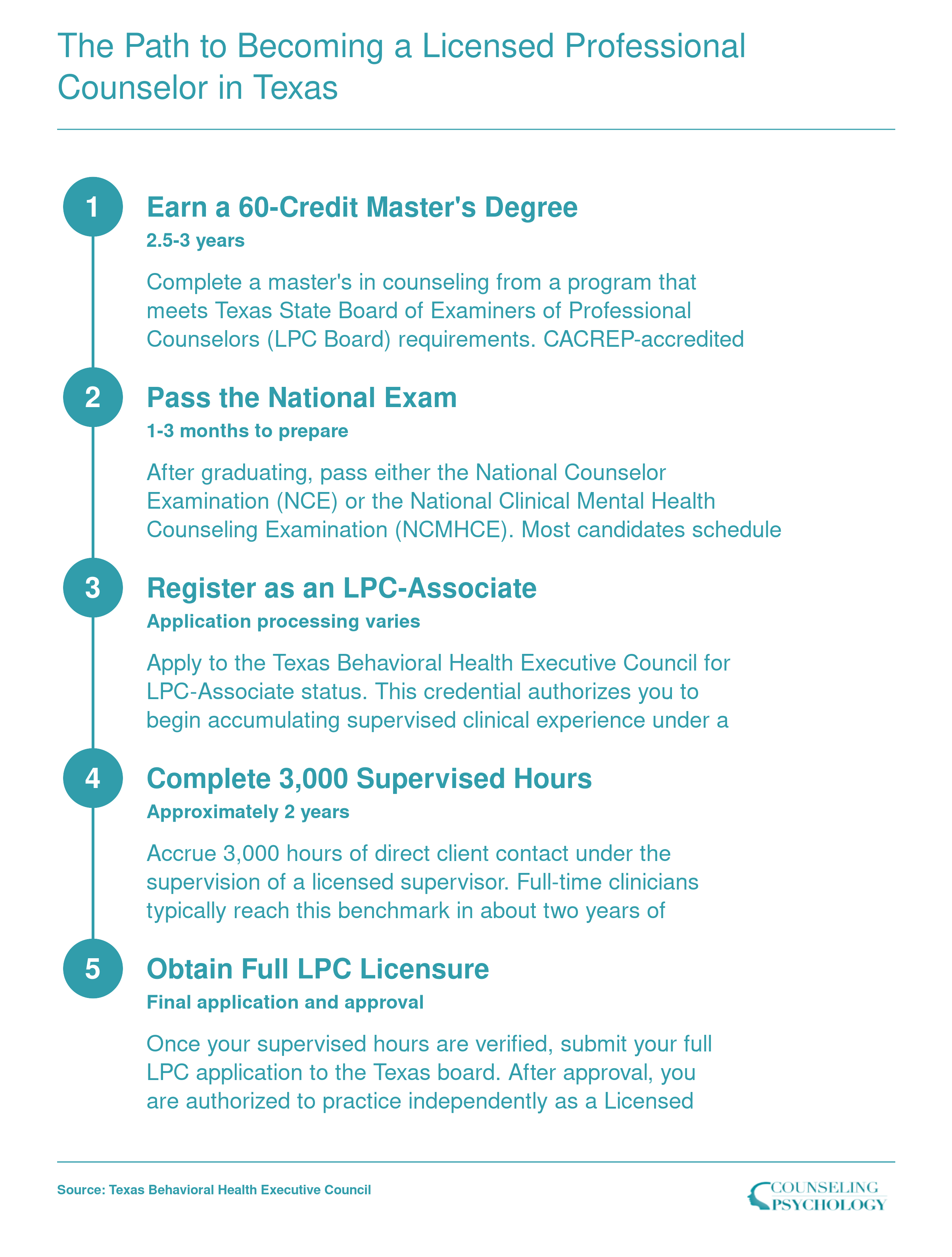
The Path to Becoming a Licensed Professional Counselor in Texas
Earning your LPC in Texas is a structured process that typically spans four to five years from your first graduate class to full licensure. Here is what each stage looks like and how long you should expect it to take.
Program Costs and Financial Aid Comparison
Every program on this list is housed at a public Texas university, which keeps tuition comparatively low. Still, out-of-pocket costs vary significantly depending on residency status and institutional aid. The net price figures below are institution-wide averages for undergraduate students receiving federal financial aid, as reported through IPEDS and the College Scorecard. They do not reflect program-specific graduate tuition, so prospective counseling students should contact each school's financial aid office directly for the most accurate estimate of what a 60-credit-hour master's degree will actually cost. Median graduate debt is also an institution-wide figure and encompasses borrowing across all degree levels.
| School | In-State Tuition | Out-of-State Tuition | Net Price (Institution Avg.) | Median Graduate Debt |
|---|---|---|---|---|
| UT Rio Grande Valley | $8,589 | $15,971 | $4,831 | $12,950 |
| University of North Texas at Dallas | $6,379 | $13,759 | $6,420 | $18,606 |
| University of Houston-Victoria | $8,315 | $15,535 | $8,109 | $18,973 |
| Lamar University | $8,642 | $16,022 | $9,366 | $21,250 |
| UT San Antonio | $10,116 | $28,720 | $10,836 | $20,500 |
| Midwestern State University | $8,198 | $9,498 | $11,656 | $21,030 |
| East Texas A&M University | $7,338 | $14,718 | $11,841 | $20,500 |
| Texas Woman's University | $8,520 | $15,900 | $11,963 | $19,218 |
| Texas A&M University, Kingsville | $6,157 | $14,560 | $12,090 | $22,934 |
| UT Permian Basin | $9,276 | $19,116 | $12,723 | $17,750 |
Online vs. On-Campus Counseling Programs: Format Comparison
Choosing between an online and on-campus counseling master's program is one of the most consequential decisions you will make, and neither format is inherently better. Both can lead to the same LPC licensure in Texas, and CACREP accredits online and campus programs under identical standards. What differs is how each format fits your life, your learning style, and your access to clinical training sites in the Dallas-Fort Worth area.
Pros
- Online programs offer scheduling flexibility that working professionals need, letting you complete coursework around existing job or family commitments.
- Studying online can reduce your total cost of attendance by eliminating relocation expenses and daily commuting to campus.
- Online enrollment opens access to CACREP-accredited programs across Texas and beyond, expanding your options well past the few schools within driving distance of Fort Worth.
- On-campus students in the DFW area enjoy the broadest access to local practicum placements at sites like Cook Children's Medical Center, Baylor Medical Center, and Texas Health Springwood.
- Campus-based cohort models foster organic peer networking and faculty mentorship relationships that often carry into your professional career.
- Fort Worth area campus students can tap school-based placement opportunities through organizations like the Amelia Flores Youth and Family Center, which operates across 10 local school sites.
- Paid internship opportunities, such as those offered by The Mind Parlor, may be more accessible to students already embedded in the local professional community.
Cons
- Online students still need local practicum and internship placements, and eligibility at DFW clinical sites is not automatic; many require a formal approval process with your program.
- Remote learning demands considerable self-discipline, and the absence of in-person classmates can limit the spontaneous peer support that sustains students through a rigorous 60-credit curriculum.
- Some coveted placement sites have limited capacity: Deep Centered Mental Health, for example, accepts only one intern cohort per year, making competition for spots intense regardless of format.
- On-campus programs typically follow rigid semester schedules, which can be difficult to reconcile with full-time employment or caregiving responsibilities.
- Commuting across the DFW metroplex adds real costs in time, fuel, and wear, especially if your program and practicum site are in different parts of the region.
- Fewer CACREP-accredited counseling master's programs exist within a convenient drive of Fort Worth compared to what is available statewide online, limiting on-campus options.
Counselor Salary and Career Outcomes in the Dallas-Fort Worth Area
Understanding what counselors earn at different career stages helps you weigh tuition costs against long-term return on investment. The table below draws on 2024 BLS Occupational Employment and Wage Statistics (SOC 21-1018) for Substance Abuse, Behavioral Disorder, and Mental Health Counselors at the national and Texas statewide levels. Keep in mind that program-level earnings data, such as what graduates of a specific university actually earn after completing their degree, can differ meaningfully from these broad occupational wage figures. Factors like practicum site placement, specialization track, and geographic practice location all influence individual outcomes.
| Geographic Level | Total Employment | 25th Percentile | Median Annual Wage | 75th Percentile | Mean Annual Wage |
|---|---|---|---|---|---|
| National (2023) | 397,880 | $44,600 | $53,710 | $70,130 | N/A |
| Texas Statewide (2024) | 19,520 | $47,600 | $60,630 | $76,390 | $67,920 |
Employment of substance abuse, behavioral disorder, and mental health counselors is projected to grow 18 percent from 2022 to 2032, much faster than the average for all occupations, according to the Bureau of Labor Statistics.
How to Choose the Right Counseling Master's Program
Choosing a counseling master's program means matching your career goals, learning style, and budget to a specific school, and then verifying that the program actually qualifies you for licensure in Texas. That second part trips up more applicants than you might expect. Here is a practical framework for narrowing your options in the Dallas-Fort Worth area.
Map Your Specialization to a Career Path
DFW's population diversity and rapid growth create demand across several counseling niches. Before you apply anywhere, think honestly about which client populations energize you.
- Trauma-focused work: Programs that embed trauma-informed coursework (EMDR foundations, crisis intervention) prepare you for community mental health agencies, VA settings, and hospital-based behavioral health units throughout Tarrant and Dallas counties.
- Substance use counseling: If you see yourself in addiction treatment centers or integrated care clinics, look for programs that include substance use disorder electives or dual-diagnosis training. Some DFW agencies actively recruit graduates with this background.
- Child and adolescent counseling: School districts and pediatric practices across the Metroplex hire LPCs with developmental and play therapy training. Ask whether the program offers a dedicated child/adolescent track or at least relevant elective hours.
- Bilingual counseling: Fort Worth's sizable Spanish-speaking population means bilingual clinicians are in high demand. A handful of area programs incorporate multicultural counseling coursework, but fluency combined with clinical training is what truly sets candidates apart in this market.
Evaluate Clinical Placement Quality
Practicum and internship hours are the backbone of your training, so dig into the details before committing.
- Does the program guarantee clinical placements, or will you be responsible for securing your own site? Guaranteed placements reduce stress and often come with vetted supervisors.
- Ask about supervisor-to-student ratios during fieldwork. A ratio of one supervisor to six or fewer students generally allows for meaningful, individualized feedback.
- Find out which agencies, hospitals, and private practices the program partners with in the DFW area. Strong site networks translate directly into job connections after graduation.
Consider Cohort Size and Faculty Access
Smaller cohorts (typically 10 to 20 students per entering class) tend to foster closer mentorship relationships and more engaged group supervision. Larger programs can offer breadth of electives, but you may find yourself competing for faculty attention. Ask admissions offices for their current cohort size and full-time faculty count so you can judge for yourself.
Confirm CACREP Accreditation and Credit Requirements
Texas requires 60 graduate semester hours for LPC licensure, and graduating from a CACREP-accredited program streamlines that path significantly.1 Among Fort Worth-area schools, TCU, UNT, SMU, Dallas Baptist University, UNT Dallas, and Tarleton State University all hold current CACREP accreditation for their clinical mental health counseling programs. TCU's M.Ed. in Clinical Mental Health Counseling, for example, requires exactly 60 credits.3 Not every nearby university holds this accreditation: both UTA and Texas Woman's University lack CACREP accreditation for CMHC as of 2026, which does not necessarily disqualify graduates from licensure but can complicate the process.
Students exploring broader options beyond the DFW area may also want to consider CACREP accredited online school counseling programs as a flexible alternative. Always verify accreditation status yourself through the CACREP directory rather than relying solely on a program's marketing materials. Accreditation cycles do expire and renewal is not automatic.
Talk to Real Students and Visit
Websites and brochures only tell part of the story. Attend a virtual info session or, better yet, visit campus. Sit in on a class if the program allows it. Most importantly, ask to connect with current students or recent alumni. The questions that matter most, like how smoothly practicum placement went, whether faculty were accessible during internship, and how prepared graduates felt for the NCE or licensure exams, are best answered by people who lived it.
Frequently Asked Questions About Counseling Master's Programs in Texas
Choosing a counseling master's program involves weighing licensure requirements, costs, and career outcomes. Below are answers to the questions prospective students in the Fort Worth area ask most often.
More Counseling Master's Programs to Consider in Texas
Beyond the top-ranked programs, Texas is home to many other high-quality clinical mental health counseling master's degrees. Explore the directory below, organized by region, for more options to fit your educational and career goals.
North Texas
- Clinical Mental Health
- Clinical Mental Health (School Counseling)
DFW Metroplex
- MA Clinical Mental Health Counseling
- Master of Education in Clinical Mental Health Counseling
- Clinical Mental Health Counseling
Greater Houston
- Master of Arts in Clinical Mental Health Counseling
- Master of Arts in Clinical Mental Health Counseling (Grief and Loss Counseling)
- Master of Arts in Clinical Mental Health Counseling (Marriage and Family Counseling)
San Antonio Area
- Master of Arts in Clinical Mental Health Counseling
Austin Area
- Master of Arts in Professional Counseling (Clinical Mental Health Counseling)
East Texas
- Master of Arts in Professional Counseling (Clinical Mental Health Counseling)
- Master of Arts in Clinical Mental Health Counseling
- Master of Arts in Clinical Mental Health Counseling
South Texas
- Master of Science in Clinical Mental Health Counseling (School Counseling)
- Master of Science in Clinical Mental Health Counseling (Rural Mental Health)
- Master of Science in Clinical Mental Health Counseling (Sandtray Therapy)
- Clinical Mental Health Counseling
- Master of Science in Professional Counseling (Clinical Mental Health Counseling)
- Master of Science in Professional Counseling (Clinical Mental Health Counseling - Hispanic Mental Health Emphasis)
West Texas
- Master of Arts in Clinical Mental Health Counseling
- Master of Science in Clinical Mental Health Counseling