
What you’ll learn in this article…
- Athens State University offers one of the most affordable fully online counseling-related bachelor's options near Huntsville.
- A bachelor's in counseling qualifies you for entry-level behavioral health roles while you prepare for graduate school.
- Alabama LPC licensure requires a master's degree, so choosing a bachelor's program aligned with graduate prerequisites saves time.
- In Alabama, LPCs generally see broader employer demand than LMFTs across schools, hospitals, and community agencies.
Huntsville's economy is anchored by defense contractors, aerospace engineering, and an expanding healthcare sector that collectively employ over 200,000 workers. That growth has created persistent demand for mental health professionals across schools, hospitals, employee assistance programs, and community agencies. Yet most counseling careers in Alabama require a master's degree and state licensure, making the bachelor's an essential but non-terminal credential.
Cost matters because graduate school is inevitable. A bachelor's program that keeps debt under $20,000 and feeds cleanly into accredited master's in counseling Alabama tracks preserves financial capacity for the LPC or LMFT credential later. Athens State University offers the region's most affordable online behavioral health science bachelor's, with in-state tuition under $11,000 annually and median graduate debt of $18,051.
The bachelor's also determines which master's programs will admit you without prerequisite coursework. Programs that build in abnormal psychology, human development, and counseling theory reduce the need for bridge courses later, compressing your total time to licensure by six to twelve months.
Best Bachelor's in Counseling Programs Near Huntsville, Alabama
Huntsville-area students looking for an affordable path into the counseling field have limited but strategically valuable options at the bachelor's level. The program below stands out for its low median graduate debt, fully online delivery, and strong alignment with the pre-counseling coursework required by Alabama master's programs. Because only one institution in the immediate region met our affordability and relevance filters, we present it as a focused recommendation rather than a padded list. Net price figures reflect institution-wide averages after financial aid and are approximate, not guaranteed quotes; graduation rates, where available, are also institution-wide metrics.
- Institutional net price after aid
- Graduate debt levels
- Program delivery flexibility
- Pell Grant recipient share
- Alignment with counseling career paths
- NCES-IPEDS federal institutional data — nces.ed.gov
- Independent program research
- Internal program database
- College Scorecard graduate earnings — collegescorecard.ed.gov

Athens State University
Athens State University is a public, upper-division institution in Athens, Alabama, roughly 25 miles west of Huntsville. It primarily serves transfer students from North Alabama community colleges such as Calhoun Community College, which keeps total degree costs low. Roughly 72% of undergraduates receive Pell Grants, signaling a student body that benefits heavily from federal financial aid. Median graduate debt sits at about $18,051, and College Scorecard data shows a median earnings figure of roughly $50,273 at ten years post-entry, combining to produce a solid return on investment for the region.
- Fully online format designed for working adults in the Huntsville metro
- Blends psychology, sociology, and behavioral science coursework
- Electives in abnormal psychology and social psychology support pre-counseling prep
- Emphasizes sociocultural diversity and community-based practice
- Pairs well with Alabama A&M or UNA master's counseling programs
- About 72% of students receive Pell Grants, reflecting strong aid access
- Median graduate debt near $18,051, well below the national average
- Minor option available for students in adjacent fields
Behavioral Health Science, B.S. — Online
What Can You Do With a Bachelor's in Counseling in Alabama?
A bachelor's in counseling won't license you for independent practice, but it opens doors to entry-level behavioral health roles that pay meaningfully more than typical retail or food-service work while you build experience toward graduate school.
Entry-Level Roles and Realistic Pay
With a counseling-focused bachelor's, you qualify for direct-care and coordination positions across Alabama. Common job titles include: - Behavioral health technician: Works alongside counselors and nurses in inpatient or outpatient settings, monitoring patients and facilitating group activities. - Case manager: Helps clients navigate social services, housing, and treatment plans, often at community mental health centers. - Community health worker: Bridges gaps between healthcare systems and underserved populations, focusing on prevention and education. - Residential counselor: Lives or shifts on-site at group homes or halfway houses, supporting daily living and recovery goals. - Substance abuse outreach coordinator: Engages at-risk individuals, organizes prevention events, and connects people to treatment resources.
According to the Bureau of Labor Statistics, Alabama substance abuse, behavioral disorder, and mental health counselors (a category that includes many of these tasks) earned a median annual wage of $48,880 in 2024.1 The national median for the same category is $59,190, and bachelor's-level roles under supervision typically fall at or slightly below the state median.2 Case managers and community health workers in Alabama generally see salaries in the $35,000 to $50,000 range depending on employer and experience.
The Licensure Ceiling (and Why It's Okay)
No bachelor's program in counseling meets the education requirement for Alabama's Licensed Professional Counselor or Licensed Marriage and Family Therapist credential. Independent practice always calls for a master's degree, supervised clinical hours, and a passing exam.2 What a bachelor's does is grant you supervised, real-world hours before graduate school, often a competitive edge in admissions and a way to test your fit for the field without committing to a full master's first.
Huntsville-Area Employers Hiring Now
Several large behavioral health organizations in and around Huntsville regularly recruit bachelor's-level graduates: - WellStone (behavioral health authority for Madison County) posts openings for behavioral health technicians, group aides, and care coordinators. - Huntsville Hospital's behavioral health unit often seeks psychiatric technicians and patient support specialists. - The Huntsville VA Medical Center hires community health workers and peer support specialists to serve veteran populations. These employers value the counseling-specific coursework and practicum experience that a degree like Athens State University's online Behavioral Health Science bachelor's provides.
Picking the Right Bachelor's for Your End Goal
When people ask, "What degree should I get for a counseling career?" the answer hinges on your destination. A general psychology degree covers broad theory and research but rarely includes applied counseling skills. A human services degree focuses on social welfare systems and case management. A counseling-specific bachelor's, such as a BS in Behavioral Health Science or a BA in Counseling Psychology, concentrates on interviewing skills, ethics, developmental psychopathology, and often a supervised practicum. That targeted coursework aligns most directly with the prerequisites and expectations of graduate counseling programs, including those in clinical mental health, school counseling, and family therapy programs in Alabama. For students still exploring the full range of counseling careers, Athens State University's program integrates sociology and psychology through a behavioral-science lens, and the latest College Scorecard data shows its graduates earn a median of $50,273 ten years after entering the program, above the state median for substance abuse counselors and a realistic indicator of where a Huntsville-area counseling bachelor's can lead before you even begin a master's.
Questions to Ask Yourself
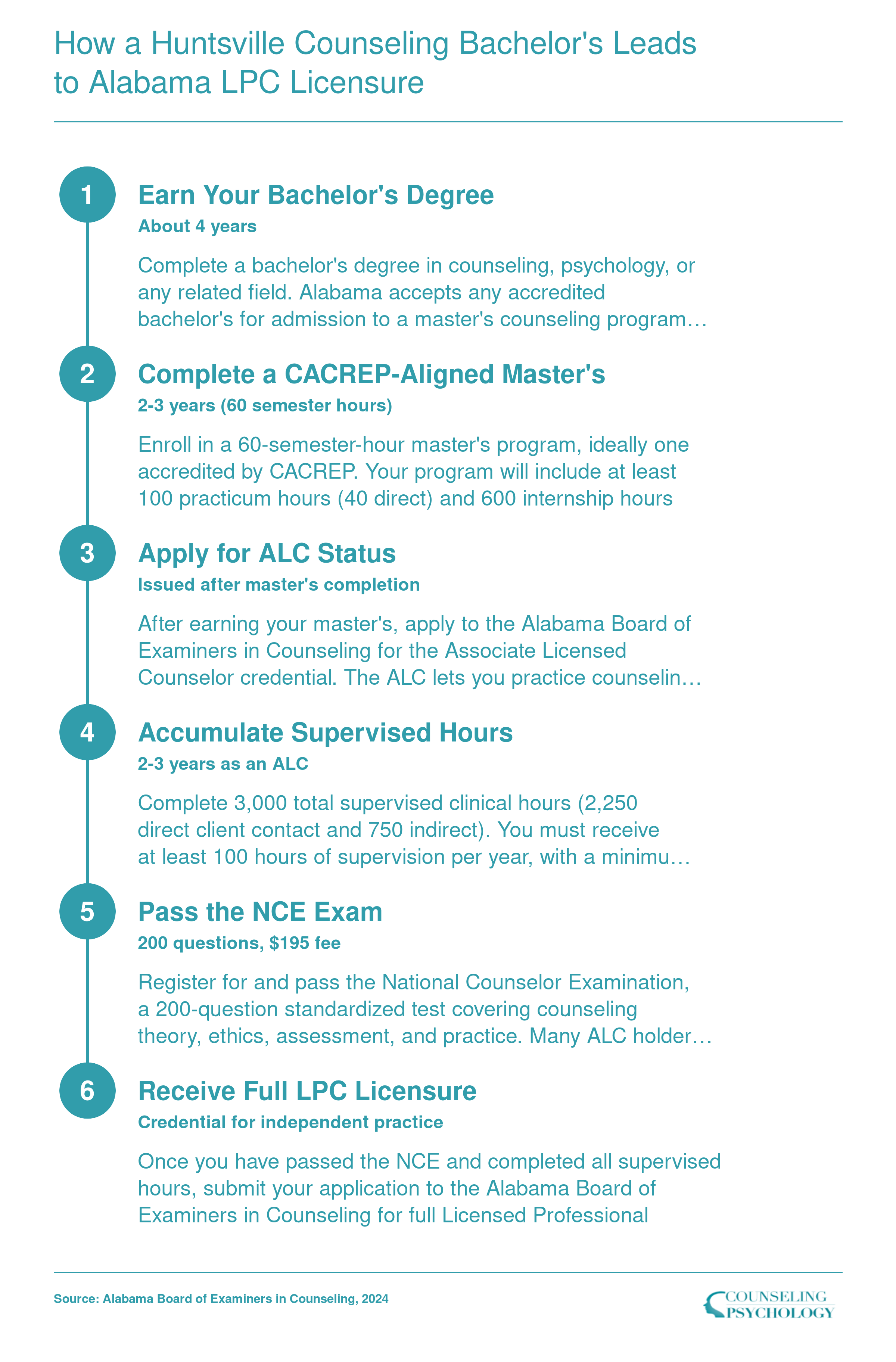
How a Huntsville Counseling Bachelor's Leads to Alabama LPC Licensure
Alabama does not require a counseling-specific bachelor's degree to enter a master's program, but starting with a counseling-focused undergraduate curriculum gives you a significant head start on prerequisite coursework and fieldwork readiness. Here is the full credentialing ladder from freshman year to full LPC status.
Related Articles
Online vs. On-Campus Counseling Programs in Huntsville
One of the most common questions prospective students ask is whether you can earn a counseling degree online in Huntsville. The answer is yes: several programs near the Huntsville area offer fully online or hybrid bachelor's formats, giving you real flexibility in how you complete your coursework. That said, each delivery mode comes with trade-offs worth weighing before you commit.
Pros
- Online formats let working students set their own study schedules, which is critical if you are balancing a job or family responsibilities.
- Tuition and fees for online programs can be lower overall once you factor in eliminated commuting, parking, and on-campus housing costs.
- Studying online opens access to accredited programs well beyond the immediate Huntsville area, broadening your options across Alabama and neighboring states.
- On-campus students benefit from direct, face-to-face mentorship with faculty who can write stronger recommendation letters for graduate school.
- Attending classes in person makes it easier to network with Huntsville-area mental health employers, community agencies, and fellow students who become future colleagues.
- Campus-based programs often have established local practicum pipelines, connecting you with fieldwork sites in the Tennessee Valley more quickly.
Cons
- Online students may need to arrange their own local practicum or fieldwork placements, which requires extra initiative and planning.
- Regardless of whether your coursework is online, practicum hours almost always require in-person client contact, so a fully remote experience is not realistic for counseling majors.
- On-campus programs demand a fixed class schedule that can conflict with full-time employment or caregiving obligations.
- Commuting, parking, and potential relocation costs can push on-campus total expenses higher than comparable online options.
Faith-Based vs. Public Counseling Programs: What to Know
Students near Huntsville often weigh faith-based institutions such as Faulkner University and Oakwood University against public options like Athens State University. Each model has distinct strengths in curriculum design, community culture, and graduate school preparation. Understanding how these differences play out in accreditation, credit transferability, and practicum flexibility can save you time and money on the path to a counseling career.
| Comparison Factor | Faith-Based (e.g., Faulkner University) | Public (e.g., Athens State University) | HBCU Option (e.g., Oakwood University) |
|---|---|---|---|
| Curriculum Integration | Explicit Christian worldview woven throughout coursework; Faulkner requires 18 credit hours of Bible and ethics in its B.S. in Counseling Psychology (121 total credits) | Secular, evidence-based curriculum centered on psychology and sociology; Athens State's Behavioral Health Science program emphasizes sociocultural diversity | Seventh-day Adventist mission infuses the liberal arts core; students also benefit from Oakwood's federally designated HBCU community, which can be a meaningful cultural and networking advantage |
| Regional Accreditation | Yes, regionally accredited (SACSCOC) | Yes, regionally accredited (SACSCOC) | Yes, regionally accredited (SACSCOC) |
| Credit Transfer to Graduate Programs | Because Faulkner holds regional accreditation, core psychology and counseling credits generally transfer to CACREP-accredited master's programs. Bible and ethics hours, however, typically count only as general electives at secular institutions. | Credits from a regionally accredited public university are broadly accepted by graduate counseling programs with few complications | Regional accreditation supports smooth transfer; religion-specific coursework may transfer as elective credit rather than core prerequisites at secular graduate schools |
| Practicum and Fieldwork Flexibility | Internship and capstone are required; placement sites may favor faith-aligned agencies, though secular options are sometimes available | Practicum sites tend to be secular community agencies, hospitals, and nonprofits, offering broad exposure to diverse client populations | Fieldwork may draw on Adventist health networks alongside community placements; students often gain experience serving underrepresented populations |
| Graduate School Readiness for CACREP Programs | Faulkner's own graduate clinical mental health counseling program holds CACREP accreditation, so the undergraduate curriculum is designed to feed directly into that pipeline. Students applying elsewhere should verify that prerequisite courses (statistics, abnormal psychology, research methods) are covered. | A behavioral science or psychology bachelor's from a public school aligns well with most CACREP-accredited master's prerequisites, though students should confirm specific course matches with their target program | Psychology coursework generally covers standard prerequisites. Oakwood graduates have entered a range of master's programs, though individual outcomes depend on elective choices and GPA. |
| Delivery Mode | On-campus and online options available | Online program available, with a 14:1 student-to-faculty ratio | Primarily on-campus; the residential HBCU experience is a core part of the institutional identity |
| Approximate In-State Tuition | Private tuition applies to all students (check current rates directly with the university) | Approximately $10,020 per year; 72% of students receive Pell Grants | Private tuition applies to all students (confirm current rates with admissions) |
Nationally, licensed professional counselors (LPCs) and licensed marriage and family therapists (LMFTs) earn similar median salaries, but in Alabama, LPCs tend to have broader employer demand across schools, hospitals, and community agencies. If you are weighing which license to pursue, the licensure pathway section of this article walks through the full Alabama LPC process step by step.
Curriculum, Practicum, and Local Fieldwork Opportunities
Bachelor's programs in counseling near Huntsville provide a strong foundation in psychological theory, human behavior, and applied clinical skills. While a bachelor's degree in counseling or psychology alone does not lead to licensure as a professional counselor in Alabama, the coursework and early field exposure prepare students for master's-level training and for immediate entry into related human-services roles.
Core Counseling Coursework at the Bachelor's Level
Most bachelor's programs in counseling psychology or human services share a common set of courses:
- Abnormal Psychology: Study of psychological disorders, symptomatology, and classification systems (DSM-5-TR).
- Theories of Counseling: Overview of major theoretical frameworks including psychodynamic, humanistic, cognitive-behavioral, and family systems approaches.
- Human Development: Life-span development from infancy through late adulthood, covering biological, cognitive, and socioemotional changes.
- Group Dynamics: Principles of group process, leadership, and facilitation in therapeutic and organizational contexts.
- Research Methods and Statistics: Introduction to quantitative and qualitative research design, data analysis, and evidence-based practice.
- Multicultural Counseling: Examination of culture, identity, and diversity issues in mental health service delivery.
Programs also typically include electives in crisis intervention, substance abuse counseling, and community mental health systems. Some schools embed case management or peer counseling training into the curriculum to prepare students for bachelor's-level support roles.
Practicum vs. Internship: What to Expect
At the bachelor's level, field experiences are typically labeled practica and are shorter and more structured than master's-level clinical internships. A typical undergraduate practicum involves 100 to 200 hours of supervised fieldwork, often spread across one or two semesters. Students observe licensed clinicians, shadow intake interviews, co-facilitate psychoeducational groups, and complete client documentation under close supervision. They do not provide independent therapy or formal diagnoses, but they gain firsthand exposure to clinical settings, administrative workflows, and professional ethics.
Internships at the bachelor's level look similar but may require more hours and greater independence in tasks such as case management, crisis hotline support, or peer mentoring. Students interested in crisis work specifically may want to explore how to become a suicide prevention counselor as a longer-term career path. Documentation usually includes weekly supervision logs, reflective journals, and a final portfolio or case-study report.
Huntsville-Area Practicum and Fieldwork Sites
Huntsville's robust mental health infrastructure offers a variety of practicum placements for undergraduate counseling students:
- WellStone Behavioral Health: A public community mental health center operating multiple facilities across Madison County.1 WellStone provides crisis services (including 24/7 mobile crisis teams), outpatient therapy and psychiatry, and community-based programs for children, adolescents, and adults.2 Bachelor's-level students often assist with intake coordination, group facilitation, and peer support services.
- Huntsville Hospital Behavioral Health: The hospital's inpatient psychiatric units for adults and seniors offer acute stabilization and family education.3 Practicum students may observe multidisciplinary treatment-planning meetings, help with patient education materials, and shadow discharge coordinators.
- Thrive Alabama: This federally qualified health center-style organization integrates primary care and behavioral health.4 The behavioral health clinic, located at 415 Church Street (Building E, Suite 10), is a natural fit for students interested in integrated care models and serving underserved populations.
- Alliance Behavioral Health: A private outpatient practice at 250 Chateau Drive that offers psychological evaluations and psychotherapy for individuals and couples.5 Smaller settings like this can provide students with closer mentorship and exposure to private-practice operations.
- Behavioral Health Group Huntsville: An opioid treatment program at 4040 Independence Drive NW that combines medication-assisted treatment (methadone and buprenorphine) with individual and group counseling and peer recovery support.6 Students interested in addiction counseling can gain specialized experience here.
- Other Madison County Providers: The Alabama Department of Mental Health lists additional sites including Aletheia House (substance use treatment), Arc of Madison County (intellectual and developmental disabilities services), and other community partners.7
Local fieldwork not only builds practical skills but also strengthens applications to competitive Alabama master's programs in counseling and psychology. Admissions committees look favorably on candidates who have already navigated clinical documentation, supervision, and ethical dilemmas in real-world settings. For students who ultimately pursue graduate training, understanding the path to becoming a counseling psychologist can help shape undergraduate practicum choices. Huntsville students who complete practica at WellStone or Huntsville Hospital often cite those experiences as decisive factors in securing graduate assistantships or early employment in regional mental health agencies.
How to Choose the Right Counseling Program in Huntsville
Alabama requires a master's degree for LPC licensure, which means your bachelor's program is the foundation that either opens or closes doors to graduate school. Choosing well at the undergraduate level saves time, money, and frustration later.
1. Accreditation and Graduate-School Alignment
Start here. Not all counseling bachelor's programs carry the same weight when you apply to master's programs. If your goal is eventual LPC or LMFT licensure, verify that the credits from your undergraduate program are recognized by CACREP-accredited master's programs in Alabama. CACREP accreditation at the graduate level is increasingly required by state licensing boards and employers, and some CACREP programs have prerequisites that favor applicants from specific course sequences. Ask each program directly whether its graduates have been admitted to CACREP-accredited master's programs, and request placement data if available.
2. Total Cost and Financial Aid
Sticker price rarely tells the full story. A program with higher published tuition may award more institutional aid, leaving you with a lower net cost than a cheaper-looking option. Run the numbers after aid, not before. Also factor in whether you can transfer credits from a community college, such as Calhoun Community College, which has campuses in the Huntsville area and could reduce your total credit load significantly.
3. Format: Online, On-Campus, or Hybrid
If you are working or have family obligations, an online or hybrid format may be the only practical option. Many accredited programs now offer fully asynchronous coursework, and you can compare online counseling degree programs to find options that align with your schedule. That said, online enrollment does not eliminate the need for in-person practicum hours, so confirm how the program handles fieldwork placement in the Huntsville area before enrolling.
4. Practicum Access in the Huntsville Area
Huntsville's mental health infrastructure, including agencies connected to Huntsville Hospital and community behavioral health organizations, offers legitimate fieldwork settings. Programs that maintain established relationships with local sites give you a measurable advantage over programs that leave placement entirely to students.
5. Faith-Based vs. Secular Fit
Some students thrive in faith-integrated environments; others prefer a secular academic approach. Neither is categorically better, but the philosophical orientation of a program shapes curriculum, campus culture, and sometimes the clinical populations you are trained to serve. If you are drawn to a faith-based track, explore online bachelor's in biblical counseling options to see how those curricula compare. Be honest with yourself about which environment supports your best work.
The Fastest Path Through a Bachelor's in Counseling
The quickest counseling degree is typically one that accepts the most transfer credits and offers accelerated course sequences. If you already have associate-level coursework, look for programs with articulation agreements that honor those credits fully. Some universities also offer accelerated eight-week terms rather than standard sixteen-week semesters, compressing a four-year timeline into three years or less for motivated students. Speed matters, but only if the credential holds up when you apply to graduate school.
The cheapest program is not always the best value. Practicum quality, faculty mentorship, and graduate-school placement rates are harder to quantify than tuition, but they shape your career far longer than any single semester's bill.
Frequently Asked Questions About Counseling Degrees in Huntsville
Choosing a counseling program raises practical questions about cost, format, and career payoff. Below are answers to the most common questions prospective students ask when exploring bachelor's in counseling programs near Huntsville, Alabama.