What you’ll learn in this article…
- SUNY Albany is a public R1 university and the Capital Region's strongest option for research-focused psychology undergraduates.
- Net price across Albany-area psychology programs varies dramatically, making school-by-school cost comparisons essential before applying.
- Transfer credit policies differ widely and can add a full year of tuition for students moving from community colleges.
- Albany graduates enter careers in state agencies, nonprofits, and private practice, though a master's degree unlocks higher earning potential.
Albany sits in a rare sweet spot for psychology undergraduates: you can commute to a highly selective Ivy League psychology department, a public research flagship, or a CUNY campus charging under $4,000 net price per year. Within two hours of the Capital Region, you'll find programs spanning $3,000 to $37,000 in annual net costs, 53% to 96% graduation rates, and ten-year median alumni earnings from $53,000 to $104,000. The gap between what you pay and what you earn later depends less on whether the school is public or private than on which specific institution you attend and how much aid you qualify for.
Most programs are campus-based; genuinely online psychology bachelor's options remain scarce in New York, though hybrid and accelerated formats have expanded at SUNY and CUNY schools since 2024. If you're transferring from Hudson Valley Community College or a similar two-year institution, your choice of four-year program will determine whether 60 credits transfer cleanly or whether you lose a semester to repeated coursework.
A psychology bachelor's alone does not qualify you for licensure as a psychologist, counselor, or social worker in New York. It does open pathways into case management, residential counseling, human resources, and research assistant roles, but most clinical and therapeutic positions require a master's degree and state licensure. Students drawn to clinical psychology should budget for graduate school from the start.
Best Bachelor's in Psychology Programs Near Albany, Ranked
The programs below span New York's public and private sectors, from highly selective Ivy League departments to affordable CUNY and SUNY campuses. Each was evaluated on institutional outcomes, affordability after aid, and the depth of its psychology curriculum. Note that the graduation rates cited are institution-wide figures, not specific to any single major, and program-level earnings data is not yet available for most of these bachelor's programs.
- Graduation and retention rates
- Net price after financial aid
- Curriculum depth and research focus
- Faculty accessibility metrics
- Long-term graduate earnings
- NCES-IPEDS federal institutional data — nces.ed.gov
- College Scorecard graduate earnings — collegescorecard.ed.gov
- Internal program database
- Independent program research

Columbia University in the City of New York
Columbia's psychology department delivers a rigorous scientific curriculum spanning perception, neuroscience, social behavior, and research methodology. A 6:1 student-to-faculty ratio means undergraduates regularly collaborate with leading researchers, and the university's 96.1% institution-wide graduation rate reflects the strength of its academic support systems. After financial aid, the average net price drops to roughly $21,590, which is notable given the $70,517 sticker price.
- Covers perception, neuroscience, and social psychology
- Emphasizes scientific research methods and ethical practice
- Hands-on faculty-led research from the undergraduate level
- Prepares students for competitive graduate programs
- Comprehensive training across multiple psychology subdisciplines
- 6:1 student-to-faculty ratio supports close mentorship
General Psychology — On-Campus

Cornell University
Cornell's 40-credit psychology major bridges biological, cognitive, developmental, and social perspectives within a single degree path. Students are assigned a faculty advisor upon admission to the major, and upper-level coursework at the 3000 to 4000 level ensures genuine depth. Cornell's institution-wide graduation rate stands at 95.4%, and median graduate debt is just $14,000, one of the lowest figures among the private institutions on this list.
- 40 total psychology credits required for the major
- Faculty advisor assigned upon admission to the major
- Upper-level courses at the 3000 to 4000 level required
- Research methods proficiency is mandatory
- Covers biological, cognitive, developmental, and social domains
- Study abroad available in over 40 countries
- About one-third of undergraduates participate in study abroad
General Psychology — On-Campus

CUNY Bernard M Baruch College
Baruch College pairs a research-focused psychology BA with one of the lowest net prices in the state: just $3,033 on average after aid for in-state students. The curriculum emphasizes both theoretical frameworks and practical applications, and graduates report median earnings of roughly $75,971 ten years out. Located in Midtown Manhattan, Baruch gives students access to internship networks in healthcare, human services, and organizational settings.
- Research-focused BA curriculum in general psychology
- Average net price of approximately $3,033 after aid
- In-state tuition of $7,464 before aid
- Located in Manhattan with strong internship access
- Emphasizes critical thinking and research methodologies
- Prepares graduates for counseling, HR, and graduate study
General Psychology — On-Campus

CUNY Hunter College
Hunter College offers a research-oriented psychology major with seven specialized focus areas, including neuroscience, clinical psychology, and health psychology. The program trains students in empirical methods and statistical analysis, building a strong foundation for graduate school or entry-level roles in education, healthcare, and social services. With a net price of about $2,984 and an institution-wide graduation rate of 56.9%, Hunter is an accessible entry point for students who plan to continue to a master's or doctoral program.
- Seven specialized focus areas within the major
- Interdisciplinary neuroscience concentration available
- Comprehensive research methods and statistics training
- Designed to prepare students for graduate-level study
- Covers biopsychology, cognitive, and social-clinical domains
- Net price averages roughly $2,984 after financial aid
- 14:1 student-to-faculty ratio
General Psychology — On-Campus

CUNY City College
City College houses its psychology programs within the Colin Powell School, offering both a BA and a BS track. The BA explores human behavior through interdisciplinary lenses covering trauma, neuroanatomy, and social psychology, while the BS leans into lab science and calculus for students eyeing healthcare or research careers. Clinical and research internships are woven into both tracks, and the average net price sits at about $3,776.
- 120 total credits with 35 in psychology coursework
- Covers trauma, neuroanatomy, and social psychology
- Includes research and clinical internship opportunities
- Career pathways in counseling, social work, and education
- Flexible advanced course options in the upper division
- Housed within the Colin Powell School
- 120 credits with lab science and calculus requirements
- Emphasis on scientific research and quantitative methods
- Hands-on research experience built into the curriculum
- Prepares students for healthcare and research careers
- Internship placements complement classroom learning
- Stronger STEM foundation than the BA track
Psychology BA — On-Campus
Psychology BS — On-Campus

CUNY Queens College
Queens College delivers a broad psychology BA covering cognitive, developmental, and social domains at one of the most affordable price points on this list. The average net price is roughly $4,195, and flexible scheduling supports both full-time and part-time enrollment. With a 13:1 student-to-faculty ratio, Queens offers more individualized attention than many CUNY campuses while still keeping costs low.
- Covers cognitive, developmental, and social psychology
- Average net price of approximately $4,195 after aid
- Flexible scheduling for full-time and part-time students
- Strong research methods foundation
- 13:1 student-to-faculty ratio
- Prepares students for counseling and research careers
General Psychology — On-Campus

New York University
NYU's psychology BA takes students through cognitive, social, developmental, and neuroscientific approaches across ten four-credit courses. An honors program lets high-achieving undergraduates partner directly with faculty on original research. The institution-wide graduation rate is 87.6%, and ten-year median earnings reach about $82,509, though the $37,050 net price makes it the priciest option in this ranking.
- Ten four-credit psychology courses required
- Honors research program for advanced students
- Multiple scientific research perspectives covered
- Laboratory course options within the curriculum
- Advanced quantitative skill development embedded
- Preparation for graduate study in psychology, law, and medicine
- 8:1 student-to-faculty ratio
- 96% first-year retention rate
Psychology (BA) — On-Campus

Touro University
Touro University's BA in Psychology requires 120 credits, including 90 in liberal arts, and spans developmental, abnormal, and biological psychology. An honors track adds a senior research project for students considering graduate school. The 10:1 student-to-faculty ratio supports close mentorship, though the $29,627 average net price is higher than many public alternatives on this list.
- 120 credits required with 90 in liberal arts
- Honors major track with a senior research project
- Covers developmental, abnormal, and biological psychology
- 10:1 student-to-faculty ratio for close mentorship
- Campus-based program in New York City
- GPA requirements apply for the honors track
- Blends theoretical study with practical applications
Bachelor of Arts in Psychology — On-Campus

State University of New York at New Paltz
SUNY New Paltz stands out for offering both a BA and a BS in psychology, plus two formal concentrations: Industrial/Organizational Psychology and Psychobiology. The I/O track blends psychology with business principles, while the Psychobiology concentration pairs the major with behavioral neuroscience. Located about 90 miles south of Albany, New Paltz is one of the closer SUNY campuses and charges $8,572 in-state tuition before aid.
- BA and BS degree options available
- 44 to 59 total psychology credits depending on track
- Capstone seminar and experiential learning credits included
- Research methods focus throughout the curriculum
- 2.75 GPA required for admission to the major
- Diverse upper-division elective coursework
- BS degree blending psychology with business administration
- 59 credits to complete the concentration
- Prepares graduates for HR and organizational roles
- Includes training in psychological testing
- Capstone seminar and research experience required
- Campus-based with internship opportunities
- BS degree combining psychology and biology
- 59 to 62 credit hours required
- Includes behavioral neuroscience coursework
- Math Placement Level 4 required for entry
- Strong science foundation for pre-health students
- Prepares graduates for neuroscience graduate programs
General Psychology — On-Campus
General Psychology with Concentration in Industrial/Organizational Psychology — On-Campus
General Psychology with Concentration in Psychobiology — On-Campus

SUNY College at Geneseo
SUNY Geneseo's 52-credit psychology BA is designed to align with American Psychological Association guidelines, covering cognitive, biological, and social psychology alongside statistics and research methods. A required senior seminar caps the program with original research. Geneseo's institution-wide graduation rate is 71.4%, and the net price averages about $18,211 for aided students.
- 52 total credits aligned with APA guidelines
- Senior research seminar required for all majors
- Five core courses in basic psychology domains
- Statistics and research methods woven throughout
- Minimum C- grade required in psychology courses
- Advanced 300-level elective options available
- Prepares graduates for careers in psychology, law, and education
General Psychology — On-Campus
Program Comparison: Cost, Format & Flexibility
Every program on this list is housed at a public New York institution, yet the actual cost students pay after grants and scholarships varies dramatically. Net price, which reflects what a typical aided student spends per year, ranges from roughly $2,984 at CUNY Hunter College to over $18,000 at SUNY Geneseo. University at Albany is the only school in this group that lists an online format for its psychology bachelor's, making it the top pick for students who need remote coursework near the Capital Region.
| School | In-State Tuition | Out-of-State Tuition | Net Price (Aided Students) | Format | Graduation Rate |
|---|---|---|---|---|---|
| CUNY Hunter College | $7,382 | $15,332 | $2,984 | Campus | 56.9% |
| CUNY Baruch College | $7,464 | $15,414 | $3,033 | Campus | 72.1% |
| CUNY City College | $7,340 | $15,290 | $3,776 | Campus | 56.8% |
| CUNY Queens College | $7,538 | $15,488 | $4,195 | Campus | 53.3% |
| College of Staten Island (CUNY) | $7,490 | $15,440 | $5,579 | Campus | 33.9% |
| SUNY Old Westbury | $8,372 | $18,842 | $11,282 | Campus | 44.6% |
| SUNY Polytechnic Institute | $8,625 | $21,215 | $14,164 | Campus | 55.1% |
| SUNY Plattsburgh | $9,035 | $18,945 | $17,156 | Campus | 58.5% |
| University at Albany | $10,601 | $30,991 | $17,167 | Online | 61.4% |
| SUNY Geneseo | $8,999 | $19,569 | $18,211 | Campus | 71.4% |
Questions to Ask Yourself
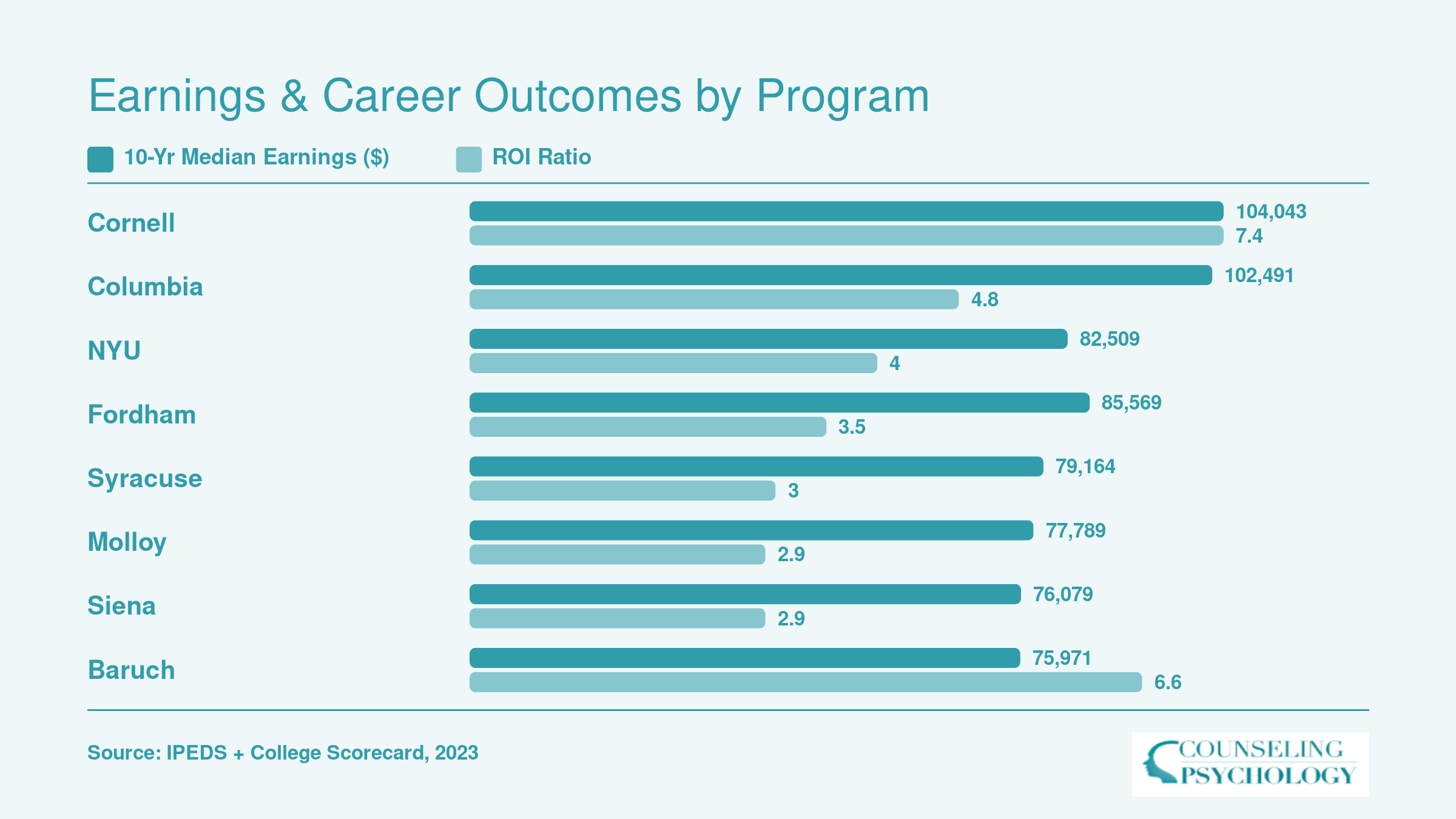
Earnings & Career Outcomes by Program
Program-level earnings at one and four years after completion are not yet published for these psychology bachelor's programs. However, institution-wide median earnings ten years after enrollment and ROI ratios (median ten-year earnings divided by net price) offer a useful value-for-money signal. The chart below compares ten-year median earnings across the top-ranked programs near Albany, NY.
Admissions Requirements & Transfer Credit Policies
How much of your community college work will transfer determines whether you graduate in two years or three, a difference that can save or cost you tens of thousands of dollars. Albany-area psychology programs vary widely in their transfer limits, GPA thresholds, and articulation agreements with local two-year schools. Below is what you need to know before you apply.
GPA Minimums and Test-Optional Status
The University at Albany requires a 2.00 cumulative GPA for general admission and a 2.50 GPA in psychology courses for students wishing to declare the major.1 Transfer applicants with 42 or more credits can declare the psychology major immediately if they have completed A PSY 101, A PSY 210, and A PSY 211 with a C- or higher and maintain that 2.50 psychology GPA.1 Students with fewer than 42 credits face conditional admission to the major and must achieve a 2.75 GPA. All psychology major courses require a minimum grade of C-. The university has moved to test-optional admissions; standardized test scores are not required for most applicants.
Russell Sage College, The College of Saint Rose, and Siena College similarly operate under test-optional policies as of 2026, though all three expect competitive high school GPAs (typically 2.5 or higher for transfer students). SUNY Empire State University maintains open admissions for New York State residents but requires students to meet prior-learning assessment standards and complete an orientation process before beginning coursework.
Maximum Transfer Credits Accepted
University at Albany accepts up to 90 transfer credits from four-year institutions and up to 70 credits from two-year colleges. Transfer grades of D are accepted for general electives but do not count toward the psychology major, which requires C- or better in all major courses.1 The psychology major itself requires 36 total credits, with at least 24 at the upper-division (300- and 400-level) completed at UAlbany.2 Students who earned an associate degree in psychology at a community college should confirm which courses satisfy upper-division requirements before enrolling.
SUNY Empire State University accepts up to 93 credits in transfer and offers maximum flexibility for nontraditional students, including credit for prior learning and work experience. Russell Sage accepts up to 90 credits, while Siena College caps transfer credit at 75 semester hours. The College of Saint Rose accepts up to 90 credits but requires at least 30 credits in residence.
Articulation Agreements with Local Community Colleges
The SUNY system maintains formal articulation agreements with Hudson Valley Community College and SUNY Schenectady County Community College, ensuring that Associate in Arts (AA) and Associate in Science (AS) degrees transfer seamlessly to UAlbany and other SUNY four-year institutions. Students who complete an AA or AS in psychology or liberal arts at these schools typically enter as juniors with full sophomore standing. However, specific psychology courses, especially research methods and statistics, must align with UAlbany's curriculum to satisfy major prerequisites.
Russell Sage and Siena have informal transfer pathways with local community colleges but do not publish blanket articulation agreements. Students should request a preliminary credit evaluation during the admissions process to avoid surprises.
Admissions Selectivity
Admissions rates offer a rough signal of how competitive each program is. University at Albany does not publish program-specific acceptance rates, but the institution as a whole admitted approximately 68 percent of applicants in recent cycles. Siena College's acceptance rate hovers near 75 percent, while Russell Sage admits roughly 80 percent of applicants. These rates suggest moderately selective admissions, where a strong GPA and completion of prerequisite coursework matter more than test scores or extracurricular portfolios. Graduates interested in advancing further may want to explore best counseling programs in New York at the master's level.
Accreditation & Licensure Preparation
Regional accreditation versus programmatic accreditation: these two terms cause confusion among prospective psychology students, and understanding the difference shapes both your educational path and career options in New York.
Regional Accreditation: The Foundation That Matters Most
Most colleges and universities near Albany hold regional accreditation through the Middle States Commission on Higher Education. This institutional accreditation confirms that the school meets established standards for faculty qualifications, student services, and academic rigor. Regional accreditation matters because it determines whether your credits transfer to graduate programs and whether employers recognize your degree as legitimate.
A common misconception involves the American Psychological Association. The APA accredits doctoral programs in clinical, counseling, and school psychology, but it does not accredit bachelor's degree programs. No undergraduate psychology program carries APA accreditation, so do not let any marketing materials suggest otherwise. Instead, look for programs that follow the APA Guidelines for the Undergraduate Major, a framework that signals curriculum quality through emphasis on scientific inquiry, ethical reasoning, and professional development. Programs aligned with these guidelines typically prepare students more effectively for graduate study.
New York Licensure Pathways After a Bachelor's Degree
A bachelor's in psychology alone does not qualify you for independent counseling licensure in New York. The state requires graduate education for credentials like Licensed Mental Health Counselor (LMHC) or Licensed Marriage and Family Therapist (LMFT). Understanding this early prevents frustration later. For a deeper look at the full career trajectory, see our guide on how to become a licensed mental health counselor.
The LMHC pathway through the New York State Education Department requires a master's degree with 60 graduate credit hours, 3,000 hours of supervised clinical experience (including 1,500 direct client contact hours), and a passing score on the NCMHCE exam.12 After licensure, counselors must complete 36 continuing education hours every three years.3 Limited permits allow new graduates to practice under supervision while accumulating required hours.2
However, certain credentials remain accessible with a bachelor's degree:
- CASAC (Credentialed Alcoholism and Substance Abuse Counselor): New York's Office of Addiction Services and Supports offers entry-level credentialing for bachelor's degree holders who complete specific coursework in addiction studies, supervised fieldwork, and the CASAC examination. This credential allows you to work in substance abuse treatment settings while deciding whether to pursue graduate education.
- School Counselor Certification: This path requires a master's degree in school counseling, but your psychology bachelor's positions you well for admission to approved programs. New York certifies school counselors through NYSED, not through mental health counseling boards.
Those drawn to addiction treatment work can learn more about the substance abuse counselor degree requirements and career outlook before committing to a specialization.
Planning Your Path Forward
If independent clinical practice is your goal, treat your bachelor's degree as preparation for graduate school rather than a terminal credential. Choose programs with strong research opportunities, faculty mentorship, and coursework that aligns with APA undergraduate guidelines. These elements strengthen graduate applications and build the foundational knowledge you will need for advanced clinical training.
Is SUNY Albany a Good School for Psychology?
Yes, the University at Albany (SUNY) is a strong choice for undergraduates pursuing psychology in the Capital Region, particularly if you want research exposure at a public R1 university and plan to attend graduate school. It is the flagship psychology destination in the immediate Albany area, and its standing rests on three concrete factors: research infrastructure, public-university pricing, and a competitive completion rate.
Outcomes and Cost in Context
Albany-area psychology applicants typically weigh UAlbany against private and SUNY peers within driving distance. UAlbany's in-state tuition (currently around $7,000 to $10,000 per year for New York residents, before fees and housing) sits well below the private competitors on the Albany list and roughly in line with sister SUNY campuses like New Paltz and Geneseo. Six-year graduation rates at SUNY institutions in this comparison set cluster in the low 70 percent range, and UAlbany falls within that band, meaning students who enroll have a reasonable likelihood of finishing on a standard timeline. Program-specific completion counts and median earnings for psychology graduates are not consistently published at the program level in the latest federal data release, so we recommend pulling the most current figures directly from College Scorecard before you commit.
Research Strength Matters for Psych Majors
The more meaningful differentiator is research. UAlbany houses a PhD program in psychology spanning clinical, cognitive, behavioral neuroscience, social-personality, and industrial-organizational tracks. For undergraduates, that translates into faculty-run labs that take on research assistants, honors thesis opportunities, and mentorship from doctoral students. If you are aiming for graduate school in clinical psychology, counseling, or a related doctoral track, that lab experience is what admissions committees look for, and it is harder to come by at teaching-focused schools. Students interested in the clinical route can explore clinical psychology doctorate programs to understand what graduate admissions committees expect.
Format Caveat
One important limitation: UAlbany's bachelor's in psychology is delivered primarily on-campus. If you need a fully online program because of work, family, or geography, look at SUNY Empire State University, which is built for distance learners, or consider the other online-capable options listed earlier in this guide. UAlbany is the right answer for traditional, in-person students, not for working adults who require asynchronous flexibility.
Here is a quick ROI snapshot: full program-level net price and 4-year post-completion earnings data for every Albany-area psychology bachelor's is not uniformly reported, so resist anchoring on a single average. Instead, pull each school's own net price calculator result and weigh it against entry-level salaries for the specific roles you are targeting.
Career Paths With a Psychology Bachelor's Near Albany
Public-sector roles in state agencies and private nonprofit positions represent two distinct career paths for psychology bachelor's graduates in the Albany area, each offering different scopes of work, advancement timelines, and compensation structures.
Finding Current Salary Data for the Albany Area
To locate up-to-date salary data for psychology bachelor's-level occupations in the Albany-Schenectady-Troy metropolitan statistical area, visit the Bureau of Labor Statistics website (BLS.gov) and use the Occupational Employment and Wage Statistics (OEWS) tool. Search by SOC code and filter by the Albany-Schenectady-Troy MSA. Relevant codes include 21-1011 for substance abuse and behavioral disorder counselors, 21-1094 for community health workers, 21-1093 for social and human service assistants, and 29-2053 for psychiatric technicians and aides. This tool provides metro-area medians, percentile distributions, and total employment counts for each occupation, allowing you to compare local wages to statewide and national benchmarks. For broader context on pay expectations, you can also review data on counselor salary trends by degree level and specialty.
Identifying Major Employers in the Capital Region
The Albany area hosts a concentration of public and nonprofit employers that hire psychology bachelor's graduates. Check the careers pages of the New York State Office of Mental Health, the New York State Office for People With Developmental Disabilities (OPWDD), Albany Medical Center, and local school districts including Albany City Schools, Schenectady City School District, and the surrounding suburban districts. Nonprofit job boards such as Idealist and the Capital Region nonprofit network provide listings for case management, peer support, residential counseling, and direct-service roles. Many of these positions serve as stepping stones toward graduate study or independent licensure.
Leveraging Professional Networks and Career Services
Consult professional associations like the New York State Psychological Association and the National Association of Social Workers for job listings, employer directories, and regional chapters. Connect with career services offices at nearby colleges such as SUNY Albany and Siena College to access alumni networks and employer partnership programs. Use LinkedIn or Glassdoor to search for psychology bachelor's roles in the Albany area and note common hiring organizations. Cross-reference your findings with state government job portals, particularly the New York State Department of Civil Service, for public-sector opportunities that require civil service exams or offer job security and pension benefits.
Common Entry-Level Titles and Career Trajectories
Typical roles include residential counselor, case management aide, community health worker, intake coordinator, and behavioral health technician. Many graduates also pursue positions in school settings as teaching assistants or paraprofessionals while completing graduate coursework. Some explore applied psychology careers that leverage research skills in organizational or community settings. Advancement often requires a master's degree in social work, mental health counseling, or clinical psychology, particularly for licensure-track roles in independent practice or clinical supervision.
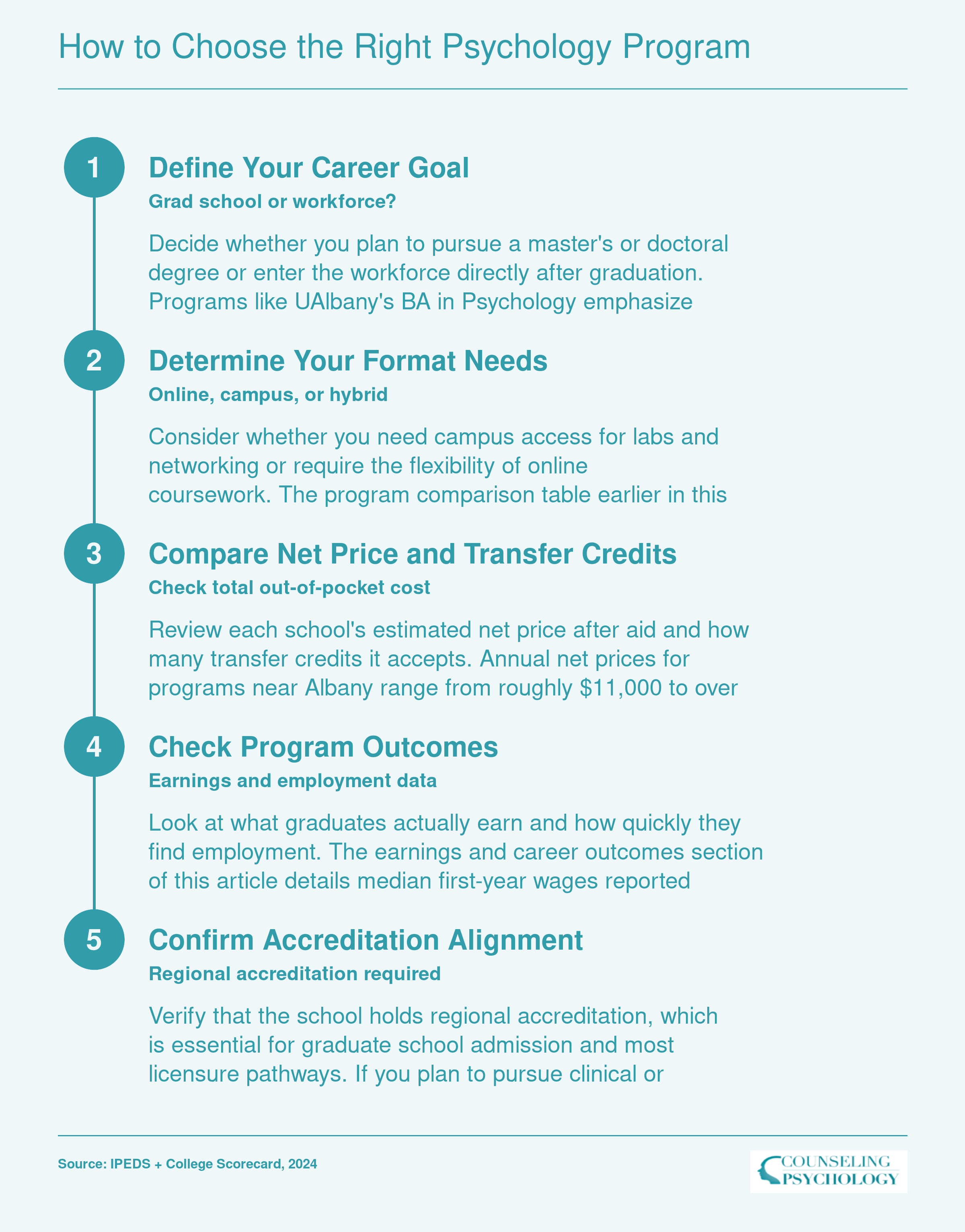
How to Choose the Right Psychology Program
Picking the best bachelor's in psychology near Albany means more than comparing rankings. Use this five-step framework to match a program to your actual career goals, budget, and learning style.
Frequently Asked Questions About Psychology Programs Near Albany
Prospective psychology students in the Albany area tend to ask many of the same questions about cost, format, and career potential. Below are concise, data-grounded answers to the questions we hear most often.
More Psychology Bachelor's Programs Near Albany to Consider
Beyond the top-ranked programs, several other schools in New York offer quality psychology bachelor's degrees worth exploring. These additional options span the state from the Capital Region to Long Island, providing a range of formats and specializations.
Capital Region
- Bachelor of Arts in Psychology
- Psychology
Central New York
- Psychology
- Psychology (B.S.)
- Psychology
- Psychology
- Psychology
- Psychology (Mental Health)
- Psychology (Social-Industrial Psychology)
- Psychology (General Experimental Psychology)
Western New York
- Psychology
- Psychology
Hudson Valley
- B.A. in Psychology
New York City
- Psychology
- Psychology
- Psychology
Long Island
- BS in Psychology
- Psychology
- Psychology (B.A.)
- Psychology (B.S.)
- Psychology