What you’ll learn in this article…
- Portland-area advanced standing MSW programs require 30 to 46 credits and can be completed in roughly one year.
- Choosing advanced standing over a traditional track can save more than $20,000 in tuition at Oregon public universities.
- The Portland metro area's median annual wage for mental health and substance abuse social workers was $62,290 as of May 2023.
- Oregon LCSW licensure typically takes two to three years of supervised postgraduate clinical experience after earning the MSW.
BSW holders in Oregon can complete an advanced standing MSW in as few as eight months and for as little as $15,920 in total tuition, compared to two years and $35,000 or more for a traditional track. The difference is meaningful: you shave off a year of study, enter clinical practice sooner, and begin accruing the supervised hours required for Oregon LCSW licensure earlier.
Only three CSWE-accredited programs near Portland offer the advanced standing pathway in 2026: Portland State University, George Fox University, and Pacific University. Each targets BSW graduates with distinct formats (campus-based, fully online, and hybrid) and tuition ranges from roughly $16,000 to $40,000. Admission is competitive, with most programs requiring a minimum 3.0 undergraduate GPA, a BSW earned within the past five years, and evidence of generalist field competence.
Portland's job market for LCSW and macro social workers remains tight but growing, and starting salaries for MSW graduates typically range from $50,000 to $65,000 depending on setting and specialization. Advanced standing students enter that market a full year ahead of their traditional-track peers, a timing advantage that compounds over a career.
Top Advanced Standing MSW Programs Near Portland, Oregon
Portland and the surrounding region offer a small but focused selection of CSWE-accredited advanced standing MSW programs, each with a distinct delivery format and cost profile. Whether you prefer an affordable public university, a fully online faith-based option, or a private campus program with unique elective tracks, the programs below cover the range. All graduation rates listed are institution-wide figures, not specific to individual MSW programs.
- Institutional graduation and retention rates
- Net price and student debt levels
- Program delivery format and flexibility
- Field placement structure and options
- Regional relevance to Portland area
- NCES-IPEDS federal institutional data — nces.ed.gov
- Internal program database
- College Scorecard graduate earnings — collegescorecard.ed.gov
- Independent program research

Portland State University
Portland State University is the only public research university in the Portland metro area offering an advanced standing MSW, and it stands out as the first school in the Pacific Northwest to launch a fully online MSW option. With both a campus-based and an online track available, BSW holders can choose the format that fits their schedule while benefiting from the lowest net price on this list ($9,552). PSU also accepts transfer applicants from other accredited MSW programs, a flexibility most competitors do not offer.
- 46 credits required across a four-term course of study
- Two concentrations: Advanced Macro Practice or Advanced Clinical Practice
- 16-hour weekly field placement integrated into coursework
- BSW from a CSWE-accredited program required for admission
- Curriculum emphasizes social justice and advanced research
- Prepares graduates for leadership roles in social work
- Fully online format with blended in-person options available
- Completion in four to five terms depending on pace
- Advanced Macro or Advanced Clinical concentration tracks
- 500-hour internship requirement fulfilled locally
- CSWE-accredited with flexible scheduling for working professionals
- Financial aid available; institution-wide graduation rate of 52.7%
- Available in 49 states, excluding Colorado
MSW Advanced Standing (Campus) — On-Campus
MSW Advanced Standing (Online) — On-Campus

George Fox University
George Fox University, a private institution based in Newberg, delivers its advanced standing MSW entirely online and can be completed in as little as 8 months or stretched to 20 months. The program is CSWE-accredited and places strong emphasis on generalist practice skills, making it a solid pick for BSW graduates who want to keep working while earning their master's. George Fox also maintains a Portland Center campus for students who value periodic access to a physical location in the metro area.
- Accelerated completion timeline of 8 to 20 months
- Fully online format with CSWE accreditation
- Minimum 3.0 GPA in social work courses required
- Academic and professional references needed for admission
- International student applications accepted
- Focus on generalist practice skills and field evaluation
- Portland Center campus available for local students
- Institution-wide graduation rate of 72%
Master of Social Work Advanced Standing (Online) — Online

Pacific University
Pacific University in Forest Grove offers an advanced standing MSW that can be completed in as little as one year, with the option to take coursework online or in person. What sets Pacific apart is its specialized electives, including Play Therapy, Animal Assisted Human Health, and Latino Family and Culture, alongside core courses in Mental Health Diagnosis and Management and Leadership in Social Work. Students complete two advanced field practicum placements in Oregon or Southwest Washington, and the 10:1 student-to-faculty ratio ensures close mentorship.
- Accelerated one-year completion for full-time students
- Online or in-person coursework options available
- CSWE-accredited with flexible part-time scheduling
- Electives include Play Therapy and Animal Assisted Human Health
- Two advanced field practicum placements in Oregon or SW Washington
- Includes management and leadership training coursework
- 10:1 student-to-faculty ratio for personalized support
- Institution-wide graduation rate of 67%
MSW Advanced Standing — On-Campus
Advanced Standing vs. Traditional MSW: Cost, Credits, and Timeline in Oregon
Choosing between an advanced standing and a traditional MSW track comes down to how many foundational credits your BSW already covers. Advanced standing programs typically require 30 to 46 credits and can be completed in roughly one year, while traditional tracks run 62 to 78 credits over two years. Below is a side-by-side look at the three Portland-area schools offering both pathways, so you can weigh the time and tuition savings for yourself.
| School | Track | Approximate Credits | Estimated Full-Time Timeline | Published Annual Tuition (In-State / Out-of-State) |
|---|---|---|---|---|
| Portland State University | Traditional MSW | 78 credits | 24 months | $17,745 / $23,334 |
| Portland State University | Advanced Standing MSW | 46 credits | About 12 months (four terms) | $17,745 / $23,334 per year (roughly half the total cost of the traditional track) |
| George Fox University | Traditional MSW | 62 credits | 24 months | $15,920 (same for all students) |
| George Fox University | Advanced Standing MSW | Approximately 30 to 39 credits (accelerated curriculum) | 8 to 20 months | $15,920 per year (total tuition reduced proportionally by fewer credits) |
| Pacific University | Traditional MSW | 62 credits | 24 months | $39,938 (same for all students) |
| Pacific University | Advanced Standing MSW | Fewer than 62 credits (accelerated one-year format) | About 12 months | $39,938 per year (roughly one year of tuition rather than two) |
Questions to Ask Yourself
Admissions Requirements for Portland-Area Advanced Standing MSW Programs
Admissions requirements for advanced standing MSW programs determine whether you can skip foundation coursework and move directly into concentration study. Because these tracks are designed for applicants who already hold a bachelor's in social work, eligibility hinges on a combination of your degree's accreditation, academic record, recency of your BSW, and, at some schools, specific field or human service experience.
Standard Eligibility for Advanced Standing
Most Portland-area programs share a core set of expectations. You need a Bachelor of Social Work from a program accredited by the Council on Social Work Education (CSWE). A minimum cumulative GPA of 3.0 is common, though some schools will consider applicants with slightly lower GPAs if other application materials are strong. Your BSW must be recent, typically earned within the last five to six years, to ensure your foundational knowledge is current. A few programs also look for completed field practicum hours during your BSW; George Fox University, for example, requires at least 400 supervised field hours.2
School-Specific Variations
- Portland State University expects a CSWE-accredited BSW earned within the last five years and a recommended 3.0 GPA.1 GRE scores are not required, but the program does ask for 2,000 hours of paid or volunteer human service experience. If your BSW is older than five years, you may need to discuss your circumstances with the program to explore possible exceptions, though no formal bridge is published.
- Pacific University also has a five-year recency window and does not require the GRE. For BSW holders whose degree falls outside that window, a bridge pathway is available: candidates can demonstrate continued professional practice and complete continuing education to update their foundation.2 This makes Pacific a flexible option for social workers who have been in the field but need to refresh their academic preparation.
- George Fox University extends its recency window to six years and sets a firm 3.0 minimum GPA. The GRE is waived for applicants who meet eligibility criteria. A distinctive bridge requirement exists for those whose BSW is older: you submit a case study and petition for faculty review, which illustrates applied practice and readiness for graduate work. The program also mandates 400 hours of prior field experience.2
- University of Portland is often listed among regional options, but as of the 2025 to 2026 cycle its MSW program lacks CSWE accreditation, meaning it does not offer an advanced standing track.2 Applicants should verify current accreditation status before considering this school for social work licensure pathways.
Application Components
Expect to submit a personal statement or essay that articulates your practice interests and alignment with the program's mission. Two to three letters of recommendation are standard, typically from academic sources or field supervisors who can speak to your readiness for graduate study. A professional resume is required, and the GRE is universally waived or not required among Portland's accredited advanced standing options, so you can focus your preparation elsewhere. International applicants with a BSW earned outside the United States must also provide a credential evaluation, a step often overlooked, to confirm CSWE equivalency.
A Note for International BSW Holders
If your BSW was earned abroad, you will need a credential evaluation from an approved service to verify that your degree meets CSWE standards. This process can take several weeks, so begin early. Without it, programs cannot determine your advanced standing eligibility, and you may be required to apply to the traditional track instead.
Field Placement Opportunities for MSW Students in Portland
Traditional MSW students complete two distinct field placements totaling 1,000 hours, while advanced standing students streamline into a single intensive placement.1 This contrast shapes how you integrate real-world practice into your degree, and Portland offers a remarkably dense network of sites for both paths.
Types of Placement Sites in Portland
The Portland metro area hosts placements across the full spectrum of social work settings. Students gain experience in acute care settings like OHSU and Providence Health, community mental health agencies such as LifeWorks NW, school-based roles with Portland Public Schools, child welfare practice through the Oregon Department of Human Services, and veteran-focused services at the VA Portland Health Care System.2 Portland State University alone maintains partnerships with over 500 organizations and places roughly 700 students each year, ensuring that specializations from clinical mental health to macro-level policy all have viable site options.3 Students interested in child welfare placements may also want to explore pathways such as child abuse counselor education.
Arranging Practicums as an Online or Hybrid Student
Online and hybrid MSW programs in Oregon, including the CSWE-accredited online track at Portland State, use a school-assisted placement model.3 While the field office helps identify and vet potential sites, you can also propose a local agency if it meets program criteria. George Fox University and Pacific University offer campus-based and some hybrid formats, and both support students proposing practicum sites within their communities.1 All Portland-area programs require field supervisors to hold an MSW with at least two years of post-degree experience, ensuring quality mentorship.3
Advanced Standing Field Requirements
Advanced standing students bypass the foundation-year practicum, completing a single concentrated placement that typically runs 500 to 600 hours. For example, Portland State's online advanced standing track requires 500 hours, while traditional students complete 1,000 hours across two placements.1 This tighter field experience demands more focused skill development, often in the same type of setting where you plan to work post-graduation. Programs still guide you through placement selection, but the compressed timeline makes early networking and site research essential.
Key Portland-Area Employer Partners
Beyond the agencies already mentioned, several partners consistently host MSW interns. Oregon Health & Science University serves as a major practicum hub for medical social work. Portland Public Schools and surrounding districts welcome school social work interns.4 The Oregon Department of Human Services Child Welfare division offers hands-on child protective services experience, and the VA Portland Health Care System provides specialized training in veteran mental health.2 Community-based organizations like LifeWorks NW give students direct practice in mental health and addiction services across the lifespan.
Related Articles
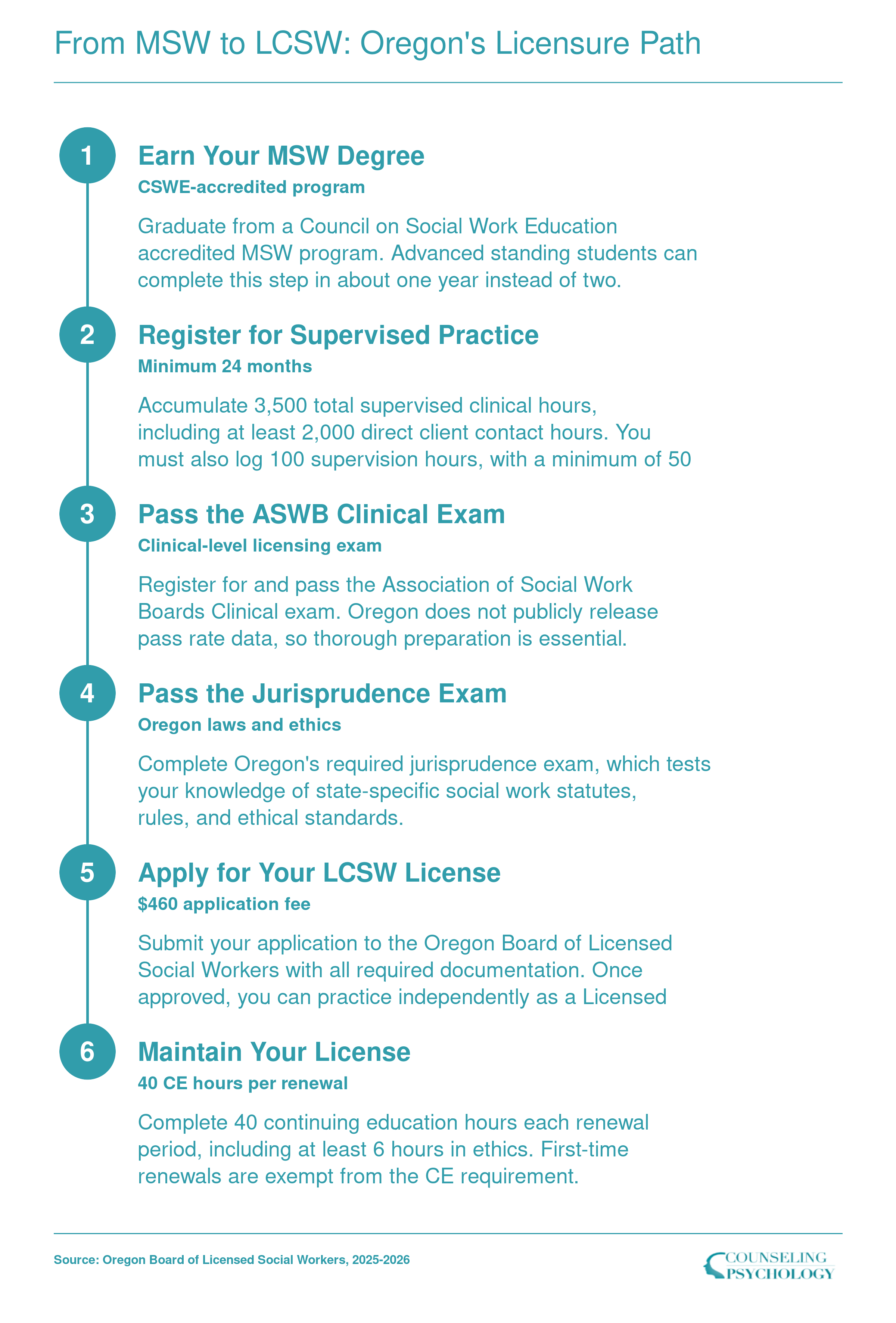
From MSW to LCSW: Oregon's Licensure Path
Earning your MSW is the starting line, not the finish. Oregon's path to full clinical licensure (LCSW) requires a structured sequence of postgraduate experience, exams, and state approval. Plan on roughly two to three years from graduation to independent clinical practice.
Career Outcomes and Earnings for MSW Graduates in Portland
Portland's social work job market rewards specialization, and the numbers from the Bureau of Labor Statistics back that up. The figures below come from the May 2023 Occupational Employment and Wages report for the Portland-Vancouver-Hillsboro OR-WA metropolitan area, which remains the most recently published MSA-level data available.1
What Social Workers Actually Earn in the Portland Metro
Across the three primary social work occupations tracked by BLS, healthcare social work commands the strongest wages in this metro:
- Healthcare social workers (SOC 21-1022): Median annual wage of $71,350, with the top 10 percent earning $93,460 or more. About 1,530 workers held these roles in the metro.1
- Child, family, and school social workers (SOC 21-1021): Median of $62,580 annually, ranging from $40,080 at the entry end to $87,470 for experienced practitioners. This is the largest segment, with roughly 2,280 employed locally.1
- Mental health and substance abuse social workers (SOC 21-1023): Median of $60,250, with a 90th-percentile ceiling of $79,920. Approximately 1,320 people work in this category across the metro.1
These are metro-area figures specific to the Portland-Vancouver-Hillsboro MSA, not national medians, so they reflect local employer demand and Oregon's cost of living.
Program-Level Earnings Data
Program-specific earnings outcomes for the advanced standing MSW programs featured in this article are not yet available through federal reporting systems. That means early-career salary comparisons at the program level cannot be made at this time. The BLS metro data above provides the most reliable earnings context for planning purposes.
Debt, Specialization, and ROI
With median graduate debt ranging from roughly $20,500 at Portland State University to $24,250 at George Fox University, the gap between what you borrow and what you can expect to earn closes relatively quickly in healthcare or school-based roles. A graduate entering healthcare social work at the metro median of $71,350 while carrying $20,500 in debt is in a meaningfully different position than one carrying $40,000 in loans at a starting wage in the low $40,000s.
Specialization matters beyond the paycheck. Portland faces persistent shortages in behavioral health, child welfare, and school social work. Candidates with field placements and coursework aligned to those areas routinely move into positions faster and at higher starting salaries than generalist graduates. For those interested in the substance abuse side of behavioral health, exploring online addiction counseling degrees can provide additional credentialing options. If earning potential is a priority, pairing an advanced standing program with a healthcare or behavioral health concentration is worth serious consideration.
Advanced standing cuts MSW credits nearly in half, saving thousands in tuition and eliminating a full year of foregone income. In Oregon, public university programs often show a difference exceeding $20,000 in direct costs, plus a head start on earning. That's a compelling financial edge.
Financial Aid and Scholarships for Oregon MSW Students
Graduate social work funding in Oregon has grown more varied in recent years, with federal workforce initiatives, state child welfare partnerships, and institution-level awards all competing for students' attention. The challenge is knowing where to look and when to apply, because deadlines and eligibility rules differ sharply across sources.
School-Specific Scholarships and Aid
Start with the financial aid pages of each program you are considering. Portland State University, University of Portland, George Fox University, and Pacific University all maintain their own MSW scholarship pools, and the amounts, criteria, and deadlines vary from one school to the next. At Portland State, the advanced standing track runs roughly $29,226 in total tuition for Oregon residents (2025-2026), compared to nearly $49,158 for the two-year traditional plan, so each scholarship dollar you secure on the shorter track stretches further.1 Contact each school's admissions or financial aid office directly to confirm 2025-2026 deadlines, because some application windows open as early as fall 2024.
Oregon Child Welfare Training Stipends
The Oregon Child Welfare Training Project (OCWTP) and Title IV-E child welfare stipends are among the most substantial funding options for MSW students committed to public child welfare careers. These stipends are typically managed through partnerships between the Oregon Department of Human Services and participating universities, so your first step is to visit the DHS Child Welfare website or speak with your MSW program's field education coordinator. Recipients generally agree to work in Oregon's child welfare system for a defined period after graduation. If that career path aligns with your goals, these stipends can offset a significant share of your tuition.
Federal Workforce Grants and Professional Associations
The Health Resources and Services Administration (HRSA) funds Behavioral Health Workforce Education and Training (BHWET) grants that sometimes flow through Oregon MSW programs. These grants support students training in underserved behavioral health settings and may cover tuition, stipends, or both. Search the HRSA website for currently funded projects in Oregon, or ask your program's grants office whether they hold an active BHWET award. Beyond federal sources, check the NASW Oregon Chapter for state-specific scholarship listings geared toward social work students. If you are also weighing related helping professions, reviewing counseling programs in Oregon can help you compare financial aid packages across disciplines.
Stay Ahead of the Calendar
Aid cycles for the 2025-2026 academic year may open well before you start classes. Set calendar reminders for each school's priority deadlines, and reach out to program directors proactively to request a full inventory of available funding. Some awards are not widely advertised on websites and only surface when you ask. A single email to a financial aid counselor can reveal assistantships, emergency grants, or donor-funded awards that never make it onto a public listing page.
How to Choose the Right Advanced Standing MSW Program
Choosing the right advanced standing MSW program near Portland means weighing your clinical or macro career goals, your preferred learning format, and how much you can invest. Each decision point carries real tradeoffs that shape your professional trajectory and financial outlook.
Pros
- Clinical track programs align well with Portland's high demand for licensed therapists in community mental health and hospital settings.
- Macro or community practice tracks open doors to policy, nonprofit leadership, and systems advocacy roles across Oregon's social service landscape.
- Online and hybrid formats let working BSW graduates maintain employment while completing coursework on a compressed timeline.
- Lower cost public university programs, such as those in the state system, significantly reduce student debt relative to private alternatives.
- On campus cohort models build strong peer networks and direct relationships with faculty, which can accelerate job placement after graduation.
- Private programs sometimes offer tighter field placement partnerships with specialized Portland agencies, giving students access to niche clinical populations.
Cons
- Clinical tracks may require additional supervised hours post graduation before you qualify for LCSW licensure, extending your timeline to independent practice.
- Macro tracks can feel limiting if you later decide to pursue clinical licensure, since you may need supplemental coursework or practicum hours.
- Fully online programs reduce face to face networking, which matters in a relationship driven field like social work.
- Public programs may have larger cohorts and fewer individualized advising resources, which can make navigating field placements more challenging.
- Private programs carry higher tuition, and stronger placement networks do not always translate into proportionally better salary outcomes.
- Hybrid formats require careful scheduling, and some students find the mix of modalities harder to manage than a single consistent format.
Frequently Asked Questions About Advanced Standing MSW Programs in Oregon
Choosing an advanced standing MSW program involves sorting through details on timelines, costs, and career options. Below are answers to the questions prospective students ask most often about Portland-area programs.