

What you’ll learn in this article…
- Arizona has no campus-based IO psychology doctorate in 2026, leaving one fully online option statewide.
- The BLS reports a national median wage of $147,420 for IO psychologists, though Arizona-specific figures are not published.
- Fully funded clinical Ph.D. programs at UA and ASU cover tuition plus stipends, while PsyD students typically carry significant debt.
- IO psychology Ph.D. holders are currently ineligible for Arizona psychologist licensure under Board of Psychologist Examiners rules.
Research-intensive Ph.D. programs and practitioner-focused PsyD tracks lead to the same licensure endpoint in Arizona, yet the training, funding, and career trajectories diverge sharply. Tucson sits roughly 100 miles from the Mexico border, giving doctoral students access to underserved border communities, tribal nations, and a bilingual patient population that few U.S. metro areas can match for clinical diversity.
The University of Arizona anchors local options with an APA-accredited clinical psychology Ph.D., while ASU Tempe, Northern Arizona University, and Midwestern University-Glendale round out the state's doctoral landscape. Industrial-organizational psychology doctorates are not offered on any Arizona campus. Students exploring counseling psychology phd programs or clinical tracks will find that employer demand across healthcare systems and defense contractors continues to outpace the supply of licensed psychologists statewide.
Best Ph.D. in Psychology Programs Near Tucson at a Glance
Arizona offers a small but distinct set of doctoral psychology programs, each with a different training model, cost structure, and regional mission. The four programs below span research-intensive clinical Ph.D.s at two flagship universities, a practitioner-focused PsyD in Flagstaff, and a private PsyD with an interprofessional health-sciences campus in the Phoenix metro. Because most Ph.D. students at ASU and the University of Arizona receive full tuition waivers and stipends, the sticker-price tuition figures matter far less for those programs than they do for the PsyD options, where out-of-pocket cost is a bigger consideration. Program-level earnings and debt figures are not yet available for these specific doctoral tracks, so the institution-wide medians listed below provide the best current comparison point.
- Tuition and net price
- Institution-wide graduation rate
- Program accreditation and funding
- Regional training partnerships
- Specialization and concentration depth
- NCES-IPEDS federal institutional data — nces.ed.gov
- College Scorecard graduate earnings — collegescorecard.ed.gov
- Internal program database
- Independent program research

Arizona State University
Arizona State University pairs a research-intensive Clinical Psychology Ph.D. with deep ties to Phoenix-area medical centers, VA systems, and community agencies serving Latinx and Native American populations. Schools offering this program have a graduation rate of about 68%, and ASU reports institution-wide median graduate debt of $19,500 alongside median earnings of roughly $62,668 ten years after enrollment. The clinical Ph.D. is fully funded for admitted students, with multi-year tuition waivers and TA/RA stipends that make the listed in-state tuition of $13,587 (or $27,521 out-of-state) largely a formality for doctoral trainees.
- Clinical Psychology concentration with PCSAS accreditation
- Fully funded with tuition waiver and annual stipend
- Faculty labs spanning trauma, cultural psychology, and child disorders
- Practicum sites across Phoenix-area hospitals and VA facilities
- JD-Ph.D. dual option with ASU's Sandra Day O'Connor College of Law
- Strong emphasis on Southwest and border-region community health
- Training oriented toward evidence-based integrated care settings
Clinical Psychology Ph.D. — On-Campus

University of Arizona
The University of Arizona is the only program on this list physically located in Tucson, giving students direct access to borderlands research and clinical training with bilingual, Indigenous, and rural populations across southern Arizona. The institution-wide graduation rate sits at roughly 68%, with a median graduate debt of $19,620 and median earnings around $59,979 at the ten-year mark. Like ASU, the Clinical Psychology Ph.D. is APA- and PCSAS-accredited and generally fully funded, so in-state tuition of $14,856 and out-of-state tuition of $34,110 rarely reflect what doctoral students actually pay.
- APA-accredited and PCSAS-accredited clinical science program
- Specialization tracks in health psychology, neuropsychology, and intervention science
- Practicum training at Banner University Medical Center Tucson and community clinics
- Faculty research addressing Latinx, Indigenous, and rural Arizona health disparities
- Academy of Psychological Clinical Science charter member
- Generalist foundation supporting diverse post-doctoral career paths
- Collaborative ties with tribal nations and southern Arizona counties
Clinical Psychology Ph.D. — On-Campus

Northern Arizona University
Northern Arizona University's PsyD in Clinical Psychology is built around a practitioner-scholar model that emphasizes culturally responsive service to rural, tribal, and underserved communities across the Colorado Plateau. Schools offering this program have a graduation rate of about 61%, with institution-wide median graduate debt of $19,000 and median earnings near $54,384 ten years out. Because PsyD funding is more limited than at the state's Ph.D. programs, the difference between NAU's in-state tuition of $13,023 and its out-of-state rate of $19,306 carries real financial weight for applicants.
- 107-unit practitioner-scholar curriculum with 2,000 clinical hours
- Practicum placements at Flagstaff Medical Center and tribal health services
- Mission-driven focus on northern Arizona and frontier mental health workforce
- Culturally responsive training aligned with Arizona demographic context
- Accepts applicants with a bachelor's or master's degree (3.0 GPA minimum)
- Clear professional licensure pathway for Arizona practice
- Emphasis on ethical, socially just clinical service delivery
Doctor of Psychology (PsyD) in Clinical Psychology — On-Campus

Midwestern University-Glendale
Midwestern University's Glendale campus houses an APA-accredited PsyD in Clinical Psychology with an optional neuropsychology concentration, all set within a broader health-sciences university that includes medical, pharmacy, and allied-health programs. As a private institution, tuition is a flat $49,369 regardless of residency, and institution-wide graduation rate and debt data are not publicly reported in the same way as for Arizona's public universities. The program's 90-plus practicum sites across the Phoenix metro area and its interprofessional campus make it a distinctive, if costlier, option for students who want clinical training embedded in a healthcare ecosystem.
- APA-accredited four-year full-time PsyD program
- 90+ practicum sites across the greater Phoenix area
- Small cohort sizes with individualized faculty mentorship
- Interprofessional education alongside medical and allied-health students
- 3.0 minimum undergraduate GPA required for admission
- Practitioner-scholar model with faculty-mentored research
- Five-year track within the existing PsyD, not a separate degree
- Four specialized neuropsychology courses beyond core curriculum
- Two year-long neuropsychology practica in rehab and VA settings
- Dissertation required on a neuropsychology-specific topic
- Aligned with APA Division 40 training guidelines
- Addresses Arizona's growing demand for clinical neuropsychologists
Doctor of Clinical Psychology (PsyD) — On-Campus
Doctor of Clinical Psychology (PsyD), Neuropsychology Concentration — On-Campus
Why Tucson and Southern Arizona for a Psychology Doctorate
Doctoral training in psychology has shifted noticeably toward applied, community-embedded practicum models, and Tucson is unusually well positioned to deliver them. The city sits at the intersection of a major research university, a sprawling federal and defense footprint, and a population whose demographics align with the cultural competencies licensing boards and APA accreditors increasingly expect doctoral graduates to demonstrate.
Clinical and Research Settings You Can Actually Reach
The Southern Arizona VA Health Care System, the Banner-University Medical Center network, and Davis-Monthan Air Force Base give doctoral students access to clinical populations and organizational research sites that smaller metros simply cannot match. Counseling and clinical Ph.D. students rotate through trauma, integrated primary care, and rural telehealth contexts. For industrial-organizational students, the University of Arizona's own Human Resources and Organizational Effectiveness office serves as a practicum site2, and Raytheon Missiles and Defense, headquartered in Tucson, is among the largest single employers of IO-adjacent talent in the state.1 Phoenix adds Honeywell Aerospace, Amazon operations, and state agency consulting work within a two-hour drive. Students interested in the broader discipline may also want to explore an industrial organizational psychology bachelor degree as a foundation before pursuing doctoral-level IO work.
Cultural Competency as a Training Asset
The University of Arizona's status as a Hispanic-Serving Institution is more than a designation. Roughly 30% of Pima County residents identify as Hispanic or Latino, and the region includes the Tohono O'odham Nation and Pascua Yaqui Tribe. Doctoral students routinely work with Spanish-speaking clients and Indigenous communities, building the kind of supervised cross-cultural hours that strengthen internship match applications and licensure files.
A Practical Cost Advantage for Funded Students
Tucson's cost of living runs meaningfully below Phoenix and well below coastal doctoral-program cities. For students on a funded stipend, typically $20,000 to $30,000 annually in counseling and clinical Ph.D. programs, that gap matters. Rent, in particular, is roughly 15 to 25 percent lower than in central Phoenix, which makes a five-to-seven-year doctoral timeline financially survivable without heavy loan reliance. Those drawn to community-centered, applied psychology phd programs will find Tucson's affordability especially compelling alongside its rich practicum landscape.
Industrial-Organizational Psychology Ph.D. Options in Arizona
Arizona has no campus-based Ph.D. or PsyD program dedicated to industrial-organizational psychology in 2026. Students who want a doctorate in IO from an Arizona-affiliated institution have exactly one option, and it is fully online. Everything else stops at the master's level.
What Arizona's Major Universities Actually Offer
Here is the current landscape across the four institutions students ask about most:
- Arizona State University: No IO Ph.D. and no IO concentration inside its general psychology Ph.D.1 The doctoral program covers behavioral neuroscience, clinical, cognitive, developmental, quantitative methods, and social psychology. IO at ASU lives at the bachelor's and master's level, including an online BA, online BS, an online 30-credit MS, and an online graduate certificate in IO psychology.2
- University of Arizona: No IO doctorate and no IO concentration. The psychology Ph.D. offers three areas: Clinical, Cognition and Neural Systems, and Social and Personality.3
- Northern Arizona University: No dedicated IO Ph.D. or PsyD.4
- Grand Canyon University: No IO doctorate. GCU does offer an MS in Psychology with an Industrial and Organizational Psychology emphasis, and it is the only Arizona program currently listed in the SIOP graduate program directory (at the master's level).4
- University of Arizona Global Campus: Offers a PsyD with an Industrial-Organizational Psychology specialization, delivered fully online. UAGC operates separately from the University of Arizona main campus.5
SIOP-Aligned IO Doctorate vs. General Psych Ph.D. with IO Coursework
This distinction matters more than students often realize. A SIOP-aligned IO Ph.D. is built around the Society for Industrial and Organizational Psychology's recommended competencies: job analysis, personnel selection, performance management, training, leadership, organizational development, and applied statistics tied directly to workplace problems. Graduates go into consulting firms, internal talent analytics roles, and applied research.
A general experimental or applied psychology Ph.D. that happens to include an IO course or two does not produce the same career profile. Employers hiring for IO roles, especially in selection and assessment, look for advisors with active IO research programs and practicum placements with HR consultancies. Arizona's current Ph.D. offerings do not deliver that pipeline.
Out-of-State and Online Alternatives
Arizona residents who want a SIOP-recognized doctorate routinely look out of state. Common alternatives include traditional IO Ph.D. programs at universities such as Colorado State, the University of Houston, Portland State, and Pennsylvania State, plus online or hybrid doctorates from regionally accredited schools. Students still weighing their options at the master's level can compare industrial organizational psychology master's programs online to determine whether a terminal master's meets their career goals. For those exploring shorter credentials first, an industrial organizational psychology certificate can signal foundational competence while you finalize doctoral plans. Always verify SIOP recognition and program format before applying, since IO doctoral training quality varies widely once you leave the small group of established programs.
Related Articles
Ph.D. vs. PsyD in Psychology: Which Path Fits Your IO or Counseling Career?
Choosing between a Ph.D. and a PsyD shapes nearly every dimension of your doctoral experience, from daily workload to long-term career trajectory. The distinction matters especially in Arizona, where both degrees can qualify graduates for psychologist licensure, yet the two paths serve different professional endpoints. For students weighing industrial-organizational (IO) psychology against counseling or clinical practice, the comparison below highlights the factors that should drive your decision.
| Dimension | Ph.D. in Psychology | PsyD in Psychology |
|---|---|---|
| Training focus | Heavy emphasis on research design, statistics, and teaching preparation; dissertation is the capstone milestone | Practitioner oriented, with the majority of training hours spent on direct client application and supervised clinical work |
| Typical time to degree | 5 to 8 years, largely because of dissertation research timelines | 4 to 6 years, with a structured curriculum that moves students through more quickly |
| Acceptance rate and cohort size | Roughly 13% acceptance rate; cohorts of about 10 or fewer students per year | Approximately 40% acceptance rate; cohorts can reach up to 100 students per year |
| Funding availability | Many Ph.D. programs offer tuition waivers and stipends through assistantships or fellowships, especially at research universities | Full funding is less common; most PsyD students finance their degree through loans or partial scholarships |
| Primary career trajectories | Research, academia, consulting, and IO psychology roles in corporate or government settings | Clinical practice, therapy, counseling centers, and healthcare systems |
| IO psychology relevance | The standard credential for IO psychologists; most IO roles in talent analytics, organizational consulting, and workforce research expect a Ph.D. | Rarely pursued for IO careers; the PsyD curriculum does not typically include the quantitative and organizational research training IO employers require |
| Arizona licensure eligibility | Fully eligible for licensure through the Arizona Board of Psychologist Examiners, though many IO Ph.D. graduates choose not to pursue clinical licensure because their work (e.g., selection systems, organizational development) does not involve direct patient care | Also fully eligible for Arizona licensure, and most PsyD graduates do pursue it because their careers center on clinical or counseling services that require a license |
| Employer perception in applied settings | Preferred for positions that blend data analysis with organizational strategy; viewed as the research expert in interdisciplinary teams | Valued in clinical hiring for depth of supervised client hours; seen as practice ready from day one in therapy and assessment roles |
Questions to Ask Yourself
Tuition, Funding, and ROI for Psychology Doctorates Near Tucson
The table below compares published tuition rates, institution-level median graduate debt, and ten-year median earnings for the three Arizona public universities that offer psychology doctorates accessible to Tucson-area students. A few important caveats: the net price figures shown are approximate institution-wide averages drawn from federal data, not guaranteed doctoral price tags. Fully funded Ph.D. students at ASU and the University of Arizona typically pay no tuition at all, so their actual out-of-pocket cost can be dramatically lower than the sticker prices listed here. Program-level earnings and debt figures specific to these doctoral programs are not yet available in federal reporting, so institution-wide medians are provided as a general reference point.
| University | Listed In-State Tuition | Listed Out-of-State Tuition | Approx. Institution-Level Net Price | Institution Median Graduate Debt | Institution Median Earnings (10 yr) | Doctoral Funding Model | Notes on Full Funding |
|---|---|---|---|---|---|---|---|
| University of Arizona (Tucson) | $14,856 | $34,110 | ~$16,674 | $19,620 | $59,979 | Full tuition waiver plus RA/TA stipend, health insurance included | Psychology Ph.D. students receive automatic multi-year funding while in good standing; College of Science fellowship adds up to $8,000/yr for two years. School Psychology Ph.D. funding is not guaranteed. |
| Arizona State University (Tempe) | $13,587 | $27,521 | ~$14,967 | $19,500 | $62,668 | Full tuition waiver plus 0.50 FTE assistantship | Psychology Ph.D. stipend of $26,544 for a 9-month academic year; multi-year support while in good standing. Internal awards (Graduate Scholar Awards) and external fellowships (NSF GRFP, NIH NRSA) also available. |
| Northern Arizona University (Flagstaff) | $13,023 | $19,306 | ~$14,158 | $19,000 | $54,384 | Tuition-driven PsyD model | NAU offers a PsyD rather than a Ph.D.; full funding packages comparable to the research universities above are not advertised. Students should budget closer to the listed tuition rates. |
What IO Psychologists and Psychology Ph.D. Graduates Earn in Arizona
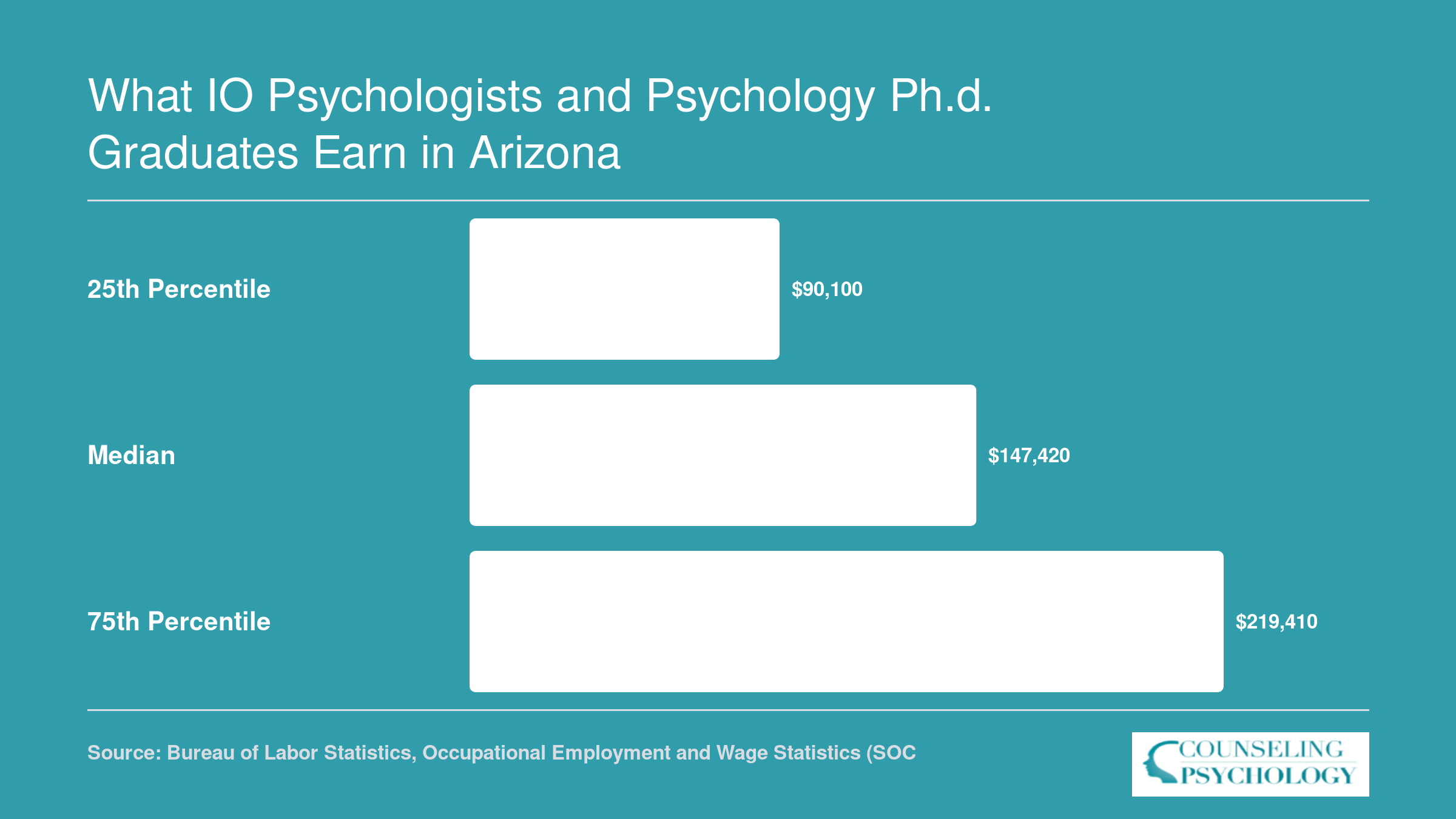
Industrial-organizational psychology ranks among the highest-paying psychology specializations in the country. The BLS reports a national median annual wage of $147,420 for IO psychologists (2023 data). Arizona-specific metro-level wage estimates for this niche occupation are not published separately by the BLS due to small sample sizes, so candidates should benchmark against the national figures below. Program-level post-completion earnings for Arizona doctoral programs in psychology are not yet available through federal reporting, but the national occupational data still offers a useful reference point for long-term earning potential.
Admissions Requirements and Competitiveness for AZ Psychology Doctorates
Getting into a psychology doctoral program at a research university is a competitive, multi-step process, and the specific requirements at each school shift more often than most applicants expect. What applied last cycle may not apply this one.
GPA, Test Scores, and Application Materials
Most psychology Ph.D. programs in Arizona have historically looked for a minimum undergraduate GPA in the range of 3.0 to 3.5, though competitive applicants typically land well above the floor. GRE policy is one area where you cannot rely on secondhand information. Both the University of Arizona and Arizona State University have updated their testing requirements in recent cycles, with some programs moving toward test-optional admissions while others retain the GRE. Check the current "Graduate Admissions" or "How to Apply" page on each department's official website before preparing your application materials, because these policies can change from one admissions cycle to the next.
Letters of recommendation are universally required, and most programs ask for three. The quality and relevance of those letters, particularly from faculty who can speak to your research experience, tend to matter more than the number. Statements of purpose are expected to go beyond personal narrative. Reviewers want to see that you have identified faculty whose current research aligns with your interests and that you can articulate a coherent research direction of your own.
Cohort Sizes and Acceptance Rates
Acceptance rates and cohort sizes for psychology doctoral programs are rarely published on department websites. This is one area where reaching out directly to the graduate program coordinator by email or phone is genuinely worth your time. Program coordinators can often tell you how many students were admitted in a recent cycle, what the incoming cohort looks like, and whether the program anticipates any changes in capacity. That conversation also puts your name in front of the department before your application arrives.
Using Professional Associations as a Baseline
The American Psychological Association publishes guidance on what doctoral programs generally expect, including typical application components and how research fit is evaluated. That framework is useful for calibrating your preparation whether you are pursuing a clinical track, a cognitive psychology phd, or an industrial organizational psychology phd. For salary and career outlook context, the Bureau of Labor Statistics at BLS.gov provides national occupational data for psychologists. Neither source replaces the admissions details on each school's own site, but together they give you a realistic picture of what you are preparing for and why it matters.
In Arizona, the title "psychologist" is legally protected by the Board of Psychologist Examiners. Industrial-organizational Ph.D. holders who want to use that title must meet the board's supervised experience and examination requirements. However, many IO practitioners work in consulting, corporate, or research roles under titles like "organizational consultant" or "people analytics director" without ever pursuing licensure.
Arizona Psychologist Licensure for IO and Counseling Ph.D. Graduates
What does it actually take to become a licensed psychologist in Arizona, and can industrial-organizational Ph.D. graduates qualify?
The short answer surprises many prospective students: IO psychology doctorates are not eligible for Arizona psychologist licensure under current Board of Psychologist Examiners rules. Understanding why requires a closer look at how Arizona defines who can use the title "psychologist" and what pathways exist for different doctoral specializations.
Arizona Board Requirements at a Glance
The Arizona Board of Psychologist Examiners restricts licensure to graduates of doctoral programs in clinical, counseling, educational, school, or board-approved forensic psychology. This health-service delivery requirement means your training must prepare you to provide direct psychological services to clients or patients.
Core licensure requirements include:
- Accredited doctoral degree: Programs must be APA-accredited or meet detailed Board criteria if non-APA.
- Supervised experience: 3,000 total hours, split between 1,500 predoctoral internship hours and up to 1,500 postdoctoral hours.
- Postdoctoral direct contact: At least 600 hours of face-to-face client contact during postdoctoral supervision.
- EPPP exam: Pass the Examination for Professional Practice in Psychology (Part 1, Knowledge).
- Jurisprudence exam: Demonstrate knowledge of Arizona psychology laws and ethics.
- Fingerprint clearance card: Required for all applicants.
- Application fee: $350 as of 2025-2026.
Why IO Ph.D. Graduates Face Barriers
Industrial-organizational psychology programs focus on workplace behavior, organizational systems, and human performance rather than clinical intervention. IO doctoral curricula typically lack the practicum hours, therapeutic training, and supervised clinical experience that Arizona mandates for licensure. If you want to learn more about what this career path entails, our guide on how to become an industrial organizational psychologist covers the typical training in detail.
While IO graduates may sit for the EPPP if their coursework aligns with the exam blueprint, passing that test alone does not satisfy the Board's degree-type and supervised experience requirements. Arizona offers no alternative pathway or exemption for non-clinical doctoral psychologists seeking full licensure.
How IO Psychologists Practice in Arizona
Many IO psychologists work successfully in Arizona without licensure because their roles do not require it. Consulting, corporate human resources, organizational development, and academic positions typically fall outside the scope of licensed psychological practice. However, title-use restrictions apply: only licensed individuals may call themselves "psychologists" when offering services to the public. IO professionals often use titles like "organizational consultant" or "workplace behavior specialist" instead.
The Counseling Psychology Pathway
For counseling psychology Ph.D. graduates, the route to Arizona licensure follows a predictable sequence:
- Complete an APA-accredited counseling psychology doctoral program.
- Finish a 1,500-hour predoctoral internship (ideally APA-accredited).
- Accrue up to 1,500 additional postdoctoral supervised hours, including at least 600 hours of direct client contact.
- Pass the EPPP and the Arizona jurisprudence exam.
- Submit your application with fingerprint clearance and the $350 fee.
Arizona also participates in universal recognition for psychologists licensed in other states, provided you demonstrate substantial equivalence to Arizona standards. This can streamline the process if you trained and practiced elsewhere before relocating.
If your career goals require the psychologist title or involve clinical services, choosing an APA-accredited counseling or clinical psychologist degree program from the start saves years of frustration. IO graduates who later decide they want licensure often find themselves needing additional coursework and supervised experience that their original training did not provide.
Frequently Asked Questions About Psychology Ph.D. Programs Near Tucson
Prospective doctoral students researching psychology programs near Tucson often have overlapping questions about funding, licensure, and career outcomes. Below are concise, data-grounded answers to the most common queries we receive.