What you’ll learn in this article…
- SF State's average net price for psychology majors is roughly $8,000 to $10,000 per year after grants and scholarships.
- Transferring from City College of San Francisco at $46 per unit can cut total degree costs by nearly half.
- Living expenses in San Francisco often exceed tuition, making housing the largest line item in any budget.
- Psychology bachelor's graduates in California typically need a master's degree or higher to reach licensed, higher paying roles.
Net prices for accredited psychology bachelor's programs accessible to San Francisco students range from roughly $4,000 to $11,500 per year, a figure that surprises many applicants expecting Bay Area price tags.
San Francisco's cost of living makes that spread matter even more. Rent, food, and transit often dwarf tuition at public universities, so the cheapest degree on paper may not be the cheapest degree in practice. Understanding what students actually pay after grants, how transfer pathways cut total costs, and which programs deliver strong earnings outcomes separates a smart investment from a financial strain.
California's public university system offers psychology majors significant leverage, but only if you know where to look.
Best Affordable Bachelor's in Psychology Programs in San Francisco (2026 Rankings)
Every school on this list is a public California State University campus, which means California residents benefit from the same in-state tuition structure regardless of which campus they attend. Because none of these campuses sit within San Francisco proper, students in the Bay Area should factor in commute costs, housing, or the availability of online and hybrid options when comparing true affordability. Net prices below reflect what first-time, full-time students actually paid after grants and scholarships, giving you a far more realistic picture than sticker-price tuition alone.
- Net price after financial aid
- Institution-wide graduation rate
- Retention and Pell recipient share
- Ten-year median graduate earnings
- Program curriculum and format
- NCES-IPEDS federal institutional data — nces.ed.gov
- College Scorecard graduate earnings — collegescorecard.ed.gov
- Internal program database
- Independent program research

California State University-Los Angeles
Cal State LA delivers one of the lowest net prices in the entire CSU system, making it the standout pick for cost-conscious psychology students. With nearly 87% of undergraduates receiving Pell Grants, the campus is built around serving students who need strong financial support. Ten-year median earnings of roughly $59,200 indicate solid post-graduation value, especially given the minimal debt graduates carry (median of $13,000).
- 120-unit campus-based curriculum in Los Angeles
- Coursework in behavioral neuroscience and social psychology
- Research methods sequence integrated into the major
- Minimum grade of C- required in all psychology courses
- Prepares students for graduate study or entry-level careers
- Hands-on learning in a diverse metropolitan setting
Bachelor of Arts in Psychology — On-Campus

California State University-San Bernardino
Cal State San Bernardino pairs deep affordability with a distinctive Industrial-Organizational Psychology concentration, a rarity at the bachelor's level within the CSU system. The campus posts an 80% retention rate and serves a student body where roughly 87% receive Pell Grants. Ten-year median earnings near $60,000, combined with a net price under $4,600, create one of the stronger return-on-investment profiles in this ranking.
- 24-unit concentration focused on workplace psychology
- Covers personnel selection, organizational behavior, and diversity
- Advanced statistical training embedded in the program
- Internship opportunities in professional settings
- Minimum 2.5 GPA required in pre-psychology courses
- Prepares graduates for HR, consulting, and management roles
Psychology B.A., Industrial-Organizational Concentration — On-Campus

California State University-Fullerton
Cal State Fullerton stands out for its institution-wide graduation rate of about 70%, the highest among every school on this list. Despite a relatively larger student-to-faculty ratio of 26:1, the psychology program maintains a strong emphasis on research methods, statistics, and ethical practice. Ten-year median earnings top $62,900, rewarding graduates who invest the net price of roughly $6,555.
- 120-unit program blending lower and upper division coursework
- Strong foundation in research design and statistical analysis
- Emphasis on ethical behavior and the role of diversity
- Curriculum prepares students for health, education, and business careers
- Real-world application woven through upper division electives
- Meets prerequisites for most California graduate psychology programs
Psychology, B.A. — On-Campus

California State University-Fresno
Fresno State offers two distinct undergraduate psychology tracks: a general B.A. in Psychology and an Applied Behavior Analysis program that prepares students for BACB certification coursework. With an 82% retention rate and a net price of $7,000, the campus provides affordable access to specialized training that is hard to find at this price point. Roughly 86% of students receive Pell Grants, underscoring the institution's commitment to access.
- Covers perception, learning, and social interaction
- Includes statistics and research methodology core
- Honors project option for high-achieving students
- Faculty hold doctoral-level expertise across subfields
- Hands-on research opportunities within the department
- Minimum grade of C required in foundational courses
- Prepares students for BACB certification requirements
- Field experience across multiple professional settings
- Minimum 3.0 GPA required for admission to the program
- Specialized coursework compatible with the psychology major
- Training applicable to clinical, educational, and community roles
- Multiple elective tracks within the ABA curriculum
Psychology, B.A. — On-Campus
Applied Behavior Analysis — On-Campus

California State University-Northridge
CSUN's psychology program covers clinical, cognitive, developmental, and social psychology within a 120-unit degree that emphasizes scientific reasoning and ethical standards. The campus carries an institution-wide graduation rate near 57% and a retention rate of 73%. With about 86% of students receiving Pell Grants and a median graduate debt under $14,000, CSUN remains a practical choice for students seeking a versatile psychology foundation in the greater Los Angeles area.
- 42 units dedicated to the psychology major
- Spans clinical, cognitive, developmental, and social domains
- Introductory statistics prerequisite with a minimum grade of C
- Upper division electives allow interest-driven customization
- Emphasis on scientific reasoning and ethical practice
- Strong preparation for graduate programs or workforce entry
Psychology, B.A. — On-Campus

California State University-Stanislaus
Stanislaus State offers the smallest student-to-faculty ratio on this list at 18:1, creating more opportunities for direct faculty mentorship and collaborative research. The campus hosts a bi-annual research conference where undergraduates present original work. Ten-year median earnings of roughly $63,200 are the second highest among the ranked schools, and a net price near $6,067 keeps the cost-to-outcome ratio compelling.
- Campus-based program with active learning approach
- Bi-annual undergraduate research conference participation
- Collaborative faculty-student research projects available
- Comprehensive curriculum covering scientific methods
- Develops communication and critical thinking skills
- Technology integration in psychological research training
Bachelor of Arts in Psychology — On-Campus

California State University-Bakersfield
CSU Bakersfield takes a multi-perspective approach, covering biological, behavioral, social, and humanistic psychology in one cohesive program. The campus offers internship placement and a choice between a senior seminar or thesis capstone. Although the institution-wide graduation rate of about 50% is the lowest on this list, the net price of $5,652 and a 79% retention rate reflect a campus that invests in keeping enrolled students on track.
- Multi-perspective curriculum spanning biological to humanistic psychology
- Laboratory experiences embedded in the coursework
- Choice of senior seminar or thesis capstone
- Internship opportunities in human services settings
- Statistics and scientific inquiry requirements included
- Elective flexibility to tailor the degree to career goals
Psychology B.A. — On-Campus

California State University-Dominguez Hills
CSU Dominguez Hills emphasizes a research-intensive undergraduate experience, including advanced research methods courses and a senior seminar capstone. The 42-unit psychology major covers biopsychology, cognitive psychology, and social dynamics without requiring a minor, giving students room for double majors or elective exploration. About 85% of students receive Pell Grants, and ten-year median earnings reach roughly $57,200.
- 42-unit major with no minor requirement
- Advanced research methods and statistical analysis courses
- Senior seminar capstone integrating multiple psychology domains
- Specialization groups in biopsychology, cognition, and social dynamics
- Flexible course selection across psychological subfields
- Research-focused training suited for graduate school preparation
Bachelor of Arts in Psychology — On-Campus

California State Polytechnic University-Pomona
Cal Poly Pomona brings its polytechnic philosophy to psychology, blending hands-on research with coursework in developmental, social, cognitive, clinical, and physiological psychology. The campus boasts an 87% retention rate and a 68% institution-wide graduation rate, both among the highest on this list. Ten-year median earnings of nearly $71,900 are the strongest here, though the higher net price of $11,531 means students should weigh long-term ROI carefully.
- Covers developmental, social, cognitive, clinical, and physiological psychology
- Opportunities for original undergraduate research
- Polytechnic emphasis on real-world application
- Strong preparation for graduate school or management careers
- Hands-on analytical skill development throughout the program
- Diverse career pathways in public service and beyond
Psychology B.A. — On-Campus

California State University-Channel Islands
CSU Channel Islands rounds out the ranking with the best student-to-faculty ratio among the smallest campus on this list, at 16:1. The 120-unit B.A. in Psychology emphasizes cultural and biological influences on behavior alongside ethical applications. Located in Camarillo, the campus is closer to the Central Coast than to San Francisco, so prospective students should evaluate whether travel or eventual relocation fits their plans.
- 120-unit program with focus on research methods
- Emphasis on cultural and biological influences on behavior
- Ethical application of psychological principles throughout
- Develops critical thinking and communication abilities
- Campus-based learning in Camarillo, CA
- Prepares graduates for diverse career paths or further study
Psychology, B.A. — On-Campus
San Francisco Psychology Program Cost Comparison
The table below compares key cost and outcome metrics across affordable bachelor's in psychology programs accessible to San Francisco students. Net price reflects what the average student actually pays after grants and scholarships, which can differ dramatically from published tuition. All figures are drawn from IPEDS and College Scorecard data.
| School | In-State Tuition | Out-of-State Tuition | Avg. Net Price | Graduation Rate | Median Debt at Graduation | Median Earnings (10 Yr) | Student-to-Faculty Ratio |
|---|---|---|---|---|---|---|---|
| Cal State LA | $7,164 | $19,764 | $3,967 | 53% | $13,000 | $59,211 | 21:1 |
| Cal State San Bernardino | $8,088 | $20,688 | $4,564 | 54.9% | $14,715 | $59,977 | 22:1 |
| CSU Bakersfield | $8,087 | $20,687 | $5,652 | 49.8% | $16,600 | $59,009 | 20:1 |
| Stanislaus State | $8,242 | $20,842 | $6,067 | 53.4% | $13,540 | $63,188 | 18:1 |
| Cal State Fullerton | $7,470 | $20,070 | $6,555 | 70.2% | $13,750 | $62,951 | 26:1 |
| CSU Fresno | $7,341 | $19,941 | $7,000 | 57% | $14,505 | $61,244 | 22:1 |
| CSUN | $7,458 | $20,058 | $7,021 | 56.9% | $13,872 | $59,115 | 25:1 |
| CSU Dominguez Hills | $7,454 | $20,054 | $8,615 | 42.8% | $13,807 | $57,162 | 21:1 |
| CSU Channel Islands | $7,159 | $19,759 | $9,849 | 51.3% | $15,000 | $62,152 | 16:1 |
| Cal Poly Pomona | $7,781 | $20,381 | $11,531 | 68.4% | $16,000 | $71,902 | 25:1 |
| UC San Diego | $15,788 | $47,676 | $12,470 | 86% | $15,500 | $84,943 | 19:1 |
| UCLA | $14,233 | $46,121 | $12,548 | 92.6% | $14,000 | $82,511 | 20:1 |
| Cal Poly Humboldt | $8,397 | $20,997 | $13,171 | 48.6% | $18,000 | $47,626 | 16:1 |
| Fresno Pacific University | $36,660 | $36,660 | $13,630 | 50% | $23,146 | $58,896 | 10:1 |
| CSU Monterey Bay | $7,779 | $20,379 | $13,663 | 59.1% | $12,750 | $59,247 | 24:1 |
| San Jose State University | $8,410 | $21,010 | $13,760 | 69.2% | $15,000 | $78,988 | 25:1 |
| CSU Chico | $8,472 | $21,072 | $14,480 | 62.8% | $16,552 | $64,172 | 23:1 |
| San Diego State University | $8,728 | $21,328 | $15,364 | 76.4% | $15,000 | $64,909 | 27:1 |
| UC Santa Cruz | $16,005 | $50,205 | $17,890 | 75.1% | $16,666 | $68,396 | 22:1 |
| Touro University Worldwide | $14,600 | $14,600 | $19,058 | 28.6% | $25,000 | $40,803 | 10:1 |
Questions to Ask Yourself
Online vs. On-Campus Psychology Programs: How Costs Differ in SF
Living expenses in San Francisco can easily double or triple the true cost of earning a psychology degree. Among the affordable programs tracked on counselingpsychology.org, the vast majority are campus-based, but one hybrid option and the general ability to study remotely from SF open a path to significant savings. Understanding the line items below helps you see where the real money goes, and where an online or hybrid format can cut it.
| Cost Factor | On-Campus (SF State Example) | Commuter or Off-Campus in SF | Online or Hybrid (Studied from Home) |
|---|---|---|---|
| Annual Tuition and Fees (In-State CSU) | Approx. $7,200 to $8,400 | Same tuition range | Same tuition range (CSU system charges identical rates for most online BA programs) |
| Housing Per Year | Included in SF State's $37,412 total cost of attendance | $9,600 to $14,400 (shared rent at $800 to $1,200/month) | $0 additional if living at home or in a lower-cost area |
| Food Per Year | Approx. $5,620 (meal plan) | Approx. $7,560 (self-prepared) | Approx. $4,800 to $6,000 (groceries at $400 to $500/month, no campus dining markup) |
| Transportation Per Year | Approx. $1,512 | Approx. $1,980 (Muni pass at $86 to $104/month plus extras) | $0 to minimal |
| Estimated Total Annual Cost of Attendance | Approx. $37,412 | Approx. $27,148 | Tuition only: roughly $7,200 to $8,400 plus modest living costs outside SF |
| Four-Year Savings vs. On-Campus | Baseline | Approx. $41,000 over four years | Potentially $80,000+ over four years if you avoid SF housing entirely |
| Program Availability (from Our Data) | 13 of 15 ranked programs are campus-based across the CSU and UC systems | Same campus programs, attended as a commuter | Fresno Pacific University offers a hybrid BA in Psychology (one evening per week, online coursework, net price approx. $13,630) |
Related Articles
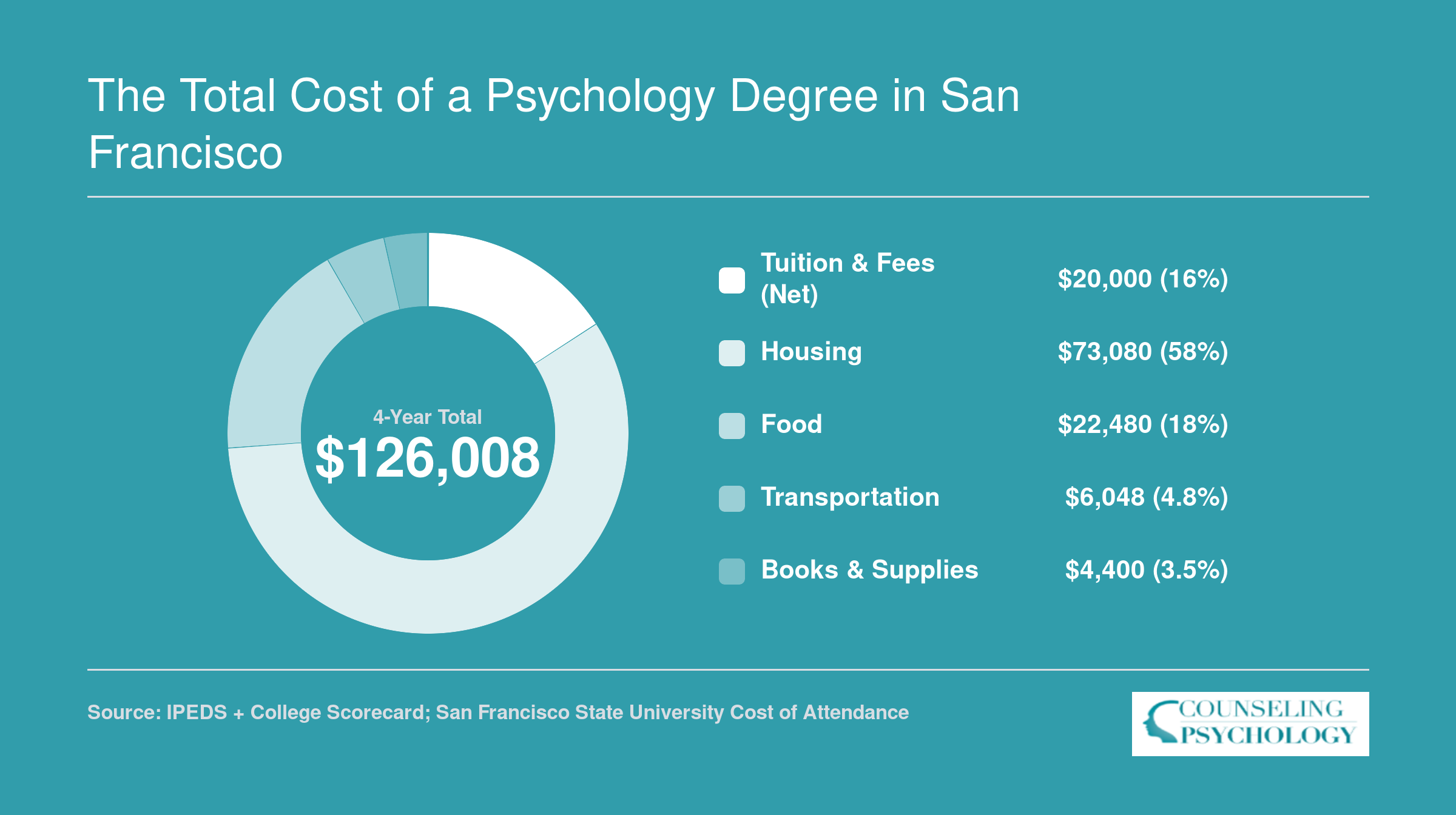
The Total Cost of a Psychology Degree in San Francisco
Tuition is only one piece of the puzzle. At a public university like SF State, living expenses in San Francisco can easily outpace what you pay in tuition and fees. Here is what four years actually costs for an on-campus student, using SF State's published cost-of-attendance figures and a median net price drawn from comparable CSU psychology programs.
Transfer Pathway Strategies to Lower Your Total Psychology Degree Cost
How much can you actually save by starting at a California community college and transferring to a university for your psychology bachelor's?
The numbers are striking. City College of San Francisco (CCSF) charges California residents just $46 per unit1, and many students pay zero net cost thanks to the Free City College Program.2 Compare that to university tuition rates, which can exceed $400 per unit at some private institutions and roughly $250 per unit at San Francisco State University after all fees. That difference compounds quickly over 60 units of lower-division coursework.
The California ADT in Psychology
California's Associate Degree for Transfer (ADT) in psychology is designed explicitly to ease this pathway. Students who complete the ADT at any California community college, including CCSF, earn guaranteed admission to the California State University system with junior standing. That means you enter SFSU or another CSU having already finished your general education and lower-division psychology prerequisites, with no more than 60 additional semester units required to graduate.
The ADT includes courses in introductory psychology, research methods, statistics, and biological psychology, plus general education requirements. Completing this coursework at CCSF rather than a university locks in maximum savings during your first two years. If you are weighing a two-year program as a stepping stone, explore associate degree in psychology options to understand what the curriculum covers before you transfer.
A Realistic Cost Comparison
Consider two scenarios for earning a bachelor's in psychology:
- Four years at SFSU: Assuming 120 total units at roughly $250 per unit (tuition and fees), total tuition cost approaches $30,000 before housing and expenses.
- Two years at CCSF plus two years at SFSU: Complete 60 units at CCSF for approximately $2,760 (or $0 with Free City eligibility), then 60 units at SFSU for roughly $15,000. Total tuition cost: $17,760 or less.
The transfer pathway can cut your degree cost by 40 percent or more, even before factoring in financial aid. Housing costs remain the same in either scenario if you live in San Francisco throughout, so the tuition savings translate directly to lower student debt or a lower family contribution.
Which SF Programs Accept the Most Transfers?
San Francisco State University is the most accessible destination for CCSF psychology transfers. The two institutions maintain close articulation agreements, and SFSU enrolls hundreds of community college transfers each year across all majors. Private universities in San Francisco typically accept fewer community college units and may require additional coursework, eroding some of the cost advantage. If your goal is maximum affordability, the CCSF-to-SFSU pipeline offers the clearest, most cost-effective route to a bachelor's in psychology.
Financial Aid, Scholarships, and What SF Students Actually Pay
California's public university system remains one of the most aid-rich in the country, and for psychology majors in San Francisco, that fact bends the cost curve far more than any tuition sticker would suggest. The published price is rarely what students actually pay, and the gap between the two is where families either save thousands or leave money on the table. Students exploring a bachelor's degree in psychology should understand these dynamics before comparing programs on sticker price alone.
Sticker Price vs. What You Actually Pay
At CSU campuses across California, in-state tuition hovers around $7,200 to $8,300 per year, but the average net price (what students pay after grants and scholarships are applied) is dramatically lower. Cal State LA students pay roughly $3,967 on average after aid. Cal State San Bernardino comes in near $4,564, and CSU Bakersfield around $5,652. Even campuses with higher post-aid costs like Cal Poly Humboldt (about $13,171) sit well below private-school territory.
The driver is need-based aid penetration. At Cal State LA, 86.9% of students receive Pell Grants. Cal State San Bernardino sits at 86.8%, Fresno State at 86.3%, and CSUN at 85.9%. These are among the highest Pell shares of any four-year institutions in the country, which means a typical admitted student qualifies for substantial federal aid before any state or institutional dollars enter the picture.
Cal Grant: The California Multiplier
If you're a California resident with financial need and a qualifying GPA, the Cal Grant A program covers full system-wide tuition at any CSU or UC. Stacked on top of a Pell Grant, this often zeroes out tuition entirely at SFSU and leaves federal aid to chip away at housing and books. At private SF schools like USF, Cal Grant A converts to a fixed annual award (currently $9,358 for 2025-26 at independent institutions), which helps but rarely closes the full tuition gap.
Psychology-Specific Scholarships Worth Applying To
- SFSU Psychology Department awards: Routed through the AcademicWorks portal, with individual awards typically ranging from $500 to $5,000 and stackable with university-wide scholarships.12
- Sharon Stephens Brehm Undergraduate Psychology Scholarships (APF): $5,000 awards, eight given annually, 3.5 GPA minimum, deadline July 10, 2026.3
- Julie Ann Dalton Memorial Scholarship: $5,000, ten awards, 3.0 GPA minimum.
- Gary A. Lucchese Scholarship in Psychology: $1,500, two awards, 3.0 GPA, April 8, 2026 deadline.
- Irvin W. and Velma C. Hartman Family Scholarship: $3,000, two awards, 3.0 GPA, same April 8 deadline.
Apply to all of them. Departmental committees frequently report that the applicant pool for psychology-specific awards is smaller than students assume, which means your odds are better than the national scholarship lottery suggests.
Don't assume public colleges are always the cheapest for a psychology degree in San Francisco. A private school with a $50,000 annual sticker price can end up costing less than a Cal State after you apply institutional grants and scholarships. Always run the school's net price calculator to see your real out-of-pocket cost before making a decision.
Career Outcomes and ROI for San Francisco Psychology Graduates
A psychology bachelor's degree from an affordable San Francisco program can open doors to diverse careers, but understanding realistic salary expectations against the city's high cost of living is essential before you commit.
What Psychology Graduates Actually Earn in the Bay Area
Program-level earnings data for specific San Francisco psychology programs are not yet published in federal databases, which makes it difficult to pinpoint exactly what graduates of individual schools earn one to five years after graduation. However, Bureau of Labor Statistics wage data for the San Francisco-Oakland-Hayward metro area provides useful benchmarks for occupations that commonly employ psychology bachelor's holders.
Human resources specialists in the SF metro area earn a mean annual wage of approximately $104,050, making this one of the higher-paying paths available to psychology graduates who pivot toward organizational settings.1 Graduates interested in that corporate trajectory may eventually consider industrial organizational psychology master's programs to accelerate their advancement. Social and community service managers, a role that often requires a few years of experience after graduation, earn a mean of roughly $97,740 locally, compared to the national median of $77,030 for the same occupation.23 Community health workers, an entry point for many recent graduates, earned a mean of about $57,860 in the metro area based on available data from 2020.4
Is a Psychology Degree Worth It in San Francisco?
The honest answer depends heavily on your career trajectory and what you actually pay for your degree. San Francisco's cost of living ranks among the highest in the nation, and an entry-level salary of $50,000 to $60,000 stretches far less here than in most other cities.
Here's where affordability matters most: graduates who keep total debt under $15,000, which is achievable at many California State University campuses, position themselves to manage monthly loan payments even on modest starting salaries. The California public university programs listed on this site show estimated ten-year earnings around $59,000 to $83,000, with median debt figures typically ranging from $13,000 to $16,000. That translates to a rough earnings-to-debt ratio between 4:1 and 6:1, a reasonable threshold for manageable repayment.
Graduates planning to stay in San Francisco long-term should factor in:
- Entry-level salary reality: Many bachelor's-level psychology positions start between $45,000 and $60,000 locally
- Growth potential: Management and HR roles can reach six figures with experience
- Graduate school plans: If you intend to pursue a master's or doctorate, minimizing undergraduate debt becomes even more critical
The bottom line: a psychology degree from an affordable SF-area program offers solid ROI if you graduate with low debt and have a clear plan for career advancement or further education. If graduate school is part of that plan, exploring options like a master's degree in psychology early on can help you map out costs and timelines. Those who pay sticker price at expensive private institutions face a much steeper climb toward financial stability in one of America's most expensive cities.
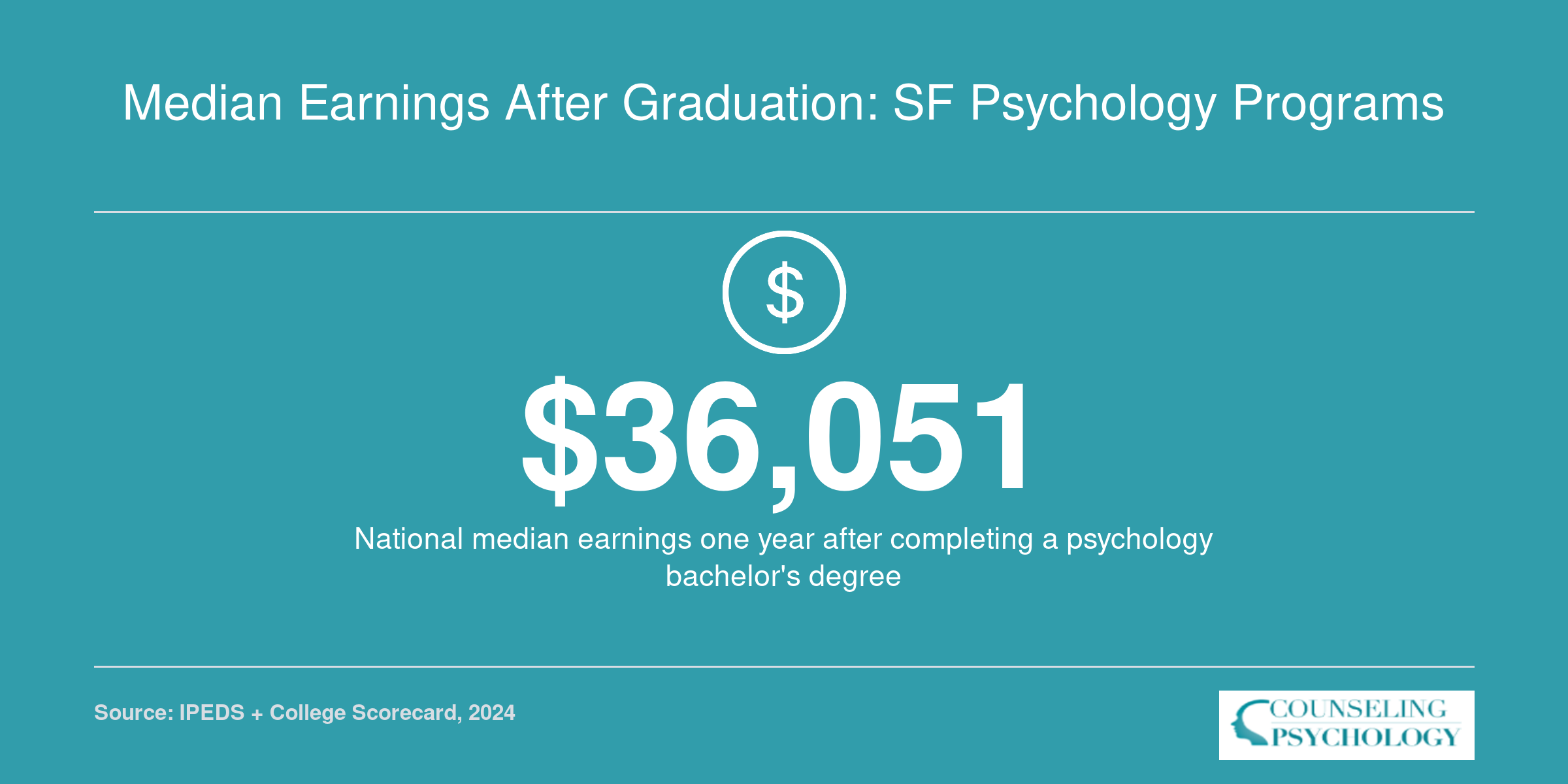
Median Earnings After Graduation: SF Psychology Programs
Program-level earnings data for San Francisco psychology bachelor's programs is not currently published in sufficient detail to compare across individual schools. When these figures become available, they will reflect one-year and longer-term median earnings for graduates, giving prospective students a clearer picture of early and mid-career return on investment.
What to Look for in an Affordable SF Psychology Program
Balancing cost against program quality creates the central tension when choosing a psychology degree in San Francisco, where living expenses already strain student budgets. A lower price tag means nothing if the credential fails to open doors for graduate school or employment. Here's what separates a genuinely worthwhile affordable program from one that simply costs less.
Regional Accreditation Is Non-Negotiable
For a bachelor's degree in psychology, regional accreditation matters far more than any specialized program designation. Regional accreditors like the WASC Senior College and University Commission evaluate institutional standards across academics, finances, and student services. A regionally accredited degree transfers to other institutions, qualifies you for federal financial aid, and satisfies prerequisites for graduate programs in counseling, clinical psychology, or social work. Without it, you may find yourself stuck, unable to continue your education or explain a credential that employers don't recognize.
Program-specific accreditation from bodies like APA becomes critical only at the doctoral level. At the bachelor's level, focus your energy on confirming regional accreditation first.
Curriculum Markers That Signal Rigor
Affordable programs vary widely in what they actually teach. Look for these curriculum components:
- Research methods sequence: At least one, ideally two, courses covering experimental design, statistics, and data analysis. This foundation proves essential for graduate applications and research-adjacent careers.
- Practicum or internship requirements: Programs that require field hours connect classroom theory to real settings, whether in community mental health centers, schools, or research labs.
- Capstone or senior thesis: A culminating project demonstrates your ability to synthesize learning and complete sustained independent work.
Programs missing these elements may save you money short-term but cost you competitiveness when applying to graduate programs or entry-level positions. Students interested in working with younger populations, for example, should note that competitive online child psychology degree programs expect applicants to arrive with strong research and practicum foundations.
Format Flexibility for Working Students
San Francisco's cost of living means most students work while completing their degrees. Evening, weekend, and hybrid course options aren't luxuries here; they're necessities. Check whether required courses rotate through multiple time slots each semester or lock you into a single daytime section that conflicts with employment. Online components can reduce commute time and costs, but verify that key courses like research methods still include hands-on lab components, even if delivered in compressed weekend formats.
Retention Rates Reveal Support Quality
Retention rate, the percentage of first-year students who return for their second year, signals how well a school supports students through challenges. Among California public universities with psychology programs, UCLA reports a 97% retention rate, UC San Diego reaches 94%, and San Diego State University maintains 91%. These figures reflect advising quality, tutoring access, financial aid responsiveness, and overall campus culture. A program with retention below 80% deserves scrutiny: students are leaving for reasons worth investigating before you enroll.
When comparing affordable options, prioritize schools that demonstrate commitment to keeping students enrolled and progressing toward graduation.
Frequently Asked Questions About Psychology Degrees in San Francisco
Choosing a psychology program in San Francisco raises practical questions about cost, program structure, and what you can actually do with the degree once you graduate. Below are answers to the questions prospective students ask most often, along with pointers to authoritative sources where you can verify the details yourself.
More Affordable Psychology Programs to Consider
Beyond the top 10 ranked programs, these additional schools offer affordable bachelor's in psychology options across California. Explore each program's details to find the right fit for your goals and budget.
Bay Area
- Psychology, BA
- Psychology B.A.
- Bachelor of Science in Psychology
- Psychology, BA
Greater Los Angeles
- Psychology
- Bachelor of Arts in Psychology (Forensic Psychology)
- Bachelor of Arts in Psychology with a concentration in Industrial/Organizational Psychology
- Applied Psychology (Clinical Psychology)
- Bachelor of Arts in Psychology (General Psychology Concentration)
- Bachelor of Arts in Psychology (Child Psychology)
- Bachelor of Arts in Psychology (Industrial/Organizational)
- Bachelor of Arts in Psychology (Preparation for Advanced Study in Counseling)
San Diego
- Psychology, Emphasis in Industrial and Organizational Psychology
- Psychology B.S. with a Specialization in Human Health
- Psychology B.S. with a Specialization in Clinical Psychology
- Psychology B.S. with a Specialization in Developmental Psychology
- Bachelor of Arts in Sport Psychology
- Bachelor of Arts in Psychology
- Bachelor of Arts in Psychology (Developmental Psychology)
Central Coast
- Psychology
North Valley
- Bachelor of Arts in Psychology
North Coast
- Bachelor of Arts in Psychology (General Psychology Pathway)
Central Valley
- Psychology, B.A.