
What you’ll learn in this article…
- Seven accredited graduate programs sit within commuting or online reach of Kenosha, spanning doctoral and specialist levels.
- Wisconsin has no standalone educational psychologist license, so graduates credential through DPI or the psychology licensing board.
- In-state graduate tuition across ranked programs ranges roughly from $9,000 to over $14,000 per year.
- UW-Parkside in Kenosha offers an undergraduate psychology degree that feeds directly into UW System graduate tracks.
Kenosha's location delivers more graduate program choices than most Wisconsin cities. You sit 40 miles south of Milwaukee, 90 miles north of Chicago, and within commuting distance of Racine, Madison, and points west. That geography places seven accredited educational psychology and school psychology programs within reasonable reach, spanning public universities with in-state tuition, NASP-accredited specialist tracks, and one online private option.
Most prospective students conflate educational psychology with school psychology, and that confusion shapes early program research. The two fields share roots in learning theory but diverge sharply in licensure pathways, workplace settings, and training intensity. Schools on this list offer both doctoral research tracks and specialist-level licensure programs, so understanding which credential your career goal requires will narrow your list quickly.
Wisconsin DPI does not issue a standalone educational psychologist license for K-12 roles. Practitioners working directly with students pursue the School Psychologist credential, while those in research, policy, or higher education settings may follow a generic psychology doctorate or remain unlicensed. That regulatory split means your program choice hinges less on prestige and more on whether the curriculum aligns with DPI or NASP requirements. Students exploring related helping professions in the state can also compare accredited masters in counseling in Wisconsin to see how neighboring fields stack up.
Best Educational Psychology Programs Near Kenosha, Wisconsin
Wisconsin is home to some of the strongest educational psychology and school psychology graduate programs in the country, and several are within realistic reach of Kenosha. The seven schools below span doctoral research programs, specialist-level licensure tracks, and fully online master's options, giving Kenosha-area students a range of paths into the field. Program-level earnings data is not yet published for these programs, so we lean on institutional outcomes and program-specific details to help you compare.
- Program breadth and specializations
- Accreditation and licensure alignment
- Institutional graduation and retention rates
- Accessibility from Kenosha area
- Affordability and financial aid indicators
- Internal program database
- Independent program research
- NCES-IPEDS federal institutional data — nces.ed.gov
- College Scorecard graduate earnings — collegescorecard.ed.gov

University of Wisconsin-Madison
UW-Madison's Department of Educational Psychology holds a No. 1 national ranking in the specialty and anchors a School of Education widely regarded as the best in the country. With a 96% first-year retention rate and an institution-wide graduation rate near 90% (note: that figure is school-level, not program-specific), the university signals strong student support across the board. The department offers doctoral concentrations in Human Development, Learning Sciences, and Quantitative Methods alongside two distinct online master's tracks, making it the most academically diverse option on this list. Assistantships and fellowships help offset the roughly $12,325 in-state annual tuition, and median earnings for all graduates sit at $73,792 ten years after enrollment.
- 56-credit minimum with three concentration tracks
- Learning Sciences, Human Development, and Quantitative Methods areas
- Research facilities include the Waisman Center
- Doctoral minor or graduate certificate required
- Assistantships available for incoming cohort members
- Comprehensive preliminary exam before dissertation stage
- 100% online format completable in two years
- 30 graduate credits at $800 per credit
- Summer term start with aligned teaching standards
- Includes Instructional Coaching Certificate
- Requires at least one year of teaching experience
- Tailored assignments for working educators
- Fully online, asynchronous 24-month program
- 30 credits at $1,000 per credit with zero textbook costs
- Cohort-based model designed for working professionals
- No prerequisite courses required for admission
- Housed in a top-ranked educational psychology department
- Z-degree format eliminates textbook expenses
- 36-credit research-focused campus degree
- Three specialized research pathways available
- Thesis or major area paper required for completion
- Access to Waisman Center research facilities
- Graduate assistantships available
- GRE required for admission
- Campus-based program with research and practice integration
- Training in human development and quantitative methods
- Emphasis on ethical standards and professional practice
- Comprehensive preparation for school psychology roles
- Financial aid available for qualified students
- Strong academic background expected for admission
PhD in Educational Psychology — On-Campus
Educational Psychology: Professional Educators MS (Online) — On-Campus
Educational Psychology: Learning Analytics MS (Online) — On-Campus
Educational Psychology: Research MS — On-Campus
School Psychology MS — On-Campus

University of Wisconsin-Milwaukee
As the nearest major public research university to Kenosha, UW-Milwaukee is a natural fit for commuter students who want a rigorous program without relocating. The department pairs an urban education and multicultural competency lens with APA- and NASP-accredited doctoral work, preparing graduates to serve the diverse K-12 populations found across southeastern Wisconsin. In-state tuition runs about $12,728 per year, and the institution's median graduate debt of $23,000 is moderate for the region. The school-level graduation rate is approximately 49%, which reflects UWM's broad-access mission rather than the outcomes of any single graduate program.
- NASP-accredited with 31 required graduate credits
- Urban education focus with diverse, inclusive curriculum
- Pathway to the Educational Specialist (Ed.S.) degree
- Research-driven approach to school psychology
- Multicultural competency emphasis throughout coursework
- On-campus program format in Milwaukee
- Research-focused doctoral program in urban learning contexts
- Multiple research method courses included
- Flexible concentration options within the degree
- Six-year typical completion timeline
- Optional GRE submission with holistic admissions review
- Dissertation and defense required
- Minimum 54 credits with focus on statistical models
- Prepares graduates for academic and research careers
- Research collaboration opportunities across departments
- Urban foundations coursework included
- Spring and fall application deadlines
- Dissertation required for completion
- Dual APA and NASP accreditation
- Combines research training with clinical practice skills
- Hands-on internships in diverse urban settings
- Emphasis on evidence-based, culturally competent practice
- Financial aid options available
- December 1 application deadline
Educational Psychology MS, School Psychology Concentration — On-Campus
Educational Psychology PhD, Cognitive and Developmental Sciences — On-Campus
Educational Psychology PhD, Educational Statistics and Measurement — On-Campus
Educational Psychology PhD, School Psychology — On-Campus

University of Wisconsin-Whitewater
Located roughly midway between Madison and Milwaukee, UW-Whitewater is one of the closest campus options for Kenosha-area students interested in school psychology. The three-year dual-degree program awards both the MSE and Ed.S. and boasts a reported 100% career placement rate for graduates. With the lowest net price on this list at approximately $14,158, it offers a compelling cost-to-outcome ratio. The institution-wide graduation rate stands at about 59% (school-level, not program-specific).
- Three-year comprehensive dual-degree program
- Nationally accredited with 100% career placement reported
- 600-hour supervised practicum included
- Full-time internship experience required
- Nationally Certified School Psychologist credential option
- Affordable graduate tuition with in-state rate near $10,543
Master's and Ed.S. in School Psychology — On-Campus

University of Wisconsin-La Crosse
UW-La Crosse sits farther from Kenosha but compensates with a flexible online school psychology track specifically built for currently licensed Wisconsin educators. The campus-based pathway is a NASP- and Wisconsin DPI-approved sequence totaling 71 to 73 credits, including a 1,200-hour internship. In-state tuition is approximately $10,832 per year, and the institution posts a 71% graduation rate and 87% retention rate at the school level. Graduates are fully prepared for Wisconsin school psychologist licensure, meaning they can practice in Kenosha-area districts immediately upon completing credentialing requirements.
- Two-year full-time study with a 1,200-hour internship
- NASP and Wisconsin DPI approved
- 71 to 73 total credits required
- Multi-Tiered System of Supports focus
- Emphasizes social justice in school psychology practice
- Awards both Master's and Educational Specialist degrees
- Designed for currently licensed Wisconsin educators
- 6 to 7 week accelerated class format year-round
- Practica completed in the student's own school
- Focus on mental health, equity, and diversity
- Financial aid available for online students
- Allows candidates to continue teaching while enrolled
School Psychology (Campus) — On-Campus
School Psychology (Online) — On-Campus

University of Wisconsin-Eau Claire
UW-Eau Claire's three-year School Psychology M.S.E. program prepares specialist-level practitioners through a 31-credit curriculum emphasizing data-driven decision-making, intervention strategies, and culturally competent practice. The program leads to Wisconsin school psychologist licensure, so graduates can step directly into roles in Kenosha-area and other southeastern Wisconsin districts. In-state tuition is about $10,665, and the school reports a median graduate debt of $20,909, the lowest debt figure among the public institutions on this list. The institution-wide graduation rate is roughly 64% (school-level figure).
- Three-year specialist-level training program
- Leads to Wisconsin school psychologist licensure
- 31 graduate credits required for completion
- Minimum 3.0 undergraduate GPA needed for admission
- Comprehensive professional preparation across multiple domains
- Pathways into public schools, behavioral health clinics, or doctoral study
School Psychology M.S.E. — On-Campus

University of Wisconsin-Stout
UW-Stout's NASP-accredited dual M.S.Ed./Ed.S. in School Psychology combines developmental assessment, counseling skills training, and intervention strategies across a structured three-year sequence. The program prepares graduates for both Wisconsin licensure and the Nationally Certified School Psychologist credential. At roughly $9,777 in-state tuition, it is the most affordable public option on the list, though the Menomonie campus is roughly 280 miles from Kenosha, making it better suited for students willing to relocate. The institution-wide graduation rate is about 55% (school-level).
- NASP-accredited dual-degree program
- Hands-on practica with focus on developmental assessment
- Counseling skills development integrated throughout
- Eligible for NCSP certification upon completion
- Requires 3.0 GPA and bachelor's in a related field
- Combines theoretical coursework with applied practice in schools
M.S.Ed. and Ed.S. in School Psychology — On-Campus

Alverno College
Alverno College in Milwaukee offers a fully online, three-year pathway that bundles an MS in Educational Psychology with an Ed.S. in School Psychology, giving students two credentials in one program. The NASP-accredited curriculum features synchronous evening courses, a 600-hour practicum, and a 1,200-hour internship completed through the college's extensive southeastern Wisconsin school network. At $900 per credit for 60 credits, total program cost lands near $54,000 before financial aid. The Multicultural and Multilingual School Psychology specialization is especially relevant for Kenosha-area districts serving diverse, multilingual student populations. The 13:1 student-to-faculty ratio is the smallest on this list. Note that the 49% graduation rate is an institution-wide figure.
- Three-year online program awarding two degrees
- NASP accredited with licensure and NCSP eligibility
- Synchronous evening courses for working professionals
- 600-hour practicum plus 1,200-hour internship
- Small class sizes with dedicated faculty mentors
- Scholarships available to offset $900-per-credit tuition
- Specialization in culturally responsive school psychology
- Language endorsement available upon completion
- 1,800 total hours of supervised practical experience
- Focus on diversity, inclusion, and multilingual assessment
- Online format with local field placements
- Designed for educators serving diverse student populations
MS in Educational Psychology and Ed.S. in School Psychology — On-Campus
Ed.S. in School Psychology, Multicultural and Multilingual Concentration — On-Campus
Educational Psychology vs. School Psychology: Key Differences
Prospective students often confuse educational psychology with school psychology, and the mix-up is understandable. Both fields focus on how people learn, but their training paths, credentials, and day-to-day work differ significantly.1 Understanding these distinctions will help you choose the route that matches your career goals.
Training and Degree Pathways
Educational psychology programs emphasize research and theory. Students typically pursue a master's degree in educational psychology or doctorate (Ph.D. or Ed.D.) and develop expertise in topics like learning sciences, cognitive development, motivation, and assessment design. Coursework centers on research methodology, statistics, and scholarly inquiry rather than direct clinical practice.
School psychology programs, by contrast, are practice-oriented. The most common credential is the Education Specialist (Ed.S.) degree, though some practitioners hold doctorates. Training includes supervised fieldwork in K-12 settings, crisis intervention, psychoeducational assessment, and consultation with teachers and families.
Licensure and Credentialing in Wisconsin
In Wisconsin, these two paths fall under different regulatory bodies:
- School psychologists are licensed through the Wisconsin Department of Public Instruction (DPI). They earn a state certification that authorizes them to work in public and private schools.
- Educational psychologists do not hold a direct, occupation-specific license. Those who want to practice as licensed psychologists must meet requirements set by the Wisconsin Psychology Examining Board, which typically calls for a doctoral degree and supervised clinical hours. Many educational psychologists, however, work in roles (research, curriculum design, higher education) that do not require clinical licensure at all.
Work Settings and Daily Responsibilities
School psychologists spend most of their time in K-12 buildings. A typical week might include administering cognitive and achievement tests, writing Individualized Education Programs (IEPs), counseling students, and collaborating with teachers on classroom interventions.
Educational psychologists usually work in universities, research centers, testing companies, or policy organizations.1 Their responsibilities often involve designing curricula, analyzing large-scale assessment data, publishing research, and advising educational agencies on evidence-based practices. Direct contact with individual students is rare.
Salary and Job-Market Considerations
School psychology offers a clearer employment pipeline. Districts across Wisconsin hire school psychologists to meet federal special-education mandates, so demand remains steady. Salaries generally align with teacher pay scales plus additional stipends for specialist credentials.
Educational psychology positions can be more competitive and geographically concentrated. Academic jobs require a strong publication record and may involve relocating. Roles in curriculum development or ed-tech, on the other hand, are growing and sometimes offer higher earning potential than K-12 employment.
Which Path Fits You?
Ask yourself where you see your future workday. If you want to support students face-to-face in schools, navigate special-education processes, and see immediate impact, school psychology may be the faster, more direct route. If you are drawn to research questions, enjoy writing and data analysis, and prefer shaping education at a systemic level, you can learn more about the steps involved in our guide on how to become an educational psychologist.
Questions to Ask Yourself
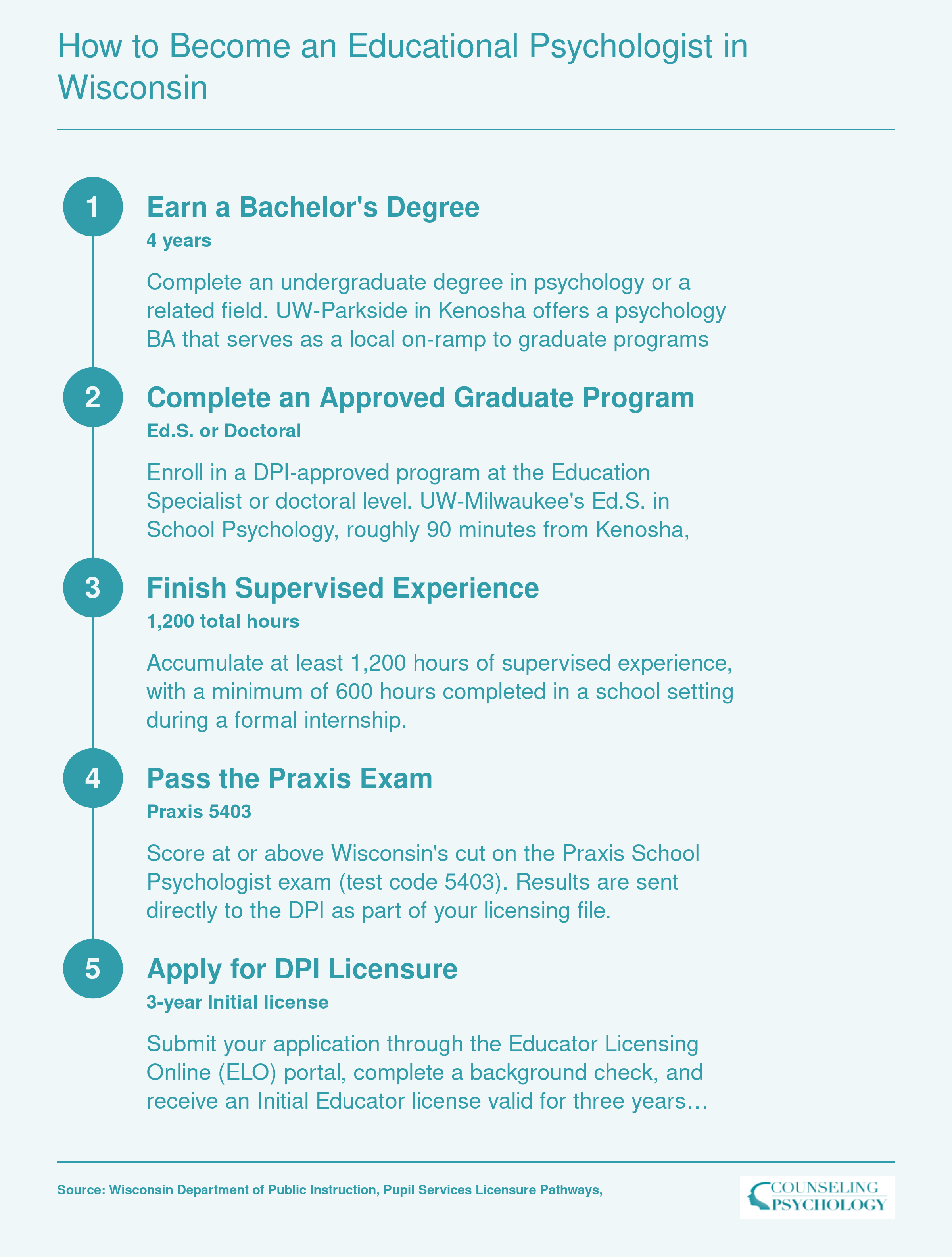
How to Become an Educational Psychologist in Wisconsin
Wisconsin does not issue a separate "educational psychologist" license. Professionals who work in K-12 settings pursue the School Psychologist credential through the Department of Public Instruction, while those practicing outside schools obtain a generic psychologist license through the Department of Safety and Professional Services. Here is the credentialing ladder most Kenosha-area students follow.
Program Costs, Financial Aid, and ROI in Wisconsin
Tuition across these programs varies enough that choosing the wrong school without running the numbers could cost you tens of thousands of dollars over the life of your degree.
What Tuition Actually Looks Like
For Wisconsin residents, in-state graduate tuition among the ranked programs runs from roughly $8,600 at UW-Whitewater to $12,700 at UW-Milwaukee per year. Out-of-state rates climb considerably higher, ranging from about $18,700 to $26,200 annually at those same schools. UW-Madison's PhD program sits in the middle of that band at $12,325 in-state and $25,651 out-of-state. Alverno College, the one private institution on the list, charges a flat $12,018 regardless of residency, which can make it surprisingly competitive for students coming from outside Wisconsin.
The figure you see advertised as sticker tuition is rarely what students pay. Institution-wide net price estimates, which reflect grants and scholarships averaged across all enrolled students, tell a more realistic story. UW-Whitewater's effective net price is around $14,158; UW-Milwaukee's is approximately $15,014; and UW-Madison's is $17,354. Keep in mind these are institution-wide averages, not figures specific to graduate psychology programs. Your actual cost will depend on your aid package, assistantship eligibility, and program format.
Graduating Debt and Monthly Payments
Median graduate debt at these schools ranges from about $20,500 at UW-Madison to $27,000 at Alverno. That spread matters when you translate balances into monthly obligations. On a standard 10-year repayment plan, each $10,000 in federal debt costs roughly $100 to $115 per month. A student graduating with $27,000 in loans could be looking at $270 to $310 monthly before interest rate adjustments. Before you commit to any program, stack that projected payment against realistic first-year salaries in Wisconsin school psychology and educational psychology roles. If the monthly payment consumes more than 10 to 12 percent of your expected gross monthly income, the math deserves a harder look.
Program-level earnings outcomes are not yet available for these specific programs in federal reporting databases, so direct comparisons on post-graduation income at the program level are not possible at this time.
Reciprocity and Border Discounts
Kenosha sits at Wisconsin's southern border with Illinois, but Illinois residents should know upfront: there is no tuition reciprocity agreement between Wisconsin and Illinois, and Illinois is not a participating state in the Midwest Student Exchange Program.12 Illinois residents enrolling at UW System schools pay full nonresident rates.
The picture is different for Minnesota residents. Wisconsin and Minnesota maintain a tuition reciprocity agreement that covers graduate-level educational psychology programs.4 Minnesota students can apply through the Minnesota Office of Higher Education, while Wisconsin residents heading to Minnesota schools use the Universities of Wisconsin reciprocity portal.56 The agreement excludes only professional programs such as medicine and veterinary medicine, so educational psychology and school psychology programs qualify.4 For students from Minnesota who want access to UW-Madison, UW-Milwaukee, or other UW System campuses, this reciprocity pact can translate into meaningful savings compared to standard nonresident tuition.
If you are coming from Indiana, Kansas, Missouri, Nebraska, North Dakota, or Ohio, the Midwest Student Exchange Program may apply at participating Wisconsin institutions.2 Confirm program-specific eligibility directly with the graduate admissions office, since flat-fee programs sometimes forfeit reciprocity benefits.4
Online vs. On-Campus Options for Kenosha-Area Students
Kenosha sits in Wisconsin's southeast corner, close enough to Milwaukee and Chicago to give you options but far enough that commuting adds real time and cost. Among the ranked programs on this list, six are campus-based (UW-Madison, UW-Milwaukee, UW-La Crosse, UW-Eau Claire, UW-Whitewater, and UW-Stout), while Alverno College offers its M.S. in Educational Psychology online with synchronous evening courses. Your ideal format depends on career goals, schedule constraints, and how you plan to complete supervised fieldwork.
Pros
- Online programs like Alverno College's let working professionals study evenings without a Kenosha-to-Milwaukee commute that can run 45 minutes each way.
- Wisconsin's participation in reciprocity agreements can unlock out-of-state online programs at reduced tuition, widening your search considerably.
- Campus-based programs at UW-Milwaukee or UW-Madison offer hands-on clinical training and direct access to research labs, which matters for doctoral-track students.
- On-campus cohort models build professional networks organically; classmates become future referral partners, supervisors, and collaborators in Wisconsin schools.
- Faculty mentorship is more accessible on campus, an important factor when you need strong recommendation letters or dissertation guidance.
Cons
- Online students may face fewer organic practicum networking opportunities, making it harder to secure local supervised placements from a distance.
- Meeting Wisconsin's supervised-experience requirements remotely can require extra coordination, especially if your program is based out of state.
- Campus programs at UW-Madison (roughly 90 minutes from Kenosha) or UW-Eau Claire (over four hours away) may require relocation, adding housing and living costs.
- On-campus students commuting from Kenosha to Milwaukee face parking fees, fuel costs, and unpredictable I-94 traffic that can inflate the true cost of attendance.
- Rigid on-campus schedules can conflict with full-time employment, making it difficult for mid-career professionals to enroll without reducing their income.
Career Outlook and Salaries for Educational Psychologists in Wisconsin
Specialist-level practitioners and doctoral-level researchers sit at opposite ends of the educational psychology pay scale, and understanding where each track lands in Wisconsin helps you plan realistically. The good news: both paths offer compensation well above the state teaching average, and demand continues to outpace supply.
What the Profession Pays in Wisconsin
According to BLS data, the median annual wage for school psychologists in Wisconsin was $79,740 as of 2024.1 The range is wide: earners at the 10th percentile brought home roughly $60,850, while those at the 90th percentile reached $128,020.1 Wisconsin employed an estimated 1,200 to 1,300 school psychologists at the time of that snapshot.2 Nationally, overall job growth for school psychologists is projected at about 7% through 2034, while the broader "psychologists, all other" category is projected to grow at roughly 6%.1 Those national figures do not capture the acute shortages many Wisconsin districts face, which tend to push local hiring urgency higher than the headline numbers suggest.
Do School Psychologists Earn More Than Teachers?
This question comes up constantly, and the short answer is yes. The BLS reports a national median wage for elementary and secondary school teachers of approximately $63,000 to $65,000. In Wisconsin, school psychologist median pay of $79,740 sits roughly $15,000 or more above a typical teacher salary. The gap widens further at the upper end of the scale, where doctoral-level school psychologists in supervisory or consulting roles push well past $100,000. For a broader look at how helping-profession salaries compare, our guide to counselor salary data offers useful context.
Program-Level Earnings Data
Program-specific graduate earnings for the Wisconsin educational psychology and school psychology programs listed on counselingpsychology.org are not yet available at the federal reporting level. That means we cannot quote a precise median salary one or four years after graduation for any individual program. What we can say is that the occupation-level data above reflects the market these graduates enter, and programs with 100% placement rates (like UW-Whitewater's school psychology track) suggest strong demand for completers.
Wisconsin-Specific Demand Drivers
Two forces are reshaping the hiring landscape. First, rural districts across Wisconsin have struggled for years to recruit and retain school psychologists; some maintain ratios far above the NASP-recommended 1:500. Second, expanding K-12 mental health mandates at the state level are creating new funded positions, particularly for threat assessment, trauma-informed practices, and multi-tiered support systems. Both trends favor job seekers entering this field in 2026 and beyond. Students exploring related helping professions can compare options through our overview of counseling careers.
A Realistic Salary Trajectory
Here is a rough progression for Kenosha-area graduates:
- Entry level (Ed.S., years 1 to 3): $60,000 to $70,000 in school-based positions, depending on district salary schedules.
- Mid-career (5 to 10 years): $75,000 to $95,000, with higher pay in districts that offer longevity steps or stipends for specialized roles like crisis intervention.
- Doctoral level or supervisory: $100,000 to $128,000 or more, especially for those who move into district-level administration, university training programs, or private consulting.
Kenosha sits within the Milwaukee-Racine metro labor market, which means graduates can tap openings across southeastern Wisconsin without relocating. That geographic flexibility, combined with persistent shortages, positions educational psychology completers for steady career growth from day one.
UW-Parkside's BA in Psychology, available on campus or fully online, gives Kenosha students a strong foundation right at home. The program serves as a direct pipeline to graduate studies in educational and school psychology across the UW System, so you don't have to relocate to begin your path toward licensure.
Steps to Choose the Right Educational Psychology Program
Choosing between program prestige and practical fit often defines the search for Kenosha-area students. A nationally recognized program may look impressive on paper, but a nearby school with strong local practicum networks and Wisconsin DPI approval can accelerate your path to licensure and employment.
Use a Five-Point Evaluation Checklist
Before committing to any program, run it through these criteria:
- Accreditation and approval status: Confirm the program appears on the Wisconsin DPI approved list for school psychologist preparation.1 NASP approval alone does not automatically satisfy Wisconsin requirements.2 Programs at UW-Milwaukee and Alverno College, for example, hold both NASP accreditation and DPI approval, which streamlines licensure.34
- Delivery format fit: Decide whether on-campus, hybrid, or fully online instruction matches your schedule and learning style. UW-La Crosse offers an online Ed.S. pathway that may suit working professionals, while UW-Milwaukee provides traditional campus-based cohorts.5
- Practicum and internship placement network: Ask programs where recent students completed field placements. Schools with established relationships in southeastern Wisconsin can place you in Kenosha, Racine, or Milwaukee-area districts, reducing commute time and building local professional connections.
- Total cost including opportunity cost: Factor in tuition, fees, and the years of foregone income. A three-year Ed.S. has different financial implications than a five-year Ph.D., even if annual tuition looks similar.
- Program completion rate and graduate outcomes: Request data on how many students finish within the expected timeframe and what percentage pass the Praxis II School Psychologist exam (minimum score of 165) on the first attempt.
Map Your Realistic Timeline
A Kenosha student beginning a bachelor's degree at UW-Parkside could enter a graduate program approximately four years later. An Ed.S. typically adds three years, putting licensure eligibility around year seven. A Ph.D. pathway often extends to year nine or ten. Planning backward from your target career entry date helps you select the appropriate degree level. For a broader look at the profession's training path, review the school psychologist requirements outlined in our career guide.
Verify Wisconsin DPI Licensure Eligibility
If you intend to work in Wisconsin K-12 schools, your graduate program must appear on the DPI approved program database.7 Completing a program elsewhere triggers a case-by-case review, which can delay licensure.7 You will also need an institutional recommendation from your program, so confirm that process before enrolling.7
Visit Campus or Attend Virtual Sessions
Milwaukee-area campuses like UW-Milwaukee and Alverno College sit roughly 40 minutes north of Kenosha. Schedule in-person visits or join virtual information sessions to ask faculty about cohort sizes, research opportunities, and placement support. These conversations often reveal program culture details that websites omit.
Frequently Asked Questions
Prospective students near Kenosha often have overlapping questions about program types, costs, and career paths. Below are concise answers to the most common questions about educational psychology programs in Wisconsin.