

What you’ll learn in this article…
- Western Michigan University, Spring Arbor University, and Michigan State University each offer MFT training accessible from Grand Rapids.
- Michigan LMFT licensure requires a master's degree, the AMFTRB national exam, supervised clinical hours, and a total of $225 in state fees.
- Both COAMFTE and CACREP accredited programs satisfy Michigan's educational requirements for LMFT licensure, but curriculum emphasis differs.
- Grand Rapids provides diverse clinical placement sites, giving MFT students access to varied caseloads during their supervised training.
Choosing a marriage and family therapy master's program often starts with a practical comparison: a traditional campus-based cohort versus an online or hybrid format that allows you to remain in your current community. In Grand Rapids, Western Michigan University's hybrid model is the only one that combines online coursework with intensive clinical training at its downtown site.
Grand Rapids has emerged as a mental health services hub, with a dense network of community clinics and hospital systems offering varied clinical placements. The area's demand for systems-oriented therapists continues to grow, driven by integrated care and a broader recognition of relational mental health.
Prospective students can evaluate COAMFTE and CACREP pathways, state licensure steps, and regional salary data. Program formats span fully online, hybrid, and campus-based options, but with only a handful of accredited MFT programs in the state, aligning format choice with licensure goals early is critical.
Top MFT Programs Near Grand Rapids, Michigan
Three Michigan institutions offer marriage and family therapy training within reasonable reach of Grand Rapids, each at a different degree level and price point. Western Michigan University stands out for its direct Grand Rapids clinical presence and hybrid delivery, while Michigan State University provides a research-intensive doctoral path with COAMFTE accreditation. Andrews University rounds out the options with a focused post-master's certificate designed for clinicians already in practice. Program-level earnings data is not yet available for any of these programs, so institution-wide outcomes are provided for context.
- Accreditation and licensure alignment
- Graduate tuition and financial aid
- Clinical training infrastructure
- Program format and accessibility
- Institutional graduation outcomes
- College Scorecard graduate earnings — collegescorecard.ed.gov
- Internal program database
- Independent program research
- NCES-IPEDS federal institutional data — nces.ed.gov

Western Michigan University
Western Michigan University is the only program on this list with a dedicated university-operated counseling clinic in Grand Rapids, giving students guaranteed access to local couple and family caseloads during their required practicum and internship hours. Its hybrid M.A. in Marriage, Couple, and Family Counseling is a 60-credit program rooted in family systems theory that prepares graduates for dual licensure paths in Michigan. The institution's overall graduation rate is 57.6%, and in-state graduate tuition sits at approximately $20,103, making it the most affordable option here for Michigan residents.
- 60-credit hybrid program combining online coursework with in-person clinicals
- Dual preparation for professional counselor and MFT licensure in Michigan
- 100-hour practicum plus 600-hour internship at WMU clinics
- On-campus training clinics in both Kalamazoo and Grand Rapids
- Curriculum grounded in family systems theory and cultural awareness
- Financial aid includes scholarships, assistantships, grants, and loans
- Evidence-based counseling skills for contemporary family challenges
- Out-of-state graduate tuition approximately $29,681
M.A. in Marriage, Couple, and Family Counseling — Hybrid

Michigan State University
Michigan State University's Ph.D. in Human Development and Family Studies with a Couple and Family Therapy concentration is the only COAMFTE-accredited doctoral program on this list. The program emphasizes applied research rooted in social justice, empirically supported interventions, and advanced statistical methods, preparing graduates for leadership roles in academia, clinical practice, and policy. The institution's overall graduation rate is 80.7%, and in-state graduate tuition is approximately $21,772 (out-of-state runs about $41,848).
- COAMFTE-accredited doctoral program with four concentration options
- Dissertation required alongside comprehensive exams and professional portfolio
- Faculty mentors guide applied research in community and clinical settings
- Social justice framework integrated throughout the curriculum
- Advanced methods training prepares students for real-world statistical analysis
- Doctoral committees include at least four faculty members
- Student-to-faculty ratio of 17:1 across the institution
- Graduates pursue careers in academia, clinical leadership, and research
Ph.D. in Couple and Family Therapy — On-Campus

Andrews University
Andrews University offers a 20-credit Graduate Certificate in Couple and Family Therapy built specifically for master's-level mental health professionals who want to add MFT competencies without completing a full degree. The program is structured to meet Michigan's requirements for Limited License Marriage and Family Therapists, covering family dynamics, sexual health, legal ethics, and practice management. Located in Berrien Springs, it draws working clinicians from across Southwest and West Michigan. The institution's overall graduation rate is 71.5%, and tuition is approximately $29,156 regardless of residency.
- Post-master's certificate: 20 credit hours total
- Designed to meet Michigan Limited License MFT requirements
- Advanced internship included as part of the curriculum
- Minimum cohort size of 7 students annually for small-group learning
- Covers family dynamics, sexual health, legal ethics, and practice management
- No entrance exam required for admission
- Prerequisite: master's degree in counseling or a related field
- Student-to-faculty ratio of 10:1 across the institution
Graduate Certificate in Couple and Family Therapy — On-Campus
How These MFT Programs Were Evaluated
Ranking graduate programs demands more than a single-tier comparison of tuition sticker prices or school brand recognition. The programs featured in this guide were scored using a composite framework that balances three core dimensions: affordability, graduate outcomes, and institutional quality markers. Each program received individual metrics for net price (the average amount students pay after institutional grant aid), published tuition rates, median earnings at one and two years post-completion (when reported to the U.S. Department of Education), typical graduate debt load, six-year graduation rates, and first-year retention. Programs that perform well across multiple dimensions score higher than those that excel in only one. For broader context on how top-ranked programs compare nationally, see our guide to the best MFT programs in the US.
Geographic and Delivery Format Criteria
Only programs within reasonable commuting distance of Grand Rapids, or fully online programs approved for enrollment by Michigan residents, were included in the pool. That geographic filter ensures that every program listed can realistically serve someone living in or near Grand Rapids without requiring relocation. For online programs, the filter confirmed Michigan state authorization and verified that practicum and supervision requirements can be met within Michigan.
Accreditation Status and Licensure Pathways
Accreditation by the Commission on Accreditation for Marriage and Family Therapy Education (COAMFTE) or the Council for Accreditation of Counseling and Related Educational Programs (CACREP) was verified for each program, but neither credential served as a strict inclusion gate. Both COAMFTE and CACREP programs appear in the ranking because Michigan's LMFT licensure board accepts graduates of either pathway, provided the program meets 60-semester-hour and curriculum-content benchmarks. Students should confirm with the Michigan Board of Marriage and Family Therapy that their chosen program satisfies all regulatory requirements before enrollment.
Data Snapshot and Individual Variance
The scorecard metrics reflect the most recent U.S. Department of Education College Scorecard release, which aggregates data from prior cohorts. Individual net price and post-graduation earnings may differ based on financial aid eligibility, part-time versus full-time status, in-state versus out-of-state residency, and local labor-market conditions at the time of graduation. Always request a personalized net-price estimate and verify current tuition rates directly with the institution's admissions or financial aid office.
Questions to Ask Yourself
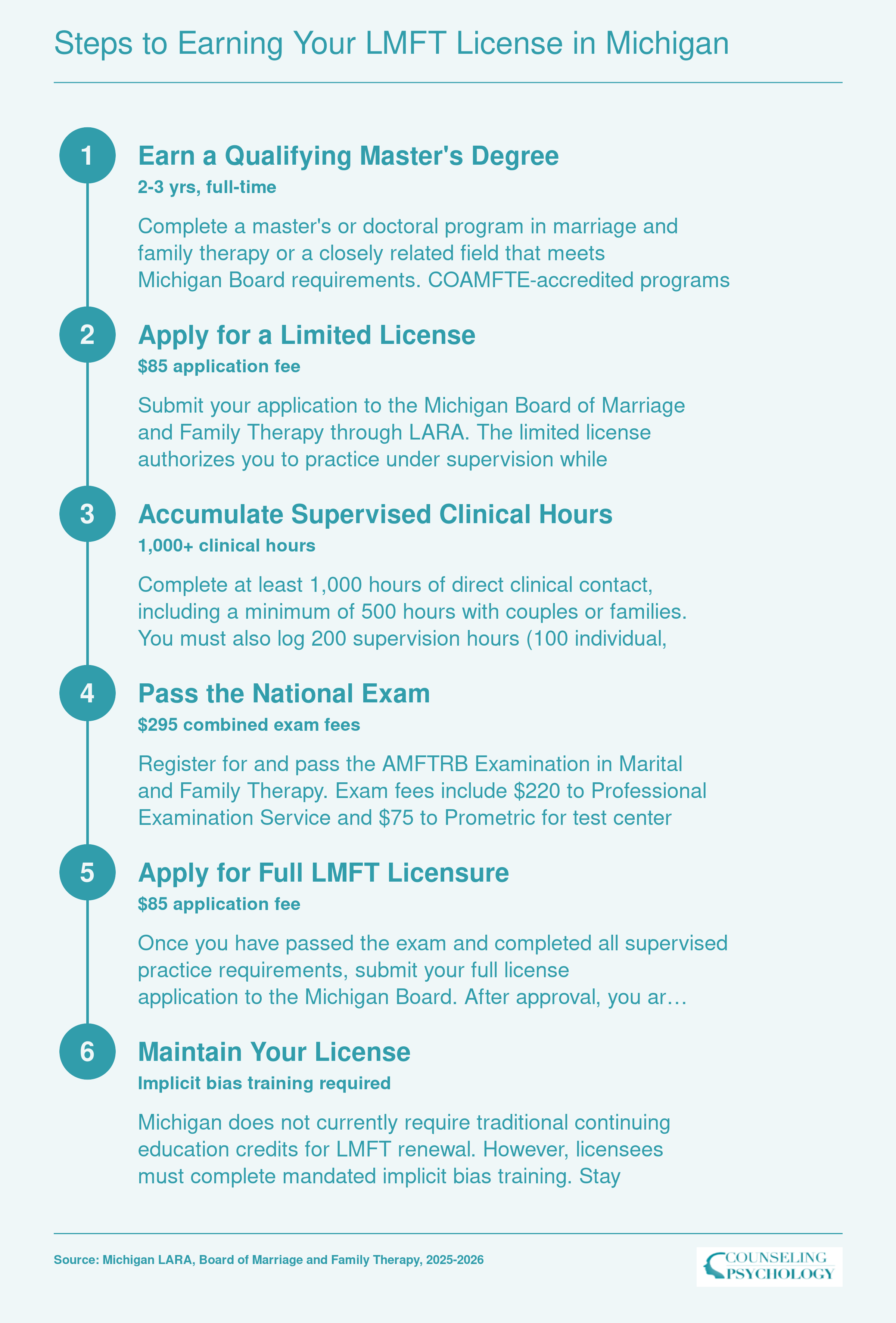
Steps to Earning Your LMFT License in Michigan
Michigan uses a limited license pathway before granting full LMFT status. Candidates must pass the AMFTRB Examination in Marital and Family Therapy and complete supervised clinical practice before applying for full licensure. Note that Michigan does not currently require traditional continuing education credits, but implicit bias training is mandated for license holders.
Michigan LMFT Licensure: Requirements, Fees, and Timeline
Michigan charges a $25 application fee and a $200 initial license fee to become a Licensed Marriage and Family Therapist, with biennial renewal at $200.1 Those numbers are the easy part. The bigger investment is the supervised practice and exam pathway administered by the Michigan LARA Board of Marriage and Family Therapy.2
The Limited License Stage
Once you finish a qualifying master's or doctoral degree in marriage and family therapy (or a closely related field), you apply for a Limited License (LLMFT). The limited license lets you practice under supervision while you accumulate hours toward full licensure. It is renewable, but it is not meant to be permanent. Most candidates clear the requirements in two to three years post-graduation.
Supervision must come from an approved supervisor, typically an AAMFT Approved Supervisor or a fully licensed MFT meeting Michigan's supervisor criteria. Expect a mix of individual and group supervision hours, with individual hours weighted more heavily in the count. For a broader look at what these requirements entail across states, see our guide to LMFT supervision hours.
Supervised Clinical Hours
Michigan requires at least 1,000 hours of direct client contact post-degree, accumulated under qualified supervision. Direct contact means face-to-face therapy with individuals, couples, families, or groups, not paperwork, case notes, or staff meetings. Relational hours (couples and families in the room together) carry particular weight in MFT training philosophy, so plan placements accordingly.
The National Exam
Michigan uses the National MFT Examination administered by the Association of Marital and Family Therapy Regulatory Boards (AMFTRB). You register through AMFTRB after the board authorizes you to test. The passing score is set by AMFTRB and applied uniformly across member states. Most candidates take it toward the end of their supervised hours.
Renewal and Continuing Education
Full LMFTs renew every two years for $200.1 Michigan requires implicit bias training every renewal cycle and a one-time human trafficking training.2 General CE hours round out the cycle, so build CE planning into your annual calendar.
Certificate Pathways
A common question: does Michigan accept a post-master's graduate certificate in MFT as the qualifying degree? The answer is no. The board requires a master's or higher in marriage and family therapy or a related field as the foundational credential. If you are still exploring degree options, our roundup of MFT programs in Michigan is a good starting point. Certificates can supplement training or help a counselor add MFT competencies, but they do not substitute for a qualifying master's degree on the LMFT application.
Related Articles
Choosing Between LMFT and LPC Licensure in Michigan
Michigan's mental health landscape is evolving as more agencies and insurance panels recognize the distinct expertise of systems-trained clinicians, making the choice between LMFT and LPC licensure more consequential than ever. While both licenses authorize you to diagnose and treat mental disorders, the training emphasis, supervised experience requirements, and client populations you are best prepared to serve differ markedly.
Comparing the Credentials Side by Side
At the educational level, the two paths look similar: both demand a master's or doctorate and at least 60 semester credits from a regionally accredited program.12 Michigan also mandates that each candidate complete training in human trafficking and implicit bias. The split becomes clear after graduation. A Limited Licensed Professional Counselor (LLPC) must accumulate 3,000 supervised post-degree clinical hours, whereas a Limited Licensed MFT needs only 1,000 hours.12 That two-thousand-hour difference can translate to an extra one to two years before full licensure.
The examination stage also diverges. LPC applicants choose among the NCE, NCMHCE, or CRCC exams; LMFT candidates sit exclusively for the National Marriage and Family Therapy Examination administered by the AMFTRB.12 Both licenses require you to renew your limited license periodically and to practice under a board-approved supervisor, but the LMFT supervisor must hold an LMFT license, keeping the relational focus intact.
Scope of Practice and Client Focus
An LPC's training typically covers individual counseling across the lifespan, career development, and a broad spectrum of mental health issues in educational, community, or private practice settings. Those interested in exploring this broader counseling track can review the best masters in mental health counseling programs available nationwide. An LMFT's education centers on relational and systemic therapy, viewing individual symptoms through the lens of family and relationship dynamics. You can certainly treat individuals as an LMFT, but your interventions will be anchored in systems thinking, whereas an LPC may lean toward cognitive, behavioral, or humanistic frameworks.
Insurance panel acceptance has historically favored LPCs, though this gap is narrowing. Michigan licensure law does not restrict either profession from diagnosing or treating any mental health condition, but individual insurers sometimes still differentiate. Before committing, it is wise to check which credential is preferred by the agencies or health systems where you see yourself working.
The Dual-Licensure Path in Michigan
A handful of Michigan programs, including certain tracks at Western Michigan University, intentionally align coursework to meet the educational requirements of both the LPC and LMFT boards. Dual licensure is not a shortcut; you still complete two sets of supervised hours and pass two exams. However, it eliminates the need to return for additional graduate credits later. If you are evaluating marriage and family therapy master's programs across the country, look for curricula that explicitly note dual-licensure alignment. This is a compelling option if you want maximum career flexibility or if you see yourself blending individual and relational therapy in an integrated care setting.
Which License Fits Your Career Goals?
If you are certain that couples and family work is your calling, the LMFT license offers the most direct and specialized path. The systemic orientation is woven into every supervision hour, and the lower post-degree hour requirement gets you to full practice more quickly. For those drawn to a broader individual counseling scope, perhaps in a school, substance abuse clinic, or general private practice, the LPC provides a well-established, versatile framework. In Grand Rapids' growing healthcare market, professionals with either license are in demand, so the decision ultimately hinges on the kind of therapy you most want to practice.
COAMFTE and CACREP Accreditation: What Each Means for Michigan MFT Students
Michigan recognizes both COAMFTE-accredited marriage and family therapy programs and CACREP-accredited counseling programs with a marriage, couple, and family track as qualifying pathways to LMFT licensure. The choice between these accreditation bodies shapes your curriculum, professional affiliations, and in some cases your ability to study online.
What COAMFTE Accreditation Offers
The Commission on Accreditation for Marriage and Family Therapy Education (COAMFTE) sets standards exclusively for MFT programs. A COAMFTE-accredited degree ensures that your coursework, practicum, and clinical training meet the American Association for Marriage and Family Therapy's benchmarks. Michigan currently has one campus-based COAMFTE program at the doctoral level (Michigan State University's PhD in Couple and Family Therapy), plus access to several nationally recognized online COAMFTE master's programs, including Abilene Christian University, Capella University, Syracuse University, and Touro University Worldwide. These online programs allow Michigan residents to complete didactic coursework remotely while arranging local practicum placements and supervision, provided those placements satisfy Michigan's supervised experience requirements.
How CACREP Programs Differ
The Council for Accreditation of Counseling and Related Educational Programs (CACREP) accredits a broad range of counseling specialties. A CACREP program with a marriage, couple, and family counseling specialization (such as Western Michigan University's master's) delivers a wider counseling curriculum alongside MFT-specific courses. Graduates from CACREP MFT tracks are eligible for Michigan LMFT licensure and may also meet educational requirements for Licensed Professional Counselor (LPC) credentials, depending on course distribution. This dual pathway can offer flexibility if you later wish to pursue both licenses or pivot between specialties.
Regional Accreditation and Michigan's Standards
Michigan's LMFT licensure rules do not mandate COAMFTE or CACREP accreditation outright. Instead, the board requires graduation from a regionally accredited institution whose program meets the state's content and clinical hour specifications. In practice, both COAMFTE and CACREP programs automatically satisfy those content benchmarks, streamlining your application. Programs without either accreditation may still qualify, but you will need to document course syllabi and clinical hour logs in detail during the licensing review.
Online Study and Practicum Logistics
Fully online COAMFTE programs are accepted for Michigan licensure, provided you complete the required 500 hours of direct client contact and 200 hours of supervision in settings approved by Michigan's board. Many online programs maintain partnerships with Michigan agencies or help students locate local supervisors who hold an LMFT or LMFT-S credential. Always confirm with the program and the Michigan Board of Marriage and Family Therapy that your proposed practicum sites and supervisors meet state standards before enrollment.
What MFTs Earn in Grand Rapids and Across Michigan
Salary expectations for marriage and family therapists vary significantly depending on where you practice, what setting you work in, and how far along you are in your career. Getting an accurate picture requires looking at multiple sources, because no single number tells the whole story.
What National Data Tells You (and What It Doesn't)
The Bureau of Labor Statistics tracks earnings for marriage and family therapists under SOC code 21-1013. The most recent national figures put the median annual wage at roughly $63,780.1 At the lower end of the field, the 25th percentile nationally sits around $45,250, while experienced practitioners at the 75th percentile earn approximately $78,440 annually.2 These are national figures. They should not be read as Michigan-specific or Grand Rapids-specific benchmarks, because regional labor markets differ in meaningful ways.
For employment context, roughly 63,340 marriage and family therapists were employed nationally as of the most recent count, and the BLS projects the field will grow about 13 percent through 2034, representing close to 9,800 new positions.1 That growth rate is faster than the average for all occupations, which reflects genuine demand for mental health services. Understanding how to become a marriage and family therapist is an important first step for anyone drawn to this expanding field.
Where to Find Michigan and Grand Rapids-Specific Wage Data
For earnings data tied to your actual region, go directly to two sources. First, the BLS Occupational Employment and Wage Statistics tool allows you to filter by state and by metropolitan statistical area. Look for the Grand Rapids-Muskegon-Holland MSA and compare it to Michigan statewide figures for SOC 21-1013. You'll find annual wage percentiles and local employment counts that are far more relevant than national averages.
Second, Michigan's own Labor Market Information (LMI) portal publishes occupational projections broken down by region, including wage estimates and projected openings by county cluster. If you plan to practice in Kent County or the surrounding area, this tool gives you a localized view that the national data simply cannot.
The Michigan Association for Marriage and Family Therapy (MAMFT) and the American Association for Marriage and Family Therapy (AAMFT) periodically release member salary surveys that capture real-world compensation across practice settings, licensure levels, and years of experience. These surveys often reveal nuances that government datasets miss, such as the income difference between agency-employed therapists and those in private practice. Students exploring masters in counseling programs in Michigan may also find these surveys helpful for comparing MFT earnings against related counseling roles.
A Word on Job Board Salary Estimates
Sites like Indeed and Glassdoor aggregate self-reported salary data from job postings and employee submissions. These figures can be useful for spotting current trends or comparing pay across employers in the Grand Rapids area, but treat them as informal signals rather than authoritative benchmarks. Reporting is inconsistent, sample sizes are often small for specialized roles like MFT, and job board numbers frequently reflect posted salary ranges rather than actual compensation.
Used alongside OEWS data and MAMFT survey results, job board information can round out your picture of the local market. Relied on alone, it can mislead you.
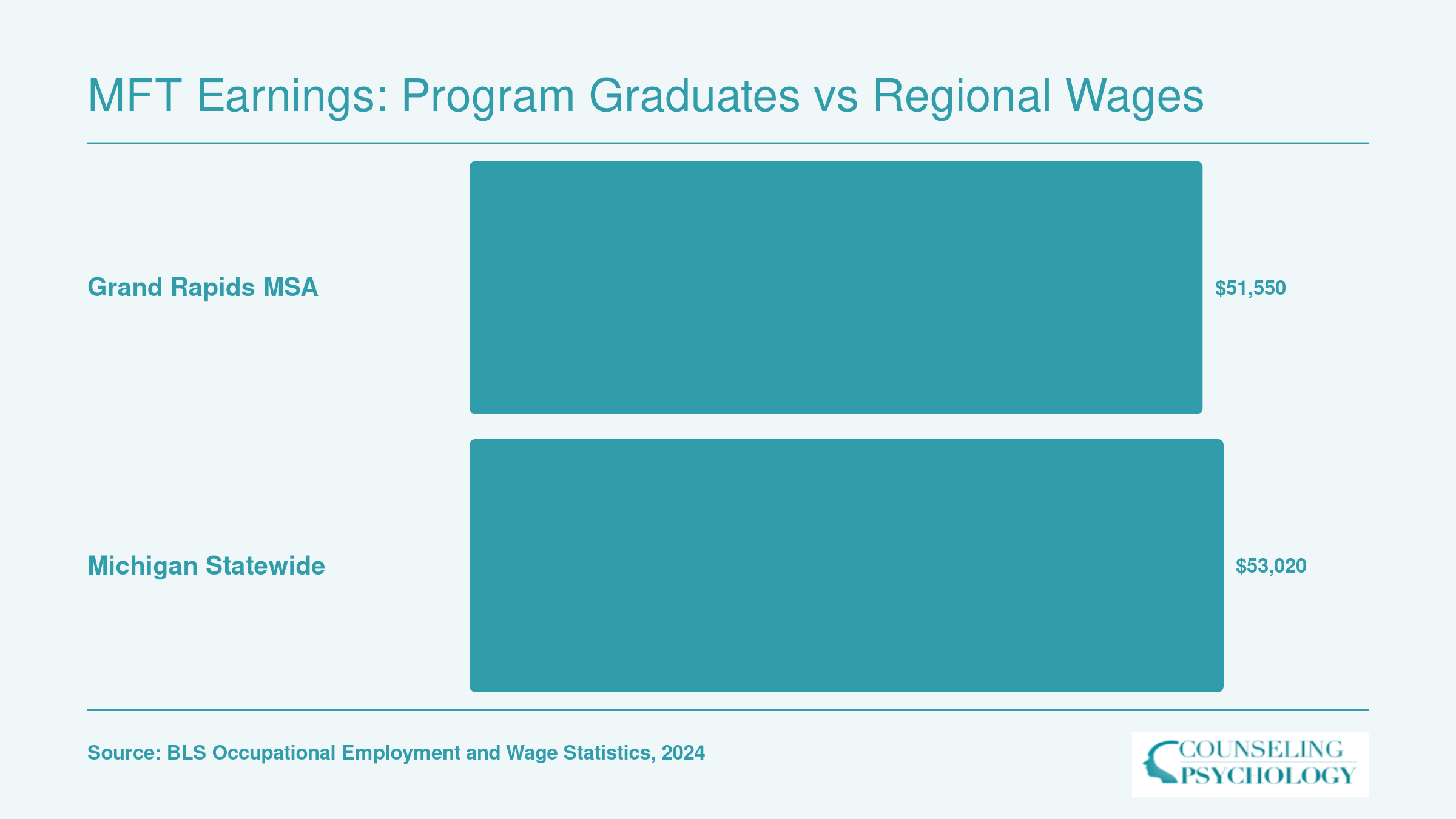
MFT Earnings: Program Graduates vs Regional Wages
Why do College Scorecard earnings and BLS salary figures sometimes tell different stories? Scorecard data captures median earnings for all graduates of a program one year after completion, regardless of whether they are working as MFTs, still completing supervised hours, or employed in a different field. BLS wage data, by contrast, reflects only those workers classified as marriage and family therapists. Program-level graduate earnings for the ranked schools near Grand Rapids are not yet available through the Scorecard, but the BLS benchmarks below illustrate what practicing MFTs earn in the Grand Rapids metro area compared to the Michigan statewide median.
Why Grand Rapids Stands Out for MFT Clinical Training
What clinical training opportunities actually exist for MFT students in Grand Rapids, and does the city offer enough diversity and caseload variety to prepare a well-rounded therapist?
A Rich Ecosystem of Clinical Placement Sites
Grand Rapids hosts several well-established agencies that routinely work with graduate trainees in mental health and family therapy settings. Pine Rest Christian Mental Health Services operates one of the largest behavioral health networks in West Michigan, offering exposure to a broad range of presenting concerns across outpatient, inpatient, and community-based programs. Cherry Health, a federally qualified health center, serves patients across multiple sites and populations, including individuals facing housing instability, substance use challenges, and primary care integration needs. Both organizations publish internship postings and demographic reports on their websites, making them practical starting points for students researching supervised hours.
Beyond those anchor institutions, the area includes county community mental health offices, school-based counseling programs, and private group practices that have historically partnered with regional graduate programs. Students should contact program coordinators directly to ask which specific agencies currently hold active practicum agreements, since placement availability changes each academic year.
Demographic Complexity That Sharpens Clinical Skills
Grand Rapids is one of the faster-growing mid-sized cities in the Midwest, and its population reflects meaningful cultural and linguistic diversity. The city has been a designated refugee resettlement hub for decades, welcoming families from regions including East Africa, Southeast Asia, and the Middle East. Working with newly arrived families requires therapists to think carefully about intergenerational trauma, acculturation stress, and culturally responsive intervention models. That context gives MFT trainees in Grand Rapids exposure that students in more homogeneous markets rarely encounter during practicum.
For current resettlement figures and population growth trends, the Grand Rapids city data portal and the West Michigan Chamber of Commerce publish periodic reports worth reviewing before you choose a program.
How to Verify Demand and Placement Quality
State-level MFT employment data from BLS.gov can give you a rough signal about workforce demand in Michigan broadly, though county-level MFT figures are often suppressed due to sample size. Use state projections as a directional indicator, then supplement with local agency job boards to gauge active hiring in Kent County. Students comparing options nationally may also want to review rankings of the best MFT programs in the US to understand how regional offerings stack up. Program directories are useful for identifying which programs have established roots in the Grand Rapids market and can point you toward coordinators who know the local placement landscape firsthand.
The best MFT program for you depends on what you prioritize: COAMFTE accreditation, dual-licensure flexibility, online access, or proximity to Grand Rapids clinical training sites. There is no single right answer. Before enrolling in any online program, confirm that its practicum and supervision structure satisfies Michigan's specific LMFT licensure requirements. A mismatch here can cost you semesters of progress and delay your path to independent practice.
Graduate Certificate and Post-Master's MFT Options for Michigan Residents
A graduate certificate in marriage and family therapy cannot, on its own, qualify you for LMFT licensure in Michigan. State regulations administered by LARA require a master's degree or higher as the minimum educational credential, and no certificate pathway substitutes for that foundational requirement. Understanding this distinction matters because it shapes whether a certificate program makes sense for your career goals or represents a costly detour.
Who Should Consider a Post-Master's Certificate
Graduate certificates in MFT exist primarily for clinicians who already hold a master's degree in a related field, such as clinical mental health counseling, social work, or psychology, and want to add systemic therapy competencies or fill coursework gaps required for LMFT eligibility. If you completed a counseling master's that lacked the specific content areas Michigan requires (6 semester hours each in family studies, family therapy methodology, and human development, plus ethics and research credits), a certificate in family therapy can bridge those gaps without requiring you to complete an entirely new degree.
Andrews University in Berrien Springs offers the only Michigan-based post-master's certificate specifically designed to align with state LMFT requirements.2 This campus-based program targets graduates of clinical mental health counseling programs or similar degrees who need additional MFT-focused coursework and supervised clinical hours. For residents who cannot relocate, online options exist through National University (a 12-month certificate)3 and Regent University (requiring a 60-credit counseling master's as a prerequisite).4 Regent's program explicitly notes it is not intended for initial licensure, reinforcing that these certificates supplement rather than replace a qualifying degree.
When You Need a Full Master's Degree
If you do not already hold a graduate degree in a mental health field, a certificate program will not advance your licensure timeline. Michigan's LMFT pathway requires completion of a master's or doctoral degree, plus 300 practicum client hours with 60 supervision hours during training, followed by 1,000 post-degree client hours (including 500 with couples or families) and 200 supervision hours before you can sit for the AMFTRB national examination.
Graduates of COAMFTE-accredited programs automatically satisfy the educational requirement. Those from non-accredited programs must demonstrate coursework equivalency across all mandated content areas, a process that can delay licensure if transcripts reveal deficits. For anyone starting fresh, pursuing an accredited master's rather than piecing together credentials through certificates typically offers a cleaner, faster route to practice.