What you’ll learn in this article…
- Miami-area clinical and counseling psychologists earn a median wage of $96,540 per year, with top earners exceeding $171,600.
- Florida requires a doctoral degree plus supervised postdoctoral hours for full child psychologist licensure.
- Certificate, master's, and doctoral programs serve different career goals, ranging from six months to seven or more years of training.
- APA accreditation at the doctoral level is the strongest predictor of licensure portability and employer recognition.
Clinical and counseling psychologists in the Miami-Fort Lauderdale metro earned a median wage of $96,540 in 2025, yet reaching that credential requires a doctoral degree, a supervised postdoctoral year, and passage of national licensing exams. That timeline typically runs eight to ten years from a bachelor's degree. For students in South Florida, the practical tension is real: the region's high cost of living collides with graduate tuition that can exceed $60,000 at private institutions.
Florida's public university system offers a partial counterweight, and several programs within commuting distance of Miami price doctoral training more competitively than their private counterparts. Students exploring MFT programs in Florida or related counseling degrees will find similar cost dynamics at play. The gap between the most and least expensive routes to licensure can reach six figures in total outlay, which makes program selection a financial decision as much as an academic one.
Demand for child and adolescent mental health services in Miami-Dade County continues to outpace the licensed workforce, a pressure that makes Spanish-English bilingual training a concrete professional asset rather than a resume footnote.
Best Affordable Child Psychology Programs Near Miami
While Miami itself is home to several graduate-level psychology programs, Florida residents looking for a cost-effective undergraduate foundation in child psychology have options across the state system. The program below stands out for its combination of low net price, specialized child psychology coursework, and strong preparation for graduate study, all at in-state tuition rates that Miami-area students can access. Net prices listed reflect institution-wide averages after financial aid and will vary based on each student's aid package.
- Net price after financial aid
- Graduation and retention rates
- Child psychology curriculum depth
- Graduate school preparation quality
- Accessibility for Florida residents
- NCES-IPEDS federal institutional data — nces.ed.gov
- College Scorecard graduate earnings — collegescorecard.ed.gov
- Independent program research
- Internal program database

University of North Florida
The University of North Florida offers a dedicated Child Psychology concentration within its Bachelor of Science in Psychology, a relatively uncommon specialization at the undergraduate level among Florida public universities. With a net price averaging around $10,154 after aid and median graduate debt of roughly $15,531, UNF delivers solid value, particularly for Miami-area students who qualify for in-state tuition under standard Florida residency rules. Graduates across all programs at UNF report median earnings of $56,343 ten years after enrollment, and the university maintains a 69.2% graduation rate. More than 61% of undergraduates receive Pell Grants, reflecting the university's commitment to serving students from a range of economic backgrounds.
- Dedicated child psychology track within the BS in Psychology
- Coursework in developmental stages and adolescent psychological processes
- Research methods training with hands-on lab opportunities
- Multiple experimental psychology courses build analytical skills
- Practicum placements connect classroom learning to applied settings
- Comprehensive developmental psychology sequence across semesters
- Strong foundation for graduate programs in clinical child psychology
- Florida Bright Futures and state aid eligible for qualifying students
Bachelor of Science in Psychology, Child Psychology Concentration — On-Campus
How to Become a Child Psychologist in Florida
Becoming a child psychologist in Florida requires a doctoral degree and state licensure, a longer and more rigorous pathway than the master's-level route to child counseling or therapy. This distinction is critical for prospective students weighing career timelines, investment, and scope of practice. A licensed psychologist holds a PhD or PsyD and can conduct psychological testing, diagnose disorders independently, and practice autonomously. A licensed mental health counselor (LMHC) or child therapist typically holds a master's degree, provides counseling and intervention within defined scopes, and does not perform formal psychological assessments. Both roles serve children and families, but the training intensity and clinical authority differ substantially.
Bachelor's Degree in Psychology or Related Field
The journey begins with a four-year bachelor's degree in psychology, child development, or a closely related behavioral science. This foundation provides coursework in developmental psychology, research methods, and statistics. Students interested in child psychologist education requirements should seek opportunities to volunteer in schools, pediatric clinics, or community mental health settings during their undergraduate years to clarify their career goals and build early experience.
Master's Degree: Optional or Required?
Most doctoral programs in clinical or school psychology accept applicants directly from a bachelor's program. However, some students choose to earn a master's degree in psychology first, particularly if their undergraduate GPA or research experience is modest. A master's can strengthen an application and provide interim licensure options. Florida licenses master's-level practitioners as LMHCs after completing a minimum of 60 graduate credits, two years of supervised experience totaling 1,500 hours, and passing a national examination.1 This pathway allows practice as a child therapist or counselor but does not confer the title or full scope of a psychologist.
Doctoral Degree: PhD or PsyD
To become a licensed psychologist in Florida, a doctoral degree from an APA-accredited program is strongly preferred by the Florida Board of Psychology and virtually required by competitive employers.2 PhD programs emphasize research and typically take five to seven years, including a dissertation. PsyD programs focus on clinical training and often complete in four to six years. Both tracks require at least 2,000 hours of predoctoral internship and a robust curriculum in assessment, intervention, ethics, and child development.2 For a deeper look at doctoral options, see our guide to child psychology PhD programs.
Postdoctoral Supervised Experience
After earning the doctorate, Florida requires 2,000 hours of postdoctoral supervised experience under a licensed psychologist. Combined with the 2,000-hour predoctoral internship, candidates must complete a total of 4,000 supervised hours before applying for licensure.2 This postdoctoral year allows new psychologists to refine clinical skills, gain specialty experience in pediatric settings, and work toward independent practice.
Licensure: EPPP and Florida Jurisprudence Exam
Florida licensure as a psychologist requires passing the Examination for Professional Practice in Psychology (EPPP) with a minimum score of 500. Applicants must also pass the Florida laws and rules examination, which covers state-specific statutes, ethics, and professional conduct. The application fee is $305 as of 2025-2026. Recent regulatory updates include mandatory electronic fingerprinting via an approved provider for all new applicants, enacted under House Bill 975 in 2024, to streamline background checks and improve public safety oversight.4 Once licensed, psychologists may specialize further in child and adolescent psychology through postdoctoral fellowships, board certification, or focused practice in schools, hospitals, or private clinics serving Miami-area families.
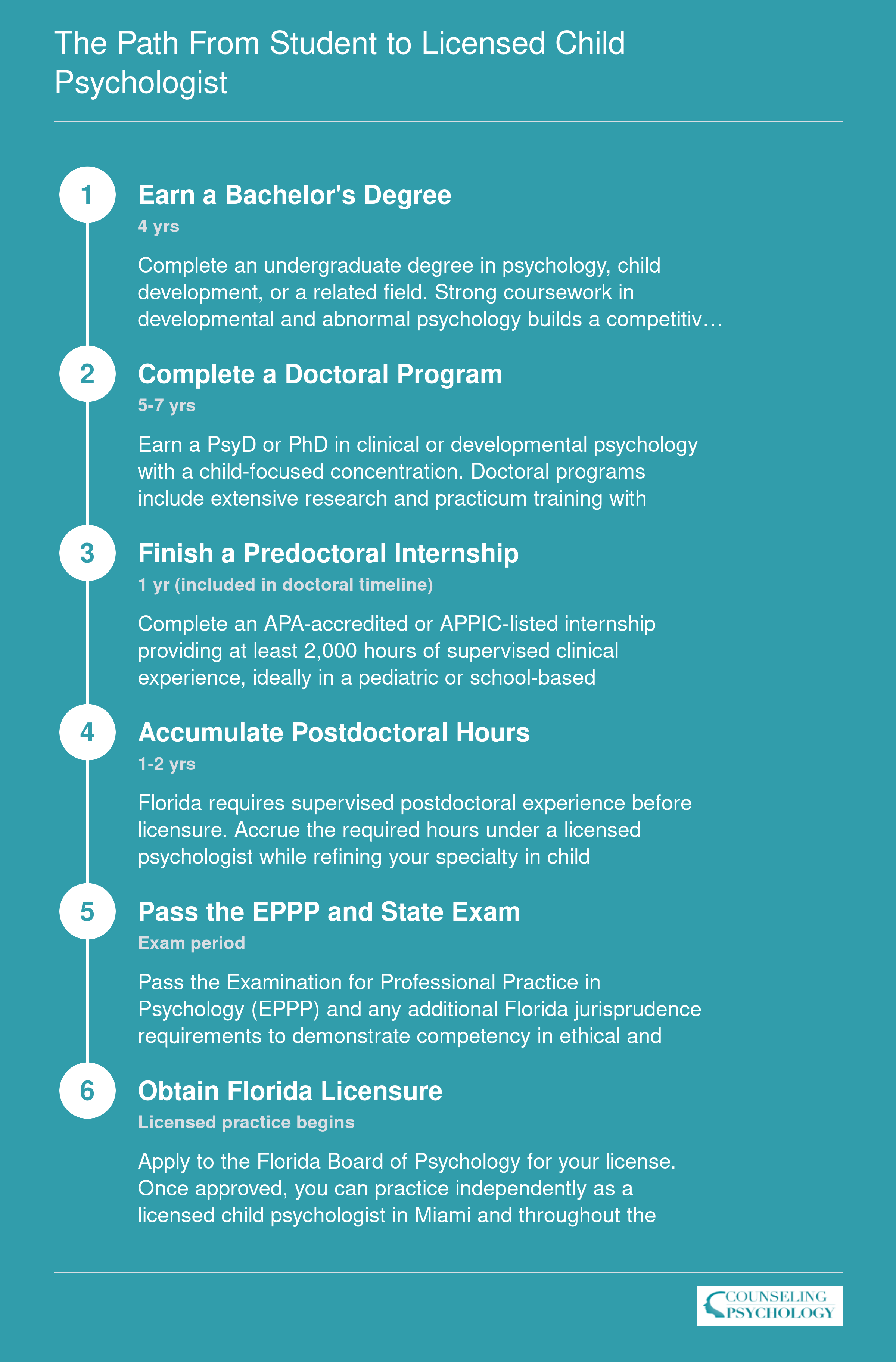
The Path from Student to Licensed Child Psychologist
Becoming a licensed child psychologist in Florida is a multi-year commitment that moves through distinct academic and clinical milestones. Here is the typical credentialing sequence, with approximate timelines at each stage.
Program Levels: Certificate vs. Master's vs. Doctorate
A six-month certificate and a five-to-seven-year doctorate sit at opposite ends of the commitment spectrum, yet both can lead to meaningful work with children. The credential you pursue should match your career goal, your budget, and how much autonomy you want in clinical practice.
Certificate Programs
Certificates come in two flavors. A non-degree child psychology certificate typically runs 6 to 11 months and prepares graduates for entry-level roles such as child care worker, preschool aide, after-school program leader, or behavior technician.1 These programs do not qualify you for any clinical license, but they offer a fast, affordable on-ramp into youth-serving settings.
A graduate certificate in child mental health is a different animal. Usually 12 to 24 months, it is designed for professionals who already hold a degree in teaching, social work, or counseling and want to add a child-focused specialization.2 It will not unlock a new license on its own, but it deepens clinical competence and can make you more competitive for supervisory or specialized positions.3
Master's Degree
A master's in mental health counseling, marriage and family therapy, or a related field generally takes two to three years and ranges roughly from $20,000 to $60,000 depending on the school and residency status. In Florida, a master's degree is the gateway to licensure as a Licensed Mental Health Counselor (LMHC) or Licensed Marriage and Family Therapist (LMFT). These credentials allow you to diagnose and treat children in clinical settings, but Florida law reserves the title "psychologist" for doctoral-level practitioners. Master's-level clinicians typically practice as counselors or therapists, and many build thriving child-focused caseloads under those titles.
Doctoral Programs
If your goal is to hold the title of child psychologist, conduct psychological testing, or pursue academic research, you will need a PsyD or PhD in clinical or developmental psychology. Those considering this path may want to explore doctorate in counseling psychology programs as a related option. Expect five to seven years of full-time study, including a year-long predoctoral internship. Total cost varies widely: PhD programs at public universities sometimes offer tuition waivers and stipends, while PsyD programs at private institutions can exceed $150,000. Upon completion, you are eligible for licensure as a Licensed Psychologist in Florida, which opens doors to roles such as clinical child psychologist, pediatric psychologist, and faculty positions.
Choosing the Right Level
A few questions can narrow the field quickly:
- Timeline: Can you commit five-plus years, or do you need to be working within a year?
- Title and scope: Do you specifically need to practice as a psychologist, or are counselor and therapist roles a good fit?
- Cost tolerance: Doctoral training is the most expensive path, though funding opportunities exist, especially for PhD candidates.
- Current credentials: If you already hold a master's degree in a related field, a graduate certificate may be all you need to pivot toward child-focused work.
Understanding these distinctions before you apply saves both time and tuition dollars, and it keeps your training aligned with the license you actually need in the state of Florida.
Questions to Ask Yourself
Cost Comparison and Financial Aid Options for Miami-Area Programs
How much does it actually cost to become a licensed child psychologist in Florida? The total investment spans years of tuition, exam fees, supervised practice, and the income you forgo during training. Below, we break down the major expenses and the financial strategies that can keep them manageable.
Tuition and Fees: The Academic Investment
Your first expense is earning a bachelor's degree. At public universities like the University of North Florida, in-state tuition for a psychology major with a Child Psychology concentration is around $5,964 per year, while out-of-state students pay about $19,407 (2023 figures). Over four years, that totals roughly $24,000 for Florida residents and $78,000 for nonresidents, before any financial aid. Master's and doctoral programs add further costs: a two-year master's in mental health counseling or school psychology can run $15,000 to $35,000 in tuition at public institutions, and doctoral programs (Psy.D. or Ph.D.) can range from fully funded with stipends to upwards of $40,000 per year at private universities. Online or hybrid options may offer lower per-credit rates, and some employers provide tuition reimbursement, but always verify that the program meets Florida licensure requirements. For a broader look at the educational pathway, our guide on becoming a psychologist outlines each step from undergraduate work through licensure.
Beyond Tuition: Licensing and Exam Fees
Once you've completed your doctoral degree, you'll face a series of fixed licensing costs. In Florida, the total outlay for required exams and applications is approximately $1,112.1 This includes: - EPPP exam registration: $691.88 (exam fee plus test center charge)2 - Board application fee: $2001 - Initial licensure fee: $1001 - Jurisprudence exam: $1151 - Administrative fee: $51
These fees are non-negotiable and must be paid before you can practice independently. Keep in mind you may need to retake exams, which adds extra charges.
Supervised Experience and Opportunity Costs
Florida requires 2,000 hours of postdoctoral supervised experience. While many positions are paid, some offer minimal stipends or are unpaid, particularly at competitive sites. The opportunity cost (the salary you forgo by spending years in school and supervised training instead of working full-time) can easily add up to tens of thousands of dollars. A licensed psychologist in Florida can earn a median around $80,000 to $100,000 annually, so each year of training is a substantial indirect expense.
How Financial Aid Can Lower Your Net Price
Most students do not pay the full sticker price. At UNF, for example, 61% of undergraduates receive Pell Grants, signaling that need-based federal aid is widely accessible. Beyond grants and federal loans, there are targeted strategies for aspiring psychologists: - Graduate assistantships: Many Ph.D. programs offer tuition waivers and stipends in exchange for teaching or research. - Loan repayment programs: Psychologists working in high-need areas may qualify for the National Health Service Corps Loan Repayment Program or Public Service Loan Forgiveness after 10 years of qualifying employment. - Employer assistance: Some hospitals and community mental health centers offer tuition benefits for employees pursuing advanced degrees.
The Bottom Line: What You'll Really Pay
Considering all components, a realistic total investment for earning a child psychologist license in Florida could fall between $50,000 and $150,000. This range covers a cost-effective path (public in-state bachelor's, funded doctoral program, and minimal debt) versus a more expensive route (private or out-of-state tuition, unfunded Psy.D., and high living expenses). Financial aid, strategic program choice, and loan forgiveness can significantly reduce the final amount. The key is to map out your entire educational journey and apply for every grant and assistantship available. The long-term career rewards in this field often justify the upfront commitment.
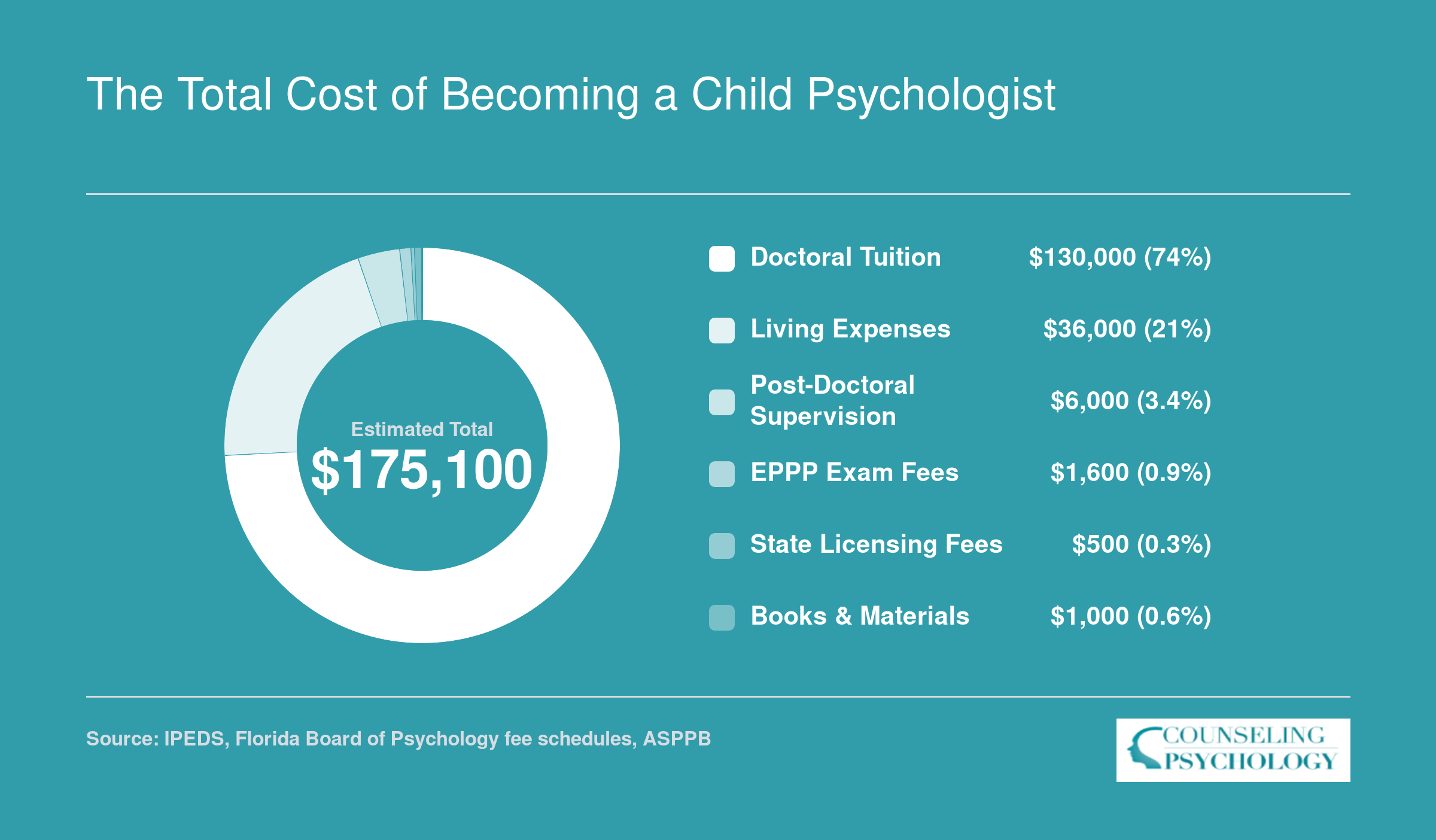
The Total Cost of Becoming a Child Psychologist
Earning a license as a child psychologist in Florida requires years of graduate training, supervised practice, and several rounds of fees. Understanding where the money goes helps you budget realistically and target financial aid to the biggest cost categories.
Online vs. On-Campus Formats in South Florida
South Florida students pursuing a child psychology degree have more format options than ever, but the right choice depends on your career stage, clinical goals, and target degree level. Both online and on-campus paths can lead to the same credentials, though each comes with tradeoffs worth weighing carefully.
Pros
- Online formats offer scheduling flexibility that lets working professionals in Miami balance coursework with jobs or family responsibilities.
- Tuition for online programs is often lower because you avoid campus fees, commuting costs, and sometimes qualify for reduced per-credit rates.
- Studying online opens access to well-regarded programs outside South Florida, including schools like the University of West Florida or Capella University.
- On-campus programs in Miami-Dade typically include built-in practicum placements at local clinics, hospitals, and school districts.
- Face-to-face instruction supports hands-on clinical training in child assessment, play therapy, and behavioral observation from the start.
- In-person cohorts make it easier to build professional networks with local clinicians, supervisors, and potential employers in the Miami area.
- Hybrid formats, offered by schools like Nova Southeastern University, combine the convenience of online coursework with required on-site clinical intensives.
Cons
- Online students often need to arrange their own local practicum or internship sites, which can be time-consuming in a competitive metro like Miami.
- Doctoral programs in psychology almost always require in-person clinical components, regardless of whether coursework is delivered online.
- On-campus programs typically carry higher total costs once you factor in parking, campus fees, and the opportunity cost of a rigid class schedule.
- Fully online formats may limit real-time interaction with faculty mentors who specialize in child and adolescent populations.
- Students in on-campus programs have less flexibility to work full time, which can increase reliance on loans or savings during training.
- Some employers and licensing boards scrutinize the accreditation status of fully online doctoral programs more closely than traditional ones.
Career Outcomes and Salary Expectations in Miami
Clinical and counseling psychologists in the Miami-Fort Lauderdale-Pompano Beach metro earn a median wage of $96,540 per year, with the top 10% pulling in $171,600 or more, according to 2025 labor data for the region.1 That puts experienced child psychologists in Miami well above the regional median across all occupations and competitive with national figures for the specialty.
How Much Does a Child Psychologist Make in Miami?
The direct answer depends on which credential you hold and where you practice. For doctoral-level clinicians (Ph.D. or Psy.D.) working under SOC 19-3033, the Miami metro wage distribution looks like this:
- 10th percentile: $51,170 (typical for early-career or part-time clinicians)
- 25th percentile: $67,480
- Median: $96,540
- 75th percentile: $132,890
- 90th percentile: $171,600
School psychologists (SOC 19-3034), who usually hold a specialist-level Ed.S. and work in K-12 settings, earn somewhat less but still command solid wages tied to district pay scales:
- 10th percentile: $49,930
- 25th percentile: $61,210
- Median: $80,340
- 75th percentile: $98,760
- 90th percentile: $121,020
The metro currently employs about 1,020 clinical and counseling psychologists and 860 school psychologists, so both pathways have real hiring volume.1
Early-Career Earnings vs. Established Practice
Those BLS figures reflect the full career arc, not what graduates take home in year one. Program-level earnings data tells a different story for the front end of the career. Graduates of the University of North Florida's child psychology bachelor's program, for example, report median earnings around $56,343 about a decade after enrollment, a figure that reflects the mix of bachelor's-level graduates who go directly into the workforce versus those who continue to graduate study. For context, counselor salary benchmarks nationally show similar variation based on degree level and specialty. Bachelor's holders typically work as behavior technicians, case managers, or research assistants while earning under $50,000 until they complete a master's or doctoral degree. The jump to six-figure earnings happens after licensure as a psychologist, which requires a doctorate plus supervised hours.
Who's Hiring in Miami-Dade
Major employers include Miami-Dade County Public Schools (the fourth-largest district in the U.S., with steady demand for school psychologists), Nicklaus Children's Hospital, Jackson Health System's pediatric behavioral health units, community mental health centers like Citrus Health Network, and a growing private practice sector serving the area's bilingual families. Some graduates also pursue roles in childhood trauma counseling, given the high demand for specialized services in South Florida's diverse communities. Spanish-English fluency is a meaningful wage and hiring advantage across all of these settings.
Practicum and Internship Opportunities in Miami-Dade
The demand for culturally competent child and adolescent mental health providers is reshaping practicum and internship availability across Miami-Dade County. For students enrolled in child psychology programs near Miami, securing supervised clinical training is a non-negotiable step toward licensure, and the region offers a robust network of pediatric-focused sites.
APPIC and the Predoctoral Internship Match
The Association of Psychology Postdoctoral and Internship Centers (APPIC) maintains a searchable directory of accredited predoctoral internships. Filtering by location for the Miami metro area and narrowing results to child or pediatric tracks yields a focused list of competitive placements. Most positions participate in the APPIC Match, with deadlines in early November. Reviewing site details directly through appic.org helps you align your application with programs that emphasize child assessment, therapy, and developmental interventions.
Leading Local Training Sites
Several Miami-area institutions anchor the practicum and internship landscape for child psychology trainees. - Nicklaus Children's Hospital: The hospital's psychology training programs include a predoctoral internship and advanced practica in pediatric psychology, neuropsychology, and integrated primary care. Application deadlines are typically in October for the following academic year. Visit the official psychology training page for current announcements and contact information. - University of Miami: The Department of Psychology's Clinical Training program coordinates placements through the Psychological Services Center and affiliated clinics like the Child and Adolescent Mood and Anxiety Disorders Program. Graduate students often secure practicum hours here before advancing to internship. - Nova Southeastern University: The College of Psychology's Center for Psychological Studies runs multiple training clinics, including a school-related assessment and intervention practicum. Priority is given to NSU students, but externally funded positions occasionally open.
School Psychology and District Partnerships
Miami-Dade County Public Schools (MDCPS) operates the fourth-largest school district in the nation, and its Department of Psychological Services regularly hosts school psychology interns. These placements emphasize psychoeducational assessment, crisis intervention, and consultation. Contact the district's psychology coordinator directly through the MDCPS website or by phone to inquire about availability and application requirements. Many graduate programs have formal agreements that streamline the placement process.
Professional Association Listings
Broader networking can surface additional child and pediatric training slots. - APA Division 54 (Society of Pediatric Psychology): The division's online forums and annual conference career center often feature pediatric psychology internship and postdoctoral listings. - Florida Psychological Association: The FPA's job board and local chapter meetings provide leads on practicum sites in the Miami area that may not be listed in national directories. Membership is not required to browse the board, but joining can strengthen your visibility.
Pursuing a diverse mix of rotations during practicum, especially across hospital, clinic, and school settings, makes your internship application more competitive and ensures broad clinical readiness. Students still weighing undergraduate options may want to explore an online child psychology degree before committing to a doctoral track, while those drawn to Florida's graduate landscape should review clinical psychology programs in Florida for a wider comparison of accredited options.
For doctoral-level training, APA accreditation is the single biggest signal of program quality: it determines licensure portability across states, eligibility for APA-accredited internships, and recognition by major employers and the VA. Always confirm a program's current accreditation status directly on the APA website before you enroll, since standing can change.
How to Choose the Right Child Psychology Program
Choosing between a nationally ranked research institution and a smaller practitioner-focused program shapes your entire career trajectory, from the populations you train with to the professional networks you build. Both paths can lead to licensure, but the fit matters as much as the prestige.
Start with Accreditation Verification
Before comparing tuition, faculty, or location, confirm that any doctoral program you consider holds APA accreditation. The American Psychological Association maintains a searchable database at APA.org where you can filter by state and program type (clinical, counseling, or school psychology). In Florida, graduating from an APA-accredited program is effectively required for licensure, so this step is non-negotiable.
For South Florida specifically, look up the current accreditation status for programs at University of Miami, Nova Southeastern University, Florida International University, and Carlos Albizu University. Accreditation can change, so verify directly rather than relying on outdated lists.
Dig into Program-Specific Details
Each university's program page offers information that generic rankings cannot capture:
- Application requirements: GRE policies, prerequisite coursework, and interview formats vary significantly.
- Faculty expertise: If you want to specialize in trauma, autism spectrum disorders, or bilingual child therapy, check whether faculty conduct research in those areas.
- Internship match rates: A strong match rate (ideally above 90 percent) indicates that graduates compete successfully for APPIC internships, which are required for licensure.
- Cohort size: Smaller cohorts often mean more direct faculty mentorship, while larger cohorts may offer broader peer networks.
Research Career Outcomes and Salaries
The Bureau of Labor Statistics (BLS.gov) publishes salary data and employment projections for psychologists in the Miami-Fort Lauderdale metro area. These figures help you gauge earning potential after you finish training, but remember that the BLS reports general psychologist wages, not child psychology specifically. Your actual salary will depend on setting (private practice, hospital, school district) and years of experience. If you are still weighing clinical versus counseling tracks, our overview of online clinical psychology programs can help you compare curricula side by side.
Contact Admissions Directly
Websites can lag behind reality. Call or email program admissions offices to confirm accreditation status, ask about upcoming application deadlines, and inquire about recent cohort placements. Questions worth asking include how many students matched to APA-accredited internship sites last cycle, what percentage of graduates obtained licensure within two years, and whether the program offers supervised hours with pediatric populations during practicum.
Direct conversations also reveal intangibles like responsiveness, transparency, and how current students describe their experience. These details help you distinguish between programs that look similar on paper but feel quite different in practice.
Frequently Asked Questions About Child Psychology Programs in Miami
Prospective students regularly ask about costs, salaries, and licensing steps before committing to a child psychology program. The answers below draw on the program details and labor market data discussed throughout this article.