
What you’ll learn in this article…
- UNR and UNLV are the only two Nevada public universities offering a counselor education doctorate near Reno.
- CACREP accreditation leads to licensed clinical professional counselor status, while APA accreditation targets psychologist licensure.
- Nevada requires 3,000 post-doctoral supervised hours for LCPC licensure and 2,000 for psychology licensure.
- Online and hybrid doctoral programs from CACREP-accredited schools expand options for students staying in northern Nevada.
Nevada recognizes 390 licensed clinical professional counselors and 220 clinical psychologists, yet only two public universities in the state offer doctoral training in counselor education. For Reno-area students, that means choosing between the University of Nevada, Reno's campus-based PhD in Counselor Education and Supervision or exploring hybrid and online doctorate in counseling programs from institutions across state lines. The two main doctoral paths diverge sharply: a PhD in Counselor Education prepares you to supervise LPCs, teach future counselors, and shape programmatic accreditation, while a PhD in Counseling Psychology is an APA-accredited track leading to licensure as a clinical psychologist with a broader diagnostic and research scope.
The distinction matters immediately. CACREP-accredited counselor education programs rarely offer full funding packages, while APA-accredited counseling psychology programs typically include tuition waivers and stipends but accept fewer students and demand stronger research profiles. Licensure timelines, supervised-hour requirements, and insurance reimbursement rates all hinge on which accreditation standard your program meets. Reno's small doctoral pipeline also means fewer on-the-ground practicum sites and a tighter job market for tenure-track faculty roles, pushing many graduates toward clinical supervision, agency leadership, or out-of-state academic positions.
Best Doctorate in Counseling Programs Near Reno, Nevada
Nevada's doctoral landscape for counselor education is compact: only two public universities in the state offer a Ph.D. focused on counselor education and supervision. For Reno-area students, the University of Nevada, Reno provides a local, campus-based option, while the University of Nevada, Las Vegas serves as the state's other accredited pathway. Both are CACREP-accredited, and both sit within the Nevada System of Higher Education, meaning Nevada residents benefit from significantly lower tuition at either institution. Because the in-state universe is small, prospective doctoral students should also weigh online and hybrid programs from accredited institutions outside Nevada, a topic covered in a separate section of this article.
- CACREP accreditation status
- In-state and out-of-state tuition
- Institutional graduation and retention rates
- Program curriculum and career preparation
- Regional workforce alignment
- Independent program research
- NCES-IPEDS federal institutional data — nces.ed.gov
- College Scorecard graduate earnings — collegescorecard.ed.gov
- Internal program database

University of Nevada-Reno
The University of Nevada, Reno houses a CACREP-accredited Ph.D. in Education with a concentration in Counselor Education and Supervision, built around 72 credit hours of advanced coursework, supervised teaching, clinical supervision, and an original dissertation. UNR's deep ties to northern Nevada school districts, community mental health agencies, and state education systems make it a strong fit for professionals who plan to practice, teach, or lead within the region. The university has also moved toward holistic admissions, de-emphasizing GRE scores in favor of prior counseling experience and academic record, which lowers a common barrier for working professionals. Institution-wide, UNR reports a 61.2% graduation rate, a 17:1 student-to-faculty ratio, and in-state tuition of approximately $7,032 per year (out-of-state: $25,174), with a net price around $15,927.
- CACREP-accredited doctoral program with a three-year completion target
- Requires 72 credit hours beyond an accredited master's in counseling
- Campus-based format in Reno with supervised teaching experiences
- Strong emphasis on research, leadership, advocacy, and multiculturalism
- Clinical supervision opportunities in Washoe County schools and agencies
- Prepares graduates for counselor educator, agency director, and school leadership roles
- GRE generally not required; holistic admissions review emphasized
- Assistantships and tuition remission may be available for qualified applicants
Ph.D. in Education: Counselor Education and Supervision — On-Campus

University of Nevada-Las Vegas
The University of Nevada, Las Vegas offers a Doctor of Philosophy in Counselor Education and Supervision grounded in five core competency areas: counseling, supervision, teaching, research, and leadership. The program foregrounds multicultural and social justice competency, reflecting UNLV's position within one of the most diverse metropolitan areas in the West. For Reno-area applicants, UNLV remains a viable option because Nevada residents pay the same in-state tuition regardless of campus location, and UNLV has expanded virtual interview and hybrid meeting options that reduce travel demands. In-state tuition sits at roughly $7,413 per year (out-of-state: $25,555), with a lower net price of about $10,359. The institution-wide graduation rate is 50.5%, and the student-to-faculty ratio is 19:1. Program-level earnings data is not yet available for this degree.
- CACREP-accredited campus-based doctoral program in Las Vegas
- Curriculum organized around five core areas: counseling, supervision, teaching, research, leadership
- Strong multicultural and social justice orientation throughout coursework
- Requires a master's degree in a counseling-related field for admission
- Practicum and supervision sites include Clark County schools and community agencies
- GRE de-emphasized; admissions prioritize experience, academic record, and program fit
- Virtual interview options available, reducing travel for northern Nevada applicants
- Nevada residents benefit from in-state tuition across the state system
Doctor of Philosophy in Counselor Education and Supervision — On-Campus
Tuition, Costs, and Funding Opportunities for Counseling Doctorates
Fully funded counseling psychology PhD programs promise tuition waivers, stipends, and healthcare, while counselor education doctorates typically require students to patch together GA lines, loans, and outside work. Understanding the funding landscape before you apply can mean the difference between graduating debt-free and carrying six figures into your first faculty or clinical post.
Tuition and Net Price at Reno-Area Programs
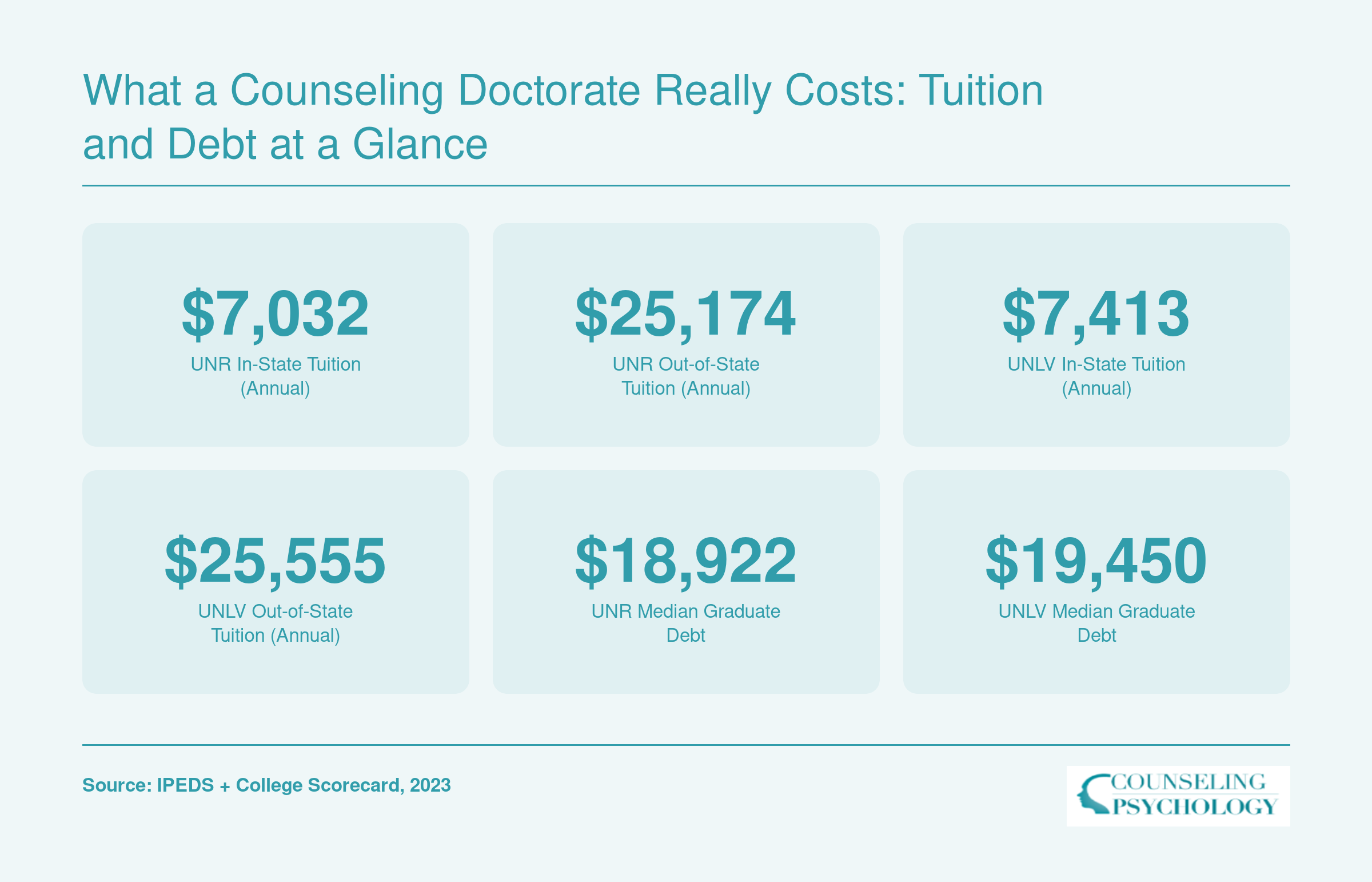
The University of Nevada, Reno lists in-state tuition at $7,032 per year and out-of-state tuition at $25,174 for its Counselor Education and Supervision PhD.1 UNLV's Counselor Education doctoral program charges $7,413 in-state and $25,555 out-of-state. These figures represent per-year sticker prices for full-time enrollment. Net price averages published by the Department of Education ($15,927 at UNR, $10,359 at UNLV) reflect institution-wide estimates across all students and all aid types, not a guarantee of what any individual doctoral student will pay after assistantships and waivers.
Over a typical four-year timeline, a self-funded student at UNR could face $28,000 to $100,000 in tuition alone, depending on residency. Add mandatory fees (approximately $800 to $1,200 per year), books, technology, professional liability insurance, conference travel, and Reno's rising cost of living (median rent for a one-bedroom apartment runs $1,300 to $1,500 per month as of 2026), and total doctoral costs can easily exceed $150,000 without funding.
Graduate Assistantships and Tuition Waivers at UNR
UNR's Counselor Education and Supervision PhD offers limited graduate assistantship positions on a competitive basis.2 Assistantship types include graduate research assistantships (GRAs), graduate teaching assistantships (GTAs), and general graduate assistantships (GAs). Recipients receive a full or major tuition waiver covering most graduate credits, though mandatory fees remain the student's responsibility.2 Stipend amounts and FTE percentage vary by role and funding source; prospective applicants should contact the program coordinator, Dr. Kristina DePue, at [email protected] for current figures.
Because assistantship lines are limited, not every admitted student receives funding, and the program does not approach the fully funded model common in APA-accredited counseling psychology programs. The Nevada System of Higher Education also awards the Sam Lieberman Regents' Award ($5,000 in 2026) to graduate students across the system, though competition is statewide and spans all disciplines.3 Nevada Department of Education scholarships primarily support teacher-preparation candidates and do not extend to counseling doctoral students.4
What 'Fully Funded' Really Means (And Why It Matters)
Fully funded counseling psychology PhD programs cover tuition, provide a living stipend (often $20,000 to $30,000 per year), and include health insurance for the program's entire duration, typically five to six years. These packages are standard in APA-accredited clinical and counseling psychology programs, where doctoral students serve as lab researchers and teaching fellows. CACREP-accredited counselor education doctorates, by contrast, rarely offer blanket funding to all admitted students. Instead, a handful of GA positions circulate among cohorts, and many students finance their degrees through loans, part-time clinical work, or employer tuition benefits. Students weighing funding models across psychology disciplines may find it useful to compare how programs in areas like educational psychology doctoral programs structure their financial packages.
Program-specific debt data for UNR's counselor education doctorate are not yet reported in federal College Scorecard files. For comparison, institutional median debt figures show UNR undergraduates who borrowed carried $18,922 at graduation, with a projected ten-year monthly payment around the national median. Doctoral borrowers should anticipate higher totals if they rely on unsubsidized loans across four or more years, particularly when living expenses push annual borrowing above tuition costs alone.
What a Counseling Doctorate Really Costs: Tuition and Debt at a Glance
Understanding the full financial picture is essential before committing to a doctoral program. Here is a side-by-side snapshot of annual tuition rates and institution-wide median graduate debt for the two Nevada universities offering counseling doctorates near Reno.
CACREP vs. APA Accreditation: What It Means for Your Counseling Career
The single most consequential fork in a doctoral counseling career is which accreditation stands behind your degree, because that choice largely determines your licensure title, your scope of practice, and the professional community you join. Two programs can look similar on paper yet channel graduates into very different professional lives.
Two Degrees, Two Accrediting Bodies
A Counselor Education and Supervision (CES) doctorate is accredited by CACREP (the Council for Accreditation of Counseling and Related Educational Programs). A Counseling Psychology PhD is accredited by APA (the American Psychological Association). The University of Nevada, Reno offers a CACREP-accredited PhD in Counselor Education and Supervision, with accreditation extending through 2033.1 UNR does not operate an APA-accredited Counseling Psychology PhD, so Reno-area students who want the psychologist credential will need to look beyond the local campus. For a broader view of available counseling doctoral programs, it helps to compare options nationally.
Licensure Pathways and Scope of Practice
These two tracks diverge sharply at the licensing board:
- CACREP CES graduates typically pursue licensure as a Licensed Professional Counselor (LPC), Licensed Clinical Professional Counselor (LCPC), or equivalent. Their scope covers psychotherapy, clinical supervision, and some assessment, though psychological testing privileges are generally limited.
- APA Counseling Psychology graduates sit for licensure as a Licensed Psychologist. That credential opens access to broader psychological testing and assessment, plus eligibility for PSYPACT, the interstate practice compact for psychologists.
In Nevada specifically, the Board of Examiners for Marriage and Family Therapists and Clinical Professional Counselors oversees LPC/LCPC licensure, while the Board of Psychological Examiners governs the psychologist license. Graduating from a CACREP-accredited program smooths the LPC pathway and increasingly matters for interstate portability as more states tighten accreditation requirements for counseling licensure.3
Career Focus and Training Model
The day-to-day training differs too. A CES doctorate emphasizes counselor education, supervision pedagogy, and program leadership. Graduates typically become counselor educators, clinical supervisors, or program directors.2 An APA Counseling Psychology PhD follows a scientist-practitioner model, preparing graduates for roles as licensed psychologists in hospitals, VA systems, university counseling centers, or psychology faculty positions.
Practicum and internship expectations reflect that split. CES programs generally require a supervised teaching or supervision practicum plus advanced clinical hours, while APA programs require a formal predoctoral internship, often through the APPIC match.
Why It Matters for Your Decision
If your goal is to train the next generation of counselors or lead a counseling program, UNR's CACREP-accredited CES doctorate aligns directly with that career. If you want to practice as a psychologist with full testing privileges, you will need an APA-accredited program, which means looking at institutions outside Reno. Clarifying this distinction early prevents costly mid-career pivots and ensures the degree you earn matches the license you actually want to hold.
Questions to Ask Yourself
Nevada Licensure Pathways After a Counseling Doctorate
Licensure is the legal gate between completing a counseling doctorate and practicing independently in Nevada. The specific board you petition, the exams you sit for, and the supervised hours you must accumulate all depend on the type of doctoral degree you hold. Understanding these distinctions early prevents costly surprises after graduation.
Clinical Professional Counselor (CPC) Pathway
Graduates of Counselor Education or Clinical Mental Health Counseling doctoral programs apply through the Nevada Board of Examiners for Marriage and Family Therapists and Clinical Professional Counselors. The Clinical Professional Counselor (CPC) credential allows independent clinical practice, including diagnosis and treatment of mental health conditions. Those exploring the broader licensed professional counselor career path will find that Nevada's CPC requirements share many features with other states, though key details differ.
Current requirements for the CPC license include:1
- Supervised experience: 3,000 total hours, with at least 1,500 hours of direct client contact
- Supervision: 300 hours of face-to-face supervision from a board-approved supervisor
- Examination: Passing score on the National Clinical Mental Health Counseling Examination (NCMHCE)
- Fees: $150 application fee plus $60 initial license fee
- Renewal: $450 biennially, with 40 continuing education hours required (including 6 hours in ethics, 4 hours in suicide prevention, and 6 hours in cultural competency)
Notably, Nevada does not reduce supervised-hour requirements for doctoral graduates.1 Whether you hold a master's or a doctorate in counseling, you complete the same 3,000-hour supervised practice period before applying for CPC status.
Licensed Psychologist Pathway
If your doctorate is in Counseling Psychology rather than Counselor Education, you pursue licensure through the Nevada Board of Psychological Examiners. This route leads to the Licensed Psychologist credential, opening doors to a range of careers in psychology beyond traditional counseling roles.
Psychologist licensure in Nevada generally requires:
- Doctoral degree: From an APA-accredited or regionally accredited program in psychology
- Examination: Passing the Examination for Professional Practice in Psychology (EPPP)
- Postdoctoral supervision: Typically one year (approximately 1,500 to 2,000 hours) of supervised experience, though exact requirements should be confirmed with the board for current rules
- Jurisprudence exam: Demonstrating knowledge of Nevada law and ethics
Counseling psychology graduates who want the broadest scope of practice, including psychological testing and the psychologist title, should plan for this pathway from the start of their doctoral program.
Which Board Do You Apply To?
Your degree type determines your licensure route:
- Counselor Education, Clinical Mental Health Counseling, or similar counseling doctorates: Nevada Board of Examiners for MFTs and CPCs, leading to the CPC license
- Counseling Psychology (PhD or PsyD): Nevada Board of Psychological Examiners, leading to the Licensed Psychologist credential
Some graduates hold degrees that might qualify under either board. If your situation is ambiguous, contact both boards before you begin accumulating supervised hours to ensure your supervision arrangement meets their specific requirements.
Nevada-Specific Considerations
Nevada has joined the Psychology Interjurisdictional Compact (PSYPACT), which facilitates telehealth practice and temporary in-person practice across member states for licensed psychologists. For CPCs, interstate portability depends on individual reciprocity agreements, which can vary. If you anticipate practicing across state lines or via telehealth with out-of-state clients, verify current compact status and endorsement policies with the relevant board.
Recent legislative sessions have addressed telehealth expansion and supervision flexibility, particularly in response to workforce shortages in rural areas. Prospective licensees should review the most current statutes under NRS Chapter 641A and the board's administrative code to confirm any changes affecting their timeline or requirements.1
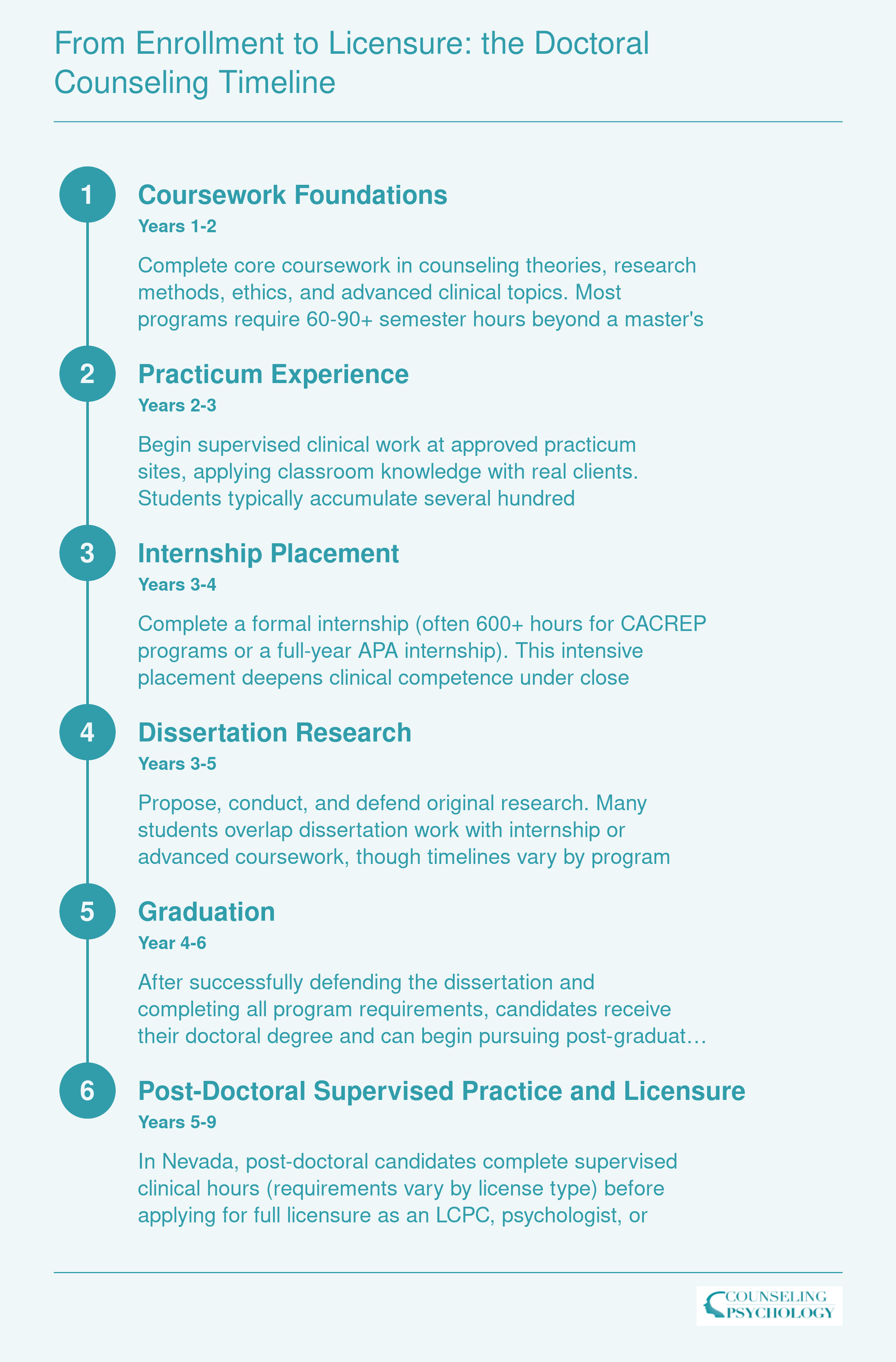
From Enrollment to Licensure: The Doctoral Counseling Timeline
Earning a doctorate in counseling and securing licensure is a multi-year commitment. The timeline below outlines a typical progression for PhD or counselor education doctoral students, from the first day of classes through independent practice.
Online and Hybrid Doctoral Options for Reno-Area Students
With only one CACREP-accredited doctoral program physically located in Reno, online and hybrid options dramatically expand the choices available to students who want to pursue a counselor education doctorate while remaining in northern Nevada. These distance-friendly programs let you access faculty expertise from institutions across the country without relocating, though they come with trade-offs worth understanding before you commit.
CACREP-Accredited Programs Serving Nevada Students
Regent University offers a CACREP-accredited Ph.D. in Counselor Education and Supervision delivered online with periodic residency requirements.1 The program accepts students nationally, making it accessible to Reno-area candidates who need flexibility around work and family obligations. While Regent is based in Virginia, its online structure means coursework happens asynchronously, with intensive on-campus residencies scheduled a few times per year.
Other institutions with CACREP-accredited online doctoral programs that accept students from western states include universities in Oregon, Idaho, and Colorado, though availability and specific Nevada practicum partnerships vary. Before enrolling, confirm directly with each program whether they have established relationships with clinical sites in the Reno-Sparks area or whether you will need to arrange your own placements.
Practicum Logistics for Distance Learners
Online delivery does not eliminate the clinical training requirements. CACREP doctoral standards mandate at least 100 practicum hours, including a minimum of 40 hours of direct client service.2 You will complete these hours in person at approved sites, regardless of where your coursework happens virtually.
Some online programs maintain formal agreements with practicum sites in major metropolitan areas but may have limited connections in smaller markets like Reno. If the program allows students to identify and propose their own sites, you will need to navigate the approval process yourself, which can add time to your timeline. Community mental health centers, university counseling centers, and private group practices in the Reno area may serve as potential placements, but securing supervisor availability requires advance planning.
Weighing Flexibility Against On-Campus Advantages
Online and hybrid formats offer clear benefits for working clinicians: you can maintain your caseload, stay in your community, and fit coursework around your schedule. Many programs design their part-time tracks for completion in four to five years, accommodating students who cannot leave their jobs. Students weighing a broader range of mft programs in Nevada or related master's-level credentials alongside a doctorate will find that online flexibility applies at multiple degree levels.
The trade-offs matter, though. Distance learners often miss the organic research mentorship that develops when you share physical space with faculty. Impromptu hallway conversations, lab collaborations, and cohort study groups happen differently, if at all, in virtual environments. If your career goals include academic positions at research-intensive universities, the reduced access to collaborative scholarship could affect your competitiveness. For students aiming primarily at clinical supervision, private practice leadership, or teaching at teaching-focused institutions, these limitations may feel less significant.
Time-to-Degree Considerations
Part-time online programs typically stretch longer than full-time residential options. Where the University of Nevada, Reno's in-person doctoral track runs approximately 36 months for full-time students3, online programs designed for working professionals often span 48 to 60 months. This extended timeline means more years paying tuition, but it also means you can continue earning a clinician's salary throughout your training rather than taking on additional debt to cover living expenses during a full-time program.
Reno area doctoral students train at a notably varied mix of clinical sites, including the VA Sierra Nevada Health Care System (serving veterans and military families), West Hills Hospital for acute behavioral health, Washoe County School District placements, and UNR's own Psychological Services Center. This range offers exposure to rural, urban, military, and school populations, giving graduates a competitive edge in demonstrating broad clinical competence before licensure.
Admission Requirements and How to Stand Out
Doctoral counseling admissions have grown more selective in recent years, with programs placing greater weight on research alignment and clinical experience alongside traditional academic metrics. If you are wondering how hard it is to get into grad school for psychology, the doctoral level raises the bar considerably.
Core Requirements Across Most Programs
Most counseling doctoral programs share a recognizable baseline of requirements:
- Degree: A master's degree in counseling or a closely related field is universally expected.
- GPA: A minimum of 3.0 is the common floor, though competitive applicants often present 3.5 or higher.1
- Standardized testing: Many programs have moved to test-optional policies. The University of Nevada, Reno's Counselor Education and Supervision PhD requires no entrance exam as of 2026.1
- Letters of recommendation: Three letters are standard at UNR, and most doctoral programs expect the same. At least one or two should come from faculty or supervisors who can speak to your scholarly and clinical capacity.2
- Written materials: UNR asks for a statement of purpose and one scholarly writing sample. Other programs use similar combinations. A writing sample drawn from a graduate thesis chapter or a published work carries more weight than a polished personal essay alone.2
The CACREP Master's Requirement
UNR requires that applicants hold a master's in counselor education from a CACREP-accredited institution.2 This is common among CACREP doctoral programs and reflects the curricular continuity the accreditor expects across degree levels.
If your master's came from a non-CACREP program, that does not automatically close the door everywhere, but it does narrow your options. Some programs will review applications from non-CACREP master's holders on a case-by-case basis, sometimes requiring additional coursework before full admission. Check each program's policy directly rather than assuming.
How to Build a Competitive Application
Meeting minimums is not the same as standing out. Programs admit small cohorts, and reviewers are looking for applicants who fit their current scholarly direction.
A few factors that consistently strengthen applications:
- Clinical licensure: Holding an LPC, LMFT, or equivalent credential signals professional seriousness and reduces time-to-licensure concerns for the program.
- Research experience: Work as a research assistant, co-authorship on a conference presentation, or involvement in a faculty project all demonstrate that you can function in an academic environment.
- A focused research agenda: Vague interest in "helping people" does not move an application forward. Identifying two or three specific questions you want to investigate, and connecting them to the work of faculty in the department you are applying to, is one of the highest-leverage things you can do.
Aligning With UNR Faculty
For the UNR Counselor Education and Supervision program specifically, the statement of purpose is where faculty alignment becomes concrete. Review the department's current faculty profiles, note the research areas that intersect with your own interests, and name those connections explicitly in your letter. Programs run on cohort models, and faculty are often selecting students they expect to collaborate with, not just teach. A generic statement of purpose reads that way immediately.
The 96-credit curriculum at UNR is designed for full professional preparation, so arriving with a clear sense of where your research fits signals that you are ready for that commitment.3
Career Outcomes and Salary Expectations for Counseling Doctorates
Earning a counseling doctorate opens doors to higher-level clinical, supervisory, research, and academic roles, but salary outcomes vary significantly by career path, licensure type, and geographic location. Understanding what graduates actually earn after completion helps prospective students weigh the investment against realistic financial returns in the Reno-area market and beyond.
Program-Level Earnings: What Graduates Report
Program-level outcomes data for the doctoral counseling programs near Reno is not yet available in federal reporting systems. These doctoral programs enroll relatively small cohorts, and early-career earnings after a doctorate can be influenced by whether a graduate pursues clinical practice, supervision, faculty positions, or research roles. Without published median earnings figures for these specific programs, prospective students should look closely at the career paths alumni follow and consult current students or program directors about typical post-graduation placements. When comparing return on investment, UNR's counselor education doctorate shows a ratio of approximately 3.2, while UNLV's program reports around 2.8, reflecting the relationship between program cost and expected career earnings over time.
National and Regional Salary Benchmarks
Nationally, clinical and counseling psychologists earned a median annual wage of $95,830 in 2024, according to the Bureau of Labor Statistics.1 This figure covers both PhD-level counseling psychologists and clinical psychologists working in a variety of settings.2 Metro-area salary data specific to the Reno market was not published in the available sources, but regional patterns suggest that Nevada's wages for licensed psychologists and counselor educators can track close to or slightly below national medians, particularly in urban academic and healthcare settings.
Career paths diverge sharply by role. Counselor educators and tenure-track faculty typically earn salaries in line with academic pay scales, which at public research universities in the Mountain West region often range from the mid-$60,000s for assistant professors to over $100,000 for associate and full professors. Clinical supervisors in community mental health or private group practices may earn less in the early years but build income as they take on supervision hours and expand their client base. Licensed professional counselors with a doctorate who maintain a private practice in Reno can command higher hourly rates than master's-level colleagues, though building a full caseload takes time. For a broader look at pathways available after graduation, our guide to counseling careers covers salaries and how to get started across specializations.
Cost of Living and ROI Considerations
Reno's cost of living has climbed significantly in recent years, with housing costs rising faster than wages in many sectors. A counseling doctorate represents a multi-year investment, often with opportunity costs including deferred income and accumulated debt. Prospective students should model their expected career trajectory against realistic salary timelines. Faculty positions offer stability and benefits but slower salary growth. Clinical roles can offer higher peak earnings but require years of post-doctoral supervision and licensure before full autonomy. Research-focused roles in academic medical centers or federal agencies typically require additional postdoctoral training and offer starting salaries closer to the national median for psychologists.
Aligning your career goals with the most relevant salary data, and understanding the time-to-licensure or time-to-tenure in your chosen path, will clarify whether a counseling doctorate meets your financial and professional expectations in the Reno region.
Frequently Asked Questions About Counseling Doctorates
Prospective doctoral students often have overlapping questions about timelines, program types, and what the degree actually unlocks. Below are straightforward answers grounded in current data for the Reno, Nevada area and the broader field.