What you’ll learn in this article…
- Accelerated applied psychology bachelor's programs in North Carolina can be completed in as few as two years with enough transfer credits.
- Online formats offer the fastest path for Fayetteville students, especially military-connected learners balancing deployments or shift work.
- North Carolina requires graduate education and supervised experience beyond the bachelor's for LCMHC or LPA licensure.
- BLS data show the state median salary for common applied psychology occupations varies widely by role and experience level.
Behavioral health staffing shortages at Fort Liberty and the surrounding Cumberland County clinics have made speed-to-credential a practical priority. Finishing an applied psychology degree faster means reaching licensure-track jobs or graduate programs months, sometimes years, ahead of traditional timelines.
But "fastest" here is relative. The programs that top the list earn that label by accepting unusually high numbers of transfer credits, awarding credit for prior military or professional training, and building in accelerated 7- or 8-week terms. Students who start with few credits will take longer, no matter the program's design.
Financial aid packaging, North Carolina's two-tier licensure sequence, and local salary floors where bachelor's-level behavioral health roles often cluster in the low $40,000s all shape whether a compressed timeline makes economic sense. That arithmetic is as important as speed itself.
Best Applied Psychology Programs Near Fayetteville, NC
For Fayetteville-area students looking to earn an applied psychology degree on an accelerated timeline, the options lean heavily toward flexible online formats built for working adults and military-connected learners. The program below stands out for its transfer-friendly admissions, short online terms, and direct relevance to service members stationed at Fort Liberty and other nearby installations. Because only one regionally relevant program met our criteria for this ranking, we present it in depth rather than padding the list with less applicable choices.
- Accelerated completion options
- Online delivery and flexibility
- Military-connected student support
- Transfer credit policies
- Graduate outcomes and affordability
- NCES-IPEDS federal institutional data — nces.ed.gov
- Internal program database
- Independent program research
- College Scorecard graduate earnings — collegescorecard.ed.gov

University of Mount Olive
The University of Mount Olive is a private institution in eastern North Carolina that caters heavily to adult and professional learners through short, accelerated online terms. Recognized as a military-friendly school, it offers tuition discounts for active-duty personnel and participates in DoD Tuition Assistance, making it a practical fit for service members and families at Fort Liberty and Seymour Johnson AFB. Generous transfer credit policies, including streamlined pathways from Fayetteville Technical Community College and other NC community colleges, help many students finish faster than they would in a traditional semester format. The school reporting this program has a graduation rate of 51.8%, and graduates report median earnings of $47,139 ten years after enrollment.
- 100% online delivery designed for working adults
- Short, accelerated terms instead of traditional 16-week semesters
- Accepts generous transfer credits from NC community colleges
- 100% graduate school acceptance rate reported by the university
- Active-duty military tuition discounts and DoD TA participation
- Dedicated military enrollment counselors for flexible scheduling
- Curriculum blends behavioral theory with practical application
- Tuition is $27,366 regardless of residency; net price averages $18,853
Bachelor of Arts in Applied Psychology — Online
What Makes a Program 'Accelerated' in Applied Psychology?
Speed in higher education usually demands a tradeoff: you gain months or years but sacrifice flexibility, depth, or personal time. Understanding what makes a psychology degree genuinely accelerated helps you weigh whether the pace fits your circumstances, especially if you are balancing work, family, or military service near Fort Liberty.
Compressed Term Formats and Year-Round Enrollment
A traditional semester runs about 16 weeks. Accelerated programs condense coursework into 5- to 8-week terms, letting you complete the same credit hours in half the calendar time. The University of Mount Olive's online BA in Applied Psychology uses 7.5-week sessions, meaning you can finish two full courses in the time a conventional semester delivers one.2 Combined with year-round enrollment, no summer breaks, and back-to-back terms, motivated students can stack credits faster. Some North Carolina online programs allow completion in as few as 24 months if you enter with substantial transfer credit, as seen at Greensboro College, which caps incoming transfer hours at 44 credits but structures its 124-credit degree to finish in two years for transfer students.3
Prior Learning Assessment and Military Credit Evaluation
Prior learning assessment lets you earn college credit for professional certifications, military training, workplace competencies, or standardized exams like CLEP and DSST. For Fayetteville's Fort Liberty population, this mechanism is especially valuable: Joint Services Transcripts and the American Council on Education's military-credit recommendations can translate deployments, leadership schools, and technical training into 12 to 30 credits or more. North Carolina schools typically accept 60 to 90 transfer and PLA credits combined, meaning active-duty service members or veterans may enter with half the degree already banked. NCCU's online BS in Psychology requires only 30 residency credits out of 121 total, allowing up to 91 credits to transfer in from other sources, which can cut time to degree nearly in half.4
High Credit Loads Per Term
Accelerated programs often encourage or require heavier course loads: six to nine credits per short term instead of the traditional 12 to 15 per 16-week semester. The faster you cycle through terms, the sooner you finish. Be clear-eyed about workload, though. Two courses in eight weeks demands the same total study hours as two courses in 16, just compressed. For working adults, this intensity can be manageable if paired with asynchronous online formats that let you study evenings and weekends.
Marketed 'Accelerated' vs. Flexible Self-Pacing
Some programs advertise acceleration as a brand; others simply permit it. ECU's online BA in Psychology does not market itself as accelerated but offers a Flight Path module and year-round terms that let self-directed students graduate early.5 The difference matters: purpose-built accelerated programs provide structured advising, cohort models, and pre-planned course sequences, while flexible programs require you to map your own sprint. Neither is inherently better, but the first suits students who want guardrails, and the second suits independent planners.
Applied Psychology vs. General Psychology at the Undergraduate Level
Applied psychology bachelor's degrees emphasize practitioner skills in organizational behavior, counseling techniques, forensic contexts, or community intervention. Coursework tilts toward case studies, fieldwork, and application rather than theory and research design. General psychology programs spend more time on experimental methods, cognitive neuroscience, and preparing students for research-focused graduate school. For students targeting counseling master's programs online, school psychology, or industrial organizational psychology undergraduate programs, an applied undergraduate track aligns better with career goals and often includes internships or supervised practice hours that general programs omit. If your endpoint is licensure as a counselor or organizational consultant, applied psychology careers provide a smoother bridge into professional graduate training.
Questions to Ask Yourself
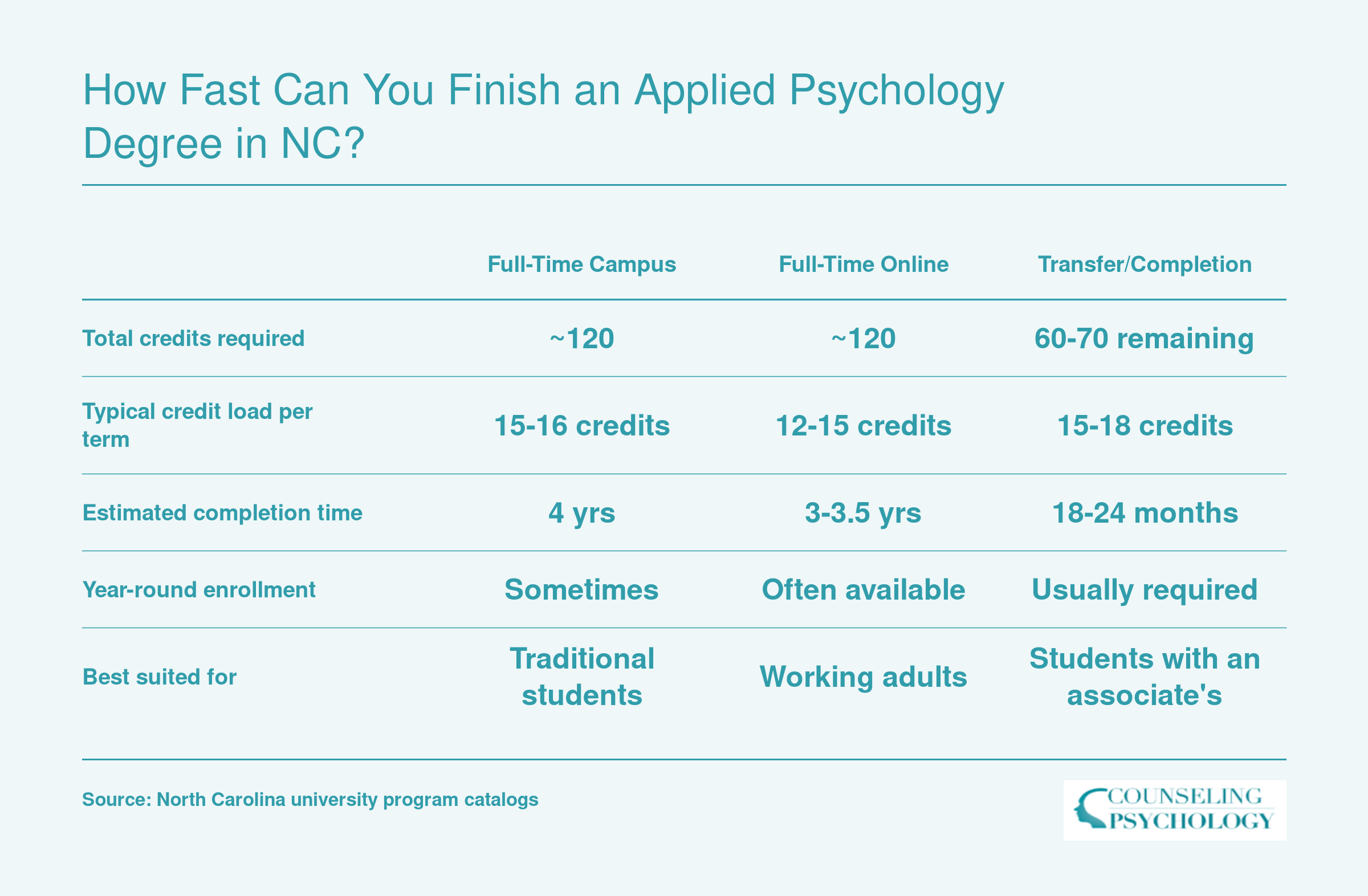
How Fast Can You Finish an Applied Psychology Degree in NC?
Completion timelines for an applied psychology bachelor's in North Carolina depend heavily on format and how many credits you bring in. Most programs require roughly 120 credit hours, but the pace at which you move through them varies. Contact admissions advisors at your target school for a personalized completion plan based on your transcript and schedule.
Online vs. On-Campus: How Format Affects Completion Speed
Choosing between online and on-campus formats is more than a lifestyle preference. For students near Fayetteville, where military rotations, deployments, and shift work shape daily life, the delivery format can directly determine how quickly you finish an applied psychology degree. Some North Carolina programs also offer hybrid formats that blend the scheduling freedom of online coursework with the clinical exposure of in-person learning.
Pros
- Online programs often allow self-paced terms and year-round enrollment, letting motivated students shave months off a traditional timeline.
- No commute means military spouses, active duty personnel, and working adults near Fort Liberty can study from anywhere without disruption.
- On-campus cohort models provide structured pacing that keeps students on track with clear milestone deadlines each semester.
- In-person formats offer direct access to practicum sites, lab experiences, and faculty mentoring that strengthen graduate school applications.
- Hybrid options at select NC institutions combine online flexibility with periodic campus intensives for hands-on skill building.
Cons
- Online learners need strong self-discipline; without a set class schedule, procrastination can stall progress and extend completion time.
- Fully online programs may lack hands-on clinical exposure, which can be a disadvantage for students pursuing licensure-track careers in counseling.
- On-campus schedules are far less flexible, creating real barriers for shift workers, deployed families, and those managing childcare.
- Commuting to a physical campus in the Fayetteville area adds time and cost that can slow overall degree completion for busy adults.
Cost of Accelerated Applied Psychology Programs in North Carolina
How much does an accelerated applied psychology degree actually cost after financial aid in North Carolina?
Sticker prices can be misleading. The figure that matters most is what you pay out of pocket after grants, scholarships, and institutional aid are applied. Among programs near Fayetteville, the average net price after aid can land well below the published tuition rate. At the University of Mount Olive, for example, the listed tuition is $27,366 per year, but the average net price after aid drops to roughly $18,853 for students who receive institutional support. That gap matters, especially when you are compressing your timeline and trying to keep total borrowing manageable.
In-State vs. Out-of-State Tuition
At North Carolina's public universities, in-state students typically pay a fraction of what out-of-state students are charged. The difference can be $10,000 or more per year. One detail worth checking: many online programs now extend in-state tuition rates to all students regardless of where they live. If you are stationed at Fort Liberty but hold legal residency in another state, confirm whether the school you are considering offers a flat online rate or requires proof of NC residency. Private institutions like the University of Mount Olive tend to charge a single tuition rate regardless of residency, which simplifies the math.
Student Debt and Repayment
Median graduate debt for bachelor's-level applied psychology students at some NC schools hovers around $27,000. On a standard 10-year repayment plan, that translates to roughly $280 to $310 per month, depending on the interest rate at the time of consolidation. Program-level debt and repayment figures are not yet published for every school on this list, so treat these numbers as a general reference point rather than a guarantee for a specific program.
Military Tuition Assistance and the Fayetteville Factor
Given Fayetteville's proximity to Fort Liberty, military education benefits deserve a close look.
- DoD Tuition Assistance (TA): Covers up to $250 per credit hour, capped at $4,500 per fiscal year and 18 semester hours.1 TA does not cover books, fees, or repeated courses, so budget for those separately.2
- Post-9/11 GI Bill (transferred): Eligible service members can transfer up to 36 months of benefits to a spouse or dependent, covering tuition and providing a housing allowance.3
- MyCAA (Military Spouse Career Advancement Accounts): Provides up to $4,000 (capped at $2,000 per year) for spouses of active duty members in pay grades E-1 through E-9, W-1 through W-3, and O-1 through O-3. However, MyCAA only covers associate degrees, certificates, and licensure programs. It does not apply to bachelor's or master's degrees.3
- NC in-state tuition eligibility: Active duty members and their dependents stationed in North Carolina qualify for in-state rates at public institutions, even if their home of record is elsewhere.2
- School-specific military discounts: Some private colleges near Fayetteville offer 10 to 15 percent tuition reductions for military-affiliated students.4 Always ask the admissions office directly, because these discounts are not always advertised prominently.
Connecting Cost to Return on Investment
Cost only tells half the story. The other half is what you earn after graduation. Institutional data shows that graduates from some of these programs report median earnings around $47,000 within ten years of enrollment, which begins to put borrowing levels in perspective. The next section breaks down salary ranges for applied psychology graduates across the Fayetteville metro area and the rest of North Carolina, so you can weigh the investment against realistic earning potential in the roles you are targeting.
Career Outcomes and Earnings for Applied Psychology Graduates in NC
Choosing an applied psychology program involves weighing what you earn right after graduation against what the field can realistically offer you five or ten years in. That gap matters, and the Fayetteville region gives graduates a geographic advantage that most psychology markets simply cannot match.
Program-Level Earnings: What Graduates Actually Report
For the University of Mount Olive's online Bachelor of Arts in Applied Psychology, program-level earnings data from federal sources are not yet available for recent completers. That gap is worth noting honestly: it does not reflect poorly on the program, but it does mean prospective students should supplement their research with outcomes from comparable North Carolina programs and conversations with current UMO advisors about where recent graduates landed. If you are still weighing the value of an undergraduate credential, our analysis of whether a bachelors in counseling psychology pays off can help frame the decision.
What the institution-level data does show is that the median graduate debt sits around $27,200, with a net price closer to $18,800 annually for students who receive aid. Understanding that debt figure alongside your likely starting salary is the calculation that actually determines whether a degree pays off.
BLS Benchmarks for NC Psychology Occupations
State-level wage data from the Bureau of Labor Statistics provides a profession-wide benchmark, though it covers all workers in psychology-related roles statewide, not just recent graduates from any single program. Across North Carolina, psychologists as a broad occupational group earn a median that varies considerably by specialty and setting. Clinical and counseling roles at community mental health centers and hospitals typically fall in a range that rewards licensure and post-degree supervised hours, making your credential level a larger determinant of pay than your undergraduate institution.
The Fort Liberty Factor
Fayetteville's proximity to Fort Liberty (formerly Fort Bragg) creates a behavioral health workforce environment unlike anything in most of the state. As of 2026, Indeed lists more than 517 mental health-related job openings in the Fort Bragg area1, with an additional 39 postings specifically for mental health specialists on Glassdoor.2 Womack Army Medical Center carries a permanent, full-time Director of Mental Health position at a median annual wage of roughly $145,000, rated at the GS-12 pay grade.3 For graduates interested in uniformed or civilian positions on military installations, understanding how to become a military psychologist provides a useful roadmap.
Beyond civilian postings, federal and DoD roles at Fort Liberty regularly offer recruitment bonuses, relocation assistance, and student loan repayment programs, incentives that meaningfully change the financial calculus for new graduates carrying debt.4 A Special Operations Licensed Clinical Social Worker posting through KBR illustrates the range of contractors and federal employers competing for behavioral health talent in this corridor.5
For applied psychology graduates willing to pursue licensure and clinical hours, the Fort Liberty ecosystem represents a rare convergence of demand, pay, and service mission that makes Fayetteville one of the stronger regional anchors for a behavioral health career in North Carolina.
Applied Psychology Salaries in the Fayetteville Metro and Across NC
The table below shows North Carolina state-level wage data from the Bureau of Labor Statistics for occupations commonly aligned with applied psychology credentials. Keep in mind that Fayetteville metro salaries for many psychology roles tend to track slightly below the statewide median, partly because the cost of living in the Fayetteville area is lower than in metros like Raleigh or Charlotte. Also worth noting: applied psychology graduates frequently move into adjacent roles such as human resources, case management, and program evaluation, which fall under different occupational codes and are not fully captured here.
| Occupation | Total Employment (NC) | 25th Percentile Salary | Median Salary | 75th Percentile Salary | Mean Salary |
|---|---|---|---|---|---|
| Psychologists, All Other | 480 | $90,440 | $137,130 | $157,190 | $122,490 |
| Managers, All Other | 21,150 | $96,130 | $131,990 | $171,480 | $143,010 |
| Psychology Teachers, Postsecondary | 1,040 | $59,960 | $74,190 | $99,810 | $82,820 |
| Entertainment and Recreation Managers | 1,110 | $57,130 | $72,910 | $97,450 | $82,270 |
| Personal Service Managers, All Other | Not reported | $45,650 | $60,400 | $75,810 | $74,090 |
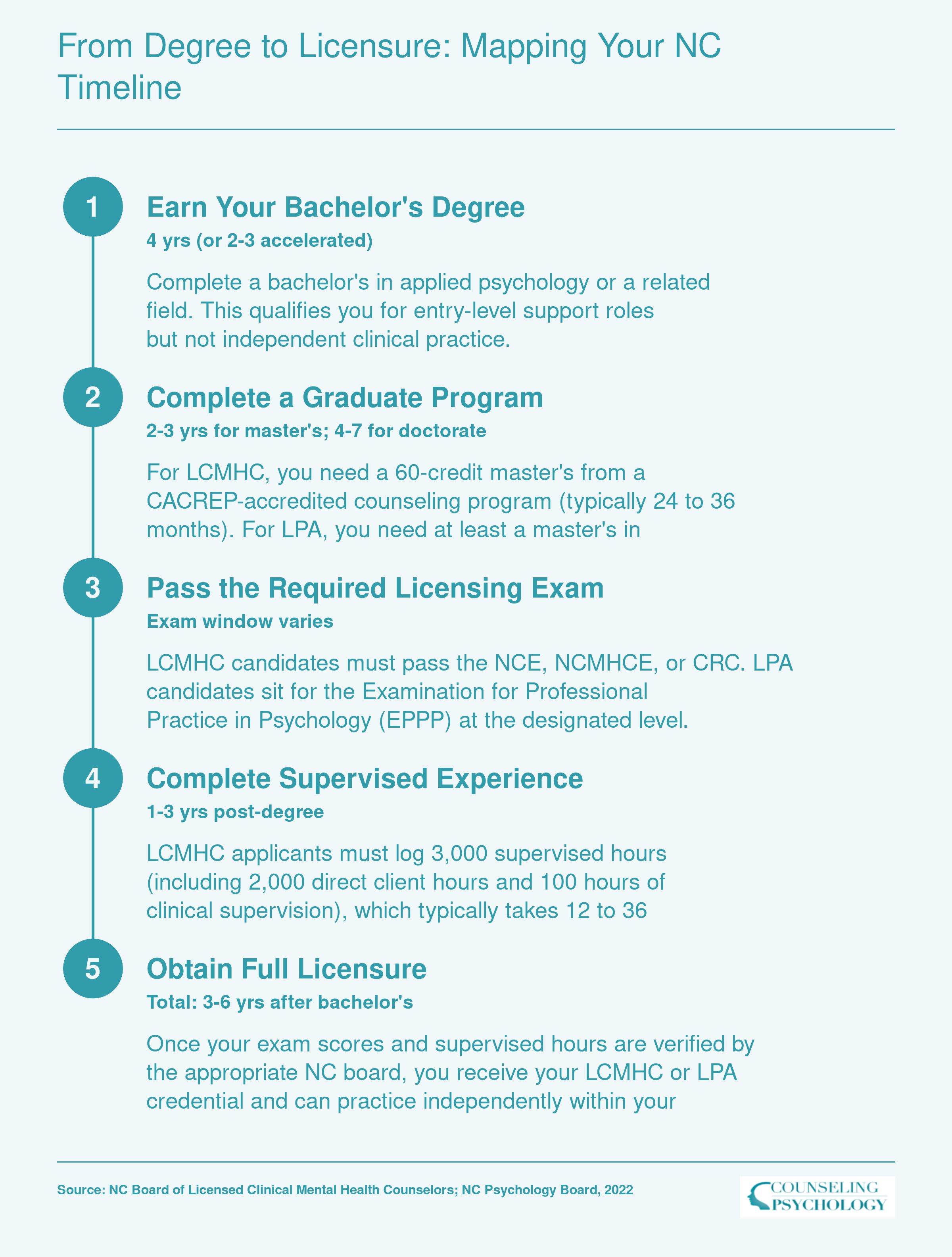
From Degree to Licensure: Mapping Your NC Timeline
A bachelor's in applied psychology builds a strong foundation, but it does not qualify you for independent clinical licensure in North Carolina. Both the Licensed Clinical Mental Health Counselor (LCMHC) and Licensed Psychological Associate (LPA) credentials require graduate education, supervised practice, and a licensing exam. Here is the realistic step-by-step ladder for the two most common paths.
Not even close. The average age of psychology doctoral graduates in the United States is over 30, and entry points at the bachelor's or master's level are even more accessible for career changers. A 25 year old who enrolls in an accelerated program could be working in the field by 27 or 28 with a bachelor's degree, or by 29 or 30 with a master's. Starting at 25 puts you well ahead of the curve, not behind it.
How We Ranked These Programs
Data Sources and Key Factors
Our ranking is built primarily on institutional and program-level data from the U.S. Department of Education's College Scorecard, which offers transparent, comparable metrics across schools. The factors we consider reflect the full student experience: net price after all grant aid, graduation rates, median earnings of graduates, typical student loan debt, and a return-on-investment ratio that compares earnings to cost. We also incorporate program-level earnings data when it is available, though such granular information is not published for every school.
It is important to note that graduation rates are reported at the institution level, not for individual programs. Similarly, net price is an average across all undergraduate students and may differ from your personal situation. These data points are useful for comparison but should be seen as indicators rather than guarantees.
Geographic and Format Filters
We limited the list to schools within a reasonable commuting distance of Fayetteville (roughly a 60-mile radius) and included fully online programs offered by North Carolina public and non-profit institutions that accept Fayetteville-area residents. This ensures that the options are geographically accessible without sacrificing academic quality. Online programs were only considered if they meet the same accreditation standards as their campus-based counterparts. Students exploring a broader view of the field may also want to review our guide to the best bachelor's in applied psychology programs nationwide.
What the Data Can't Tell You
College Scorecard does not track completion time or detailed curriculum structures. To identify accelerated options, we reviewed each program's published catalog, transfer policies, and prior learning credits. We also verified whether programs offer compressed terms, evening cohorts, or combined bachelor's-to-master's pathways. Because every student's pace varies, we encourage you to speak with admissions staff to confirm how quickly you might finish.
Additionally, program-specific licensure exam pass rates and internship placement statistics are not uniformly reported. Where available, we mention these outcomes directly in the school profiles to help you gauge professional readiness.
Frequently Asked Questions About Applied Psychology Programs in NC
Prospective students in the Fayetteville area frequently ask about program formats, licensure timelines, and salary expectations. The answers below draw on current state requirements, national data from the Bureau of Labor Statistics, and published program details from universities that offer combined or accelerated tracks.