
What you’ll learn in this article…
- Only four public universities near Baton Rouge offer relevant graduate counseling degrees, making each program worth careful comparison.
- In-state master's tuition at Louisiana public schools ranges from roughly $8,000 to $13,000 per year before aid.
- Louisiana joined the Counseling Compact in 2026, opening a path toward multistate LPC practice after graduation.
- Living in Baton Rouge during graduate study can save $15,000 or more compared to higher cost metro areas.
Louisiana's demand for licensed mental health professionals has grown steadily since 2020, yet the number of graduate programs that prepare counselors in the Baton Rouge area remains remarkably small. Four public universities within a reasonable commute offer counseling psychology or clinical mental health counseling degrees, and their net prices after aid span a meaningful range: from around $11,900 to $19,150 per year for in-state students. For prospective counseling students, that spread translates to $15,000 to $20,000 in total cost difference over a typical two- or three-year master's program.
The ranked programs below represent the complete accredited universe within driving distance, so comparison shopping here means understanding differences in program length, format, licensure alignment, and financial aid packages rather than sifting through dozens of options. Whether you are pursuing a counseling psychology degree or a clinical mental health counseling track, tuition sticker price is only the starting point: net price, assistantship availability, and local cost of living together determine what you will actually pay.
Each program prepares graduates for different credential paths, from school counselor certification to Licensed Professional Counselor status or, at the doctoral level, Health Service Psychologist licensure. Louisiana joined the Counseling Compact in 2026, making portability across state lines more straightforward for newly minted LPCs, but the credentialing timeline still begins with choosing the right program match on the front end.
Best Affordable Counseling Psychology Programs Near Baton Rouge
Counseling psychology is a specialized field, and the number of accredited programs within driving distance of Baton Rouge is genuinely small. Only four public universities in the region offer relevant graduate degrees, so each option deserves a close look. The rankings below are ordered primarily by net price, the estimated annual cost after grants and scholarships, with program quality, accreditation, and regional accessibility factored in. Because the pool is limited, students who are flexible about commuting an hour or attending classes in a hybrid format can meaningfully expand their choices and lower their total cost of attendance.
- Net price after financial aid
- CACREP or APA accreditation status
- Proximity to Baton Rouge metro
- Institutional graduation and retention rates
- Program depth and concentration options
- NCES-IPEDS federal institutional data — nces.ed.gov
- College Scorecard graduate earnings — collegescorecard.ed.gov
- Independent program research
- Internal program database

Louisiana Tech University
Louisiana Tech University in Ruston carries the lowest net price among the four schools on this list and is the only institution in the group offering a doctoral degree in counseling psychology. Its APA-accredited PhD follows a scientist-practitioner model with four years of residency plus a one-year internship, while the CACREP-accredited MA in Counseling and Guidance gives master's-level students three concentration tracks. The university serves a high share of Pell Grant recipients (61%) and posts an institution-wide graduation rate of about 64%, the second highest in this ranking. Ruston is roughly three hours from Baton Rouge, so this option works best for students willing to relocate or commit to an intensive residential schedule.
- APA-accredited doctoral program in counseling psychology
- Scientist-practitioner training model with cohort structure
- Four academic years of residency plus one-year internship
- Practicum placements in VA facilities, university centers, and clinics
- Rural mental health services emphasis through the Psychological Services Clinic
- Seven-year maximum completion timeline with transfer credit options
- GRE waiver available for certain admission cycles
- CACREP-accredited master's program, 48 to 60 credit hours
- Counseling Psychology concentration with advanced psychological training
- Multicultural counseling and professional ethics coursework
- Practicum and internship field experiences required
- 3.0 minimum GPA for admission
- Prepares graduates for LPC licensure eligibility in Louisiana
- CACREP-accredited Clinical Mental Health track
- Covers psychopathology, group therapy, and family therapy
- Includes practicum and internship placements
- Focus on multiculturalism, diversity, and ethical practice
- Prepares candidates for Licensed Professional Counselor credentials
- Rigorous academic standards with 3.0 GPA requirement
- CACREP-accredited School Counseling specialization
- Prepares students for Louisiana school counselor certification
- Coursework in developmental psychology and career theory
- Practicum and internship in K-12 educational settings
- Research methods and psychometrics fundamentals included
- On-campus delivery with 3.0 GPA admission standard
Counseling Psychology PhD — On-Campus
MA in Counseling and Guidance, Counseling Psychology Concentration — On-Campus
MA in Counseling and Guidance, Clinical Mental Health Concentration — On-Campus
MA in Counseling and Guidance, School Counseling Concentration — On-Campus

Southeastern Louisiana University
Southeastern Louisiana University in Hammond is consistently cited as the most affordable CACREP-accredited counseling program in the state, and its location roughly 45 to 60 minutes east of Baton Rouge makes it the closest option for capital-area commuters. The 60-credit MS in Counseling includes 700 hours of hands-on clinical or school-based experience across three concentration tracks. A hybrid course format blends face-to-face and online instruction, a practical design for working professionals who cannot commit to a fully on-campus schedule. About 67% of undergraduates receive Pell Grants, reflecting the university's accessibility mission.
- CACREP-accredited 60-credit-hour Clinical Mental Health track
- 700 hours of supervised clinical internship experience
- Hybrid delivery with face-to-face and online coursework
- Prepares graduates for LPC licensure in Louisiana
- National Certified Counselor (NCC) designation eligibility
- Flexible three-year course plan for working students
- CACREP-accredited 60-credit School Counseling program
- 700 hours of practicum training in K-12 settings
- Leads to Louisiana School Counselor certification
- Pathway to National Certified School Counselor (NCSC) credential
- Culturally inclusive learning environment emphasized
- Three-year course sequence accommodates part-time schedules
- CACREP-accredited Marriage, Couple and Family Counseling track
- 60 credit hours with 700 hours of clinical experience
- Hybrid and online course options for flexible scheduling
- Prepares candidates for LPC and NCC credentials
- Focus on family systems and relational dynamics
- Welcoming of diverse student backgrounds and experiences
MS in Counseling, Clinical Mental Health Counseling Concentration — On-Campus
MS in Counseling, School Counseling Concentration — On-Campus
MS in Counseling, Marriage, Couple and Family Counseling Concentration — On-Campus

University of Louisiana at Lafayette
The University of Louisiana at Lafayette sits about an hour west of Baton Rouge and ranks among the seven most affordable counseling master's programs statewide. Its CACREP-accredited MS in Counseling spans 60 to 72 credit hours with a dual-concentration option, while a separate M.Ed. in Counseling targets aspiring school counselors. All programs are campus-based, so prospective students should factor in commute time. UL Lafayette's 18:1 student-to-faculty ratio is the best on this list, and funding opportunities for graduate counseling students are advertised.
- CACREP-accredited program focused on clinical mental health
- Hands-on clinical practice across individual, family, and group settings
- Prepares graduates for LPC licensure in Louisiana
- Ethical practice and diverse population competency emphasized
- Campus-based delivery in Lafayette, about one hour from Baton Rouge
- No thesis required; comprehensive exam serves as capstone
- Campus-based program meeting Louisiana certification requirements
- Completion timeline of approximately 2.5 to 3 years
- Hands-on clinic experience in K-12 educational environments
- Year-round course availability supports timely graduation
- Aligns with professional school counseling standards
- Prepares candidates for state licensure exams
- CACREP-accredited 60 to 72 credit hour master's degree
- Dual concentration option available for broader skill development
- Funding opportunities advertised for graduate students
- Emphasis on diversity, inclusion, and ethical counseling practice
- Comprehensive exam required in lieu of thesis
- Prepares students for Licensed Professional Counselor credential
Clinical Mental Health Counseling Master's Degree — On-Campus
M.Ed. in Counseling, School Counseling Concentration — On-Campus
MS in Counseling — On-Campus

Louisiana State University and Agricultural & Mechanical College
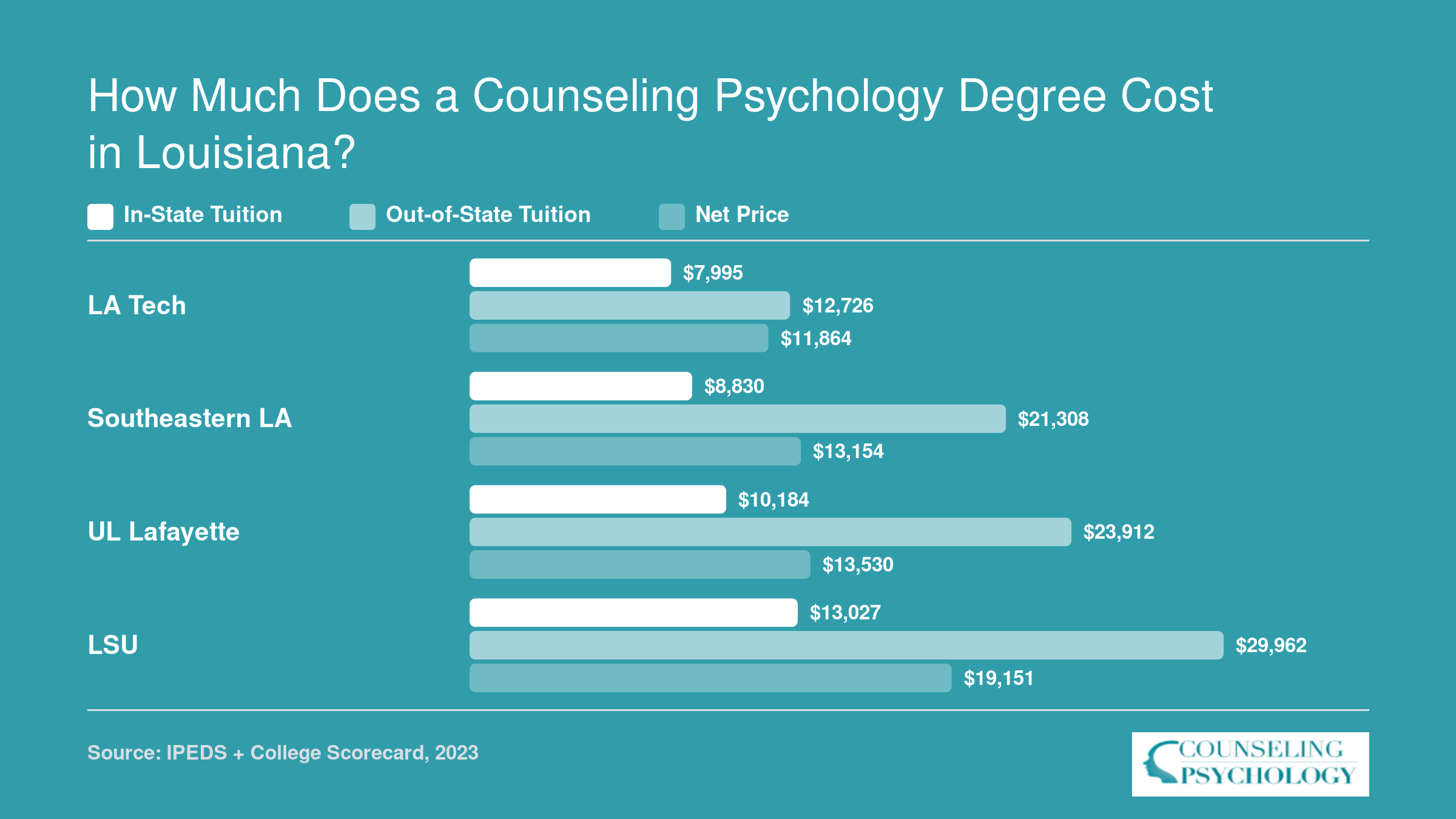
Louisiana State University is the only school on this list physically located in Baton Rouge, which eliminates commuting and relocation costs for local residents. Its M.Ed. in Counseling is a 60-credit, CACREP-accredited program with concentrations in clinical mental health counseling and school counseling. LSU's flagship status and nationally recognized faculty translate into strong local networking opportunities, and practicum placements draw on Baton Rouge-area clinics, schools, and community agencies. The trade-off is price: LSU's net price of approximately $19,151 is the highest in this ranking, and its in-state tuition runs about $13,027 before aid. Institution-wide, LSU posts the strongest graduation rate here at roughly 69%. Program-level earnings data is not yet available for this degree, though the institution-wide median earnings ten years after enrollment reach $61,251.
- CACREP-accredited 60-credit-hour clinical mental health program
- Nationally recognized counselor education faculty
- Evidence-based practices with social justice advocacy focus
- Supervised clinical training at Baton Rouge area sites
- Graduate assistantships available to offset costs
- Minimum 3.0 GPA and GRE score of 297 required for admission
- Multicultural competence development integrated throughout curriculum
- CACREP-accredited 60-credit School Counseling track
- Hands-on clinical training in local K-12 settings
- Prepares graduates for LPC licensure in Louisiana
- Ethical standards and multicultural counseling coursework
- Faculty advisement model supports individualized planning
- Campus-based delivery with access to Baton Rouge practicum network
M.Ed. in Counseling, Clinical Mental Health Counseling Concentration — On-Campus
M.Ed. in Counseling, School Counseling Concentration — On-Campus
Counseling Psychology vs. Clinical Mental Health Counseling: Key Differences
The terms "counseling psychology" and "clinical mental health counseling" get used interchangeably in everyday conversation, but they describe two distinct training pathways with different accreditors, credentials, and price tags. For prospective students in the Baton Rouge area, sorting out which one you actually mean is the single most important early step, because it determines where you can study, how long you'll be in school, and what license you'll hold at the end.
Two Accreditors, Two Degree Levels
Counseling psychology programs are accredited by the American Psychological Association (APA) and exist almost exclusively at the doctoral level (PhD or PsyD). Expect five to seven-plus years of full-time study, more than 2,000 supervised training hours, and the EPPP licensing exam at the end. APA accreditation covers the doctoral program itself, the required internship year, and postdoctoral residencies.
Clinical mental health counseling (CMHC) programs are accredited by the Council for Accreditation of Counseling and Related Educational Programs (CACREP) and are master's-level, typically two to three years of coursework with 700-plus supervised practicum and internship hours. Graduates sit for the NCE or NCMHCE rather than the EPPP. CACREP accredits both master's and doctoral counseling programs, though the master's is the practice-entry credential.
How Each Maps to Louisiana Licensure
In Louisiana, the two paths lead to two different licenses:
- Licensed Psychologist: Requires an APA-accredited doctorate in counseling psychology (or clinical/school psychology), supervised postdoctoral experience, and the EPPP.
- Licensed Professional Counselor (LPC): Requires a 60-credit master's in counseling, generally from a CACREP-accredited CMHC program, plus post-graduate supervised hours and the NCE/NCMHCE.
These are not interchangeable. A master's in counseling will not qualify you to be licensed as a psychologist in Louisiana, and a counseling psychology doctorate is overkill if your goal is independent LPC practice.
What This Means for Affordability Near Baton Rouge
Here is the practical reality: there is no APA-accredited counseling psychology doctoral program based in Baton Rouge. Students set on the Licensed Psychologist route generally look toward programs elsewhere in Louisiana or out of state, often relocating for the duration of training.
Most of the affordable, locally accessible options you'll find on this page are CACREP-accredited CMHC master's degrees pointing toward LPC licensure. If you are exploring best clinical mental health counseling programs nationally, you will notice the same pattern: master's tuition runs a fraction of doctoral training and finishes years sooner. That is good news for cost, but it is worth knowing what you are actually buying before you compare price tags.
Questions to Ask Yourself
How Much Does a Counseling Psychology Degree Cost in Louisiana?
Sticker price rarely tells the full story. Net price, the amount a typical student actually pays after grants and scholarships are subtracted, is a far more useful measure when comparing affordability across schools. Keep in mind that the net price figures below are institution-wide averages for first-time, full-time undergraduates receiving aid; your actual cost will depend on your financial profile, degree level, and aid package.
Related Articles
Baton Rouge Cost of Living: Why Location Matters for Total Affordability
Tuition is only half the equation. Where you live during your two or three years of graduate study can swing your total out-of-pocket cost by $15,000 or more, and Baton Rouge sits in a genuinely affordable bracket compared to most U.S. metros and even compared to nearby New Orleans.
How Baton Rouge Stacks Up Locally
According to the U.S. Census Bureau's American Community Survey, median gross rent in the Baton Rouge metro runs roughly $1,000 to $1,100 per month, modestly below New Orleans (closer to $1,200) and comparable to Lafayette. Composite cost-of-living indices from C2ER and BestPlaces typically place Baton Rouge at 92 to 95 (national average = 100), with housing the biggest contributor to the discount. New Orleans tends to score slightly higher overall once tourism-driven grocery and entertainment costs are factored in.
What to Verify Before You Sign a Lease
Numbers shift quarterly, so confirm before committing:
- Rent benchmarks: Pull the latest ACS 1-year estimates for the Baton Rouge metro, then cross-check active listings on Zillow or Apartments.com for the neighborhoods near LSU or Southern University.
- Transportation: Baton Rouge has limited public transit, so the BLS Consumer Expenditure Survey figures for Southern metros (often 15 to 17 percent of household spending) usually apply. Budget for a car.
- Composite indices: Run a side-by-side on BestPlaces.net comparing Baton Rouge to New Orleans and Lafayette across housing, groceries, and utilities.
Why This Affects Program Choice
A program with $2,000 higher annual tuition in Baton Rouge may still beat a cheaper Lafayette or New Orleans option once rent, commuting, and parking are added in. When comparing counseling masters programs in Louisiana, build a full two-year budget, not just a tuition comparison, before ranking your finalists.
Financial Aid, Assistantships, and Scholarships for Louisiana Counseling Students
With sticker-price tuition for Louisiana counseling master's programs now landing between roughly $8,000 and $13,000 per year for in-state students, the real affordability story is what aid layers on top of that base. Most full-time counseling students at public Louisiana universities end up paying a fraction of the published rate once assistantships, federal aid, and post-graduation loan relief enter the picture.
Graduate Assistantships at LSU and Regional Universities
The LSU Graduate School funds teaching, research, and service assistantships that bundle three benefits: a monthly stipend, a non-resident fee waiver (valuable for out-of-state students), and a full tuition exemption.1 The counseling program at LSU lists assistantships as available, though they are competitive and the department does not publish a counseling-specific stipend chart.1 Award decisions typically run through individual faculty and the College of Human Sciences and Education.
At LSU Shreveport, the assistantship program is more standardized: roughly 75 positions per year, hired directly by departments, with full-time appointments at 20 hours per week and part-time at 10 hours.2 Tuition waivers run either full or partial depending on the position, and stipends are paid hourly. LSUS also reports about $12.4 million in total scholarship aid distributed institution-wide, a meaningful pool for graduate students who apply early.3
Southern University and Southeastern Louisiana run smaller assistantship programs through individual departments. Contacting the counselor education program coordinator directly tends to surface more openings than the central graduate school portal.
Federal Loan Forgiveness for Counseling Graduates
Two federal programs do most of the heavy lifting for counseling graduates in Louisiana:
- Public Service Loan Forgiveness (PSLF): If you work full-time at a 501(c)(3) nonprofit, community mental health center, public school, or government agency, your remaining federal Direct Loan balance can be forgiven after 120 qualifying payments. Most LMHC and LPC jobs at Louisiana community mental health centers qualify.
- NHSC Loan Repayment Program: The National Health Service Corps offers up to $50,000 in loan repayment for a two-year commitment at an approved site in a Health Professional Shortage Area. Louisiana has substantial designated shortage areas, particularly in rural parishes and parts of north Louisiana, and licensed behavioral health providers (LPC, LMFT, LCSW, psychologists) are eligible.
Graduates interested in careers at agencies that serve underserved populations should explore the path to becoming a community mental health counselor, since those roles often qualify for both PSLF and NHSC repayment simultaneously.
What Pell Share Tells You About Affordability Culture
The share of undergraduates receiving Pell grants is a rough proxy for how experienced a school is at serving financially constrained students, which often carries over to graduate-level advising. Among ranked Louisiana programs, Southeastern Louisiana (about 67% Pell), UL Lafayette (about 61%), and Louisiana Tech (about 61%) sit well above the national average, while LSU's main campus sits around 51%. Higher Pell shares typically correlate with stronger financial aid offices, more flexible payment plans, and staff who are accustomed to helping students stack federal aid with assistantships and outside scholarships.
Louisiana does not currently operate a dedicated state loan repayment program specifically for master's-level counselors, and TOPS aid is generally undergraduate-only. Your best state-specific leverage points remain institutional assistantships, federal forgiveness, and NHSC service commitments.
Program Formats and Scheduling: Online, Hybrid, and Evening Options
Choosing the right program format can make or break your ability to finish a counseling degree while managing work, family, or other commitments. The programs near Baton Rouge vary meaningfully in how they deliver coursework, and that flexibility directly affects your total time to completion. Here is how the ranked programs compare across key scheduling and format dimensions.
| Program | Format | Evening or Flexible Scheduling | Practicum / Fieldwork Structure | Typical Time to Completion | Suited for Working Adults |
|---|---|---|---|---|---|
| Louisiana Tech University (Ph.D. Counseling Psychology) | Campus based, cohort model | Not confirmed; four years of residency required | Diverse practicum settings plus a one year internship; seven year maximum completion window | Approximately 4 to 5 years (doctoral level) | Limited; residency and internship demands make full time enrollment the norm |
| Southeastern Louisiana University (M.S. in Counseling) | Campus based with hybrid elements | Courses alternate between day and evening sections; part time enrollment supported | 700 hours of hands on school counseling experience; internship is near full time | 3 year structured plan at 60 credits | Moderate; evening course options help, but the near full time internship requires schedule adjustments |
| University of Louisiana at Lafayette (Clinical Mental Health Counseling M.S.) | Campus based | No accelerated track; specific evening availability not confirmed | Clinical practice hours embedded in the curriculum across multiple semesters | Approximately 2 to 3 years at 60 credits (full time pace) | Moderate; CACREP clinical requirements demand in person site hours regardless of class scheduling |
| LSU (M.Ed. in Counseling, Clinical Mental Health Concentration) | Campus based (on campus) | No accelerated option; evening offerings not confirmed; part time likely possible | Clinical training with a comprehensive exam; hands on counseling hours required | Approximately 2 to 3 years at 60 credits | Moderate; no formal evening only track, though graduate assistantships may offset costs for full time students |
| LSUHSC New Orleans (MHS Clinical Mental Health Counseling) | Hybrid synchronous (in person or via Zoom) | Daytime and evening class options available; flexible enrollment supported | Clinical fieldwork hours required; synchronous attendance expected for all sessions | Approximately 2 to 3 years at 60 credits | Strongest option; hybrid synchronous delivery with evening sections offers the most scheduling flexibility in the region |
Meeting Louisiana Licensure Requirements After Graduation
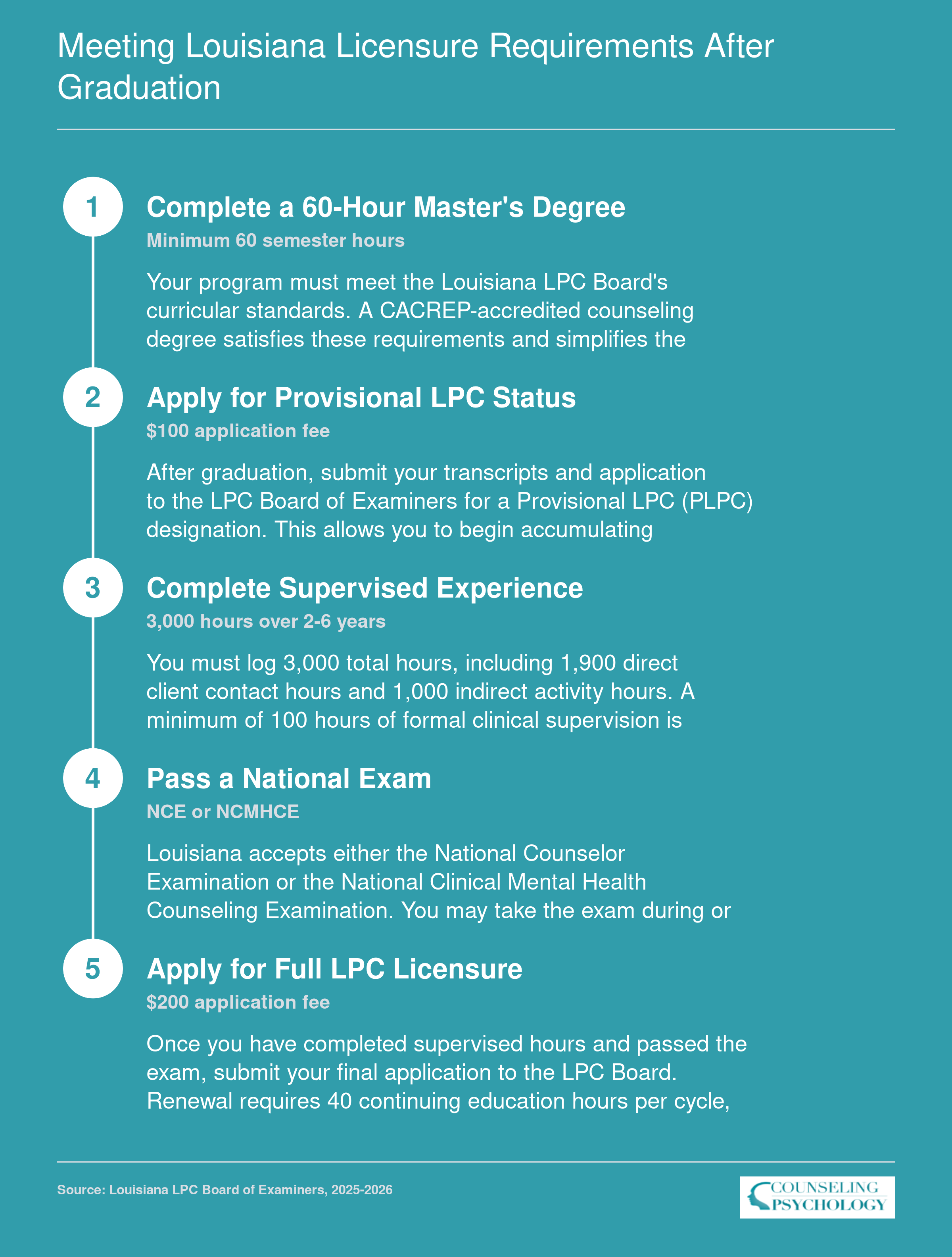
Earning your counseling psychology degree is just the starting line. Louisiana requires a structured credentialing process before you can practice independently as a Licensed Professional Counselor. The state joined the Counseling Compact in 2026, which will eventually streamline practice across member states, but you still need to complete every step below through the LPC Board of Examiners. For graduates considering the LMFT or LCSW track instead, note that scope and pay differ: LPCs and LMHCs focus broadly on mental health counseling, LMFTs specialize in relational and family systems work, and LCSWs can address clinical mental health within a social work framework. Among these credentials, pay varies by setting and specialty, so the right license depends more on your career goals than on salary alone.
Career Outcomes and Earning Potential for Baton Rouge Counseling Graduates
Earning potential in counseling fields varies significantly depending on your degree level, license type, and role. The table below shows Louisiana statewide wage data from the Bureau of Labor Statistics for occupations most relevant to counseling psychology graduates. Note that these figures reflect statewide medians and percentiles, not Baton Rouge specifically. One common question is whether Licensed Professional Counselors (LPCs) or Licensed Marriage and Family Therapists (LMFTs) earn more. At the occupation level, clinical and counseling psychologists (a category that includes many doctoral-level practitioners) earn substantially more than general counselors, which often aligns with LPC roles. LMFT wages nationally tend to fall between these two groups, though Louisiana-specific LMFT data is limited. Doctoral credentials and specialization consistently correlate with higher pay.
| Occupation (Louisiana Statewide) | Total Employment | 10th Percentile | 25th Percentile | Median (50th) | 75th Percentile | 90th Percentile | Mean |
|---|---|---|---|---|---|---|---|
| Clinical and Counseling Psychologists | 370 | Not reported | $63,850 | $67,470 | $81,940 | Not reported | $88,950 |
| Counselors, All Other | 1,760 | Not reported | $36,160 | $46,000 | $54,090 | Not reported | $46,590 |
| Psychology Teachers, Postsecondary | 160 | Not reported | $64,060 | $81,640 | $105,420 | Not reported | $87,400 |
How to Choose the Right Counseling Psychology Program
At LSU's M.Ed. Counseling program, students complete 100 practicum hours plus 600 internship hours across the second and third years before sitting for licensure.1 That single requirement, multiplied across two or three years of your life, is why program selection deserves more weight than tuition alone.
Start With Accreditation, Then Match It to Your Goal
CACREP and APA accredit different things, and the choice shapes your career. CACREP accredits master's counseling programs that lead to LPC licensure, which is the path most clinical counseling students take. LSU's M.Ed. and the University of Louisiana at Lafayette's Clinical Mental Health Counseling master's are both CACREP-accredited. APA accreditation applies to clinical psychology doctorate programs, like Louisiana Tech's Counseling Psychology PhD, and it matters if you intend to practice as a licensed psychologist. Pick the credential first, then the program.
Look at Total Cost, Not Just Sticker Tuition
Published tuition tells you part of the story. The average net price (what students actually pay after grants and aid) gives a truer picture: roughly $19,000 per year at LSU, around $11,900 at Louisiana Tech, and about $13,100 at Southeastern Louisiana. Factor in fees, books, living costs, and any unpaid practicum hours that limit your ability to work. A program that looks $3,000 cheaper on paper can cost more in lost wages over three years.
Weigh Placement Quality and ROI
Baton Rouge offers something smaller markets don't: a deep bench of training sites. LSU doctoral students rotate through the on-campus Psychological Services Center, the Capitol Area Human Services District, and the APA-accredited Southeast Louisiana Veterans Health Care System.23 Those placements shape your supervision quality, your specialty exposure, and the professional network you graduate with.
On return, LSU graduates report median earnings around $61,000 ten years after entry against median debt near $20,500, the strongest debt-to-earnings ratio among Louisiana counseling programs in our data. Cheaper programs with weaker placements can leave you with similar debt and lower earnings, which is the real trap.
Your Next Step
Shortlist two or three programs, request a current cost-of-attendance sheet from each admissions office, ask for a list of active practicum sites, and schedule a campus visit or virtual info session. Talking to a current second-year student tells you more in twenty minutes than a brochure does in twenty pages.
Frequently Asked Questions About Counseling Programs Near Baton Rouge
Choosing an affordable counseling program involves weighing tuition, format, licensure alignment, and career outcomes. Below are answers to some of the most common questions prospective students ask when exploring counseling psychology programs in and around Baton Rouge.